Archive for the ‘Tools’ Category

New Jack City

Wednesday, September 18th, 2019

Hard Work isn’t Chic

I’ve started to feel obligated to report on my day after the sun goes down. I guess I’ll quit doing it.

But…

today was a very good day.

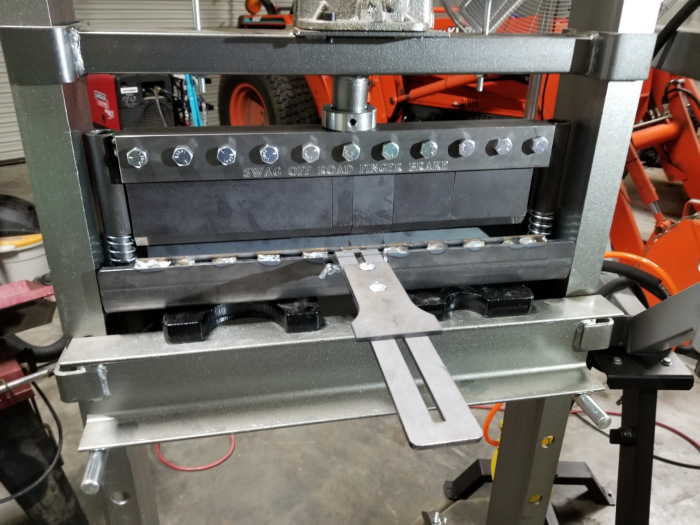
Because I managed to assemble my Offroad Swag finger brake, I decided to get an air-powered jack to replace the press’s hand-operated jack. When you’re doing one or two presses to fix something, pumping the handle isn’t a big chore, but when you’re working with metal and doing repeated bends, it’s a tremendous hindrance.

Harbor Freight sells an air jack for $80, post-coupon. I bought one today.

The jack is very nice. People rave about them. They lift trailers and houses with them. It’s an extraordinary tool. You can put a generator and a small compressor in the back of your truck, drive to someone else’s house, and help him level it.

Right now, all I have in my workshop is a 4.5-CFM compressor. It’s good enough for the jack. It slows down if you keep pumping long enough, but it’s adequate.

The jack does not come with screw holes in the base. The original jack had two holes, and there were two screws that went through the base into threaded holes in a plate on the press. The holes in the plate don’t line up well with areas in the new jack where screws can go without causing problems, so if I decide to put screws in it, the best thing will be to drill new holes in the plate, drill and tap blind holes in the bottom of the jack, and run the screws through the plate and into the jack from below.

You don’t really need to attach a jack to a hydraulic press at both ends, or so I’m told. The press holds the upper end of the jack in a steel cup, so that end can’t move, and the bottom of the jack is confined by pressure when you use it. But screws would be nice. A better design.

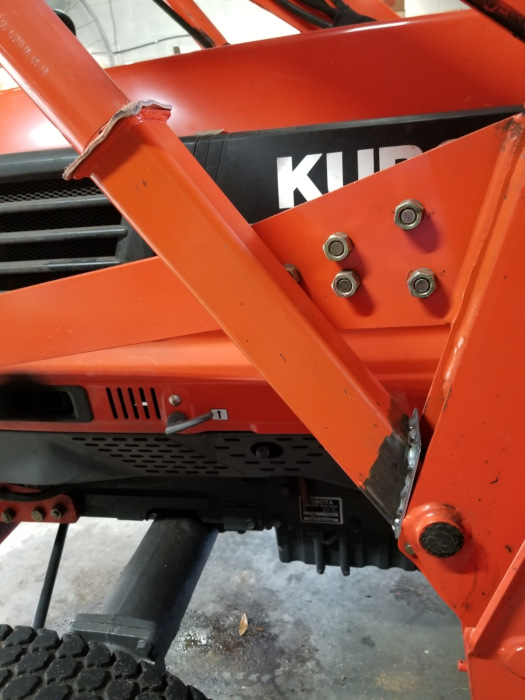
I decided to use my new front end loader brace today. I was so happy with it. It was all shiny and orange. It looked almost like a factory part. I tried to put it on the tractor, and I realized I had installed one end shield incorrectly. I don’t want to get into details, but I had to cut it off, shorten the brace, and weld it back on. I enjoyed the welding and grinding, but I wasn’t happy that I had to cut up a new project.

When I was done, the brace worked fine, except that it was shorter than I needed. I’m going to make another one. The steel will only cost around $20, and it will be good practice for me. The current brace will be useful when I’m working on the tractor, but I need a longer one to do it right.

I forgot something when I made the brace. It will hold the front end loader up, but it doesn’t restrain the other hydraulics on the front end. The bucket may still rotate. It has heavy forks on it, trying to pull it down. I left it up tonight to see what it would do.

It may not be safe to use the brace to park the tractor with the loader up, without something restraining the bucket. Oh, well. I was planning to move the tractor outside anyway, and the brace will be nice to have.

I used my new 6″ angle grinder to remove the end of the brace so I could redo it. That grinder is monstrous. Cuts metal much faster than a 4.5″ grinder. I’m glad I bought it.

I put leather pads on the ends of the brace to prevent it from marring the tractor, and today I learned that 5-minute epoxy does not work well for this purpose. It doesn’t bond leather and metal well. Time to look into some kind of rubber.

That’s all that’s happening today.

Today’s Projects

Tuesday, September 17th, 2019

Two More Annoying Strongholds Fall

This day is going well.

This weekend, I tried to teach some boys how to run my pressure washer. Before we really got anywhere, the motor started acting up. Changing the gas did not help. I knew what the most likely culprit was: leftists. They forced ethanol gas on us, and it ruins carburetors, gas tanks, and other parts while providing no benefits whatsoever, unless you grow corn.

I ordered myself a new carb without blinking. There is usually no point in paying to get a small engine carb fixed, because you can generally buy new ones for between 10 and 20 dollars. I opted to treat myself to a genuine Honda carb for $19.95, but I’m sure the $13 carb with no name would have worked as well.

This afternoon I ripped the old carb off and installed the new one, along with a fuel filter. I didn’t see a filter when I worked on the pressure washer this weekend. I would guess that Honda went with some kind of annoying in-tank filter. Forget that. I added some fuel line and added a filter I can actually see.

The pressure washer runs great now, and I didn’t have to go to a small engine shop and wait a month for them to charge me a hundred bucks to fix a $13 part.

When I was done, I looked at the old carb, and I thought about it for a couple of seconds. Then I dropped it in the trash. It just doesn’t make sense to keep it when a) I know it doesn’t work, and b) a new one from China will cost nearly nothing and have no problems.

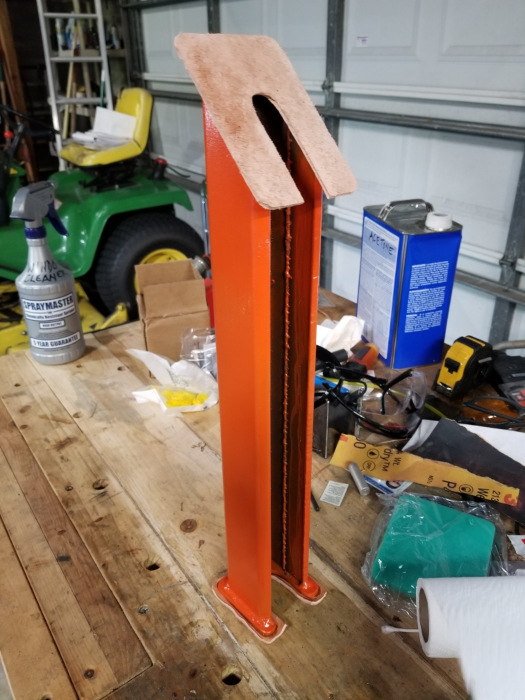
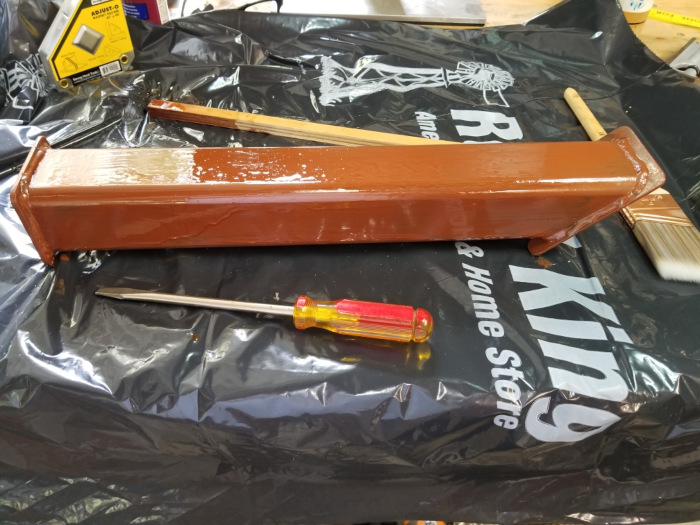
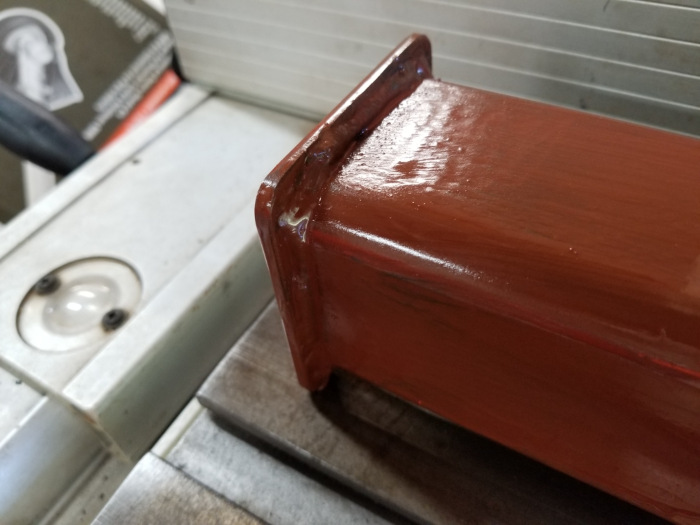
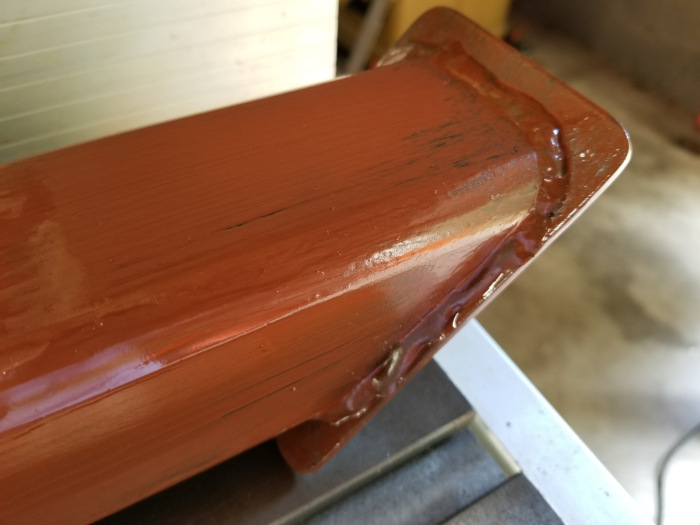
I also finished making the brace for my Kubota’s front end loader. I fixed up the paint and added leather pads to prevent the brace from gouging the tractor. I don’t know if the pads will work. They’re not really necessary, but why cut up a piece of machinery if you don’t need to?

I cut the pads out of leather and glued them to the brace with 5-minute epoxy. Which takes an hour to set. No joke. I kept waiting for it to set up, and I finally got tired of it, so I went online and searched. Five-minute epoxy takes around an hour to set, and it takes a day to fully cure.

I wonder if all the guys who lost on Forged in Fire because their handles fell apart know this.

I can’t figure out why they call it 5-minute epoxy. Warnings provided by various brands agree that an hour is about right. You should finish moving your project around in maybe 20 minutes, because the glue will have started to cure by then, but it will still be wet.

I plan to throw a little dye on the leather to hide the ballpoint pen marks I left after I measured it. Can’t hurt anything.

I hope it works. I’m not sure how the pointy end will act when it’s under pressure. It won’t break, but I’m hoping the force won’t destroy the leather and scratch my tractor’s paint up.

Doesn’t matter. I can keep working on it.

My acetylene outfit should arrive this week, so I need to get going on a tank cart. I have to decide what to do. I plan to use propane nearly all the time, but I also want to be able to use acetylene when I want. It would be nice to have all three tanks (oxygen, propane, and acetylene) on the same cart, but maybe it’s not realistic. I guess I should make a cart which will hold the oxygen and either of the other two tanks. I can find a way to store the acetylene safely when it’s not on the cart.

My New Superhero Power: Bending Metal

Monday, September 16th, 2019

Finger Brake Finished

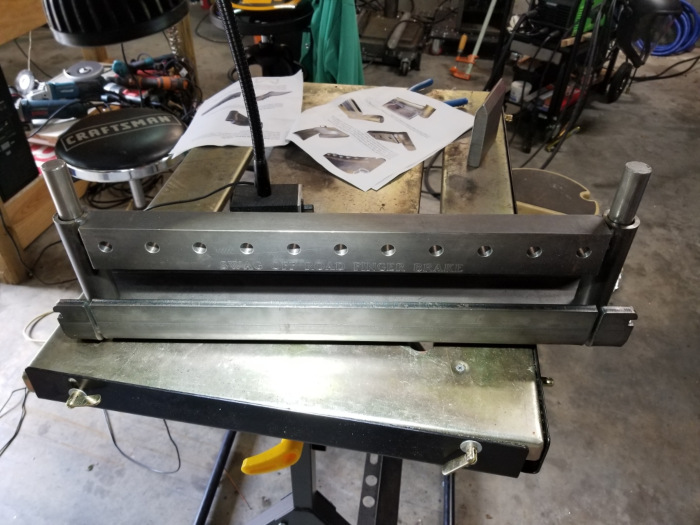
I had another great day today. I finished building my Offroad Swag finger press brake…finger brake press…whatever.

I’ve wanted one of these tools for a long time. It will allow me to bend thick metal and make things from it. This is a huge advantage for anyone who likes to work with tools. A lot of people end up with disappointing things made from plywood or from angle iron badly welded with Home Depot welders because they can’t bend metal.

The thing that deterred me from building this tool in the past was the welding involved. I had done a fair amount of simple MIG welding, but I didn’t really understand a lot of things about welding. For one thing, I thought my welder wasn’t big enough to do the job.

When you buy a MIG, it will probably come with specifications and a little chart, and it may say you can only weld metal up to a certain thickness. I took those figures too seriously. I thought a welder that was only rated for 1/4″ steel was not the right tool for jobs involving thicker steel. That’s not true. I still don’t know where they come up with the figures, or what they really mean, but you can weld thick metal with a small welder. You may have to make more passes, but it can be done.

This finger brake (I checked the terminology) has what appears to be 1/2″ plate in it, and you have to weld 1″ rods to it. You also have to weld a very thick piece of angle iron to it. I didn’t know if I could get it done. I found out I was concerned about nothing, so that obstacle disappeared.

I was also concerned about my vision. I was having a lot of trouble seeing what I was welding. I got a better welding light, I turned my helmet’s shade down all the way, and I cleaned the lens. Now I see well enough to weld without a lot of problems, so I’m not as nervous about taking projects on.

Once I got the kit and started putting it together, I found out the biggest part of it tended to warp badly when welding, so that slowed me down. I learned a lot about reducing welding distortion, I came up with a plan, and I went forward.

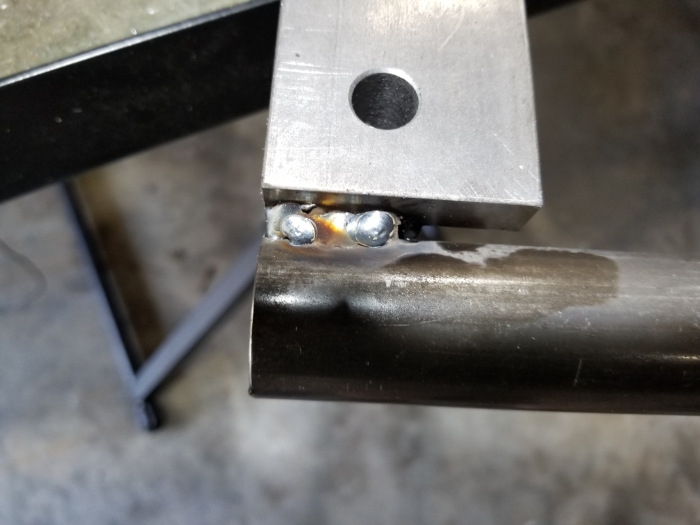
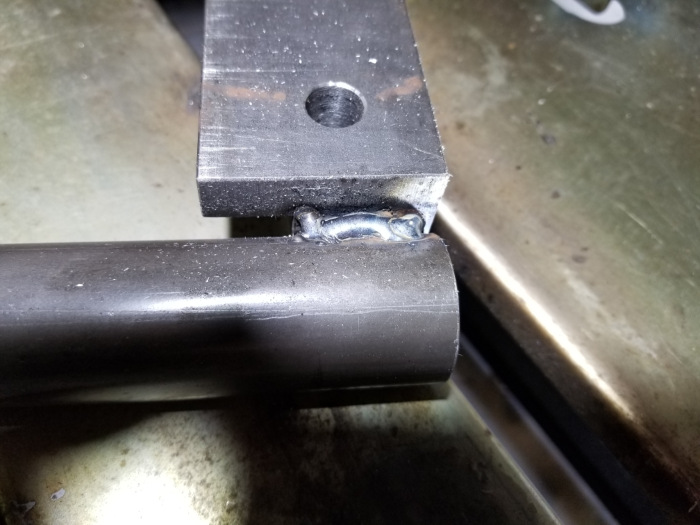
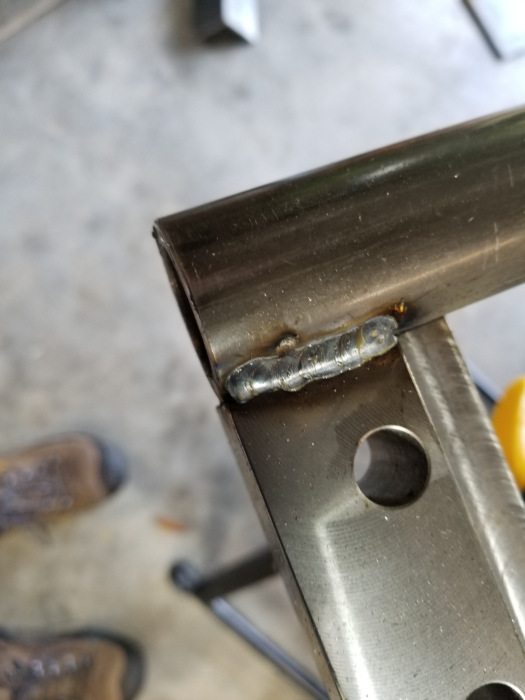
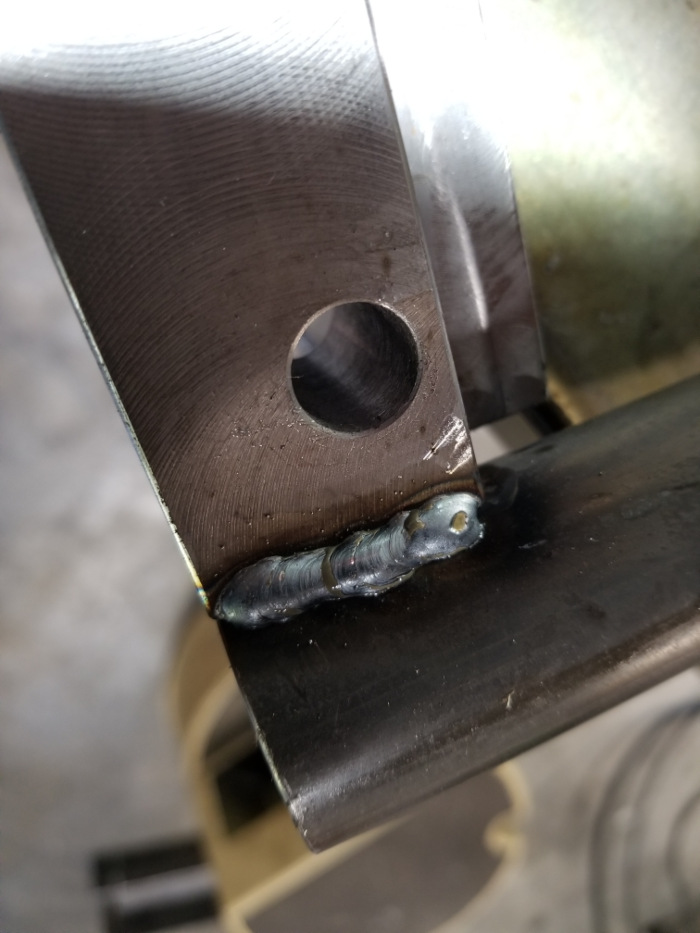
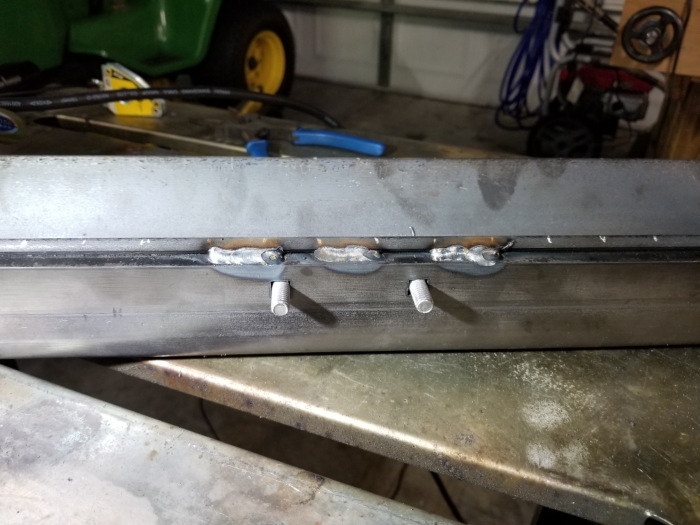
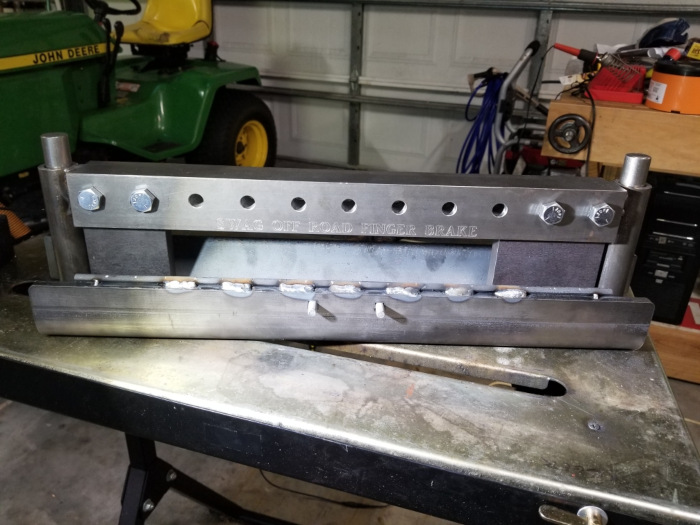
Today I welded the guide tubes to the upper part of the press, and then I welded the angle iron lower die to the base.

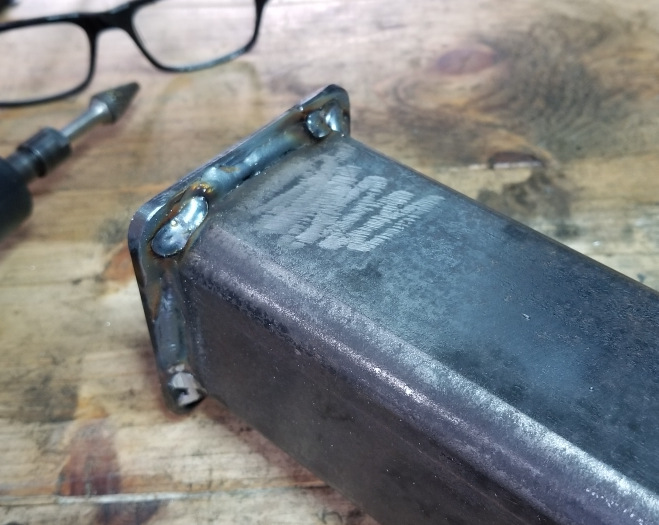
The guide tubes were scary because Offroad Swag’s instructions are vague. I had to weld two upright tubes to a long rectangle of metal, with very good alignment. I had to figure out how to get it aligned to begin with and how to avoid distortion. I used a machinist’s square to scribe lines halfway across the tops of the tubes. I used calipers to scribe lines halfway across the parts the tubes were supposed to align with. I set the parts up on my welding table, tacked them in place, checked to see if they were still aligned, and welded them up.

The welds aren’t too bad.

These particular parts see almost no strain, so there is no point in overwelding them. The more weld you add, the more you heat your parts, and the more distortion you can get. I tried to be economical. A lot of guys pour on the weld because they don’t know what they’re doing. It causes problems and wastes time and wire.

The only problems I had with the finished product were caused by Offroad Swag’s loose tolerances, and they didn’t affect the way the part functioned. I was thrilled to get such good results.

I decided to grit my teeth and weld the bottom die in place. The seams I had to weld were 19″ long, and there were two of them. Most people apply a ton of weld, in two continuous beads. There is no reason to do that. These welds don’t have to do much, so they don’t have to be huge.

I put soapstone marks on the seams one inch apart. I started welding with the middle inches. I welded one inch per side, put the torch down, and did something else while the parts cooled. Then I went back, skipped inches on both sides, and welded two more inches per side. This is called “intermittent welding,” and it prevents a lot of distortion-producing heat from accumulating in any area.

I didn’t finish the job for several hours, because I kept leaving to let the heat dissipate. I didn’t weld all 19 inches of either side. I welded about half of the seams’ lengths. I don’t see any point in doing more.

My guess is that a lot of people make big, thick, pretty, continuous beads on these things, and this is why there are so many complaints about warping. My brake won’t look as good, but on the other hand, it isn’t bent.

I assembled the brake and bent a piece of 2″ by 1/4″ flat bar. No problem. You can’t do that with a typical brake. This is why Offroad Swag’s product was so appealing to me. I see no point in spending a grand on a tool that won’t bend anything thicker than the lid of a barbecue.

That bend isn’t too sharp, but there are ways to do better and get a nicer product, so I’m not concerned.

I can’t bend anything wider than 19″, but that leaves the door open to a huge number of useful projects. If I had blown a thousand dollars on a factory-made brake, I would be very limited in what I could do.

The kit isn’t perfect. They made one bar of steel about a millimeter shorter than it should have been, and they supplied a bunch of half-inch bolts which must be Chinese, because they don’t like to go into standard 1/2″ threaded holes. I chased the threads in some of the holes, thinking they hadn’t been tapped correctly, but the threads were fine. The bolts are just fat.

They made the bar that clamps the fingers in place slightly longer than it needs to be. When you weld the guide tubes on, the welds are likely to interfere with the bar’s fit against the top bar of the press. The instructions recommend grinding the welds down. Forget that. I like those welds. I took the bar to my belt grinder and beveled the ends of it to clear them. Took two minutes. I would rather grind their bar than my welds. It’s faster, and besides, those welds are the nicest ones on the brake.

I also painted the brace I made for my tractor’s front end loader. Unfortunately, it fell in the dirt after I applied the second coat. A gust of wind hit it while it was standing upright on a box. Dirt got into the paint on one end, so I had to blow it off with a hose. Now I have to fix the paint. Day after tomorrow, I should be able to put the leather pads on the brace with 5-minute epoxy and finish it.

Now that I have a finger brake, I have no conceivable excuse for not using it, so I need to design some useful things. I’ll get on that as soon as I can.

The Harbor Freight Titanium welder is a blast to use. I wish I had gotten it sooner, but then I couldn’t. They didn’t start selling them until recently. It welds flawlessly. People say the gun is on the cheap side and that it may wear out early, but I don’t care. The light, handy gun is one of the welder’s best features. If a MIG gun is clumsy, your welds will ramble all over the place. I’m happy to sacrifice durability for function. I can always buy a new gun.

That’s enough fun for one day. I look forward to more projects.

Success Brings Joy

Sunday, September 15th, 2019

Projects Yield to God’s Favor

I feel like I can’t go about my business at the end of the day without blogging because I have an obligation to let people know how well life is going. If you’ve learned a few things about God, and they start to work for you, it can be hard to make people understand that they need to seek the same things. If people see how well you’re doing, they might start asking themselves if they need to try to do what you’re doing.

That being said, today was a great day.

I got up and finished mowing the yard, and the John Deere didn’t have a fit or anything. That was pleasing to me. When I was done, I found myself sitting in the shop, looking at the Kubota brace I’ve been working on. I had intended to go in and take a shower (because I don’t bathe before doing yard work), but the steel was there, the welder was there, I was there…I did some welding.

Last night, I got the metal ready to be welded. Today I had to do the welding. I had a bunch of new welding magnets from Strong Hand Tools, and I was eager to use them. I took them out of their packaging and found that they didn’t work for the parts I was welding.

The shield I was welding was supposed to be joined to a piece of tubing cut at a 44-degree angle (yes, 44). The magnets weren’t right for that. I had to think.

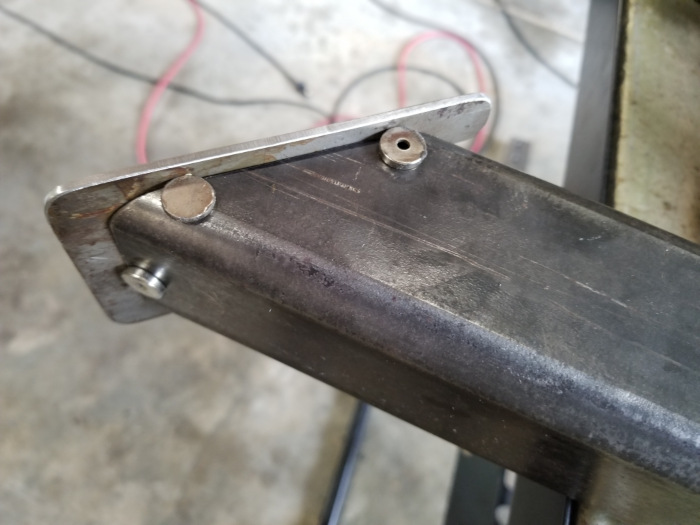
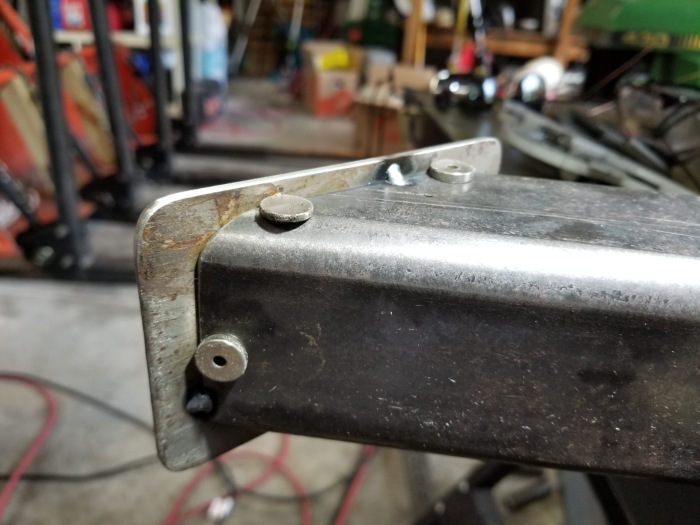
I went in the house, where I had a stack of Chinese rare earth magnets stuck to the fridge. I brought 4 out and used them to hold the shield on the tubing. They worked perfectly. Tacking the shield was a breeze.

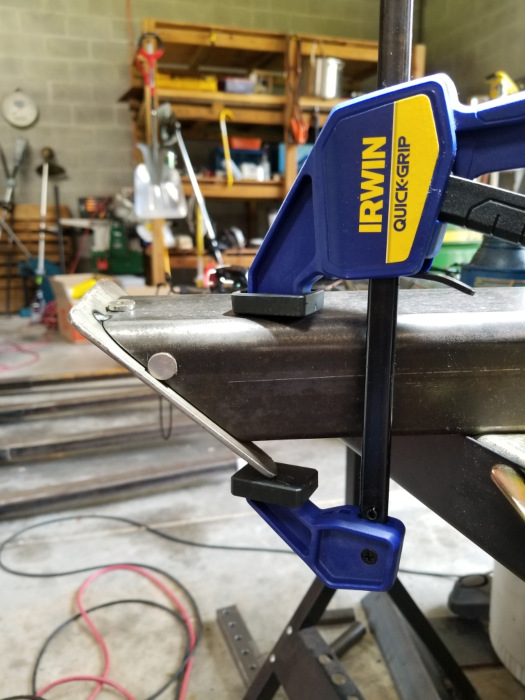
Welds always pull on the base metal. A gap opened up before I placed the last tack. I had to come up with a way to close it. I decided to use an Irwin woodworking clamp with rubber pads. One tack wasn’t going to heat the metal enough to melt the rubber.

When I was done, I got out the Dumore hand grinder and a carbide burr and cut the tacks down a little to prevent them from sticking up through the final welds. Then I welded. I didn’t do too bad. My welds were professional quality. Of course, most professionals don’t weld all that well. Like theirs, mine were good enough to do the job but not good enough to be on the cover of a welding magazine.

I own manufactured products with factory welds which are worse than my welds, so I can live with the welds I produce now. They’re going to get better. I’m learning the importance of 1) being able to see the puddle clearly, 2) being comfortable before I start welding, and 3) concentrating intensely while I weld.

I cleaned and primed the brace. The primer sagged in some places, so I had to do some of the priming over, but I got it done, and tomorrow I’ll pick up some new Kubota-orange paint (my old can dried up), and I’ll finish the painting. Then I’ll form leather around the ends, glue the leather to the brace, and see if it works.

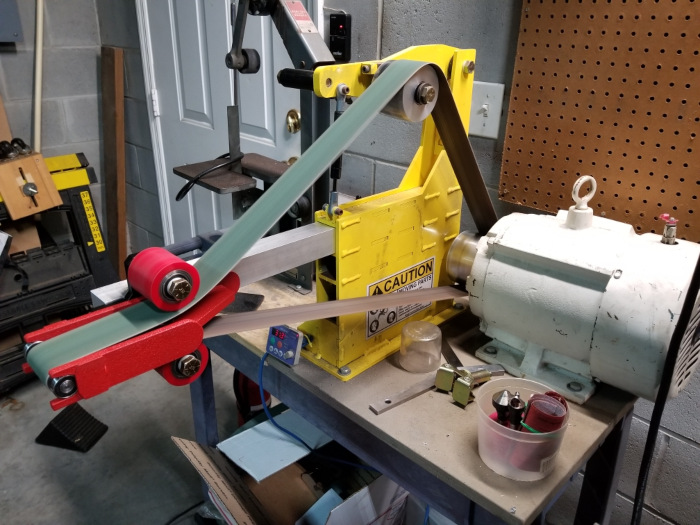
I also fixed the small-wheel attachment for the belt grinder. It wasn’t tracking right. This attachment comes by itself, or you can get it with an additional attachment that adds two wheels to it to force the belt into a sharper bend. I bought the second attachment. When I installed everything, the belt tracked way off to one side.

I finally realized it did this because the additional attachment was attached beside the first one, pushing the first one out and forcing me to adjust the belt outward. The second attachment is around 0.400″ wide, so I needed to take that much metal off the side of the tooling arm it was mounted on. And I had no milling machine.

I used the table saw. You can cut aluminum just fine on a table saw, as long as you go slow and use WD-40 to lubricate it. I made about 48 parallel cuts on the tooling arm. The cuts joined each other, creating a 6″-long rabbet. I then used the router table to smooth off the surface the table saw had left. Then I deburred with the belt grinder and a file. The product was less refined than a machined part, but it will work just as well.

Cutting aluminum with the table saw is always an adventure. The blade threw hot, sharp pieces of aluminum at me the whole time. I got several cuts on my arms. Hey, that’s metalworking for you. It’s not for snowflakes. If you’re afraid of getting aluminum in your man bun or having hot metal burn little holes in the pink tights your mom borrows sometimes, find another hobby. And go get some testosterone shots.

I found something else wrong with the grinder’s alignment. It had been off for years. I fixed it today. The belt tracks perfectly now, and because I got a bunch of top-quality belts, I should be able to do great things.

I’ve been watching metalworking videos. Some featured Jesse James. This is the guy who may be remembered forever mainly as the man who cheated on Sandra Bullock. That’s unfortunate, because he makes magnificent vehicles. There are builders who do things that are more startling and perhaps more creative, but Jesse James vehicles are classics. His taste is impeccable. Everything he makes will look just as good 25 years from now as it does today.

He has a bunch of incredible machines. He likes to buy old metalworking tools. I’m not sure he really needs them, because there are people who do equally good work without them, but I can understand the attraction.

He has one machine that came from an aircraft carrier. He says a lot of them were shoved over the side after World War Two because they weren’t needed any more. He has a machine he got from an Air Force base. Airplanes that fly in combat need a lot of aluminum panels.

He’s an interesting guy. He has made a lot of bad decisions in life, and he has suffered because of it. He always talks about how much he has suffered and how hard he fights life’s obstacles. He seems happy about it. I don’t think he understands that we’re supposed to have blessed lives in which things don’t go wrong all the time. I saw him talking to some pastor about his life, and the pastor seemed equally in love with the drama and hard knocks. That’s crazy. I can understand why a bike builder would think life was supposed to be hard, but a pastor has no excuse for believing that. They’re supposed to know God’s word, and his word says his yoke is easy and his burden is light.

We love drama because of pride. Drama and suffering make us feel important, and they bring us attention.

Today I watched an old show featuring Indian Larry. He was also a bike builder. I had seen the show before. He died not long after it came out. I wrote about him on my old blog.

Like Jesse James, Indian Larry’s taste in machinery was faultless. He didn’t want to build slick-looking bikes that would have looked at home in front of a mansion in Dubai or in a pimp’s driveway. He built classic V-twin machines with all sorts of mechanical parts proudly displayed. He used laced wheels, not weird billet wheels that looked like they came from show cars.

In the show, Larry was up against a guy named Paul Yaffee, who was building the kind of bikes you would expect to see characters in Marvel movies ride. Way over the top. No soul.

Indian Larry died in an accident. He used to do motorcycle tricks. He would stand on his motorcycle’s seat while riding at high speed. The odds caught up with him while he was doing tricks for a crowd, and he fell and died from a head injury.

I wrote about him on my old blog, and strangers showed up to post comments. It was as though I had created a monument. Hundreds of comments appeared. Unfortunately, they came down when I started the new blog.

It was neat to watch Jesse James and Indian Larry shape metal to fit their visions. Woodworking is great, but there is something special about working metal. Metal is hard and unnatural. It doesn’t occur in nature. It resists being shaped. When you start working it, you find yourself dealing with a very stubborn material, but when you’re done, you’ve created things you could never create from wood. You can’t create a new wooden object. All you can do is join and bend existing shapes. You can distort metal. You can twist it. You can add to it. You can melt it, cast it, and forge it into something different. The main limit to what you can do with it is your patience.

I feel that I should get farther into metalworking. Wood is nice, but it’s limited. I’m not a worldly person, and I could never consider a person like Jesse James or Indian Larry a role model. Working with tools is never going to give me purpose. I have God for that. But it’s nice to have interesting things to do here on earth while you serve God.

I’m thinking I might get a tubing bender. That’s the main thing I’ll lack after I get the finger press brake working. I also want a lift table big enough for my John Deere garden tractor. I want to be able to lift big projects up where I can work on them without straining my back. I’m looking at products now. I may buy one. They’re not cheap, but it’s not like what I want is going to pop up on Craigslist. I need 1500 pounds of capacity, with removable panels so I can work on wide objects as well as narrow ones. Most people who buy lift tables get narrow ones that can only hold motorcycles. A wide one will hold anything short of a car.

I don’t have much interest in working on cars, which is good, because a good general work lift is no good for cars, and a car lift is no good for other projects.

I’m going to clear out the garage this week and see if I can get my lathe and mill moved up here. I think I’m going to sell my compressor and get a bigger one I’ll never need to upgrade. After I get these things done, along with the lift table, everything else should be small strokes. I’ll have machining, grinding, TIG, MIG, stick, a lift, lots of air, a finger brake…everything except talent, knowledge, and skill.

Now you know what happened today, so you can relax.

Blessed Streak Continues

Saturday, September 14th, 2019

When You Get the Devil on the Canvas, Just Punch him Harder

This has been a wonderful day.

I got up and mowed the yard. The John Deere didn’t blow up, quit, run over its own grill, pump oil out onto the lawn, or refuse to start. For a John Deere product, that’s remarkable. As far as I can tell from my experience. I also ran the leaf blower, the weed eater, and the edger, and I poisoned some plants I didn’t like. Wonderful.

My friend Amanda came over with her sons, and I showed them some tools and taught them how to run the pressure washer. Which DID quit. But I know how to deal with that. I went to Amazon and bought a new carb for $20, plus a fuel filter, which the pressure washer appears to lack. Never pay anyone to fix a small engine carburetor. Just buy a new one. I could have gotten a fine carb for $13, delivered, but I decided to splurge and get a genuine Honda, which surely comes from the same Chinese factory. Probably. Anyway, it’s coming.

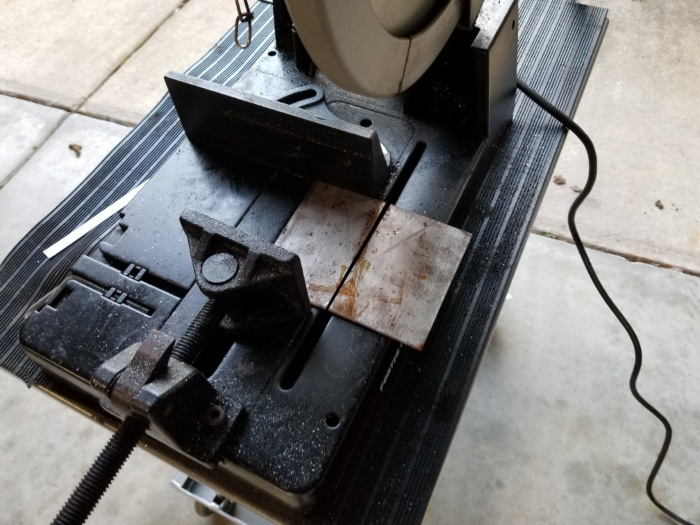
I fired up my tools and made another end shield for my tractor front end loader brace. I didn’t have to pay for the steel. My friends at the metal place gave me free scrap to practice welding on, and one piece was a nice sheet of 1/8″ plate. I cut a rectangle out of it with the dry-cut saw, made a hole with the drill press, cleaned it up with the belt grinder and drill press, and I was done. Bang. Like that.

I used the new 6″ Metabo grinder to cut a piece out of the shield to open it up for the belt grinder. The Metabo is dynamite. So glad I bought it. It will save me a lot of time.

The shield is beautiful. I won’t be modest. I love metalworking. This just proves I need more tools. Which I already knew.

The first end shield is 1/4″ steel, and I wondered if I should wait for a similar piece, but I chose not to. The 1/8″ piece is strong enough, and every time I see it, it will remind me of the pleasant experiences I’ve had at the metal dealer’s place FAR, FAR FROM MIAMI.

In three or four days, I’ll have the new carb, and the pressure washer will almost definitely run. The pump could be giving out, but I don’t think it is. If it is, I’ll buy a new $125 pump on Ebay for $70 and install it. It takes 5 minutes. There is probably no good reason for ever buying a new pressure washer until the engine dies and can’t be fixed.

That’s it. I’m about to go relax with my pets and a cold beverage. I will post photos of the metalwork later.

Oh, all right. I’ll post them now.

Back to the Grind

Friday, September 13th, 2019

More Stuff!

Today was not spectacular. It was merely excellent.

I finally got myself an acetylene rig. I’ve been wanting one for years. Acetylene is not very useful for welding these days because there are better ways to weld, but gas is still great for cutting, heating, and flame-straightening. Many people are turning to propane/oxygen rigs because acetylene is so expensive, but propane isn’t as good for flame-straightening, so I bought an acetylene outfit and a few doodads that will allow me to use it with propane.

You may think you know what flame-straightening is, and maybe you do, but you’re probably wrong. It doesn’t mean heating up a part so it’s malleable and then bending it so it’s straight. It means heating a small area of a part very intensely and very quickly and then chilling it with water to make it contract. You can straighten a propeller shaft using this method. It’s amazing. You can also use it to straighten things that have warped during welding.

Propane doesn’t heat small areas as quickly and intensely as acetylene, so I definitely want to have acetylene in the shop. Most of the time, however, I would expect to use propane, which is fine for cutting, bending, and heating.

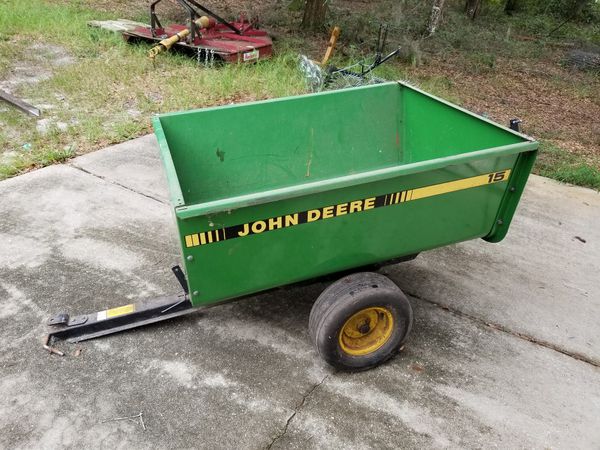
I’m thinking of cutting up my John Deere cart and making a welding cart. I’ve been trying to sell the cart, but it looks like it will only bring $50. I thought a cart from the same company that charges $800 for a lawnmower grill would go for hundreds, but it looks like even John Deere fans aren’t that crazy.

I also visited Northern Tool and got some new welding magnets. I’m pretty sure my old ones are in Miami, stuck to the side of my lathe. You can’t weld without magnets. Well…you can. But it’s more difficult.

Since I’m on the subject of magnets, I’m about to get a patient lift, which is an engine hoist for human beings. When I do, I plan to get a lifting magnet for it. I’m talking about a powerful magnet you can turn on and off. You can get magnets that lift a ton. I’d get a smaller one and use it for heavy steel objects.

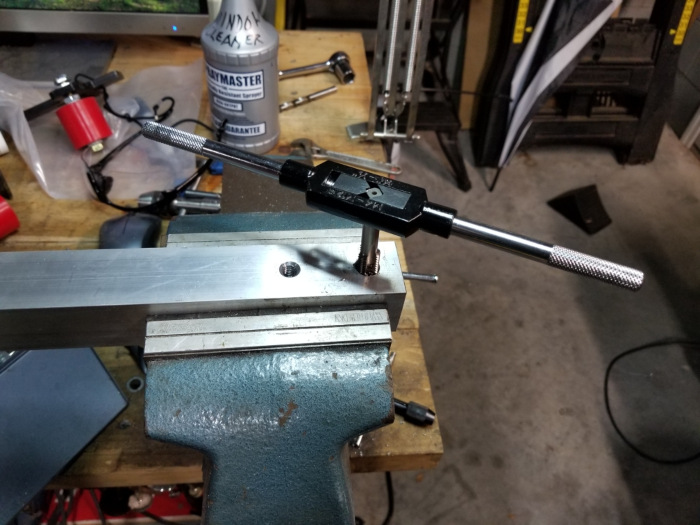
On today’s trip, I visited my new friends the metal dealers and got two aluminum bars. They’re going to be tooling arms for my belt grinder. One of them already is. I drilled and tapped it today. When I showed up to buy more stuff, they treated me like they had always known me. The older lady said, “What are you making this time?”, like she was already familiar with my eccentricities.

To get two tooling arms from a company that sells them, I would expect to pay around a hundred bucks, including shipping. I’m talking about two 20″ bars, each with two tapped holes in it. Today I paid $38. That felt good.

I came home, ate a steak, and went to work.

First, I put the bars on the belt grinder. The ends had been cut with a band saw, so they were rough. I ground them smooth with three horsepower of pure overkill. My grinder is so strong, I can’t slow it down. I was jamming the bars into the belt to see what I could do, and I couldn’t change the speed at all.

I ran the grinder at 145 Hz for a while, just because I could. That was fun. Here’s a shout-out to all the people who said I couldn’t do that.

Once the bars were looking good, I marked one of them for holes using dial calipers and a Starrett punch. Then I drilled and tapped one. After that, I cleaned it off and installed my latest grinder tool: a small-wheel attachment. I’ll post photos. It allows you to make grinds in very tight places. Very useful.

My next grinder tool will be a big contact wheel. After that, I’m done for a while. I would like to modify the grinder so it turns sideways, but it would be difficult with a monster 84-pound motor. Maybe I’ll build a new grinder eventually.

I saw a guy on Youtube building a grinder, and I was startled. He runs a company called Fireball Tool. He knows a great deal about tools, and he manufactures tools for welders, but as I watched him, I realized I knew a lot of things he didn’t.

He took two go-kart wheels and used them as the basis for a grinder with a 6″ belt something like 60″ long. The wheels had tires on them, and they had offset hubs, which are weak and floppy compared to solid wheels and pulleys. You don’t want tires on a belt grinder. You want a small upper pulley, because a big one uses up a lot of belt. Why pay more for long belts if you’re going to waste two feet on your drive wheel and pulley?

The grinder only had one piece of plate on the side for support, and it was 1-1/8″ thick. He used a waterjet to cut it out, which means he had total design freedom, but he didn’t cut any holes in the plate to save weight. That was a bad decision. The grinder would have been very strong with 1/4″ plate, and he could have moved it on a handtruck. As it is, it weighed over 600 pounds before he even finished. And he was happy about that.

He welded the tool rest onto the frame, perpendicular to the belt, and he didn’t put a T-slot in it. What??? What good is a tool rest you can’t rotate to a desired angle? Why wouldn’t you want a tool rest for fixtures?

He made the grinder so he couldn’t rotate the belt into a horizontal position. Think of all the things he can’t do with it.

He used a single-phase 5-HP motor, which means he gave himself no way to vary the speed. I don’t know what to say about that. Variable speed is a huge improvement to a grinder. Obvious.

He made a huge hollow platen on the grinder, and he filled it with garnet powder to stifle vibration. If your belt grinder is vibrating so badly it affects the function, you built it wrong. My grinder doesn’t vibrate. He solved a problem that didn’t exist. How is a 600-pound grinder with only 5 HP going to vibrate? He only has 5/6 HP per inch of belt width, and I have 1.5, with no vibration.

His grinder is very poorly designed, and eventually, he’ll probably cut it up and give up on it. I’m not glad someone else put a bunch of mistakes on Youtube, but I’m glad I’ve reached the point where I can discern them. I felt good about that.

People in his comments were telling him how great it was. I was aghast. I guess none of them had ever used a 600-pound grinder with no casters, a fixed tool rest, belts that cost 50% more than they should, and a single-speed motor.

He makes some neat tools for setting up welding projects. I thought about buying one of his squares, but I don’t think it’s really necessary, and they cost $190. I think I would do better putting the money toward a real welding table.

Tomorrow I hope to get back to the Kubota front end loader brace. Hope your day was as good as mine.

The Bucket on my List

Thursday, September 12th, 2019

One Step Closer to Front End Loader Domination

I chalked up another wonderful day today.

I was hoping to work on my Offroad Swag finger brake, but I needed to finish the Kubota front end loader brace to get it out of the way, so I worked on that instead.

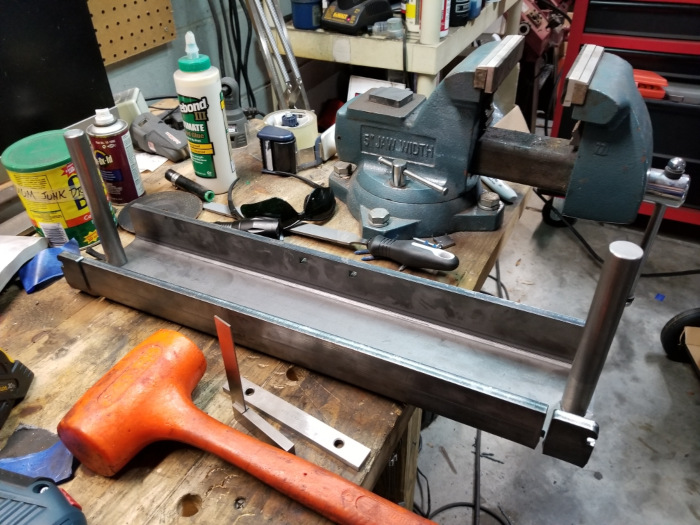
The brace is a steel channel with two end plates on it. It goes on a hydraulic rod to prevent the front end loader from coming down.

Yesterday I went through the shop like a hurricane, moving stuff into more-logical positions, throwing things out, and generally turning a crowded shop into a spacious one. I moved nearly all the metalworking stuff to one end, and I distributed it around an open area, facing in. I took my beverage fridge to the dump. That hurt, but it was a very cheap fridge with no defrost cycle, and it was so badly engineered, it was not possible to use it. It froze over every few days.

For some reason, the guy who sold us this house had a big set of shelves on the wall by the workbench. First of all, a workbench should never be against a wall. Things will fall down behind it, cleaning it will be impossible, and if you put something heavy on it, you will have to turn it over and over while you work on it because you can’t walk behind the bench. The seller’s bench was against the wall, and when I moved here, I told the movers to put mine there TEMPORARILY, and I let it sit there for two years. Now I can get to it from all sides.

I’m digressing. The shelves were in a place where they got in the way. All the other shelves were across the shop. I took everything off the shelves, dragged the whole thing outside, pressure-washed it with Dawn, and put it with the other shelves. I put stuff on it relatively neatly, with some effort at organization.

Now my bench, tool chests, and metalworking tools are all in one area. That’s where I worked on the brace. I loved it. I was able to get to things without climbing over junk or walking around the tractors.

I did something I should have done sooner: I did final measurements for the brace. I raised the loader to see how long the brace needed to be. When I did that, I realized one end plate on the brace needed to be installed at an angle. It was going to rest against the framework that supports the loader. The loader cylinders move, and the framework doesn’t, so when the loader is raised, the cylinders are at a sharp angle with regard to the framework. The flat plate at the end of the brace has to be angled so it will rest flat against the framework.

I took a T-bevel and measured the angle on the tractor. I drew the angle on the brace. Then I cleaned off my dry cut saw, put it on my Harbor Freight scissor lift cart, and cut the brace perfectly.

That made me happy.

I considered quitting, because I didn’t have enough steel. When I changed the end of the brace from perpendicular to angled, I lengthened it. I had a 3″ square of steel ready to weld over it, but now I needed 3″ by 4″. I decided to weld the plate on the other end to get me a head start on the next day.

Problem: I could not find my welding magnets. I needed them to position the plate on the brace for tacking. Again, I considered quitting.

I don’t know if the movers stole my welding magnets, or I left them stuck to a machine tool in Miami, or what. I knew I was not going to have them to help me with the plate. I decided to try a woodworking clamp.

I got myself a long bar clamp and used it to hold the plate in place. It was not a great setup. One end of the clamp rested on the newly cut angled end of the brace, so it didn’t have much to hold it in place. Also, the clamp had rubber pads on it, and I was using it for welding.

I fired up the Harbor Freight welder, took a deep breath, and started tacking. No problems! Once I had the first tack done, I knew I was home-free, because I could use that tack to hold things together while I moved the clamp to produce better alignment for the other tacks.

I placed my tacks, removed the clamp, and welded the plate on. Things went very well by my standards. I saw the weld pretty well, and I didn’t blow through the metal. I put the weld more or less where it should have been. It wasn’t gorgeous, but it wasn’t terrible, either.

The welds were shiny, I didn’t get porosity, and I didn’t have any disasters.

When I was done, I played around with my Dumore hand grinder and a carbide burr, prettying up the welds a little, but I didn’t do much. It will look okay as it is.

Now that I’ve got things fixed so I can see what I’m welding (and now that I have a decent metal supplier), I should be able to get much, much better at welding in the coming weeks.

I’m going to get some more welding magnets. I have a feeling mine are in Miami. I’m not going to wait around.

I’m glad I had the dry cut saw. It does beautiful, precise cuts, and it’s fast. I need to make a mobile stand and base for it.

I guess I’ll go see the metal dealer tomorrow and get more steel for the brace. I should be able to finish the metal work tomorrow, no problem. Then I can throw a coat of paint on it. When the paint is dry, I’ll form some leather over the ends, glue it on, and be done with it.

I still think I’ll start parking the tractor outside from now on, but the brace is an important thing to have because it will allow me to work on the tractor without removing the loader. Today I had to install a support for the battery, and I had to climb over the loader bucket over and over. I won’t have to do that any more.

If I can get the brace welded up tomorrow, I can start welding (or practicing to weld) the finger brake. Once the finger brake is done, my world will change. I’ll be able to make some incredible stuff, very quickly.

I love the Harbor Freight welder. It’s extremely handy. Very easy to use. I’ll be doing more welding now simply because I have a tool that takes a lot of effort out of it.

I’ve been watching Forged in Fire lately, and it’s hard to believe how little the contestants know about tools. They don’t know how to use the drill press, which is a simple tool. Almost none of them can weld. They can’t use a mill. A lot of them call themselves master smiths. All I can say is that the master smith exam must be pretty easy. Seems like all they know is how to heat and beat steel, and many of them can barely do that.

I don’t know how to forge a knife, but I can use tools every knife smith should be very comfortable with. Teach me to forge, and I’ll be the master of all master smiths, not because I’m great, but because most of these other guys are hopeless with standard metalworking tools. They make mistakes no machinist would make.

I’m mediocre at many metalworking tasks, but I know the basics. That would set me apart on that show. Not that I plan to become a knife smith. Just something that occurred to me. Made me feel better about my skills.

I don’t know much at all about fixing houses and cars. Something for the future, I guess.

Give me a Boost

Wednesday, September 11th, 2019

Getting Ahead by Copying Other People’s Work

I think I have the answer to my latest welding puzzle.

To complete my Offroad Swag finger brake kit, I have to weld a big angle iron into a channel. The angle iron will open upward, and the outer edges will be welded to the upper edges of the channel. Other people who have done this have gotten warped projects.

I now have a copy of Design of Weldments, which is a useful book a Youtuber recommended. You don’t have to be a welder to find it useful. I don’t think the Youtuber welds. It’s useful for anyone who builds stuff. This morning I checked the book to see if it could help me, and I found the answer in chapter 6.

The correct procedure for my welds is to preset. This means I need to clamp the work down so it can’t bend during or after welding. I can clamp it down as it is, or I can put a slight bend in it, away from the anticipated warp. Presetting is what the pros do.

I thought about peening the welds. This means beating them with a hammer to flatten and lengthen them while they’re still hot. The book says this is a waste of time.

It says I should do the welds in small segments, and I should wait for each set of segments to cool before welding the next set. I say “set” because I plan to do one segment on each side of the project at a time, so they will balance each other. The project can warp back-to-front as well as vertically, so you can’t just weld the front and then turn it around and weld the back. Funny how no one on Youtube has checked to see if he has warpage in the horizontal plane! It’s surprising that I figured that out and they didn’t.

I can clamp the project to my table saw, with sheet metal on the saw table to keep spatter off, or I can put it in the press and weld it. The press would be better, but it may be hard to do, because I’ll need something longer than arbor plates to support the project.

I can use the table saw easily because I now have a 25-foot extension cord for my welders and plasma cutter. I won’t have to shove the 700-pound saw across the shop.

Incidentally, Harbor Freight provides good arbor plates with its presses. They used to use cast iron, which is brittle and snaps suddenly. Now they’re steel. Good thing to know. If you have cast iron, you should get new plates. It’s dangerous when a plate snaps.

Right now, I have two jobs on my mind. One is to practice MIG until I feel good about doing the welding, and the other is to rearrange the workshop so I can make a final decision about where to put my machine tools. Right now, I’m leaning toward putting them out there instead of in the garage. I would need some serious electrical work.

If you think your shop is too small, spend a whole day rearranging it. It will expand by at least a third. Trust me.

I should be able to finish my tractor front end loader brace today, except for the paint, which takes a while to cure. Then I have to decide what to do with the tractor. I intended to park it inside with the loader up, but maybe it’s okay to park it outside with a sturdy cover over the seat. It is, after all, a tractor, and I will probably have another solution in a year or so, so it would not be out there long.

I’ll bet someone sells tractor seat covers. I’ll check.

I can’t find temporary covers, like grill covers, for tractor seats. There are a lot of permanent covers which would probably be a hassle to take off when I mow. You can’t sit in a wet seat cover.

A small tarp will work fine. That’s what I should get.

I’m still making the brace. I want to be able to walk under the loader and work on the tractor.

God told me three great things the other day.

1. All strength comes from inheritance.

2. There is no strength without inheritance.

3. Satan hates inheritance.

When you inherit, you don’t earn. You just receive. Other people do the work for you. This works with knowledge as well as wealth. When you inherit knowledge, other people make the mistakes and suffer the resulting problems. You come along later and get the knowledge that works, so you don’t suffer or waste time.

When you get knowledge from other people by any method, it’s like inheriting. They do the work, and you get the benefit.

I could sit around and theorize about how to weld things, and that would be my natural inclination, but it’s a lot better to open a book and get the truth–BAM–like that.

Think how rich and informed you would be if your all of your ancestors had understood and applied the principles of inheritance. Every generation would have made the next one stronger. You would have been born into a life of privilege and power. Unfortunately, it doesn’t work this way. People forget and waste, and their kids have to start with little or nothing.

Fred Trump was rich. Donald Trump is rich. Eric Trump is rich. His kids are too young to have jobs, but they’re rich, too. This is how life is supposed to be. The Trump patriarchs pass on wealth and knowledge so their kids hit the ground running. Making your children grovel and toil like mules in order to get where you are is stupid and often based in a sick desire to see them fail.

I could never figure out all the things in the book on my own. I like coming up with my own solutions to problems, but it’s smarter to find out what other people have done.

You can see why physicists are so useless compared to engineers. When a physicist has a problem involving building something, his skills will only help him to write equations and work from scratch. An engineer will pick up a book, look at a table, and copy the answer. Or he’ll stand up and ask the guy in the next cubicle. Some engineers complain that they never get to do math or design anything at work. Everything is laid out for them. That’s a good problem to have.

Engineers inherit things physicists have to build.

Interesting stuff.

A Weld of Difference

Tuesday, September 10th, 2019

No More Braille

I won’t say I had a good day. I would call today “spectacular.”

The first exciting event of the day, after prayer, was a trip to Svinga Brothers. They’re junk dealers. They have a big building with rows of weird salvaged junk, along with new metal. They didn’t have anything that called out to me, but it was nice to see the place. If I ever want an old brass fire extinguisher or a 45-RPM 3-phase motor, I’ll go back.

After that, I did some welding on my Offroad Swag finger brake kit.

As I believe I’ve already written, the kit requires you to push two inch-thick rods halfway into tight holes in 3/8″-thick channel and then weld them in place. I was hesitant to do this, because I’ve had a number of crummy welding experiences over the last several years. I have had problems seeing what I was doing, and it made me feel like I would have to give up welding.

I’ve been cleaning my mask often lately, to remove the yellow crud that accumulates from smoke, and I have a great new light. I also keep the shade turned down low. Today I was able to see very well, which took a big load off my mind.

I used my Harbor Freight Titanium Unlimited 200 welder. I chose to MIG. I could probably have used 7018 and done okay with stick, but I’m not good at it at all, and I didn’t want to gouge up my expensive kit.

Just interrupted my writing to walk out and close the valve on the C25 tank.

I wanted to do a good job with the welds, so I wanted to practice. Yesterday, I picked up some steel at my metal dealer’s house, and I mentioned the fact that I was going to use some of it for welding practice. Both of the employees there were ladies. One said, “Oh, you’re going to become one of THEM.”

They’re both welders. The business does fabrication and welding as well as selling metal. They gave me all sorts of tips on stick welding, and then they did something amazing: they gave me maybe 15 pounds of scrap steel to practice on!

Man, Ocala is better than Miami. In Miami, if you’re not Cuban, you’re an outsider, period. You don’t get the good prices when you buy things. You don’t get favors. Salespeople treat you like a stranger, even if you’re a regular. Metal cost me a lot more there. I didn’t know what metal was supposed to cost. All I knew was that it was a lot cheaper than Home Depot. Here, metal seems extremely cheap, so I can tell I was getting bad deals in Miami. I paid high prices, and the idea of getting something for nothing in Miami…impossible.

This is all on top of the general rudeness, which is not something you can blame on Cubans. Everyone is rude in Miami. It was like that before Cubans showed up. Then there’s the traffic.

If I sound bigoted, you should hear what Cubans say about Miami. A lot of them agree with me 100%.

I know a Cuban lady who insisted on transferring to another city because her non-Cuban husband was treated so badly. People used to say snotty things about him to each other in Spanish, in his presence, because they didn’t know his wife was Cuban. In restaurants, other people were moved ahead of them in line because he and his wife didn’t look Cuban and it was assumed that they wouldn’t understand what was being said. Horror stories.

Miami is just a bad place to live. The Cubans dislike blacks and often exclude whites. The blacks don’t like the Cubans. White people are generally just trying to get along with everyone without taking sides. White people keep leaving. Now the South and Central Americans are filling the place up, and Cubans are very disturbed. Many Cubans see themselves as whiter than South and Central Americans, so they look down on them. Also, South and Central American cultures have a lot of problems. There is a reason why their home countries are, nearly without exception, messed up.

I know you’re not supposed to talk about bigotry and bad behavior among non-white people. Tough. The truth matters.

One piece of metal the ladies gave me is so nice I don’t know if I can bear to practice on it. It’s a piece of 3/8″ plate around 7″ square. That’s a good piece of steel!

I would have expected to pay $20 for the extra metal in Miami. And you have to remember that metal dealers get paid for their scrap. If I hadn’t taken it, they would have included it in their recycling metal, and a dealer would have bought it.

Anyway, I ran a few beautiful beads on a piece of 1/4″ diamond plate scrap. That was encouraging. I was able to see what I was doing perfectly. That told me I would be able to hit the seams between the rods and the holes without bubbafying the whole project.

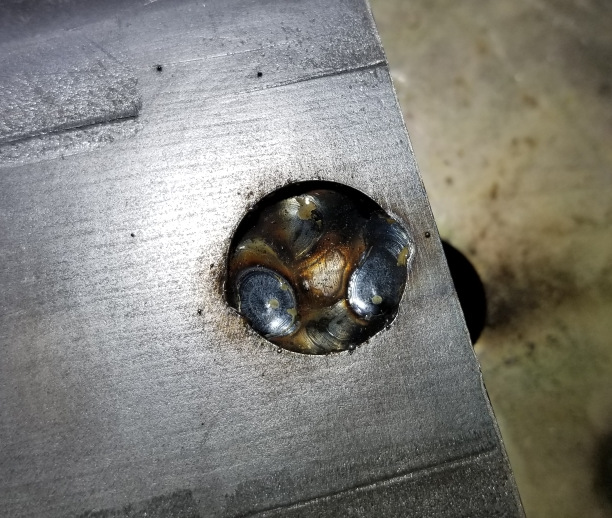
I deliberately set the welder a little hot, because the metal was very thick, and I didn’t want to have to cut out ineffective welds. Things went almost perfectly. I laid 4 solid globs of weld in each hole. I had to turn the welder down a little, and I melted a little metal off the rims of the holes, but when I was done, the guide rods were still straight to within a few thousandths.

The Titanium welder is excellent. I’ll just say it. I can’t tell you it will still be working next year, but it probably will, because Chinese stuff gets better all the time. The gun is nimble and easy to use. They give you plenty of cord. It welds smoothly with no surprises. I may never use my Lincoln again. I don’t have any reason to.

I guess I’ll put different wires in the machines, and I’ll use whichever one has the wire I want for a given job.

There is still a lot of welding to be done before the finger brake is functional, but now I feel better about the likelihood of not destroying it. Maybe tomorrow I’ll have time to practice MIG so I can do a better job.

More Tools for Various Areas of Life

Monday, September 9th, 2019

If You Can’t Move it, You Won’t Use it

I’m thinking about more shop upgrades.

Yesterday, I had to press two steel rods into tight holes, and then I had to adjust them. I used my wooden workbench and Wilton mechanic’s vise. The vise was stretched nearly to its full opening capacity, so I didn’t use it. It’s not a top-quality vise, and I don’t want to put more stress on it than it can take. My workbench is very heavy, but it bounced a lot when I hit the parts with a 3-pound rawhide hammer.

This tells me I could stand to make three improvements. A better vise would be helpful. A sturdier workbench is needed. Finally, an anvil would be nice to have.

People love overpriced Wilton bullet vises, but they’re not really that exceptional. There are other vises which are just as good. The really old bullets–I am told–may not have been made from the same strong iron as the new ones, so it may be a waste of time to buy a bullet made before they changed the metal.

I’m thinking I might get a Chinese Yost vise made from super-strong ductile iron. For a small fraction of the outrageous, Snap-On-like price of a 6″ Wilton, I can get a 7″ Yost which is much, much stronger. It will open to 9.5″, which is very impressive; right now I get 5.25″. It would also weigh much less than a bullet.

You don’t really need a heavy vise. You need a strong vise which is very securely fastened to something which is also very strong. Added mass is sometimes an engineer’s way of compensating for bad materials and/or bad design. The iron Wilton uses can’t compare to Yost’s, at least in terms of breaking strength. I don’t know about rigidity, but since the Yost can clamp with 11000 pounds of force, it must be at least somewhat rigid.

The lighter weight of the Yost would make it easier to deal with.

I don’t know what to do about the workbench. I could make one by laminating 4″ (nominal) lumber side by side. That would be twice as thick as what I have now.

If I had a big anvil, I could use it instead of a bench when I needed to beat on something. I’m not sure you’re supposed to beat cold mild steel objects on an anvil’s face, though. I need to look into that. Even if it’s a bad idea, the problem could be solved with a small piece of steel plate that goes over the anvil.

I’m also going to invest in a patient lift. This is basically the same thing as an engine hoist, except it’s made for invalids and overweight people. It has wheels and an arm powered by hydraulics. You attach it to a patient who needs to be moved, and you pump it up. A basic lift will raise anything up to 400 pounds.

I want to use the lift to move things around the shop. Many people use gantry cranes and forklifts. I don’t have room for a forklift, and a gantry crane is not as maneuverable. I can remove the doodads that attach to human beings and replace them with nylon straps or something.

Patient lifts are expensive…unless you live in northern or central Florida. This area is full of invalids, and, I’m sorry to say, a lot of them pass away every week. This leaves their caregivers with expensive lifts they are sick of looking at. Today I replied to an ad. Someone is selling one for $50. Can’t beat that. If I don’t get this one, another one will pop up. Some people try to charge $400 or more, to get their investment back, but it’s a lost cause. There are too many of them on the market.

I could have used a patient lift when I was trying to get the upper pan off my John Deere garden tractor. I’m going to have to do that again, and I don’t plan to lift the pan this time. Not when $50 can buy me a patient lift.

The weather here is beastly hot right now, but the humidity is way down, and it warms up later and cools off earlier than it did in August. This all adds up to a much more suitable working climate. I’m taking advantage of it. Back when my dad was dying, I wanted to get things done during the pleasant months, but I didn’t. I spent way too much time huddling indoors, waiting for the difficult time to pass. Now there is nothing holding me back.

As long as I’m writing about new tools, I should talk about the improvements in my Christian walk. God has been giving me a new revelation of the power he has given me.

The Bible promises us a lot of things, but there are many we don’t receive. Sometimes it’s because of lack of knowledge, but it can also be because of lack of faith. Your mind knows you’re supposed to have something, but you’re not convinced in your heart, so you don’t receive.

It’s pretty obvious from the New Testament that we are supposed to have everything Jesus had. We’re not supposed to wait for it. It’s supposed to be ours right now. But you can’t fully believe that unless you have faith.

The Bible says our faith comes from God. It’s not something you can generate by trying to believe. When God gives you faith, which is a kind of revelation, things start moving.

When we speak, other beings, including God, are supposed to receive it as though Jesus were talking. When God looks at you, he doesn’t see the old man who died during baptism. He sees a replica of Jesus, and that person has the authority of Jesus.

When demons flee us, it’s because they feel as though Jesus were talking to them.

Where does faith come from? Praying in tongues is crucial. It builds up your faith. The Bible says faith comes by hearing, and hearing by the word of God, but it doesn’t mean you get adequate supernatural faith just by listening to someone quote the Bible or by reading the Bible. People believe that, but it isn’t true. It means the supernatural word of God comes to you from inside, and you listen and believe. This happens when you pray in tongues.

If something shouldn’t have happened to Jesus, it shouldn’t happen to you. If Jesus, while in the form of a man, should have been able to do something, you should be able to do it now. This is what God was working to bring about through the crucifixion. It was an act of reproduction, and to reproduce means to make copies.

God’s new covenant way is much better than the old way, which involved a great deal of work and defeat. Daniel, for example, got God’s help with spirits that opposed him. We fight and defeat them directly, as though we were Jesus. We don’t have to wait for God to send angels to defeat the Princes of Persia and Greece and so on.

The Bible says we “clothe ourselves” with Jesus and “put on” the new man. That makes sense. It’s like putting on a military uniform. When others see the uniform, they give it the obedience it is due, regardless of who is inside it.

You know what they say in the military: “Salute the rank, not the man.” Satan says, “You’re the guy who fornicated, lied, and stole. Why should I listen to you?” He says that because he knows he can’t fight the uniform. He wants you to forget you’re wearing it.

I think I know why Satan continues to fight God. It’s because he has no hope. If you want to see someone do great evil without hesitation, take his hope away. Satan is going to be burned for eternity, in what will probably be the greatest humiliation of all time. He knows that. He fights in order to delay it. He doesn’t care about offending God, because he knows his end will be horrible no matter what he does.

He continues lying to us after we become new people, in order to prevent our power and righteousness from manifesting. I suppose I would do the same thing, even if it only delayed the onset of the burning for 10 seconds.

Certain things have to happen before Jesus can return, and they depend greatly on us. Satan is doing his best to slow us down. He has done a fine job for 2000 years, and he is not done having temporary victories, but he doesn’t have to have any victory at all in your life. He may keep knocking mankind to the canvas, but you don’t have to fall with everyone else. The word says, “A thousand shall fall at thy side, and ten thousand at thy right hand, but it shall not come nigh thee.” This is because you’re God’s favorite, if you’re his Christian child. Expect favoritism and accept it, no matter what happens to the people you know.

The bad things that happen to other people are justified, and they are not your responsibility. You’re not supposed to sink with them.

I hope I get that patient lift. Right now I have to go buy more steel for the tractor brace.

Turning my Swag On

Sunday, September 8th, 2019

Finger Brake Kit Fails to Intimidate

Chalk up another good day.

My finger brake kit from Swag Offroad arrived in the mail yesterday. I didn’t know, because I didn’t check the mail until today. Obviously, once I saw it, I had to start putting it together.

To reiterate, this is a hydraulic press accessory that will let you make bent metal parts from very thick steel.

The box was really heavy. I would say 40 pounds. Who cares? I’m the guy with the $39 Harbor Freight tool cart. I drove the box from my mailbox to the garage, and then I put it in the cart and wheeled it to the workshop. I love that cart.

I didn’t get to work on the kit right away because I had to get in some stick welding practice. I have had three sessions so far, I believe. The first one was disastrous. The second was much better. The third was better still. I expect to be fully capable of nice-looking simple welds in a week.

The kit requires welding. In order to get it in a long flat rate box, Swag cuts a couple of parts off of it, and there are other parts that probably would not fit in the box if they were welded on. You can buy the kit fully assembled for $125 more, which is not unreasonable, but I wanted to start using tools instead of just buying them, so I didn’t go that route.

I didn’t do a whole lot today. The first task is to push two solid steel guide bars into a couple of holes on one of the kit’s major parts. When the upper “jaw” of the press moves up and down, it has to have something to locate it, and that’s what the bars do. It rides on the bars.

The bars fit in two tubes on the ends of the jaw. Obviously, everything has to be parallel, or the tool won’t work well.

The instructions say to use a hammer or press to cram the rods halfway into the part, and then they say to use a small square to make sure the rods are square to the part.

That’s really all they say. If you’re no good with tools, that’s the end of the line for you.

Obviously, I used the hydraulic press. Why would you use a hammer when you’re making an accessory for your press?

I surprised myself with my ability to deal with the challenge. I put two pieces of tape around the ends of the rods to indicate half the thickness of the part they would be pressed into. That allowed me to see how far the rods were going in without removing the whole mess from the press over and over to check. I got their depths within 10 thousandths of each other, which I was able to measure because I have dial calipers.

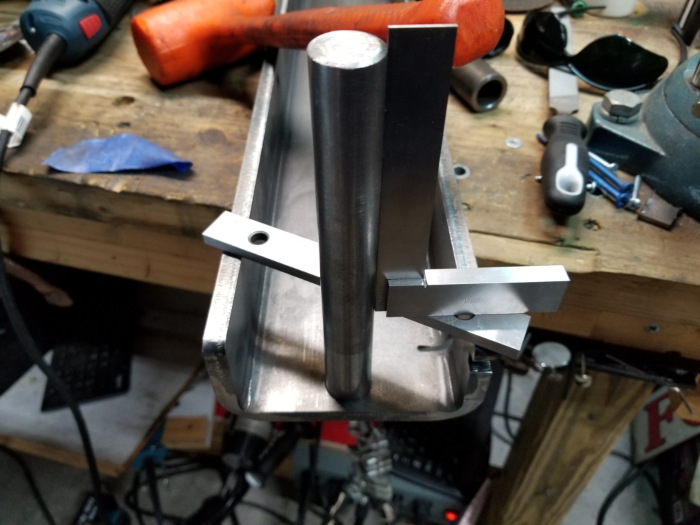
Using a square to align the rods seemed impossible, but I thought it over and came up with an answer. I have a set of machinist’s squares. I selected one. I had no problem squaring the rods along one axis. I just rested the square’s base in the big part to the the big part’s axis, and then I whopped the rods with a rawhide hammer until they were perpendicular to the part, within a few thousandths. Then I got out a thick machinists’ parallel and rested it on top of the part. This gave me a surface wide enough to rest the square on to check alignment along the other axis. Before long, I was done. Not only did I do okay; I may end up with the most perfectly aligned finger press brake lower jaw in the world.

The accuracy of the alignment is limited by the uniformity of the parts, but I got it about as close as a human being could.

I saw some guy complaining about how the tool doesn’t work because the rods aren’t aligned. That tells me there are people out there who are worse at this than I am. A good machinist, or even a bad one, should be able to get these parts aligned, and I have enough experience to know how to do it.

I’m doing pretty well for a white-collar guy.

Next time, I have to start welding. That means MIG. I’m not going to gouge up a nice new tool trying to weld it with stick. I’ll have to spend a little time practicing with the MIG, to make sure I don’t blow it when I weld the parts.

This is the nice thing about working with tools. You struggle for a long time, but eventually you reach a point where you just know how to do things, and you already have the tools you need. You will probably develop a collection of scrap material, so much of the time, you’ll even have the stuff you need to make parts.

I’ve probably known about the Swag Offroad kit since it was introduced, but the welding scared me off. Not any more.

I think this will work out great, and when I’m done, I should actually be able to improve the finger brake. When I get my mill running, I can make some modifications.

I want my first project to be a mobile base for the band saw. I already have it sitting on one, and it’s very nice, but I think I can do much better.

Tools That Actually Fulfill Your Desires

Sunday, September 8th, 2019

I Can Make Stuff Now

I’m still getting new stuff for the workshop.

There are a few things that really liberate a person who uses tools. I can list them: welder, drill press, mill, lathe, serious belt grinder, plasma cutter, large air compressor, lift table, hydraulic press, finger brake, and angle grinder COLLECTION. One angle grinder won’t do it. You need a bunch.

I’m just talking about metal right now. For wood, you really, really want a large vertical band saw. I would not settle for less than 17″. You also need a DeWalt 13″ planer.

If you have a belt grinder, you will never really need a bench grinder. There are things a bench grinder is handy for, but a belt grinder will do almost everything–perhaps everything–better and much faster.

Over the last week, I worked on a brace for my tractor’s frond end loader, and it involved cutting steel tubing. This experience taught me that it was time to order angle grinder number…4, I think.

Cutting metal is one of the hardest jobs in the shop. The sad truth is that, while small grinding and cutting tools (including files) can do nearly anything big tools can do, you have to be crazy to rely on them. I’ll give you an example of what I’m talking about. Using a 4-1/2″ angle grinder, I can make a 12″ cut through 1/4″ steel in maybe 45 minutes. The plasma cutter takes maybe 60 seconds.

What if you’re trying to make a 12″ square from a scrap piece of 1/4″ plate? Forget the angle grinder. Bring your lunch and put your phone on mute. Buy several new cutoff disks, too, because you will go through more than one.

I have other tools for cutting metal. I can use my 14″ dry cut saw. It’s very nice, but it won’t do long cuts. I have a really bad 4×6 Chinese horizontal bandsaw. The capacity is small, and it’s impossible to make it reliable. Plasma is a different ball game. Not only is it fast; you can go up to 5/8″ steel with mine. I think. Maybe it’s 3/4″.

I’m getting another angle grinder, primarily for cutting metal.

You can’t get by with one angle grinder unless constantly changing disks and wheels is acceptable procedure for you. To get good use from the tool, you need grinding wheels, cutoff disks, wire knot wheels, flap wheels, and an adaptor that allows you to use die grinder tools. I listed 5 different things there, and I’m probably forgetting some.

Another interesting thing: grinders for the same diameter wheel come in different sizes and amperage ratings. It doesn’t take much grunt to run a knot wheel, so a low-amperage grinder will work fine, and it will probably be a lot smaller and lighter than a powerful grinder. I have a little Bosch which works great. It’s much quieter than a strong grinder, and it’s so quiet you don’t really need ear plugs.

The other day, I saw a video of a guy using a 6″ grinder to cut large metal tubes for welding. The speed was amazing. It was better than a band saw. You need to see it to understand. I ordered myself one, along with a package of cutoff wheels from Walter.

Why do I want a grinder when I have plasma? The plasma cutter is a pain to set up, and I can only use it when I’m pretty close to a 250V socket. I can grab a grinder and be done with a job faster than I can set up the plasma cutter.

I might blow $20 on a couple of small Harbor Freight grinders, too. There will be times when I will want more than 4 tools ready to go, and I don’t know if I want to keep buying $80 grinders for very limited use. It’s hard to argue with $10 for a grinder.

I can already see how the new things I’m getting will open up possibilities. Example: I decided to look at propane forges. A good one costs $700. Then I thought about it. I will have a finger brake in a few days. Here’s how you make a forge with a finger brake: cut metal sheets with plasma. Deburr with grinder or belt grinder. Drill holes with drill press. Bend into needed shapes with finger brake. Weld and screw together.

I can get a sheet of stainless and slap a forge together in a hurry. Even for me, it should be a two-day job, once the parts are on hand. It’s just a box with a door and feet. I’ve already done something like it. I made a fire box for my smoker. Same basic thing. Total cost: zero, except maybe for a few bolts.

I would have to get fire brick and one or more burners, but they would cost a lot less than $700. And I would have a stainless forge, so it wouldn’t be rusty, flaky, and nasty.

I’ve been thinking it would be nice to have a big compressor on wheels. Now I can do it. Cut two long pieces of thick steel bar. Bend upward at ends to form areas where casters can attach. Drill holes for casters. Attach casters. Attach bars to compressor through existing holes. Done.

The bars would only have to resist 150 pounds of flexing force at each end. I’m pretty sure 1/2″ bar would be fine.

I can actually check and find out what will work, because I have a new book: Design of Weldments. You can have a copy shipped to you for $27.50. The name is deceptive. It’s about machine design.

I heard about the book from a guy named Jeremy Fielding. He has a Youtube channel. Apparently, he was some kind of nondescript entrepreneur, and he wanted to get into tinkering. A mechanical engineer gave him the book and told him to read it. Now he designs machinery for a living.

He’s not even a math guy. I have something like 8 semesters of calculus, not including physics courses. If he can understand it, so can I.

The book will tell you how to design metal machinery for different purposes. It’s an engineering text, even though the title makes it sound like a welding handbook.

I think it would be hard for a person with no tech background to get through the book. My physics background is extremely helpful, but because engineers are wrong about everything…I mean because engineers use terms I’m familiar with in very unfamiliar ways…I still have to look things up.

A finger brake is an astonishing tool. There are a lot of problems a piece of bent metal can solve, but almost no end user has the ability to do the bending. A finger brake gives you that power.

The brake I’m building is especially good, because it will bend very thick metal for extremely strong projects. If you spend a thousand dollars on a brake right now, you’ll find that it only works on thin sheet metal, which is relatively useless. Try making a base for a 2000-pound machine with one. Forget it.

The grinder I ordered is a Metabo 6″ job with a brake and a rat tail handle. The brake makes it stop faster so you’re less nervous about putting it down. The rat tail handle gives you more control. The large size and high amperage make it rip through steel way faster than my grinders ever could.

I’ll probably put five or six grand into new stuff before I rest. I don’t care. It’s reasonable for what I’m getting. I don’t go on vacations. I don’t play golf or own a boat. I don’t buy new cars. I don’t have a girlfriend extracting money from me. It’s okay to spend a little money on something I really love.

Life is short. What are you going to do? Dream of getting a useful tool until you’re 75, buy it, and die two weeks later with it still in the crate?

Speaking of love, I would love to have a hydraulic lift table. It would make working on heavy things way easier. Imagine I want to work on my 1500-pound lawnmower. I would just drive it onto the table, jack it up to waist height, and get to it. That really beats rolling around on the floor in the filth.

A lift table would also pick up cars and motorcycles. It wouldn’t lift a car over my head, but it would make brake jobs and so on very quick.

It wouldn’t lift my Dodge Cummins, but it’s so high off the ground already, I don’t need a lift. It would actually be nice to have a table that lowered it.

Harbor Freight sells a hydraulic lift table for around $1700. It works, but they beat the snot out of it in shipping. Bendpak charges a lot more, but presumably, they would stand behind their shippers and get you something that wasn’t dented up.

You can put a motorcycle on one of these tables if you modify it, but you end up with a long reach to one side of the bike, because the table is wide.

Youtube has some cheaper options. You can buy a high-lift pallet truck. This is a combination pallet jack and scissor lift. You can lift things 4 feet in the air. It comes with forks, but if you put a board on it, you have a table. Very nice.

Only weighs maybe 450 pounds, so not portable unless you’re determined.

It would not hold my lawn tractor, which is exactly 7 feet long.

The new stuff will raise my horizons considerably, and I look forward to seeing the results.

Tractor Brace Taking Shape

Friday, September 6th, 2019

Metal Fears Me

Today was a good day for tools and getting closer to God.

I want to be able to park my tractor with the front end loader up, so I have to have a steel brace to put on one of the hydraulic cylinders to prevent it from retracting. This means I have to do metalwork.

I got a piece of 2.5″ square tubing, and I cut one side out of it to make a channel. That was yesterday. Today I fired up the Rockwell drill press, the Origin Blade Maker belt grinder, and the Ridgid oscillating sander, and I made an end shield for the brace.

You’re not supposed to damage hydraulic rods even slightly, because the damaged places will scrape against the seals and cause leaks. The brace I’m making will rest on the rod. I have to make sure the hard steel of the brace won’t beat the rod up. I also want to have a flat end on the brace to rest on the cylinder cap without banging it up. The shield I’m making should accomplish what I want to do.

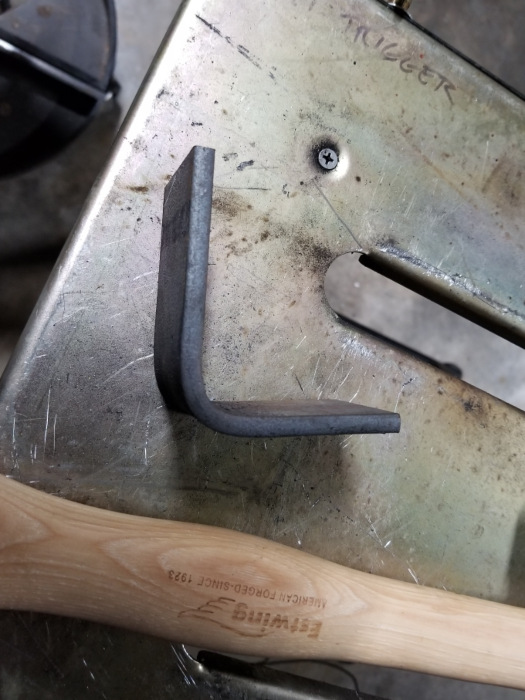
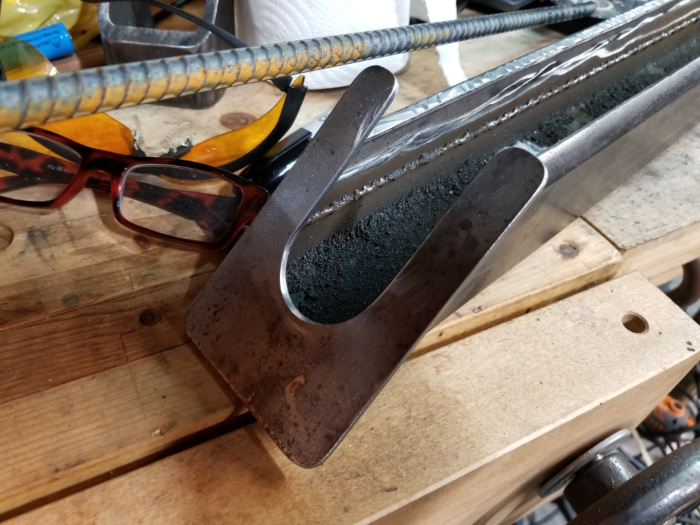
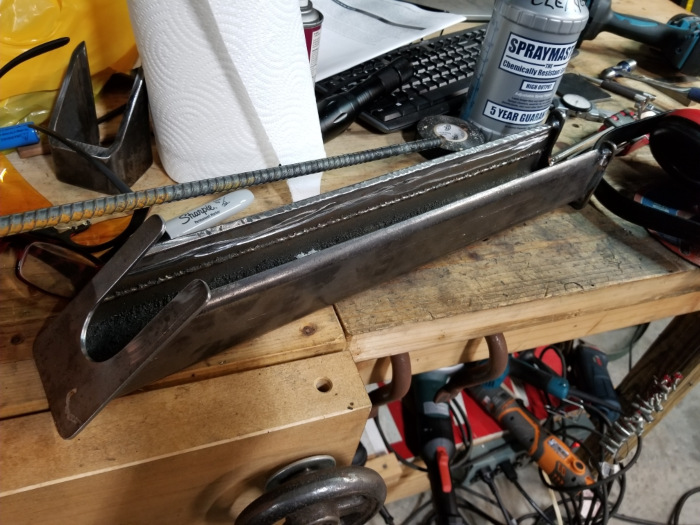
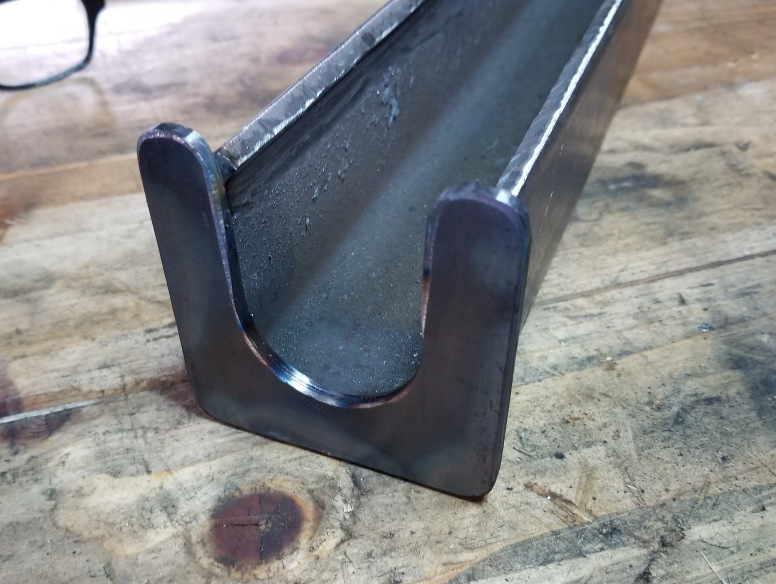
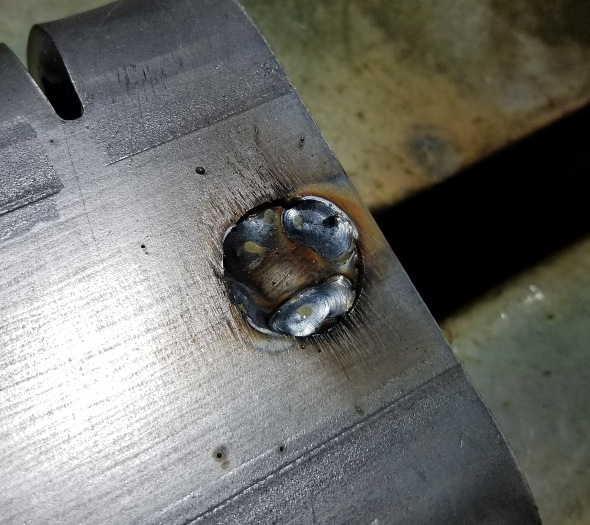
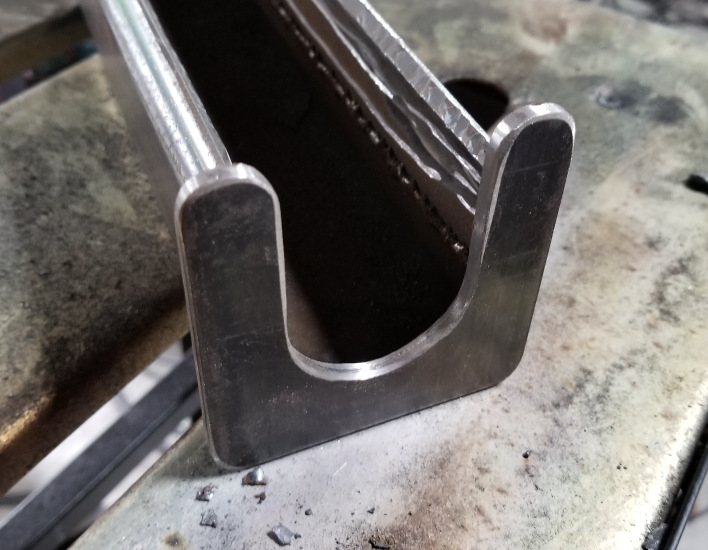
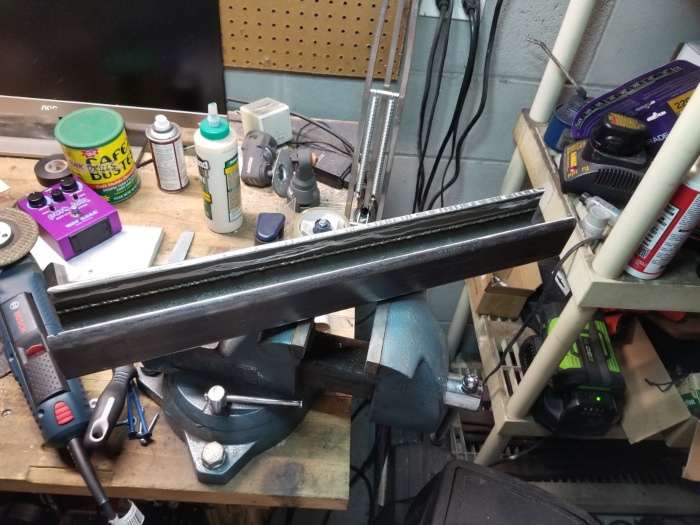
Today I used the drill press and a hole saw to put an opening in the shield, and then I used an angle grinder to cut a piece out of one side of it so the grinder belt could get in there. I used the grinder to open the cut up and create two straight forks. You’ll understand when you see the photo.

When I was done with that, I had a shield with a somewhat rough inner surface, and because the opening was deep, the belt grinder couldn’t get in there to smooth it out. It only does flat things and very big curves.

I remembered I had a Ridgid oscillating spindle sander. This is a machine that has a table and a spindle that projects up through it. You put sanding drums on the spindle, and it goes up and down while it spins. It’s really a woodworking tool, but it’s also good for certain metalworking jobs. It’s a fantastic tool. Very, very useful if you have any imagination.

I used the sander to smooth out and deburr the shield, and I was all done. Time to rest.

The picture makes the inside of the channel look very rough, but it’s not. It has some light grinding marks on it.

Now I have to figure out what else I want to do. I have to weld the shield onto one end of the brace, and then I have to shape the other end so it will rest on the front end loader’s hinge without damaging it. I’m not sure how to go about that.

I want to put some kind of padding on the shield to prevent it from contacting the cylinder cap directly. I think a piece of a tire is the best possible choice, but I don’t have an old tire. I guess I should go find one. I could put wood on the end, but it will be under a great deal of pressure, and I don’t trust it.

I could take two pieces of round tubing and weld them to the end of the brace to sit on the loader hinge, which is made from tubing. I could glue rubber inside them, and that would prevent them from marring the hinge.

I guess now I have a plan.

I was not happy that I couldn’t finish the shield with the belt grinder, so I have ordered a small wheel attachment. This is a gadget that will allow you to sand with a very small wheel on the end of your grinder. The belt will go over the wheel and allow you to sand inside very tight round cavities.

This is a phenomenally useful tool. In addition to getting into tight places, you can use it to grind tubing so it will mate up with other tubing for welding. This is called “fish mouthing.”

I was studying up on the grinder today, and I learned something interesting about my motor. I put a 3-HP motor on it because they were easier to find than 2-HP motors. The motor is a Reliance (now part of Baldor) that originally sold for over $600. I got it for something like $70, with free shipping. May have been $80. Anyway, many people suffer with 1/2-HP motors. A 1-1/2-HP motor is standard for this type of grinder. My motor is twice that powerful. It’s much, much better.

I bought an 1800-RPM motor because people told me they were built better than fast motors. Then I thought about speed. I needed to run it at 4000 or more RPM to get good performance from the grinder, but I didn’t know whether it would be safe for me or the motor. I did a lot of research back in 2016, and I tentatively concluded it should not be a problem.

Today I found relevant information from a highly respected machinist. He said he had run many motors at 400 Hz for long periods with no problems. This is 6-2/3 times the rated speed. He said speeding up motors was very safe. They don’t fall apart mechanically and blow up. The big problems are overheating and reduced performance.

I don’t care about overheating or reduced performance. This motor is way oversized to begin with, so if the power drops by half, it will still be right up there with the vast majority of grinders in operation today. I was concerned about being killed by shrapnel, but evidently, that is not an issue. If he can run a motor at 400 Hz, I’m fine at 120, and I should be able to go 180 when I really want to. Not that I do. Not usually. Once you get over a certain speed, the grinder cuts so fast you can damage work before you know it.

I also confirmed that my motor was inverter-rated. That means it was made to work with a VFD. Generally, 3-phase motors will work fine with VFD’s even if they were made before the VFD was invented, but it’s good to know that the engineers who designed my motor took VFD’s into account.

What it all adds up to is brutal grinding performance. That’s the main thing.

Before I read what the machinist wrote, I contacted Baldor via a form and asked them how fast I could run the motor. I haven’t heard back from them yet, but I think I know what they’re going to tell me. They’ll probably say the motor shouldn’t be run faster than 2700. A number of similar motors they make have that specification. The thing is, they may have set their top numbers with performance, not safety or reliability, in mind. If you’re running a 20-HP motor in a business, you don’t want to jack up the speed and find out you now have 5 HP and can’t do your job. In a home shop, things like this don’t matter.

It’s nice to know I can turn on the afterburners if I feel like it. For fast stock removal, speed is the top priority.

I really like metalworking. I love machining, but I like the caveman stuff even more. When you cut, weld, and grind, you really get intimate with the metal. You take all the harshness out of it and turn it into tame shapes that feel and look friendly. Now that I have welders, angle grinders, belt grinders, a plasma cutter, and a hydraulic press, I can actually do a few things. When my finger brake kit is assembled, I’ll be a major threat. Maybe I’ll get crazy and by a tubing bender. Once you have one of those, you’re out of the kiddie pool.

Metalworking is not like woodworking, because woodworking doesn’t give you nearly unlimited power to improve your tools. Woodworkers have to buy things metalworkers can make. A creative woodworker can do a lot, but it’s not the same.

Maybe some day I’ll get things like bead rollers, slip rolls, and shears.

I’ll post photos of the brace when I’m done.

Bracing Experience

Thursday, September 5th, 2019

Metal, Angle Grinders, Plasma, and the Belt Grinder

Today has been great so far.

I sound like a broken record, thank God.

I want to be able to park my Kubota with the front end loader raised, and that means I have to be able to brace one of the hydraulic tubes with a specially made steel device. I need a piece of U-shaped tubing that will fit over a hydraulic rod. One end will press against the end of they cylinder, and the other will fit against the hinge the cylinder is attached to. The cylinder won’t be able to retract, and people in the workshop will be less likely to be crushed.

I now have three welders ready to rock, so all I needed was metal. I went to the local supply place. I love that place. It’s a house with a giant Doall band saw and a monstrous jib crane in the backyard. It shows how you can make a good living out of your house doing something completely unexpected, as long as the zoning people are with you.

For $18, they gave me a length of 2.5″ square tubing, a piece of plate to cap the end, and 12″ of angle iron for my anvil project, which I will write about later.

They didn’t have steel channel deep enough to go around a hydraulic rod in a way that gave me confidence, so I had to buy the square tubing instead. That meant I had to cut one side out of it. Time to fire up the plasma cutter.

I was delayed because the presence of God filled the car on the drive home, and I ended up spending some time praying before I got to work.

I made the mistake of searching online to figure out how much air pressure to use to cut 5/8″ steel. I figured all plasma cutters were about the same, so I settled for an Eastwood manual. It said to use 40 psi. I didn’t question it.

I clamped a wooden yardstick to the tubing to use as a guide. I figured there would be one quick swipe of the torch, and the stick wouldn’t burn. I was wrong about that. The torch kept clogging up. I had to replace the little copper orifice inside the tip. I couldn’t cut the tubing to save my life.

I got on the web and looked around, and a source said the kinds of problems I was having were caused by low air pressure. Okay.

The yardstick was largely carbonized by this time, so I grabbed a piece of steel strip and used that instead. Should have done that to begin with.

I turned the compressor up to 90 and let it rip. No problems this time. Unfortunately, I already had one boogered-up cut. Time for the angle grinders.

I decided to put my new Hercules (Harbor Freight) grinder up against my new Bosch, to see if there was a difference. All I could tell for sure was that the Bosch made more noise. I don’t think it worked better, but it was more pleasant to use. The paddle switch wasn’t as hard to get used to.

I used two free cutoff disks I got from the Walter company. They make top-notch flap disks, and they give away samples. I couldn’t tell whether the disks cut any better than the other ones I had, but they were free, and I love the flap disks.

It took a very long time to liberate the unneeded side from the tubing. Then I had to use the grinders to clean up the terrifying burrs. I guess that took 45 minutes.

Using angle grinders on metal is fun. It’s surprising how accurate you can be with such a violent tool. It’s very absorbing. Angle grinders are great because you can turn bubba’d-up messes into great-looking projects with them.

I want to get a 6″ Metabo for cutting metal. They’re incredibly fast. Today’s experience gives me motivation to go ahead and order one.

After the tubing was modified and cleaned up with a knot wheel, I put it on the belt grinder and did some deburring. Very nice. There is nothing like a 2×72.

Now I have a channel ready to be turned into a brace.

The cuts are not identical, but it doesn’t matter. Besides, it would be good practice to make a second brace, now that I know how much air the plasma cutter needs.

Tomorrow or the next day I need to cut an opening in the end cap and weld it onto the tubing. With a mill, it would take 15 minutes, and it would be gorgeous. I’ll probably have to use a hole saw and the plasma cutter. I also have to modify one end of the tubing so it will rest securely on the loader joint. Maybe I can do that with the belt grinder.

I can’t decide how to weld it. The welds don’t have to be strong. The tractor will push the cap toward the tubing, and the welds are only there to hold the cap on the tubing, so the tractor and the welds will be doing the same work. But I want to do a good job. I’m not ready to TIG it, but it would be neat if I could do the job with stick and 7018.

I guess I can practice on the metal I removed from the tubing. That will be helpful.

When I’m done, I’ll get out my can of Kubota orange implement paint. People will think I bought a Kubota brace.

I should take some chances with the project. If I ruin it, it will still be good practice, and it will only cost me maybe $14 to try again.

The weather was surprisingly good today. It got up to 99 in Ocala, but there was a high wind, and it was very dry. Another present from Hurricane Dorian. I’ll take it. Hot weather with very little sweat is better than hot weather with soaked clothing.

As is often the case, it was considerably cooler where I am than in town. My workshop thermometer read 88 today. I can’t explain it.

I don’t have an anvil. I am thinking I might like to try forging, though, and I would need something to beat metal on. I have a piece of 4″ square 1018 steel maybe 15″ long. I’m considering welding angle-iron tabs to it, drilling holes in them, and using them to screw the block to a stump. It would’t be as hard as an anvil, but it would work well enough to give me a chance to see whether I like forging, and it would give me some welding practice.

I don’t know how I’d move the stump and block into the workshop. I guess I need to move the stump indoors first.

The improved workshop is a joy to use, and God willing, it will be much better in a month or two. I really look forward to that.

Workshop Begins Living up to its Name

Thursday, September 5th, 2019

Floor now Visible

Yesterday I got a lot of stuff done in the workshop.

Ergonomics is a weak point with me. I tend to put things I use in the worst possible locations. I stack things on the floor in front of shelves. I cover new horizontal surfaces with junk so I feel like I need to buy more tables. I put tools where I have to walk past junk to use them.

I hate clutter and disorganization, yet I tend to generate them.

Yesterday I moved a bunch of stuff in the shop and made it possible to do more work.

First off, I put a set of Amazon casters on my Harbor Freight 20-ton press.

If you don’t have one of these presses (or a better press), you must be a fool. For around $150, you get a press that functions perfectly well, and you can easily upgrade it to air/manual power. If there are things about the press you don’t like, you can modify it. It’s a very simple piece of machinery. The fundamental structure is fine, so any problems the press might have are unimportant and repairable. They used to make orange presses that tended to fail, but the grey ones they make now are great.

These presses sit on steel angle irons, and the angle irons are pre-drilled for casters. I spent around $20 on Amazon and got a set of 4 swivel casters, two of which have brakes. It took 5 minutes to install them. Now I can move the press wherever I want. It will no longer be blocking my access to other things, and I can move it to the metalworking area of the shop.

I plan to put a sheet of plywood between the press and casters. It will give me a storage surface that moves with the press. I may also put some kind of box or shelves on it. I can fix it so they can be moved off when they obstruct the press.

I ordered a Swag Offroad finger brake kit for the press. This will let me put decent-quality bends in very heavy steel. I plan to use it to make improved mobile bases for my heavy tools. Storebought bases have to be adjustable, and this introduces lots of problems. I look forward to having bases that work better, and I also look forward to being able to make boxes and brackets.

I’ll have to do some welding to put the kit together, but I have–let’s see–THREE welders ready to go. I should be able to get it done.

I advertised my John Deere utility cart for sale, and I moved it to the goat shed. When I bought my tractors and golf cart, the seller threw this thing in. I can see why. It’s useless. If I want to move things, I have a pickup and a golf cart with a dump bed. The JD cart sat in the way collecting leaves and dead bugs.

John Deere is a sad cult, like Snap-On and Apple, so people will pay stupid prices for anything green. I think this cart is worthless except for parts for projects, but I have already had two contacts from the ads. I priced it at $500, figuring John Deere lovers had no common sense whatsoever. I’ll bet anything I get $250.

If I can’t get a high price, I may cut the sheet metal off and turn it into a base for a mobile barbecue.

I moved my drill press and grinding cart to the metalworking area of the workshop. Now they’re near my toolboxes, as they should be. I also added my Chinese welders, since I am more likely to use them than the Lincoln, and I put my Harbor Freight welding table nearby.

My wood stuff is all on the other side of the shop now.

With the cart gone, I was able to move a lot of junk to shelves, so now I can walk quickly across the garage instead of stopping and turning to avoid things.

I ordered a 25-foot cord for the 50-amp socket. That will let me move the welders and plasma cutter around instead of jamming them against the wall by the socket. Manufacturers save money by selling these machines with tiny cords.

One of my air hose reels was on a shelf, and the hose was on the floor in sprawling coils. I mounted the reel on the wall and put the hose on it. Now I have air up to 70 feet from the shop. It’s not much air, because the compressor is small, but it’s air. And I can walk where the hose used to be.

There is no outlet on the side of the shop where the compressor sits. That’s unforgivable. There is an outlet maybe 18 feet away, embedded in the wall, and the wires that feed it drop down through the cinderblocks from above. I believe I can pull the box out, drop new wires down from above, attach them to the existing outlet to draw power from it, run them down the wall to the compressor area, drop them into the cinderblocks, and install a second outlet. This is my plan. I don’t really want to splice into the existing romex, but that could actually be a better plan. Anyway, I WILL have another outlet.

I am considering hanging 4 power cords with multiple sockets from the roof trusses so they’ll end about 6 feet in the air. That would let me connect tools to them without running cords on the floor. I already have one outlet up there for the useless ceiling fan. I plan to replace it with a four-socket outlet, and then I can run the cords over the trusses.

I may also run a couple of 250V cords up there for 20-amp tools.

I had a brainstorm regarding the big tractor. I was thinking I should build a shed for it and get it out of the workshop, but then I realized I could park it with the front end loader in the air. The loader and forks take up an area which is maybe 6′ by 8′, so this would make the workshop much easier to use.

I learned that hydraulics can’t be trusted to hold pressure. That means the loader will slowly sink if I leave it up, crushing whatever is under it. Also, if someone (like a kid) touches the hydraulic lever, the loader can plummet very quickly. To prevent this, I need a brace to fit over one hydraulic ram. Kubota doesn’t make a brace for this loader, but I can make out from steel C channel. That’s one of my projects for today. I want to buy the channel, make an end plate for it, cut recesses to fit the loader hinge, weld the plate on, and paint it Kubota orange. Whenever I park the Kubota, I’ll stick the brace on one rod, and the loader will stay in the air.

I looked into sheds for the John Deere, but you have to spend a lot of money to get a shed with a doorway a 6′-wide tractor can negotiate. I might make a wooden shed myself, with one open side. It would be very cheap, and it’s not complicated. Four four-by-four posts with concrete slugs. A bunch of pressure-treated boards nailed to the posts. Galvanized metal for the roof. Done.

I’m going to put casters on my shop fan. It’s very heavy and hard to move.

I now have a big clear area by my workbench, and my metal tools are right there. Very nice.

I’m going to throw out my Rockstar beverage fridge and put my retired mini-fridge in the shop for drinks. I have to make a stand for the fridge first. It’s very short, and I don’t want to waste floor space. A rolling stand will allow me to have some shelf space under it.

I vacuumed the shop. I have given up my delusions about blowing debris out. Women are right about this. Men like to blow debris away. Women like to suck it in. When you suck it in, you can get rid of it. When you blow it away, it just lands somewhere else, where it has to be blown again. From now on, the leaf blowers and compressor blow guns are only for things the vacuums can’t handle.

It makes a big difference to have a somewhat clean floor.

I’ve been thinking a lot about my basic strategy. I was considering building a new shop, because there was so much clutter in the existing building. If I can put up a shed and keep the Kubota’s forks up, I can do a lot with what I have.

I want more 50-amp lines out there. That project is looking less intimidating. The electrician I called to give me an estimate turned out to be completely incompetent, and I had been relying on his expertise. He was wrong about a lot of things. I’ve been investigating, and I don’t think running more wires will be hard. He couldn’t find the place where the existing wires entered. I did. I found out how to bury bigger wires. This is something I can handle.

I tried to open one of the boxes the big wires go through, but the screws are carbon steel, not stainless. On an outdoor box. Unbelievable. The philips slots are nearly gone. I decided this was a good excuse to order special pliers for removing damaged screws. They’re called Vampliers. They look like they have little teeth.

Vampliers are sold on TV, but they’re actually excellent Japanese pliers. The company makes other good tools. If you order them under the Japanese company’s name, you pay much less for the same product. That’s what I did.

I had to find stainless screws made to screw into plastic. They exist. Amazon sells them. They’re called “thread rolling screws.” I ordered a pack of 25 for $3.47. I made sure they had Philips heads on them so I don’t have to go dig out a ridiculous Torx bit or use a flat blade which is guaranteed to slip out 15 times per screw.

I want to put my lathe and mill in the garage by the house. This is not an optimal setup, but I think it’s better than cramming them in an un-air-conditioned workshop. For under $600, I can put a unit in the garage window.
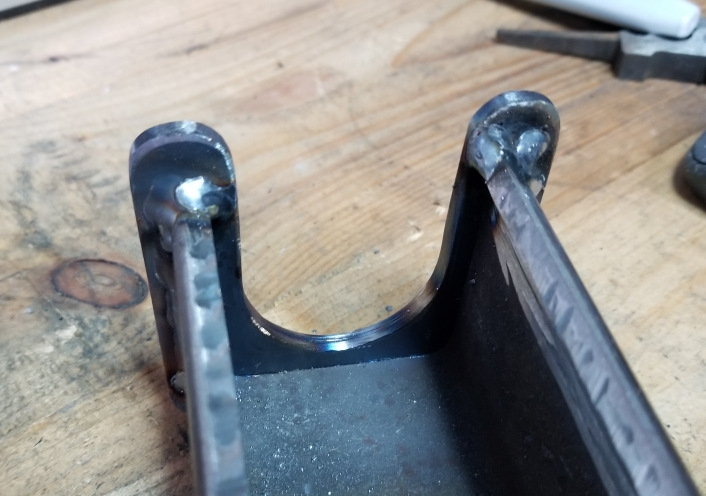
It’s not that terrible, having to walk between buildings to get tools. The distance is around a hundred feet. In fact, now that I’ve got a hose reel mounted, I don’t think I need two big compressors. I can do most of my air-intensive work in one building, and if I need to something in the other one, I can just extend the hose to it.

All I need now is good weather. Hurricane Dorian was wonderful. Yesterday, I enjoyed the hurricane in cool weather with pleasant breezes that really mitigated the sweating. Now we’re getting abnormally hot weather, and it’s supposed to be here for days. The shop fan is okay, but it’s no substitute for October.

I may get tarps for the tractors and start parking them outdoors right now. That extra space is very tempting. The John Deere looks like it has spent at least 15 years outdoors already, so a tarp is probably more than adequate. It’s never going to look like a new tractor.

I still want the brace for the front end loader. With a brace, you can work on the tractor with the loader raised. Very helpful. And it’s a simple and fun project.

I will post a photo to show where things stand now.

The junk in the foreground needs to be stored and/or rearranged.

Clearly, I now have room for a propane forge.