Back to the Grind
September 13th, 2019More Stuff!
Today was not spectacular. It was merely excellent.
I finally got myself an acetylene rig. I’ve been wanting one for years. Acetylene is not very useful for welding these days because there are better ways to weld, but gas is still great for cutting, heating, and flame-straightening. Many people are turning to propane/oxygen rigs because acetylene is so expensive, but propane isn’t as good for flame-straightening, so I bought an acetylene outfit and a few doodads that will allow me to use it with propane.
You may think you know what flame-straightening is, and maybe you do, but you’re probably wrong. It doesn’t mean heating up a part so it’s malleable and then bending it so it’s straight. It means heating a small area of a part very intensely and very quickly and then chilling it with water to make it contract. You can straighten a propeller shaft using this method. It’s amazing. You can also use it to straighten things that have warped during welding.
Propane doesn’t heat small areas as quickly and intensely as acetylene, so I definitely want to have acetylene in the shop. Most of the time, however, I would expect to use propane, which is fine for cutting, bending, and heating.
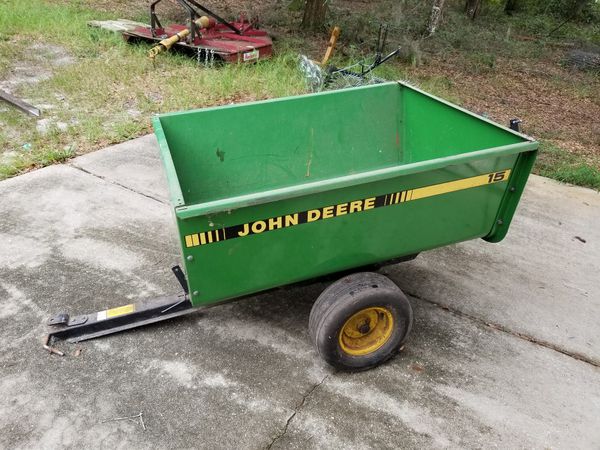
I’m thinking of cutting up my John Deere cart and making a welding cart. I’ve been trying to sell the cart, but it looks like it will only bring $50. I thought a cart from the same company that charges $800 for a lawnmower grill would go for hundreds, but it looks like even John Deere fans aren’t that crazy.
I also visited Northern Tool and got some new welding magnets. I’m pretty sure my old ones are in Miami, stuck to the side of my lathe. You can’t weld without magnets. Well…you can. But it’s more difficult.
Since I’m on the subject of magnets, I’m about to get a patient lift, which is an engine hoist for human beings. When I do, I plan to get a lifting magnet for it. I’m talking about a powerful magnet you can turn on and off. You can get magnets that lift a ton. I’d get a smaller one and use it for heavy steel objects.
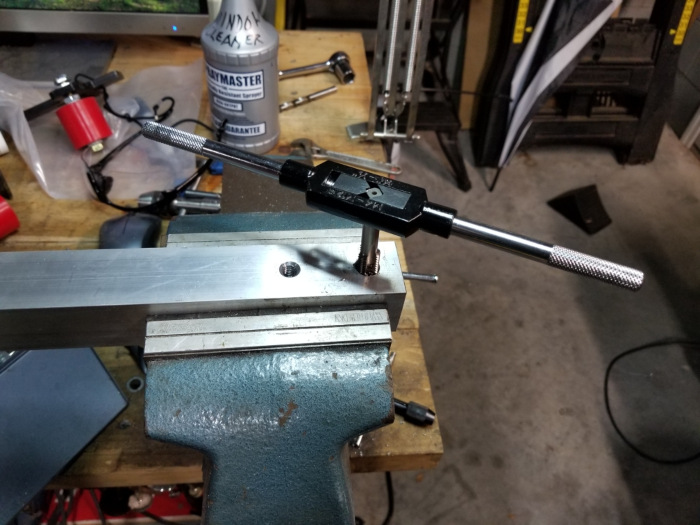
On today’s trip, I visited my new friends the metal dealers and got two aluminum bars. They’re going to be tooling arms for my belt grinder. One of them already is. I drilled and tapped it today. When I showed up to buy more stuff, they treated me like they had always known me. The older lady said, “What are you making this time?”, like she was already familiar with my eccentricities.
To get two tooling arms from a company that sells them, I would expect to pay around a hundred bucks, including shipping. I’m talking about two 20″ bars, each with two tapped holes in it. Today I paid $38. That felt good.
I came home, ate a steak, and went to work.
First, I put the bars on the belt grinder. The ends had been cut with a band saw, so they were rough. I ground them smooth with three horsepower of pure overkill. My grinder is so strong, I can’t slow it down. I was jamming the bars into the belt to see what I could do, and I couldn’t change the speed at all.
I ran the grinder at 145 Hz for a while, just because I could. That was fun. Here’s a shout-out to all the people who said I couldn’t do that.
Once the bars were looking good, I marked one of them for holes using dial calipers and a Starrett punch. Then I drilled and tapped one. After that, I cleaned it off and installed my latest grinder tool: a small-wheel attachment. I’ll post photos. It allows you to make grinds in very tight places. Very useful.
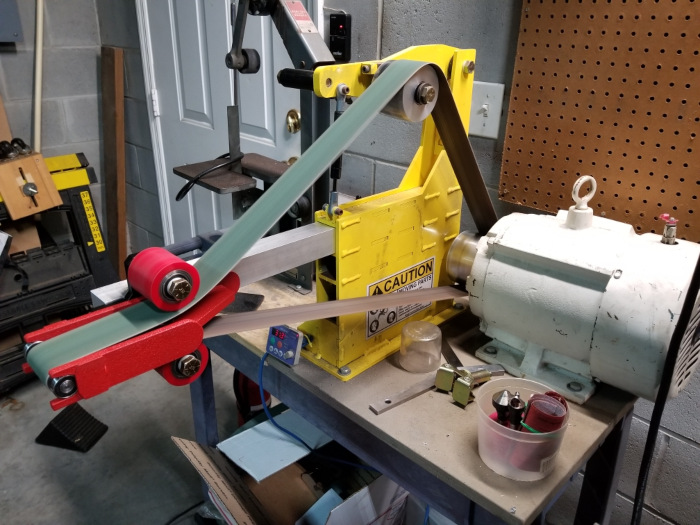

My next grinder tool will be a big contact wheel. After that, I’m done for a while. I would like to modify the grinder so it turns sideways, but it would be difficult with a monster 84-pound motor. Maybe I’ll build a new grinder eventually.
I saw a guy on Youtube building a grinder, and I was startled. He runs a company called Fireball Tool. He knows a great deal about tools, and he manufactures tools for welders, but as I watched him, I realized I knew a lot of things he didn’t.
He took two go-kart wheels and used them as the basis for a grinder with a 6″ belt something like 60″ long. The wheels had tires on them, and they had offset hubs, which are weak and floppy compared to solid wheels and pulleys. You don’t want tires on a belt grinder. You want a small upper pulley, because a big one uses up a lot of belt. Why pay more for long belts if you’re going to waste two feet on your drive wheel and pulley?
The grinder only had one piece of plate on the side for support, and it was 1-1/8″ thick. He used a waterjet to cut it out, which means he had total design freedom, but he didn’t cut any holes in the plate to save weight. That was a bad decision. The grinder would have been very strong with 1/4″ plate, and he could have moved it on a handtruck. As it is, it weighed over 600 pounds before he even finished. And he was happy about that.
He welded the tool rest onto the frame, perpendicular to the belt, and he didn’t put a T-slot in it. What??? What good is a tool rest you can’t rotate to a desired angle? Why wouldn’t you want a tool rest for fixtures?
He made the grinder so he couldn’t rotate the belt into a horizontal position. Think of all the things he can’t do with it.
He used a single-phase 5-HP motor, which means he gave himself no way to vary the speed. I don’t know what to say about that. Variable speed is a huge improvement to a grinder. Obvious.
He made a huge hollow platen on the grinder, and he filled it with garnet powder to stifle vibration. If your belt grinder is vibrating so badly it affects the function, you built it wrong. My grinder doesn’t vibrate. He solved a problem that didn’t exist. How is a 600-pound grinder with only 5 HP going to vibrate? He only has 5/6 HP per inch of belt width, and I have 1.5, with no vibration.
His grinder is very poorly designed, and eventually, he’ll probably cut it up and give up on it. I’m not glad someone else put a bunch of mistakes on Youtube, but I’m glad I’ve reached the point where I can discern them. I felt good about that.
People in his comments were telling him how great it was. I was aghast. I guess none of them had ever used a 600-pound grinder with no casters, a fixed tool rest, belts that cost 50% more than they should, and a single-speed motor.
He makes some neat tools for setting up welding projects. I thought about buying one of his squares, but I don’t think it’s really necessary, and they cost $190. I think I would do better putting the money toward a real welding table.
Tomorrow I hope to get back to the Kubota front end loader brace. Hope your day was as good as mine.