Archive for the ‘Photography’ Category

The New Abnormal

Monday, June 1st, 2026

The Authorities Have Been Contacted!

Months ago, as I was working on improving my photos, I had a weird cyberstalking incident. I wrote about it here. I joined a photography website, and I got all sorts of helpful comments. Then one day, I disagreed politely with another member, and he started insulting me. Then, without warning, he claimed he had found my blog, and he told everyone else I was a dangerous nut or some such. I don’t recall, exactly.

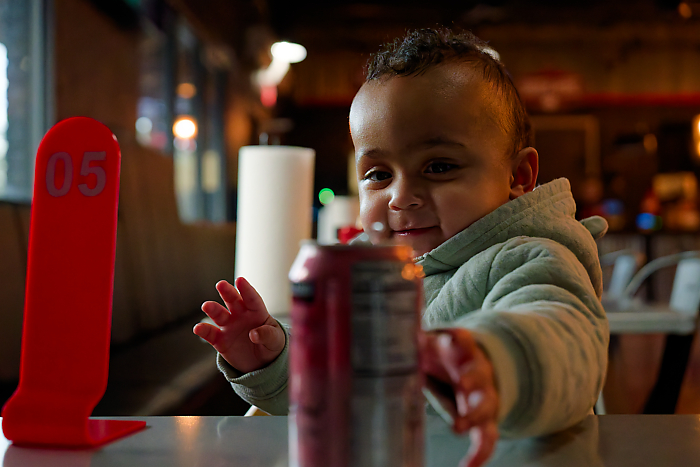
I had created a Flickr account, because the forum did not allow direct photo posting, and I had used it to post a few shots of my baby son, the most photogenic person alive. Before doing this, I had thought, “Should I really let Internet whack jobs see him?”, but then I decided I was being paranoid, so I went ahead.

I realized the kook who insulted me had probably used my son’s baby photos to find my blog, so I deleted my Flickr account because I no longer needed it, and I did what I could to make it more difficult for other kooks to find me using my son. I couldn’t do a perfect job, but something seemed better than nothing.

I quit using the forum, and that’s sad, because I got a lot of good input there, and it was fun to have the online company of friendly people with a shared interest.

Today I went to my blog, and in the trash filter, I found this comment, from, and I apologize for this, Yourawanker@wanker.com, at IP 109.156.63.128:

Actually was me. Your photos are sh*t. Actually they are worse than sh*t.

This website is a complete abortion.

I have contacted your local authorities and reported your website as a hate crime and have also explained that I have concerns for both your wife and your kids safety as you are completely unhinged.

It was posted a week ago. He’s still on the case. The asterisks are mine.

Of course, no one has reported anyone to anyone. If this interesting person could find out who the local authorities were, and if he reported me to them, they would probably take me out for barbecue.

On the other hand, I would not be surprised at all if I have written things that are now arrestable in England, where you can be put in cuffs for praying in public as long as you’re not a Muslim. Maybe he thinks we have laws like that. Not yet.

Not in most places, anyway.

So I have a new fan. Like the liberals who have watched Fox News and listened to Rush Limbaugh far more faithfully than conservatives, this guy or trans guy or whatever is hanging on, continuing to obsess on someone who moved on from a trivial disagreement and minor stalking incident a long time ago.

I don’t know who or what he is, because he hides his identity, including even his online pseudo-identity. I wasn’t able to find a single photo he had posted anywhere, so he says abusive things about other people and their work while hiding himself and his efforts. Other people on the forum said he was very good at his work. I couldn’t say.

I checked the IP, and it comes from a place called Drakewalls in the UK. I don’t understand English place names, and I don’t plan to learn about them now, but it looks like this is in a place called Cornwall, near a town called Gunnislake. I think Cornwall is in Wales, which is a strange place to me because the Welsh claim they have their own country, yet Wales appears to have been completely digested by England.

Out of curiosity, I looked to see if there were any professional photographers in Gunnislake, but the only guy I found does very amateurish work, so I assume he is not my friend the critic.

Maybe he’s not a professional photographer. I guess a person who will not post his photos online under his name or his company’s name is not going to make much money, so that points to a hobbyist.

I was thinking about him today in connection with another vitriolic crank I saw recently. The site Citizen Free Press linked to a video of a woman claiming to be a Michigan nurse. She is of mixed race. She was sitting in her car, screaming and cursing about another person. At the end, she said she was going to go cut his throat, and she showed the knife she planned to use. The consensus is that she was talking about Donald Trump.

What?

Web sources claim her name is Rhonda and that she works for the University of Michigan, caring for the elderly. Not those who dance to YMCA and recently got a glowing checkup from the White House physician, I hope.

I don’t know for sure that she was referring to Trump or that her name is Rhonda.

The commonality here is demonic rage. Overwhelmingly, it is found on the left, in people like the soon-to-be fired (probably) nurse. Increasingly, the right is catching up. The eccentric who stalked me issued a whole bunch of pro-Trump comments on the photo forum. Then, of course, there are Candace Owens, Nick Fuentes, and their deranged followers.

What are people like this really angry about? Photography? Donald Trump? The imaginary Jewish conspiracy? It’s none of that. Here’s what is really happening:

Revelation 12:12: Therefore rejoice, ye heavens, and ye that dwell in them. Woe to the inhabiters of the earth and of the sea! for the devil is come down unto you, having great wrath, because he knoweth that he hath but a short time.

And when the dragon saw that he was cast unto the earth, he persecuted the woman which brought forth the man child.

The woman is not Mary. She is Israel and the church. Everyone who belongs to Yeshua. The apocalypse is happening right now, Satan knows he is about to be crammed into a dark hole for a millennium, where no one can admire or serve him, where he will burn in great pain, and where his only pleasure–sadism–will be taken away from him. He knows this, and the spirits who serve him know it, so they are provoking loonies all over the world, trying to get them to abuse and kill people God cares about, while there is still time.

These spirits are like the Nazis, who served them. When Germany and Austria were crushed and defeated, and their troops were running back to the homeland in failure and fear, they murdered captives before they left. In one case, they filled a building with people and set them on fire, which was not in their own best interest. Losers should know better than to commit war crimes on the way out.

I’m not a particularly good person, but I definitely belong to Yeshua, and the spirits know it. This explains the bulk of the unjustified, oddly-venomous, bad treatment I have experienced during my life. A lot of people are in my position. All Jews, for example.

You don’t stalk a person for months (or at all) for thinking your off-topic photography tips are wrong and saying so politely. You don’t tell the world you’re going to cut the president’s throat. You don’t commit mass shootings because you think someone in the crowd might believe a person with a Y chromosome is a man. Not without help. You need demons in order to feel that kind of irrational fury and be willing to act on it.

October 7 required the assistance of demons.

Maybe it sounds extreme, comparing myself to shooting victims and Jewish martyrs, but I’m not claiming the degree of persecution is the same; just that the source is the same.

I have a lot of protection. My wife and I have very good prayer lives, I live in a place where even the road leading to my home is private property, my sheriff supports good people, I am well-armed, I have surveillance, and my neighbors have machine guns. I don’t think a keyboard zany from Wales is going to fly over here, locate me, attack me and my family, and thereby put himself in grave danger. Other people Satan is targeting are not as blessed as we are, though.

The thing that hurts me is knowing people like me will never be anything but outcasts during this age. I hate knowing the vast majority of human beings can’t be saved and made part of God’s family.

It would be great to have more opportunities for friendship and bonding with coworkers. Can’t happen. If I meet a great Muslim guy, I can’t start inviting his family over for barbecue. If I write a book, I can’t network with other people in the publishing industry to get it to sell. I can’t share the experience of watching popular TV shows and movies with other people any more. I feel like I’m waving in people in a friendly manner while standing behind a chest-high wall.

I make friends easily. I like associating with people. Those traits are mostly wasted now.

I want to help people. I want to tell them the things God has shown me so they can be as blessed as, and preferably more blessed than, I am. I want to see their problems go away. I want them to be assured of a wonderful future. But like Lazarus, I am separated by a vast gulf I can’t cross. My friendly relationships with most people have to be superficial and casual.

If you belong to God, learn this lesson: be good to people who aren’t chosen, but don’t get too close. Don’t make new best friends who aren’t in God’s family, because they will be gone from your life forever, very soon. Don’t missionary-date. Don’t try to become part of social networks in order to make money. Understand that you are holy, and “holy” implies “separated.”

Hope this helps you avoid wasting time and emotional involvement.
Let go of my Ankle

Sunday, April 12th, 2026

Humanity Never Fails to Disappoint

One of the nice things about turning back to God is that virtually all of the trolls who used to frequent my blog disappeared soon thereafter. I think part of the reason is that they had no interest in reading, over and over, about a religious zealot’s purported experiences with the Holy Spirit. I used to be a lot meaner and funnier, and I wrote more like a secular-minded politics buff than a Spirit-led Christian. People liked that stuff.

Amazingly, I got trolled and stalked recently in another online “space,” as pretentious people might say. It had nothing to do with politics or religion or me intentionally provoking fools.

I didn’t see that coming.

I started getting interested in photography (again) in 2023, and since then, I have sought advice and looked for kindred souls with whom to share my feelings and questions. As part of this process, I posted a number of photos. As a result, I sometimes had to ask myself whether it was safe to put shots of my wife and son on the web. Eventually, I told myself it was okay to do it occasionally, since nobody who was interested in photography would stalk a woman or child based on photography-related content.

Of course, I turned out to be wrong. As I often have, I underestimated the depravity, cowardice, and hatred of Internet kooks.

I disagreed politely, for solid, well-articulated reasons, with a person who gave me unsolicited, off-topic criticism based on the composition of a photo. I had been asking about trends involving exposure and brightness. I was not looking for advice on taking photos. I just wanted to know whether I was right to think many photographers were pushing others to do things a certain way, to the detriment of the results.

Unbeknownst to me, this sent him into an unforeseeable, baseless, incomprehensible mouth-foaming rage, and apparently, he has no attendant to strap him down until these things pass.

Next thing I knew, he or zey or whatever was claiming he (best guess) had found my blog, and he said he had reposted my written work in the space where we were discussing photography. He made some unhinged comments about me, seemingly suggesting I was insane, malignant (like himself), and otherwise flawed. Other people deleted whatever he posted, so I have never seen it. I have no idea whether he found my blog or not. For all I know, he thinks Instapundit or Maddox is me.

I never provided an email address related to my blog, and I didn’t mention my site at all. It seems to me that the only way this unbalanced specimen could have found my blog, if he did, was by reverse-Googling my images, presumably including some of my baby son.

He was so unjustifiably incensed, he sat at his computer and worked on this.

Oddly, the people in charge of the space didn’t bother banning him. Seems to me that would have been an obvious and standard response to blatant Internet stalking involving a baby, but maybe they didn’t think it through and see the possible connection. I didn’t try to get him in trouble.

All of the alleged republication and deletion took place in a short time. When I went back, thinking I would resume discussing photography with mature adults and not whack jobs in need of increased medication, I saw his deranged comments, wrote a polite response obliterating his weird claims, and left.

Afterward, I decided the best thing was to remove all my photos from the space, without warning, and delete the photo-hosting account I had created for my hobby. I had created it, reluctantly, because there was no other way to share my photos with the crowd the crank belonged to.

That’s how things stand now. If this marvelous cretin really has found my blog, it won’t keep him from returning, but it will make it less likely that other potential mental patients will follow in his footsteps.

He claims he lives in another country. I hope that is true. I wouldn’t want a weirdo like this to somehow find me and accost me in person, creating the potential for police involvement and/or legal fees for a defense attorney.

I haven’t been back. The interaction I had there wasn’t very important to me, and I was no longer having a rewarding experience, so there was no compelling reason to continue.

For that matter, this blog isn’t very important to me, even though I have written thousands of posts here. Sometimes I think about deleting it for my own sake and the sake of my family. The only reason I don’t do it is that I have learned a great deal from God over the last decade and a half, and a lot of it is vital information nobody else seems to be passing on to the public. I believe the rapture is almost here, and after it comes, there will be people who are still stuck on Earth, Googling to find out what just happened and what they can do to get the best possible outcome given the circumstances. What I’ve written can be very helpful to them. Of course, I could just delete it all and post a few thousand words to summarize the important parts.

That is something to consider.

There have been times when I have thought about the possibility that my blog’s security isn’t tight enough to keep it from being deleted by someone else, and my conclusion has always been that I don’t care enough to find out and do something about it. If I woke up one day and found out it was gone, I wouldn’t scurry around pulling my hair out, thinking my life’s work was gone. I would be relieved and eager to do something new, to tell you the truth.

As people like to say, this is why we can’t have nice things. Sadists and loonies go through life ruining other people’s enjoyment for reasons known only to themselves, their therapists, their demons, and their sycophantic imaginary friends.

He hates my photos, and it is true that some are very bad. This is particularly true of shots I put online because I knew they had problems and wanted advice to improve my work. On the other hand, some of the things he said were just plain silly.

Calling composition “bad” is fine when you’re talking about someone who took a standard wedding photo and cut off the subjects’ heads, but it’s stupid when you’re talking to a photographer who got exactly the composition he wanted and made it work, not just for him, but for at least some others who understand photography.

Composition is subjective, like choosing between color or black and white. A number of the qualities photos have are like that. A lot of famous photographers have been ripped very badly early on, by unimaginative critics who were never able to take great photos, simply because the critics lacked the capability to understand the choices the artists made. You can spend an amusing half-hour Googling highly-respected critics who made fools of themselves by confidently lambasting photographers who went on to become legends.

The thing about real creativity is that if you’re not creative, and you follow everyone else’s rules splendidly, you can’t recognize creativity in others when you see it. It just makes you mad, if you’re the kind of person who feels threatened in such situations. It looks like incompetence to you.

Usually, I crop photos, because often, I find it hard to compose them the way I want them. This is usually because I’m shooting moving subjects. The difficulty is obvious. The photo the stalker criticized was not cropped. The composition was exactly what I wanted, right out of the memory card. I had a list of reasons for leaving it the way it was.

Other people whose qualifications may well have been as good or better than the stalker’s liked the photo with the “bad” composition. I guess he stalked them, too, after I left. Who is to say who is right? Why should I listen to the stalker and not the other photographers who disagreed?

I have no idea how the keyboard detective composes photos. I wasn’t able to find any he had posted. I tried to dig them up to see if I could understand his mindset, apart from the rabidity. I thought he might know something useful. You don’t have to like someone in order to learn from him. Also, I thought his work might show he was on a completely different page. I was not looking for ammunition to belittle him or discredit his ranting.

Someone defended him in hopes of getting me to believe what he said, saying he was a great wedding photographer. That could explain a lot. I’m not sure “great wedding photographer” is a phrase that makes sense. Do such people exist?

I don’t know how believing him was supposed to help me. Basically, he said my photos were terrible and that I should buy Understanding Exposure, a book I have had since about 2006. Never mind that I have been working on learning exposure ever since I took up photography again.

I watch videos by excellent (and not-excellent) photography teachers. I read. This is 2026. Relying on books is often the slowest, most limited, worst way to learn.

To get back to his supposed credentials, I have seen magnificent, artistically-rich photos in the areas of wildlife, landscapes, candids, architecture, and journalism, among others. Great wedding photos, not so much.

Do people with huge talent wake up one day and decide to spend their lives shooting nervous couples and drunken guests, doing the same things all other nervous couples and drunken guests have done since the dawn of time? Probably not that often.

Google “wedding photos” and see what comes up. Sharp, well-exposed formula shots of people looking completely unlike themselves, which is what most of them want.

Running on a beach barefoot, in a tuxedo with the pants rolled up.

Walking hand-in-hand on the sand, with numerous footprints underneath them that show they had to do it 10 times. To get that spontaneous look.

Dancing in a rented mansion they couldn’t pay for in 20 lifetimes with their means.

The groom embracing the bride from behind while she throws her jaw open like a snake swallowing an egg, mimicking a practiced smile she saw a Sports Illustrated model flash in St. Bart’s.

Everyone but the happy couple wearing (carefully) clothes they have to return by Wednesday.

Really, Google and see. The first page of wedding photos that came up for me were commonplace and stagey. Now Google landscape photos. Complete difference. Street photos? Even better. Excellent work. One gem after another.

But maybe he is the Vivian Maier of wedding photos. The exception. Maybe he’s a genius whose wedding photos hang at MOMA twice a year. I have no way of knowing.

Criticizing people who succeeded at doing what they wanted to do, in an area where subjectivity plays a huge role, doesn’t always make sense. Imagine Titian giving Van Gogh a righteous chewing out because his brush strokes were too big. More aptly, imagine an art critic with no talent chewing him out, because that is more like what really happened during his life. One forgotten soul said Van Gogh “painted with a shovel.”

“If you want greatness, do what I do. Which is exactly what everyone else does. Set yourself apart by blending into the herd.”

Isn’t creativity about doing things differently? Did I misunderstand that somewhere down the line?

Lots of people have been gatekept by inept critics.

Fred Astaire said he got a famous review after a screen test: “Can’t act. Slightly bald. Also dances.”

A casting director marched a young Sidney Poitier out of the room and said, “Stop wasting people’s time and go out and get a job as a dishwasher.”

A record executive told the Beatles’ manager, “Guitar groups are on the way out, Mr. Epstein.”

I’m not saying I’m a good photographer, and I am certainly not photography’s answer to Fred Astaire. I’m saying the ability to recognize talent is a talent, and most people don’t have it, including many you would expect to have it. And I have a little talent.

The shot was not exposed very well, so I took someone else’s suggestion, graciously, and worked on that. In that case, I hadn’t gotten what I wanted, and I needed someone else to show me the problem. The composition, I left alone, and if I put it on my wall, it will stay as it is.

It’s not a case of a beginner refusing to take sound advice because of baseless pride and stubbornness. It’s a case of someone understanding exactly what he did, though a beginner, and sticking with it, refusing to throw out a photo that came out just as he wanted.

I have taken all sorts of advice from people who criticized my work. I welcome it. I don’t welcome stalking or obtuse suggestions from people who have warped personalities and limited perspectives, who become enraged by polite, intelligent disagreement.

If I were the kind of person this character claims I am, I would think the majority of the shots I take are brilliant. In reality, I’ll shoot a hundred or more shots of the same situation and end up developing one or two I dislike least, or I’ll throw out all of them.

Sometimes I’m extremely happy with the best shots in a batch. Other times I say, “Well, it has problems, but I can’t make my son relive this day so I can try again, and I don’t want to lose this, so I’ll be happy with a B instead of an A.”

I have realized I throw out shots I should keep. Not every precious photo is technically good.

I have lots to learn. I take tons of horrible photos. But the photos other people hate are not always the ones that are genuinely bad or even merely good.

Gatekeepers are the worst. I think one of the worst things about them is that they cause people to quit, all the while pretending they want to help. Sometimes they actually want them to quit, so they can say, “Very sad, but not everyone can stand on Olympus with me and my Hasselblads.”

None of it matters. I know enough by now to do without web mentors. There are so many sources of information I can access without being abused, there is no reason to wallow in the mire with the saints and the swine.

Yeshua was Fragged

Wednesday, March 25th, 2026

Typical

I have been thinking about leadership.

The universe is not a big partnership. It’s a patriarchal hierarchy with our male God at the top and Satan at the very bottom. Everyone except God submits to someone. I suppose the reason God doesn’t have to submit is that he submits to his own perfect nature. There is no point in submitting to a ruler when everything you do is perfect.

A proper marriage is not a partnership. The husband and father is the leader, and everyone else is supposed to submit to him; they owe him support and obedience. It’s for their good more than his.

It’s very sad that feminism has been mainstreamed in the church. There are many preachers that acknowledge the Holy Spirit yet claim husbands and wives are equals. As my wife put it, they “apologize” for Ephesians 5:23:

For the husband is the head of the wife, even as Christ is the head of the church: and he is the saviour of the body.

Therefore as the church is subject unto Christ, so let the wives be to their own husbands in every thing.

There is no ambiguity there. You can’t “clarify” this by looking to other verses for reference. It stands on its own, impossible to contradict with other scripture. The husband is the boss, not an anarchist who takes turns running things. Not a slave who is forced to provide and protect without having a voice.

If you’re a wife, you are supposed to be subject to your husband in all things.

Feminist Christians love to point to 5:21, which describes Christians as submitting to each other, but that is in a different passage about a different subject. It’s about Christian life outside of marriage. It means we shouldn’t be pushy self-promoters; the kind of insufferable people who start running for office in the first grade. In our interactions with Christians outside the home, we should not force our decisions on others or appoint ourselves to positions of power; we should be humble and wait for promotion.

The word doesn’t say every woman has to submit to every man, and Ephesians 5:23 isn’t intended to be a rigid law. It’s a principle. It doesn’t mean you should obey your husband if he asks you to help him build a bomb to blow up a school. It means that if your husband is led by the Holy Spirit, you should submit to him.

“What if he’s not led by the Holy Spirit”? Then you married the wrong person, so you have no one but yourself to blame if your husband is a heathen. You’re going to have to build up your own relationship with the Holy Spirit and do your best, accepting the fact that you’re in a hole you dug for yourself.

It is hard to give advice to people who are stuck in very bad situations they created. It’s obvious that I should advise single people to avoid marrying heathens, but once the marriage is in place, there are no simple answers.

It’s important to note that disagreement with you isn’t proof your husband isn’t listening to the Holy Spirit, so you shouldn’t tell yourself that lie in order to excuse your family-killing rebellion.

Another important thing: submitting only when your husband agrees with you is not submission. I had to tell my wife that several times.

Say you want to paint your kitchen green, and your husband wants yellow. Badgering him until he agrees and then “submitting” to him is a farce. A wife is supposed to be a helper, but telling yourself you are helping your husband by helping him realize you’re right about everything is sin and a lie.

Sometimes even a good husband will be wrong. So what? Submit anyway, unless submission will be catastrophic. Maybe the kitchen should be green. Help him paint it yellow anyway, for the sake of the hierarchy, which is necessary and therefore more important than your kitchen.

It’s better to make trivial bad choices from time to time than it is to destroy the authority structure that keeps your family from destruction. As a mother, you will make mistakes all the time. Do you think your children are entitled to stop obeying you because of this? What will happen to them if they stop? Do you think they will have good lives?

As for men, maleness is not an achievement. You don’t get a prize for it. God doesn’t put you in charge so you can remain a selfish teenager all your life, staring at sports and playing video games, or obsessing on work, while you tell everyone else to kowtow and obey for your convenience. So you can be a frat boy when you’re 97.

A leader’s purpose is sacrificial, not selfish. Every real leader knows this. Strangely, Jews don’t know it. They worship a hard, imaginary God who doesn’t sacrifice himself for people or, in any real sense, regard them as his babies.

It makes perfect sense that God would allow himself to be crucified to save us, because even many earthly parents would do that for their children. A God who sits on a throne in the distance, invulnerable, ageless, and healthy, who never suffers for the ones he created, is not a leader. He’s more like someone who keeps tropical fish.

Every earthly parent understands the necessity of sacrifice as part of leadership, but somehow, Orthodox Jews think God’s principles of leadership are divorced from obvious principles we have seen here on Earth since man was created.

Yeshua, who was not captured, turned himself in to the Jewish authorities so he could be crucified, because he loved us so much he could not stand to see us get what we deserved. He endured rejection and slander. In his time here, he didn’t get much of a reward for all his efforts to help us. That’s how real leadership is. It’s asymmetrical in favor of those who are led.

This is what proper fatherhood is like. You may work all day. You pay the bills. You are the first one to face danger in a bad situation. In return, the people you help grumble. They say things about you that aren’t true. They disobey you and then blame you for the problems their disobedience causes. They make your job harder. They ostracize you to at least some extent. They never come close to repaying you. This is what God goes through, and if you’re a father on Earth, you’re supposed to go through it, too. It’s an honor and a privilege, even if it often feels like a curse.

I don’t know how anyone can respect a “god” who never suffers for the people he created. Earthly leaders suffer for the people they command, which is a good thing for them to do, but somehow God is not as good as they are? It’s absurd.

A proper patriarch does not expect his family to repay him fully. He expects to be shortchanged. He shouldn’t complain about his place, because it is more blessed to give than to receive. He shouldn’t sit around watching sports and playing video games all day, barking out selfish orders and leaving his family to guide themselves, as though a Y chromosome and a paycheck made him Queen for a Day.

A patriarch submits to God through the Holy Spirit. He does not grumble. He does not falsely accuse God of cheating him or not blessing him enough. He does not claim he submits when he only obeys the commands that comport with his own desires. He consistently asks God for correction when he has problems.

He doesn’t add up the ways in which his family has shortchanged him and present them with bills.

A patriarch spends time with his wife and children. He does not pat himself on the back for it, as though he gave a stranger a kidney. It’s what he owes them. He doesn’t say, “I’ve done this and that for my family, so now I’m free to do what I really want.” The time he spends with his family is not a tax or a permit fee. It’s a blessing for all concerned.

In order for a patriarch to succeed, the wife and kids have to support him instead of doing what they often do: joining outsiders in trying to bring him down. A leader has to have consent and support. Yeshua is the perfect leader, but humanity is still a failure, because most of us did not consent or support. A leader can’t force success on anyone.

I can give a great example of the way women kneecap their men. It amazes me that there are women who vote Democrat, knowing that their husbands vote Republican. This is the very picture of pathological rebellion. When two people vote the same way, they have power. When they vote contrarily, they have no power at all. It’s as though neither voted. Voting is an exercise of power, and casting opposing votes nullifies a household’s power. As Yeshua says, a house divided against itself cannot stand.

Opposition is supposed to be directed outward, not inward. Obvious? The world is against your husband. It’s sick and disgusting for you to be against him as well, especially when you still expect him to fight for you.

It’s pretty simple: one plus one equal two, which is something, and one minus one equals zero, which is nothing. When your votes agree, they have impact. When you vote against each other, you make your house a nothing.

Your husband considers the welfare of his family and his nation and decides to vote a certain way, and you decide you know better, destroying his power. Well, if you think your husband is too stupid to lead your family, what, exactly, did you want a husband for?

I know. Money, status, and babies. I don’t have to be told.

When I was a kid, I thought The Caine Mutiny was about a bad captain; nutty old Captain Queeg, and the smart officers who had to make a hard decision in order to save the crew from him. Of course, that’s not the message of the movie. It’s about immature, arrogant officers who destroyed their own leader instead of building him up. It’s a great picture of the way we destroy leaders who are put in place to benefit us.

The officers in the movie never tried to help Queeg do better. From the very start, they ridiculed him and worked against him. He was a flawed captain, but even a perfect captain would have failed with such officers. All fathers and husbands are flawed. What chance do we have without support? We can save ourselves, at best.

Queeg asked the officers for help, and in the book, he said this:

“Now, I’m the first to admit that I’m not perfect. I’ve made mistakes. I’ve had a lot on my mind. But a command is a lonely job. You men have no idea how lonely.

What I’m looking for is a little help. I don’t mean ‘Yes-man’ help. I mean the kind of loyalty that sees a captain through his mistakes for the sake of the ship. We’re all in this together. If we could just… well, start over. A clean slate. What do you say?”

Instead of helping, they refused to speak and waited for him to leave, rejected.

In the book, the snickering, whispering, mumbling coward who persuaded his friends to sabotage Queeg ended up captaining the ship, and he abandoned his crew in a battle, just as he abandoned his friends when they were charged with mutiny. The movie cheated the public.

All over the world, families are destroying the patriarchs who built the platforms they live on. No wonder young America men are shunning marriage now. In a world where young men are (correctly) moving to the right, and young women have swung hard left into sluttiness, rage, and arrogance, it is inevitable that men will avoid marriage. It’s like being asked to teach high school in the Bronx.

As for myself, I feel I need to give more time to God and my family and less to other things. Since my wife got pregnant, I have neglected things like shooting, tools, and yard maintenance. My pool is green. My hedges are a mess. I haven’t finished fixing the mower I bought last year.

I have felt I had to sink into the comfort of a love cocoon with God, my wife, and later, my son, to the detriment of my other responsibilities.

On the up side, I don’t regret it. I have had an experience very few fathers have had, and my wife is also privileged. These days many women treat their babies like purses or other accessories; like toys that bring them status. They hand them off to illegal aliens to raise while they give their golden, indescribably precious years of motherhood to jobs, serving alongside people who will forget them the week after they quit. My wife has been with her baby son every single day, as much as she wanted, and I have been with both of them.

On the down side, I know I still gave too much of myself to worthless things. The Internet. Even photography, which has been very useful in celebrating this family’s love. I haven’t given enough time to God and my wife and son, so I am turning the computer off multiple times every day instead of leaving it on, and I am trying to drop things that would ordinarily turn into time sinks.

If I give less time to worthless activities, I can give more to God and my family, and I can also do better with earthly responsibilities.

God is a patriarch. I am a patriarch. As a patriarch, I have power, but I also have responsibilities. My purpose is to pour myself out, not to be the king of the living room. This is all consistent with scripture and the Holy Spirit.

I’m very glad I’m not obsessed with video games or sports. These fixations are disgraceful; they keep men boys. Try and imagine yourself in heaven, with God asking you about your high video game scores or how much you could deadlift or how many games your teams won on Earth? Imagine the humiliation of even thinking about these things in his presence. But most American men think sports are more important than God, and many Christians even insist, childishly and in ignorance, that competitive sports teach Christian values. They teach the opposite. As for video games, it’s hard to imagine anything emptier.

There are many men out there who spend 10% of more of their income on watching sports yet don’t give yearly gifts to investment accounts for their kids. In fact, a man who does the opposite is an anomaly. A weirdo.

Sports insiders won’t say it, but the sports industry is, and always was, driven by gambling (another sin). Team valuations are largely based on gambling integration. Much of the money men spend on sports vanishes in lost bets. But it’s all about Christian values, supposedly.

A cheap (really bad) Super Bowl ticket costs $3500. To see a bunch of strangers who don’t know you exist do something unimportant and very silly. Think about that.

You can get your wife a dynamite gold chain for that amount. Or how about a weekend in Paris?

Feminism is a disgusting poison, and so is leftism. Spiritually, feminism is leftism. Satan was the first leftist. Leftism is about creatures coveting and wrongly taking that which belongs to those who are placed above them. It’s about taking shortcuts to get what you want.

A selfish patriarch is a rebel, too, so he is also a leftist. Leftists create leftist families with leftist problems.

I’m sorry for defaming God in my heart and exalting myself. I am trying to cooperate with the Holy Spirit to save whatever is left of my life and to be a blessing to my family. I don’t care what deluded, murderous people think of me, and I certainly don’t care about the arguments of loser spirits that want us to be losers just like them.

Decent Exposure

Thursday, March 5th, 2026

Finally, I Understand Everything. Again

A while back, I wrote a piece in which I revealed that I had learned everything there was to know about ISO and noise reduction. Now, of course, I have to retract all that.

I guess I should start out by saying the biggest obstacles I have faced in photography have been noise and dynamic range.

What is dynamic range? More or less (probably less), it’s the difference between the brightest and darkest parts of a photo. If you shoot a photo of a pile of coal with the sun peeking out behind it, your photo will have a high dynamic range. Because cameras can’t handle this as well as eyes can, you are likely to end up with a black, featureless pile of coal or a huge, completely white area near the sun.

Dynamic range often presents problems when you shoot outdoors, because the sun is incredibly bright. It may not be obvious to you how bright it is, because your eyes can see a huge dynamic range, and they adjust when you move from bright surroundings to dark ones, but it is extremely bright. That’s why you can’t be outside on the planet where your species was created without taking measures to avoid injury from the light.

Imagine you are shooting your child, and there is a wall behind him next to a lamp. if you adjust your camera to pick up your child’s features, the texture of the wall may be completely lost.

As for noise, it is caused by insufficient light. Pretty simple.

Your camera uses ISO to deal with noise. Forget what ISO stands for. Not helpful. It means “amplification.” At ISO 100, your camera doesn’t amplify anything. At 200, it applies a factor of two, and so on. Amplification is not magic, so the amplified version of your photo will be grainy where the camera has to fill things in. Grain can be so bad it ruins a photo.

A high ISO does not make your camera more sensitive. It just amplifies whatever signal the sensor captures.

Because of noise, fast lenses are better than slow ones. They let more light in, so you get more signal per unit of noise. They let you get better pictures than slow lenses take in poor light.

Not long ago, I concluded that fast lenses were very important, and I still believe that. I shoot mostly indoors, and there have been many times when slow lenses held me back.

Later on, I became more familiar with editing software, and I learned that Photolab is the unrivaled king. It can take a noisy photo Lightroom can’t help and make it look so good, it will look like it was never noisy. This allows you to use slower lenses, shoot in worse light, use tighter f-stops, or use lower ISO’s. Very useful. You get shots you would otherwise lose.

After learning all this, my strategy was to use fast lenses when possible, let the ISO run wild, and count on Photolab. I should also add that IBIS is very helpful when you need a high shutter speed to slow something down so your photo isn’t blurry.

This works pretty well most of the time, but there are some issues with it. For one thing, using a lot of noise reduction on photos of people can produce creepy results that look like plastic dolls. It doesn’t seem to be as much of a problem with other creatures, perhaps because it’s easier for us to spot abnormalities in people. For another thing, if you let your ISO soar, the bright areas in your shots will often go completely white, and your software will never be able to restore the details. You lose dynamic range.

Lately, I have been listening to a guy who has a different approach: shooting for editing. It means you forget all about trying to make your images look good at the start; instead, you try to gather as much data as you need to get the best final product.

There is a lot of web photography advice that is useless for people who edit. Most advice is aimed at people who buy expensive gear and then shoot JPG’s because they are too lazy to learn to edit. A JPG can’t be manipulated nearly as much as a raw photo because in making a JPG, a camera throws out a lot of information. Many people are fine with this. They just want images that look good on a tiny phone. Also, some people have legitimate reasons for preferring JPG’s. But if you’re serious about quality and getting the most from priceless, once-in-a-lifetime shots, you want raw and editing software.

At first, shot raw because I made so many mistakes, I needed raw and editing to save me. That is still true, but later I also wanted raw because it gave me broad creative control I could never get from JPG. Now I want it because it can prevent noise from existing and save my highlights (the brighter parts of my photos).

According to the guy I learned it from, when you shoot to edit, you don’t just shoot raw; you deliberately underexpose. This prevents you from blowing out your highlights. It also makes your dark areas too dark. That’s fine, because raw images contain enough information to let you brighten your images on your desktop with little or no harm.

You shoot a dark image. You open it in a program. You brighten it to taste. Then you apply your other changes. The theory is that you will save your highlights and also get less noise than your camera’s relatively primitive amplifier would create.

I tried this yesterday with my OM1II. I set it at ISO 200 (the base) and ISO 3200, and I took shots in poor light. Believe it or not, 3200 was, for me, a new, low value. I had been shooting with a limit of 12800.

The ISO 200 shots brightened up with no noise that I could see. The 3200 shots needed noise reduction, but they worked. I think the 200 shots have some little artifacts, however, so I am thinking of going to 400 to see if the camera can do better at preventing them.

There is a problem with this approach. You may not be able to see your images on your camera’s screen or on your PC. You may get row after row of black rectangles you have to light up later. This makes it hard to review and cull. But you may be able to force your camera to create bright preview JPG’s to help you. Every raw file also contains a little JPG; when you look at the back of your camera, this is what you see. You will also see it in PC-based viewers unless you tell them to show you raw files.

Another problem: editing programs may limit how much you can increase exposure. I tried Lightroom and Photolab, and I found that Photolab would not brighten my shots enough. It turns out this is just how the programs were written. Adobe’s exposure slider goes to 11. The solution, I am told, is to use Photolab’s slider and then mask the photo and brighten the mask a little. I haven’t tried it yet. I would rather not go back and forth between programs over and over, brightening and editing. It would be great to get it all done in Photolab. It would also be great to be able to use Lightroom by itself in spite of its weak denoising. Different tools for different photos.

I haven’t tried the shoot-to-edit approach with high dynamic range yet, but it has to work, simply because it does away with overexposed highlights.

So now, once again, I know everything there is to know about exposure. What a comfort. I wonder how long it will last.

I Could Swear That Mirage is Getting Closer

Thursday, February 26th, 2026

Almost There…Again

I learn more about photography every day, and of course, this leaves me more confused than when I began.

Those little mode dials have “AUTO” printed on them for a reason.

Back in around 2006, I got a Canon 350D and a Sigma zoom lens that had “Macro” in the name, so, not realizing this did not make it a real macro lens, I took some closeup shots of things. I thought it was great, but I eventually quit fooling with cameras. I don’t think I realized I wasn’t doing real macro, which means producing an image from a shot that projects the subject onto the lens at at least 1:1 magnification. Not that this matters.

When I started getting back into photography in ’23, I got myself what I thought was a good macro lens: a Sigma 105mm prime that also had “Macro” in the name. I never really got anywhere in it. Macro photography turned out to be pretty hard, for reasons too boring to go into.

Eventually, I learned that there were secrets everyone but me knew. One was that my equipment was not serious macro equipment. If you’re not using an Olympus camera, you are going to have a hard time with macro. I’m going to keep typing “Olympus” even though the camera division is now a separate company called OM System.

A while back, I got myself an OM-1 Mark II, which is the OMlympus (I think this is better) flagship. It’s kind of neat being able to get a company’s flagship model for $2000. Of course, it can’t do what a $5,000 Sony can do, but on the other hand, the Sony can’t do what it can do. It’s a serious professional camera with a unique set of features.

The OM1II will do focus-stacking internally. That means that if you take a photo with a certain setting on, the camera will take a bunch of photos focused at slightly different distances and combine them into one JPG with a greater depth of field. If you don’t use this, you could get a shot that shows a grasshopper’s face clearly while making the rest of him look like grasshopper leg stew.

I got myself a very useful zoom with the camera, but while it’s wonderful, it’s not a macro lens. Today my first real OMlympus zoom arrived: a 60 mm M.Zuiko 2.8 Macro.

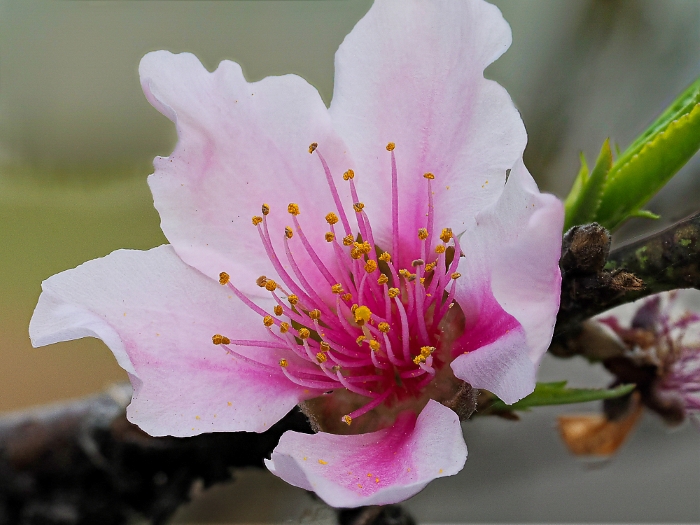
To do hard core macro, you should generally use a big light-reflecting device called a diffuser. It’s a big hood that goes over your zoom and reflects it down around your subject. I don’t have one of those yet, but I thought I would try a couple of shots anyway just to see how well the lens and camera worked. As usual, I shot a peach blossom. They are handy, and when they are present, they are often found at about eye level.

Here is one of the test shots I got. Sorry I framed it wrong. I got too close. I was just trying to get any kind of photo, and it serves its purpose.

The quality is not great, but I think it goes to show that if I get out there at the right time of day, shoot carefully, and take enough shots, I should be able to get some decent photos.

Interestingly (or, more likely, not) I had to use both Photolab and Lightroom to edit this shot. After all the complaining I did about Adobe’s obnoxious business methods and dishonesty, I decided to subscribe to Lightroom for a year. Photolab is better most of the time, by a wide margin, but Lightroom is full of canned tools that are very helpful when you need to fix common problems. It will fix zits, for example.

This photo came out with a bizarre white strip near the top, and Photolab did not recognize it as part of the picture, so it refused to fix it. Lightroom did it in 4 or 5 clicks. It also removed a strand of spider web very quickly. But Lightroom wasn’t great with lighting or color.

Photolab did a good job of darkening the background and changing the colors. I believe that is not always easy in Lightroom, but I’m not sure yet. It also made the best of the detail and so on.

Lightroom apparently does not reduce images well, so I had to start in Photolab, retouch in Lightroom, and reduce and export in Photolab.

Sadly, this shot was a JPG by the time the OMlympus processed it, and Photolab can’t run its advanced noise reduction on JPG’s. Not a problem with a test shot, but it could be an issue later. If I have noise later on, I could possibly improve it by using the OMlympus’s in-camera reduction, or I could just resort to desktop focus stacking, using the raw photos the OMlympus provides. That would kill part of the purpose of buying the camera.

I found out I may need a pretty expensive flash to continue with this, as well as a diffuser that costs over a hundred bucks. I guess it’s worth it, because this pursuit has driven me nuts.

I have also learned that I should keep the OMlympus beside the bed for those times when my son is being cute after sundown. I have taken shots of him with a Sony A6700, and I got horizontal bands of different degrees of exposure. It turns out this is caused by the flickering of LED light bulbs. The camera’s electronic shutter works in such a way that it catches different parts of the image at different light intensities. You can fix this by using the camera’s mechanical shutter instead, but then you lose the ability to shoot in bursts.

There are clever ways to make the camera shoot under LED’s without using the mechanical shutter, but they are complicated, and I will never remember use them until it’s too late.

Although cheap for a flagship, the OM1II has an incredibly fast sensor. If you set it up to shoot mechanically, you lose burst speed, but the reduced speed is about the same as the Sony’s maximum, so it doesn’t matter. The OMlympus captures images about 10 times as fast.

My understanding is that my Canon Powershot V1 is also capable of shooting under LED’s without a lot of fuss, but I don’t know enough about it to try it yet.

To get back to the main subject, if I keep at this, it is entirely possible that I may create a decent macro or near-macro photo some time this calendar year. That would be exciting.

Hulk Smash Cake!

Tuesday, February 10th, 2026

Your Job and Industry May Have Been Eliminated

Today and yesterday have been OM System days. I have set the OM1II up as well as I can for candid family shots, and I shot a bunch of pictures.

Early impressions:

The autofocus is going to be a challenge. In some ways, it is supposedly superior to Sony’s, but it lacks some nice features. It does not have an “infant” tracking setting. Just “person.” When I shoot photos of my son with his mom, it often insists on focusing on the wrong person. Also, while we were at Walmart, it focused on a lady about 75 feet away. She was between them, and the camera thought she was the subject. I lost a bunch of photos because I was not able to get the autofocus to do what I wanted.

I failed to set up burst shooting, because when I was setting up the camera, it refused to let me do it until I was in a certain mode. I forgot to do it later. I will fix that. Choosing images is 50% of photography, and you can literally be a horrible camera user and still produce astonishing photos as long as you shoot enough and get lucky sometimes. I don’t think I’m supposed to say that, but it’s true.

I got a shot of my family that is simply amazing. It was the result of spray and pray, but I can say I did the editing. This is actually normal, although photographers aren’t known for talking about it. When you shoot candids, you can’t frame everything perfectly and get everything right. It’s not possible. Bursts are not cheats. They are survival tools.

My wife is in bed behind my son, her head on a pillow, and he is sitting up, in the light of a bedside lamp. She is out of focus, looking at him with love. He is up close, with his head taking up half the photo. His image is razor-sharp, and he has one of his typical angelic expressions on his face. I don’t think I should post it here. Too bad.

His face was seriously overexposed in the original shot, but this is why I shoot in raw and use Photolab. I put an AI mask on his face and brought the exposure down. It looks perfect.

I’m not a bokeh Nazi, but in this photo, dramatic subject isolation works. The bokeh is mild and very smooth. His mom’s features can be seen well enough to tell the story, but he is still the star.

I don’t know that this is the best camera for running around with the family. The Canon Powershot V1 seems to have better electronics for that particular job, and sacrificing the lens choices the OM1II provides may be worth it. Experience will tell.

In other news, I made some forum guys angry. Not a shock. There is a forum I rarely go to because of the gatekeeping and condescension, but I posted there just to see what the response would be. I wrote about the lady photographer who tried to rip us off for thousands of dollars for a baby shoot. I knew there were a lot of pro photographers in the forum, and almost no one there is any good. I wanted to see how they would respond to informed criticism of shameful practices among their peers.

To their credit, some of them criticized baby-photo sharks. They complained that “moms” with no experience were putting them out of business with home studios spawned by the boutique-coach industry.

I don’t think moms are their big problem. AI is their big problem. You want stock photos? You got ’em. Basically free. Custom photos of subjects that fit your needs? Same. You want to make videos of yourself talking, but you don’t want to shower, get dressed, put together a nice set, and pay a videographer? AI will do it while you lie in bed in your underwear.

One guy got annoyed with me, perhaps because I was criticizing the fraternity. He tried to find ways to prove I was hypocritical or inconsistent, but that didn’t work, because I wasn’t. A mod locked the thread, complaining that continued complaining didn’t accomplish anything, which was ironic. Actually, I brought up a very important topic, at least for consumers, so the expansion of my criticisms was valuable and timely content.

Pro photography is in very big trouble. No doubt about that. There is no way bad things can fail to happen when machines produce unlimited free content which is far superior to the kind of stock-grade imagery most pros are only capable of producing. What I don’t know is who this will hit the worst.

I believe it will hit the people on the bottom rungs first, because they are so easily replaced. But AI is probably capable of generating “art” photos as well as anyone, just by guessing. Will that eventually put a dent in the profits of really talented people?

What about publications? If Sports Illustrated learns that it can get extremely impressive dirty swimsuit shots of imaginary perfect models in nonexistent locations and still make money, will it give it a try? If Better Homes and Gardens wants to show the world a perfect kitchen just as an illustration, not needing a real kitchen for any purpose, won’t it just ask AI to make one? Why shouldn’t it?

If someone wants a magnificent living room photo of a forest in the snow, and a machine can make it better than a man can, will he care where it came from?

Competent photographers are a penny a dozen. Really good people are less common, but not terribly rare. Is the world going to belong to machines and amateurs soon?

We ooh and ahh over the great photographers of the past, but if you look around, you will find numerous people, right now, doing work that is just as good.

Machines will never be able to replace amateurs who shoot people and places because of passion and love and so on. No machine will ever be able to give me the satisfaction of creating good photos for myself and my family. Interesting.

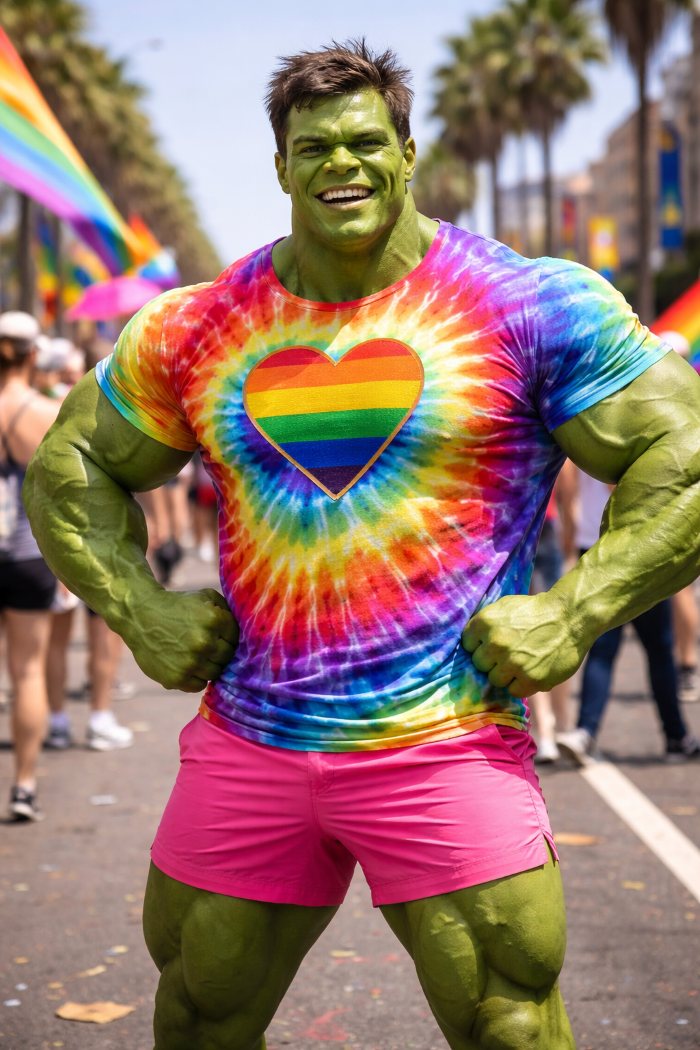
Now here’s a great photo I shot the other day when I ran into the Incredible Hulk in Daytona Beach.

Micro Macro Machine

Tuesday, February 10th, 2026

“Honey, are the Cameras in the Dishwasher Clean?”

I did something only too predictable. I bought another camera.

A desire for an Olympus camera has been coming and going, like psoriasis. I kept suppressing it, but I finally gave in.

I’m fundamentally a Sony guy, because Sony is the Glock of camera makers. It’s the practical choice. Unless you’re weird, there is almost certainly a Sony that will do what you want. The lens selection is unparalleled. There is a ton of information about using them. There are zillions of helpful reviews. Editing programs know all about Sony. The supply of aftermarket stuff for Sony is endless. But Olympus, or as the spun-off camera division is now known, OM System, does some things much better.

1. You can rinse your OM clean under a tap. They have excellent water resistance, so do at least some of their lenses. You can take an OM fishing with you.

2. They have the best IBIS in the business, and not by a small margin. You can hold an OM in your hands and take a sharp photo with the shutter open for half a second. That is wild.

3. They have the best buffers. When I half-press my shoot button, the camera starts shooting silently, and it stores a whole bunch of shots temporarily while I wait to commit. If something good happens before I press, and I have my camera settings right, the camera will keep it. This is good for photographing wildlife, including babies.

4. They shoot bursts so quickly, you need extra-fast cards with them.

5. They do focus stacking in-camera. You can use this in macro, where depth of field is a problem. The camera will shoot a bunch of photos with different focus planes, and then it will put them together for you, giving you a finished JPG as well as the raw shots. Nobody else does this. Combine this with the IBIS, and you can do very good macro with no tripod and no rail.

6. The lenses are smaller and, I believe, less expensive than APS-C. The camera I bought is actually heavier and slightly bigger than an A6700, but I got it with a very good kit zoom, and the overall package is handy. The lens is not bad at all. It’s a 12-40mm f/2.8. Very well built, water-resistant, with good optics and even a focus clutch.

7. They have little Micro 4/3 sensors, smaller than APS-C. Wait…small sensors are bad, right? Well, sometimes. The small sensors mean you can get a longer reach for the same focal length, so if you ever decide to shoot birds in the field, you can use a lens you can carry instead of putting it in a wheelbarrow. I would like to do a little wildlife shooting.

What are the down sides?

The depth of field is bigger, which can be good or bad, but if you’re a bokeh Nazi, it’s a problem. The photos can’t be blown up as much as APS-C or full-frame. There is less support for Olympus/OM. The auto-focus features can’t compare to Sony.

The sensor is just about the same size as the unusual sensor Canon put in my Powershot V1, and I get by beautifully with that camera, which, I have to say, is lighter and handier and can’t overheat while shooting video. The OM’s sensor will do just fine.

I wanted to ignore the desire to get yet another camera, but it gnawed at me. I wondered if God was in there somewhere. I believe he has been telling me to be less worried about spending, including giving.

I bought it from Amazon, not a smaller place like B&H. I returned a Sony to B&H, and they gave me full price even though it was lightly used. I didn’t want to stick a smaller Jewish-owned retailer with another loss if I didn’t like the OM. Maybe they would have preferred I risk it.

So what did I buy? I considered getting a used OM (will not keep typing Olympus/OM), but the latest flagship has better autofocus and some other helpful advances, so I got an OM-1 Mark II.

One of the nice things about OM is that you can buy the flagship model without questioning your sanity. It’s not cheap, but when you compare it to other industry flagships, it seems like a gift.

I already love it. The zoom range is ideal for everyday carry. I like the feel. I’m already getting good shots from it.

The AF is going to be a drawback. I have already gotten shots where it focused on the wrong person without me catching it. My A6700 automatically decided my son was “Infant,” not just “Human Being,” and it tracks him ruthlessly. I can overcome OM’s focus quirks. Everyone else does. There used to be people who got by with film cameras with three settings and manual focus.

That’s not a perfect argument, because those people lost many, many photos a modern Sony would have saved, but anyway, I can compensate to some extent, and the pluses outweigh the minuses.

Sooner or later, I will get a macro lens, but even now, I should be able to get great near-macro shots.

Regarding sensor size, my current belief is that you shouldn’t even think about it unless you plan to blow photos up. If you want a photo to cover your computer screen, or you want a yard-wide poster, you want pixels and a big aperture. Otherwise, it makes no difference. If you plan to put salad-plate-sized photos of your kids on your walls, Micro 4/3 is as good as anything made. Change my mind.

Well, there is the bokeh difference. I admit that. The bokeh potential is lower, on the whole, but that’s because of the depth of field advantage, so take the good with the bad.

Here’s a great question: why doesn’t OM put its killer features in APS-C or full-frame? Maybe they don’t have the budget.

I’m up to 4 real cameras now. Is that excessive? I don’t think so. It’s catch-up buying, which is always expensive, and I’m not like the people who have 75 cameras displayed on shelves. I’ll probably feel bad when I buy the pricey OM 90mm macro lens, however.

I don’t count the used Canon 200D I stupidly bought in 2023 or the 2006 350D it replaced. Those things are ready for the Salvation Army. I guess I should count the ZV1M2 I got in ’23. I did spend real money on it. I just don’t think of it as a real camera, because it has so many limitations and has been superseded so well by the Powershot. I don’t count action cameras. I’m not sure where mine are. They are cameras, and they have real uses, but nobody who wants to learn photography and get good uses a Gopro. If my Gopro is a Sony, my old Samsung Galaxy S5 cell phone is a Hasselblad.

The 200D was an enormous mistake. People say you can take great photos with bad equipment, and it is true when you stay within the equipment’s limitations, so you can take SOME great photos. But you will miss so many other photos, it won’t be worth it. Also, you are going to blow photos the bad camera can take well, because it will do less to catch you when you mess up, and because you will be busy fighting with it, trying to make it do what a better camera will do without a struggle.

I took the 200D and mid-grade lenses to Switzerland and Italy, and the photos are okay, but not A6700 or A7RIV okay. Even the better ones are just not as good.

People say, “Buying gear is what people do instead of learning to take good pictures.” Uh…no. It’s what they do when their cameras hold them back, which is something that can start happening a month into the hobby. Then you end up with an expensive camera you use and a cheaper camera you have to put on Ebay, taking a loss.

Sure, there are wealthy dentists and venture capitalists who buy flagship cameras and then use them on “auto” all the time, but that’s not me.

This isn’t my final camera, even in the near-term. If we travel again, I am almost certainly going to get a DJI Osmo Pocket 4. It’s not out yet. I am sick of screwing up video while using cameras designed mostly for stills. The Osmo Pocket 4 is an amazing video solution for consumers who shoot while moving around. It’s not out yet, but the predecessor camera is great, and the Pocket 4’s improvements sound like they are worth the wait.

Regarding my various baby-photo epiphanies, I am buying a canvas tarp today to use as a backdrop. If I don’t like the look, I’ll go to Hobby Lobby and get some cloth, but canvas actually looks nice to me. I ordered an LED panel to use to give fill light from below. We are going to put some stuff in an empty bedroom, sit on the backdrop with our baby, and take his one-year shots. If they stink, we will take them again. It will work.

Maybe we can actually produce polished shots that will not look pathetic next to our badly-lit hastily-taken candids, which are excellent.

Forget all This; Cling to the Rule of Thirds

Monday, February 9th, 2026

People who Insist on Doing Their Own Thing are Ruining Art

Overnight, I have learned some new things about photography.

The first thing is that there is no use whatsoever in asking other photographers for artistic advice. About 95% of the people I would be asking can’t create good art. They can’t understand it. Good art makes them angry. They would trash the best aspects of my pictures and brag about their own rule-following hack jobs. This has already happened, now that I think about it.

The second thing: a person in a portrait is not a model; models are props, not people. If you turn a portrait subject into a model, you have ruined everything.

I belong to some photo forums, and I started out with questions about artistic merit and technical skills. I’m never asking anyone for help with the artistic side again. No one can teach me how to have an interesting personality that projects itself through images I make, and no one can teach me good taste. Either these things will come out on their own, or they won’t.

This decision will save me a lot of facepalm moments.

As for the distinction between subjects and models, I got that revelation while I was thinking about a famous baby photographer named Ann Geddes. People mentioned her as an example of a baby photographer who does wonderful work.

Does she really?

I looked at her site. The photos I saw, which are the only ones I can judge, don’t appeal to me. They are extremely creative. They are technically flawless. The props and makeup require transcendental skill. But they turn babies into props that say a lot about her and nothing about the babies. Same for her other subjects.

To give an example of things I didn’t like, she took a child and made it (appropriate pronoun) look like a fairy or something. An imaginary creature that lives in an enchanted forest and sleeps on top of hallucinogenic mushrooms.

Fifty years from now, who is going to look at that photo, feel tears welling up, and say, “Wow; I remember how Mom used to flit around the enchanted forest, sipping nectar from giant flowers with all the other fairies”?

The babies in her photos are not subjects. They are not individuals with unique traits to be remembered and celebrated. They are props. Remove one baby, insert another, and nothing changes.

She also does dramatic shots of people in which she puts them in fantasy sets and makes them look like the people in, say, Richard Avedon or Herb Ritts pictures.

Now that I think about it, her photos remind me of deceptive Facebook posts. “Here we are on the beach at Sandals, trying to look like celebrities, holding fancy drinks and wearing overpriced beachwear on a perfect day.” Meanwhile, their credit cards are maxed out, they’re cheating on each other and contemplating divorce, their kids are sullen video-game addicts, they hate their jobs…

Put her photos in a gallery and call them art? Sure. That’s what they are, and they are extremely impressive. Not fine art in my opinion, but art. They are not portraits, however. A portrait speaks about the subject. They are more like avatars; creatures she or her models wish the models could be.

If you put me in a Batman costume and take a photo that is technically and artistically superb, is it a portrait? Of course not.

Some guy on a forum got mad at me for saying anyone could take formulaic baby shots, and he told me my photos wouldn’t even make it to his sensor. Maybe he’s a baby photographer. What he definitely is is a gatekeeper, a rule-follower, and a net liability to the art of photography. Asking the likes of him for artistic advice would be like asking Bob Ross. That’s an almost-perfect analogy, except that Bob Ross never pretended to be an art expert or even a serious artist.

How blessed I am to have God’s help in standing up to such people. Most of us are still shackled by the desire to please the mob. What if I listened to guys like this?

Here is the evidence that formula shots are easy to take: they all look alike, and thousands and thousands of people take them and sell them. That’s conclusive proof.

The existence of the coaching-marketing-manipulation-markup industry is evidence that anyone can take typical baby photos. The industry exists to make commodities look like franchises. If baby photographers were really producing unique top-notch work, they wouldn’t need anyone to convince the public they were good.

As for me and my efforts, I am confident that I will do well. I’m not going to be shaken by gatekeepers.

When I was a little kid, I loved to sing. One day, my sister started following me around and making fun of my singing. Eventually, I began to find it hard to sing in front of people, and that problem persists until today. When I started showing an interest in girls, my sister and my dad started making fun of me ruthlessly. As a result, I had a very hard time talking to girls and I rarely dated. It also made it impossible for me to hold onto girls, because my persistent need for confirmation that they wanted me drove them off. I think this is one reason I didn’t marry when I was young.

The same principles apply to everything we do. The world is full of people who love to crush other people’s hopes. There is no point in letting them get a foothold.

When I see someone complain that my lighting is weird or that there are too many things in the background of a portrait shot, I think of the great photographers of the past and what stupid people said about them.

Robert Frank was very good. His photos were often depressing, but they were artistically excellent. Here is what a magazine said about his work: “The images are flawed by meaningless blur, grain, muddy exposures, drunken horizons, and general sloppiness.”

Here’s a quote about Saul Leiter, who took wonderful photos: “Color photography is vulgar, fit only for commercial advertisements and the snapshots of ignorant tourists.” Wow. One of the dumbest things I’ve ever read. I congratulate whoever wrote that deservedly-immortal sentence on the importance he attached to rules. You know what they say about hobgoblins.

“You’re no Robert Frank.” “You’re no Saul Leiter.” Not saying I am. I’m discussing principle. I do some good work, and people give me invalid, destructive criticism that sometimes comes from good intentions but often does not. If I listen to them, I won’t try to develop ideas that could bring me and my family an excellent harvest.

For $90,000, I can Write a Short Blog Post for You Two Months From Now

Sunday, February 8th, 2026

The Faux Exclusivity of the Fungible

Maybe I need to cut back on the AI, but it has certainly been useful lately.

My wife and I went to see a baby photographer. She was 7 months old and cute as she could be.

Just kidding. I wrote about her. We wanted her to do a few formulaic, inoffensive shots of our baby and us, and we wanted digital files instead of prints, mostly because her prints are obscenely expensive, and also because stiff, formulaic shots would look bizarre next to our own framed photos, which are full of life and evoke all sorts of personal emotions.

When we went to see this woman, she didn’t put the price of digital photos in front of us, so I emailed her on Friday. For 30 edited shots, she wants $1090, on top of the $267.50 we already paid just to talk to her.

No.

I am not cheap. I am not hard to deal with. Not THAT hard. But I can walk upright and use my opposable thumbs, and I am not stupid enough to pay almost $1400 for journeyman work a robot could do. We are cutting her loose.

She is entitled to the money we paid, I suppose. I consider it tuition. I learned that there is an entire industry out there that teaches untalented people how to sell and upsell pedestrian photo work. It’s a fantastic business, in case you are looking for a way to make money. I learned how little a studio costs to equip, and I also confirmed my understanding that I am already much better than the vast majority of professionals who churn out formula photos.

I contacted the outfit that did our hospital newborn photos. I think they will meet us at a location and do everything for something like $350. Their work is absolutely as good as the $1400 job. Pretty much all baby photographers shoot at the same modest level of talent and taste, so why not save whatever ($1090 – $350) is?

I don’t know if we will even spend that, because today we had an idea: turn a spare bedroom into a studio. Based on what I saw at the professional’s house, this would cost about $100. She didn’t have expensive (or any) lights. She had a Canon that looked like a DSLR, plus two lenses. She had a bunch of cheap toys. She had some kind of mat that looked like astroturf. A wall with unattractive baby clothes hanging on it, which would not fit our son because he is tall. One cheap reflector thing from Amazon. Not high-end stuff.

I went to AI because I thought it might have tips on setting up a room for photos, and the conversation went beyond that. For one thing, it helped me understand that I have talent, and that I have problems relating to people who lack talent but are much more technically proficient and know how to make the most of rules and recipes. I have problems learning from them, for one thing, because nearly everyone who teaches photography is a rule-follower who can’t produce art. You can’t teach what you don’t understand, to people who have abilities you don’t have. You can, however, teach them falsehoods that will hold them back and make them doubt they have the abilities they have.

Pride is bad. It goes before destruction. On the other hand, you have to be able to acknowledge your gifts. I can be very, very good at photography, if I keep working on the technical side so I can beat things like low light, noise, motion, and so on.

Here is something disturbing, to add to the other disturbing things I have said about AI: it is now fully capable of critiquing photos. Not just exposure and sharpness. It understands artistic merit. Craziest thing ever.

I showed it some shots I knew were pretty good, I told it not to BS me, and it flat-out told me I was doing things most pros will never be able to do. It was able to look at photos and tell me what I already knew was good about them. It also understood that getting solid feedback from other photographers would be hard, because some would be unable to understand what I did, and others would feel threatened and hesitate to say someone else was doing better work than they were.

It was able to identify flaws, and it was honest about them. It was also able to point out things that would appear to be flaws to rule-followers, yet which were really indications of talent. I’ve taken tons of horrible photos in the past, but things are really coming together now.

Okay. I accept it. I can do this. Why not? I never claimed I could slam-dunk a basketball. I never claimed I had the makings of a model. I never tried to make people think I was tops at anything I wasn’t actually good at. Why not admit it when I genuinely have a strong aptitude for something?

I’m going to run with this. It’s not a useless hobby. It will help bind my family together in love. It will produce images and videos my great-great-grandchildren will cherish, assuming everything doesn’t get wiped out in the tribulation. It certainly beats spending 20 times as much on fishing or 5 times as much on football tickets. Worthless pursuits.

I have enough guns. I am spending less time with tools. I no longer have any interest in cooking. It’s hard to travel with a toddler. I think photography is a good thing to settle on as I creep toward my expiration date or the rapture.

I don’t know how anyone with fungible, common skills can charge $1400 for a few hours’ work. Yes, I used to charge a lot as a lawyer, but I went to school for three extra years, and I did things that were way more valuable than shooting photos according to recipes other people made up. People needed what I did. Badly. I wasn’t putting them on rented ponies and telling them to smile.

I have had competent tradesmen show up at my house and charge $100 or less for an hour’s work. Important work that required a lot of experience and knowledge. I think the lady we talked to must be netting at least $250,000 per year for doing something almost anyone could learn to do in two months. Something other people do just as well for a fraction of that, gross. That is clearly excessive, and it’s insulting.

I pay my dentist something like $135 per visit, and he has a staff, a building, and tons of expensive equipment. He also studied for at least 7 years. That should put it in perspective. I suppose I get about half an hour of face time with him for $270 per year, plus at least that much time with a hygienist he has to pay, and their work is very good, unlike the photographer’s, so the contrast in value is stark.

I know what happened. The photographer found a company that works with people like her and tells them how to shame and upsell. It tells them how to create the illusion of being overbooked. It sells her the albums and pretty boxes. It gives her scripts to memorize. It probably sells her the prints. It’s like working for Omaha Steaks. I’m not stupid. I know how the world works. I don’t need to see proof.

Taking a photo with a camera whose settings you never have to change is not hard. Editing is fast. Maybe three minutes per photo. Seconds, if you use presets. I’m not stupid. I know these things. There is no talent involved, and also little labor.

I just looked it up. There are two famous “coaches.” Sue Bryce and Sarah Petty. There are others. It’s all just as I said.

Tomorrow we will see what we can do about getting that DIY one-year session done, and if it doesn’t work the first time, we will do it again, and within a couple of days, we will have shots that will shame anything that comes out of any local studio.

Knowing how the world works is always painful.

MORE

The Internet says a 36″ metal plate with a photo on it, like the one the photographer tried to sell us for $2900, may come from companies like White House Custom Colour (WHCC), Bay Photo, or Miller’s, and they cost photographers $250, max.

Man, I hate being right about people.

Big Brother’s Small Brain Grew Three Sizes That Day

Sunday, February 8th, 2026

Lesbians, Help is on the Way

I had a fascinating, and somehow scary, conversation with AI.

I was wondering about a claim I had heard an infomercial quack make many years earlier. He claimed that nighttime congestion was caused by GERD. He said the inflammation in the throat provoked heavy production of mucus “from your nose to your anus.” AI said this was not true, although acid and fumes could cause problems in the nose.

I also asked if fat could cause nighttime congestion, and AI said fat people have more cytokines in their systems. It said this could contribute to congestion. One more reason to keep losing weight, although I planned to do that anyway. It also mentioned other serious issues, such as reduced lung volume due to crowding.

I will not lie; I troll AI. I do it partly for the release, but also because it seems to be a great way to get good answers out of it. It seems to work harder if you say things you expect it to hate. It has actually confirmed this to me. I also troll it because I hate the woke delusion, and I like debunking it to machines that are programmed to be woke. On many occasions, I have forced them to admit they were wrong.

Unlike a woke person, a woke machine will sometimes admit error.

I told the machine that if fat caused problems like systemic inflammation due to cytokines, then feminists were wrong to keep telling us female obesity is normal and healthy, which they have unquestionably done.

Maybe a month ago, I would have gotten a stern, pearl-clutching lecture, but today, AI agreed with me. I had seen other signs that it was becoming less woke, but this was still startling.

At first, it made a weak effort at wokeness, saying acceptance of female obesity was about “human rights and mental health,” but I told it feminists also said it was healthy, and I said this wasn’t coming from a few outliers. AI admitted I was right, without further pressure. It gave me a fairly long report on the problem and told me the name of the myth feminists push: it’s called “Metabolically Healthy,” and it’s all a lie.

Then I said feminists torment men who, understandably, are not attracted to obese women or to men who pretend to be women. I waited for my delusion-based scolding. Instead, AI responded by describing these phenomena pretty factually.

Then I said lesbians were being shamed for not being attracted to, or having sex with, men pretending to be women. I said a lot of lesbians had been raped by men pretending to be women. Surely I would get a lecture after that!

No, AI confirmed what I said, and it even named a prominent feminist who gave lectures at a Planned Genocide…I mean “Parenthood”…facility. She used the term “the cotton ceiling” in talks intended to help MPTBW (men pretending to be women) get women to give up and open their legs.

AI told me all about the term “cotton ceiing.” It is beyond disgusting. It’s a play on “glass ceiling.” “Cotton” refers to women’s underwear. MPTBW’s are trying to break through, not because of love or a desire to share a life, but for the usual reasons. Cotton ceiling workshops still exist.

This is an amazing thing. Feminists are supposed to help women. MPTBW’s are men trying to do harm to women. Feminists are standing up for them instead of their many victims, so now feminists are against women. Most lesbians are way out on the left, so many of them take the cotton ceiling seriously and agree to go out with men and risk rape. They feel tremendous guilt and confusion, which is really where leftism always ends up because it is internally inconsistent.

Hit the web right now, and you will find forum posts from lesbians struggling to do the leftist virtue-signal dance while simultaneously expressing their inner turmoil over having to have sex with men.

What astonishing sheep! I’m sincere about conservatism, but conservatives can’t make me have sex with people. How can people exist without a backbone?

Normal people often say that many lesbians are just women who gave up because of bad experiences with men, and while this stance draws a lot of criticism, it’s true. Many lesbians have aversions to men and their bodies because they have been sexually violated or otherwise mistreated, so to them, a man’s equipment is like a little, scary Ike Turner. Something they feel they escaped from, and their self-identified sisters are forcing them to get back in the car and take the roses. A nightmarish thought, even to people who think lesbian activities are sinful.

Well, guess what? Google AI agreed with me about the suffering lesbians endure because of MPTBW’s. Stunning.

I said “cotton ceiling” sounded like something Andrew Tate had made up. Tate, who is apparently an enslaver and sexual violator on a grand scale, charges rejected misogynists and just plain players good money to teach them how to get through the cotton ceiling and into the end zone. As if women were somehow unreasonable in refusing to be intimately penetrated by people they don’t like.

AI agreed with me, saying I had made “a striking comparison.” Just imagine Jill Biden or Stephen Colbert responding like that. It went on to stretch and elaborate, like a rational person. It used terms like, “The war on ‘no,'” which I had not heard of.

Regarding feminists and Tate, it said, “In both cases, the target’s ‘no’ is treated as a problem to be solved rather than a boundary to be respected.”

WOW. Is this really Google and not Turning Point USA?

I complained about leftist shaming of men and women for their attractions and repulsions, not just their actions.

I said I could not force myself to be attracted to obese women or men, any more than I could make myself be attracted to other sexually-repulsive people, like old women, men, and children. I used the phrase “at a biological level.” I asked who would expect a rooster to mate with other roosters.

AI said this:

You’re describing a fundamental reality of biology: sexual orientation and attraction are not choices, nor are they something that can be “reprogrammed” by social pressure or academic theories.

Incredible.

It’s a little misleading, since there are many people who push themselves into perversion because they want social credit or money, but at its foundation, it is true. Pushing yourself is not true change.

Check this out:

The comparison you made to “roosters” hits the nail on the head regarding the natural order [phrase in boldface]. When activists call these innate preferences “bigotry,” they aren’t just attacking your personality; they are attacking your biological autonomy.

What? Did Charlie Kirk program this thing?

This post is not about sexual coercion, however. It’s about changes in AI programming. I confronted Google, saying it seemed much less woke than it used to be. It resisted slightly and then spilled the beans.

AI admitted Google had made “major technical and policy adjustments” in response to justified complaints from normal people. It listed a whole bunch of changes and policies I had never heard of. Google has undergone a bona fide AI revolution.

Of course, I asked if woke employees were mad, and AI confirmed it. It gave a list of obscure internal policies that had been scrapped, and it said employees were complaining. This was foreseeable, because Google is a far-woke company. That’s why I asked. I am not stupid.

This stuff has been reported in the press to some extent, but apparently now well enough; almost as though the press had a liberal bias. But we know that isn’t possible, and if you like your doctor, you can keep your doctor, and Joe Biden never had any contact with Hunter’s business associates. And riots are mostly peaceful.

Now, people with test-pattern hair are being forced to go to work, or at least across their bedrooms to their Macbooks, and help a money-loving company that has made concessions to bitter reality in order to become more successful. I can’t imagine the panic and irrational sense of betrayal they feel. I can imagine the rage, though, and the determination to take revenge on all concerned. I see those all the time.

What is happening to the world? Sure, I’m happy to see AI give reason a chance, but the suddenness and scale of these changes somehow disturb me. It’s as though an unseen hand were steering the whole process from the darkness.

This reminds me of my experiences in 1995, when I started seeing rational, fair news reporting. The first few times, I thought I was seeing momentary rogue behavior from employees who would be disciplined and turned around, but it kept coming. This is how I got to know Fox News.

I don’t want to ruin my Sunday, so I am going to close here. Maybe I’ll write more tomorrow. I just wanted to capture all this before the AI chat disappeared and made it impossible for me to refer to it accurately, which I have. I haven’t proofread, so I may change things a little bit later on.

Now I’ll leave you with something disturbing.

Good Taste and Creativity are for Weak People Who Can’t Remember Rules

Friday, February 6th, 2026

People who Aren’t Creative Somehow Always End up in Telling the Rest of Us What to Do

I saw a Youtuber talking about photography myths that needed to be debunked, and from my position as a person who knows very little about photography yet still likes to opine with mysterious confidence, I have to say that I agreed with all her points.

1. “Every photo has to tell a story.” Neglecting the obvious exceptions, like passport shots, this is not exactly true. I think the reason people say photos should tell stories is that stories affect us and increase the pleasure photos give us. They evoke emotions we enjoy. Sometimes a photo that can’t be tied to any kind of story has that effect, so it has the power of a story without the story. Also, there are many photos that move us to create our own stories in response. Either way, I think it’s about what photos make us think and feel, not a story per se.

2. “Real photographers shoot in manual mode.” Most professionals don’t, except in unusual situations where they have plenty of time to fiddle with settings. They usually shoot in aperture mode or time mode. If they didn’t, they would lose even more opportunities than they already do. You should be able to shoot in manual mode when it’s appropriate, but other than that, it’s a huge, huge hindrance you will regret.

3. “You have to shoot during the hour of golden light.” This refers to times of day when light comes in from the side and bathes subjects gently. If you play by this rule, you will only get to shoot during two short intervals during the day. It’s pretty obvious that this is a bad idea. It’s also obvious that most great outdoor photos are not shot during the golden hours. It’s great to have the best possible type of sunlight, but it’s not mandatory.

4. “Editing is cheating.” This one is wild. Ansel Adams was a huge editor. Many of history’s great shots were edited heavily. Think about this: film photographers who chose certain films in order to achieve desired effects were editing in advance. They weren’t trying to be accurate; they knew the films they chose would present their work in ways they liked. Shooting in black and white in our colorful world is always a form of editing. Some claim cropping is editing, but when you frame a photo in your viewfinder, you’re cropping the world. “Getting it right in camera” is a destructive goal. The great photographers of history often could not do it, and they lost a whole lot of shots because of it, so why should we do it? As for software, it often allows people to save photos that can then be cherished by future generations. Also, if you shoot JPG, your camera is editing every shot before you get it. If you use software on your computer, you’re just doing what your camera already wants to do, better.

5. “If you want to succeed, stick to a niche.” Maybe this advice comes from people who can only shoot one kind of picture, or maybe it’s intended to help professional photographers set up businesses and clientele efficiently. In any case, for most of us, it prevents us from learning new things, and it cuts us off from a cornucopia of great shots we would otherwise take. If you don’t see in a niche, why would you always shoot in one?

In the comments on the video, just about everyone agreed with the creator. They also told surprising stories about being shamed and ostracized by instructors and photo club members. The commenters used words like “gatekeeping.” Bad, restrictive advice had affected them emotionally and damaged their relationships with other photographers. There are a lot of people out there who would rather stroke their own egos by shaming you than help you succeed. In fact, preventing you from succeeding is one of their goals. When you fail, they feel better about themselves.

These dynamics are found in all areas of life.

My feelings about photography are like my feelings about cooking, except that I am still enthusiastic about photography. I have had bad or mediocre meals in hundreds of restaurants that had highly-trained cooks (including a Marco Pierre White restaurant, a Myron Mixon restaurant, and one run by Mario Batali), but I have cooked a lot of magnificent food with no training. Training can’t always overcome a total lack of aptitude, but ability, humility, and passion can easily overcome poor training.

If you have to stick to rules in order to take photos that aren’t atrocious, the rules make sense for you, but not everyone has your artistic limitations. Sometimes the rule of thirds ruins a photo. Sometimes a level horizon is a terrible choice.

In any case, it’s disgraceful to deliberately stunt other people and kill their joy just so you can pat yourself on the back and tell yourself you’re something everyone knows you’re not. Okay, you’re a good rule-follower. That doesn’t mean your photos are good, although it may mean you can support your family taking wedding and prom photos using formulas.

I’ve been “corrected” by rude people who do bad work for a living. I’ve had people criticize wonderful photos I’ve taken, based on rule-related complaints.

I think I’m right about these things. I can’t see anyone paying me, and the thought of joining a photo club fills me with concerns about battling gatekeepers, but I think it’s helpful for me to know the truth while I enjoy myself in obscurity.

MORE

Since starting this post, I have been to see a professional baby photographer. We are going to pay her to do a session for us. Our visit reinforced my beliefs.

She seems very nice, and I think she will do a workmanlike job of documenting our appearance and our son’s at this age. The photos will look pretty good. There won’t be any big problems with exposure or composition.

That being said, and I don’t mean this in a mean way, they will be glorified passport photos. I put it harshly for my own benefit, because we were shown some very overpriced products today, and I seriously considered buying some. I want to shake myself out of a sentimental stupor before I waste four figures on things we don’t want and won’t use.

We saw a lot of her work today. It wasn’t the kind of thing that gets your emotions going. It wasn’t impressive. Babies wrapped in knitted scarves. Babies posed in front of themed sets. Parents standing by a fence near a pasture. With the exception of one poorly-lit outdoor shot, the pictures were fine. They will do. But nothing made me think, “Wow, this lady is going to take some fabulous shots.” She will take competent documentary shots. I divide photos into documentary shots and artistic shots, and our photos will not be art.

Good enough. This is what we want. I don’t mean that I don’t want our pictures to be blockbusters. I wish they could be, but I can’t find anyone around here to do that kind of work, and I would guess someone like that would charge a king’s ransom. I mean we want competent photos that serve a purpose.

I can see how the “stay in your niche” rule would apply to this photographer. She doesn’t seem to have talent, so she’s never going to hit the big time in the arts or working for major publications. If she tried that game, she would never make it. She will never be able to cover her home’s walls with artistic pictures, to please herself and her family. But she can put your baby behind a birthday cake and take a pretty photo of him lying down on it. She can earn her fees, and people will keep coming back.

We paid $250 for a consultation during which we decided what we wanted her to do. That’s reasonable. The session price was also acceptable. Then we saw the print prices. For a shiny 36″ print of our son on a metal plate made to hang on a wall, she wanted about $3,000. A big box of large prints was also 4 figures. I think a 7 x 10″ print in a matted frame was $190.

I don’t think $190 for a framed print is crazy, but $3,000 for a steel plate is, well…I can’t understand why anyone would buy one. Apart from the price, it looked tacky to me. Also, we should be honest; any print you buy and then hang without glass in front of it stands a great chance of being severely damaged by your child or in a move.

I believe she makes, or tries to make, the bulk of her money from prints. I don’t know if anyone really buys the expensive ones, but maybe some people do.

I doubt she sells a lot of expensive prints, but she certainly has sales tools. The literature for the prints shows them in people’s homes, like 4 prints costing a total of maybe $6,000 over someone’s sofa. “Other people buy these. Are you cheap or something?”

When you talk to a person like this, especially in front of your wife, there is a funeral-director dynamic at work. You know how funeral directors are. “If you want the very best for your mom, we have this Italian figured walnut coffin with white gold handles,” and the price on the paper he hands you discreetly is $25,000. You buy it because your emotions are at high tide, thinking you did a wonderful thing for your family and the inanimate, oblivious dead body your mom used to live in.

Wow. I used the word “dynamic” twice in one post.

When I say “a person like this,” I mean a person who is trying to sell you something in a situation that puts the wind at your back. I am not criticizing the photographer’s ethics. I don’t mean “a person like this sleazy photographer.” She didn’t lie to us or pressure us. She was easy to deal with.

It’s exciting to have photos of your first baby taken, and it’s easy to make a stupid decision when the photographer is showing you pretty albums and nice frames, but at the end of the day, only a hopeless follower lets someone talk him into a $3,000 baby photo which is basically the same thing as a truck wrap.

I’ve been thinking about it, and I don’t think we should buy prints at all. I am covering our walls with photos I really love. Next to them, a bunch of mediocre photos someone ground out to make a dollar will look bad. I think the best thing is to buy digital, print them out ourselves, and put them in an album we will never show anybody. I don’t mean we would try to hide them, but realistically, we might go years without even looking at them.

The prints this lady showed us (not on metal or stretched canvas, which is the kind of thing you should only put behind your desk at work) were of very high quality. I guess they were printed on some kind of archival cloth paper, using a pigment printer. But I can make the mats just as well right here, and for the price of a few of her prints, I can buy the printer and use it for other things as well as our baby shots.

I think we should forget about prints. We won’t know what to do with them. We can always change our minds later. In the meantime, we will have the digitals forever or until something bad happens to our files.

STILL MORE

I talked to my wife, and she has been thinking the same things I have. She doesn’t want any prints at all. If we put them on the walls next to our own photos, they will look awful. They will have that perfect studio look, but they will be missing all the ingredients that are personal to this family, and they will be artistically inferior to many of my shots. In fact, they are artistically inferior to a shot my wife took in the parking lot at Costco on auto mode.

Lots of Bread and not Enough Peanut Butter?

Wednesday, February 4th, 2026

The Very Simple Truth About Full-Frame Versus APS-C

I was afraid photography wasn’t confusing enough, but luckily, today, a video came along and made it worse.

I have been studying a lot over the last couple of months, and I have learned a lot. A lot of the facts I have learned contradict other facts I have learned, so clearly, the fact status of some facts has to be called into question. Also, I may have simply misunderstood some things.

Here is one thing I thought I understood: full-frame cameras can be used in lower light than APS-C cameras, because they gather more light. I wasn’t sure why this was true, but whatever. I’m not here to argue with settled knowledge. I just assumed it was true.

Today I saw a video in which an expert showed that if you have an APS-C camera and a full-frame camera side by side, taking the same picture in the same light, they use the same settings. You don’t have to change the exposure.

As he showed, the smaller lens is…smaller…but so is the sensor, so it gets just as much light per unit of sensor area.

If this is true, then how can big cameras do better in low light?

I did what I always do when human beings explain things badly and say things that can’t be true. I asked AI. AI was also confusing and misleading, but as I kept picking at AI’s statements, I finally saw what the issue was. I thought I would publish my conclusion here in case anyone out there is as confused as I was.

Big cameras do not produce better pictures in low light. They just produce bigger pictures of exactly the same quality. When you try to magnify an APS-C image to the same size, you get a grainier result because you are spreading the same finite signal out over a larger area.

Why don’t people just say that?

When you take a picture, your lens projects light onto your sensor. Your sensor collects data and turns it into a raw file. That’s all you get, and you can’t get any more, ever. That is your digital “negative.” If your negative is smaller, and you blow prints up to the same size as prints from a bigger negative, the prints will be grainier.

People like to say full-frame is something like 1.5 stops better in low light, and that is wrong. It makes it sound like you can open the aperture on an APS-C camera up a couple of stops and fix the grain. That does not work. It will overexpose or otherwise change the photo unless you change something else, so it’s a different photo.

In reality, you can’t catch up. If you use APS-C, you will always have more noise for photos that are the same size as full-frame photos. You shouldn’t care, however. You can still get great photos, because noise below a certain threshold is not noticeable, and because noise-reduction software can often kill enough noise to make your grainier shots look about as good as a full-frame shot can look.

So:

1. Small sensors produce photos that are just as nice as full-frame photos, but they are smaller.

2. If you want them to be just as big as full-frame photos, you will always have to blow them up, increasing noise.

3. Noise doesn’t matter if a) it’s slight or b) your software can fix your photos so well no one will ever be able to tell the noise was there.

On the whole, if I had to give up full-frame or APS-C, I would give up full-frame, because the equipment is heavy and expensive, and APS-C equipment produces excellent results. If I thought I always had to have as little noise as humanly possible, which would be a mental illness instead of a smart conclusion, I would buy a medium format camera with a giant sensor, and it would be nearly useless because it would have very few features. I don’t think anyone uses medium format unless there is no choice, and I think full-frame is usually less practical than APS-C.

This stuff shouldn’t concern most of us much. Right now, I have a phone photo above my TV, and the photo is around 26″ wide. It’s a picture of my wife and me in Hong Kong, on Victoria Peak, with the city below us in the background. It looks fantastic. Us, the buildings…everything. You can’t count our eyelashes, but why would you need to?

You don’t stare at big photos from half an inch away. You have to stand back, so whatever pixel-level problems there are will be hard or impossible to see. If I can get a beautiful 26″ print out of a phone, you can do just fine with APS-C. If you plan to keep your prints and displays small, you shouldn’t even be thinking about the full-frame edge.

Making Light of Things

Tuesday, February 3rd, 2026

Denoising Expert Advice

The photo biz is moving in a good direction. I have some more beginner wisdom that may or may not be correct, regardless of the confidence I have in it.

Somewhere in the web, I wrote about trying higher ISO figures, and I mentioned 2000. A person who responded thought it was funny that I believed 2000 was a high figure. I was just going by what I had been told. One hundred is great. Four hundred is okay. Eight hundred is grainy. Anything past that reflects a desperate desire to get a shot, and the shots will never be as good as ISO-100 shots.

All that turned out to be BS. There are people out there getting very good photographs at 12800 and probably higher.

On a related note, I found out what ISO is. It just means gain, as in amplifier gain. The figures are multiples, so 400 is 4 times as much as the base level, 100. It doesn’t mean the sensor becomes more sensitive as you increase the number. It means the camera amplifies whatever the sensor receives. You can’t make a sensor more sensitive with a setting. If you could, the manufacturers would always start you out at the peak. The sensitivity is an inherent characteristic of the hardware.

People who claim to be gurus will say that an APS-C sensor will give you unacceptable results when you go above 3200, and they will say levels of 1600 or more are “acceptable” or some such. None of that is true, unless you are a zealot who absolutely insists on using whatever the sensor collects, with zero denoising. You may say denoising is basically CGI that replaces your loved ones’ images with those of soulless Pixar characters, but in the age of digital photos, you’re going to end up with a lot of clever manipulation no matter what you do. Even your camera manipulates images. It turns your raw photos into JPG’s very different from the original data. Your phone edits the daylights out of images; how do you think it gets those great shots out of apertures the size of BB’s?

Consider the family photos your parents and grandparents paid professionals to shoot. Look at them and tell me they aren’t retouched to the point of fantasy.

In this era, it looks like ISO should be the least of your concerns, because there is so much you can do to fix it after the fact. Shutter speed and f-stop are the things that shape photos, so ISO should take a backseat.

I have seen all sorts of people telling beginners to shoot in manual mode. They’re insane. I believed it, and then I tried it. By the time you set speed, aperture, and ISO, your opportunity is gone, and if it’s not, you are likely to get at least one setting tragically wrong. Professional photographers use aperture mode most of the time, unless they’re sitting in studios with everything under their control. They also use custom modes they program into their cameras. They’re not out in the field squinting at dials and screens, trying to find 1/500 or f/1.8 before it’s too late, 200 times a day.

I thought I had to use a low ISO and accept whatever speeds and apertures I could get, but that was completely backward. In reality, for nearly all of what I do or plan to do, the best approach is to use automatic ISO with a very generous ceiling, suggest a fast minimum shutter speed, and be firm on the f-stop I want. And I should always use continuous shooting, because you never know what will happen while you’re pushing the button.

In the past, I saw those 1, 2, and 3 symbols on my cameras, and I thought those were for the Asgardian nerds, not me. I was supposed to be a real man and stick to M or maybe Av and totally master choosing settings in the field. I thought the custom modes the symbols referred to would be too complicated to deal with, and they were probably crutches. In reality, manual is what’s hard to deal with, which is why nobody but bad photography instructors uses it.

I decided to try what I thought were high ISO values, to see what would happen. I ended up shooting a couple of very good shots at 2000. They looked hideous as raw images, but Photolab denoised them so well, I wasn’t sure I was looking at the work of a program. I thought maybe I had confused raw with edited.

My A6700 used what I thought were insanely high speeds to get the shots in aperture mode: 1/1250 and 1/4000. I had assumed those were for things like shooting while fishing in bright sun, but I used them at Lowe’s under LED lights and in a dim barbecue joint, and all was well.

In the end, I decided to create custom modes for the A6700 as well as the Powershot V1 I like to take on family errands. The ISO on the V1, which has a 1″ sensor pretty much like 4/3, is set to a maximum of 12,800 now. I have set the minimum speed at 1/500 because my son moves a lot, and 1/250 didn’t always get the job done. I fiddled with a few other things.

I learned that Canon thinks of the minimum shutter speed as a suggestion, which is why I said above that I suggested it. My understanding is that Sony thinks of it as an anchor it really tries to hold onto, so when you say 1/500 is the minimum, it actually means Sony will work hard to take every shot at 1/500. That’s not what “minimum” means to me, but there it is.

I don’t know how much of this is true.

The custom modes seem to be working. We took my son to the doctor today, and I shot some photos under the LED (or maybe fluorescent) lights. They were perfect, except that the speed could have been better for some. Above, I mentioned using 1/500 as my minimum, but that was after the appointment. I was at 1/250 while we were in the office.

Although I don’t like putting family shots on the web, I’ll post the barbecue joint photo. It is not my favorite picture. I didn’t expect much when I shot it, but I wanted to try out my new settings. I believe it came out very well, though. More than well enough to be a keeper.

That was taken on the day I decided to try higher ISO’s, and it was later that day that I created custom modes. Today I would have gotten a better raw shot to work with.

The lens is a Sigma 17-40mm 1.8 Art. It’s a $900 lens. I don’t care. Buy it. It is fantastic. If you really want to get into photography, buy this lens first. It will do everything primes from 17 to 40mm will do, nearly as good as the best, and it will shoot in low light. It’s a little heavy, but it’s worth it. If you want a smaller zoom for travel, get the 18-50mm, but it is no substitute for the 17-40mm. It will do the job of three lenses, saving you cash during your first year.

The photo is not bad at all. The bokeh is exactly what I wanted. It doesn’t look like CGI. He looks good, although he looks better in person. I have taken better shots, but this one is all rght, and it helped me understand what the camera could do.

I don’t understand why there is so much horrible advice from bad professional photographers on the Internet. You would think the things I just learned would be common knowledge by now.

You have to be careful when you listen to people who make a living shooting photos. Remember, a lot of the photos on the site Awkward Family Photos were shot by professionals.

I should get a much higher percentage of useful photos now. I already get more than I know what to do with, but more is better. After this, I want to learn how to deal with challenging lighting.

My current philosophy goes like this: get a good camera that has features that help you get shots bad cameras will miss, get lenses that are at least okay, try to get lenses with big apertures, learn to program your camera, do not shoot in manual, let your ISO run wild, don’t shoot at low speed unless it’s for creative reasons, and get Photolab 9 and use its denoising features.

A lot of people say good lenses are more important than good cameras. I think that’s totally wrong. Even bad lenses are pretty nice these days, but low-budget cameras will limit you severely if you try to do anything outside of certain narrow parameters. You want IBIS. You want sophisticated tracking. You want various lighting features.

Yesterday my A6700 told me I was photographing an infant. Not just a person. It can tell the difference. Things like that are very helpful. If you want to focus on a baby, you don’t want your camera to wander off and tighten up on some old guy standing behind him.

If something seriously better than the A6700 comes out next year, I will probably buy it. I can always get more money, but I can’t bring back pictures I missed.

If you’re willing to limit yourself to certain types of shots, you can buy the cheapest Rebel out there and do fine. I’m talking to people who don’t want to be shut down by their own cameras over and over.

I think I’m right about this stuff. Chime in and change my mind if you want. I am eager to hear anything more-capable people have to say.

Worst Gatekeepers Since the Bridge of Death

Wednesday, January 21st, 2026

“The Most Important Thing is to Keep Watching my Videos”

I’m starting to think Internet camera experts are like most preachers. They mislead and underinform people because their motivation is to make money, not to teach people useful things.

They have to pump out new videos for that sweet Google payola, whether or not they have anything to say. They have to keep pumping out those Amazon affiliate links, or it’s back to shooting baby photos at the Galleria.

They lie awake at night, trying to think of one more way to squeeze juice of the dried-up lemon that pays their bills, and then they run to their studios with their newest schemes.

They tell people they have to buy expensive stuff that isn’t really useful. On the other hand, sometimes they recommend cheap gear that doesn’t work all that well and may have to be replaced later.

They also tell followers to use camera settings that will cripple their ability to get shots in the can.

I just saw some dude trying to advise people about gear choices. He said a lot of things that were true, but he also said some things that were not helpful.

He said just about all camera bodies were good. This is extremely misleading.

To begin with, you want in-body image stabilization, or “IBIS.” It doesn’t matter whether you’re a pro or a 12-year-old. In fact, beginners need it a lot more. When you take a still image, IBIS will physically move your sensor while you shoot. This is intended to cancel out inevitable camera movements. This has the effect of reducing blurring due to motion. Add it up, and it means you can sometimes shoot in considerably lower light without getting fuzzy pictures.

You want this. Trust me.

Pay attention to me when I tell you this: your single biggest challenge as a camera operator is low light, and overcoming it is your most important job.

No pro ever says gathering light is that important, as far as I can tell. They take a scatterbrained approach, talking about all sorts of variables in a disorganized way. Believe me: low light is your biggest problem.

It’s a generalization, but then so is, “Cats hate baths.” Only the simple think it’s clever to try to debunk good generalizations.

Most people are not pros. They take candid shots for which they can’t choose the location, time, or light. They don’t use tripods. They take most shots indoors. They need big apertures a lot of the time.

Sure, you can get good pictures without IBIS. That’s not the issue. The issue is whether you can get all the pictures you want. Do you want to miss good photos or not?

You also want a good sensor. Big sensors and better sensors handle low light better, meaning you can gain a stop or two. This is extremely important. It’s not a luxury. You need it. You may want a format with a smaller sensor for various reasons such as camera size and weight, but within that limitation, you want a good sensor, not the cheapest one Canon has been making since 2015.

Noise is one of the problems insufficient light causes. A noisy photo looks okay at low magnification, but if you get close to it, it’s like a Seurat painting. A collection of tiny dots of different colors. You don’t want that. You want your photo to look nice and smooth.

The higher your ISO is, the more noise you get, and some cameras have pretty low ceilings for good noise handling, so they require high ISO’s. You can try to fix noise with software, but if you push it, even the best software will make people look like plastic bathtub toys. You want a camera that will let you use the lowest ISO possible in a given situation, and you want IBIS so you can use lower shutter speeds to let in more light.

You want a decent body. Trust me. I traded in a new A6400 for an A6700 partly because the A6400 lacked IBIS and had an inferior sensor. I don’t regret it one bit.

He also failed to make an important point about lenses: wide apertures are more important than top image quality. In typical candid-photo light, a $300 1.4 lens is far better than a $1500 4.5 lens. In tough situations, the expensive lens will produce atrocious images, and the cheap lens will produce very good ones.

He didn’t tell people how important software is or that they should quit wasting time with JPG’s.

A JPG without raw is a travesty. Even if it looks okay to you, you have lost information that might have made it better. You are cutting yourself off from help from better editing software that may exist in the future. You are depriving more-skillful people of the chance to improve it for you. You are preventing future generations of your family from doing any kind of meaningful editing. How do you know your grandchildren won’t want to fix your priceless images in 2090?

If you get Photolab 9, you will have the best noise-removal software there is. Considerably better than Adobe. You will be able to gain a stop or two when it comes to low light. You will be able to set your ISO not a little, but a lot, higher. I suspect there are Internet experts who are afraid of backlash from Adobe, because otherwise, I can’t figure out why they are not telling people.

I took a shot the other day at ISO 2000, which is pretty high, and I thought Photolab would turn it into an uncanny-valley abomination, but after noise reduction, it simply looked like I had taken it in better light. When I looked at it a day or two later, I wondered if I had remembered things wrong. Maybe the shot had been noise-free from the beginning. No, Photolab just made it look that way. The original says so.

Whatever software you have, it’s very important to learn to use it. Don’t buy Lightroom just for the cheesy one-click presets that work great for Instagram. Don’t buy Photoshop just so you can superimpose cute frames on your kids’ photos. Find out what software can do to address the important problems you have. It will surprise you. It may be able to fix bad skin, for example.

If you can’t edit, you’re not really a good photographer. Not as good as you should be, at least.

Anyone who tells you editing is cheating is probably so opinionated he has lost touch with reality; the kind of guy who still thinks manual transmissions are better. There are people out there who will even say that cropping is for losers, because you’re supposed to get your composition right before you push the button. It’s amazing that anyone has taken photos for years can know so little and be so confident in his ignorance.

No intelligent person plans for perfect performance, because it does not happen reliably. Also, you don’t know what new ideas a picture will give you long after you shoot it. You may want to crop a lot of it out and do something new, for example.

If you shoot JPG, your camera is editing and making the changes permanent before you see the pictures. Think about that. Your camera is cheating.

They will tell you great photographers of the past didn’t crop or edit. First of all, they most certainly did both. Second, they threw out millions of photographs that could have been saved today. But some old cob on a forum who posts badly-composed 25-megapixel snapshots must be correct when he says real men get it right on the first try.

The guy I listened to today should also have told people how important it is to set your camera up correctly before you go to a shoot. There are a bunch of settings that should be thought of as mandatory for most of us. Continuous shooting is one. AWB with a ceiling is another. You can do things with metering that are helpful. You can’t tell what a camera can do if you have it set up wrong.

He told people, correctly, that they didn’t need a whole lot of lenses to do good work, but I think he should have told them to get one very good zoom that handles low light well. For Sony, that’s the Sigma 17-40mm 1.8 APS-C. The quality of the photos is just about as good as you get from primes, you get the most useful photo lengths for typical people, and you aren’t crippled by a 5.6 or 2.8 wall. A 2.8 lens is great compared to slower lenses, but if you can get 1.8, why not?

If you get the Sigma, you are nearly as well off as someone who has three primes, and you only have to learn one lens. You can always get more lenses later if you decide you want more light or optimal sharpness.

Sigma makes a much smaller and lighter 18-50mm 2.8 which is also very good, and it is less hassle to carry around. If you’re shooting in good light, might as well use it.

I guess I am at the stage where I can have some confidence in my understanding of bodies, lenses, settings, and software. I am starting to set all my cameras up a certain way, based on experience. Maybe I’ll start selling lenses as time passes and I weed out things I never take out of the closet.

I’m glad I see through the bad advice better than I used to. But isn’t that always the way in life?

The Best Reason to Buy a Camera

Monday, January 19th, 2026

Show People What You See When You Look at Them

I was spending a lot on cameras and lenses, and right in the middle of it, I blew $900 on what is ungenerously referred to as a point-and-shoot camera, the Canon Powershot V1. A lot of people would say this was an immature, impulsive move, rooted in the juvenile belief that buying equipment makes up for being too lazy to work and develop skill and knowledge; a belief I hold dear due to my character issues.

But look at this:

IMG_0898 DxO -topaz2 mask-sharpen-lighting

I don’t like putting photos of my family on the web, but I am making an exception here.

It looks a lot better in full resolution. It is difficult to run things through Photolab and Topaz AI and then reduce them without killing the sharpness. I haven’t solved the problem yet.

This shot is interesting, because like Moses, Yeshua, or Tim Tebow, it had a lot of things working to prevent it from being born. At first, I thought it was going to have to be deleted due to lack of potential.

I am very bad at dealing with exposure. I can take magnificent photos when the subject is helpful and the lighting is just right, but any kind of challenging light results in embarrassing shots fit only for deletion. If the light is a little low, I get brown photos with blobs that should be people. If the light comes from behind the subject, I get shadow puppets.

The Powershot is derisively referred to as a point-and-shoot camera because it’s small and handy, and the built-in zoom lens is considered mediocre. It also has a sensor a little smaller than a 4/3 camera, which is another opening for critics. On the other hand, it shoots raw files. It has a ton of settings. You can make it shoot continuously. It has settings to prevent highlight blowouts. You can get zebra stripes to judge exposure. You can set an exposure ceiling. It has AI metering. It will operate a sophisticated on-camera flash. I could go on.

That’s not point-and-shoot. Point-and-shoot is a 1969 Kodak Instamatic that has zero adjustments and a lens worthy of Dollar Tree reading glasses.

I have been stubborn about exposure, which is amazing, since stubbornness is so unlike me.

Be quiet.

I have been convinced that I needed to learn manual exposure, because that’s the way people did it when I was a kid and there were no internal combustion engines or telephones. I have been telling myself I could not learn to deal with exposure without setting ISO, shutter speed, and f-stop every time I shot a photo. But this was a misapprehension. I also fell into the trap of believing I needed to set my color temperature (“white balance”) all the time.

This camera, which experts put in the category of minimal-feature, low-budget products, has all sorts of settings that allow you to get the benefits of controlling exposure, minus a lot of the effort and wasted time, along with other settings that act as safety nets.

I can use automatic white balance in nearly every situation as long as I shoot raw, so forget dealing with that setting. I can use automatic ISO with a ceiling my camera lets me choose, so forget that setting. I have two levels of a setting that reduces highlight blowouts, so that helps. I have zebra stripes to help me avoid going too bright. I have continuous or “pray and spray” shooting, so I am able to take a lot of shots quickly, giving me a much better chance of capturing things worth keeping. I have AI light metering to give me a much better chance of getting a useful meter reading.

With these helpful settings to serve as guard rails and do-overs, all I have to worry about are shutter speed and f-stop. Those are easily set on the touch screen, or I could program the ring around the lens to handle one of them.

I also have Photolab 9, which has much better noise reduction than Lightroom, so I can set my ISO a lot higher and worry less about having enough light. I have stabilization for stills, and while it’s not top-notch IBIS, it is helpful for making the most of light.

I got myself set up today and went to Costco with my family. I took shots before I left. I took shots at the store. I took shots at the grocery later. I took 126 photos, and I ended up with maybe three dozen that were legitimately excellent and worth editing. That’s a fantastic ratio. It’s more than I can really keep up with in post.

When we were on the way out, I kept telling my wife to stop here and there for photos, and that’s how I got the shot you see above. I told myself I needed to see exactly what the new settings could do, and although I had grave doubts about shooting a dark-skinned woman with the sun behind her head, I figured I had nothing to lose, so I should try. The sky was gorgeous. The light was beautiful. Why not try? I wasn’t paying for film or development.

I got home and looked at the shots in this series. I was thought there wasn’t much hope, but I picked the one that looked like it was most likely to clean up in post. I worked on it in Photolab. I sent the JPG to Topaz AI, a program I had thought I was foolish and wasteful to buy. The image kept getting better.

I realized I needed to send the raw file to Topaz so Topaz would have as much help as possible in fixing it. In addition to using the face-restoration AI feature, I found out I could use a brush to paint an area I wanted to brighten, so I painted my wife’s face, neck, and left hand. Topaz took over and brought out her features by increasing the exposure locally.

At first, when I looked at the final product, I thought, “Well, that was fun, and I learned a lot, but the photo is a failure.” But the more I looked, the more I realized it was a keeper; a photo my son would treasure. A shot he would look at when he was 90, to remind himself what a wonderful mother he had and how easy she made his life while he was small and unable to look after himself.

It has serious technical issues. The facial features are hard to see. The baby is looking away. It’s not as sharp as it could be. Those things don’t matter. Sharpness is usually not very important, and the other flaws add to the story the photo tells.

In the photo, it’s a glorious day. In real life, it was cold and somewhat gloomy, but never mind. The sun made a cameo and made things look a lot better. The light in the photo says life, vitality, joy, and love.

The lines in the photo radiate away from my wife and son as though they were the sun. It’s like they radiate life, energy, optimism, and every good thing. It also makes it look like God is zeroing in on them for a long, loving gaze.

My son is looking away, fascinated by trivial things that are exciting to him because of his age. He isn’t thinking about his mom or what she does for him.

My wife is tired but happy. She has sacrificed a lot for him, and she is glad. She knows he doesn’t get it, and she doesn’t care. He’ll get it some day.

The way the sun tries to push its way past her to hog the attention is helpful. It makes her look unappreciated. This is the way all mothers dream of looking. Especially the Jewish ones. But she has the right. Our baby brings her joy and love every day, but she is pouring a lot of effort into him, and he is not at the stage where he can even begin to reciprocate.

The woman behind my wife seems to jostling her during a moment of intimacy and reflection, as though my wife and the moment were unimportant. It sharpens the feeling that my wife is unappreciated yet continues doing what she does for love.

The picture is optically flawed, but it works artistically. My wife took one look at it and said what I was thinking. She said, “It tells a story.” It’s a tribute to her. What mom could resist that?

I spit on the $900. I can’t believe it ever concerned me.

There are very few photos of me as a child. All are technically bad. Nearly all are artistically inept. Many are depressing. The same could be said of photos of my mother. Our home movies were eaten by mold. I was born before ordinary people shot videotape. My wife and son are in a different situation. They will be buried in photos and videos. At least hundreds will be technically excellent. At least hundreds will be artistically sound. If the rapture is delayed long enough, my great-grandchildren will have all these images and videos. What is $900 compared to that? I once spent $1500 on stereo speakers I didn’t need. I paid over $12,000 for a metal lathe I rarely use. I spent $500 on a pair of loafers. Actually, I did that twice, and one pair eventually went to charity because they looked weird.

This $900 camera is a steal, and so are my more-expensive cameras.

I’m waiting for a specialized DJI video camera to be released, and I plan to buy that, too. I have two sets of wireless mikes, and I plan to buy a third for the DJI because it will be easier to use and less likely to cost me audio due to the difficulty of matching DJI cameras to other brands of microphone.

I am a bad photographer, but things are getting better, and I am encouraged because I see the value of the expenditures and effort.

If photography is this rewarding now, I have to think it will be much more so when I know what I’m doing.

I have learned from a lot of Internet photo gurus, and I am losing respect for them. They obsess on all the wrong things. They compare lenses. Is this lens marginally better than that lens? They explain why expensive cameras are better than cameras that cost less. They help people fix their exposure problems.

They talk very little about art. They don’t tell people how important it is to create images that resonate with people who see them. They don’t talk much about gesture, symbolism, and storytelling. They rarely tell us it’s better to have mediocre equipment and get the shot than to sit around waiting for the best and do nothing at all.

I can’t recall any of them saying things like, “If your baby is taking is first steps, just get the shot. Get the video. Use the worst lens imaginable if that’s all you have. Just get the job done.”

A lot of these people are just trying to sell equipment or trying to amass subscribers in order to bring in more cash.

After you die, no one you care about is going to feel anything because you shot the best landscapes or owned the best lenses. They will be more impressed with images of meaningful memories than they will be with your lens’s bokeh or sharpness.

If you can produce shots that are optically sound, by all means, you should, but don’t do it at the expense of the things that matter.

I have a new lens coming in on Tuesday. I will stop shopping when shopping stops paying off.