Tractor Brace Taking Shape
September 6th, 2019Metal Fears Me
Today was a good day for tools and getting closer to God.
I want to be able to park my tractor with the front end loader up, so I have to have a steel brace to put on one of the hydraulic cylinders to prevent it from retracting. This means I have to do metalwork.
I got a piece of 2.5″ square tubing, and I cut one side out of it to make a channel. That was yesterday. Today I fired up the Rockwell drill press, the Origin Blade Maker belt grinder, and the Ridgid oscillating sander, and I made an end shield for the brace.
You’re not supposed to damage hydraulic rods even slightly, because the damaged places will scrape against the seals and cause leaks. The brace I’m making will rest on the rod. I have to make sure the hard steel of the brace won’t beat the rod up. I also want to have a flat end on the brace to rest on the cylinder cap without banging it up. The shield I’m making should accomplish what I want to do.
Today I used the drill press and a hole saw to put an opening in the shield, and then I used an angle grinder to cut a piece out of one side of it so the grinder belt could get in there. I used the grinder to open the cut up and create two straight forks. You’ll understand when you see the photo.
When I was done with that, I had a shield with a somewhat rough inner surface, and because the opening was deep, the belt grinder couldn’t get in there to smooth it out. It only does flat things and very big curves.
I remembered I had a Ridgid oscillating spindle sander. This is a machine that has a table and a spindle that projects up through it. You put sanding drums on the spindle, and it goes up and down while it spins. It’s really a woodworking tool, but it’s also good for certain metalworking jobs. It’s a fantastic tool. Very, very useful if you have any imagination.
I used the sander to smooth out and deburr the shield, and I was all done. Time to rest.
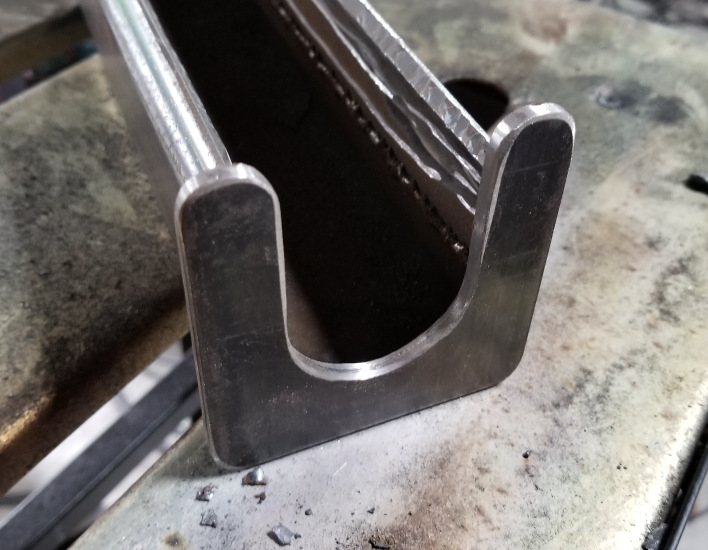
The picture makes the inside of the channel look very rough, but it’s not. It has some light grinding marks on it.
Now I have to figure out what else I want to do. I have to weld the shield onto one end of the brace, and then I have to shape the other end so it will rest on the front end loader’s hinge without damaging it. I’m not sure how to go about that.
I want to put some kind of padding on the shield to prevent it from contacting the cylinder cap directly. I think a piece of a tire is the best possible choice, but I don’t have an old tire. I guess I should go find one. I could put wood on the end, but it will be under a great deal of pressure, and I don’t trust it.
I could take two pieces of round tubing and weld them to the end of the brace to sit on the loader hinge, which is made from tubing. I could glue rubber inside them, and that would prevent them from marring the hinge.
I guess now I have a plan.
I was not happy that I couldn’t finish the shield with the belt grinder, so I have ordered a small wheel attachment. This is a gadget that will allow you to sand with a very small wheel on the end of your grinder. The belt will go over the wheel and allow you to sand inside very tight round cavities.
This is a phenomenally useful tool. In addition to getting into tight places, you can use it to grind tubing so it will mate up with other tubing for welding. This is called “fish mouthing.”
I was studying up on the grinder today, and I learned something interesting about my motor. I put a 3-HP motor on it because they were easier to find than 2-HP motors. The motor is a Reliance (now part of Baldor) that originally sold for over $600. I got it for something like $70, with free shipping. May have been $80. Anyway, many people suffer with 1/2-HP motors. A 1-1/2-HP motor is standard for this type of grinder. My motor is twice that powerful. It’s much, much better.
I bought an 1800-RPM motor because people told me they were built better than fast motors. Then I thought about speed. I needed to run it at 4000 or more RPM to get good performance from the grinder, but I didn’t know whether it would be safe for me or the motor. I did a lot of research back in 2016, and I tentatively concluded it should not be a problem.
Today I found relevant information from a highly respected machinist. He said he had run many motors at 400 Hz for long periods with no problems. This is 6-2/3 times the rated speed. He said speeding up motors was very safe. They don’t fall apart mechanically and blow up. The big problems are overheating and reduced performance.
I don’t care about overheating or reduced performance. This motor is way oversized to begin with, so if the power drops by half, it will still be right up there with the vast majority of grinders in operation today. I was concerned about being killed by shrapnel, but evidently, that is not an issue. If he can run a motor at 400 Hz, I’m fine at 120, and I should be able to go 180 when I really want to. Not that I do. Not usually. Once you get over a certain speed, the grinder cuts so fast you can damage work before you know it.
I also confirmed that my motor was inverter-rated. That means it was made to work with a VFD. Generally, 3-phase motors will work fine with VFD’s even if they were made before the VFD was invented, but it’s good to know that the engineers who designed my motor took VFD’s into account.
What it all adds up to is brutal grinding performance. That’s the main thing.
Before I read what the machinist wrote, I contacted Baldor via a form and asked them how fast I could run the motor. I haven’t heard back from them yet, but I think I know what they’re going to tell me. They’ll probably say the motor shouldn’t be run faster than 2700. A number of similar motors they make have that specification. The thing is, they may have set their top numbers with performance, not safety or reliability, in mind. If you’re running a 20-HP motor in a business, you don’t want to jack up the speed and find out you now have 5 HP and can’t do your job. In a home shop, things like this don’t matter.
It’s nice to know I can turn on the afterburners if I feel like it. For fast stock removal, speed is the top priority.
I really like metalworking. I love machining, but I like the caveman stuff even more. When you cut, weld, and grind, you really get intimate with the metal. You take all the harshness out of it and turn it into tame shapes that feel and look friendly. Now that I have welders, angle grinders, belt grinders, a plasma cutter, and a hydraulic press, I can actually do a few things. When my finger brake kit is assembled, I’ll be a major threat. Maybe I’ll get crazy and by a tubing bender. Once you have one of those, you’re out of the kiddie pool.
Metalworking is not like woodworking, because woodworking doesn’t give you nearly unlimited power to improve your tools. Woodworkers have to buy things metalworkers can make. A creative woodworker can do a lot, but it’s not the same.
Maybe some day I’ll get things like bead rollers, slip rolls, and shears.
I’ll post photos of the brace when I’m done.
September 7th, 2019 at 3:04 PM
Maybe dip the contact area with this:
Performix 11604-6 Blue Plasti Dip, 14.5 fl oz https://www.amazon.com/dp/B000HE9T6A/ref=cm_sw_r_cp_api_i_k6.CDbRQKEQ9J