Bracing Experience
September 5th, 2019Metal, Angle Grinders, Plasma, and the Belt Grinder
Today has been great so far.
I sound like a broken record, thank God.
I want to be able to park my Kubota with the front end loader raised, and that means I have to be able to brace one of the hydraulic tubes with a specially made steel device. I need a piece of U-shaped tubing that will fit over a hydraulic rod. One end will press against the end of they cylinder, and the other will fit against the hinge the cylinder is attached to. The cylinder won’t be able to retract, and people in the workshop will be less likely to be crushed.
I now have three welders ready to rock, so all I needed was metal. I went to the local supply place. I love that place. It’s a house with a giant Doall band saw and a monstrous jib crane in the backyard. It shows how you can make a good living out of your house doing something completely unexpected, as long as the zoning people are with you.
For $18, they gave me a length of 2.5″ square tubing, a piece of plate to cap the end, and 12″ of angle iron for my anvil project, which I will write about later.
They didn’t have steel channel deep enough to go around a hydraulic rod in a way that gave me confidence, so I had to buy the square tubing instead. That meant I had to cut one side out of it. Time to fire up the plasma cutter.
I was delayed because the presence of God filled the car on the drive home, and I ended up spending some time praying before I got to work.
I made the mistake of searching online to figure out how much air pressure to use to cut 5/8″ steel. I figured all plasma cutters were about the same, so I settled for an Eastwood manual. It said to use 40 psi. I didn’t question it.
I clamped a wooden yardstick to the tubing to use as a guide. I figured there would be one quick swipe of the torch, and the stick wouldn’t burn. I was wrong about that. The torch kept clogging up. I had to replace the little copper orifice inside the tip. I couldn’t cut the tubing to save my life.
I got on the web and looked around, and a source said the kinds of problems I was having were caused by low air pressure. Okay.
The yardstick was largely carbonized by this time, so I grabbed a piece of steel strip and used that instead. Should have done that to begin with.
I turned the compressor up to 90 and let it rip. No problems this time. Unfortunately, I already had one boogered-up cut. Time for the angle grinders.
I decided to put my new Hercules (Harbor Freight) grinder up against my new Bosch, to see if there was a difference. All I could tell for sure was that the Bosch made more noise. I don’t think it worked better, but it was more pleasant to use. The paddle switch wasn’t as hard to get used to.
I used two free cutoff disks I got from the Walter company. They make top-notch flap disks, and they give away samples. I couldn’t tell whether the disks cut any better than the other ones I had, but they were free, and I love the flap disks.
It took a very long time to liberate the unneeded side from the tubing. Then I had to use the grinders to clean up the terrifying burrs. I guess that took 45 minutes.
Using angle grinders on metal is fun. It’s surprising how accurate you can be with such a violent tool. It’s very absorbing. Angle grinders are great because you can turn bubba’d-up messes into great-looking projects with them.
I want to get a 6″ Metabo for cutting metal. They’re incredibly fast. Today’s experience gives me motivation to go ahead and order one.
After the tubing was modified and cleaned up with a knot wheel, I put it on the belt grinder and did some deburring. Very nice. There is nothing like a 2×72.
Now I have a channel ready to be turned into a brace.
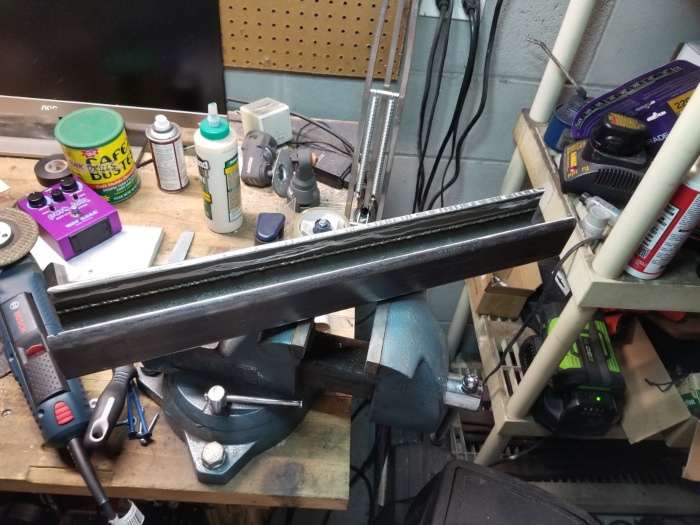
The cuts are not identical, but it doesn’t matter. Besides, it would be good practice to make a second brace, now that I know how much air the plasma cutter needs.
Tomorrow or the next day I need to cut an opening in the end cap and weld it onto the tubing. With a mill, it would take 15 minutes, and it would be gorgeous. I’ll probably have to use a hole saw and the plasma cutter. I also have to modify one end of the tubing so it will rest securely on the loader joint. Maybe I can do that with the belt grinder.
I can’t decide how to weld it. The welds don’t have to be strong. The tractor will push the cap toward the tubing, and the welds are only there to hold the cap on the tubing, so the tractor and the welds will be doing the same work. But I want to do a good job. I’m not ready to TIG it, but it would be neat if I could do the job with stick and 7018.
I guess I can practice on the metal I removed from the tubing. That will be helpful.
When I’m done, I’ll get out my can of Kubota orange implement paint. People will think I bought a Kubota brace.
I should take some chances with the project. If I ruin it, it will still be good practice, and it will only cost me maybe $14 to try again.
The weather was surprisingly good today. It got up to 99 in Ocala, but there was a high wind, and it was very dry. Another present from Hurricane Dorian. I’ll take it. Hot weather with very little sweat is better than hot weather with soaked clothing.
As is often the case, it was considerably cooler where I am than in town. My workshop thermometer read 88 today. I can’t explain it.
I don’t have an anvil. I am thinking I might like to try forging, though, and I would need something to beat metal on. I have a piece of 4″ square 1018 steel maybe 15″ long. I’m considering welding angle-iron tabs to it, drilling holes in them, and using them to screw the block to a stump. It would’t be as hard as an anvil, but it would work well enough to give me a chance to see whether I like forging, and it would give me some welding practice.
I don’t know how I’d move the stump and block into the workshop. I guess I need to move the stump indoors first.
The improved workshop is a joy to use, and God willing, it will be much better in a month or two. I really look forward to that.