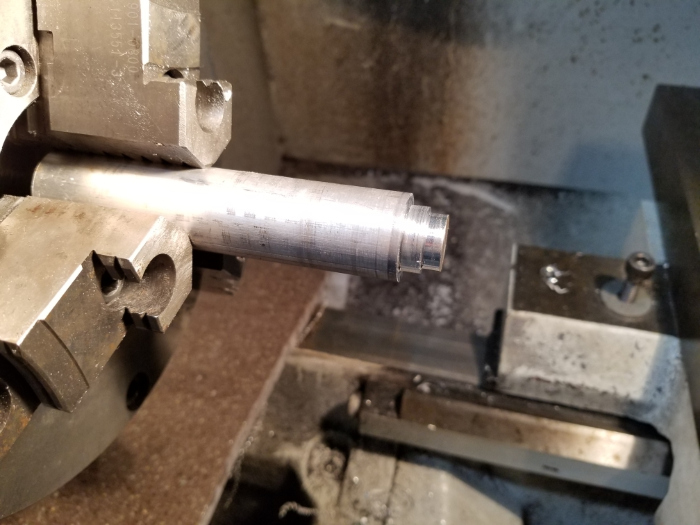
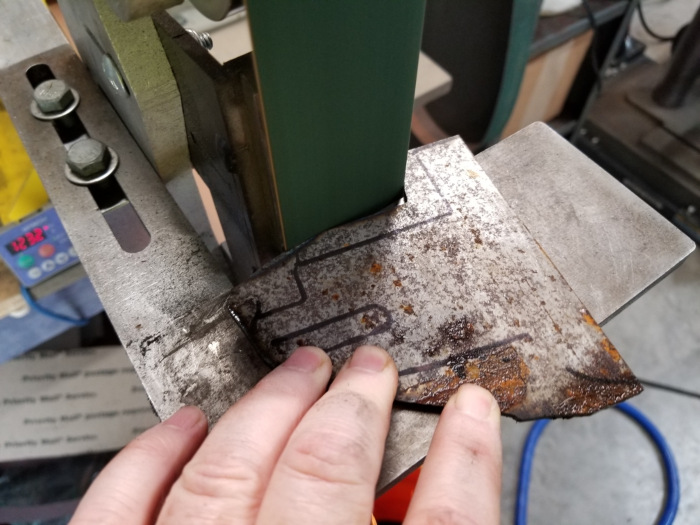
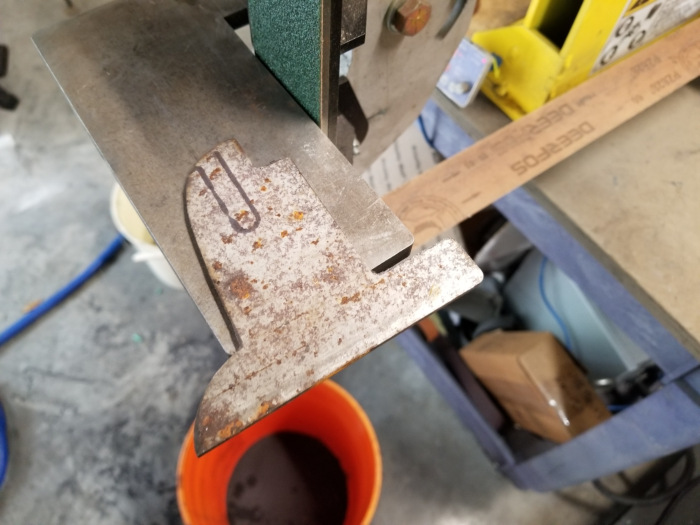
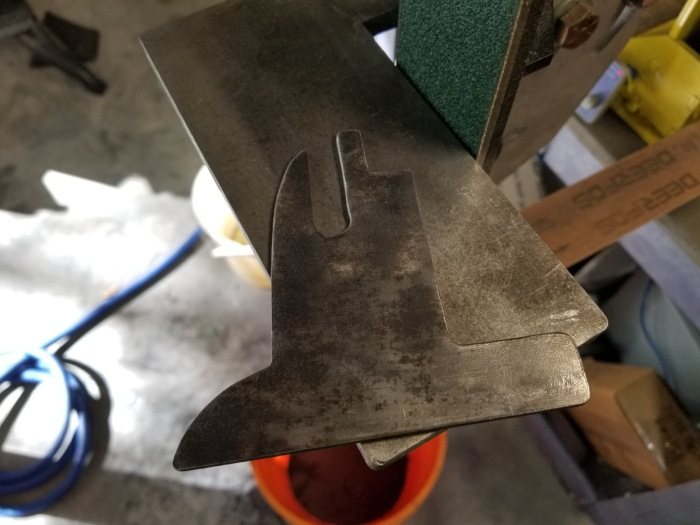
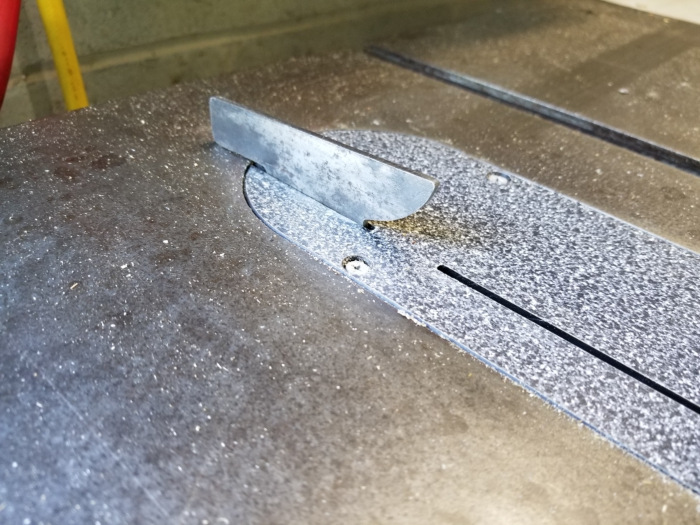
Today I machined something. It was nothing great. Let’s be honest; I faced the end of a piece of aluminum and put two steps on the end. Whoo hoo. But I felt great anyway. I haven’t done this in over two years.
I’ll post a photo of my amazing achievment.
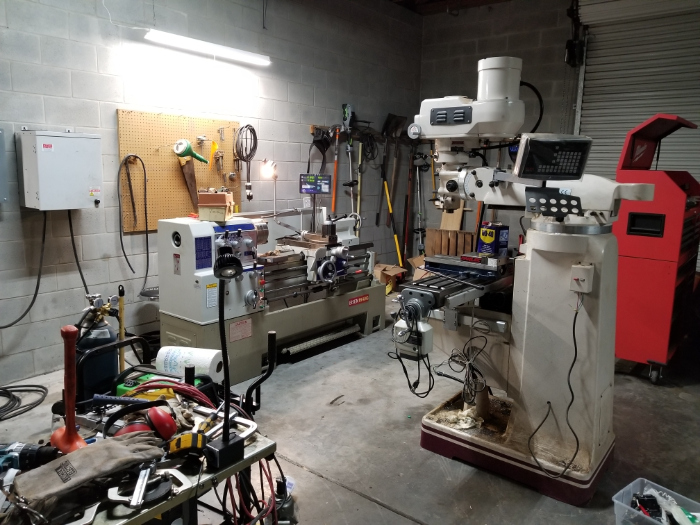
My mill and lathe arrived here on Tuesday. I’ve been so busy with a house closing and getting my workshop together, I have had very little time to do anything resembling using tools. I still have maybe 300 pounds of junk in my truck.
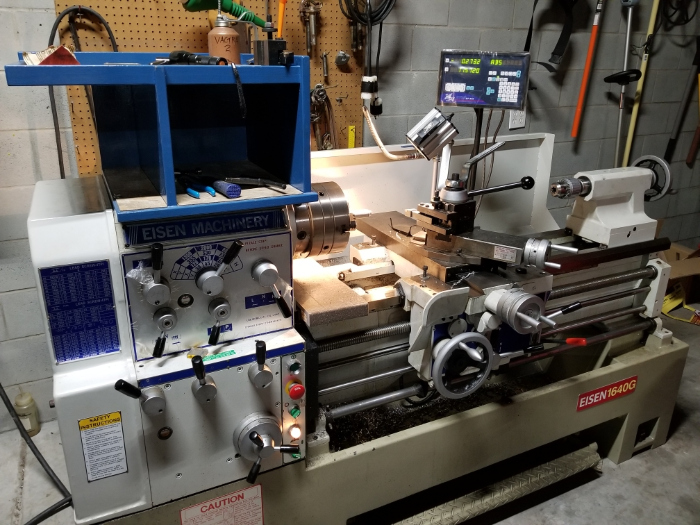
Yesterday I got the machines sort of ready to work. The lathe needed to have its connections to the phase converter restored, and I had to mount the DRO. That was about all I got done. The mill has a rotating head, like all Bridgeport-style mills, and in order to make moving the machine easier, I had rotated the head down onto the table, so I had to crank it back up.
I located my milling vise and 3-jaw lathe chuck so I could install them. They have been here less than two weeks. Of course, they had already started to rust. I don’t know what it is about this area. Everything rusts like crazy.
I cleaned them off and oiled the daylights out of them, and I did the same things to both machines. I would rather have oil everywhere than rust anywhere.
By the time I got done with all this, it was too late to do anything more.
Today I went back out, and I mounted the chuck on the lathe. I also mounted the wooden shelf unit I made to go on the headstock. This thing is very handy. It holds a chuck plus a load of toolholders and other doodads.
I also had to put the jaws back on the chuck. When I left Miami, the chuck had soft jaws on it, so today I reinstalled the hard factory jaws.
When the lathe was more or less together, the first thing I did was to turn it on, just to hear it spin. Wonderful.
I grabbed a piece of aluminum and turned steps into it with a carbide insert. It’s a little rough. I think the insert needs to be rotated.
The only thing I have to do now, lathe-wise, is to install the cast pucks it sits on and then level (straighten) the lathe. I have a Chinese precision level for this purpose. I don’t know how well it works, but I am reasonably confident.
The mill is going to be more annoying. I have to tram the head to the table, which is tedious. Then I have to mount the vise and tram it to the head. Equally tedious. I may put my rotary table on the mill table next to the vise. This is a smart idea if you mainly cut small parts. Moving a rotary table on and off your mill is a pain, so it’s nice to leave it in place. If you need to mill something big in the vise, you can just move the rotary table.
Once all the tramming is done, I have to connect the mill to power. I have two options. I can run a new wire to the phase converter, or I can reinstall the VFD I used in the past. The problem with the VFD is that it has no place to live. I used to keep it on the wall by the mill, but now the mill is far from the wall, so the wall won’t work. I could make some kind of stand, I guess. That would be strange.
If I wire it to the phase converter, life will be somewhat simpler, but I’ll have to run the huge phase converter every time I use the mill.
It’s probably the best way to go.
When I’m done, I’ll have a spare VFD. I already have a beautiful 2-HP motor gathering dust. You can guess what I’m thinking. I know you can. New belt grinder! Sure, I already have a belt grinder, but if I had two, I could keep two belts mounted at once, saving me precious, precious seconds when I want to change grit.
I would like to make myself a belt grinder simply because I feel bad about buying a prefab grinder the first time around. I fell prey to doubt. People talk about grinders as though they’re hard to build, but the truth is that they’re very crude, very simple machines. As I have often said, you could build a fine one from two-by-fours and plywood, plus aluminum pulleys.
My grinder is very nice, and it was cheap. I bought an Oregon Blade Maker (now Original Blade Maker), which is basically a steel box with two pulleys and an arm. It works just as well, and will last just as long, as an expensive industrial grinder. But you can’t turn it sideways to orient the belt horizontally. This is a bummer. Sometimes turning a grinder 90° can make life much simpler.
People like grinders with welded bodies. The truth is that you don’t need a welded body at all. A grinder held together with fasteners is just as good, and you can break it down when you need to move it or modify it. I would like to weld a grinder body together, but I’m not sure it’s the smart move. It may be more elegant, but a bolt-together grinder gives you more options.
I would like to do more stuff tomorrow, but it appears that my aunt, my cousin, and the cousin’s son are going to be here over Christmas, so I have to get the house ready. The garage is a total disaster right now because I’ve been pulling things off the truck and throwing them on the floor so I can get to other things I need. Luckily, my relatives aren’t picky.
I’m hoping to help them get closer to God. They are rejected, oppressed people.
Maybe I can squeeze out time to get the mill running. That would be beautiful.
I made what I hope will be my last trip (in this lifetime) to Miami over the weekend. It has been a tough month so far. I visited twice, and I had to put an enormous amount of junk out for the garbage people, in addition to making trips to the dump. It’s surprising how a house that seems empty can yield tons (literally) of junk. On the up side, I have moved my machine tools north, so now I can feel technologically complete again.
I threw out hundreds of dollars’ worth of things. I could not sell them, and I had a hard time giving them away. I put my mother’s patio furniture, which was expensive and in very good shape, in the trash pile. I had advertised it, and people responded, but they didn’t have the gumption to come get it. At least one lady asked my house sitter to deliver it. Thank God, a couple of Cuban trash-pickers came by in a pickup and grabbed it.
It may surprise people to see that I’m not writing about the Trump impeachment vote. I’m not that interested. I will say that, fundamentally, it’s not politically motivated. It’s motivated by spirits that hate God and every friend of God. The Democratic Party could almost be called “the body of Satan” these days. Don’t be surprised that what they do doesn’t make sense. When things don’t make sense, a supernatural force is usually at the root. Bill Clinton was impeached for lying under oath–which would have been a felony, had the Paula Jones case not been dismissed–on camera. He was also forced to give up his law license, after being turned in to the Arkansas Bar by a federal judge. That’s the kind of thing that grounds a real impeachment. Trump’s enemies had to make up a new charge (“abuse of power”) because there was no good evidence that Trump broke any existing law. What we are seeing is a continued effort to make conservatives afraid to run for office, and it goes back to Newt Gingrich, who was shown to be innocent. If you want to read more about it, Alan Dershowitz is probably a good source.
To get back to what I really want to write about, I’m dying to machine something. I don’t even care what it is. Even I just put a steel rod in the lathe and turn the radius down a quarter of a inch, I’ll be happy.
I watch tool videos all the time. For over two years, I’ve been watching people put metal in their machine tools and do things to it, and I couldn’t do it, myself. I’ve had a lot of jobs I could not do or which I had to do with inferior tools. Life without machine tools is primitive and restrictive. I’m glad it’s over.
It’s very disturbing, watching a forklift raise a 2-ton lathe so high the underside is 6 feet off the ground. My baby was sitting on two steel forks; nothing more. She wasn’t even very close to the forklift. She was way out at the bouncy ends. Every time she swayed back and forth, I braced for the devastating sight of $16,000 worth of very heavy machinery plummeting face-first onto the asphalt.
Machine-moving accidents are pretty nasty. There is a guy in Kentucky you has a huge machine shop, and he posted a video of an accident he had. He has a huge bridge crane in his shop. This is an overhead transverse beam mounted on two beams running the length of the building. The transverse beam has a trolley with a winch on it. He bought a drill press which must weigh at least three tons, and he tried to use the crane to lower it onto a freshly created concrete slab he had poured.
He backed a semi holding the drill press into his shop, and then he used the crane to lift the drill press a few inches off the trailer. He moved the drill press so it was suspended over the pad, which was about 3 feet beneath it. He was standing on the trailer next to the drill press when the cable holding it up snapped.
The drill press dropped instantly, breaking his new slab as well as part of the main casting of the drill press. If he had been under any part of the drill press, he might have been squashed like a grape. And he was alone! What was left of him could have been pinned to the ground or the truck, or parts of him could have been pinned to both, and nobody would have found him until suppertime.
He must have spent a lot of money on the crane, because he decided not to buy new cable before he used it. That’s why the drill press fell.
I’ll post the video here. If you’re in a hurry, skip to about 6:05. Expect profanity.
I read a story on a forum about a man who sold machine tools He had a lathe on a truck, and it rolled off onto his son-in-law. That was the end of him. Terrible story. Probably not a clean death. Imagine what it did to the family.
The riggers did an excellent job with my machines, and the experience taught me a great lesson: I need a trailer. Moving machinery with a semi is insanely expensive. One of the rigger told me to look into air-bagged trailers. These have platforms held up by air bags, as you might guess. Let the air out, and the platform drops to the ground. They lie flat, like sheets of plywood. There are no ramps. To put a lathe on one of these things, you just put it on skates (not difficult) and roll it onto the one-inch high platform. Then you pump up the air bags, and you’re ready to go.
The giant bonus is that you don’t need a forklift or a forklift operator. Simply putting three machines on a trailer costs about $1800, as does taking them down, if you use riggers. Even if you risk death by renting forklifts and doing the job yourself, you will spend $1000 or so for the two days you will need them.
If I get an air-bagged trailer, I’ll be able to move my tractors, my golf cart, and all of my machinery. The next time I move, I may have to make a few trips, but it will definitely be better than paying whatever it costs to move all my stuff across several states.
I haven’t machined anything since arriving home because I haven’t had time. I had to work on unloading my own truck today; it was (still is) full of Miami junk. I also had to bring my birds home from the boarding place, where they are a huge hit. Marv now has a girlfriend named Jessie. She’s a big silvery Congo African grey who occupied a neighboring cage. Sadly, they will not be seeing each other again any time soon. I don’t think Marv cares. He seems immune to negative emotions.
I couldn’t use my tools last night because they were wet. The weather was dry for most of their journey, and then there was a blinding rain near the end of the trip. I had to wipe the machines down, blot up water, and blast them with a solution of lanolin and mineral spirits. I took a big can of WD-40 and poured it onto my mill table. I soaked a rag with Mobil Vactra 2 way oil and oiled things heavily. I was determined not to let the machines rust.
Rust is a big problem north of Miami. It’s surprising, but machines don’t rust at all in humid Miami if they’re indoors. Humidity doesn’t rust machines. Condensation does. When a machine is in an area where the air cools and warms up a lot–meaning all of North America north of South Florida and maybe parts of Texas–it ends up being cooler than the surrounding air many times a month. In humid areas, this causes water to condense on it. Then you get rust. In Miami, machines don’t get very cold very often, so condensation is not a big problem.
My table saw rusted over during my first Ocala winter, and that taught me I had to look out for condensation. Fortunately, a little rust doesn’t really harm a table saw. Even light rust will ruin a lathe, and it’s not great for mills, either.
If you watch machining videos, you will see a lot of people proudly “restoring” rusty lathes. They’ll pay good money for metal lathes that have been sitting outside in the rain, and they’ll scrape the rust off the bed ways, use Evaporust on the moving parts, paint everything, and claim they’re done. They have no idea what they’re doing. Once you have thick rust on a lathe’s ways, the precision is gone, permanently. If you want to bring it back, you have to pay someone to put it on a giant grinder, or you have to be a genius who can use scraping tools to restore flat, true, parallel surfaces. Basically, it means you’re done, unless you just happen to know someone who is willing to load your junkyard beauty on a grinding machine for nothing. The cost of grinding a lathe bed pretty much destroys the purpose of buying a cheap, rusted lathe.
Wood tools can be restored. Take off the rust, paint everything, make sure the motor turns, and you’re off. That’s because wood tools are not precise. If your table saw has a dip 10 thousandths deep in the middle of the top, no one cares. If rust takes 10 thousandths off your lathe’s ways in random places, it’s time to forget about metal and start turning wooden table legs with it.
The funny thing is that most machining hobbyists would probably disagree with me. They’re wrong, though. They’re just caught up in a bit of stubborn mythology born of the natural reluctance to accept bad news.
Another problem with “restored” lathes is that rust and grinding can remove the hardened part of the ways. Many lathes made during the last hundred years have flame-hardened ways, which means they were exposed to high heat after they were made. The hardening doesn’t go all that deep, so even if you scrape or grind your old lathe, you may end up with soft ways which will wear out and lose precision again quickly.
Bottom line: a rusty machine tool is generally going to perform badly, even if you try to restore it. It will be okay for certain purposes after you sand the formerly precision surfaces, but it will not perform like a machine that hasn’t rusted. Preventing rust is important, and rusty machines are not bargains. They are scrap.
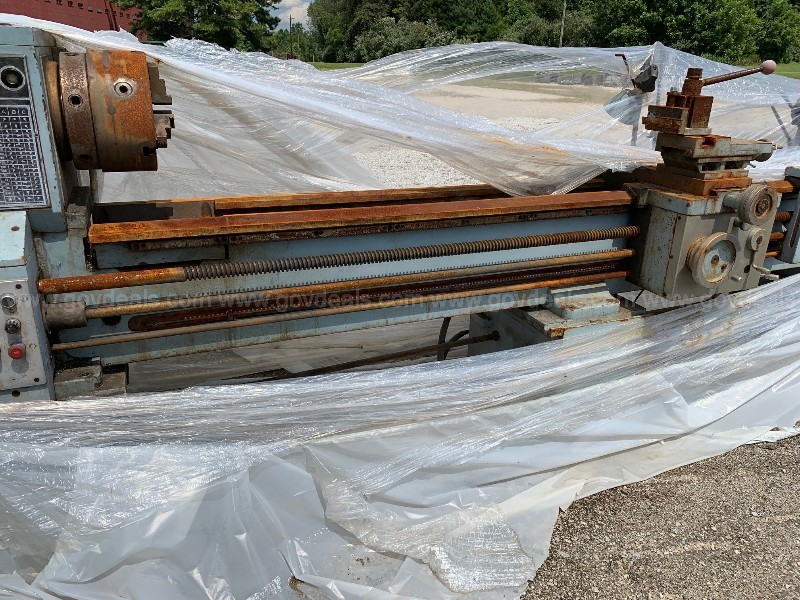
Our government puts nice machines out in the rain all the time. It’s horrifying. If you go to government websites that list used machines for sale, you’ll see machines that are largely red. You may see a photo of a machine that cost $40,000 new, stored outdoors without a $5 tarp or even a layer of oil. I don’t know who buys these things. I wouldn’t go near one even if it were free.
Before the machine is put outdoors, it’s worth $8000. A month later, it’s worth the scrap price.
It shows how much government employees care about spending our money wisely. Shocking.
I’ll post a photo of a lathe our government is trying to sell. The bidding is up to $1550.00. I think I can tell you who is bidding on it. Retirees who want a new hobby and don’t know anything about lathes. Either that or people who know it’s ruined and don’t care about precision.
I’ve spent a lot of time on machining forums. Many of the people who participate are middle-aged guys who want a new hobby, and they get very bad advice from everyone else. People encourage them to buy old machines that are in very bad condition, and they make them think “a little rust” is no big deal. I guess a terrible lathe is better than no lathe, but I can’t imagine using a machine that has been stored in the rain. I don’t know what it would be useful for, apart from woodworking.
To get back to my story, my machines are as dry and greasy as I could get them. Maybe tomorrow I can connect the power and start doing something. I have to put my vise back on the mill and tram it, and I may actually level the lathe. A lathe that isn’t “leveled” (actually straightened) may produce tapered parts instead of straight ones. It doesn’t matter all that much if you’re making short parts, which I usually am, but longer parts will be affected more.
I don’t want to spend the whole evening blogging, so I won’t go into the way God has changed my life during my two trips to Miami. He made big changes in my heart. The changes are so great–dare I say it–the unpleasantness of visiting Miami seems well worth the pain. I’ll try to write about them tomorrow.
I’ll say this. I believe the difficulty I’ve had in separating myself from Miami, and in separating myself from financial interests in Kentucky, is related to things inside me that needed to be changed. Our problems here on earth tend to be reflections of the problems God has with us.
Pray the house closing goes well and that I don’t have to look for a new buyer. I am ready to cut that place loose.
I never go online and talk about trips, because I want it to be harder than that for burglars to find out I’m not home. Last Friday, I drove to Miami to work on the last home I’m selling (hooray). I have to get it cleared out reasonably well for the buyers.
I ended up paying a king’s ransom to move my machine tools up here. They were put where they are by Miami Transfer, a big crane and rigging company my dad and I used to represent. They very kindly received my lathe and delivered it in Miami for nothing, so I wanted to use them again so they would finally make some money from me. Months ago, they said they could move everything here for $4000. I called again a month or so ago, and they quoted me nearly $8000. They said the job was harder than they originally thought.
I have no doubt that they’re telling the truth, but naturally, when the price jumped, I felt motivated to look around for better deals. I’m grateful for what they did for me, but…$8000.
Several companies looked at the job, and they always said the same thing: $8000 was WAY out of line. Then they came back with estimates that were not a whole lot better. In the end, I picked a major outfit that has an office in town. I call them at least twice a week to make sure they haven’t forgotten.
I should have bought a trailer and moved the machines myself, but it’s too late to be learning a new skill. I don’t have time. If I had done that last year, I would be a lot better off now. Caring for my dad had absorbed my life, however, so I kept putting the machine move off.
If the machines were here, I would have been willing to play around with a trailer and rented forklift. I can’t do that when they’re 300 miles away. Every day of experimentation would be a day away from my responsibilities here. It seemed better to bite the bullet and get it over with.
“First world problems.” That’s what they call challenges like this one. Some people are in Bangladesh, wondering if there will be anything fit to eat in the local dumpsters tonight, and I’m in America, concerned about the trials of moving expensive hobby machines to my expensive home.
In order to get this sale over with, I threw out and gave away a lot of stuff. I had a fighting chair for a fishing boat. They probably cost $10,000 new. Mine was in pieces and needed some work. I took $75. I could not get anyone to take it for more than that. I threw out all sorts of electronics and cables. I put a good Sony receiver and remote in the trash. I’m selling 5-gallon beer kegs for $10 each. I’m giving away all the patio furniture.
I must have put half a ton of stuff out for the waste people, and I took half a ton to the landfill, known as Mount Trashmore. The view from up there is wonderful. It was also a little disturbing. I saw so many places I had been. I saw areas in the bay and ocean I was familiar with, from years of fishing. It was like having my life unfolded before me, so I could view it from atop a mountain of garbage.
There were some family photos in the house. I haven’t retrieved them yet. I decided to break my visit into two trips, so I’ll be going again when the machine movers are ready, and I’ll grab more things then. I found a framed photo my sister loved. It was a picture of her, of course. She would have been about three years old. I thought she already had it. She came for it a long time ago. She looked at it and said, “I was so beautiful.” Not normal.
In the photo, her eyes are ice-cold, in spite of her age. When you look at it, you can tell something is very wrong. She looks like a future serial killer. I kept asking God if I should keep the picture. I am inclined to throw it out. It will disturb me every time I see it.
My friend Travis wanted to help me with everything, but it seems like there are some things God wants me to do by myself. I had to clean up the house and load everything (but for one item) myself, and I will be unloading alone today. Travis was busy with important things. There was nothing he could do.
I feel much better about throwing out my dad’s golf clubs now. I threw them out with a lot of stuff several years ago, and I was a little uneasy about it. I almost wish I had left the house unlocked and let strangers steal everything.
In situations like this, you can keep everything you think is valuable, move it at great expense and with great effort, and then sell it for pennies on the dollar, or you can dump it early and be free. You can also pay a fortune to move it, only to end up dumping it afterward. That’s the hard truth.
Miami is an interesting town. If you list something for ten dollars on Craigslist, it will take days to get a response, but if you list it for nothing, people will trample each other to come get it. I listed a $170 wheelbarrow that has barely been used for $50, and people are trying to get it for less.
While I was there, I got a great revelation: I needed to forgive Miami.
I always think of forgiveness as something that applies to individuals, but it appears that it can apply to cities, organizations, countries, and so on. That was news to me.
I do not like Miami. The traffic is bad. The people are unpleasant. It’s full of voodoo and sexual defilement. Non-Hispanics are not treated well. People refuse to learn English. There is little to recommend the place. It’s okay to say these things, because they’re true, but I should not harbor hostility toward the people. That harms me and makes me a less effective Christian.
I realized this the morning after I arrived. I was lying on an air mattress in a dusty, nearly empty house, and I could not sleep. God made me understand that I had to forgive, so I did, and I asked him for help in getting his love to flow. I also thought of other big groups to forgive. Churches, cities, and so on. I worked on those. I cast out spirits of anger and vengefulness.
I felt much, much better afterward. I knew this was major progress.
Something strange happened later. Ordinarily, I feel terrible in Miami. It’s as though slimy, stinking worms are crawling on me. I feel unclean. I want out. This is actually normal for people who move away and then have to return. Come to think of it, I used to feel the same way even when I was in college. I felt it when I flew home for breaks. After I forgave, I felt much more comfortable. I still want nothing to do with Miami, but now I can visit and not be as miserable.
I know there is a connection between physical problems and sin. Sin brings iniquity and demons, and then you get things like cancer and arthritis. Yesterday, on the trip home, I heard something which I believe to be revelation: sin doesn’t CAUSE disease; it IS disease. What we see as disease is really just the symptoms. If you smoke cigarettes, which is a sin, you already have COPD, strokes, heart attacks, and cancer. The diseases are in you. They just have not been able to manifest yet. If you have chronic anger, you already have high blood pressure and strokes, even if you haven’t seen proof. The doors are open, and the entities that cause disease can come in when they choose.
Unforgiveness is obviously related to disease. Anger and stress harm your circulatory system.
Here’s something interesting: the Bible says envy rots the bones. That’s pretty clear.
I want to keep moving into deliverance. I don’t care about the cost, which is an illusion. Anything inquity allows me to keep is actually a liability.
In other news, I saw a really wacky video today. Youtube recommended a Zev Porat video about a rabbi who is incredibly angry. I don’t know the man’s name. I’ve seen him before, and I wrote about him. Porat pronounces his name “Vinestein,” but the Internet says his name is Eitan Bagdadi. I assume he’s a fringe nut no one takes seriously, because he is WAY out there.
Porat showed a clip of this man’s teaching. His eyes were wide. He was waving his hands. He was yelling in a high-pitched voice. He said something about God coming in the future to make churches explode. He was looking forward to it.
If he had been wearing a different hat, I would have thought he was a Muslim cleric teaching about jihad. He was completely enraged. Look at the video and see.
The thing I find interesting is that he said the Talmud says Jesus is boiling in excrement. He calls him “the cursed one,” and he says he’s in hell right now. For some reason, he decided to tell us about the composition of the feces. He said it was from people, cats, dogs, lions, and tigers. I don’t know where that information came from. Why these particular animals?
This quotation has been the subject of a lot of argument. If you Google, you will see rabbis denying that it applies to Jesus, but here Bagdadi is, asserting that it does. It would make sense for anti-Semitic Christians to say this, but it’s remarkable to see it coming from a rabbi. Is he hoping speaking in Hebrew will prevent people from finding out? Jews who speak Hebrew put English subtitles on his video. I wonder if that surprised him.
Notice I am not angry about the quotation. I am not saying synagogues will explode. I never get mad when people attack God. It just does not bother me much. I sometimes get annoyed when people lie about Christians or what we believe. Even then, I don’t go off like this guy. He has full-blown conniptions.
He’s extremely angry at Jewish believers who talk to other Jews. He thinks they destroy Jewish souls.
I’m not sure I understand the whole thing. I can understand why rabbis would want the number of Jews to increase instead of decreasing, and I know they see conversion as a threat, but this man’s consuming rage doesn’t seem to make sense. If you cease to be a Jew (as rabbis claim) when you accept Yeshua, is it a catastrophe or just a misfortune? They believe Jews have to be much better in order to make it to paradise, while gentiles only have to obey a few laws. In reality, you would think Porat would be helping people who can’t make it as Jews.
Maybe he thinks converts are damned for some reason.
Porat got his video clip from a messianic ministry called One for Israel. They used it first.
Some pretty weird quotations are attributed to this man. Here’s one: “Do you have an animal? Don’t leave it with a Gentile, he will come and rape your animal, according to the Talmud.”
Is that really in there? Actually, animal rape is considered acceptable in some Latin American countries, and several countries in Europe permit it. There are now animal bordellos in Europe. Maybe Bagdadi is onto something! He’s overgeneralizing, however. It’s actually very unlikely that a gentile will rape an animal entrusted to his care. We don’t see news stories about perverted things taking place when people board their pets.
It turns out Bagdadi isn’t making his rape claim up. Here it is, from a Talmud site:
Said Mar ‘Ukba b. Hama: Because heathens frequent their neighbours’ wives, and should one by chance not find her in, and find the cattle there, he might use it immorally. You may also say that even if he should find her in he might use the animal, as a Master has said: Heathens prefer the cattle of Israelites to their own wives. . .
I would hope that most modern Orthodox rabbis are aware that this is not really true. For all I know, it was true of the gentiles Jews knew when it was written. After all, you can imagine the things a rabbi might write today if he lived in San Francisco. Ancient Babylon was a weird place, too. But gentiles generally are not interested in sex with animals.
There is a lot of rough stuff in literature like the Talmud. Things a smart person would never say publicly, even if he believed them. One for Israel exposes it, on the theory that such secondary sources are inferior to scripture and distance people from God. They have quoted things like this, from 14th-century rabbi and kabbalist Isaac “Ha’ari” Luria: “The Gentiles have neither spirit nor soul and are not even equal to animals considered clean, but rather lower than them.”
Lower than animals? Where did that come from? Did he get mugged by gentiles or what? That’s some pretty impressive bigotry.
Maimonides, who is revered more than anyone except Moses, said this:
“As for Gentiles with whom we are not at war…their death must not be caused, but it is forbidden to save them if they are at the point of death; if, for example, one of them is seen falling into the sea, he should not be rescued, for it is written: ‘neither shalt thou stand against the blood of thy fellow’–but [a Gentile] is not thy fellow”
How many Orthodox Jews would live by that? Very few, I would imagine. There are Orthodox paramedics and doctors, and they help Gentiles all the time.
I can’t imagine a world in which Jews tell their kids not to become doctors.
Sometimes you have to look at things you have accepted and ask yourself if you made the right choice. You can invest your life in a religion and then find out the people who teach you are looking in the wrong direction; it has happened to me.
Scripture itself holds up very well; there is nothing in it anyone should be embarrassed to believe, regardless of when it was written. Dubious secondary sources, not so much.
The Mormon “prophets” have taught that dark-skinned people were cursed with dark skin because they were immoral, and they have said that such people will turn white when they become righteous. The Mormons banned blacks from the priesthood until the Nixon era. The Jehovah’s Witnesses taught that Jesus, whose divinity they deny, was coming back on a certain day. Then he failed to appear, so they said he had appeared invisibly. Catholics…don’t get me started. As I always say, the Catholic church was once the most powerful terrorist organization on earth; they burned people or threatened to burn people for crimes like saying the earth orbited the sun. They still teach people to pray to other people, and they say only Catholics go to heaven. Prosperity preachers–right now–make up garbage about God giving people a hundred-to-one returns on monetary donations. There are Christian kooks teaching that Jews run the world and that they aren’t really Jews.
When you get away from the source, you hear a lot of nonsense, and you lose all connection to authority, so you, yourself, lose authority.
I suppose the likely fallout, as information becomes more widely dispersed, is that Jewish nuts like Bagdadi will provoke Muslim and Christian nuts, and then all the nuts will go at it, and everyone else will conclude that all religious people are violent, hate-filled nuts.
You should not have to hide what your religion teaches. God told prophets to speak boldly. Jesus said not to try to prepare when we were called in front of authorities to answer them; he said God would tell us what to say. He said that if we denied him before men, he would deny us before the Father. You shouldn’t provoke people pointlessly, but if you have to conceal your doctrine and claim it doesn’t exist, you must be doing something wrong.
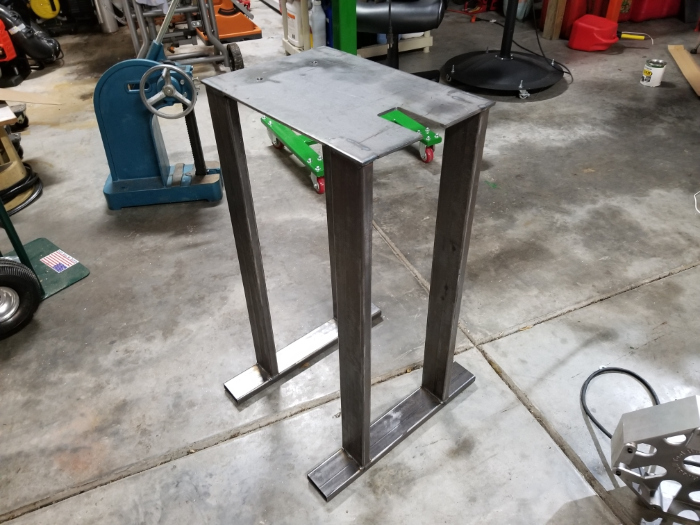
My arbor press stand is fundamentally finished. It still needs casters, little things to prevent it from tipping forward, paint, and two bolts. I may also put a shelf on it, as well as something to catch broaches that fall through the top.
I had an interesting time working on it today.
Yesterday I got all the legs put on. The front legs were joined by a crossmember at the bottom, as were the rear legs. When I measured today, I found out the front legs were warped toward the rear, the rear legs were warped toward the front, and the front and rear sets were angled with respect to each other, like the blades of a pair of scissors.
Rather that tear the project up and start over, I decided to try brute force.
I cut pieces of wood on the band saw, and I jammed them between the legs to hold them apart. When I did this, one set of legs ended up too far apart at one point, so I also had to put a long wood clamp on them. The scissor effect was still there, but I was a lot closer to home.
I welded a front-to-rear crossmember to one set of legs. Then I used another wood clamp to pull on the crossmember and force the two sets of legs parallel. I had scribed lines on the new crossmember and the old one to tell me when they were lined up. I had to move everything about 3/8″ to get the witness marks to line up. I tacked again, got rid of everything that was in the way, and welded up the tacks before they could explode from the tension I had put on the steel.
It looks like it worked. The bottom of the stand is maybe 3/32″ off flat, and that’s about as good as I could have done even had I known what I was doing. The top of the stand is flat. I don’t know how square everything is yet, but it can’t be too bad, because it looks okay.
I put my arbor press on my hydraulic table and lifted it up so I could put it on the stand. Once it was up there, I understood how bad the Chinese casting was. The stand’s top is made fairly precisely, but the casting does not line up with it all that well. The opening in the arbor press is very irregular, and it extends past the opening in the top.
Next time, I’ll put more parts on the stand, and soon, I hope to paint it and get this over with. It will be fantastic, being able to use and move my arbor press.
Maybe I’ll eventually make another stand, just to prove I can do it.
I’m working on my arbor press stand, using my new welding table. I quit for the Thanksgiving push, but now I’m out of the kitchen.
My arbor press is a Chinese beauty that weighs 135 pounds. It has to have a sturdy stand. Coming off my recent success with the bench grinder pedestal, I figured a mobile arbor press stand would be no problem.
I’m making it from 1″ by 3″ tubing and 1/4″ plate. It’s basically a box with a plate on top. I may also put a shelf halfway down.
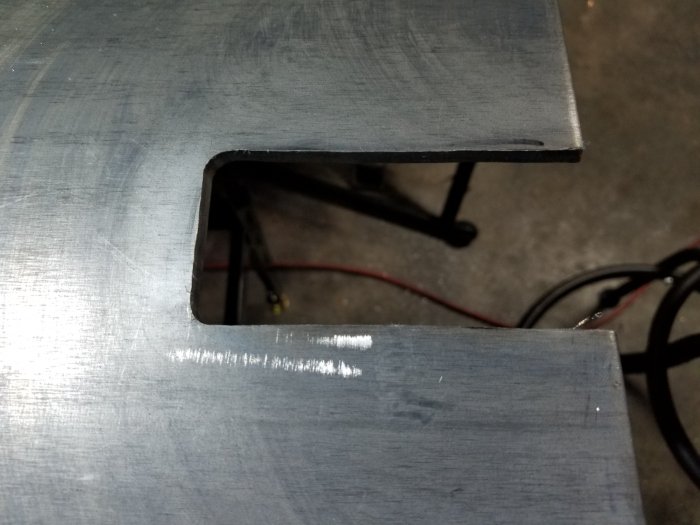
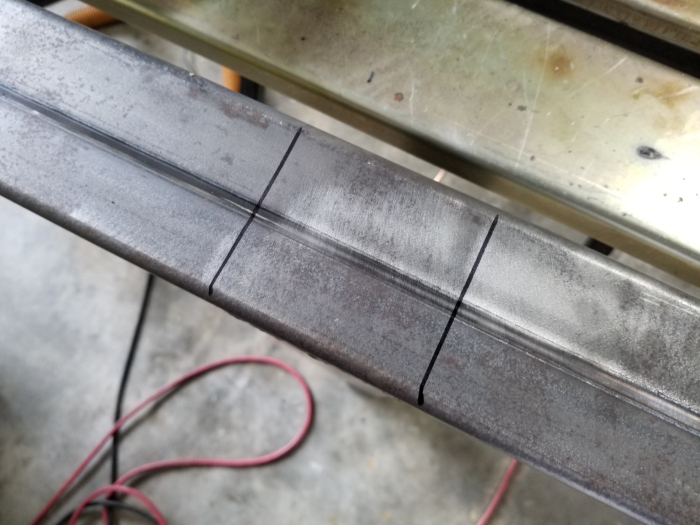
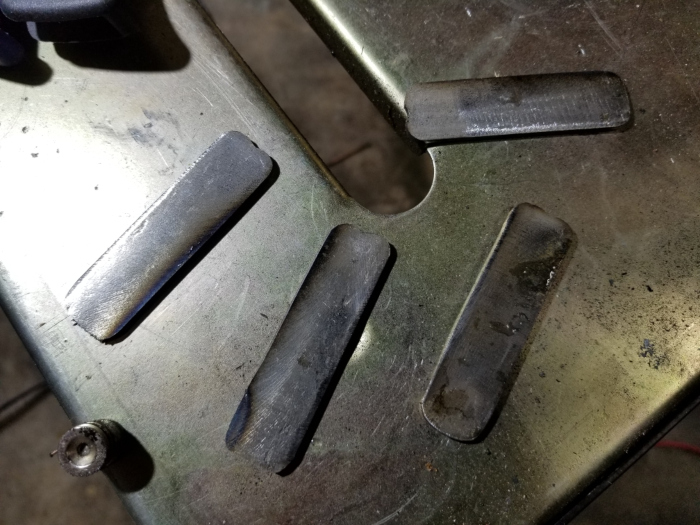
The top needed a cutout. Arbor presses have forked bases so long workpieces can protrude below. I had to cut steel out of the top plate to match the fork in the press’s base.
Cutting the recess with a milling machine would have been quick and easy. I have not managed to motivate anyone to move my machines to me yet, so I had to use handheld tools.
I started with the plasma cutter, but it left a very crude opening. I used a 6″ angle grinder with a cutoff wheel to improve the recess, and then I finished it with my Dumore hand grinder and a carbide burr. The results were excellent. From 5 feet away, it looks like I machined it.
The press has two holes in it for mounting bolts. I didn’t feel like putting the heavy plate on the drill press, so I scribed locations for the holes with a square, and then I used a center drill, a jobber drill, and a unibit to finish them. They came out perfectly. Unibits are wonderful because they’re fast and they also deburr holes.
Welding has been tricky. I’ve seen people suggesting the use of fixturing tables and welding squares to hold metal in place so it doesn’t warp. I now have both products, and I can tell you that they’re not enough. Even if you clamp two pieces of steel so they’re at right angles to each other, they will move as soon as you remove the clamps. Clamping seems to reduce warpage, but it’s not the complete answer.
Frustrating.
I think I made a mistake in choosing to weld one part on at a time.
My stand has 31″ legs. When I attached the first two legs, they were 9-5/8″ apart near the plate. At the other end, they were 1/4″ closer together. I had to weld another tube across them at the far end, so I made a piece of wood 9-5/8″ long, wedged it between the legs to force them apart, and then welded. It did the trick, so the legs are parallel, but how do I know the legs are square to the plate?
Right now, the stand looks pretty good, but two opposite corners are slightly lower than the others, so it appears that the front legs and rear legs are not completely parallel. I think I can fix this when I weld the member that joins them. I can weld it to the center of one of the bottom tubes, and then I can force the sets of legs to line up so the new member is precisely centered on the other bottom tube. I’m probably only off by an eighth of an inch, so I’m hoping this will square the stand up to within a sixteenth or so. That’s a bullseye as far as I’m concerned.
If this plan doesn’t work, I can look into flame-straightening, or I can cut the stand up and start over. I have a gas rig for straightening, but I still haven’t found an acceptable deal on gas bottles.
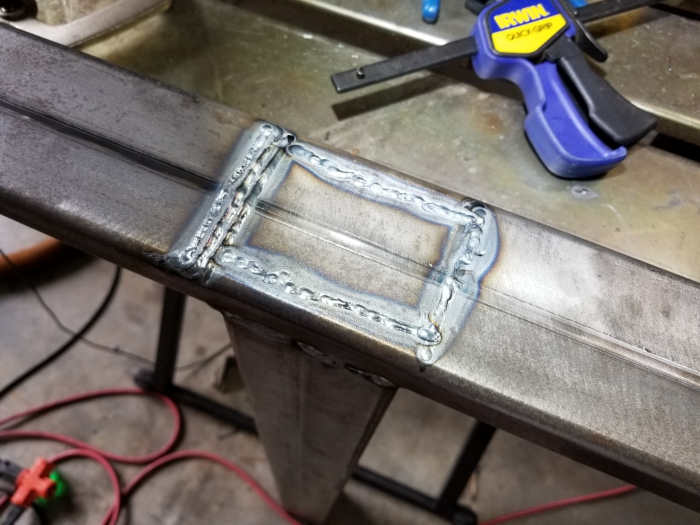
I failed to do two important things before welding this thing up. I didn’t put in holes for the casters, and I didn’t weld in plates at the ends of the bottom tubes to make them pretty. I can still do all these things, but it will be a little more work than it would have been had I done it before the tubes were attached.
It should be a good stand. It will be very strong, and I’ll be able to roll it out of my way. It will be a lot nicer than the tool that sits on it.
Regardless of the fact that they don’t prevent warpage, the fixturing table and squares are very nice to have. This job would have been much harder without them. The table has already taught me something: I need a bigger table. This 3′ table is bigger than the 30″ Harbor Freight table it replaced, and I can see that 4′ is really about as small as you want to go. You need room for your project, your torch holder, a light, and some tools you won’t feel like storing across the room when you’re working.
The current table will be just fine for now, but I can see that a 2′ by 4′ table makes sense for the future.
I’m not sure how many projects you have to build before you stop warping things. This is my second arbor press stand, and I’m not there yet.
It seems like the exciting news never stops. I have made a decision regarding buying a welding table.
Why am I buying a table at all? I still haven’t finished painting the grinder pedestal I welded together. A fine fabricator I turned out to be. I keep putting things off.
The finish on the top is going to have to be sanded and repainted at least one more time. I also need to enlarge or replace a couple of holes for the bolts that hold the grinder on. I put them in the wrong places.
I really will finish the pedestal. I could use it right now (after using the drill twice). I just want it to look a little better.
Anyway, I had a couple of table ideas in mind. One was to build my own table, which would be somewhat challenging…without a welding table. Another was to buy a Fabblock table from Weldtables.com and assemble it myself. The Fabblock I wanted, plus legs, runs $800 plus shipping. Ow.
There was a third alternative, but my opportunity to try it was temporary, and I let it slip by. Now I have another opportunity, so I’m pouncing.
Northern Tool sells Klutch tools. I think it’s their house brand. They have a welding table that usually sells for almost $400. For some inexplicable reason, they put it on sale for $179. I noticed it a while back. Then, while I was fighting temptation, they took it away! Fiends!
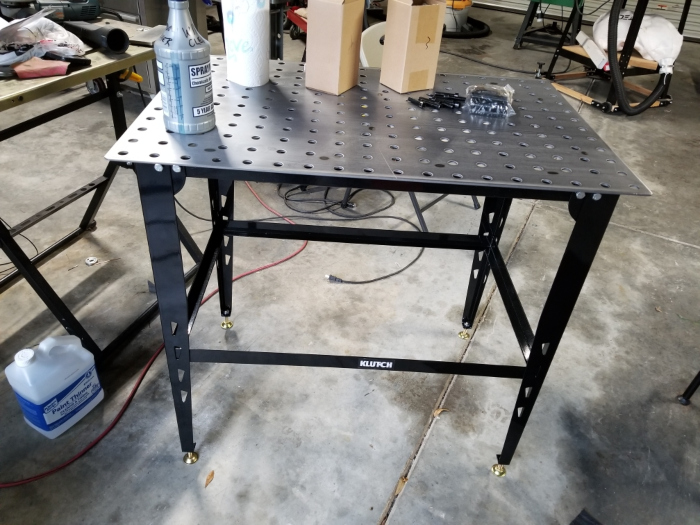
This is a very nice table. The top is 4mm thick, which means it’s around 1/6 of an inch. It has 16mm holes all over it. It comes with a bunch of clamps and fixturing tools. You can open the box, put it together, and start welding without buying a single clamp.
People say the top is generally very flat, but you may get a lemon with a 1/16″ crown or dip. I think it’s worth the risk. It might be possible to improve a warped table, and in any case, it shouldn’t be hard to shim workpieces and get them flat. A 1/16″ bend is not hard to compensate for.
Is it the table of my dreams? No, but it’s very cheap and very good, and if I move to Tennessee, it will be a lot easier to move than a Fabblock. If Northern Tool kills the sale price again, I should actually be able to sell it locally for more than I paid. Then I can buy a Fabblock when I’m firmly situated.
I can use this table to build a bigger table, if I want. That may actually be the best move. My milling machine is about to be returned to me, so preparing slats for a shopmade table will be easy.
Northern Tool made it impossible to say no. They brought the low price back, and then they sent me an email saying they would give me a $10 gift card for ordering online (code 268178). That brings the price to $169 plus tax. The other day I spent $180 on a lame restaurant meal. How can I say no to a welding table that costs $11 less?
Strong Hand Tools makes wonderful [Chinese] stuff, and their version of the Klutch table costs about $430. Strong Hand is actually kind of disturbing, because it’s one of those companies that show us the future. Their products are Chinese, but the quality is really good. I have their version of the famous Bessey clamp, and it looks like an improvement to me.
I can’t wait to abandon my Harbor Freight table. For the money, it is a stellar tool, but when you consider what they cost, that’s faint praise. It’s wobbly, it’s not flat, and it’s small. I may keep it for use as a portable, which is the purpose it’s made for. I do not plan to weld on it in my shop unless I have no choice.
Now I need to get wheels for the new table. Once that’s done, I’ll be sitting pretty.
Speaking of Chinese, I finally have a good source of Chinese food. The only local place I have tried was a disaster. It was hot and dirty, and the proprietress kept screaming at the cook in Chinese. Their kung pao chicken was pretty bad, and instead of cooking the peanuts in sauce, they just dumped dry raw peanuts on top of the food.
Small towns are known for terrible Chinese, as is Miami. My area had only one decent place, and they tore it down to build something or other.
I know good Chinese food. When I was a student at Columbia University, I had access to very good Szechuan places. For example, I used to eat at the Hunan Balcony on upper Broadway. I also know bad Chinese food. The oil smells rancid. The meat always seems to be nearly spoiled. The smell when the kitchen door opens is scary. All the sauce is basically duck sauce. The seasonings are off.
I found myself a recipe for kung pao chicken, over at Epicurious. It’s from a book by a lady named Kuan. I used Epicurious because I’m not a Cook’s Illustrated subscriber any more, and I hate Cooks.com and the Food Network’s revolting recipes. When I think about the Food Network, I always think about Bobby Flay’s inept 325° prime rib recipe. Don’t buy a rib roast and cook it at 325°. Just buy some liquid rubber, pour it in a roast-shaped mold, and let it cure for several days. Same result.
The recipe called for a couple of weird items. It called for black vinegar and hoisin sauce. I went to an Asian grocery to pick up the vinegar. I told the girl there the local Chinese food was heinous. She said it wasn’t Americanized. I can understand why she would stand up for her pals, but no, it has nothing to do with being Americanized. Bad food which is authentic is still bad food.
I can’t tell you what authentic Chinese food tastes like, and I’m not sure I want to find out, because authentic Mexican food is garbage compared to American Mexican food. I can tell when a person is a bad cook, however, regardless of the cuisine.
She sold me a big bottle of black vinegar for $4. I would say it tastes like malt vinegar that has been strained through dirt. I don’t like it. I suspect her brand is really cheap.
I got my hoisin sauce at a supermarket. They had several brands. I don’t like buying prepackaged sauces, but in order to make hoisin sauce, you have to ferment soybeans. Not going to happen. Also, let’s face it: Chinese cuisine standards are pretty weak. I have zero doubt that I have never had a Chinese meal that wasn’t made with stuff from bottles and cans.
Making the dish was not easy. It did not require skill, but there were a lot of ingredients, and the recipe was confusing. Basically, you marinate chicken, prepare sauce ingredients in another bowl, fry the chicken, throw the sauce in, throw in a few more ingredients, and call it good.
The recipe said to put corn starch in the chicken marinade. I am not a Chinese chef, but I’m not an idiot, either, and I don’t see how this can work. If you put starch on meat and then throw it in a hot pan, what happens? The starch burns instantly and sticks to the pan. This is what happened to me, and it was not a surprise. I ended up with a layer of burned stuff on my skillet.
I don’t have a wok. I don’t even have a burner that will work with a wok. I used a 14″ stainless skillet. I don’t think the food really fried all that much, because I don’t have a way to provide that much heat, but here’s the thing: the texture and so on were exactly like what I’ve experienced at good Chinese restaurants, so if I’m doing it wrong with my skillet, they’re also doing it wrong with their fancy woks, and it doesn’t matter at all.
The recipe had virtually no vegetables in it, so I added diced bell peppers, both red and green. So much for authenticity.
I also tripled the sauce recipe. People who commented over at Epicurious said the recipe was extremely dry, so I took their advice and multiplied by three.
The result was very nice, but there was a dirt aftertaste I did not like. I considered the hoisin sauce and the dirt-tasting black vinegar, and I chose the most likely culprit.
Yesterday I made the dish again. I made a lot of changes. No corn starch in the marinade. I halved the black vinegar and made up the difference with balsamic. I cut the number of chiles in half. I also added a can of baby corn, because I like baby corn.
I figure I can add whatever I want to the dish. Here’s a known fact: all spice Chinese chicken dishes taste nearly alike. Kung pao has peanuts. Ta chien has baby corn. Orange chicken has citrus peels. Other than little differences like these, they’re pretty similar. I like baby corn, and I think it belongs in kung pao chicken, along with tasty bell peppers. So there. I would have put little Asian mushrooms in it if I had been able to find them. I think water chestnuts would also be good.
How was the food? Amazing. Best “Chinese” food I’ve ever had, hands-down. There was still a slight dirt taste from the awful black vinegar, which I plan to eliminate next time by blending malt and cider vinegars, but other than that, it could not have been better. I especially liked the way the tiny bits of fresh ginger exploded in citrusy flavors when I bit down on them.
There was too much starch in the sauce. The recipe called for an obscene amount, which I knew was wrong, but I gave the author the benefit of the doubt. The sauce was clumpy and didn’t flow well. Next time, I’ll use half as much, if that.
The recipe calls for one pound of chicken and supposedly feeds 4 people. I am totally serious. I used two pounds, and I plan to get a total of three dinners out of it.
Here is what I learned: professional Chinese chefs are not very good. They must not be putting their hearts into what they do. No surprise. Anyone who has smelled the rear of a typical Chinese joint knows they’re not doing everything they should.
I can’t cook any Chinese dish except this one, and I’ve only cooked it twice, and my recipe still needs work, yet my version blows the real thing away. That’s a scathing indictment of restaurant chefs.
If I decide to learn how to cook anything else, it will be pan-fried dumplings. I can’t think of any other Chinese dishes I like enough to learn how to cook.
I can’t understand why professional cooks are so bad. It’s not just Chinese cooks. It’s nearly universal. It’s like cooking school fundamentally does not work.
I don’t feel like buying a wok or a propane burner, because my food comes out nearly the same as wok-cooked food. I don’t know if stir-frying is really frying, except when there are only a few little things in the wok. Adding a lot of food pretty much moves you into the simmering arena.
What a beautiful future I see stretching out before me. Myself, seated at a wonderful welding table, consuming the best Chinese food in North America. It’s hard to imagine how things could get better, unless I moved a couch into the shop.
Now there’s an idea.
More
I went and got the table. The box was very difficult to get in the car. The weight is only 73 pounds, but it hangs way out there when you’re trying to wrestle with it, and the Northern Tool cart kept trying to scoot around the parking lot while I maneuvered the box.
I thought I felt something going funny in my back, so I slowed down and tried to use common sense. I hate that. Prayed in the car on the way home, and my back seems okay.
I can’t tell you whether it’s a good table until I use it, but things look okay right now.
The top is not far from 3/16″ steel, which is very good for a cheap table. It’s also nearly flat. It looks like it has a 1/32″ crown in the middle. It’s hard to get upset about that. I doubt I’ve ever welded anything that warped less than 1/32″.
The legs have a funny rectangular brace that goes around them. It’s held on by friction, which is not good. The frame has little hooks which fit in holes on the legs and pinch them. I figure I can stabilize it by drilling holes and adding some screws.
The legs have M10x1.5 threaded holes for the feet. I am looking around for casters that will screw into those holes. The table is light enough to pick up and move, but casters would be better.
I can tell it’s going to fit well in my shop, because I’m already using it to hold things I should put away instead.
The square inchage is 864, which is considerably better than the Harbor Freight table, which comes in at just under 600. Also, because the table has round holes instead of long slots, I should not have any problems with objects falling through it. That was always a concern with the other table.
If you follow the directions, the table takes an hour to assemble. If you just guess, you can do it in about 15 minutes.
I have not tried the clamps yet, but they must work, because people are not howling about them all over the web.
I sprayed it down with lanolin and mineral spirits. I want to keep the top shiny and silvery for as long as I can.
Not much to complain about here. I finally have enough tools to weld relatively well. Now all I need is skill.
Yesterday I wrote about a couple of healings I received. It seems obvious to me that if you have a positive testimony about God, and you share it, you are then obligated to post any corrections that come later. God doesn’t want help from fraudulent testimony.
Here is my follow-up.
I had some pain in my left hand. I commanded it to be gone and so on, and it left immediately. I then noticed I had slight pain in my right hand, and it responded to supernatural healing, too.
Later in the day, I felt some pain in my left hand again, so I repeated the healing process, and the pain left again. I did this a number of times.
My hand never got back to the original pain level, but I have had to fight whatever is trying to take the healing away.
What’s the conclusion? Here it is: I got a miracle healing. Pain doesn’t just leave randomly. My pain responded instantly to supernatural healing. If it then tried to come back, it doesn’t prove I was not healed.
If you had an amputated leg, and it grew back instantly and then went back to being amputated later in the day, could you then say you didn’t get healed? Of course not. The miracle still took place.
I don’t know if there is something in my life that gives hand pain power to resist me, or if I just need to persist until I overcome. But pain doesn’t just leave when you tell it to, unless a miracle takes place.
I’ve been honest about what happened, so now it’s not my problem.
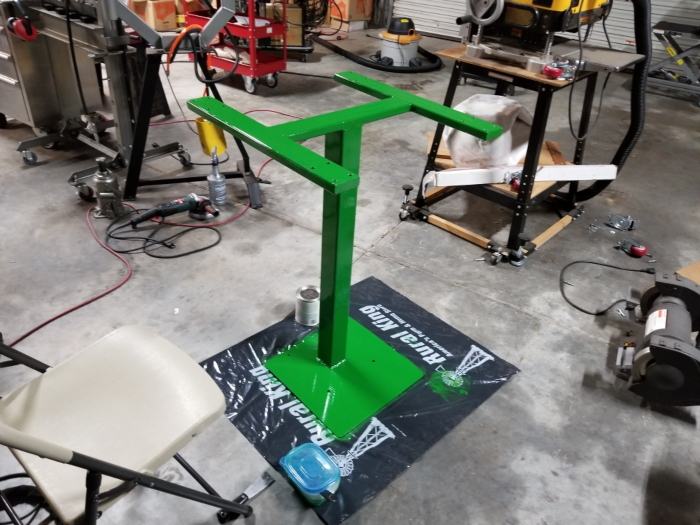
In other news, I’m starting to wonder if painting is the hardest thing a human being can do. Yesterday I wrote about the problems I was having, getting my grinder’s mobile base painted. I learned that environmentalist meddling had made paints harder to apply successfully. I had problems with persistent brush marks.
I had the stand sitting on its top, which already had several coats of dry paint on it. I turned it over last night to finish the top, and I found that paint had mysteriously flowed over the edge of the top and onto the surface. The top was resting on a garbage bag I used to cover the floor, and I found big areas where the new paint had glued the top to the bag.
I applied the paint very sparingly, so you can imagine how surprised I was to see that it had found its way around the edge of the top and up to two inches into it.
I removed the damaged paint, applied primer, and quit. Today I painted the top again. Will it work? I don’t know. The paint will stick, but I don’t know if I can get the new paint to level with the old. I may have to strip the entire top.
I’m wondering if I can wet-sand it. It would be less aggravation. I could get some 300-grit paper, sand the paint, paint it again, and then repeat a couple of times. Maybe it would work. It works on car paint.
I also found that the tops of the bottom forks of the base didn’t look as good as the bottoms, which no one will ever see. Frustrating. If you’re going to have a really nice area on a painted project, you want it to be an area everyone sees.
I really dislike painting. Things keep going wrong. Even when the paint seems okay, tiny bits of stuff fall on it while its drying, just to mess with me. I have the base indoors where there should be very little material falling through the air, but it still happens.
It makes me wonder how anyone paints anything successfully without a special clean room no consumer can afford.
I should go get some truck bed coating, strip the top of the base, apply the coating, and tell people I planned to do it that way from the start. Yes…I wanted a green base with a black top. That was my plan. These aren’t the droids you’re looking for.
In any case, to recap, it works like this: time to cut and weld mobile base nearly perfectly: 8 hours. Time to paint mobile base very badly: two weeks, not including the time it actually takes hardware store paint to harden fully, which is another three weeks.
Something is wrong there.
I should find a powder-coating place and let them coat my next project. If it costs 50 bucks, it will be well worth it. I had crazy ideas about making my own projects cheaply. Now I doubt that’s possible, except for people who have been painting for 20 years. I can make projects inexpensively, but only if I don’t mind terrible, blobby paint.
I’m going to move my painting projects to the garage. I think the air there is better than it is in the shop, and my projects will be far from my other tools, so I will be able to use them while I wait for paint to dry. Right now, I’m afraid to do anything in the workshop. I might send crud flying onto my perpetually wet paint.
If I ever figure this out, I will blog it. There must be an answer out there somewhere.
“Progressive” Used to Mean Something Completely Different
I have some exciting things to tell you about painting. I’m not sure if they’re true. But I was excited to learn them nonetheless.
I am making a mobile pedestal for my 8″ bench grinder. I have been at it for two weeks. Cutting and welding the metal was a one-day job, even though I made it last a little longer than that. Painting is what’s holding me back now. It takes forever to paint things.
I haven’t been at it continuously since I started. I took several days off to visit North Carolina. Still, even if I had worked at it nonstop, it would have taken a long time. Painting things is very hard, and there is no way to rush it.
I can machine pretty well. I am an okay MIG welder. I can do basic woodworking. Painting, on the other hand, is impossible. Anyone can grab a can of Krylon, spray big globs of paint on an unprimed project, and come away an hour later with a conglomeration of globs and runs that starts to peel within 6 months. Painting well is another matter. It’s highly skilled labor.
Painting house interiors is the exception to the rule. It’s very simple, and interior latex is very cooperative and easy to apply. Painting furniture and metal objects is crazy hard.
I decided to paint my base John Deere green. I think John Deere is run by, well…by people I would not want to associate with on a social basis. I did not choose the color because I liked the company. I chose it because I knew Rust-Oleum tractor paint was pretty tough, and John Deere green was the color that stood out from among the choices.
I made sure my steel was free of rust, and I cleaned it with acetone. I primed it using the recommended spray primer. Right away, I had problems. Either the primer went on like dust and covered nothing, or it ran. I had to make quite a few corrections.
Once the priming was done, I got myself a quart of paint, plus a quart of the spray equivalent in case I needed it, and I started.
The actual paint went on much more easily than the primer, probably because I used a brush. I’m starting to think that rattle-can paint doesn’t really work. It always runs or takes 15 coats. A brush gives you a lot more control, and you don’t end up wasting 75% of your paint on overspray. When you use spray cans, you’re lucky if half of the paint lands on the project.
Once the paint was on, I thought I was doing great, but when it dried, I had brush marks.
Quality paint is self-leveling. This means that even if it has brush marks when you apply it, it smooths itself out and lies flat as it dries. I have been reading up, and it looks like the EPA has put an end to all that. For some reason, they don’t like self-leveling paint. Now paint dries faster than it used to, and the brush marks are preserved forever.
In other words, unbelievably, the brush marks were not my fault.
It took a lot of Googling, but I finally found what some people think is the answer. You can probably guess what it is. It’s an additive. Lumpy paint is like ethanol-free gas. You pay for it and think you’re all set, and then you find out you have to add things to it in order to make it work.
An Australian company named Flood sells a product called Penetrol. I had never heard of it until I started this project. A reader named Tom mentioned it in a comment, but he was talking about some use that had nothing to do with brush marks. Penetrol apparently prevents paint from forming a brush-mark-preserving skin.
Tom was commenting on some welding I did, and he said it looked “like crap.” I feel that was totally unwarranted and also, arguably, a slight exaggeration. I spent some time with my Bernie Sanders and My Little Pony do Burning Man coloring book, however, and I got over it. Also, I welded plates over my worst welds and ground everything smooth, so I don’t really care how the old welds looked.
Penetrol costs almost as much as paint, of course. Environmentalism never costs you LESS money.
I got some Penetrol today, and I mixed it into my paint at a ratio of around 1:10. It seems to work. When I left the shop, the paint looked like it was flattening out. Even the areas that already had dried-in brush marks looked considerably better.
Tomorrow, I’ll look again, and that will tell me whether Penetrol actually did the job.
Environmentalists are unpopular with many people, for very good reason. They are heartless authoritarians. They tell themselves, “I am morally superior, so I don’t have to accommodate the needs of other people. I will make this rule, and if other people suffer, that’s too bad.” They don’t prepare us. They don’t inform us. They just apply their draconian measures, and the rest of us take it in the neck.
Here’s what they should have done. They should have advised manufacturers to put warnings on their labels. “NO LONGER SELF-LEVELING.” “USE ADDITIVE TO PREVENT BRUSH MARKS.” How hard would that have been? Not very.
You can’t get rid of deep brush marks once you have them. If you try to sand them out, you end up going through the paint completely so you have to redo the whole job. It would have been nice to have some idea what was in store for me so I could have prepared.
You would think Rust-Oleum would have warned customers instead of just hoping we didn’t notice.
Penetrol seems to make paint somewhat more runny. I had to correct some unexpected drips. Still, it may work out to be better than tractor paint all by itself.
I’m going to guess that the EPA hates Penetrol. It’s a workaround. I’m sure the bureaucrats, who never paint anything or have to answer to angry customers (or do anything resembling actual work in commerce), don’t like it when people weasel around their unreasonable regulations. Penetrol increases the volatile organic compounds paint releases, and VOC’s are probably the reason paint was debased to begin with.
Maybe I’m wrong about what happened to paint, but it sounds plausible, and I found evidence for the theory while surfing the web.
I wish greenies would wait for new technology that works before getting rid of important, useful products. Remember how they killed incandescent bulbs? Thousands of American factory workers were fired from their jobs, and we were forced to buy curly fluorescent bulbs that a) cost too much, b) took a solid minute to start working, c) were full of mercury, d) had very short lives, and e) were made in China, partly because of the environmental problems involved in manufacturing them.
LED’s came along a few years later. They were cheaper, they worked even better than incandescent bulbs, they were made to last a very long time, and they used very little electricity. Why couldn’t the EPA wait for technology to catch up to its aspirations? Because…leftism. Leftism is always about the sizzle, not the steak. If it gives people the superficial but erroneous impression that you’re helping Mother Gaia, it must be right, even if it’s unbelievably and obviously wrong.
Leftists’ goals are always, always urgent. They can never wait for anything.
Was there a volatile organic compound crisis that simply could not wait until paint formulations that actually worked were developed? If so, I did not notice it.
My wild guess is that we will have paint that works within a couple of years. Until then, people all over the country will be cursing and blaming themselves, wondering why their favorite products now produce projects that look like hammered poo.
Here’s something else that’s interesting: I’m reading that some people have concluded that priming metal projects is actually detrimental. Can that be true? Surely Rust-Oleum wouldn’t make me spend three days priming a project when they know perfectly well I can just apply the paint and have perfect (but for the brush marks) results.
I should paint a piece of bare steel while I’m doing this, just to see what happens. I can throw it out behind the shop, let the rain and sun hit it, and check on it from time to time.
While I’m on the subject of painting, I think paint makers should put realistic instructions on their cans. For example, they should quit saying paint dries thoroughly in 24 hours when it actually stays soft for at least a couple of weeks. A few years back, I painted a project and thought it looked great. Then I let something touch it a few days later, and the paint sort of slid in the area where the touching occurred. The paint was Rust-Oleum hammered finish spray paint. It takes forever to get hard. I just used it again and had the same problem.
I have read that Penetrol will serve as a primer. They say it’s so good you can actually paint bare steel with it and then leave it as it is, outdoors. I don’t know if I should try priming with it next time, or if I should forget about priming altogether.
I guess the summary here is a) painting is hard, b) paint takes weeks to dry thoroughly, c) you need an additive to get rid of brush marks, and d) if you think you’re going to weld something up today, paint it tomorrow, and use it the day after, you are living in a fool’s paradise.
Actually, there is more. I know of a product which is better than paint OR Penetrol, so I’ll toss it out there. Duplicolor truck bed coating. It’s really a type of spray paint. I’ve used it on mobile bases. It sprays just like paint, it dries quickly, and it becomes so hard and tough it can be difficult to tell it from mill scale. I think it only comes in black, however. Anyway, if the EPA hasn’t ruined it, it’s a fantastic product.
Another interesting product: CRC Rust Converter. Apply it to rusted metal, and it forms a tough black coating. AVOID IT. Why? Because it can give off phosgene gas when you heat it. Extremely dangerous. I don’t mean “You might inhale two micrograms of VOC’s” dangerous. I mean actual danger of observable real-world harm. Phosgene will do severe, permanent lung damage the first time you inhale it. What if you use CRC Rust Converter, forget about it, and then repurpose the steel 5 years later? You might find yourself welding it and then moving into an oxygen tent.
I hope the mobile base looks good tomorrow. Regardless, I’m going to keep painting until none of the white primer is visible, and then I’m going to mount the bench grinder on the base. If it’s not perfect, I’ll consider it a lesson learned, and I’ll do better when I make my next project.
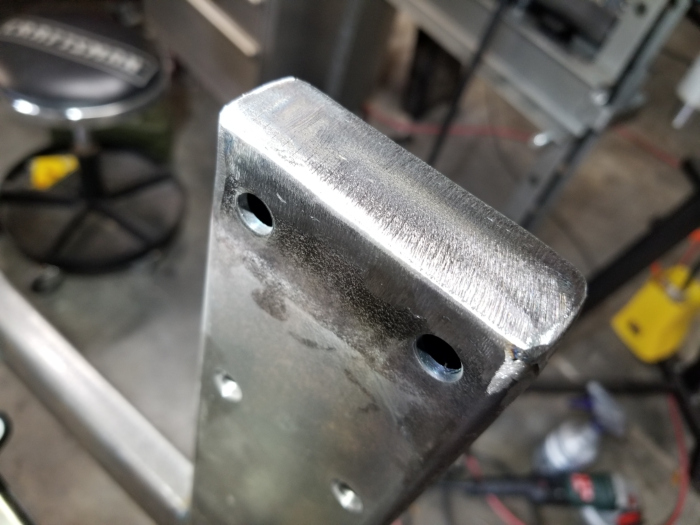
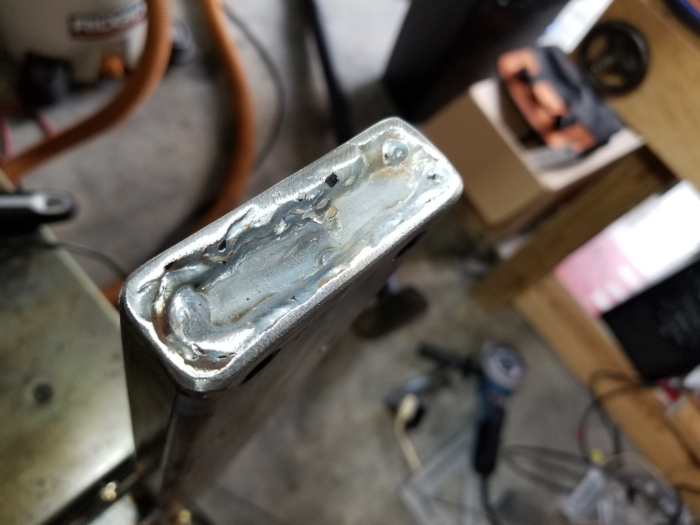
Today I succumbed to perfectionism. I welded metal caps over the ends of the tubes in the foot of my new grinder pedestal, and I faired the new metal in so it would look original.
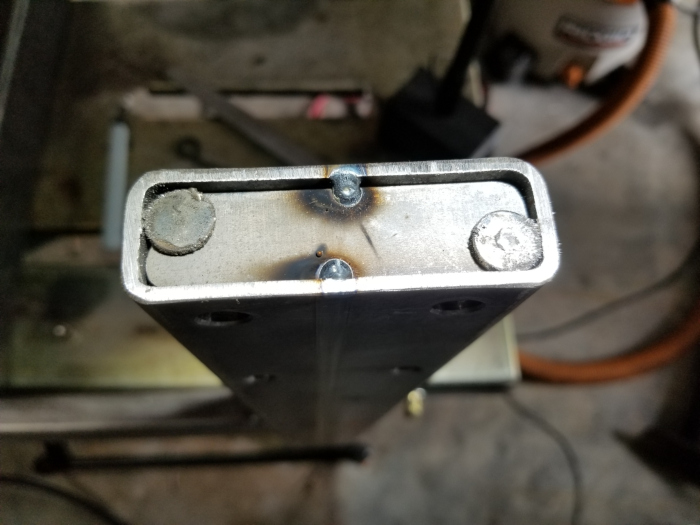
I made the pedestal over the weekend. I thought I was done with the metalworking last night, but I kept thinking about the raggedy ends on tubes. I couldn’t take it. I had to do something. This was AFTER I had already welded plates inside the ends of the tubes.
At first I planned to grind the ends of the tubes flush with the plates I had already welded inside them, but I saw that the tubes were too short to permit this. The casters attach with bolts, and the bolt holes are close to the ends of the tubes. If I had ground the tubes shorter, the washers under the bolt heads would have protruded past the tubes. That wouldn’t do.
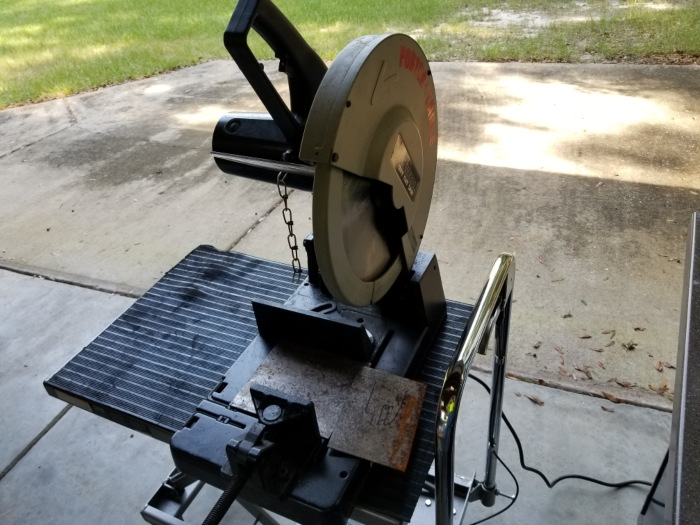
I cut 4 pieces of 1″ x 1/8″ bar. I used tiny magnets to hold each one on the end of a tube. I welded them in place, and then I ground everything down with an angle grinder and an amazing Walter flap disk. These disks are wonderful. They eat metal like crazy, they leave a good finish, and you can trim them to get more life out of them.
This little project illustrates something I love about metal. It was the world’s first plastic. You can nail and screw wood together, but you can’t cast or mold wood, and you can’t put wood back once you cut it off. When you work metal, you can do just about anything. Cast, mold, bend, and weld. If you cut something too short, you can make it long again, as long as the type of metal permits it.
When you look at these tubes from outside, it looks like they began life as solid bars. You can’t tell the metal on the ends was added to them. It looks like it was always there.
If you opened them up, you would find two layers of welded-in plate, plus some nasty-looking weld beads. Doesn’t matter. No one is going to open them up.
Now I have peace. I don’t have to worry about bugs crawling in and out of my grinder stand. They have no way in. I should also note that the column is hermetically sealed with weld. If archaeologists ever want to find out how my workshop smelled in 2019, all they’ll have to do is open the column. It’s full of captive 2019 air.
I should have done this before welding the bottom of the pedestal together. It would have been a lot easier.
Tomorrow, I plan to throw a coat or two of primer on the steel. If that goes well, I can get started on paint.
I’m bummed out now because I’m out of welding projects. I think I need to get to work on an arbor press stand. My arbor press is on the workshop floor, in the way. That has to change.
Yesterday I was excited because I was able to see what I was welding. I’ve been taking vitamin A, and it appears that I can see weld puddles better now. Today was frustrating, because I had trouble seeing again. It was so humid in the shop, my glasses and helmet fogged up as soon as I put them on. Can you believe that? I finally get to where I can see what I’m doing, and the weather steps in to take away my joy.
Guess I’ll design an arbor press stand and get to work.
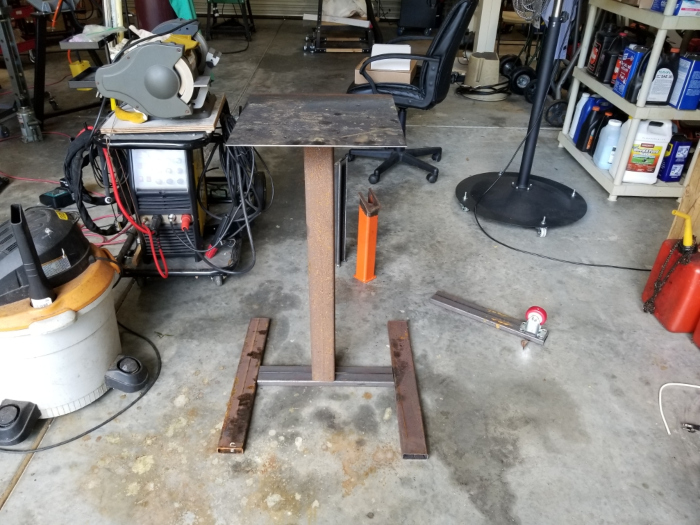
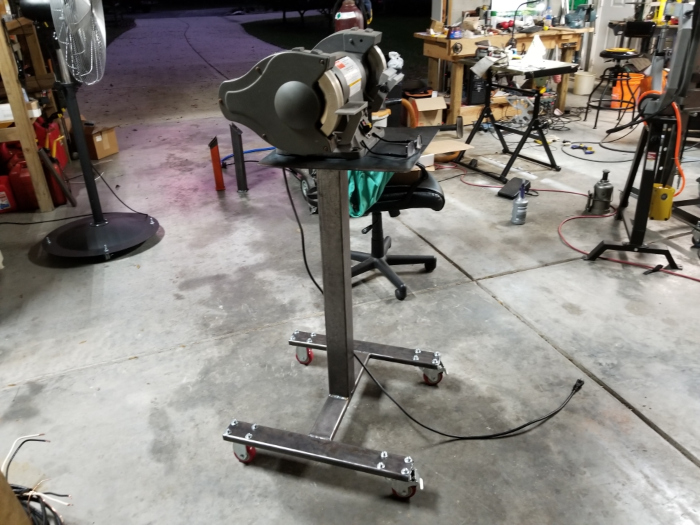
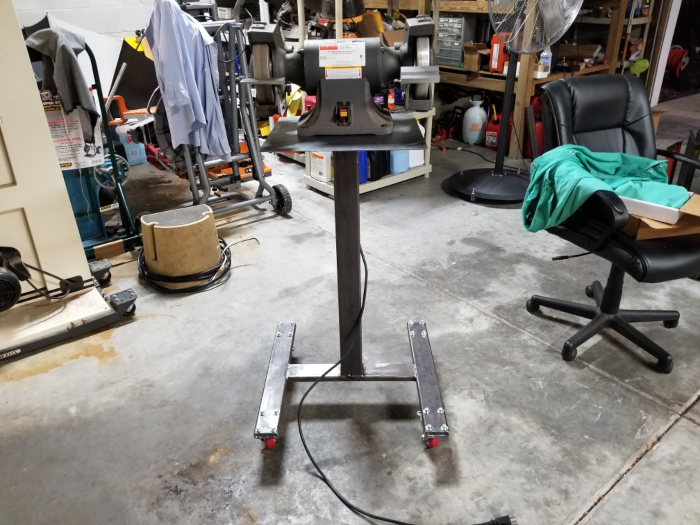
Yesterday I finished building my new bench grinder pedestal. I exaggerate somewhat. It still needs to be painted, and I’m thinking of grinding some metal down to make it look better.
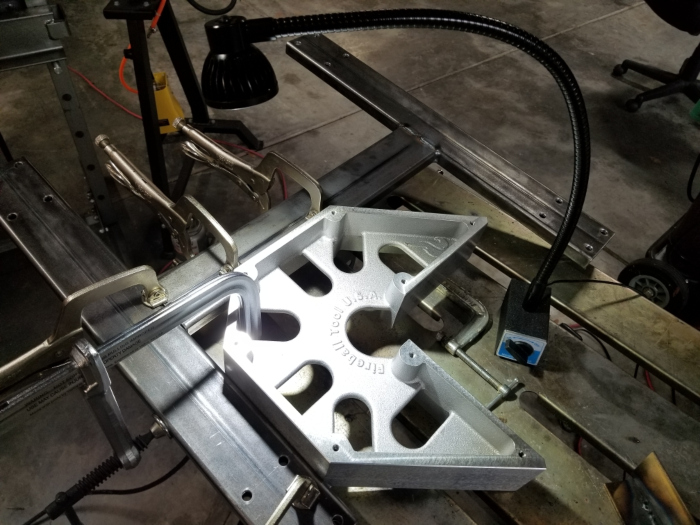
It was a big job. Took two sessions over two days. I used aluminum welding squares made by Fireball Tool.
For a long time, I only had one welder. I had a Lincoln PowerMIG 180C, on a Lincoln cart. The cart was not good. It didn’t really fit the welder. I upgraded to a bigger two-tier cart from Eastwood. The Eastwood cart had a defective part, so I complained. They sent me a second cart for nothing. I fixed the defective cart, and I used it to hold my plasma cutter and bench grinder.
The cart was okay, but it was very low to the ground, and it was bulky and hard to maneuver. This is why I built a grinder pedestal. I wanted something higher and more nimble.
I didn’t want a heavy pedestal. One of the pitfalls amateur fabricators fall into is the belief that heavier is always better. In reality, one of the big goals of competent engineering is to reduce material waste. If you’re building, say, metal shelves, you don’t want to spend $50 per unit on steel when you can spend $15. I could have gone with heavy tubing, but I decided to use rectangular tubing with 1/8″ walls.
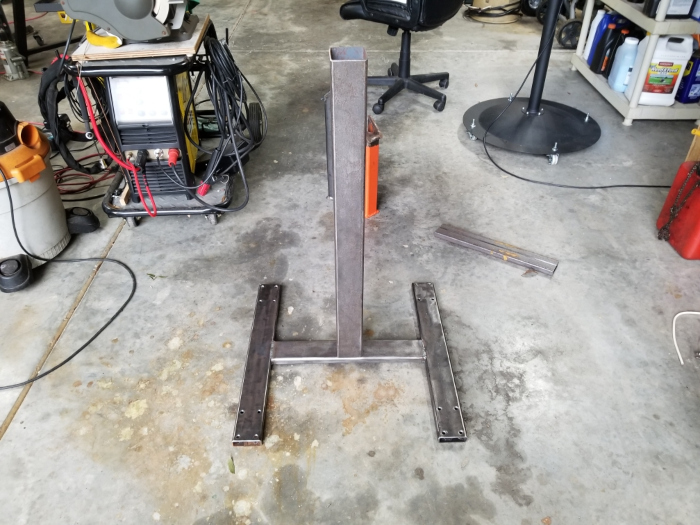
The pedestal only has one column. I used 3″ x 3″ square tubing. This stuff will support thousands of pounds, so the 90 or so pounds it will carry won’t challenge it at all. The only thing to be concerned about was rigidity, and it’s pretty hard to flex a 3″-square tube by pushing a piece of metal into a grinding wheel. By “hard,” I mean, “clearly impossible.”
You can buy cast iron pedestals that probably have walls 1/4″ thick. It sounds good when you’re telling your buddies about your cool new “beefy” pedestal, but if you make a pedestal that way, you’ve added weight and cost without realizing any benefit. You’ll regret it the first time you have to move it.
Speaking of moving, I was determined to have casters. The more things you put on wheels, the bigger your shop will seem. I had a set of casters on hand already, so I was ready to go.
For the top, I planned to use a 10″ square of 1/8″ plate. The metal dealer was not able to provide that when I showed up late on Friday, but they sold me a 16″ square that was a drop, so I saved some money, and I decided not to cut it down, because I could use the extra area for things if the need arose. Some people like to clamp fixtures in front of their grinding pedestals.
I have been afraid to weld complicated objects like this because of an experience I had with my arbor press. I made a stand for it, using scrap taken from a door at my dad’s old house. I lined the parts up well when I welded them, but when I stood the stand up, it wobbled. It was warped. I didn’t know metal would warp that badly when welded, and I didn’t know how to prevent it.
When you weld little things, warpage usually doesn’t matter. If you put a 5° bend in a part 8″ long, you probably won’t even see it. In a part three feet long, it’s different.
I want to create a welding table, or at least a set of legs and a frame for one. One of the purposes of a welding table is to provide a flat reference surface for projects. A lot of people use their garage floors, but concrete floors aren’t really flat. I had a problem. I wanted a welding table in order to allow me to weld things flat and square, but I needed a welding table in order to create a flat and square base…for the welding table.
There are various ways to get around this problem. You can make your own jigs, which may or may not work. I chose the easy way. I bought myself two welding squares.
A little company named Fireball Tool produces a lot of innovative items for tool users. They make welding squares cast from thick iron and aluminum. They machine the castings to get flat surfaces and correct angles. You can clamp things to the squares before you weld them, and the squares will help them remain aligned until they cool.
Because the squares are cast iron and aluminum, welding spatter doesn’t stick to them very well. This is a plus.
I didn’t see why anyone would want cast iron. It’s heavy, it rusts, and it shatters. Sooner or later, I’ll drop any tool you give me. I don’t want to spend a lot of money on a square and then destroy it. An aluminum square may deform, but I have a milling machine and welders, so I can repair aluminum. Welding cast iron is not easy.
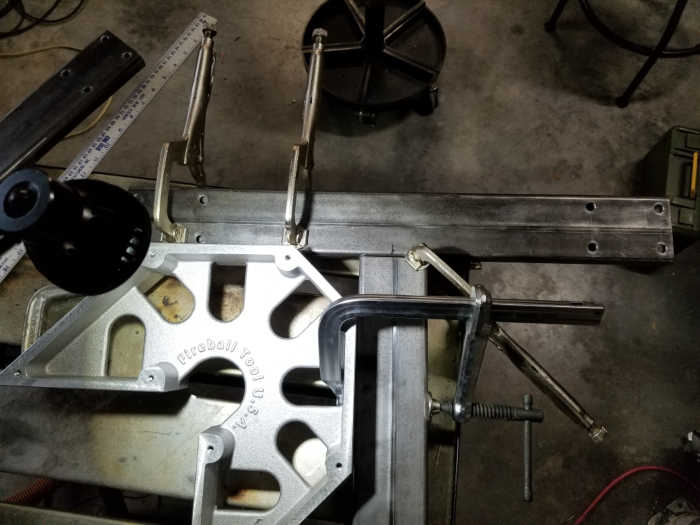
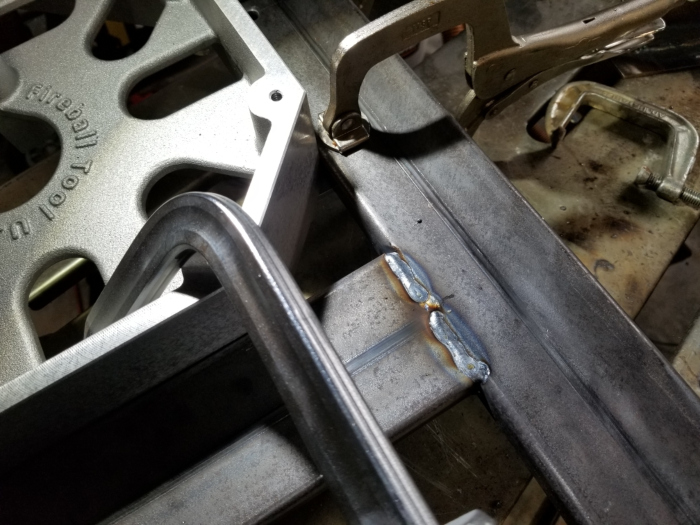
They make two main types of squares. One is an L-shape with a sharp outer corner. The problem with this is that the outer corner fits in the inner corner of whatever you’re clamping. You can’t get in there to weld. Their other product, the Mega Square, has another side, cut at 45° to the others, where the L-shaped square has a corner. You’ll understand when you see the photos. When you clamp steel to two sides of the Mega Square at 90° to each other, you can reach into the inside corner to weld.
I ordered two different sizes, figuring one would always be too small and the other would always be too big.
I chose to use my Harbor Freight Titanium Unlimited 200 multi-process welder. It’s extremely handy. I picked MIG because it’s the type of welding I do best.
First, I laid the metal out without welding it to see if everything looked right. It seemed okay.
After that, I took an angle grinder and knot wheel and cleaned most of the rust off the steel. I then cleaned the parts with window cleaner. Raw steel is always covered with rust and black dust, so if you clean it before you work with it, you can avoid a lot of hand-washing and laundry problems.
I followed the angle grinder with the belt grinder, deburring everything to get rid of sharp edges. I beveled things so the weld beads would fit in better. I wasn’t because I was worried about penetration. This project will never see significant stress. It doesn’t need perfect welds. The bevels will help assure that the welds are deep and strong, but that wasn’t the purpose.
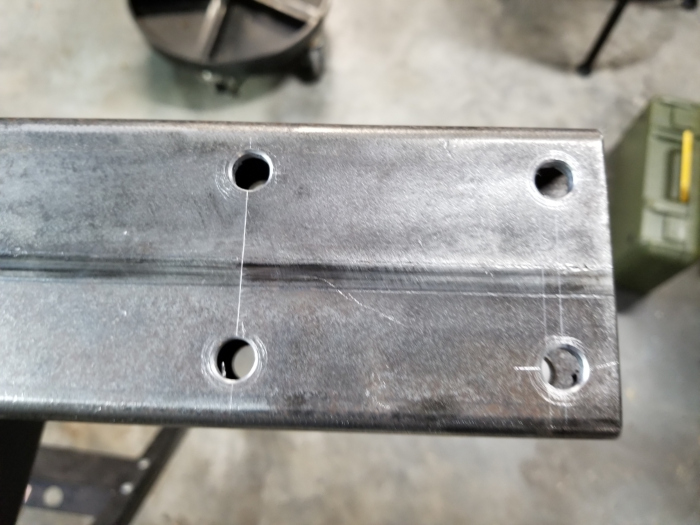
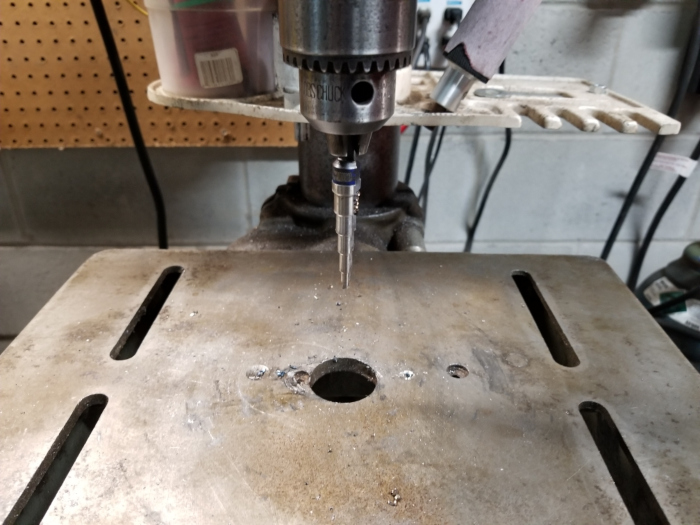
After the metal was cleaned up, I drilled holes for the casters. If I had waited until the pedestal was assembled, I would not have been able to get the parts onto the drill press, so I had to do it early. I used a machinist’s square, a carbide scribe, and a center punch to locate the holes. I started them with a center drill and finished them with a unibit. These things are great. It cut through both walls cleanly and accurately, and it even beveled and deburred the holes.
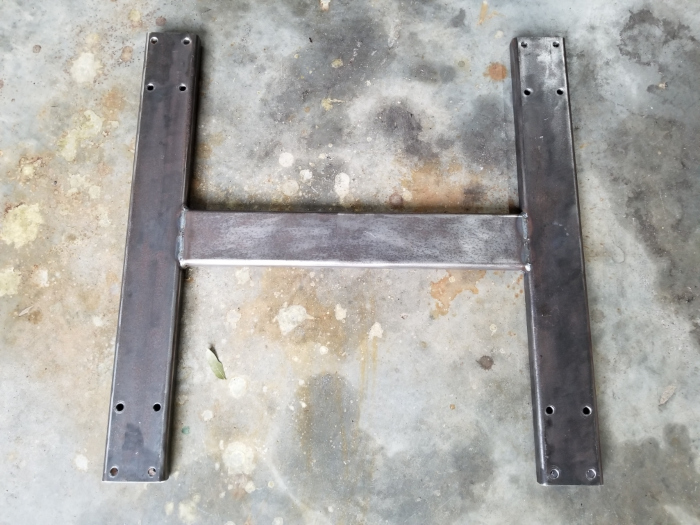
With all this done, I was ready to weld. I clamped two pieces of steel onto the big Mega Square and let fly. It worked perfectly. No distortion at all after the parts cooled.
It looks like there is hope I can build a table frame after all.
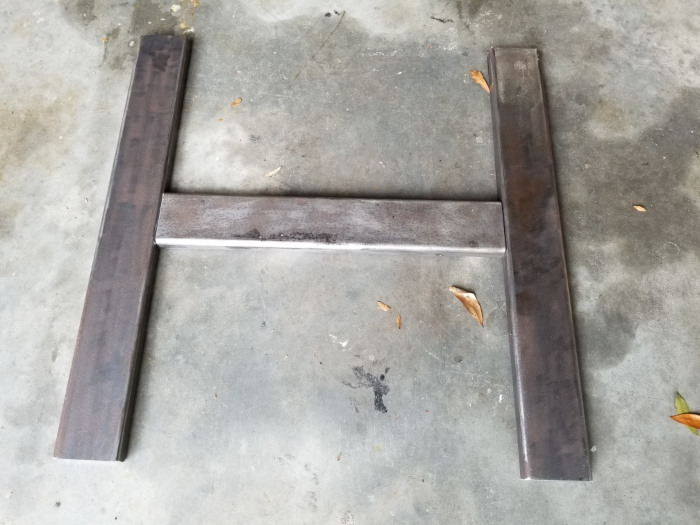
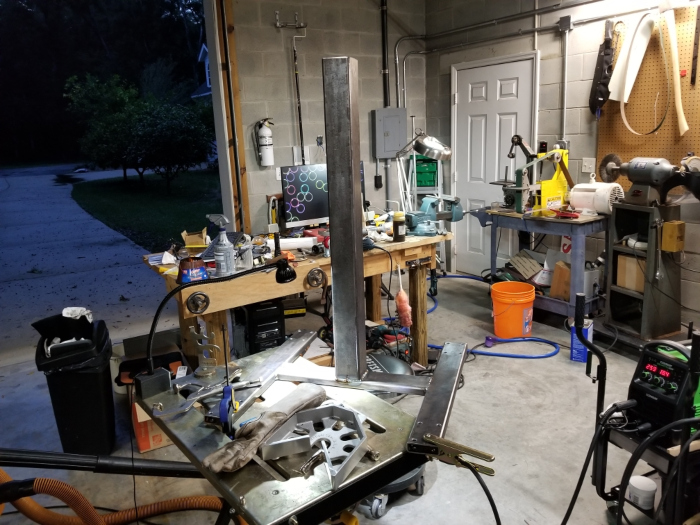
I followed the same process with the other side of the base, and then I put the whole mess on the table, clamped it as well as I could, and welded the column in place.
Everything went well, but I ended up bowing the piece the column attached to. I welded it pretty quickly, I didn’t let it cool between segments, and I didn’t clamp it straight.
The bow didn’t really matter. It was maybe 1/4″ over two feet. The bowed part was not going to be on the floor, so it could not make the pedestal rock. The pedestal was going to have a caster at each corner with the bowed part centered between them about 4″ off the floor. Still, I wanted to see if I could fix it.
I had heard about acetylene straightening. This is not the same thing as heating a piece of metal so you can bend it. When you do acetylene straightening, you heat a small area of a part just until it begins to melt. This expands the metal in thickness. When it contracts, it stays thicker than the surrounding metal, but it contracts in the plane of the wall you heated. This means it bends the part in the direction of the side you heated.
If you think you’ve done flame straightening with a propane or MAPP torch, you don’t know what flame straightening is. Read up on it. You can’t do it with propane or MAPP alone.
I have an acetylene outfit, but I don’t have tanks yet because I’m waiting for a good deal. It occurred to me that a TIG torch ought to work. I turned the pedestal upside-down, drew lines where I wanted to apply heat, and gave it a whirl. It worked great. The bottom tube is now straight. There is a tiny bit of bend between the center tube and a tube that has casters in it, but it’s so small, I felt that trying to fix it would be obsessive.
The TIG torch left some lumps on the steel, so I used a flap disk to make them less lumpy. They’re on the underside of the pedestal, so no one will see them.
Attaching the top plate was hard. I could not use a square. I had to grind the top of the column carefully to make sure it was absolutely level. Then I attached it to the plate with a magnet, and I tacked the plate in place while sitting on the floor underneath it.
The top plate now has a slight bow. I decided not to try to prevent it, because I knew it would be forced straight when I bolted the grinder to it.
Now I had a pedestal, but I was not satisfied with the open ends on the bottom tubes. I made little plates and welded them in there.
This was scary, because I have had serious problems with weld control. For years, it has been hard for me to see anything but the arc when I welded.
A few weeks back, it occurred to me that I might have a vitamin A deficiency. I have had some gallbladder issues, and the gallbladder is what allows you to digest fat. Vitamins A, D, E, and K are fat-soluble, so if you don’t absorb fat, you can become deficient. I got myself some vitamin A and some lecithin, which emulsifies fat. I started talking both every day.
When I welded yesterday, I was able to see what I was doing. The difference was tremendous. Was it the vitamin A? I don’t know. I just know I’m not afraid to weld things I would not have touched a year ago. I had no problems welding the little plates in, apart from basic lack of skill.
I held the plates in with little magnets when I tacked them. I can’t tell you how useful these are for welding.
I may take the grinder and grind the ends of the tubes smooth, so it looks like they were never open.
I attached the casters and the grinder. Of course, I found that two of my screw holes were in the wrong places. This kind of thing always happens. I’m going to have to put two new holes in the top plate. I may weld the old ones closed, just because I can.
The pedestal is fantastic. You can jump on it without flexing it. It rolls very easily. The brakes hold it very firmly when you need to use the grinder. The platform is around 40″ off the floor, so the grinder is at a very convenient height. I love it.
I may add features. I would like to have a steel loop that holds a water bowl.
I bought primer and paint. I’m going to paint it forest green. This will take several days because the paint takes forever to cure. When I’m done, I’ll be sitting pretty. I’ll have a very nice stand I can move with ease, and I’ll be one step closer to getting rid of my extra Eastwood cart. My plasma cutter is sitting on it now, and it works, but I want something less bulky. Maybe another Harbor Freight Vulcan cart. They’re wonderful.
I should have my machine tools here in two weeks. I still have some wiring to do.
I think I’m going to buy a welding table top and forget about making one. The premade ones are just too good. I’ll be satisfied with fabricating a frame to hold it.
Things are looking good in the shop.
In other news, I had a pain in my wrist and hand this morning, and after watching some healing videos, I prayed for healing and commanded myself to be healed. The pain is almost totally gone. Really neat.
It came out fantastic. I wish I could say it was cheap, too, but I spent over $110 on materials. It’s great, though. You can ride around on it without making it flex.
It’s a bench grinder pedestal, in case that’s not obvious.
I still do not have a quote on moving my machine tools here, but I am closer. A guy from a rigging company just came by and looked the place over to see how hard it would be to get trucks in here.
I said something about being eager to cut all ties with Miami, and we started talking. The poor guy was born in Hialeah.
HIALEAH.
Cubans have a word: “chusma.” It’s sort of like “redneck.” When a southerner calls you a redneck, he means you’re the kind of person he doesn’t want marrying into his family. It’s not a compliment. It’s okay if people like you show up to lay sod or fix the roof, but you better not be on the property after sundown. A chusma is very similar. A chusma is a person with no class whatsoever.
Hialeah is the hub of chusma activity in North America. Cubans make fun of Hialeah all the time. Cuban women make fun of the way Hialeah women do their nails and hair. It’s a running joke in Miami.
This poor guy was BORN there.
Miami is bad enough. Hialeah…unthinkable.
He said he left after an incident at his home. He was working on his truck, and some kid in a Japanese car tore through his lawn, like he wasn’t even there.
I have seen these kids many times. It’s the weirdest thing. I can’t explain it, but they’re very common. It’s always a scrawny kid with a very small, very round head, shaved or nearly so. Their heads look like little coconuts. They drive tiny Japanese cars which are very slow, but the cars always have aftermarket tailpipes as big around as coffee cans. They make a terrible noise as they accelerate incredibly slowly.
Because they’re so slow, you get to enjoy the noise for a long time. It takes them forever to pull away.
I don’t know where these kids come from. It’s like there’s a factory somewhere. Their heads are always round and tiny. They never have much hair. They always have that crazy tailpipe. Their cars are always unbelievably slow. They rig them up to make noise to compensate.
I don’t think I’ve ever seen one of these kids on foot. Just in Japanese cars. They don’t even look like other Cubans. It’s like they materialize briefly while visiting from a hell dimension full of Honda Preludes with 300,000 miles.
Anyway, I’m pretty sure the machine-moving guy got a visit from the mysterious coconut clan.
He told me something interesting. He said the heavy-hauling business was more active than he had ever seen it. I had to ask him: was it because businesses were being torn apart, or was it because they were being started?
During the Obama years, you could go on Ebay and find dozens of bench grinders, lathes, saws, and so on for very good prices. The economy was not that great, so people were selling tools. It got better toward the end, except for people like me, who like cheap tools.
News heads like to tell us Trump is destroying the world. If Trump mailed every person in America a gold bar, they would say he was trying to poison us with heavy metal. I asked the machine-moving guy my questions because I wanted to find out the truth about the economy.
He said construction was keeping truckers busy. It’s moving frantically right now. He also pointed out that construction moves in booms and busts, so he expects a bust.
Have you noticed that a huge percentage of tractor trailers have signs on them saying, “WE’RE HIRING”? I don’t recall seeing that before Trump.
Anyway, whatever may be in store at the end of the boom, things appear to be going pretty well under Trump at the moment.
He told me he can get stuff moved in 48 hours, from the time the order is placed. That’s wonderful. I want the machines here NOW NOW NOW.
Actually, I want them here in 2017. No, 1975.
I probably won’t be able to do anything until week after next, but as soon as I can, I will get the ball rolling. Can’t wait.
In even better news, I now have a contract to sell my last bit of Miami real estate which isn’t income-producing. God willing, it will be gone by the new year. Maybe considerably sooner.
Once this property is gone, I will think about moving north and getting rid of everything else I have in South Florida.
It amazes me that people told me I would miss Miami. I hate Miami more every day. The longer I live in Ocala, the more I love Ocala and hate Miami. I haven’t missed Miami for one second. It would be like missing dysentery.
No one here misses Miami. I’m not the only refugee here. The others don’t miss Miami. I have friends who moved to Kissimmee and Orlando. They don’t miss Miami. My friends who moved to Pompano Beach don’t miss Miami.
My friend in Orlando says he feels sick when he visits Miami. He can’t stand it.
No one who moves ANYWHERE misses Miami. Maybe Cubans do, but I’ll bet they don’t. They pump Miami up when they live there, but they probably change their tune when they’ve lived anywhere else.
It will be so beautiful, watching the remaining cords snap. The big ones were houses that produced no income, sucked up money, and presented problems all year round. The little cords aren’t that bad, but I still want to cut them.
Today I bought steel for a bench grinder stand. That’s my big weekend project. I’m really looking forward to doing some metalworking. It will be even better when I have a lathe and mill so I can do more stuff.
The next time you hear from me, my bench grinder may be riding in style.
I feel like God put me here to heal. I’m getting over my family, Miami, the putrefaction of American culture…I was going to make a long list, but that’s about it.
If things are this good only two years into the process, how good will they be in 2025?
Woody Allen once said, “Eighty percent of success is showing up.” How true that is.
I can’t tell you how many times I’ve contacted someone with a business proposition and received no response or a response so late it didn’t matter. Also, I know a lot of working-class people, and I’ve noticed they don’t respond to texts, answer the phone, or show up when they say they will. I believe this is one of the main reasons they live from hand to mouth.
This week I started calling rigging companies to see if I could find someone to move my lathe and milling machine to my home in Ocala. So far, out of four companies, one has responded. They don’t sound too good, but at least they proved they’re conscious, so they may end up with the job.
Another company just called. I’m up to two!
Before I started calling these companies, I talked to a big outfit in Miami. My dad used to be their labor attorney. Very nice people. They moved my lathe into my shop in Miami for nothing. They want $4000 to move my machines here, so I feel like there is probably someone out there who will do it cheaper. Some companies don’t have locations near both Miami and Ocala, so they would have to charge to send more things longer distances. For example, one company said they would have to send two trucks from Tampa to Miami to pick up the machinery. I found a company that has locations in Miami and Ocala, so I’m hoping they will be able to use different crews on both ends and save me cash.
It will be wonderful having machine tools again. It will be wonderful having one more tie to Miami severed permanently. I’m in the process of selling a house there, and once it goes, I will have no place to lay my head in Dade County. I truly look forward to having to rent a hotel room if I ever have to visit again. I hope I never have to visit, though. That would be even better.
One of the things I’ve really missed is drilling holes accurately. I have an industrial drill press which cost a fortune new in the 1960’s or 70’s, but once you’ve used a mill, it’s hard to take any drill press seriously. A mill does everything a drill press does, much, much better. I’m sick of using punches to mark holes and doing my best and still having holes a millimeter away from where I want them.
I am considering building a welding table. I would want to mill the top flat. I can do that easily with a milling machine. Without one, it would be like using a teaspoon to plant a tree.
I considered buying a trailer and moving the machines myself, but it seems like a bad idea. I would have to spend $2500 on the trailer, and I would have to rent a forklift on both ends of the jobs. I say “jobs” because I would have to make two trips.
I don’t think I’m a good choice to secure a top-heavy 4000-pound machine to a trailer and then drive it around curves. A boat or tractor, sure. Random household junk, no problem. A lathe is another story. It should not be my first or second hauling job.
If I did it myself, I would spend maybe $900 on forklifts, so the total cost, with everything included (fuel, whatever), would approach or top $4000. I would have a nice trailer when it was over, so I figure I would come out $2500 ahead, but I might also have a lathe lying on its side beside the road somewhere.
Getting this stuff moved and dumping the house will put me much closer to feeling free of Miami. I will still have investments there, but they don’t require travel.
What a poisonous place Miami is. It leaves a mark. The other day, I found myself standing behind two Cubans at a store here in Ocala, and I couldn’t wait to get away from them. They’re probably wonderful guys. I don’t care. That’s not the point. They remind me of a place where my family endured decades of defeat and misery. I don’t even like to drive by Cuban restaurants. I haven’t had any type of Cuban food since 2017, and I don’t plan to fix any in the foreseeable future.
The mental association is unpleasant, whether or not it’s rational. If Miami were full of Norwegians, I wouldn’t want to be reminded of them, either.
Every decent person I know in the Dade County area agrees with me. They can’t wait to get out. None of them ever ask me why I don’t like Miami. It’s almost a litmus test. If you like Miami, you’re probably shallow or blind.
My young friend Travis is stuck at the University of Miami until May, and he may have to stay on in Miami for some time after that. He hates the city. He keeps telling me about people he knows who got out. It’s like he’s talking about runaway slaves. They all tell him how much better life is.
Cubans are the only people who like Miami. They moved there from a worse place, and they turned it into a very Cuban-friendly place. They give each other preferential treatment. They don’t have to learn our language or adopt American manners. Many of them don’t know about the rest of the country. They tend to stay put, and they make their kids stay, too. They live in a strange state of blindness. Everyone else wants out, out, out.
By the middle of the last century, southern whites were pretty much gone from Miami. Northerners took their place, but they eventually began following them. Now even some Cubans are fleeing. They don’t like the South Americans who are moving in.
Black people really hate Miami. They’re right. They are treated very, very badly by the dominant Hispanics. Anti-black racism is thick there, and it’s very hard for blacks to find decent work. In a lot of places, black people make racism out to be a much bigger problem than it is, and they are held back by a victim complex, but Miami gives them ample reason to complain.
It’s so nice to be away from voodoo, car horns, traffic, pervasive Spanish, and rudeness. I can’t describe it.
Can’t wait to see those machines sitting in my shop and to receive a closing statement via email. It will be like bathing after simmering in a heated septic tank.
The problem with having a lot of tools is that you spend way too much time building, preparing, modifying, and fixing tools.
Today, I fixed the table saw and the buffer.
A long time ago, I bought a Shark Guard for my table saw. This is a neat clear guard with a fitting on top for a vacuum hose. I like it a lot. It came with splitters in several heights, including a tiny splitter maybe half an inch high.
The guard attaches to the splitter. When you use the tiny splitter, there is nothing to attach the guard to. It’s for those times when you can’t use a guard.
I misplaced my small splitter when I moved away from Miami. Of course, I have needed it since then. I thought about ordering another one, but it looked like it would be pretty costly for a tiny scrap of metal, so I put it off. After all, I’m a tool guy! I can make my own stuff!
I can also procrastinate for two years, but that’s another subject.
Today I made myself a new splitter around 3/4″ high. I had steel plate lying around the shop, I had a belt grinder, yada yada yada. I had no excuse to put it off any longer.
I held one of my tall splitters against the steel and traced the outline with a Sharpie. This gave me something to shoot for. I cut the end with the tracing off the plate, using the dry saw.
Once the sawing was over, I took the workpiece to the belt grinder and cranked it up to 120 Hz. The metal was around 1/8″ thick, so it was not a problem for the grinder. I would guess I put in 15 minutes.
I had to cut a long slot in the metal. This is not something you can do with a belt grinder. It can enlarge slots, but it can’t start them, except in human beings.
I got out my crazy 6″ angle grinder and Walter Zip Wheel and cut the slot. You would be surprised how well a big angle grinder can do delicate work. I roughed the slot out, and then I finished it, for the most part, on the belt grinder.
When that was done, I wanted to round out the bottom of the slot so it looked more like a milled feature than something made with an axe. I got out the Dumore hand grinder and a carbide burr. I mounted the splitter in my vise and rounded the slot.
I then wanted to clean and deburr the splitter using my pedestal buffer, but it wouldn’t turn on. It has an overload protector on it to kill the power when the shaft can’t turn, and the protector had pooped out. I could not get anywhere with it. I decided to use an angle grinder and knot wheel, and the results were excellent.
When I was all done, I had a nice splitter. I installed it in the table saw, and I was happy. Except for having no buffer.
I was advised to open the motor protector up and see if there was something I could fix, like a relay with a bent contact. When I got into it, I saw that it was not very repair-friendly.
I didn’t feel like sacrificing the evening to fix it, so I took the hot wires off of the protector and connected them with a wire nut. Now I can use the switch on the buffer instead of the one on the motor protector.
You don’t really have to have a motor protector on a 3/4-HP buffer. I have a grinder which is essentially the same type of machine, and all it has is a toggle switch. Motors at and above a certain power level need motor starters in order to avoid ruining switches, but my buffer does not. I suppose the protector was there to protect the motor from abuse. Maybe it also tames power surges. I don’t know.
The buffer would cost around $1000 to replace with a new one. I suppose the school system that originally bought it felt the protector would be a good way to keep an expensive machine safe from bored kids in shop class.
I might try to get the protector working, or maybe I’ll buy a used one on Ebay some day. Right now, I can live without it. The buffer, on the other hand, is vital to my sanity. I have to have a running buffer. I have only had it a few months, and I can’t live without it.
When I talk about my reasons for owning tools, I like to say I want to buy whatever it takes so that when I walk out into the shop with a job in mind, there is at least a tiny sliver of hope that I will be able to get it done with the tools I have on hand. That sums it up very well. Today, I got what I wanted. I had two jobs to do, and I was able to get them done without too much straining and improvising. Granted, I didn’t really fix the buffer, but I found out what was wrong, and I got it running.
The saw splitter is installed, and it looks really nice. I may grind it a little smaller.
Yesterday, I got my Jonsered chainsaw running again. Socialism, in the form of ethanol, keeps destroying my small engine carbs, and the Jonsered’s original carb was terminally congested. I bought a Chinese carb and replaced it, but the Chinese carb had a defective spring. I got myself a second Chinese carb, installed it, and got the saw going. It still needs a little tuning, but it will work perfectly.
I haven’t received the sonic cleaner I ordered. I plan to throw the Jonsered carb in it. It might revive it, and if it does, then maybe I’ll be able to use it on future ethanol-defiled carbs in the future and avoid buying an endless succession of new ones.
My little Husqvarna blower is acting anemic. It has never suffocated due to ethanol, unlike the other tools, and I have used additives and so on to keep it healthy, but it looks like its day of reckoning is nearly here. I can try the cleaning machine out on it and find out if I wasted my money.
I’ve been contacting machinery riggers to get quotes on moving my big machines here. Once that’s done, life should be nearly perfect.
Helping the Environment by Buying Big, Electricity-Sucking Carb Cleaners from China
I have sprung for an ultrasonic parts cleaner.
My Jonsered chainsaw pooped out due to the destructive and hard-to-reverse effects of toxic ethanol-polluted fuel. I spend a few bucks on a Chinese carb for it, but I was never able to get the carb adjusted so the saw would run well enough to use.
It was very frustrating. I downloaded official instructions from the manufacturer. If you have a Jonsered with a Zama carb, you may find them useful. They’re very simple.
1. Open the idle screw all the way (turning clockwise).
2. Start the saw.
3. Adjust the L screw until you get maximum speed.
4. Adjust the H screw until you get smooth operation at all speeds.
5. Adjust the idle screw until the saw stops trying to turn the chain at idle.
It’s best to remove the chain before you do these things. The instructions I downloaded said to adjust the idle with the chain in place. Not very smart. You have to hold onto a saw with one hand and turn a screw with the other, while the chain is zipping around at high speed. I don’t know who wrote the instructions. Probably not the smartest engineer the company has.
The saw has a drum that turns the chain, so you can observe the drum instead of the chain while you adjust the idle. Just make the drum stop turning.
That’s all there is to it, but I could not make it work. I tried over and over. I resisted taking it to a repairman, because they would have kept it a month and charged a hundred bucks or more.
A tree fell over in my yard, and I left it there for weeks because I was stubborn. I didn’t want to cut it with my heavy felling saw. I was determined to get the small Jonsered working. I eventually gave up and used the big saw.
Two days ago, I resolved to get the small saw working. I took the carb out, which is a very unpleasant job on the poorly engineered Husqvarna-made Jonsered. I found that a spring on the throttle was in the wrong place. I bent it back into position, but when I reinstalled the carb, it popped back out.
I was not going to spend half a day fighting to get a Chinese spring to behave. I ordered a new carb. This will bring me up to three Jonsered carbs. I should be able to take them and make one that works.
This is the second time I’ve had a problem with a new Chinese carb, but I still recommend them because they’re so cheap and repairmen are so expensive, slow, and inept. You’re actually better off buying a used saw on Craigslist than going to a shop.
Now that I’ve had this issue, I have decided to grit my teeth and get a cleaning machine so there will be some hope of reviving old carbs in the future.
I resisted getting a machine in the past because they cost over a hundred bucks, and they are known to die. I found out they die mainly because people don’t fill the tanks all the way. The transducers expect to work against fluid, and they do something bad–I don’t know what–when you run them without enough liquid. I’m smart enough to put liquid in a tank. I think I can overcome this problem.
I was also reluctant because I didn’t want to deal with the disgusting liquids people use to fill these things. They use all sorts of petroleum products. I didn’t want to have to empty many liters of black, greasy solvent every time I put the machine away.
I learned you don’t have to put solvent in direct contact with the tank. You can put a small amount of solvent in a plastic jar, along with your part, and the machine will clean it through the jar just fine. You put ordinary water in the tank. It never gets dirty, and you never have to pour a huge amount of nasty solvent into a storage container.
Sonic cleaners come from China these days, like everything except air and water. They’re all the same. I bought the least-expensive brand I could find. I hope I don’t have to use it a lot.
I’m going to clean my original Jonsered carb, just to see if it works. I have a couple of other carbs to toss in there. When ethanol inevitably ruins another carb, I’ll try one of my cleaned carbs before I buy Chinese again.
Sonic cleaners are good for lots of things. You can clean jewelry and ammunition cases. It will be nice to have this capability. If it works.
Here’s a tip from someone who has suffered a lot: if your small engine carb dies, and you don’t want to give up on it, take a look at the metering diaphragm. This is a black rubbery looking thing you will find clamped between two plates on the carb. It’s supposed to flex back and forth. Flex it a few times. If you hear any noise at all, throw it out and replace it. They get hard and stop working. A good diaphragm should be so soft it flexes silently.
The Walbro company, a Japanese concern which makes carburetors, has come out with a weird type of metering diaphragm which lasts longer than fabric. They have little spirals of metal in them. Might be worth looking into, if you have a Walbro carb. Your black old-fashioned diaphragm will definitely die, so you might as well look into replacements early.
It’s hard to believe how difficult it is to keep a chainsaw running from one month to the next. They’re as frail and unreliable as racehorses or inbred European royals, so of course, Congress made things worse by forcing us to use debased fuel which can kill the toughest motor ever made.
They should come with two carbs. In fact, it’s a great idea to buy an extra carb when you buy a small-engine tool such as a chainsaw or pressure washer. Why wait for it to break down, when $20 or much less buys you insurance?
Maybe when cars run on 100% ethanol fuel, we can just buy spare engines for them and put them on pallets in our garages. The small $8000 investment will be a small sacrifice in order to appease Mother Gaia.
How much did the ethanol I burned in my small engines help the environment or extend the life of our oil reserves? How much did it hurt the environment and deplete our reserves to manufacture, sell, and deliver the new carbs I’ve bought? Hmm.
The new carbs didn’t just require burning diesel, coal, and gasoline. They required mining and processing ore. They required casting and metalworking. They were made in a country where carburetor factories are about as green as Chernobyl.
Just a little info I feel like passing along.
The ethanol scam needs to end. The only people who like it are deluded environmentalists and spoiled corn farmers.
I think the ultrasonic cleaner will be very handy. If only it ran on coal.