Splitsville
October 23rd, 2019Table Saw Yields to my Might
The problem with having a lot of tools is that you spend way too much time building, preparing, modifying, and fixing tools.
Today, I fixed the table saw and the buffer.
A long time ago, I bought a Shark Guard for my table saw. This is a neat clear guard with a fitting on top for a vacuum hose. I like it a lot. It came with splitters in several heights, including a tiny splitter maybe half an inch high.
The guard attaches to the splitter. When you use the tiny splitter, there is nothing to attach the guard to. It’s for those times when you can’t use a guard.
I misplaced my small splitter when I moved away from Miami. Of course, I have needed it since then. I thought about ordering another one, but it looked like it would be pretty costly for a tiny scrap of metal, so I put it off. After all, I’m a tool guy! I can make my own stuff!
I can also procrastinate for two years, but that’s another subject.
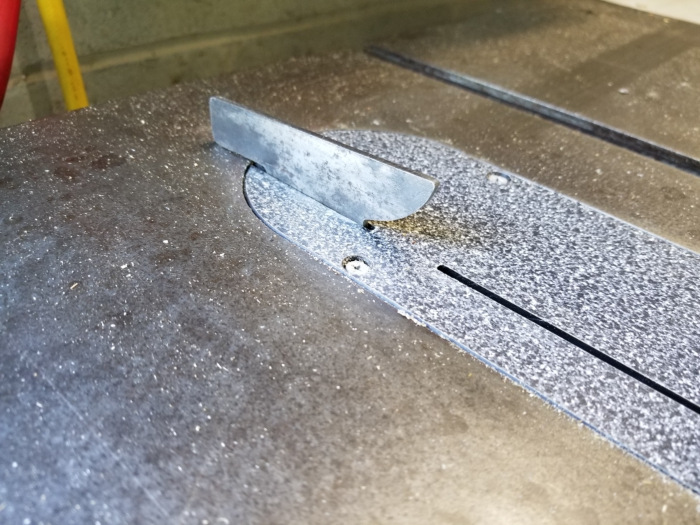
Today I made myself a new splitter around 3/4″ high. I had steel plate lying around the shop, I had a belt grinder, yada yada yada. I had no excuse to put it off any longer.
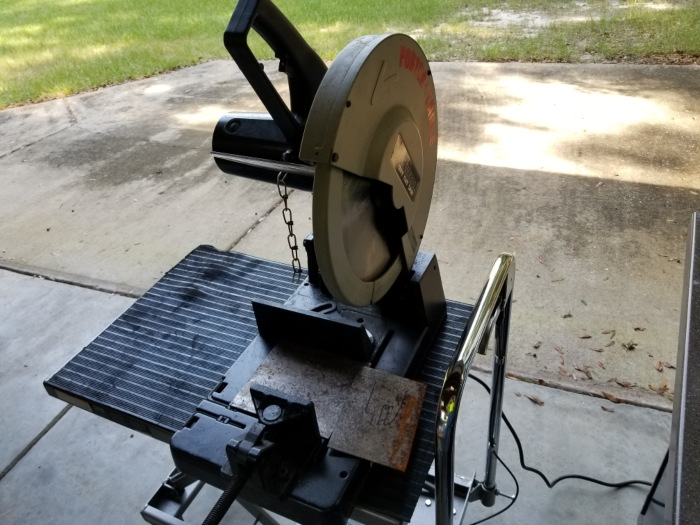
I held one of my tall splitters against the steel and traced the outline with a Sharpie. This gave me something to shoot for. I cut the end with the tracing off the plate, using the dry saw.
Once the sawing was over, I took the workpiece to the belt grinder and cranked it up to 120 Hz. The metal was around 1/8″ thick, so it was not a problem for the grinder. I would guess I put in 15 minutes.
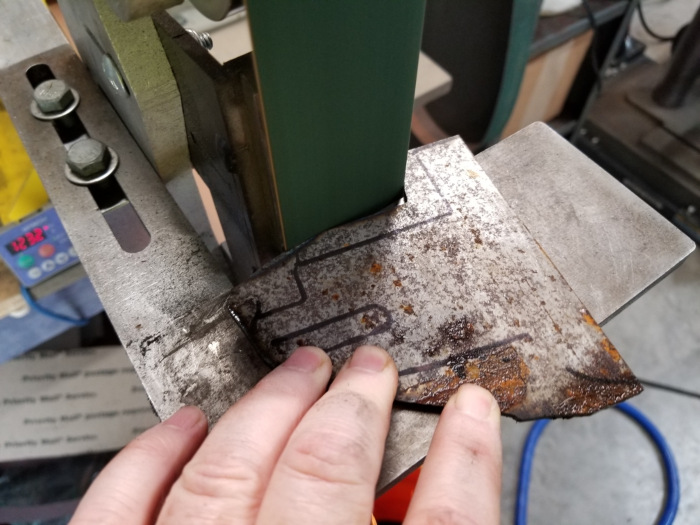
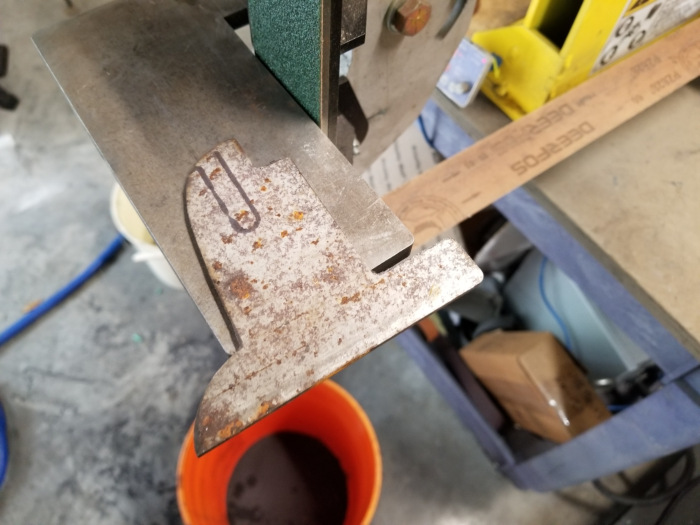
I had to cut a long slot in the metal. This is not something you can do with a belt grinder. It can enlarge slots, but it can’t start them, except in human beings.
I got out my crazy 6″ angle grinder and Walter Zip Wheel and cut the slot. You would be surprised how well a big angle grinder can do delicate work. I roughed the slot out, and then I finished it, for the most part, on the belt grinder.
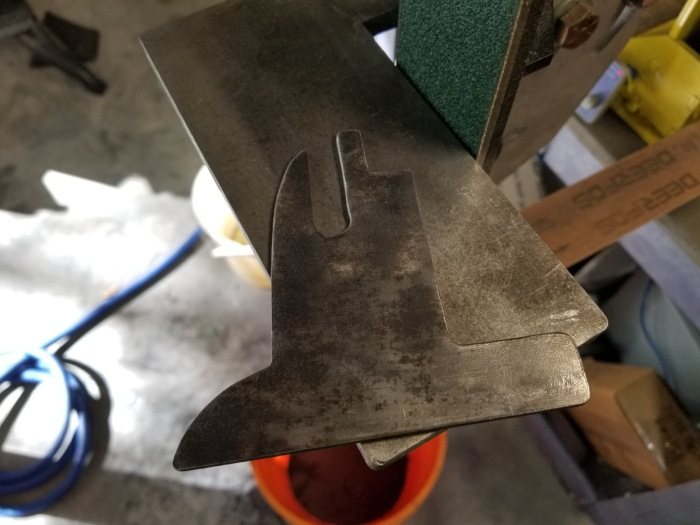
When that was done, I wanted to round out the bottom of the slot so it looked more like a milled feature than something made with an axe. I got out the Dumore hand grinder and a carbide burr. I mounted the splitter in my vise and rounded the slot.
I then wanted to clean and deburr the splitter using my pedestal buffer, but it wouldn’t turn on. It has an overload protector on it to kill the power when the shaft can’t turn, and the protector had pooped out. I could not get anywhere with it. I decided to use an angle grinder and knot wheel, and the results were excellent.
When I was all done, I had a nice splitter. I installed it in the table saw, and I was happy. Except for having no buffer.

I was advised to open the motor protector up and see if there was something I could fix, like a relay with a bent contact. When I got into it, I saw that it was not very repair-friendly.
I didn’t feel like sacrificing the evening to fix it, so I took the hot wires off of the protector and connected them with a wire nut. Now I can use the switch on the buffer instead of the one on the motor protector.
You don’t really have to have a motor protector on a 3/4-HP buffer. I have a grinder which is essentially the same type of machine, and all it has is a toggle switch. Motors at and above a certain power level need motor starters in order to avoid ruining switches, but my buffer does not. I suppose the protector was there to protect the motor from abuse. Maybe it also tames power surges. I don’t know.
The buffer would cost around $1000 to replace with a new one. I suppose the school system that originally bought it felt the protector would be a good way to keep an expensive machine safe from bored kids in shop class.
I might try to get the protector working, or maybe I’ll buy a used one on Ebay some day. Right now, I can live without it. The buffer, on the other hand, is vital to my sanity. I have to have a running buffer. I have only had it a few months, and I can’t live without it.

When I talk about my reasons for owning tools, I like to say I want to buy whatever it takes so that when I walk out into the shop with a job in mind, there is at least a tiny sliver of hope that I will be able to get it done with the tools I have on hand. That sums it up very well. Today, I got what I wanted. I had two jobs to do, and I was able to get them done without too much straining and improvising. Granted, I didn’t really fix the buffer, but I found out what was wrong, and I got it running.
The saw splitter is installed, and it looks really nice. I may grind it a little smaller.
Yesterday, I got my Jonsered chainsaw running again. Socialism, in the form of ethanol, keeps destroying my small engine carbs, and the Jonsered’s original carb was terminally congested. I bought a Chinese carb and replaced it, but the Chinese carb had a defective spring. I got myself a second Chinese carb, installed it, and got the saw going. It still needs a little tuning, but it will work perfectly.
I haven’t received the sonic cleaner I ordered. I plan to throw the Jonsered carb in it. It might revive it, and if it does, then maybe I’ll be able to use it on future ethanol-defiled carbs in the future and avoid buying an endless succession of new ones.
My little Husqvarna blower is acting anemic. It has never suffocated due to ethanol, unlike the other tools, and I have used additives and so on to keep it healthy, but it looks like its day of reckoning is nearly here. I can try the cleaning machine out on it and find out if I wasted my money.
I’ve been contacting machinery riggers to get quotes on moving my big machines here. Once that’s done, life should be nearly perfect.
Until something breaks.