Painter’s Plaint
November 9th, 2019“Progressive” Used to Mean Something Completely Different
I have some exciting things to tell you about painting. I’m not sure if they’re true. But I was excited to learn them nonetheless.
I am making a mobile pedestal for my 8″ bench grinder. I have been at it for two weeks. Cutting and welding the metal was a one-day job, even though I made it last a little longer than that. Painting is what’s holding me back now. It takes forever to paint things.
I haven’t been at it continuously since I started. I took several days off to visit North Carolina. Still, even if I had worked at it nonstop, it would have taken a long time. Painting things is very hard, and there is no way to rush it.
I can machine pretty well. I am an okay MIG welder. I can do basic woodworking. Painting, on the other hand, is impossible. Anyone can grab a can of Krylon, spray big globs of paint on an unprimed project, and come away an hour later with a conglomeration of globs and runs that starts to peel within 6 months. Painting well is another matter. It’s highly skilled labor.
Painting house interiors is the exception to the rule. It’s very simple, and interior latex is very cooperative and easy to apply. Painting furniture and metal objects is crazy hard.
I decided to paint my base John Deere green. I think John Deere is run by, well…by people I would not want to associate with on a social basis. I did not choose the color because I liked the company. I chose it because I knew Rust-Oleum tractor paint was pretty tough, and John Deere green was the color that stood out from among the choices.
I made sure my steel was free of rust, and I cleaned it with acetone. I primed it using the recommended spray primer. Right away, I had problems. Either the primer went on like dust and covered nothing, or it ran. I had to make quite a few corrections.
Once the priming was done, I got myself a quart of paint, plus a quart of the spray equivalent in case I needed it, and I started.
The actual paint went on much more easily than the primer, probably because I used a brush. I’m starting to think that rattle-can paint doesn’t really work. It always runs or takes 15 coats. A brush gives you a lot more control, and you don’t end up wasting 75% of your paint on overspray. When you use spray cans, you’re lucky if half of the paint lands on the project.
Once the paint was on, I thought I was doing great, but when it dried, I had brush marks.
Quality paint is self-leveling. This means that even if it has brush marks when you apply it, it smooths itself out and lies flat as it dries. I have been reading up, and it looks like the EPA has put an end to all that. For some reason, they don’t like self-leveling paint. Now paint dries faster than it used to, and the brush marks are preserved forever.
In other words, unbelievably, the brush marks were not my fault.
It took a lot of Googling, but I finally found what some people think is the answer. You can probably guess what it is. It’s an additive. Lumpy paint is like ethanol-free gas. You pay for it and think you’re all set, and then you find out you have to add things to it in order to make it work.
An Australian company named Flood sells a product called Penetrol. I had never heard of it until I started this project. A reader named Tom mentioned it in a comment, but he was talking about some use that had nothing to do with brush marks. Penetrol apparently prevents paint from forming a brush-mark-preserving skin.
Tom was commenting on some welding I did, and he said it looked “like crap.” I feel that was totally unwarranted and also, arguably, a slight exaggeration. I spent some time with my Bernie Sanders and My Little Pony do Burning Man coloring book, however, and I got over it. Also, I welded plates over my worst welds and ground everything smooth, so I don’t really care how the old welds looked.
Penetrol costs almost as much as paint, of course. Environmentalism never costs you LESS money.
I got some Penetrol today, and I mixed it into my paint at a ratio of around 1:10. It seems to work. When I left the shop, the paint looked like it was flattening out. Even the areas that already had dried-in brush marks looked considerably better.
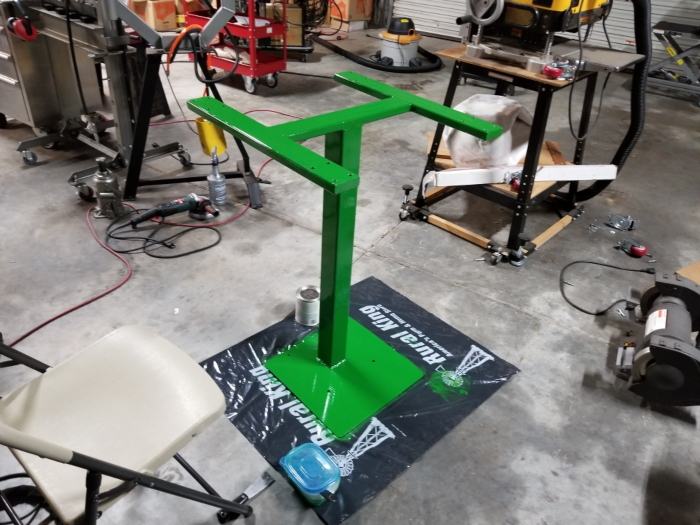
Tomorrow, I’ll look again, and that will tell me whether Penetrol actually did the job.
Environmentalists are unpopular with many people, for very good reason. They are heartless authoritarians. They tell themselves, “I am morally superior, so I don’t have to accommodate the needs of other people. I will make this rule, and if other people suffer, that’s too bad.” They don’t prepare us. They don’t inform us. They just apply their draconian measures, and the rest of us take it in the neck.
Here’s what they should have done. They should have advised manufacturers to put warnings on their labels. “NO LONGER SELF-LEVELING.” “USE ADDITIVE TO PREVENT BRUSH MARKS.” How hard would that have been? Not very.
You can’t get rid of deep brush marks once you have them. If you try to sand them out, you end up going through the paint completely so you have to redo the whole job. It would have been nice to have some idea what was in store for me so I could have prepared.
You would think Rust-Oleum would have warned customers instead of just hoping we didn’t notice.
Penetrol seems to make paint somewhat more runny. I had to correct some unexpected drips. Still, it may work out to be better than tractor paint all by itself.
I’m going to guess that the EPA hates Penetrol. It’s a workaround. I’m sure the bureaucrats, who never paint anything or have to answer to angry customers (or do anything resembling actual work in commerce), don’t like it when people weasel around their unreasonable regulations. Penetrol increases the volatile organic compounds paint releases, and VOC’s are probably the reason paint was debased to begin with.
Maybe I’m wrong about what happened to paint, but it sounds plausible, and I found evidence for the theory while surfing the web.
I wish greenies would wait for new technology that works before getting rid of important, useful products. Remember how they killed incandescent bulbs? Thousands of American factory workers were fired from their jobs, and we were forced to buy curly fluorescent bulbs that a) cost too much, b) took a solid minute to start working, c) were full of mercury, d) had very short lives, and e) were made in China, partly because of the environmental problems involved in manufacturing them.
LED’s came along a few years later. They were cheaper, they worked even better than incandescent bulbs, they were made to last a very long time, and they used very little electricity. Why couldn’t the EPA wait for technology to catch up to its aspirations? Because…leftism. Leftism is always about the sizzle, not the steak. If it gives people the superficial but erroneous impression that you’re helping Mother Gaia, it must be right, even if it’s unbelievably and obviously wrong.
Leftists’ goals are always, always urgent. They can never wait for anything.
Was there a volatile organic compound crisis that simply could not wait until paint formulations that actually worked were developed? If so, I did not notice it.
My wild guess is that we will have paint that works within a couple of years. Until then, people all over the country will be cursing and blaming themselves, wondering why their favorite products now produce projects that look like hammered poo.
Here’s something else that’s interesting: I’m reading that some people have concluded that priming metal projects is actually detrimental. Can that be true? Surely Rust-Oleum wouldn’t make me spend three days priming a project when they know perfectly well I can just apply the paint and have perfect (but for the brush marks) results.
I should paint a piece of bare steel while I’m doing this, just to see what happens. I can throw it out behind the shop, let the rain and sun hit it, and check on it from time to time.
While I’m on the subject of painting, I think paint makers should put realistic instructions on their cans. For example, they should quit saying paint dries thoroughly in 24 hours when it actually stays soft for at least a couple of weeks. A few years back, I painted a project and thought it looked great. Then I let something touch it a few days later, and the paint sort of slid in the area where the touching occurred. The paint was Rust-Oleum hammered finish spray paint. It takes forever to get hard. I just used it again and had the same problem.
I have read that Penetrol will serve as a primer. They say it’s so good you can actually paint bare steel with it and then leave it as it is, outdoors. I don’t know if I should try priming with it next time, or if I should forget about priming altogether.
I guess the summary here is a) painting is hard, b) paint takes weeks to dry thoroughly, c) you need an additive to get rid of brush marks, and d) if you think you’re going to weld something up today, paint it tomorrow, and use it the day after, you are living in a fool’s paradise.
Actually, there is more. I know of a product which is better than paint OR Penetrol, so I’ll toss it out there. Duplicolor truck bed coating. It’s really a type of spray paint. I’ve used it on mobile bases. It sprays just like paint, it dries quickly, and it becomes so hard and tough it can be difficult to tell it from mill scale. I think it only comes in black, however. Anyway, if the EPA hasn’t ruined it, it’s a fantastic product.
Another interesting product: CRC Rust Converter. Apply it to rusted metal, and it forms a tough black coating. AVOID IT. Why? Because it can give off phosgene gas when you heat it. Extremely dangerous. I don’t mean “You might inhale two micrograms of VOC’s” dangerous. I mean actual danger of observable real-world harm. Phosgene will do severe, permanent lung damage the first time you inhale it. What if you use CRC Rust Converter, forget about it, and then repurpose the steel 5 years later? You might find yourself welding it and then moving into an oxygen tent.
I hope the mobile base looks good tomorrow. Regardless, I’m going to keep painting until none of the white primer is visible, and then I’m going to mount the bench grinder on the base. If it’s not perfect, I’ll consider it a lesson learned, and I’ll do better when I make my next project.
November 9th, 2019 at 10:37 PM
Where’d you get the acetone?
November 10th, 2019 at 11:11 AM
Probably Home Depot.
November 10th, 2019 at 6:55 PM
Next try self etching primer for steel, much better.