Archive for the ‘Math Science Tech’ Category

The Best Reason to Buy a Camera

Monday, January 19th, 2026

Show People What You See When You Look at Them

I was spending a lot on cameras and lenses, and right in the middle of it, I blew $900 on what is ungenerously referred to as a point-and-shoot camera, the Canon Powershot V1. A lot of people would say this was an immature, impulsive move, rooted in the juvenile belief that buying equipment makes up for being too lazy to work and develop skill and knowledge; a belief I hold dear due to my character issues.

But look at this:

IMG_0898 DxO -topaz2 mask-sharpen-lighting

I don’t like putting photos of my family on the web, but I am making an exception here.

It looks a lot better in full resolution. It is difficult to run things through Photolab and Topaz AI and then reduce them without killing the sharpness. I haven’t solved the problem yet.

This shot is interesting, because like Moses, Yeshua, or Tim Tebow, it had a lot of things working to prevent it from being born. At first, I thought it was going to have to be deleted due to lack of potential.

I am very bad at dealing with exposure. I can take magnificent photos when the subject is helpful and the lighting is just right, but any kind of challenging light results in embarrassing shots fit only for deletion. If the light is a little low, I get brown photos with blobs that should be people. If the light comes from behind the subject, I get shadow puppets.

The Powershot is derisively referred to as a point-and-shoot camera because it’s small and handy, and the built-in zoom lens is considered mediocre. It also has a sensor a little smaller than a 4/3 camera, which is another opening for critics. On the other hand, it shoots raw files. It has a ton of settings. You can make it shoot continuously. It has settings to prevent highlight blowouts. You can get zebra stripes to judge exposure. You can set an exposure ceiling. It has AI metering. It will operate a sophisticated on-camera flash. I could go on.

That’s not point-and-shoot. Point-and-shoot is a 1969 Kodak Instamatic that has zero adjustments and a lens worthy of Dollar Tree reading glasses.

I have been stubborn about exposure, which is amazing, since stubbornness is so unlike me.

Be quiet.

I have been convinced that I needed to learn manual exposure, because that’s the way people did it when I was a kid and there were no internal combustion engines or telephones. I have been telling myself I could not learn to deal with exposure without setting ISO, shutter speed, and f-stop every time I shot a photo. But this was a misapprehension. I also fell into the trap of believing I needed to set my color temperature (“white balance”) all the time.

This camera, which experts put in the category of minimal-feature, low-budget products, has all sorts of settings that allow you to get the benefits of controlling exposure, minus a lot of the effort and wasted time, along with other settings that act as safety nets.

I can use automatic white balance in nearly every situation as long as I shoot raw, so forget dealing with that setting. I can use automatic ISO with a ceiling my camera lets me choose, so forget that setting. I have two levels of a setting that reduces highlight blowouts, so that helps. I have zebra stripes to help me avoid going too bright. I have continuous or “pray and spray” shooting, so I am able to take a lot of shots quickly, giving me a much better chance of capturing things worth keeping. I have AI light metering to give me a much better chance of getting a useful meter reading.

With these helpful settings to serve as guard rails and do-overs, all I have to worry about are shutter speed and f-stop. Those are easily set on the touch screen, or I could program the ring around the lens to handle one of them.

I also have Photolab 9, which has much better noise reduction than Lightroom, so I can set my ISO a lot higher and worry less about having enough light. I have stabilization for stills, and while it’s not top-notch IBIS, it is helpful for making the most of light.

I got myself set up today and went to Costco with my family. I took shots before I left. I took shots at the store. I took shots at the grocery later. I took 126 photos, and I ended up with maybe three dozen that were legitimately excellent and worth editing. That’s a fantastic ratio. It’s more than I can really keep up with in post.

When we were on the way out, I kept telling my wife to stop here and there for photos, and that’s how I got the shot you see above. I told myself I needed to see exactly what the new settings could do, and although I had grave doubts about shooting a dark-skinned woman with the sun behind her head, I figured I had nothing to lose, so I should try. The sky was gorgeous. The light was beautiful. Why not try? I wasn’t paying for film or development.

I got home and looked at the shots in this series. I was thought there wasn’t much hope, but I picked the one that looked like it was most likely to clean up in post. I worked on it in Photolab. I sent the JPG to Topaz AI, a program I had thought I was foolish and wasteful to buy. The image kept getting better.

I realized I needed to send the raw file to Topaz so Topaz would have as much help as possible in fixing it. In addition to using the face-restoration AI feature, I found out I could use a brush to paint an area I wanted to brighten, so I painted my wife’s face, neck, and left hand. Topaz took over and brought out her features by increasing the exposure locally.

At first, when I looked at the final product, I thought, “Well, that was fun, and I learned a lot, but the photo is a failure.” But the more I looked, the more I realized it was a keeper; a photo my son would treasure. A shot he would look at when he was 90, to remind himself what a wonderful mother he had and how easy she made his life while he was small and unable to look after himself.

It has serious technical issues. The facial features are hard to see. The baby is looking away. It’s not as sharp as it could be. Those things don’t matter. Sharpness is usually not very important, and the other flaws add to the story the photo tells.

In the photo, it’s a glorious day. In real life, it was cold and somewhat gloomy, but never mind. The sun made a cameo and made things look a lot better. The light in the photo says life, vitality, joy, and love.

The lines in the photo radiate away from my wife and son as though they were the sun. It’s like they radiate life, energy, optimism, and every good thing. It also makes it look like God is zeroing in on them for a long, loving gaze.

My son is looking away, fascinated by trivial things that are exciting to him because of his age. He isn’t thinking about his mom or what she does for him.

My wife is tired but happy. She has sacrificed a lot for him, and she is glad. She knows he doesn’t get it, and she doesn’t care. He’ll get it some day.

The way the sun tries to push its way past her to hog the attention is helpful. It makes her look unappreciated. This is the way all mothers dream of looking. Especially the Jewish ones. But she has the right. Our baby brings her joy and love every day, but she is pouring a lot of effort into him, and he is not at the stage where he can even begin to reciprocate.

The woman behind my wife seems to jostling her during a moment of intimacy and reflection, as though my wife and the moment were unimportant. It sharpens the feeling that my wife is unappreciated yet continues doing what she does for love.

The picture is optically flawed, but it works artistically. My wife took one look at it and said what I was thinking. She said, “It tells a story.” It’s a tribute to her. What mom could resist that?

I spit on the $900. I can’t believe it ever concerned me.

There are very few photos of me as a child. All are technically bad. Nearly all are artistically inept. Many are depressing. The same could be said of photos of my mother. Our home movies were eaten by mold. I was born before ordinary people shot videotape. My wife and son are in a different situation. They will be buried in photos and videos. At least hundreds will be technically excellent. At least hundreds will be artistically sound. If the rapture is delayed long enough, my great-grandchildren will have all these images and videos. What is $900 compared to that? I once spent $1500 on stereo speakers I didn’t need. I paid over $12,000 for a metal lathe I rarely use. I spent $500 on a pair of loafers. Actually, I did that twice, and one pair eventually went to charity because they looked weird.

This $900 camera is a steal, and so are my more-expensive cameras.

I’m waiting for a specialized DJI video camera to be released, and I plan to buy that, too. I have two sets of wireless mikes, and I plan to buy a third for the DJI because it will be easier to use and less likely to cost me audio due to the difficulty of matching DJI cameras to other brands of microphone.

I am a bad photographer, but things are getting better, and I am encouraged because I see the value of the expenditures and effort.

If photography is this rewarding now, I have to think it will be much more so when I know what I’m doing.

I have learned from a lot of Internet photo gurus, and I am losing respect for them. They obsess on all the wrong things. They compare lenses. Is this lens marginally better than that lens? They explain why expensive cameras are better than cameras that cost less. They help people fix their exposure problems.

They talk very little about art. They don’t tell people how important it is to create images that resonate with people who see them. They don’t talk much about gesture, symbolism, and storytelling. They rarely tell us it’s better to have mediocre equipment and get the shot than to sit around waiting for the best and do nothing at all.

I can’t recall any of them saying things like, “If your baby is taking is first steps, just get the shot. Get the video. Use the worst lens imaginable if that’s all you have. Just get the job done.”

A lot of these people are just trying to sell equipment or trying to amass subscribers in order to bring in more cash.

After you die, no one you care about is going to feel anything because you shot the best landscapes or owned the best lenses. They will be more impressed with images of meaningful memories than they will be with your lens’s bokeh or sharpness.

If you can produce shots that are optically sound, by all means, you should, but don’t do it at the expense of the things that matter.

I have a new lens coming in on Tuesday. I will stop shopping when shopping stops paying off.

Half-Baked Adobe

Saturday, January 17th, 2026

Thank you for Making a Hard Decision Easy

As I work to become capable of producing photos that aren’t appalling, I go to Internet sources and learn from self-proclaimed experts. One of the problems with this is that they contradict each other, and some of them give advice which is just plain bad. As a beginner, I am not competent to detect bad information right off the bat. It takes me considerable time, research, and shooting. I think some of the good info is starting to solidify.

White balance has always confused me. I didn’t know what the term meant, and of course, I didn’t bother looking it up or trying to understand it. I was content with being annoyed about it. I think I understand it fairly well now.

Let’s start with the fact that it’s a stupid term. It sounds like you’re trying to do something that somehow balances white areas of your photos. In reality, it’s just light temperature, measured in Kelvins. They should just call it light temperature. When you buy a TV or light bulb, they call it temperature, so why not do the same thing in camera terminology? If they had called it temperature in the first place, I would have understood.

So what is light temperature?

Physicists have noticed that every solid substance radiates the same type of light when heated to a given temperature. When something is red hot, it gives off light concentrated in the red and orange area. When it’s white hot, the light is shifted toward the blue. This is true of iron, rocks, lead, or whatever you choose. It’s a universal thing.

Men who smelt metals developed a tool called a pyrometer. It measures the temperature of molten metal visually. They look at metal through these tools, and the tools show them colors to compare the metal colors with. Those colors match known temperatures. Easier than sticking a thermometer in there. I don’t know if pyrometers are still used, but it demonstrates the principle.

One weird thing about light temperature is that cold temperatures look warm, and hot temperatures look cold. An old incandescent bulb in your house gives off a nice, cozy glow that evokes warm emotions, but the light temperature is low, providing more yellow and so on. Direct sunlight has a high temperature, but it makes photos look cold.

On top of that, there is no relationship between light temperature and air temperature, so you can be freezing while you sit in high-temperature light.

How does light temperature affect photos? Simple. It makes them look warmer or colder, more or less. Too much warmth, and the sensation is stuffy and cloying. Overly feminine. Too little warmth, and people look like cadavers under fluorescent lights.

In making a photo look too cold or warm, a bad temperature choice can mess up the colors. It may make white look blue or pink, for example.

It is possible to use a card to adjust your camera for a given situation so the colors look right. It’s an annoying process. I bought a grey card which is not merely grey but a very precisely measured grey. To change my camera’s white balance, I have to hold it in front of the lens and push various buttons. If I do this, the camera should do a good job of getting a “correct” temperature for the lighting in which I find myself.

The big problem with this, apart from the fact that I will miss all sorts of shots because I’m playing with the camera, is that the setting does not last. Say I’m under a tent. I take a shot inside the tent, and then I turn and shoot so part of the scene is outside in the sun. The white balance setting for inside the tent will be completely wrong for the second shot. If you move around while taking photos, like nearly every human being on Earth, you will have to set your white balance over and over to keep it in the ballpark.

Nonetheless, I was told this was very important. It’s not. Spoiler, I guess. It’s a stupid idea.

Cameras generate two kinds of files: raw and JPG. A raw file contains just about all the information the sensor can get. A JPG is a smaller file your camera creates by guessing how you want a photo to look. If that sounds crazy to you, because you know a camera’s software is inferior to whatever you can install on your PC for editing photos, you’re onto something. Camera-generated JPG’s are like TV dinners. They’re supposed to be good enough for the masses; for people who aren’t capable of editing photos and getting the most out of them. People who think Jack Daniel’s is good whiskey.

When you see a photo on the back of your camera, even if you’re shooting in raw so your camera doesn’t store separate JPG’s, you’re looking at a JPG. If you judge your camera by that junk, you will never have any idea what it’s really capable of. It’s like buying a Ferrari and only using the valet key.

Many professional photographers shoot in JPG, but here are some key things to remember: 1) most photographers are not trying to produce great images, and 2) most photographers aren’t very good anyway.

I have learned that professional photographers are generally not interested in generating photos that affect people deeply or which are of top optical quality. They’re grinding out B-minus shots by the hundreds in order to feed their kids. They take the same family photos over and over, using the same lights, in the same room. They go to weddings and shoot hundreds of photos per event, just to document what happened. They want to work fast, get jobs over with, and move on to other jobs.

When my son was born, a photographer who had a deal with the hospital showed up in my wife’s room and shot a bunch of photos. Precious shots, to be sure, but not very good. She sold us a zip file of JPG’s and went on her way. She has been doing this for a long time, but I take much, much better shots of my son, even with my phone.

I’m not a professional. I’m an enthusiast. There is a difference. When people see photos I’ve taken of my family, and which I have edited carefully, I want their hearts to break. I want them to feel the love I felt when I was shooting. I want the composition to be stunning. I want the lighting to be just right.

I have set my cameras to quit storing JPG’s, and I found out how to make my phone shoot raw. I’m all done with Budweiser. I’ve moved on to homebrew.

Are JPG’s useless? No. CAMERA-GENERATED JPG’s are useless. When you edit raw photos, you will generally create JPG’s from them, and those finished files are fantastic, because they were processed by your skilled eye, not by engineers in Tokyo who will never see them.

If you shoot raw, you will keep information that will allow you do fix almost any white balance issues. This is why I’m going on about raw and JPG. If you shoot JPG’s, your ability to change the white balance in finished photos will be very limited, and you may be unable to do it. You will also have problems fixing lots of other things. Just shoot raw.

So to recap the situation so far, white balance is color temperature, you don’t have to set it every time you take a shot, you should shoot in raw if you want really good photos, you should not waste space storing camera-created JPG’s, and you should edit your photos on a PC like a man.

What are you supposed to do about white balance, then? Use the auto setting. It will work for almost every photo.

If you’re a wedding photographer, forget all this.

There are some situations in which using AWB (automatic white balance) can screw up a raw photo so much it will have to be altered by AI or discarded, but those situations are rare, and you should be able to figure out what they are and set your white balance manually when you encounter them.

Most professional photographers shoot in AWB nearly all the time. Consider that.

It can be important to set your white balance if you’re doing certain types of work that have to be standardized in various ways, but you’re not going to do those kinds of work unless you join the grind-and-dump industry.

A touchy old guy on a photo forum looked at a photo I had shot and told me the white balance was clearly off, and this sent me off on a rabbit trail, trying to figure out how he could see that just from a photo. It turned out he had no idea what he was talking about. Other photographers (much better ones) told me there was no way he could tell just from the photo, which I showed them. By then I had wasted $14 on a grey card, and I had spent a session shooting bad photos while adjusting my white balance incorrectly. If I had relied on AWB, I could have bypassed all that.

I believe this is all correct. Tell me if I’m wrong.

Key points:

1. White balance is color temperature, which affects the perceived warmth of photos.

2. White balance can almost always be corrected to your liking in post if you shoot raw, so shoot raw.

3. Automatic white balance works nearly all the time, so use it nearly all the time, or else you will miss shots while you’re trying to set it.

4. Never listen to advice for wedding photographers.

5. Never listen to bad photographers.

Number 5 is of interest, since I’m a bad photographer, and I am trying to give advice, but I’ll ignore that.

In other news, I canceled an Adobe subscription Adobe signed me up for dishonestly, and I uninstalled both Lightroom and Photoshop.

I thought these programs might be worth the insane $720 three-year cost, so I signed up for a 7-day free trial. Of course, a week is not long enough to learn much of anything about either program. I opened Photoshop once. I used Lightroom a few times, and I liked it for certain things, but my impression is that it is mainly for professional grind-and-dumpers. “Smooth out those wrinkles and send Mrs. Garfinkel her portrait!” It seems to have a lot of prepackaged, gimmicky settings to make it easy to churn out polished, if cheesy, images. But I may be wrong.

I will never find out if I’m wrong, because Adobe is so unpleasant to deal with, I canceled my subscription.

When I signed up, I was offered two options: $19.99 per month or $239.99 per year. I picked the monthly option, thinking that if I couldn’t make up my mind in a week, I would pay for a month and accept the loss. It seemed like a good move to me, and I didn’t see any reason why Adobe wouldn’t sell people these products by the month.

Yesterday, I tried to cancel on the Adobe site. I was weighing several options. First, I could see if they would offer me a discount, and if so, I might go ahead and buy a year. Second, if no discount, I would pay for another month and then make a firm decision. Third, if I was feeling generous, I might just pay full price and buy a year.

The site asked me if I really wanted to cancel, of course. It said I still had a day left. I decided to leave it until today.

When I went to the site today, I was blocked from managing my account. This is something Adobe does to prevent people from ending free trials. I saw a little blurb saying I would be able to manage my account soon, with an explanation mark, as though this was great news. Adobe also said I had been charged, after telling me I had a day to go.

So Adobe had dropped a surprise charge on me while simultaneously blocking my ability to question it, presumably until the trial period was so long gone so they could say it was not reasonable to ask for a cancellation and refund.

I resorted to chat, and I got some guy with a name like Joreet. His English communication skills were abominable, and I think he tried to swindle me. Because he was so inept at communicating (perhaps intentionally), it is impossible to know exactly what he was trying to do. He told me they would give me two free months.

Naturally, I had questions. If they were giving me two free months, and I was on a monthly plan, what would happen if I canceled after those two free months?

There was no way to get him to explain this. I could not get him to tell me whether I had an annual or monthly commitment. I could not get a clear explanation of what would happen if I canceled. My impression is that like the website where I signed up initially, Joreet or Poreet or whomever was trying to make me think I was getting something I was not.

I finally got him to admit that my 7-day trial came with a yearly, not monthly, commitment, so if my subscription renewed, I would be on the hook for the rest of a year.

I couldn’t make him tell me what I had been charged. I never got that information out of him. When I asked him when the block on the site would be removed, so I could cancel through the site, he kept telling me everything was fine and that he could do it all for me.

He never told me when the block would be gone. I told him what I thought of his work, as nicely as I could, and I insisted he tell me how to cancel using the site. He gave me a link to the blocked page. He seemed mad at that point. I think they get in trouble if you don’t let them run you. I think Adobe coaches them and says it’s a major failure if customers stand up to them and don’t go along with their scamming.

Just guesses.

My patience ran out abruptly, and I told him to cancel and give me a full refund. By that point, he was out of jolly, comforting canned responses intended to keep me in the fold, so he canceled my subscription instantly.

I would probably have been willing to pay them full price for a year, but dealing with Adobe was so unbearable, I got to the point where I no longer cared about their software. It’s not the best, and some superior programs are cheaper. I discovered some helpful features in Lightroom, but man, it’s not worth tolerating the disrespect and lies. They can keep it.

I think the folks at Adobe are scammers who operate just inside the law, and I want their company out of my life because I am afraid they will keep trying to find ways to stick it to me. I just uninstalled Photoshop, Lightroom, and their Creative Cloud app (which I never wanted) because I am afraid that if I click on something accidentally, they will send me a bill and say I reactivated my subscription.

I have Photoshop Elements 2024, which has never been useful to me and is no good for editing raw photos and can’t create full-color images. I think I’ll uninstall it, too. For all I know, it has spyware in it.

In case anyone else Googles, “Is an Adobe free Photoshop and Lightroom trial a good idea?”, I’ll give my opinion.

1. Adobe dishonestly hooks people by making it look like they can pay for a month at a time, when they are really committing for a year. UPDATE: I will take this back, partially. They do this in chat, but their website does point out the difference. I was apparently careless about this when I signed up, and that is my fault, although they tout their trial in a way that is intended to encourage people to sign up hastily. It was dishonest of them to block me from canceling on their site, and it was dishonest of them to try to sign me up and charge me while I was blocked.

2. Adobe rigs its site so canceling is very difficult. This is normal behavior for tech nerds.

3. Adobe’s reps are inept and probably crooked, and a CR chat which should take three minutes will take 20, at the end of which you will be expected to take whatever bum deal they shove down your throat, even though they have consistently refused to tell you what you’re paying or what you get.

4. If you’re not a grind-and-dumper, you probably don’t need or want Photoshop or Lightroom.

I actually enjoy being forthright and unwilling to bend with people who pressure me and try to cheat me, so Adobe’s trashy approach might as well have been designed to make me quit. I flat-out told the rep his answers were useless and so on. I recognized all the patented gimmicks intended to make me throw up my hands, give up in exhaustion, and pay Adobe. I hate sleazy, disrespectful sales tactics so much, a boiler-room-mentality company like Adobe would have a hard time selling me five-dollar bills for 50 cents.

So that’s the news. I am going to put all my cameras on AWB, keep on using Photolab, and see how things go. I know Adobe will be happy to take my money if I ever change my mind.
Zombie Photos!

Sunday, January 11th, 2026

Can These Dry Bones Live? Lightroom and Photolab say Yes

Today is the day of the week we reserve for God and family, so I will not be writing long.

I have been trying to save photos I took before I got my current phone and cameras. I got my old phones running and dumped a lot of things into my cavernous storage drive. I still can’t get the Galaxy S2 going, but I may be able to do it eventually.

I am learning two big lessons: first, there is nothing like having lots of photos of people and pets you love, and second, you should not throw out old shots until you have learned to use editing software, because often, a shot you thought was not worth keeping will, upon editing, turn out to be a digital heirloom.

As usual, I can’t upload the best examples of what I’m doing, and that is a major handicap when writing about photography, but at least there will be the writing, and that’s something.

I found a photo of my dad, taken in 2017. Thing is, it’s not a photo of my dad. We were at Tractor Supply, picking up the only decent new chainsaw in the county. A hurricane had just hit us with tropical-storm-force winds, and I managed to buy a Jonsered saw a few minutes after it was made available online.

My dad was not behaving all that well that day. In the car, I had tried to reason with him about something or other, and as we approached Tractor Supply, he told me to go to hell three times. Then he forgot all about it, and he was amazed when I brought it up.

I made it into the store before he did, and I saw something funny: a colorful metal chicken sculpture. I took a shot of it with the store window behind it. I guess I wanted to text it to a friend.

I was going through my old shots yesterday, and when I looked at the chicken photo, I saw that my dad was visible in the window, in the parking lot, on his way to the door. Maybe I included that on purpose.

It was not the kind of image that cheers people up. He looked frail and uncertain. Nothing like the strong, blustery, confrontational man he had been for most of his life.

I threw it into Lightroom, which I am trying out. The software lit up the chicken’s colors. I cropped the image to reduce distractions. I probably fiddled with the color. Now I have a touching shot of my late father fit to put on a wall.

I also found a photo of my buddy Mike standing next to a burn pile. It really captured him, so I cropped it and fixed the colors and lighting.

I won’t post these shots, but maybe I can find some other zombie photos that were saved by editing. Not prizewinners, but worth the effort.

I have been trying not to get snobby about JPG’s. It is true that they are far inferior to raw photos for editing, and if you screw up a raw shot, you are much more likely to be able to turn it into a masterpiece, but JPG is not a bad format. If it were, people wouldn’t convert photos to JPG before saving them to disks or printing them. The phone shots I have been salvaging are all JPG. I will continue shooting in raw, but I’m not going to give up on old photos just because they’re JPG’s.

I’m also trying not to get snobby about lenses.

I have gotten used to listening to experts, and they are extremely picky. They find all sorts of faults with lenses. Many of these faults can be fixed after images have been captured, but they still sound bad somehow.

I am not stupid. I know that as long as a lens is pretty sharp and can produce images in real-world lighting conditions, I can use it to make excellent photos nobody will ever find fault with. In the real world, nobody gets out a microscope when looking at photos.

I happen to have a 9 mm manual focus lens I got for travel, and I tried to shoot my son with it. Even with focus peaking, I got images that were not sharp. Then I saw a video about a new, inexpensive 9 mm that has autofocus. I watched a couple of videos, and I ordered it. Now I have two 9 mm lenses, which seems like a waste of money, but the new one arrived yesterday, and I already have several fantastic photos.

It was a good investment.

The experts said it had something called “moustache distortion,” which was not easily fixed unless software companies made special profiles for this lens. Who cares? If a million people look at these wonderful photos, not one will notice distortion.

A lens may be soft in the corners or produce vignetting or have some other issue and still be a fantastic investment. Excellent photos taken with a middle-of-the-road lens are better than perfect photos you never get to take because you can’t afford the best.

I’ve spent a considerable amount of money on lenses, but if all I had were an APS-C camera and an 18-135 mm kit lens, I would be able to produce great work as long as the photographer was up to the task.

As an aside, I am getting irritated with people who think every portrait has to be tall and cropped and has to be shot with a long lens. Everyone seems to think human beings should be isolated in photos, and people seem to be obsessed with bokeh, the pleasant blurring that surrounds foreground subjects.

Guess what? A 9 mm lens is about as wide as they get, and it is magnificent for taking people’s pictures. If you want the standard waist-up photo which is taller than it is wide, which is exactly as creative as a passport photo, good for you, but wide photos allow you to add important context, and if you make a habit of leaving it out, in the future, people will wish you hadn’t. “Is that Daisy’s tail? Why didn’t you get her face?”

They also give pictures a dramatic look you can’t get with longer lenses.

As for bokehmania, it’s a restrictive, dogmatic fad. Sorry, but it is. When you want it, you want it, but it’s not for every photo. Often, it will cost you context you should have kept.

I should not be harsh or irritable. Most people are never going to think for themselves, and it is unfair to ask them to, but it would be nice if they didn’t insist on pushing the rest of us to put on their shackles. I am about to quit a forum because there is an old guy there who can’t think outside the box and gives me rude lectures when I don’t climb in there with him. He knows a lot of things, but too many of the things he knows are not true.

His photos are not good, by the way. I have encountered some extremely capable photographers on forums, and this guy is not one of them. My policy these days is to listen to people whose work is excellent. The rest are less credible.

I better stop. If you’re planning to learn photography, I suggest you be careful not to dump old photos because you think they’re embarrassingly bad in view of your new skill and knowledge. Run them through the editing process, and you may find there are a lot of babies in the bathwater.

Your Government Knows Who’s Been Naughty and Nice

Tuesday, January 6th, 2026

This is not the Kind of Flock God has in Mind

I am enjoying life more and more. At the same time, I continue to say there is no hope for the world and that immense suffering is on the way for humanity. There is no inconsistency. God helps my family and me to have increased love, protection, transformation, and abundance in our little cocoon, but around me, the human race is destroying itself with technology.

Case in point: the destruction of free will.

I have been writing about this for ages, and I still have not seen anyone else point out the obvious: God’s plan depends of free will, and free will diminishes as surveillance increases. This is one of the reasons why God doesn’t walk around in plain sight, correcting us at every turn. He knows that if we did, he would never see us being ourselves. We have to be free to be ourselves. Without the freedom to behave badly, we never learn to behave well for the right reasons. Instead, we do whatever we think we should do to win approval and blessings and avoid punishment.

If we didn’t have free will, our interactions with God would be like scripted plays. They would be like the scripted interviews hostages and prisoners of war have been forced to give. Our obedience and expressions of love would be a lot like our forced contributions to social programs through taxes. They wouldn’t be motivated by our true feelings, and we wouldn’t deserve any credit for them.

Today I learned there is a name for the obvious change surveillance makes in people’s behavior. It’s called the Hawthorne Effect. It was named after the Hawthorne Western Electric plant, where researchers concluded that increased attention stimulated workers to be more productive.

The legitimacy of the Hawthorne Effect is disputed, but it is unquestionably true that people change their behavior when they think they are being watched.

God’s kingdom depends on judgment, and you can’t judge people who have never been free, whether they were unable to behave well or badly.

I learned about the term “Hawthorne effect” from a video I saw today. Many people are up in arms about our new surveillance state, and the latest big offense has been the spread of spying systems made by a company called Flock Safety. It’s a lovely name. They should have gone ahead and added “for the Children” to the end of it.

Flock makes revolting systems that automatically surveil people in public. Their cameras pan and zoom, and when they see human beings, they lock onto them. They even blow up and capture things people are looking at on their phones. They store videos the government has no business with.

Some of you are already in videos like this, and things you think no one but you knows have been recorded and put in the hands of the government.

God help any man whose ex-wife or ex-girlfriend works for a municipality that uses these cameras. God help any woman whose stalker is a city employee.

Municipalties love these systems because the kind of people who run for public office tend to be tyrants who like telling the rest of us what to do. That’s a fact. They have bizarre, unrealistic ideas about imposing order on others, and they don’t care about the humiliation and oppression that result. These are the kind of people who say, in complete seriousness, “You won’t mind surveillance if you don’t have anything to hide.”

They don’t understand that the Bill of Rights was not written just to prevent disasters. It was written largely to prevent rudeness. An occasional strip search isn’t going to ruin your life. Neither will random urine tests. Neither will police stops without reasonable suspicion, just to see if you’re up to anything. But the Bill of Rights limits the use of such tools to an extreme degree. Why? Because having no privacy is intensely humiliating. A government that treats you rudely as policy is unbearable.

I think it goes without saying that the people at Flock are incredible jerks. How could they do what they do if they weren’t?

Activists who are going to lose are exposing Flock and trying to persuade cities and towns not to buy their Nuremberg-worthy products. I say they will lose, because I know something most people don’t understand. The vast majority of Americans are only too happy to sell their freedom for trinkets.

When I was a kid, TV programs and movies were full of BS about the American spirit and our willingness to die for dignity and freedom. I don’t think we were ever willing. I think Americans fought the British because of money. I think Americans fought the Japanese and the Nazis mainly because they were angry about Pearl Harbor. Sure, the had concerns about liberty, but it seems to me Americans were concerned about extreme oppression by foreigners but not about milder creeping oppression by our own countrymen.

I believe Flock will win because most Americans will show up at town halls and say they want safe cities. And I am sure local politicians fear having distraught families show up with photos of dead loved ones and demand to know why there were no surveillance cameras to prevent their murders.

Personally, I would stand up and say the loss of a certain number of lives is acceptable if it means we keep our freedom. That is supposedly the rationale we relied on when sending many thousands of young men to die in wars, and it should also apply to civilians. But I would be treated like a heartless monster. By stupid people.

Anyway, it turns out the nincompoops who actually run these systems do a horrible job of keeping evildoers from accessing the videos, and once they have them, they can use facial recognition to learn their names and all sorts of private details of their lives.

An activist named Benn Jordan just made a video showing a whole slew of surveillance videos he downloaded from towns across the US. He was able to take these videos and invade people’s privacy to a horrifying degree. I will embed the video here so you can see.

This isn’t the far-off dystopian future. This is the dystopian present. It’s here right now.

By the way, don’t think that living in the country makes you safe. The government can put cameras on your property without warrants. Look it up. Most people don’t know it. The cheaper camera technology gets, the more likely rural Americans are to find themselves under surveillance on farms and even in little cabins in the woods where they think no one will know if they hot-tub naked or shoot protected predators that menace their families and livestock.

Check the video out. This is the future we have chosen because we don’t have the guidance of the Holy Spirit.

Off Base

Saturday, January 3rd, 2026

The Water is Rising

I used to watch a pair of biracial conservative Youtubers known as the Hodge Twins. They say they were raised leftist but came around later in life, and I thought that was good. They were also very funny. On the other hand, they were clearly ignorant in spite of understanding the evil of leftism, and they made a lot of crude remarks.

I quit watching them, but a couple of days ago, I heard about them again. Guess what? They hate Jews. I had no clue.

They’re 100% on board with Candace Owens, and they gave Nick Fuentes a softball interview. They have a podcast, and some white weirdo they talked to said “Hitler was based!” One of them agreed. He said he had read one of Hitler’s speeches and concluded that we needed someone to say the same things today.

Hitler was based? A person really sad that in front of the public, with pride? In America? After the well-known events of the last century?

I wonder what the twins would say if they knew how Hitler felt about blacks and biracial people like themselves. Their parents’ marriage would have been called “race defilement.” The twins might have been castrated like many other biracial people. The Nuremberg laws were extended to apply to blacks. Hitler claimed the Jews brought blacks into Germany to bastardize the white race.

The existence of the video is bad, but the worst is yet to be discussed.

I looked at the comments on one of their videos, and they were almost unanimously supportive. A lot of them claimed the Jews had been expelled from 109 countries, and that there had to be a good reason. I had never seen that one before.

I would have been disturbed if 5% of the comments had been antisemitic, but it was more like 98%.

Jews are not upset enough. Even the ones who are very upset are not upset enough. Things are even worse than the most vocal coalmine canaries seem to think. Conservatives are finally starting to live up to the libels leftists have projected onto them for decades. They are becoming Nazis.

The worst development of all is that many or perhaps most of the conservatives who have turned against Jews are claiming it’s their Christian duty.

What?

Christianity is an offshoot of Judaism. In the beginning, all Christians were considered Jews. They truly were Jews, even in places like Asia Minor. Christianity was just a new Jewish sect. Gentiles weren’t a big factor until later. Every single apostle was Jewish.

As for today, we are required to worship a Jew who said, “Salvation is of the Jews.” He told Jews, “You are the light of the world,” confirming what the Jewish prophet Isaiah had said. When he first announced his status as Messiah, he did it by reading from Isaiah in a synagogue.

I’m not saying modern Jews are on the right track or spreading salvation, because those things are not generally true, but the church is inextricably entwined with Judaism, and hating Jews is antithetical to our core beliefs.

Yeshua sits on the throne of David, which is the throne of Israel. The Old Testament says so, and the New Testament agrees. He truly is the King of the Jews, whether or not they agree. But we’re supposed to give Israel to murderous Muslims and kill Jews? How is their king supposed to feel about that?

I don’t want to waste a lot of time debunking patent idiocy. It’s like going to a mental asylum and debating people who think they’re cats. The big point here is that Jews are in big, big trouble, right now, not in 5 years or 10 years or 50 years.

A huge majority of American Jews has empowered their enemies and libeled and opposed their friends for many decades. They have had way too much faith in America’s hospitality. They have concentrated themselves in areas where their enemies concentrate. They have been huge proponents of self-disarmament, otherwise known as gun control. Now they are not ready for what is going to happen.

They still have many friends in conservative areas, but I don’t think we can do much to help Jews. I think they will stubbornly cling to the urban centers they love, just as many European Jews refused to get out before the Holocaust. They love the culture. They want to be able to walk to synagogues on the sabbath. They want to live close to kosher butchers and restaurants. They think of our cities as their homes.

The election of New York Mayor Mamdani, an obvious antisemite, is amazing. About a third of New York’s Jews voted for him. I don’t know what is more surprising: that a third of them voted for him or that it wasn’t the historic 90% Democrats get. Anyway, even a third is a figure way too large to be consistent with sanity.

What were they thinking? American Jews are appeasers. Were they thinking that voting for blatant antisemitism was a good way to curry favor with their enemies? Was it supposed to be yet another self-hating, self-destructive, pointless olive branch?

Historians think 10% of German Jews voted for Hitler. It shouldn’t be a surprise.

You have almost no guns. You are surrounded by people you hate you, and they now appear to be a majority. The government is turning against you. You are far from most of the people who are inclined to help you. How could anyone think this was a desirable outcome?

The prophets tell us terrible things are in store for Jews in Israel. It will be like October 7, all over the country. If it will be that bad inside the Jewish state, I have to wonder what it will be like in gentile nations.

What are Christians supposed to do? How much is possible? Not much, I suppose. My wife and I pray for the Jews and Israel twice a day, but a lot of the good things we pray for can’t happen unless Jews accept their Messiah, and that is not within our control or God’s.

This isn’t like the 1930’s. With the technology human beings now have, you won’t be able to hide Jews behind false walls in your house. You won’t be able to take in their kids and pretend they’re yours. None of that stuff will fly in the age of total surveillance, cashless transactions, drones, and thermal cameras. Every Jew will need the help of God himself. They will need the kind of help Daniel, Shadrach, Meshach, and Abednego got.

Christians are in trouble, too. The rapture and tribulation are real events, and they are coming. Most people who call themselves Christians are only Christians in name, and they will be stuck here during the tribulation, experiencing the worst suffering humanity has ever known. They can’t be helped unless they listen and repent before the rapture.

I suppose nominal Christians are just as bad off as Jews, except their holocaust will come later.

As for the rest of the world, they have always been in trouble, and that will not change. They will think they’re doing good when they go after Christians and Jews, but they will come to regret it.

I can understand how antisemitic conservatives exist, because conservatism is not a religious position. Heathens like Vivek Ramaswamy and Elon Musk are conservative. What is astonishing is that people can be convinced they are Christians and that Yeshua wants them to torment, expel, and kill Jews.

These days, boys believe they’re girls, and many Americans agree. When we started seeing the trans movement gain credibility, we should have realized no insanity was beyond us.

I don’t know why I’m writing this. What’s going to happen is going to happen. The only thing worse than witnessing destruction is witnessing self-destruction.

Houston, the Toast is Burned

Thursday, December 18th, 2025

This Much Memory Should be Illegal

It’s an interesting day here at the Armed Northern Florida Compound.

I think I have solved my photo-editing problem. I bought Photoshop Elements 2024 because I got very bad advice. It turned out to be a horror for editing raw files. Useless. Then I tried Affinity, a free program which works very well. It turned out not to be the answer, because I bought a Canon Powershot V1 for shooting while out and about, and I learned that Affinity would never, ever be set up to take this camera’s raw files and produce photos without black (black) corners. I had to download Canon’s free program, and it works, but I don’t want it. I want to use one good program well, not 53 programs badly.

Adobe Lightroom appears to be a perfect solution, except that it costs a fortune. Adobe has adopted the lamprey business model. They went to subscription-only, so stupid people who can’t multiply by 12 will think it costs $20. Of course, it’s really $240 per year. Every year.

Enter DXO Photolab9. I’m not sure, but based on video reviews and tutorials, it looks like it will do everything Adobe does, considerably better, and while it is expensive, you don’t have to pay for it over and over and over. It is particularly good at fixing noisy photos, which is a huge plus for me. Low light is always an issue. It also updates lens profiles fast. Adobe can’t deal with my lens, but Photolab can.

I have a trial version, and I am going to go through tutorials before I make sure I should pay. It costs $240, just like Lightroom, but you only pay once. Until you upgrade, yes, but the upgrades are cheaper than a Lightroom subscription.

It looks great so far. Extremely intuitive by editing-software standards, which means not all that intuitive, but usable. And it has sorting features that should make dealing with thousands of old photos easier.

In addition to all that, I decided to mirror my phone photos and videos to Google’s cloud. I don’t like clouds or Google, but I don’t think this will allow Google to spy on me for the feds or basically turn me over to Big Bro. Not that there is any point in spying on me, because it would be unbelievably dull, but it’s the principle of the thing.

Finally, I received my new hard drives today. I have a new editing PC, and I’m going to keep all my media on backup drives, not C. It’s hard to find deals on hard drives now. Apparently the AI revolution is somehow drying up the supply. Inexplicably, however, I found two pro-grade 14TB drives on sale from the manufacturer, cheaper than their consumer drives. I saved a hundred bucks moving from consumer to pro, and I also got 14TB per drive instead of 10. I wasn’t looking for 14TB, but if it’s cheaper, why not?

I formatted one drive and installed it in my old PC so I can move all my media files to it, and I formatted the other and put it in my new PC. When the files are moved, I’ll install the second drive in my new PC, and then I’ll set them up so my stuff is synched. I’ll put stuff on the first drive, I’ll save edited files there, and I’ll have my PC set up to sync everything to the second drive.

What if my house burns down? Well, that would be bad. Maybe I should eventually find a big cloud I trust.

I got my first real PC in about 1993, and it had a 340 MB drive. I told somebody about it, and he rolled his eyes and said, “Oh, that MIGHT be enough.” It seemed outrageous. Huge. As of today, on one PC, not counting C, I have 41,000 times as much space.

That figure comes from AI, so feel free to double-check. “AI” often means “Artificial Idiot.”

AI claims the best Apollo spacecraft computer had about 72KB.

It says my toaster has more memory than that.

I think I should put a big external USB drive on my PC for additional peace of mind. I could put it in the workshop and bring it indoors for synching once a month. I can’t do much better than that without an annoying subscription that will go way up in price once I’m comfortable with it. You know it will.

I will now buckle down, clean my glasses, and watch the rest of a Photolab tutorial. I hope this program turns out to be what I need, because Adobe is just too annoying to live with.

Photo Realism

Wednesday, December 10th, 2025

What I Think Works…as of This Evening

I keep working on my photo skills as well as my gear. I am strongly aware that my baby son’s first year will never happen again, so I am doing what I can to produce quality photos and edit them well.

I’ve learned a lot of things since 2023, when I finally bit the bullet and started buying new equipment and learning to use it.

When I found my wife in 2021, I had a 2006 Canon 350D, a Samsung Galaxy S8, a Yi action camera, and a Gopro Hero 8 Black. The 350D was a decent amateur DSLR for its day. It had an 8-megapixel APS-C sensor, meaning it was smaller than a full-frame sensor, which would be about the same size as a rectangle of 35 mm film. In 2006, putting 8 megapixels on an amateur-level camera was fairly impressive.

We started traveling in order to see each other in 2021. We made three overseas trips with phones and action cameras. The 350D stayed home, covered with the cockatoo dust it had accumulated after years of hanging near a bird cage. I don’t recall why I didn’t take it with me. Weight, maybe.

We got acceptable photos and a little video that year, although I screwed up more than once and ruined videos. I found the Yi to be difficult to work with. I have a video about 10 seconds long which I accidentally shot so it would be sped up upon viewing. I would guess it was supposed run more like 5 minutes. All that’s missing is the Benny Hill music.

In 2023, instead of taking the 350D on trips, I bought a used 200D. This is a more advanced camera from about 2017. I was under the delusion that my 2006 zoom lens needed to be saved, so I stuck with Canon. The lens fits the 200D. This was a bad idea, since I turned right around and bought a better zoom. I should have gone with Sony or maybe an Olympus.

I also bought a Sony A7IV and a Sony ZV1-M2. The A7IV was my no-holds-barred (few, anyway) quality-gear splurge. It’s a full-frame camera. I thought I should have the gear to do a truly top-notch job of capturing things. The ZV is a compact camera made to appeal to vloggers. It has a built-in zoom lens, and it’s very handy. Much better photos than a late model Samsung Galaxy, too.

I have never taken the A7IV anywhere. It’s heavy and expensive. I don’t want to carry it on trips, and I don’t want to have it stolen. It’s great when air travel is not in the plan, however.

When we went to the Far East for the second time, I took the ZV and the 200D. I was not ecstatic about the shots I got with the 200D. It was like I had forgotten everything I knew about composition, and I didn’t think they were sharp enough. The video was also extremely amateurish. I don’t know how I managed to perform so badly. The ZV gave me good video, but the stills were not always great. I relied mostly on my phone for stills.

I learned something interesting: the ZV1-M2 quits in hot weather. My wife and I were on a food tour in Singapore, and I noticed the camera’s monitor would go dark during video shooting. At first I thought it was saving energy, but in reality, it was turning itself off, without so much as a warning beep. It was overheating. Black camera that absorbed heat. Hot equatorial sun. I later learned that the ZV is just about useless for video in hot, sunny weather. Oddly, Sony does not trumpet this fact in ads. You find out after your videos of your priceless trip are ruined.

In retrospect, I find it amazing that anyone recommends this camera. It’s like buying a car you can only drive 10 miles at a time. Its primary purpose is video, and that is the only purpose at which it fails.

It is helpful if you remove the battery from your ZV and power it using a cable. The battery contributes a lot to the heat. But it’s still a very poor video camera for anyone who shoots videos in hot weather, unless they’re very short. If you have this camera, it’s fine for short indoor videos. Other than that, stay away. And it’s not cheap. I think they still cost about $900.

Since I began to buy better stuff, I have drawn a few conclusions, which may very well be wrong. And they overlap.

1. The most important thing is equipment that works, not equipment that works perfectly.
2. A handy camera you use is better than a heavy, complex camera you dread taking out of the bag.
3. Useful lenses are more important than buying the best camera.
4. Unless you want to spend a lot, don’t buy a few pricey lenses with top optical quality. Buy lenses that shoot well in low light.
5. For video, and maybe photos, you want some kind of stabilization.
6. A very good camera phone will do everything 95% of the population wants.
7. You absolutely must use wireless external mikes.
8. Good photography is almost completely about choices.

I guess I’ll start with 1.

Consider 2015. Ten years ago. They made pretty nice cameras. Twenty megapixels and more. Good connectivity. Good features. Excellent accessories. You can spend maybe $600 and get a very good, lightly-used camera from 2015, with a nice low-light prime lens that will be useful in lots of situations. On the other hand, if you buy a very, very good newer camera with a truly excellent low-light lens and a big sensor, think more like $4,000. Will the photos be 4,000/600 as good? No.

If you want to take photos that are optically very good, and you aren’t a perfectionist, buy a very good camera and lenses. If you want to take photos that are technically superior, spend 6 or 7 times as much for superior equipment. But consider the fact that many of the world’s great photographers used cameras and lenses that were, objectively, bad by today’s standards. Most of photography is about content and exposure, not corner-to-corner sharpness or minimal chromatic aberration.

2. I would guess my A7IV weighs over three pounds with the big zoom attached. There is no way to have a normal day with that hanging on you from breakfast to bedtime. You’re not going to drag it around with you unless you take pictures for a living. The a6400 weighs much less. It’s doable. The 200D also weighs less. All the other cameras weigh less. Then there is the phone, which is pretty good. Figure out what you are willing to lug around and use, and concentrate on whatever that is for day-to-day photography. If you insist on heavy cameras, you are going to end up using your phone nearly all the time.

3. Any 20-megapixel camera made can shoot excellent photos, but not without the right lenses. A $10,000 camera with one crummy zoom is less useful than a used $200 camera with several good lenses.

4. You can spend $15,000 on one amazing lens, but when people look at your photos, almost no one will be able to tell the difference between the photos it takes and the ones you can take with a $500 lens. You’re better off with several okay lenses than one lens that makes photo nerds cry when they see it on your camera. If you can afford it, get very good lenses, but if not, get lenses that will take okay photos with the exposures you want. It is EXTREMELY important to have lenses that shoot well in low light. You will find this out when you try to use your $1,500 f/3.5-5.6 lens to shoot a once-in-a-lifetime event in a dim restaurant. Go for 1.4 primes, at the highest.

5. Shaky video is annoying to watch. You can buy a thing called a gimbal, and it’s a big, cumbersome device that holds your camera and moves it up and down to cancel out your shaking, but it’s a royal pain to use. There are cameras that stabilize, and there are lenses that stabilize. Stabilized is better. My understanding is that a stabilized system will also let you shoot images in lower light (if it stabilizes images as well as video), because you will not move as much, and you can use a lower shutter speed without getting blurring.

6. If you don’t want the hassle and expense of getting camera gear, get a phone that does a very good job. Some phones are much better than others.

7. Buy external mikes, like Rode or DJI. My wife has the speech volume of a turbine-powered helicopter at home, but getting her to speak up on videos while traveling is nearly impossible. I have videos where you can see her lips move, but that’s about it. You, too, will find that ordinary situation noise kills speech, so buy external mikes. You can even use them with phones and selfie sticks. And use dead cats (wind noise suppressors) unless you like listening to wind instead of people.

8. Choice, not gear, is what makes photography an art.

I came up with my own system for categorizing photos. There are two kinds in the system: documentary, and artistic. A documentary photo’s main purpose it to show that something happened. “Wayne Newton kissed me at his show.” “This is really my driver’s license.” An artistic photo is, well, art. A documentary photo doesn’t have to have artistic merit, and it doesn’t have to be done well. An artistic photo has merit, and generally, although not always, it should be technically good.

A lot of people think photography is not an art, because you don’t have to draw or paint something in order to take a picture of it. They think it’s like having a sprained finger x-rayed or Xeroxing your behind at the office Christmas party. Of course, this is not true. An artistic photo evokes emotions. It usually seems to tell a story. It may tell a story that has nothing to do with what was actually happening in front of the camera. For example, a photo of two strangers at a bus stop, who don’t even know each other, may seem to be about dramatic events taking place between two people who have some kind of relationship. The mind and heart of the beholder fill out artistic photos with backstories that may be completely imaginary.

You choose your subject. You choose your camera. You choose a focal length, f-stop, ISO, and shutter speed. You choose the angle. You may be able to choose the lighting. You may shoot a number of shots and then choose the only one that says what want to say.

This is what makes photography a legitimate art.

If you want to take artistic photos, which is what I want to do (even when shooting my family), if you master the art of making choices, you will not be blocked by your equipment’s limits. You may not perform as well as you want to, but it’s better to have the right choices and the wrong equipment than the wrong choices and the right equipment. Bottom line: you should use whatever equipment you can get, today, instead of moaning about being unable to take pictures because you don’t have the gear you want.

I say all this stuff, but I keep buying gear. I got myself a couple of f/1.4 lenses for my a6400, and they have made a huge difference in my life. I can take shots now in light that used to produce noisy photos that looked awful. I also replaced the Sony ZV1M2 with a Canon Powershot V1. It’s bigger and heavier, but it will do everything the Sony will do and more, and it has a built-in fan.

I like the small size of the Sony, and it’s a little annoying to put the Canon in my pocket, AND I just wrote that handy is better than not-handy, but I’m willing to put up with a little more bulk in this case, given the enormous advantages the Canon offers. It shoots better in low light, it’s not going to overheat as fast, and it has image stabilization for still shots.

It’s too bad I don’t put photos of my son on the web, because he is extremely cute and possibly the most photogenic person in history. I’m not just saying that as his dad. He is really something. And I don’t consider “photogenic” to be a compliment anyway. Many ugly people are photogenic.

If I could post some of the shots I’ve taken lately, I think people would see how helpful the 1.4 lenses have been, not to mention how much better the ZV1M2 and the Powershot are than my phone.

I’m continuing to work on my editing. I just got a new PC. I bought a gaming computer because it happened to have a lot of parts that were excellent for editing photos and video. I am learning Affinity 2 and Topaz AI. I have Photoshop Elements, but I find it annoying and not noticeably better.

Editing photos is shockingly relaxing and satisfying. I don’t know why. I honestly think it’s one of those things that will improve your health if you do it regularly, like spending time outdoors.

I am going to put two very large hard drives in the new PC to store photos and video. One will back up the other, and my hope is that no catastrophe will wipe both out at once. I am hoping 10 TB will keep me going for a few years. It would be nice to have two huge, fast SDD’s, but that would run around $1600, and I don’t think I really need them.

I don’t like the idea of cloud storage. I don’t trust it, and I have an irrational (I hope) fear of having hostile people root through my files in order to harm me or my family. I also think it would take a decade to upload a single terabyte.

Now you know my current stance, valuable as it may or may not be, on the subject of photography.

The Hardest Thing About Learning is Weeding Out the Bad Teachers

Friday, November 28th, 2025

Let the Light In

I take a lot of photos of my son using my phone. I also shoot video. It’s very convenient. It’s quick. My phone is always in a handy pocket on the side of my leg. It’s not heavy. It’s not in the way. It takes around 4 seconds to get it out and get the camera function working.

The photo quality is amazing I don’t mean it’s good. I just mean it’s amazing. The phone is around 1/4″ thick, the lenses are smaller than Cheerios, optical zoom is a mechanical impossibility, and yet somehow, I get photos that are more than good enough to blow up to three feet wide and hang on my walls.

Does that mean they’re “good”? Well, no. Not if you judge them by camera standards.

The other day, I shot some photos of my son, using a Sony ZV1-M2. This is a camera that cost me around $900. If you’re not a photo buff, you may not know it, but $900 is not anything close to what new professional-grade cameras cost, so I’m saying it’s not the best camera there is.

It has a built-in mechanical zoom lens. It has an APS-C sensor, meaning it’s smaller than a full-frame sensor. It has an articulated touch screen on the back. It has two microphones. You can also plug external mikes into it. It has a hot shoe.

It’s aimed at the video-blog market. It will give you better videos than a phone. It’s not intended to be the world’s best still camera, but of course, you can use it for stills.

I bought it for travel. I found it to be good for video, albeit cumbersome with all the audio stuff and the mini-tripod or gimbal attached. It overheats quickly in the sun, however, and the Rube Goldberg nature of adding mikes led to me making a number of videos without sound. Unintentional silent movies. The stills were okay, but I also took a DSLR to see if I could do better.

When I put the shots of my son up on the 65″ TV I use as a monitor, I saw that I had been missing out. Even though I was using a compact vlogging camera with numerous limitations, the photos were clearly superior to anything my phone could produce. Better subject separation. Better sharpness. He just plain looked better.

Last night, I wanted shots of my son at Thanksgiving dinner. I grabbed a Sony a6400, figuring it would be better than the ZV1-M2. Problem: I didn’t have any lenses that combined a suitable focal length with acceptable light-gathering. In other words, I wanted a wide-angle lens that would give noise-free shots in my kitchen at night, and my only option was 9mm, which is over the top. I gave up and grabbed the ZV1-M2, which can shoot as wide as f1.8. The shots are probably pretty good. I have not seen them.

This experience made me realize, once again, that I had been looking for, and buying, the wrong lenses.

Photo gurus really push handy zoom lenses for travel, as well as sharp primes that don’t do well indoors. I listened to them, so now I can’t use my expensive cameras to shoot family photos without additional lighting.

Seriously, am I going to run and get a complicated lighting contraption and set it up every time I want to take a candid shot of my wife and son? Am I going to fiddle with my complex on-camera flash and hope I don’t end up with what looks like a bad amateur wedding reception photo? No. I’m going to grab the phone or the compact.

As fate would have it, things aren’t all that bad. Help was on the way before I realized I had the wrong lenses. Before Thanksgiving, I ordered a 23 mm Sigma f1.4 prime lens for the a6400. This would have been perfect for last night. It’s very sharp, it’s not terribly expensive, and the focal length is just right for most indoor people shots.

Before I bought it, I took my 18-135 mm zoom and took shots inside the house. I simulated 23 mm and 35 mm shots. The 35 mm shots were claustrophobic. They left things out. This is how I landed on 23 mm.

By the way, I put a space between numerals and “mm” for a reason. The convention of putting them next to each other is stupid and anomalous, and it causes all sorts of problems for search engines. It needs to stop.

Sigma makes a family of low-priced, good-quality f1.4 lenses, and that’s why I had to take the test shots. I could have gone wider or narrower.

The lens arrives today, and I expect it to revolutionize my a6400 game. I should be able to keep the camera sitting out where I can grab it, and I should be able to get a lot of very nice shots with it.

I also found a useful video about low-light shooting. Finally.

Why didn’t I know what I needed sooner? Well, I did study up. Quite a bit. But there is a lot of bad advice out there, from people who claim to know what they’re doing.

There are a bunch of camera courses on Youtube, and they must be pretty good, because people say nice things about them, and some of them used to cost a lot of money. I picked one, and I started watching it.

I have not seen the whole thing, so maybe the host will eventually get around to really useful information, but so far, he has not done all that well. He has spent considerable time talking about the Rule of Thirds, a maxim (not a hard rule) which seems useful when you first hear about it and then turns out to be disappointing.

It works like this. You divide your frame into 9 boxes. When you frame subjects, you try to arrange things so each third (bottom to top) contains something different. For example, ocean at the bottom, blue sky in the middle, clouds at the top. If you have an important object in the frame, put it near a corner of the middle box; the Paul Lynde box.

This is considered aesthetically pleasing, and it definitely works in many circumstances, or nobody would teach it. On the other hand, the vast majority of photos I enjoy violate it pretty vigorously.

I like watching Youtubes featuring the works of great photographers, and when I watched a few after learning about the Rule of Thirds, it seemed more like the artists were obeying the Rule of Avoiding Thirds. Makes you wonder if they ever heard of the rule. Go look at some great photos, and you will see I’m right.

I’ve watched other advice and instruction videos as well.

My impression is that most instruction videos are useful but not terribly so, and they can push you into formulaic approaches that obscure whatever talent you may possess. Photography is an art, so talent is the main thing.

I listened to Youtubers when I chose lenses, and they talked a great deal about things that aren’t nearly as important as getting the shot in the first place. Vignetting. Barrel distortion. Sharpness. Focus breathing, which, I believe, only applies to video.

The sharpness obsession got me excited, so I bought sharp lenses. I think they’re just swell, but I also realize I got too caught up in sharpness. Even as I was shopping, I thought I was probably focusing, if you will, too much on the wrong thing.

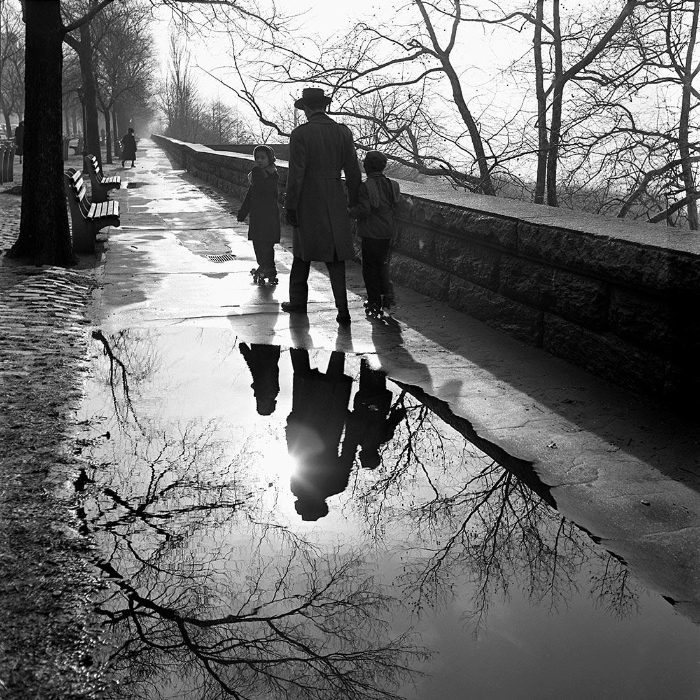
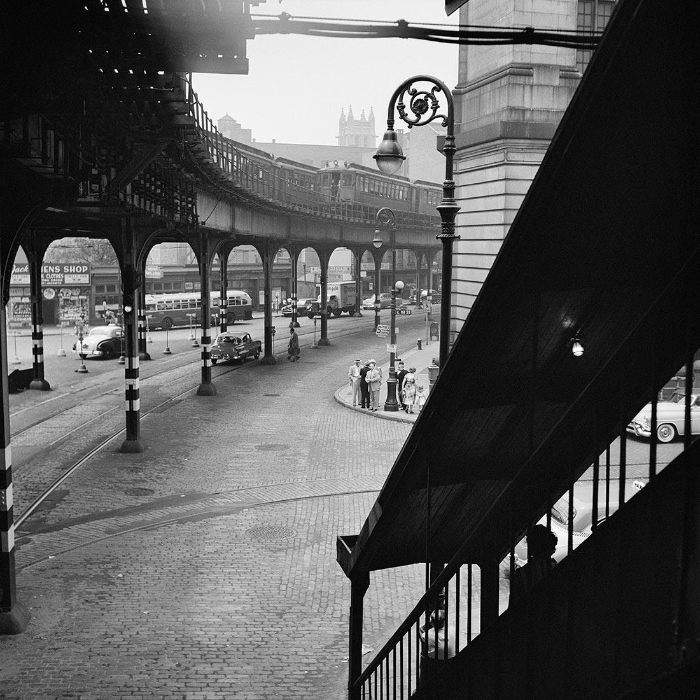
If you want to see how right I was about being wrong, go look at photos from Vivian Maier.

Maier was a nobody when she lived. She was a professional nanny. She owned an expensive Rolleiflex twin-lens camera that shot square photos. Guess how many photo lenses she had. “Two,” you’re thinking, because I just called it a twin-lens camera. Wrong. It had one. The other lens was just for feeding the viewfinder to set up pictures. The images it passed never touched film.

Guess how sharp the shooting lens was. I’ll tell you. Not very.

Maier had a one-lens, one-focal-length, unsharp camera that shot square photos, and her work was magnificent.

She used to shoot photos on her days off. The families that hired her traveled, so she shot in exotic locations as well as around New York and Chicago, where she lived. She left 150,000 negatives behind, that I know about. Maybe there are more. She was discovered posthumously in 2007, when a guy looking for useful old photos of Chicago bought a box of her negatives for $380. It had been left in an abandoned storage unit.

I will take the liberty of posting a photo or two. I don’t think I can be accused of infringement, since this is pretty clearly fair use, and it’s not like anyone can blow up a grainy resized photo from a blog and sell prints to the public or charge money to see them. There are a bunch of photos on the site named for her, and they advertise books you can buy on Amazon. My understanding is that the site is legitimate, and the profits go to people who are entitled to them.

It seems obvious that most photographers default to cameras that shoot 3:2 frames these days, and maybe Maier would have done so if she had had access to the variety of quality cameras we have today. In fact, she moved to 3:2 later in life. But she did just fine with square photos. It didn’t matter what shape the photos were as long as she was behind the camera.

Also, she didn’t seem to care about the Rule of Thirds. Maybe she didn’t know what it was.

The low-light video I found was made by a guy named Jason Vong, and he provided some simple rules I had never heard of before. He said there was one set of rules for handheld photos and another set for tripod use.

He says using the “auto” function on a camera will give you poor-quality low-light shots. You’ll preserve your precious memories, but they won’t look very good. I think it’s a waste of money and potential to use a good camera in “auto” when you don’t have to. It’s like driving a Ferrari with the valet key.

Handheld: set your aperture, your speed, and your ISO, in that order. “A-S-I.” Use the lowest f-stop you can. Use a shutter speed that matches your focal length for full-frame, and double the focal length for APS-C (example: 60 mm and 1/120 second). Use an ISO no higher than 3200 (APS-C) or 6400 (full-frame), and try to stay below 800 APS-C or 1600 full-frame. If you have to go higher than 800 or 1600, but you stay below the upper limits, software should give you an acceptably clean photo.

Tripod: S-I-A. You can set your shutter speed to be very low because the camera won’t shake.

Is Vong right? Probably. I haven’t tried his suggestions yet, but he is talking about basic theory, and he does photography for a living. I will find out.

Most instructors give vague advice. “This is what aperture does.” “This is what shutter speed does.” They don’t present information about exposure in a systematic way, as Vong has.

Maybe the longer video I haven’t finished watching will eventually cover the same points.

So what do I take away from all this?

Learn the Rule of Thirds, but remember that it’s just a suggestion. Learn what composition is, and get good at it. Then you can forget the Rule of Thirds. Don’t let a rule ruin your photos.

If you want to take candid photos instead of having people line up unnaturally and give creepy smiles in unison to produce bad flash photos where everyone has red pupils, you should get a couple of low-light lenses. I think this is probably a good conclusion.

I think you are better off with a bad camera and a good low-light lens than you are with a fantastic camera and a lens that quits at f3.5. When I started upgrading in 2023, I had a 2005 or 2006 Canon 350D with an 8-megapixel sensor. I thought moving to a 200D with way more resolution was the best move, and for $200 or so, it was a good buy, but now I believe faster lenses would have had more impact for indoor work.

I took some surprisingly excellent photos with the 350D back when it was young, and in the 80’s, I took some great shots with a Yashica FX-2 that only had one lens.

If you have to choose between optical perfection and low-light performance (or whatever other kind of performance you need), go with performance. People will care more about the quality of your photos than they will about “softness in the corners” or whatever other flaws they may have, and you will miss far fewer shots.

I think these are sound conclusions, but I am still fairly uninformed as photographers go, so anyone who knows more is welcome to chime in.

Here’s a great suggestion: don’t take advice from bad photographers unless you’re sure their badness is unrelated to the advice. I keep seeing videos and articles from successful photographers, accompanied by images I would delete instantly. It looks like there is, quite literally, no substitute for talent. No amount of experience, training, or equipment can help someone who is just not wired to take a good photo.

I am planning to work with the 23 mm lens to see what it can do, and after that, I will consider other low-light primes.

By the way, that little ZV1-M2 is not bad at all for travel stills. If you can’t stand the weight and size of a more serious camera, you can put it in your pocket or purse, and it will definitely outdo your phone.

Added Complexity is not Always Progress

Monday, November 24th, 2025

For Want of a Fob, the Explorer was Lost

It is remarkable how man loves to use technology to make life harder and more irritating.

I have a Ford. It has stupid electronic key fobs instead of brass keys. I wrote about it a few days back. One of my fobs was disintegrating, and I thought I had found a good solution to the problem. It turns out I was overly optimistic, so I am revisiting the issue.

What are the benefits of an electronic key fob?

1. You can operate your door locks with it. Brass keys do this as well, cars come with interior lock switches, and brass keys don’t fail due to battery problems.

2. You can start your car with it, if you have a fancy fob. Brass keys do this as well, and again, they do not fail. Yes, you can start your car remotely when it’s cold and get in when the heat has warmed it up, but then how sorry and useless do you have to be for that to matter to you? Is it really that hard to walk out to the car, start it, and go back inside?

3. You can make your horn honk when you’re in the parking lot at Walmart and you can’t find your car. Okay; score one for technology.

What are the problems with fobs?

1. They can cost up to $300 each. Each. And that’s not all. You may have to go sit in a dealer’s waiting room while they program your fobs.

2. They don’t last. Step on one or drop it just the right way, and you’re out a day’s pay. A brass key will work for a millennium.

3. As noted above, the batteries die.

4. Illiterate punks with gadgets from Ebay can clone your fob from across a parking lot, and then they can steal your car while you’re shopping. You, on the other hand, probably can’t program your own fob. Car makers work to make it impossible because, hey, $300 fob, which costs them $10.

5. When fobs that fit your car are no longer available anywhere, you will still be able to go to Lowe’s and get all the $1.50 keys you want for your 1975 Maverick.

My car is 10 years old. It has two of the fanciest 2016 Ford fobs. One of them slowly fell apart, and it finally refused to close. I decided to fix this. Being me, I thought there had to be a way to avoid the dealer.

I used AI. I watched videos. I did my homework. I was told I could buy a Chinese fob clone and program it myself, using some functions built into the car. I also read that I could buy a new shell for my busted fob so I could put the OEM guts in it.

I also read that in order to program a new fob, I needed two working fobs. Why? Because Ford is a jerk.

They don’t tell people this when they buy cars because they hope you’ll lose fobs and end up paying more.

I came up with a genius plan. Buy a Chinese fob. Clone my old broken fob to it. Make another clone for my wife. Put my old fob in a new shell. Put both OEM fobs in a safe place. Continue using Chinese fobs and replace as needed. Boom.

I ordered three items from Amazon for very low prices, and I felt pretty smug.

When the items arrived, reality hit me across the face like a cold, wet fish.

1. It was not possible to clone the fobs using my car. The year my car was made, they disabled the cloning feature for the particular type of fob I have. Other people with lesser fobs can still clone. Great.

2. The Chinese shell was impossible to assemble. The company that made it shipped it disassembled, and when I tried to put it together, I found out why. I think all the people who reviewed it positively were in China in review farms or they were the voices of the AI matrix.

3. Two of the fobs I ordered could not be made to work because they were not actually fobs. They were empty shells. Okay, technically I guess you could say that was my fault for ordering the wrong thing without paying attention.

I kept researching, and I learned some stuff.

It is (allegedly) possible to clone fobs like mine at home. You have to buy a cheap device that connects your ODB to a PC or phone via Bluetooth. You also have to buy an $11 program called Forscan. You hook up your car to your PC, crank up the program, and clone away. You can also change certain other functions of your car.

I bought the program. I ordered the gadget from Amazon. I’m sending the shells back and getting Chinese fobs complete with guts. I don’t know if I can do anything to fix the structural issues with my old fob, but I did put a thick rubber band around it to keep it together.

In a couple of days, unless I have been brutally deceived again, I will have two OEM fobs and two working Chinese fobs. Total cost about $105. Sounds expensive, and it is, but compare it to using a dealer or locksmith. And the ODB thing could come in handy later.

I would absolutely love to have a new car with brass keys and zero fobs. Keys are objectively superior, and I can say with equal certainty that the fob movement was a very bad idea that should be abolished. It’s like motorized mirrors and hatches. You just don’t need it, and the problems it causes when things go wrong, which they usually do, are horrifyingly expensive and bothersome.

Ford is an astonishing company. It is hard to understand how a company this stupid could continue to turn a profit. My car has design issues a monkey would have fixed prior to production, and cars with similar problems keep coming off the line, year after year, uncorrected. Ford is right up there with Nissan and the city of Los Angeles when it comes to incompetent management.

Somebody out there needs to start converting cars back to brass keys. He would make a fortune.

Revenge of the Nerds, Part 562

Thursday, November 20th, 2025

Tech Turns Faultless Two-Dollar Item into $250 Nightmare

I have good news for people who are justly upset with Ford for making keys ridiculously expensive, fragile, easy for hackers to copy, and hard for owners to copy.

Electronic keys are stupid. The electronic key boom is just one more example of engineers doing things they can, but should not, do. It demonstrates a total lack of common sense.

I have two fobs covered with buttons I don’t really need. They lock and unlock the doors. Don’t need. They open and shut the hatch. Don’t need. I think one of them will start the engine, but I don’t know, because…don’t need. There is also a button to set off the alarm, and that’s nice when I forget where I parked at Walmart, but truthfully…don’t need.

These keys are easy to duplicate. Easy for you and me? No. Easy for punk car thieves. They see you walking to your car. They watch you raise your fob. Then they use a machine to capture the signal. Later, they use it to get into your car. A 15-year-old moron who can’t read and write can do this, but you aren’t allowed to go to a hardware store and have your key copied electronically, like you could copy, oh, EVERY key made before engineers lost their minds.

Each fob has a real key inside it. Great. Problem solved. Throw out the fobs and use the metal key.

Oops…wait! Can’t do it. The metal key will not start or stop the engine. It just gets you into the car when your fob fails, so you can sit in the shade while you wait for a locksmith to come and charge you hundreds of dollars.

If the problem is a dead fob battery, you should be able to use the secret slot in your center console to start the car. You put the dead fob in there and start normally. If the fob got smashed or something, you may be stuck.

Here’s more great news. The fobs are made cheaply, so they fall apart. Eventually, long before your car gives out, your fob will start to come to pieces. Then Ford expects you to buy a new one.

If you buy a new Ford fob, you have to go to a dealership or a locksmith, prove ownership, and pay three digits to get it programmed. And you get to wait around while they get ready to call your name.

It’s a money-making scam for Ford, pure and simple. It’s also an insult. It doesn’t make the car harder to steal; it makes it easier. It doesn’t save the consumer money; it costs him money. It gives preferential treatment to thieves and dealers. Perhaps I repeat myself.

So what do you do?

If your fob breaks, it will almost always be the cheap plastic shell that fails. You can buy new Chinese shells on Amazon for as little as $10. You take the guts out of your old fob and put them in the new one. You’re welcome.

The new fob may or may not last, but for what you’re paying, you shouldn’t care.

What if you lose an OEM fob?

It turns out that all the problems that result from this are your own fault, assuming you know what I’m about to tell you.

You never use the OEM fobs. They are to be put away in a safe place. Both of them.

You can buy programmable Chinese fobs on Amazon for $27. If you have an Explorer, which is the only car I’ve checked out, you can program them yourself, easily. You have to do this before you lose one, because the car will do the programming, and it requires you to show it you still have both OEM fobs. Stupid. This is why you never take the OEM fobs out of your house.

I’m not going to show you the programming procedure. You can Google it, and I would probably get something wrong.

Before you lose or destroy a fob, buy at least two Chinese jobs and program them. Then put the OEM’s away. If you want, you can copy your metal key and put copies in the new fobs, but be sure you keep at least one key with your OEM fobs, because once you lose it, you are out of luck. You can program more fobs, but you will have to pay a locksmith to make the keys.

Are the keys useful? Well, I have driven this car since 2017, and I have never needed the real key.

You can also get electronic doodads to put on your keychain so you can find your keys with your phone. Samsung makes the Smarttag2, and Amazon makes Airtags. Ford sold you $250 fobs and did not include this cheap feature. Ford likes it when you lose your fobs. Ford wanted you to buy more fobs, because Ford is a jerk.

The rest of us will never stop paying for all the cafeteria wedgies the STEM kids got in junior high.

I guess I should not make unsupported allegations, but I lost my personal fob for a day and a half, and then I found it, broken, under a nightstand near which a certain small diaper-wearing person had been playing. Let’s say I have my suspicions. This is why I am learning all these new things.

Stacked Against Me

Tuesday, November 18th, 2025

Inching Upward Toward Mediocrity

Some new gadgetry arrived today, so I made some effort to shoot some more macro shots.

I was interested in focus stacking and focus bracketing. I should cover these things first.

Macro teachers on the web bamboozled me into thinking all I needed were a camera, a diffuser, and some patience. Not really true. You can get plenty of good pictures without a ton of equipment, but there are things you just will not be able to do, and the smaller you go, the more obvious this is.

With the lens I’m using on my APS-C Sony, the depth of field is something like 1 mm. That is small. It means that if I’m shooting a flower that measures an inch in my sagittal plane, I’m only getting about 1/25 of it, in terms of depth, in focus. That is no good.

A lot of people take shots that focus on one part of a small subject and give up on the rest, or they settle for low magnification. That’s okay, but sometimes you want to see more.

The way to get more depth of field, assuming you can’t back up enough to get it naturally, is to combine images using a computer. This is focus stacking. You take multiple images, changing the in-focus plane in steps. Then the computer discards the fuzzy stuff and puts the rest together in one sharp image.

How do you get all those images?

First of all, you have to use a tripod. Forget doing it the old-fashioned way. You will move around and get shots that are not the same.

Second, you can forget changing the focus between shots manually. It’s just too hard.

I thought in-camera focus bracketing might be the way to go. It looked that way when I read about it. It doesn’t work.

When you make your camera do focus bracketing, you push the button, and your camera shoots more than one shot, changing the focus between shots. The problem with this is that if you’re doing macro, not just “taking pictures of small things,” the camera will not change focus in small enough increments.

It turns out you need to move the camera, using a device that has a micrometer screw. That device is called a focusing rail. You mount it on your tripod, you line up your shot, and then you take numerous shots, leaving the focus alone. This moves the focused plane along your subject, giving you the desired material for focus stacking.

I got a pretty good tripod, and it arrived today. I got a geared head for it because geared heads hold stuff more reliably and allow for easy tilt adjustments around several axes. I found out how to make my A7IV do focus bracketing, and then I took pictures. I merged them in software, and the results are about what you would expect if I just held the camera and hoped for the best. Bad.

It isn’t going to work. I’m not going to fool with it. I’m getting a rail.

The tripod is excellent. I’m not saying it’s a great tripod, because it seems like any piece of equipment that qualifies to be called “great” by real photographers had to be made of spun platinum and cost over $50,000. I believe it’s excellent for my plans, given what I am willing to spend.

It’s a Vanguard Pro 2+, or something like that. Carbon fiber for weight reduction.

It holds a lot of weight, and you can move the legs and the central column in ways that will put your camera just about anywhere, solidly.

Using the tripod for the shot above was heaven on Earth. So much less aggravation than an Amazon Basics.

If you want to photograph a mushroom on the ground from 8 inches away, this tripod will hold your camera right where it needs to be. That’s pretty neat.

I got a geared head for it, and that’s also fun, but I think I could have lived with a regular ball head, which has a ball-and-socket joint you tighten with a screw.

I think I blew around $350. It’s not a childish splurge. It’s me, being a grown-up about photography. You can’t nickel-and-dime everything. You can’t buy a nice camera and nice lenses and then cheap out on everything else.

My $20-$25 tripods are amazing for what they cost, but you can’t put a real camera and a real lens on one and expect things to go smoothly. The weight is just too much. They’re wonderful for things like smartphones and Gopros.

I am getting a mid-range focusing rail, and with that done, I should be in good shape to do some photography. I am eager to see the results. The rail goes on top of the geared head, under the camera.

Pushing the button to take a shot is nerve-wracking, because it takes a lot of force and moves the camera. I’m going to be using remotes instead. I would stay away from Canon and Sony remotes. For one thing, they are back in the Stone Age when it comes to batteries. They use coin batteries that are a pain to replace, and my OEM Canon remote actually has a tiny Phillips screw you have to remove. Insane. I got rechargeable remotes from a company called Aodelan. I also have a tiny Smallrig tripod that has a rechargeable Sony-compatible remote in the handle.

I’m not using a phone app to pop the shutter because NOT EVERYTHING IN LIFE SHOULD BE DONE THROUGH A SMARTPHONE. Man, I wish millennials would understand this. I’ll bet I have over 100 apps, and in a sane world, maybe 35 of them would not exist. The 21st-century obsession with forcing people to do everything on phones is incredibly stupid. A 50-year-old who can use a desktop is almost godlike compared to a millennial who can’t.

I’ll bet there are kids out there writing term papers with their thumbs.

Well. That’s not true. They tell ChatGPT to do it, and they go on their illiterate, merry ways. Oh well; 6-7, right?

I guess I’ll want a real diffuser eventually. The fabric job I have is not very good. The diffusing part is white fabric, and the flash shines through it. This would be fine if there was any distance between the flash and the fabric, but it’s very close to it, so I think I’m probably getting a very localized light source. I think it’s a lot like wrapping your underwear around the flash. The light isn’t direct, but I don’t think it is spread out effectively. Could be wrong.

Diffusers are cheap, so no worries there.

Looking back, it’s a wonder I ever got any nice shots of small things.

My conclusions are always subject to change, because I am learning as I do, and I knew almost nothing to start with. I think I’m right about focus bracketing, but who knows what knowledge tomorrow may bring?

Macro Enthusiasm; Micro Ability

Monday, November 10th, 2025

Spending More Money is Always the Answer

I plan to try to take more macro photos today. I am determined to figure it out. I have learned that if you want extremely beautiful, compelling, or interesting subjects, macro wins hands down. There are more small things than big things. You should be able to find excellent subjects in your own house, if you are satisfied with very small objects.

I have decided to upgrade my backup camera, and I don’t mean the camera on the rear of my car. I think I was stupid to try to make do with an old DSLR instead of getting a decent mirrorless during my last upgrade. Now I am correcting that mistake.

I don’t have to ask my wife if she thinks it’s a good idea. She always tells me not to worry about what I spend. I say I don’t want her to end up working at IHOP. She says God will take care of her.

Two years ago, when I decided to get a real camera for family photo purposes, I already had an ancient Canon 350D with 8 megapixels. It was not a bad camera, but I couldn’t get really sharp photos with it, and it was generally not as good as 2023 or even 2015 cameras. The screen was bad. It needed a lot more light. It was a 2005 camera.

I got a Sony A7IV, which, to me, is a Bentley of a camera. To a pro, it’s more like a Jetta, but I considered it a splurge. It’s full-frame. It has zillions of features. The lens selection is crazy. It’s easy to get great photos and videos with it.

My wife and I were still traveling a lot, and when I packed for trips, I learned that you have to be a very serious guy to take an A7IV with you on vacation. It is heavy. They lenses are big. If it’s stolen, it’s a big hit.

I had a Sony vlogging camera, but it’s not great. I don’t get fantastic stills with it. The lens can’t be changed. It overheats and turns off without warning while shooting video (that cost us dearly). I’m not sure I should ever use it again. It’s very convenient, but it doesn’t do much a phone will not do just as well.

My Canon had a lens I liked. I thought it would be smart to buy a newer but still old Canon that would take the lens. I bought a 200D, which was made in around 2017. It had lots of helpful features. It had zillions of megapixels.

Then I did something that blew my whole “bargain” theory out of the water. I got two new lenses for the 200D. One replaced the old Sigma lens that had made me think buying the 200D was smart. DOH!

We took the 200D on trips, and it was okay. It was lighter than the big Sony; so much lighter I actually used it. I got nice photos and videos. On the other hand, I now had two ecosystems, so I had to speak both Sony and Canon. I had to remember which camera could or could not do certain things, because the 200D was DSLR, not mirrorless. The 200D could not be zoomed during video shooting with a remote. Learning that was a real bummer.

I have been immersed in baby-related activities for over a year, and I have spent very little time with the A7IV and 200D. We are stabilizing now, so I got my gear out, arranged and sorted it, and started shooting macro. I found I had to use new features on both cameras. I had to use two flashes. There were useful features the 200D lacked.

I decided to do what Porsche should have done in the early Sixties instead of doubling down on stupid and continuing to make troublesome rear-heavy cars: I admitted fault. I gave up on the 200D and also on Canon. I’m getting a Sony a6400, which is a mirrorless camera which is lighter than the A7IV. Of course, I have to get a few lenses, and that adds to the pain. I can try to work with adaptors, but life is short, and I have already cheaped myself out of enough good photographic experiences.

I thought the a6400 was a good compromise between frugality and getting features that would be satisfactory for the next decade or so.

I looked at used cameras, but the discounts weren’t great, and the a6400 comes bundled with a lens I want, plus some other good stuff, at a nice price. I bought new.

While I was working on picking out a camera and two lenses, I read other people’s reviews. In particular, I looked at reviews of Laowa Venus lenses. Laowa is one of those Chinese optical companies that have been giving companies like Sigma and Tamron fits by making pretty darned good lenses for bad-lens prices. Not always the best, but often too good to turn down.

While I was checking out macro lenses, I had a realization: there a lot of very experienced, highly trained, bad photographers out there. It made me feel I had been selling myself short.

I have seen all sorts of shots on the web recently, and most were posted by people who thought they had gotten great results. Maybe 80% of the time, they were shots I would either delete or keep to myself. Bad composition was the biggest sin. After that, I noticed photos that were too bland and uniform; not enough color or brightness variation. I also noticed that most people were happy with photos that weren’t very sharp at all. Also, people took shots that either had boring subjects or seemed to have no subjects at all. Are we supposed to look at the island way off in the middle of the lake or the little crooked tree on the island?

Some people were posting sublime, eye-popping shots that made me feel I was destined to lead a life of utter inferiority, and I was glad to see those, because they showed me I should improve. The others were the kind of shots that make you try to think of polite things to say. “Everything in the shot is kind of orange, isn’t it? That’s certainly…interesting.”

So how much can you tell about a piece of equipment if people who use it post bad shots? A bad lens can make bad photos, but it’s not easy to create really good shots with an objectively bad lens. If a person’s photos are good, you know the lens must be okay, but if they’re awful, you don’t learn much about it at all.

Here is how I feel about photos: if a shot is good, you know it almost instantly. It grabs you. To me, this quality is more important than focus or obeying rules.

When I’m editing shots, I move selector buttons back and forth, and when a photo is right, I suddenly feel it and stop moving them. I don’t have any rules. When the photo looks right, it sort of yells at me and tells me to stop.

So…the people who take very bad photos with very good equipment and think they’re wonderful…are they just too proud to look for instruction, or is it an incurable lack of innate talent? I guess sometimes it’s both, and sometimes it’s just a talent void.

I know I can take very good photos. Can I create great photos? When I ask that, I mean great photos that aren’t lucky shots. Anyone can get lucky.

I know nearly nothing about photography, even after all these years. I haven’t worked at it. I make almost no use of filters because I don’t know how. I don’t know how to work with white balance. Someone told me about stacking software. Don’t know anything. I don’t know how to use fill flash. The list is almost endless. I can’t do a whole lot of the things a real photographer can do, but I can do good work within that limitation, and I should be able to improve somewhat.

I wish I understood editing software. Seems like every program has 5,000 functions, and I understand 4.

I wonder if I could find a useful course. Maybe there are online courses for people who are beyond being told what an f-stop is but not capable of anything advanced.

Now, of course, I’ll sell the Canon stuff and try to mitigate the pounding I took when buying the new Sony.

Yeah, right. I know me. I’ll find a reason to keep it.

I’ll post another macro from yesterday. The depth of field could be better, the subject matter is okay but not great, and I felt there was a limit to what I could do to improve the composition.

MORE

I got a few shots today.

I tried to keep the f-stop at 18, and I kept the speed at 1/160.

I believe my biggest issue today was focus. I used the A7IV’s focus peaking, and it really failed me.

First, a peach blossom I shot. I believe I need to jack up the ISO, because things come out a bit dark, and the color is bleached out. Nonetheless, I like this better than the results I got yesterday.

It looks a little better at full size, but it is not perfect.

Second, a fly on a magnolia leaf. These guys were all over the leaves. I am considering smearing the leaves with a piece of tuna or something to leave a smell that will draw more bugs.

This is a very small bug, like 3/16″ long.

As you can see, the focus is poor. This is true even though the focus peaking lit up all over this guy. I got a bunch of shots like this, and they’re all useless. I don’t know if I need to use the feature that blows things up for focusing, or what. The person I watched in order to learn macro says not to do that.

A tripod won’t work unless the bugs sit still, and that won’t happen.

I got a lot of bad shots of some blossoms, so I deleted them.

It’s difficult to press the camera’s button without ruining composition and moving the lens off to the side or up or down.

Anyway, I made some progress.

In Gorilla Glass, Darkly

Saturday, November 8th, 2025

Mankind Fails Again

What a week. An antisemitic Muslim socialist who awaits the 12th Imam, who he thinks will turn the world Muslim and make the rest of us dhimmis, is now the mayor of New York, a city so heavily identified with Jews that Jesse Jackson calls it “Hymietown.” A nut who said he wanted to put two bullets in the head of his GOP opponent and said his small children should also be killed is now the Attorney General of Virginia.

Here’s something I haven’t seen anyone talking about: if Republicans and Jews had voted for Andrew Cuomo, Zohran Mamdani would have lost. Hmm.

About 100,000 Jews voted for a man who is on the side of those who want to put an end to the Jewish state; their only lifeboat. The worst enemies of the Jewish people have always been Jewish, just as Christians have always been the most effective enemies of Yeshua.

As for conservatives, I think it’s fair to say we are seeing a powerful wave of antisemitism on the right. As a Babylon Bee sketch character said concerning the left, hating Jews is cool now. That is literally true in the mainstream left, and it is becoming true on the right.

It’s a shame Americans are so young. If the average age were 60, more of us would remember a more-normal, less-insane America, so we have the background to understand how deranged the populace has become.

The average age of a US citizen is 39. That is pretty young, in a world where a person who isn’t a total health idiot can expect to live to be over 80. A person who is 39 now was only 21 when the first Iphone was released and people started seeing the world through their phones and engaging with it with their thumbs.

About a third of us are 25 or under. They are generally like loaves of bread that haven’t been baked long enough. They have no idea how to look for the truth. Their morals are appalling. They get their news from random nuts on social media sites and also from the withering MSM, which is very dishonest and hostile concerning Christians, Jews, Israel, conservatives, men, and America itself.

The kids have no idea what a normal country looks like. They don’t see how America has changed, and they don’t realize how much healthier it used to be.

What is happening in the US parallels what is happening around the world, and it’s happening for the same reason. Israel’s allies are vanishing, we are moving toward a world that is almost universally antisemitic, and it’s because mankind rejected the Holy Spirit. The Jews claimed to accept Yahweh but rejected Yeshua and the Holy Spirit. Christians claimed to accept Yahweh and Yeshua but rejected the Holy Spirit.

To reject any part of the Trinity is to reject every part, and there will be a price to pay.

Only the Holy Spirit keeps people sane. If you’re not spending time with him every day, you can be made to believe anything. If you think Caitlyn Jenner is a woman and Donald Trump is a serial pedophile rapist, you’re listening to demons, and you are probably lost forever. If you think the pandemic was planned, you’re in the same boat.

We are seeing things that were not possible in 2000 America. Millions of us now admire a sick, disgusting boy named Nick Fuentes, who says he loves Hitler. If figures can be trusted, Candace Owens has over 7 million X followers. She repeats classic libels as though they were true, and self-described Christians tell her she is doing God’s work.

Not long ago, these two bigots would have been considered radioactive. No one would have given them platforms. Owens would be working in a cubicle somewhere, or she would be a liberal pundit who was careful not to step on Jewish toes. Fuentes would be working at Walmart. The guy the other employees didn’t want to sit with at lunch.

Someone who pays for ads is supporting these two. I guess antisemitism is now good business. Doesn’t that mean that someone somewhere was paid to do a survey asking people questions to find out whether it would bother them to see products associated with people like Owens? Advertisers don’t roll over in bed without a survey. Surveys are what got conservatives and gun enthusiasts demonetized on Youtube.

Americans must have have given responses that encouraged advertising companies to associate their clients’ products with hating Jews.

I’ll say what I always say: if it’s this bad now, what will it be like in 6 months?

The prophecies are coming true. I know people say Christians have been making apocalyptic pronouncements since the day after the crucifixion, but we live in a time like no other. For the first time, nations all over the globe are turning against the Jews, as the prophets said they would. It’s a new thing. The UN persecutes Israel. In 1948, the UN established Israel. The prophets say all the nations of the world will come against Jerusalem. That was never on the table until now.

The church is collapsing in the US. It collapsed a long time ago in Europe. There is no place on Earth that hasn’t been evangelized. Not China. Not India. Not Japan. Not the Muslim world. There is no nation that is a candidate for a future revival that will give Christians and Jews a refuge. America is going to abandon Christians and Jews, and then there will be nothing to prevent the prophecies from playing out.

Look for conservatives, including “evangelicals,” to adopt antisemitism as the dominant policy soon. I think three years will get it done.

I don’t think it would be hard to get J.D. Vance onto the wrong side, if he isn’t there already. He’s a Catholic who married a Hindu. Here is Christianity 101: don’t marry a pagan. Vance has zero revelation, he doesn’t know the Holy Spirit, and that means he is open to anything.

Maintream Americans weren’t like this in the past. Candace Owens isn’t the first nut to grab a microphone and squirm with rage while ranting against innocent Jews, but her support is unprecedented. So is Fuentes’. So is Tucker Carlson’s. Megyn Kelly is also turning a blind or at least severely astigmatic eye toward antisemitism.

No one should be surprised to see blatantly hateful and dishonest people win elections. It’s normal now. No one should be surprised to see uncloseted antisemites receive wealth and acclaim. No one should be surprised to see Jews help them and vote for them. Jews have been empowering their enemies since Genesis. For Christians, it has only been since Acts.

Adolescent Baby

Saturday, October 25th, 2025

I Better not See a Bro Stache on Him This Year

I expected my son to grow up gradually, but it seems like he changes in sudden jumps.

Maybe 6 weeks ago, we got him a push walker because he was standing and holding onto furniture. We thought a walker would help him learn to walk. A push walker is sort of like a lawnmower. Babies stand behind them. They don’t sit in them.

He started standing and grabbing it right away, but he could not figure out how to move it around. He kept pulling it backward onto himself. He banged his head on it. I put padding on it to keep him from getting bruised.

He wasn’t able to push it around, but it has a panel with a bunch of toys on it, and he loved using those.

Last night, I was lying in bed looking at my phone, and I heard a noise. I looked down, and I saw his funny little head smiling up at me from beside the bed. He had pushed the walker across the room and into the bed.

I was amazed. It happened very suddenly.

He pushed it all over the bedroom last night. He loves it. It’s very easy for him. He holds the top bar with one hand and takes off. He acts like he has been doing it for months.

He will be walking in a week or so. I am sure of it. He has tons of strength, and he can stand up and squat without support. I’ve only seen him stand unsupported once, and it was only for a few seconds, but he is changing fast. What he’s doing with the walker is very close to walking.

We had to buy him a bunch of toys because we realized he was bored. He was chewing on charging cables and playing with anything we left within his reach. We got him a little plastic table with toys in it, and we also got him a plastic fire truck and a little toy TV remote that plays songs and so on.

He loves all of this stuff. He has learned how to use the table toys, and he spends a lot of time playing with them. There may be one toy he’s not using; I’m not sure. He sucks on the remote and pushes the buttons. He takes the parts out of fire truck and throws them around.

Now he has moved to a new stage, so we have to figure out what else to get him. I don’t even know what babies play with, so I am researching.

I don’t believe giving kids things spoils them. I believe teaching them not to appreciate things spoils them. It’s important to give kids anything they can make good use of. Where would we be if the great pianists hadn’t had good pianos when they were little more than toddlers?

My dad made good money, but my parents deprived me in comparison to the kids who lived around us. My sister and I had toys, but not many. I actually received hand-me-down toys from my best friend. I should have been given music lessons and good instruments as soon as I could benefit from them. My dad should have bought me equipment and taken me hunting and fishing. He and my mother should have shown me how to use science and engineering toys. I should have been taught to use tools. We should have traveled to Europe and Israel instead of taking cheap trips to Kentucky over and over.

It’s sad that I was encouraged to write. My parents and my teachers let me down with that advice. As a hobby and a way to communicate with people you care about, writing is fine, but anyone who encourages his child to do it for a living is extremely foolish. I should have been helped along with STEM pursuits. I would have had a bunch of patents by the time I was 30.

Toys aren’t luxuries. For kids, play is work. It’s their job. It builds capable adults.

We should also get something better than a stroller to use for walks. I don’t know anything about babies, so strollers were the only things that occurred to me when we had to move him around. There must be other things, like wagons. I’m looking into it.

We like taking mile-long walks on our private road, so we need something that will work well for that.

This boy is in such a hurry. We need to enjoy him the way he is while we can.

Can You SMELLLLLLLLLL What the Kirk Was Cookin’?

Thursday, October 9th, 2025

This Will Separate the Sheep from the Goats

Either I’m on fire today or I’m just willing to do anything other than clean the pool, so here comes more blogging.

My wife tells me Candace Owens has published authentic texts from some snitch, revealing that Charlie Kirk was, maybe, not happy with Jews because a Jewish donor that gave TPUSA two million a year cut Kirk off for refusing to denounce the raving, ignorant, immature, frat-boy antisemite Tucker Carlson.

Supposedly, Kirk said something about his Jewish donors living up to stereotypes. Maybe I can find it.

I got it! Here: “Just lost another huge Jewish donor. $2 million a year because we won’t cancer Tucker. Jewish donors play into all the stereotypes. I cannot and will not be bullied like this. Leaving me no choice but to leave the pro-Israel cause.”

Kirk supporters will say the texts were taken out of context, but my response to that is that there are many things context can’t fix.

This reminds me of some lines from a Woody Allen movie. A Latin American dictator has been deposed and replaced by a rebel leader who will, of course, be the next dictator, because Latin America. When they try the former dictator, this exchange takes place:

Rebel Leader: You are accused of killing over a thousand people in your term of office… of torturing hundreds of women and children. How do you plead?

Diaz: Guilty… with an explanation.

There are a couple of things wrong with what Saint Charlie said.

1. There is something wrong with anyone who won’t “cancer Tucker,” because Tucker is rapidly moving into Josef Goebbels territory. It’s not subtle. There are no grey areas. It’s not debatable. Reasonable minds may not differ.

2. “Jewish donors play into all the stereotypes” is, well, antisemitic.

I’ve known more Jews than Moses, and while every ethnic group has people who live up to and even exceed stereotypes, I have not found Jews to be particularly stingy or manipulative. Actually, if I had to come down on one side or the other, I would say that on the whole, Jews are more generous than Gentiles, and I haven’t noticed any difference when it comes to manipulation.

I have known some Jewish people who were a bit aggressive, but I can’t say they seem more aggressive than Gentiles. Except with women. That, I have been a witness to. But only in Israel. I don’t know what it is with Israeli men, but they hound women relentlessly,like they have a quota. I haven’t seen it here in America.

There are definitely Jews who don’t like Gentiles, but I don’t think that makes Jacob’s children any worse than the rest of us. It’s not like Gentiles are free of bigotry.

Just to open myself to criticism, I have found other groups to run more truly to stereotypes. American ghetto blacks are frightening. Cubans are hard to live among because of the materialism, machismo, and corruption. Many of my own people are just emotional ghetto whites. I have found Jewish people to be less consistent with stereotypes.

They tend to promote antisemitic notions in their own self-deprecating humor. Maybe they should reconsider that. I learned the only antisemitic jokes I know from Jews.

The third thing wrong with Saint Charlie’s text is that he says he is abandoning Israel because a few Jews quit sending him money.

So he was not Saint Charlie after all. He was Charlie the Whore.

All you folks who got mad when I said he wasn’t a real minister, line up and have a plate of crow with kreplach on the side. I didn’t even insult him. I wrote of him approvingly. I just said he wasn’t a minister.

For the slow, I will explain. You do not change your support for a country or anything else because people stop paying you. Support is supposed to be sincere. If you pretend to support anything just because you are paid, you are a huge and despicable whore, and if your work endangers a small and perpetually-beleaguered country that continually faces unfair existential threats fomented by Satan himself, you may be among the kings of whores.

Is Kirk even in heaven? I doubt it now. How can a professional liar go to heaven? The word says the lake of fire was prepared for “all liars.” It says lying is abomination, just like sodomy.

Everyone lies, but not everyone makes it a career and refuses to repent.

If he lied about Israel, what else did he lie about? Maybe he was not even conservative. Maybe he was like Candace Owens and Arianna Huffington, who defected overnight when they saw the side where the grass was greener.

No one becomes conservative or liberal overnight. This should be obvious.

Andrew Breitbart worked for Drudge, then for Huffington, and then for himself. He flapped like a windsock in a tornado. He was a snake. He was no conservative. I said so, and the usual toadies criticized me for being right. Don’t speak ill of Saint Andrew. Kirk looks even worse.

If there is anything positive in the new Kirk revelations, it’s that it makes me, the main character of the universe, feel even better about not worshiping Kirk. I did think he was a good guy who helped Trump get elected, but I never thought his shtick of sitting in a chair and arguing with unprepared liberals made him a great man.

I guess the fact that I feel better is not all that helpful to the rest of the world, but it’s something.

I told my wife I was upset with Jews for not sending me money. I will be happy to “cancer” Tucker. I do it all the time. I cancered Candace. I’ve cancered all sorts of enemies of Israel. I do it sincerely. Still, no checks.

The fact that I am obscure and have no impact on society could be part of the reason.

I’d settle for hamantaschen. A big tray, once a month. Cherry and apple. I know apricot is more traditional, but cherry and apple would be better. Made with butter. No Crisco. I’ll be watching my doorstep. I’ll even put up a mezuzah.

In other news, I am thinking about resistance training.

Back when I was in law school, I lifted weights a lot. I maxed out almost every machine in the University of Miami Wellness Center (gym, for normal people). I never got big or bulky, except for a 48″ chest. It always blows up, even with slight exertion. A genetic aberration, I guess. Too bad it’s localized.

I thought machines were pretty good, but it turned out they were not. For example, I used to lift 300 pounds very slowly, with deep motions, for 8 reps at a time. I didn’t bounce the weights three inches from full extension and claim I had lifted 300 pounds for real. Then a guy asked me to try a barbell, and I managed one repetition of 220. My strength was real, but it was only good for motion in a straight line with no freedom in any other direction. I could not stabilize a 300-pound bar.

Also, I wondered why I never looked particularly strong. People who were a lot weaker than I was looked better.

Lately, I have been considering doing a little resistance training. I did some last year, but I let it go. I am not trying to look buff or compete in contests. I just want to avoid crumbling faster than necessary in old age. I don’t want to have to ask the wife to open jars for me, and I don’t want to be easily injured because my frame has atrophied.

I learned a few things this week. I sort of knew most of it already, but I didn’t bother to put it all together until today.

A guy calling himself Anatoly popped up in my Youtube feed. He weighs about 180 pounds, but he looks more like 150 because he has no fat. He’s skinny.

He goes to gyms dresses as a janitor. He goes up to guys who are so full of steroids they will definitely die by 60, and he asks if he can try the weights. They laugh at him and make condescending remarks, and then he lifts more than they do, effortlessly.

I must make a disclaimer: I am assuming the bodybuilders in his videos are not shills. They could be.

He’s a powerlifter. He has benched 330, and he has deadlifted 640. People say he has lifted more and that these are old records. His real name is Volodymyr Shmondenko.

Benching 330 is not amazing, but it’s 110 more than I ever lifted. I don’t think he uses drugs, because his numbers are really good but not shocking. I could be wrong, though, because he could be someone who has limited genetic potential and looks like a good natural bodybuilder when he’s on the juice.

I found out that the bench press is not a great exercise. It makes you strong for doing one highly unlikely motion you will never make except when working out or trying to impress someone.

So anyway, I looked at this guy, and I thought I should think about powerlifting.

Here’s something weird: muscle size doesn’t correlate well to strength. For example, Schwarzenegger used to lift something like half of what his workout buddy lifted. His buddy Franco Columbu, was 5’6″ tall. Schwarzenegger’s claims have gone as high as 6’3-1/2″, but some witnesses say 5’11” is more like it. At least he’s taller than Burt Reynolds, who wore three-inch heels.

In any case, he was a lot bigger than Columbu. I saw Columbu lift the back of a Fiat and move it. I think it was in Pumping Iron.

Found it.

I had a fake friend in law school, and he was 6’6″ and weighed 330 (that he would admit). In the gym, he benched less than half of what I did, and I was not maxed out. The machine wouldn’t go high enough.

It’s not because my arms are shorter. I have long arms for my height. He was just naturally weak.

Bodybuilders commonly get two things wrong: they think they’re strong, and they think they can beat other men up. They’re not as strong as they could be, because they work out the wrong way. They can’t beat other people up unless they’re fighting untrained people. Fighting requires skill. Strength is not very useful if you have no skill and your opponent has lots of it.

Most untrained men can’t hit another guy with their left hands. It’s just right-right-right-right. That’s really something. And the rights are usually looping love taps that leave their faces and bodies open.

Bodybuilding is not about being strong. It’s about looking strong. This is why we now have men paying doctors to insert big pieces of plastic in their bodies to look like muscles.

What I’m getting at is that the majority of weight-training wisdom in America is aimed at making men look strong, and the things most men do actually limit their strength gains while filling them with relatively weak muscle.

I should have learned about this back when I was really working out, instead of waiting until I was ready for the shuffleboard court.

I have studied up, and I have learned a few things.

1. Bodybuilding is not a good way to build strength.

2. The really strong guys are powerlifters and strength trainers.

3. Powerlifting is a competitive sport, and while it shares things with strength training, it’s not the same thing. If you want to be strong, you want to use strength-training methods and forget about powerlifting.

4. Isolating muscles, which bodybuilders love, severely limits real-world strength. To become strong, you want exercises that involve multiple groups. The reason to isolate muscles is to make them big and impress all the other possibly-latent dudes in the gym shower.

5. To get strong, you want sets with low repetitions. A maximum of 5. Not the 8 or 12 you may have heard about at the gym. You set weights so you can lift them safely a maximum of three times. You lift until you can lift them 5 times. Then you increase the weight.

This is great, because it means less work.

6. Strength training, which involves heavier weights, is less likely to injure you than vanity training, which requires you to use your joints over and over. This surprised me.

I was very glad to learn that isolating muscles was stupid, because the more you isolate groups, the longer and more miserable your workouts will be. Your body has a lot of muscles to isolate.

It speaks poorly of humanity that so many people are lifting for stupid reasons. Why would anyone want to be weaker than necessary while working out harder than necessary? It’s effeminate, prancing around in shiny thong panties with other men, hoping your calves are more cut than theirs.

Different types of workouts build different types of muscles. Low reps build strong muscles. Supposedly, they also increase your body’s ability to “recruit” muscle fibers, so you get more power out of the muscles you have.

With all this in mind, you can see that it’s incredibly stupid to lift like a bodybuilder. You will work harder, be weaker, and endanger your body more. Also, if you’re looking for workout advice on the web, you have to be careful to detect bodybuilder garbage. Any fitness guy who says the words “big” or “bigger” while demonstrating an exercise should be ignored.

If you look around the web, you can find pictures and videos of men who look like refrigerator repairmen or Uber drivers, lifting enormous weights with their seemingly-flabby, untoned bodies.

All this makes me think of Dwayne Johnson, AKA “the Rock.”

People love this man. He’s a professional nice guy. He tries to avoid saying anything negative. He always smiles. He wants you to see him with his tiny daughter and his tiny dog. He gives people supportive shoutouts. I don’t like him.

I used to think Johnson was great, because I was foolish. Back in law school, I thought WWF wrestling was a hoot, and I watched it diligently. I loved the Rock character. The funny eyebrow. “It doesn’t matter what your name is!” The people’s elbow. Hilarious.

I should not have let the WWF’s excrement enter my mind, but I did.

He became an actor, and eventually, he hit the juice really hard. And lied about it. He says he hasn’t used drugs since he was a teenager, but the world is full of men his age, and so far, he is the only one out of hundreds of millions who has managed to look like the Hulk at age 55.

He lies and says it’s all about diet and exercise, like no one ever dieted or exercised before. Like no one else on Earth worked hard until he invented work.

He claims he has been a workout fanatic since he was a little child, but somehow he was bigger in his mid-fifties, with almost no body fat, than he was at any point earlier in his life when he was blessed with more natural testosterone and better recovery abilities.

People say he’s naturally big because he’s a Samoan, and many Samoans really do have a genetic edge. Well, he’s only half Samoan, his non-Samoan dad was on steroids, and no other Samoan has ever looked like him without drugs, so BS on that. He was half Samoan when he was working out like crazy and 30 years younger, and he was smaller.

Now he has given up drugs because he has clogged arteries, which steroids cause. He has dropped 50 or 60 pounds, or maybe one third of his total muscle weight. People are not 100% muscle. He claims he did it for a movie role. No; he did it to avoid an early grave.

He is a role model for kids, and they go to the gym and try what he claims he does, and they get lackluster results. They don’t look like he does, because they’re not on drugs yet, and they don’t get as strong as they should because they’re doing glamour exercises that make weaker muscles.

Then what do they do? Many do what he really does. They use drugs. Then they blow up and look like him. They go bald early. They get scarring acne. Their testicles all but vanish. Like Johnson, they grow breasts that have to be cut out. They have rage problems. They suffer from depression. They cry for no reason. They remain short because steroids end natural growth.

This is all bad, but it looks like he hurt his health and hurt kids without even getting as strong as he could have. He blew himself up so he could be a shirtless dandy for all his little bros, but smaller guys who don’t look like dangerously overinflated tires are much stronger.

On top of that, many women find grotesque steroid physiques a little repulsive. Steroid users tend to look like they’ve been skinned.

I am probably never going to work out seriously, because I am too lazy. I know I will never do long workouts assiduously, so I have reasonable goals.

I came up with an exercise which turns out to be very, very good for strength development. I put two dumbbells by my feet, I squat to get them to waist level, I curl them to my shoulders, I press them overhead, and then I do it all in reverse.

I don’t strain my back the way squats or deadlifts could. I give both sides of my body the same treatment instead of allowing a barbell to shift the work to my right side. It’s not bad for an old guy who has modest expectations.

I haven’t done any resistance training at all at least since the beginning of the year. I started up today, and I managed 5 reps with 42.5 pounds on each side. It will never win me any prizes, but it’s an okay start for an old man who mostly lifts a fork. Lifting dumbbells is harder than lifting barbells for the same reason lifting barbells is harder than pushing machine handles, so you end up using less weight.

If things go well, I should be up to maybe 60 pounds per side in a few months. I may add another exercise if I think I’ll keep up with it. I should get back to climbing stairs with a weighted vest.

I almost never feel I’m not strong enough, although putting tires back on hubs while sitting on the ground is an area where more power would be nice. I’m doing okay, but I think it’s wise to try get a little better and avoid falling apart too fast.

Preventing injuries is important at my age (or any age), and stronger muscles are harder to hurt.

Hopefully, my arteries will remain clear, my strength will be optimal in relation to the amount of exercise I do, and I will never have to drop 50 pounds in three months and come up with lies to explain it.