The Hardest Thing About Learning is Weeding Out the Bad Teachers
November 28th, 2025Let the Light In
I take a lot of photos of my son using my phone. I also shoot video. It’s very convenient. It’s quick. My phone is always in a handy pocket on the side of my leg. It’s not heavy. It’s not in the way. It takes around 4 seconds to get it out and get the camera function working.
The photo quality is amazing I don’t mean it’s good. I just mean it’s amazing. The phone is around 1/4″ thick, the lenses are smaller than Cheerios, optical zoom is a mechanical impossibility, and yet somehow, I get photos that are more than good enough to blow up to three feet wide and hang on my walls.
Does that mean they’re “good”? Well, no. Not if you judge them by camera standards.
The other day, I shot some photos of my son, using a Sony ZV1-M2. This is a camera that cost me around $900. If you’re not a photo buff, you may not know it, but $900 is not anything close to what new professional-grade cameras cost, so I’m saying it’s not the best camera there is.
It has a built-in mechanical zoom lens. It has an APS-C sensor, meaning it’s smaller than a full-frame sensor. It has an articulated touch screen on the back. It has two microphones. You can also plug external mikes into it. It has a hot shoe.
It’s aimed at the video-blog market. It will give you better videos than a phone. It’s not intended to be the world’s best still camera, but of course, you can use it for stills.
I bought it for travel. I found it to be good for video, albeit cumbersome with all the audio stuff and the mini-tripod or gimbal attached. It overheats quickly in the sun, however, and the Rube Goldberg nature of adding mikes led to me making a number of videos without sound. Unintentional silent movies. The stills were okay, but I also took a DSLR to see if I could do better.
When I put the shots of my son up on the 65″ TV I use as a monitor, I saw that I had been missing out. Even though I was using a compact vlogging camera with numerous limitations, the photos were clearly superior to anything my phone could produce. Better subject separation. Better sharpness. He just plain looked better.
Last night, I wanted shots of my son at Thanksgiving dinner. I grabbed a Sony a6400, figuring it would be better than the ZV1-M2. Problem: I didn’t have any lenses that combined a suitable focal length with acceptable light-gathering. In other words, I wanted a wide-angle lens that would give noise-free shots in my kitchen at night, and my only option was 9mm, which is over the top. I gave up and grabbed the ZV1-M2, which can shoot as wide as f1.8. The shots are probably pretty good. I have not seen them.
This experience made me realize, once again, that I had been looking for, and buying, the wrong lenses.
Photo gurus really push handy zoom lenses for travel, as well as sharp primes that don’t do well indoors. I listened to them, so now I can’t use my expensive cameras to shoot family photos without additional lighting.
Seriously, am I going to run and get a complicated lighting contraption and set it up every time I want to take a candid shot of my wife and son? Am I going to fiddle with my complex on-camera flash and hope I don’t end up with what looks like a bad amateur wedding reception photo? No. I’m going to grab the phone or the compact.
As fate would have it, things aren’t all that bad. Help was on the way before I realized I had the wrong lenses. Before Thanksgiving, I ordered a 23 mm Sigma f1.4 prime lens for the a6400. This would have been perfect for last night. It’s very sharp, it’s not terribly expensive, and the focal length is just right for most indoor people shots.
Before I bought it, I took my 18-135 mm zoom and took shots inside the house. I simulated 23 mm and 35 mm shots. The 35 mm shots were claustrophobic. They left things out. This is how I landed on 23 mm.
By the way, I put a space between numerals and “mm” for a reason. The convention of putting them next to each other is stupid and anomalous, and it causes all sorts of problems for search engines. It needs to stop.
Sigma makes a family of low-priced, good-quality f1.4 lenses, and that’s why I had to take the test shots. I could have gone wider or narrower.
The lens arrives today, and I expect it to revolutionize my a6400 game. I should be able to keep the camera sitting out where I can grab it, and I should be able to get a lot of very nice shots with it.
I also found a useful video about low-light shooting. Finally.
Why didn’t I know what I needed sooner? Well, I did study up. Quite a bit. But there is a lot of bad advice out there, from people who claim to know what they’re doing.
There are a bunch of camera courses on Youtube, and they must be pretty good, because people say nice things about them, and some of them used to cost a lot of money. I picked one, and I started watching it.
I have not seen the whole thing, so maybe the host will eventually get around to really useful information, but so far, he has not done all that well. He has spent considerable time talking about the Rule of Thirds, a maxim (not a hard rule) which seems useful when you first hear about it and then turns out to be disappointing.
It works like this. You divide your frame into 9 boxes. When you frame subjects, you try to arrange things so each third (bottom to top) contains something different. For example, ocean at the bottom, blue sky in the middle, clouds at the top. If you have an important object in the frame, put it near a corner of the middle box; the Paul Lynde box.
This is considered aesthetically pleasing, and it definitely works in many circumstances, or nobody would teach it. On the other hand, the vast majority of photos I enjoy violate it pretty vigorously.
I like watching Youtubes featuring the works of great photographers, and when I watched a few after learning about the Rule of Thirds, it seemed more like the artists were obeying the Rule of Avoiding Thirds. Makes you wonder if they ever heard of the rule. Go look at some great photos, and you will see I’m right.
I’ve watched other advice and instruction videos as well.
My impression is that most instruction videos are useful but not terribly so, and they can push you into formulaic approaches that obscure whatever talent you may possess. Photography is an art, so talent is the main thing.
I listened to Youtubers when I chose lenses, and they talked a great deal about things that aren’t nearly as important as getting the shot in the first place. Vignetting. Barrel distortion. Sharpness. Focus breathing, which, I believe, only applies to video.
The sharpness obsession got me excited, so I bought sharp lenses. I think they’re just swell, but I also realize I got too caught up in sharpness. Even as I was shopping, I thought I was probably focusing, if you will, too much on the wrong thing.
If you want to see how right I was about being wrong, go look at photos from Vivian Maier.
Maier was a nobody when she lived. She was a professional nanny. She owned an expensive Rolleiflex twin-lens camera that shot square photos. Guess how many photo lenses she had. “Two,” you’re thinking, because I just called it a twin-lens camera. Wrong. It had one. The other lens was just for feeding the viewfinder to set up pictures. The images it passed never touched film.
Guess how sharp the shooting lens was. I’ll tell you. Not very.
Maier had a one-lens, one-focal-length, unsharp camera that shot square photos, and her work was magnificent.
She used to shoot photos on her days off. The families that hired her traveled, so she shot in exotic locations as well as around New York and Chicago, where she lived. She left 150,000 negatives behind, that I know about. Maybe there are more. She was discovered posthumously in 2007, when a guy looking for useful old photos of Chicago bought a box of her negatives for $380. It had been left in an abandoned storage unit.
I will take the liberty of posting a photo or two. I don’t think I can be accused of infringement, since this is pretty clearly fair use, and it’s not like anyone can blow up a grainy resized photo from a blog and sell prints to the public or charge money to see them. There are a bunch of photos on the site named for her, and they advertise books you can buy on Amazon. My understanding is that the site is legitimate, and the profits go to people who are entitled to them.
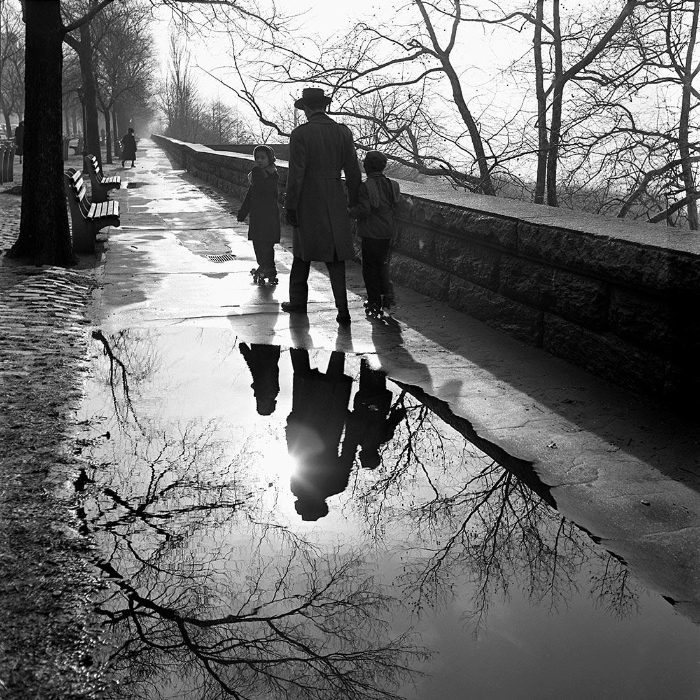
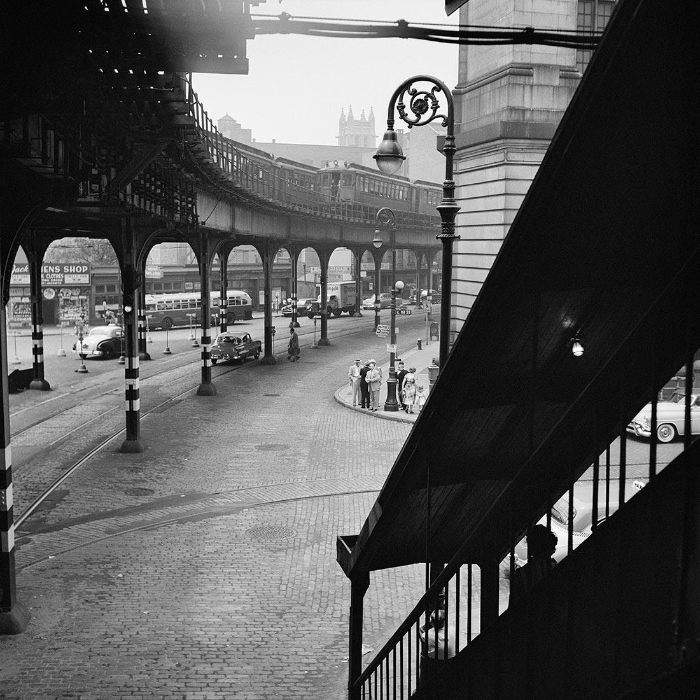
It seems obvious that most photographers default to cameras that shoot 3:2 frames these days, and maybe Maier would have done so if she had had access to the variety of quality cameras we have today. In fact, she moved to 3:2 later in life. But she did just fine with square photos. It didn’t matter what shape the photos were as long as she was behind the camera.
Also, she didn’t seem to care about the Rule of Thirds. Maybe she didn’t know what it was.
The low-light video I found was made by a guy named Jason Vong, and he provided some simple rules I had never heard of before. He said there was one set of rules for handheld photos and another set for tripod use.
He says using the “auto” function on a camera will give you poor-quality low-light shots. You’ll preserve your precious memories, but they won’t look very good. I think it’s a waste of money and potential to use a good camera in “auto” when you don’t have to. It’s like driving a Ferrari with the valet key.
Handheld: set your aperture, your speed, and your ISO, in that order. “A-S-I.” Use the lowest f-stop you can. Use a shutter speed that matches your focal length for full-frame, and double the focal length for APS-C (example: 60 mm and 1/120 second). Use an ISO no higher than 3200 (APS-C) or 6400 (full-frame), and try to stay below 800 APS-C or 1600 full-frame. If you have to go higher than 800 or 1600, but you stay below the upper limits, software should give you an acceptably clean photo.
Tripod: S-I-A. You can set your shutter speed to be very low because the camera won’t shake.
Is Vong right? Probably. I haven’t tried his suggestions yet, but he is talking about basic theory, and he does photography for a living. I will find out.
Most instructors give vague advice. “This is what aperture does.” “This is what shutter speed does.” They don’t present information about exposure in a systematic way, as Vong has.
Maybe the longer video I haven’t finished watching will eventually cover the same points.
So what do I take away from all this?
Learn the Rule of Thirds, but remember that it’s just a suggestion. Learn what composition is, and get good at it. Then you can forget the Rule of Thirds. Don’t let a rule ruin your photos.
If you want to take candid photos instead of having people line up unnaturally and give creepy smiles in unison to produce bad flash photos where everyone has red pupils, you should get a couple of low-light lenses. I think this is probably a good conclusion.
I think you are better off with a bad camera and a good low-light lens than you are with a fantastic camera and a lens that quits at f3.5. When I started upgrading in 2023, I had a 2005 or 2006 Canon 350D with an 8-megapixel sensor. I thought moving to a 200D with way more resolution was the best move, and for $200 or so, it was a good buy, but now I believe faster lenses would have had more impact for indoor work.
I took some surprisingly excellent photos with the 350D back when it was young, and in the 80’s, I took some great shots with a Yashica FX-2 that only had one lens.
If you have to choose between optical perfection and low-light performance (or whatever other kind of performance you need), go with performance. People will care more about the quality of your photos than they will about “softness in the corners” or whatever other flaws they may have, and you will miss far fewer shots.
I think these are sound conclusions, but I am still fairly uninformed as photographers go, so anyone who knows more is welcome to chime in.
Here’s a great suggestion: don’t take advice from bad photographers unless you’re sure their badness is unrelated to the advice. I keep seeing videos and articles from successful photographers, accompanied by images I would delete instantly. It looks like there is, quite literally, no substitute for talent. No amount of experience, training, or equipment can help someone who is just not wired to take a good photo.
I am planning to work with the 23 mm lens to see what it can do, and after that, I will consider other low-light primes.
By the way, that little ZV1-M2 is not bad at all for travel stills. If you can’t stand the weight and size of a more serious camera, you can put it in your pocket or purse, and it will definitely outdo your phone.
December 1st, 2025 at 11:40 AM
The guy who discovered Vivian Maier’s negatives — John Maloof — paid a French cousin of hers, once-removed, $5000 for copyright ownership, in an attempt to secure any future profits from prints, books and so on, for himself.
However, some other surviving family members subsequently sued him in the USA, and he had to settle out of court with them.
I’ve always found the idea of Maloof profiting from this woman’s work a little distasteful. (He made a movie about the whole story, which is quite interesting, though he’s profiting from that too I suppose.)