Archive for the ‘Tools’ Category

Hornady LNL Fixed!

Sunday, March 15th, 2009

Friction Gone

More info for Hornady Lock-N-Load AP owners.

A while back I wrote about the problems I had with my Lock-N-Load. I want to emphasize something: this machine may have been completely perfect when I got it. It is possible that I screwed it up while learning how to use it. But I don’t think so, because it appears that the fundamental problem is excess friction, and that’s a design and/or manufacturing tolerance issue.

I had problems with indexing from the time I got the press. The ball detent things under the shell plate are of limited value; they don’t give enough resistance to prevent the plate from indexing incorrectly. You have to have the pawls set perfectly. These are little spring doodads that push the index wheel that turns the plate. They must be aligned with extreme precision; one quarter of a turn of an adjusting screw can mess things up.

The pawls move the plate by pushing the index wheel with their upper edges, which are very thin and somewhat fragile. The index wheel is hardened steel, and it will eat the pawls quickly if they have to work too hard. If it takes a lot of torque to turn the wheel, the pawls aren’t going to last. I think Hornady dropped the ball here. It seems to me that if you’re going to use a thin, delicate metal edge to push something, you should reduce the required force as much as possible. It would have been just as easy to make machines that turned with less resistance. Change two specs: the diameter of the drive hub, and the diameter of the drive shaft.

I figured I was having a problem with friction, so I took the driveshaft out, mounted it in a drill, and spun it inside a sheet of emery paper until it was shiny. When I stuck the shaft back in the machine, the decrease in friction was obvious. But I couldn’t test the press because while I was fooling with it I snapped a little key off the drive hub, and I put a lot of wear on the pawls. I ordered new pawls and a new hub, and they arrived a couple of days ago.

I put the hub on the shaft, mounted it in the drill, and gave it the emery-paper treatment. I cleaned out the inside of the sub plate (the hub rotates inside it), and I greased everything and put the machine together. When all was said and done, it turned considerably more freely than in the past, and it indexed perfectly.

One interesting side note: I had a hell of a time getting it to index when I first put it back together. Finally, I looked at the index wheel. It appeared to me that it was impossible for the pawls to push it as far as it needed to go, because of the shape of the wheel’s arms. They seemed to be curved in the opposite direction from the way they needed to go. And of course, they were. I had put the wheel on upside-down. This is probably why I couldn’t get the machine to index the last time I worked on it, after I ground the worn parts off the pawls. In all likelihood, I bought new pawls I didn’t need. Oh well. I’ll need them eventually.

I also have a habit of reassembling coaxial parts in the wrong order, so whatever I’m working on has to be taken apart several times before I’m done. I only did that about three times tonight.

The machine works great now. Slick as snot on a doorknob. And I understand it, finally. I suspect that every LNL owner needs to do what I did. Unless some units have less friction than others.

Hornady redesigned the shell ejection system. You have to buy a $30 replacement sub plate and pay $10 each to get your shell plates converted to work with it. I don’t know if I’ll bother. The old system relies on a stiff wire that pushes shells out of the plate. It’s very clearly at an angle which is suboptimal for the job. That’s not the whole problem; when the wire pushes on the side of the case to eject it, the rim rotates up against the bottom of the shell plate and creates resistance to ejection. But I think that if I bent the wire a bit, it would be reliable enough to keep using. I have two or three spares, so I don’t really care if I ruin one.

It feels great to get something fixed. So often now, when I have a problem, I’m able to go out in the garage and fix it. I can’t explain how wonderful that feels. I am finally getting something I’ve wanted all my life. It’s like coming up for air after a long swim under water.

My tool journey has been much more than a frivolous waste of money or a passing interest. I has been a genuine voyage of self-actualization. Christians don’t use that term much, but we should, because self-actualization is something the Psalms promise us. “Delight thyself also in the Lord, and he shall give thee the desires of thine heart.” “The steps of a good man are ordered by the Lord, and he delighteth in his way.” God knows us before we are born, and he designs each of us for a purpose. So it’s only natural that faith and obedience lead to a life in which you find yourself doing the very things that fill your innermost needs.

It’s funny. Non-Christians talk about the importance of “finding yourself.” That’s exactly what’s happening to me. So often, we spend our lives trying to find the things we know we need, when we should be living by faith and letting God bring us those things. You don’t need to find yourself. God already knows where you are, and he can show you.

I am starting to wrap up my lathe search. I have a couple of candidates. The prices are merely fair, but I can live with that, if it means not having the headache of coping with disappointing tools from shady dealers. Sometimes you have to pay for things. That’s just how it is.

I’m thinking I’ll get a 12″ by 36″ lathe and possibly a Millrite. I would prefer a Bridgeport, because there is a good chance I’ll eventually want to upgrade from a Millrite, but space is an issue, and a Bridgeport is about half again as big as a Millrite, in linear terms. The Millrite I found locally appears to be very nice, and I can get it at an okay price, with a shipping charge much lower than what I’d pay to drag one in from out of state. Once I have a mill and a lathe, I’ll be pretty well set for major tools.

Just don’t talk to me about Bobcats.

Better Than Barbara Eden

Friday, March 13th, 2009

Free Stuff!

I got some comments touting the reliability of pump-action shotguns and implying that the Saiga I got is a product that lacks the pump’s long history of trouble-free use. I have no reason to doubt that pumps are reliable. I don’t know much about them. But I think I should point something out, if only to keep people from inadvertently making themselves look silly. The shotgun I bought is made by Izhmash, and the brand name is Saiga, but what it is, is a KALASHNIKOV. It’s an AK-47 shotgun. So maybe it’s best not to call it “untried.” That is my thinking, anyway.

I have had an interesting day. I got two new tools. Are you ready for this? One is a huge GENIE LIFT.

I know what you’re thinking. I have a giant Gomez-Addams-style vault under the floor, so I don’t care what I spend. No. Sadly. I got this thing for nothing. It’s really incredible.

My father owns some warehouses. The economy is bad. People are going out of business. He lost a tenant. The tenant was in construction. He told me the warehouse was full of “junk” up to the ceiling. He could not get the tenant to remove it. They called Habitat for Humanity, and they wouldn’t take any of it. It has been abandoned. He said there were “two big machines” in there, and he invited me to go look.

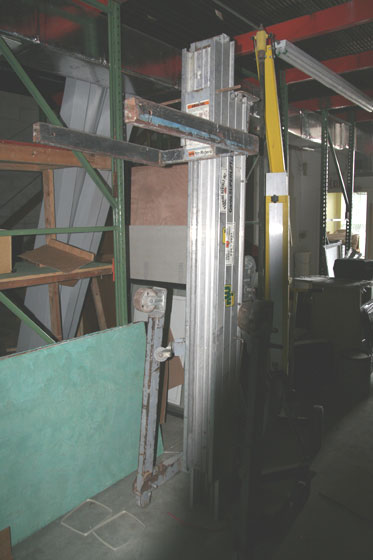
We drove out there today and opened the place up, and lo and behold, there was a Genie Lift in the back. And I don’t mean a little one. This thing looks like the suit Sigourney Weaver wore to fight the alien queen. It has the outrigger deals and everything. You could lower a 600-pound tool from the back of a truck with this machine. I have no idea what I’m going to do with it , but I know one thing. It’s coming home with me.

03-13-09-genie-lift-in-warehouse

Can you believe that? On the way out there, I kept thinking how great it would be if one of the machines were a mill or a Genie Lift. I guess a Genie Lift is better, because I am willing to pay for a mill, but I would never have sprung for a Genie Lift.

It’s beat-up, but who cares? It’s in working condition.

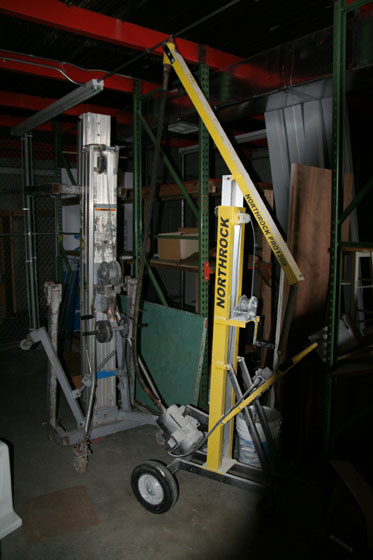
The other machine, I could not figure out. It had two big tires on the bottom and a big flex shaft about eight or nine feet long, running from a Baldor motor to what looked like a platform for lifting drywall into place. I looked it up when I got home. It’s a ceiling grinder.

03-13-09-ceiling-grinder-in-warehouse

I would guess that even among my bizarre readers, there are few people who would recognize this thing. Here’s how it works. You make a concrete garage. It has cruddy excess material at the seams on the ceiling. So you go in with the ceiling grinder and grind them down. It works with wheels that look just like 10″ cutoff wheels. Google it. Very odd.

It’s in excellent shape. Unfortunately, I can think of no earthly use for it. So I plan to Craigslist it.

I plan to Craigslist a lot of stuff. My father wants no part of this mess. He just wants it out. He made me a key, and he told me it was my problem. I guess I’ll have to go out there and catalog and photograph it. Here is some of the junk I found.

1. A huge Ridgid brand driveshaft. For what? I don’t know. It’s brand new, still in the box. It’s around six feet long.

2. Boxes and boxes of grey PVC fittings. Lots of “end bells.”

3. Nuts for electrical conduit. Many boxes. I’d say most are 3″ across. Maybe 2″.

4. At least four stainless in-wall restroom towel dispensers.

5. Five sheets of 3/4″ sheathing plywood, plus other scraps.

6. A ten-foot-long formica workbench.

7. Three air cleaners. These are huge box fans that take air filters. Very heavy. One is still in the box.

8. Miles of rigid and EMT conduit. I will never lack for scrap again, if I can just find a place to put it.

9. All sorts of leftover steel from a modular mezzanine put in by a previous tenant. Beautiful for welding.

10. About 30 sheets of painted 3/16″ steel, in one-foot squares. These are panels intended for some specific purpose, but to me, they are some of the most gorgeous welding scrap imaginable.

11. Lots of electrical boxes, including some about two feet high and two feet wide. Full of tasty salvageable breakers begging to be ripped out and stored for later use.

12. Gigantic commercial lighting fixtures, including at least one street lamp about two feet across.

13. Miles of Romex and Cat-6 wire.

14. A steel desk with a very sturdy plastic top. Looks like a solid sheet of nylon or polyethylene. It would make a pretty sweet workbench.

15. A big Ridgid tool stand with no tool on it.

What a mess. I guess I should catalog it, find out the retail prices, list it for 50% off, and see who buys.

How to Disassemble a Hornady Lock-N-Load AP

Saturday, March 7th, 2009

Void Your Warranty the Correct Way

In case anyone else out there has a Hornady Lock-N-Load ammunition press that needs taking apart, I am posting this entry.

I felt there was too much friction between the driveshaft and the rest of the press, and that this screwed up the indexing, so I decided to take the driveshaft out, polish it to make it more slippery, and put it back in. Unfortunately, this is kind of a pain, and even if you have the exploded drawings, you may get confused.

1. Lift the ram and fix it so it can’t go back down. How you do this is your problem. This is going to give you access to a couple of hex screws on the ram’s sides.

2. Take out the hex screws. Hornady says to tap the wrench with a hammer if they won’t move. Be patient and don’t bust anything. It works.

3. You have liberated the subplate from the drive hub and shaft. They’re still attached at the bottom of the press, so you need to remove the yoke. It’s held on by snap rings. Remove one of them and it will slide out. How do you remove snap rings? Simple. Go to Sears and buy one tool for each of the 952,000 types of rings, and see if one fits. Or do what everyone else does and push it with two screwdrivers until it pops off and flies into the rafters. A magnetic pickup tool may be useful when you finally locate the ring. It will land in the deepest crack in your garage, wherever that may be. If, for some reason, you want to find the least accessible area of your garage, popping off a snap ring and observing its trajectory is a good method.

4. Slide the shaft and ram and whatever down out of the press.

5. Pop the snap ring off the index wheel and remove the wheel. It will lift straight off.

6. There is a pin sticking out of the shaft where the index wheel used to be. Pull it out with pliers. Don’t mangle it.

7. The shaft is now free of the ram. Push it upward and it will come out.

8. If you need to take the drive hub off, there’s another little pin in the shaft you have to pull. You’ll see it.

There may be mistakes in this entry. If so, sorry. I’m writing from memory.

I took my shaft and mounted it in a drill and spun it in 200-grit emery paper. Having no lathe, I had no better way to polish the shaft. I stuck it back in the ram, and sure enough, it turns easier. I think the shaft is machined a little bigger than it really needs to be. You don’t need great precision in this area. It would seem to me that ease of rotation is a lot more important.

When my new drive hub arrives, I’m going to polish it, too, if there is any resistance to rotation. I squirted lithium grease down inside the ram so it would would have some chance of seeping into the shaft channel or whatever it’s called and lubricating the shaft. The grease fittings on the LNL do nothing to help the shaft spin, and there is no way to lubricate it from outside. Trust me, spraying the ends of the shaft is a complete waste of time. The shaft turns in a tight channel (help me with the jargon, nerds) maybe 1 1/2″ long and you are not going to get in there with a spray can while the press is assembled.

I took my press apart and got it back together. I am the King. All hail me.

Nearly Locked and Not Loading

Saturday, March 7th, 2009

Cheap Ammunition Makes You Pay Dearly

Yesterday I made some .45 ammunition, and as usual, there were little problems. I won’t mention the accident in which the clear plastic cylinder on the powder measure fell off and covered the floor with Unique. We’ll just omit that. There were other difficulties.

I have a Hornady Lock-N-Load AP, built before they decided the ejection wire was a bad idea and got rid of it, making upgrades to existing presses necessary. It is a turret press. There are, I guess, six stations on a little turntable (drive hub plus shell plate), and you pull a handle to turn it, and each station does an operation on a casing. For this to work, each casing has to be lined up pretty well under the tool that alters it, so the turntable has to stop at the right places. When it does this, in response to various mechanical doodads that are supposed to make it line up, it’s called “indexing.”

If your turntable doesn’t index right, you have problems. First, the sizing die will miss the case and possibly deform it. Second, the primer will miss the case and fail to seat, leaving a hole for powder to dribble out of. The powder will eventually find its way into crevices and cause friction, making the indexing problem worse. It’s a nice cascading effect.

If you don’t push the lever pretty hard on the upstroke, your primer may not seat completely. If this happens, the primer may project downward in a way that blocks the table’s movement. Or you may end up with no primer in the pocket, and the primer can also pop out of the press and find its way into various places where it will drive you crazy.

Pushing the lever hard on the upstroke–I am pretty sure–is hard on the left pawl. Pawls are little things on springs that turn the table. Once the pawls are out of position or damaged, everything goes to hell. And I believe the instructions for adjusting the pawls are backward. Until you realize that, you will find yourself making things worse by doing what Hornady tells you to do. I’m looking at a PDF of the manual, and it appears to be right, but I think the printed one I have is wrong. Maybe they changed it, or maybe I misread it. Anyway, I had to write my own notes in the manual to resolve the confusion.

On top of all that, the shaft that turns the table has a lot of friction, so the pawls have to work hard under the best of circumstances. And there is no bearing on the shaft, and while there are grease fittings, they appear to have no relationship to the driveshaft. So grease away; nothing will happen.

I think my problems are worse, because my press is bolted to a somewhat springy bench edge. The Lock-N-Load likes to rock and throw powder around, and bench movement just generally degrades the way the press functions. I am going to reinforce it today.

I got the press working yesterday, and I ran off around 70 rounds, and then the press started balking. I fiddled with the pawls. A pawl allows things to go by in one direction, and it may push them in that direction, but it shouldn’t push things in the other direction. I had a situation where the left pawl was hitting the drive wheel (“index wheel”) in both directions, so the tip of the pawl got eaten off.

I ground it down and replaced it, and it worked for a while, but eventually, things became hopeless. And while I was fooling with the press, I put pressure on the drive hub, a part with which Hornady has had serious problems. There is a little key sort of a thing on the hub that drives the shell plate that holds the casings. It broke off. Now the press is useless, and I have to wait for a new hub and pawls. I ordered two sets of pawls; I can tell this is a problem that is likely to happen more than once.

I’m really irritated with this thing. I don’t understand why they would build a rotating part that takes a lot of effort to turn, and which has no bearing and no means of lubrication or cleaning without disassembling the machine. I can improve it by taking it apart and sanding down the drive shaft so there is less friction. I think. still, I’m out thirty bucks, and I can’t reload, and this should never have happened. I’m sure the folks at Hornady are doing their best, and I understand that they give fantastic service, and the machine has a lifetime warranty (which does not apply to my problems). But this is bad.

Last night I realized how much better life would have been, had I had machine tools. I could have popped the shaft out and machined a couple of thousandths off of it to make it turn easier. I could have done the same with the drive hub. I could have made a new drive hub after it broke. Making pawls would be a piece of cake. If I really got mad, I could change the machine so it would accept bearings. And all this work would have been enjoyable and satisfying. As it is, I have to screw around with sandpaper and a bench grinder.

I have come to a tentative conclusion, and maybe my machinist readers can tell me if I’m right. It seems to me that it’s better to spend a few thousand dollars once, on a lathe and a mill, than it is to spend your entire life buying parts for things and putting up with frustrating things that a machinist could easily fix.

I suspect that my press is just plain defective, and that the defect is tightness in the lower hole the driveshaft goes through. I can’t think of any reason why the shaft would need to be hard to turn. I’m going to have to take it apart, and it’s held together with snap rings. I hope the pliers I have will fit . Otherwise, I’ll have to strip naked, set my hair on fire, and run down the street screaming. And in Coral Gables, that means pulling a permit.

More

I want to be sure I don’t across as an angry Hornady customer. I said I suspect this press is defective, but I don’t know that, and if it is defective, the defect is pretty small and easily cured. There are some things about the LNL that could be better, but I don’t claim it’s a bad product. Lots and lots of people use them with great success. And because my problem happened on a Friday night, like all warranty problems and veterinary emergencies, I did not call Hornady for help, so I don’t know what they could or would have done to help me. As I said earlier, they have a great reputation in the area of customer support.

It’s possible that I contributed to the problems I’m having now, back in the weeks when I was basically trying to make the press work by grunting and beating it with a stick. I feel safe in saying the machine has more friction in it than it should; if you could see it in front of you, you’d realize it doesn’t take a genius to figure that out. Maybe that wouldn’t matter if I had been more experienced when I bought the machine.

In any case, putting new pawls in is a three-minute job, and once you understand what they do, adjusting them is not a complex task. Neither is replacing the drive hub. Lots of people do these things. So I’m not going to wreck it by putting these parts in, or by smoothing the hub and shaft down a little.

I screwed a block to my workbench to make the press more stable. I think once the new parts are in, everything will be swell.
Racks!

Saturday, February 28th, 2009

Note the Fine Paint Job

I just welded up my saw blade racks, and I painted them with truck bed paint, and I’m waiting for them to dry so I can screw them to the garage wall.

Here’s a tip from a tool expert. If you don’t have a shade tree and some fishing line, it is perfectly acceptable to suspend parts on professional stands while you paint them. But it is not the favored method. Also, try to get all the paint on in one coat so you’ll get that nice bubbly dribbly effect.

I did try to paint these things correctly, but I guess I didn’t hold the can far enough away, because there was considerable bubbling. It’s not a major crisis. The paint is to discourage rust and cover the welds and grinder marks and brush marks. It really doesn’t matter. If I get tired of the bubbles I can toss the racks in a fire, clean them off, and brush Rustoleum on them.

The welds are only somewhat ugly this time. I feel quite a sense of accomplishment.

I was somewhat confused. If you have ever watched a welding DVD or read a welder manual, you know welder wire feed and gas flow are based on metal thickness. So what do you do when you weld the base of a half-inch dowel, cut at a 30-degree angle, to a 1/8″ piece of plate, with the dowel base over a 3/16″ hole?

I didn’t know, either. So I set it for 1/8″ and let fly. It was too much for the skinny side of the dowel and too little for the fat side, so I figure it averaged out. Let’s be real; if I did not achieve full penetration, it doesn’t matter. The dowels only have to be strong enough to hold maybe twenty pounds of blade, each.

I got serious spatter at one point. Not sure why. Maybe something got on the metal. I had to grind off two tiny spatter warts.

In keeping with my fine tradition of exemplary workshop safety, I welded in shorts again. Man, it makes you feel alive when a drop of spatter falls into the opening of your tennis shoes.

I have been told that welding bed rails is a bad idea, because they’re too hard, and the welds crack. I used a couple of surplus HTC mobile base rail extensions for these racks, and I wondered if they were made from the same stuff as bed rails. Ultimately, I don’t care. They were free, so if the blades break the dowels off, I can chalk it up to welding practice. I have plenty of scrap steel; I can make new racks.

Incidentally, some welders say bed rails are fine scrap. You just have to heat them properly before welding. Here’s how you do it. You get on Google, and you find the guys who said that, and you follow their instructions. I don’t know if it works, but I thought I’d mention it.

Guess I better get to work on my table saw guard.

More

How come none of you anal-retentives have noticed the tiny discrepancy between the two racks? I didn’t see it until I tried to hang them. Fortunately it didn’t affect their usefulness.

More

Wimps are Healthier

Saturday, February 28th, 2009

Best Shop Safety Device: a Macho Man Who Will Take Stupid Risks For You

I got a very weird email this week. A reporter from The New Republic wanted to interview me about Pajamas Media. The temptation was fairly potent. Think about it. The PJs reviled me in a forum to which no one pays attention. The interview would give me a chance to respond before a different and more respectable audience.

But I turned it down. Some of the mean things I have said about PJM still make me cackle helplessly, but like I said in my response to the reporter, picking on the PJs is a vice. It would be fun telling him what I thought about a group of college graduates thinking they could make money selling something which a) nobody wants, and b) is already available for nothing. And I could once again compare Simon and Reynolds to the Thunderdome characters “Master-Blaster.” But what little conscience I have would plague me.

I am trying to be a nicer person these days. Really.

I told the reporter he needed to talk to Moxie and Dennis, neither of whom is currently trying to be nicer. So clearly I’m not cured yet.

I think they will give him material that is way more entertaining than anything I would be willing to say.

In other news, I have had a problem which will amuse all of you. I joke all the time about being addicted to tools, but over the last couple of weeks, I have been seriously concerned. I would get up, write a blog post, shop for machine tools, work with tools, do my regular daily stuff, write another blog post, and shop for machine tools again.

It interfered with my early morning prayer time. It distracted me from more important things. So I have been trying to get a handle on it. I’m shutting the PC down earlier now. Hopefully I won’t need an intervention.

I am part of the group of Christians who think that anything that is too important to you is equivalent to an idol. An idol doesn’t have to be an object carved in the shape of a God. It can be a job, a car, a woman…you can even be your own idol. And if you miss your daily Bible study because you’re busy Ebaying tools you will never buy, you are over the line.

I feel a whole lot better now that I’m getting back on track. I missed God.

I’m not totally free; let’s be serious. A neighbor has two juicy mahogany logs in his or her trash, and I plan to make a rescue mission later today. But I think my priorities are a little more balanced.

This trash-wood business has me interested in woodturning. That means buying a wood lathe, right? Not really. You can turn wood on a metal lathe, if you rig it up so wood won’t get into the machinery. Lots of people do it. I would be limited to about a 12″ swing, but I don’t plan to turn manhole covers, so I don’t care. I don’t know what a reasonable swing for a wood lathe is. Lots of people like the Jet 1220VS, which has a 12″ swing.

I used to think turning was sort of silly. You plop a chunk of wood on the lathe, you spin it, a bowl comes off, and you put it on Ebay, where it brings 79ยข (because your mom feels sorry for you and bids on it under a friend’s account). Ho hum. But some people do very creative work, and you can turn wood that is worthless for other purposes. I’ve seen at least one beautiful item made from poinciana wood. Which is not rare in Miami trash piles.

I have learned that there is such a thing as a bandsaw blade made especially for cutting green wood. I suppose I need one. My 3/4″ blade is pretty gummed up right now.

Today I had an idea for an invention. It’s not really useful, but I still think it would be great to make it. I’ll explain.

Lifting things is bad. It’s stupid. You can ruin your back lifting something as small as a typewriter (remember those?). But we have no answer to the lifting problem. We have those stupid belts they wear at Home Depot, but research suggests they don’t actually work. What’s the answer?

Clearly, we need mini-forklifts. We have big forklifts for huge things, and we have somewhat smaller lifting devices for things that are still pretty big, but what if you want to lift something that weighs 50 pounds? Go pack sand. Nobody in industry takes you seriously. But it’s a very legitimate need. I have a dry cut saw that weighs maybe 65 pounds. I have a planer that weighs nearly a hundred. I don’t want to lift these things from the garage floor to a shelf, over and over. They’re small, but they’re definitely big enough to be risky to lift. I’ve been lifting wet mahogany logs to the bandsaw table because I had no choice, and one of them probably weighed a hundred pounds. It’s a bad habit to get into.

If you go to sites like Northern Tool, you’ll see there are things called Genies which are small-footprint, hand-powered lifts. They lift up to 500 pounds. Swell. But they cost $500, and they take up an area about two feet by twenty inches. For a guy with a few tools and other items that need to be moved around in a garage, this would be overkill. You would have to have a fairly big garage in order to have room to use this thing, and would you really want to use it for something like a miter saw? It’s too inconvenient. You’d grab the saw and take your chances.

I think it would be neat to make a lift with a 250-pound capacity that would lift things five feet off the ground. You could have forks 12″ apart, and you could make them 18″ long. If you need more area, slap a piece of plywood on it, with bolts that go through the forks. No, forget bolts. Use pins that pop in and out. It would take up about as much room as a handtruck, and it would be so light you would actually use it. You wouldn’t even need decent steel. You could weld it up using galvanized fence posts.

A lot of men are ashamed to ask for help lifting things. They are utter morons. Those are the guys who end up moaning about how they can’t leave the couch. The last time I had to lift one of the props from my dad’s boat, I told another guy to take one end. He was a steroid-enhanced bodybuilder who was not overly burdened with genius. He was clearly contemptuous as he grabbed the 80-pound, awkwardly-balanced prop and carried it by himself. Me? I was delighted. I can carry an 80-pound prop. But I’m smart enough not to. When I’m 70 and he’s 55, I’ll be able to kick his ass. He’ll be a cripple.

There is nothing macho about ruptured disks or having to ask your wife to carry your laptop case. Life is not a weightlifting competition, and lifting stuff does not impress people. No one cares about your mighty feats of strength. Women do not find them sexy, and men do not find them intimidating. Sorry to break the news.

It would be even more fun if I could put a motor on the lift, to shoot things up and down and make a crank unnecessary. That would be the difference between a usable lift and a dust collector. You shouldn’t need a whole lot of torque, so it should be possible to make the lift work pretty fast. Maybe a motorcycle gel battery would work.

Maybe I’ll try to make something once my other projects are not so backed up.

Another Victory for Ford Engineers

Thursday, February 26th, 2009

New Way to Cause Misfires

Here’s interesting information about the 2003 Ford Thunderbird. When the ground cable on the battery gets loose, the car misfires as if it needed to have a COP replaced.

Unbelievable.

I thought I was having problems due to ghetto gas with water in it. My car gave me the flashy engine light on I-95, and I took it home and put water remover in it. Then it quit acting up. Then it acted up again. I figured it was time to drag it to Ford for another repair. The COPs on this car–what an idiotic invention–are so bad, Ford extended the warranty to 10/100,000 solely with regard to them.

I have read that COPs are better than old-style ignition coils. They are supposed to last longer. Apparently, that’s not true unless the engineer who designs the engine knows where to put them. In Thunderbirds, they fail right and left. And I’ve never seen or heard of a car with the old kind of ignition, breaking down because it quit working. And here’s a question. If you replace one cheap, easy to replace part with eight parts that are a pain to replace, and each one costs $65, have you really saved anyone any money? The COPs would have to be eight times as reliable to avoid repairs, and each repair would have to cost one-eighth of the cost of repairing the old type of engine, just to break even. Is that true in practice? It’s not for Thunderbirds. Not by a longshot. I wonder if it’s true for cars in which the COPs last longer.

I have a sneaking suspicion that these infernal things have some connection to air quality or fuel economy. Some insane standard liberals forced on the car industry. I can’t figure out why else they would exist. Seriously, how often does a car’s ignition fail? Was there really a great need to invent these things?

Okay, here is the happy part. The Thunderbird is a plastic car. That means you can’t ground anything to it. The ground cable from the battery goes through plastic. Evidently, that makes it likely to loosen over time. And when that happens, it’s like having a COP go bad. Or worse. And it will come and go. Sometimes the car will generate OBD codes, and sometimes it won’t.

I found this out by pure chance while I Googled “Thunderbird” and “P0352,” which is a code this condition can give you. I went out to the car, checked the cable, and sure enough, it was not tight. And the charge indicator was red. No wonder this battery crapped on on me three years ago. It wasn’t connected to the car!

I assume you can have this problem with any car that needs a good battery connection in order to supply a quality spark. I don’t know. But it’s probably a much bigger problem with cars that are hard to ground things to.

Wood That I Were Finished

Thursday, February 26th, 2009

Logged Out

I am worn out from cutting up trash pile mahogany.

I’ve been writing about the pile of rotten mahogany logs I found in a neighbor’s trash. I stole a bunch and took them home. Since then I have been sawing viable wood out of them.

It’s shocking how much wood you can get out of a short rotten log. You can take a log maybe 11″ wide with a 4″ hole running down the middle of it and get a clean 9″ slab that is surprisingly thick out of each side. Then you resaw the slabs into thinner slabs. You wind up with a lot of perfectly useful wood.

At first, I was disappointed when I cut out the rot and ended up with pieces that were short or oddly shaped. Then I thought of the horrible screw jobs I had taken on red oak at Home Depot.

First of all, red oak is remarkably ugly. It looks like a desk from a high school, circa 1970. Maybe that’s the kind of wood they used for desks. It’s plain, it’s coarse-grained, and the color is about like a Band-Aid. Sure, it’s strong. In Appalachia, they used to make solid wagon wheels out of it, cutting slices out of round logs, because it wouldn’t split. But it’s very drab.

Second, Home Depot oak is very expensive. Sometimes you really need a piece of hardwood for something, like maybe a backing slab for a latch on a shed door, and you can’t just pull the wood out of your ear. You have to get it somewhere. So you find yourself making a ridiculous trip to the store for maybe a foot and a half of three-inch-wide oak. And then you find out it’s ten bucks, or some such insane price. That is beyond belief. It makes you wonder where all the forests went. Don’t we still have a few trees?

It may seem silly for me to carve out a piece of mahogany two feet long, three inches on one side, and two and a half inches on the other. But that’s equivalent to more than two of the pieces of Home Depot oak I just talked about. It’s probably twenty bucks’ worth of wood. And it will also look good. Damn, why not take it when you have the chance?

For that matter, why not take live oak? It’s better-looking than red oak, and it’s probably just as tough. It’s free, all over the place. A couple of months ago, a live oak fell on a neighbor’s house, and when the clearing crew got done, there was a pile of logs as big as two cars. FREE. Sitting by the street.

I suppose live oak is desirable wood, to people who like oak. What the hell. Take it and make furniture. Hmm…Wikipedia says it warps and twists when you dry it. Okay, fine. Make two-by-fours out of it. They surely won’t be any worse than the corkscrews Home Depot sells.

I am looking up other trees that grow around here.

Tamarind is hard and dense, and it has all sorts of weird figuring in it. And spalted tamarind is highly desirable.

Poinciana wood is crap. Whoops, wait. You can turn it and make beautiful things.

Lignum vitae is probably too hard to do anything with.

Citrus wood is hard, dense, and really pretty.

I’m starting to think about wood lathes.

I will stop now.

Sometimes the Losers Write History

Tuesday, February 24th, 2009

Get me a Cat so I Can Beat a Rug With It

I got my Smartflix account started. I tried to rent a series of videos on big machine tools, but the Smartflix site is confusing; it lacks the typical, logical, flow chart structure. I ended up with the wrong videos in my queue, and I assume it was because I got mixed up and clicked on the wrong thing. The people at Smartflix were very nice about it and changed my queue. I still got three DVDs from Swarfrat because I didn’t get the queue changed in time to prevent Smartflix from sending them to me.

Swarfrat.com is a site for mini-machine-tool enthusiasts.

I don’t plan to get small machine tools, but the videos were here, and I knew they would be great entertainment, so I watched a couple anyway. It’s wonderful stuff. They start out with shop safety, which is something that needs to be beaten into all of us over and over. And then they present the machines, including crucial but non-glamorous topics like layout.

The guy who emcees the videos popped up during the FBI warning on one of the DVDs and said Swarfrat wasn’t too thrilled about rental outfits distributing their material. That was pretty funny. He said you can go to their site and rent the DVDs, and that if you buy, Swarfrat will apply the rental fees to the DVD cost. Whatever. I don’t want to get caught up in federal tort litigation. I just want to lie back and watch other tool nerds make chips.

Oddly, the Swarfrat DVDs have the same problem the Smartflix site has. The menus don’t work well. I’m still not sure I managed to see everything. They need a “scene selection” feature.

I can’t tell you how much I enjoyed this stuff. I love my woodworking DVDs, but this stuff is even better. There is something more mysterious and seemingly forbidden about machining. So few men can do it. How many machinists do you know? Okay, bad question. My readers will say things like “500.” But normal human beings don’t know many. Yet everyone knows several woodworkers, provided you use the term “woodworker” loosely.

The Swarfrat dude is a motorcycle lover, and he demonstrated toolmaking skills by making tools to take old bikes apart. This is exactly the kind of thing that gets me excited about tools. Every man runs into problems he can’t fix because he doesn’t own the secret, bizarre tools he needs. He may be completely unaware that such tools exist. And what could be better than using tools…to make tools? It’s like having a breeder reactor.

He made some T-handled items for pulling and pushing things out of motorcycle parts. They had brass things on them. It’s hard to describe. Let’s say you want to push something. You make a threaded brass deal which goes around your threaded tool. One set of threads on the brass thing attaches to a motorcycle part. The other set of threads is what the shaft of your tool runs through. You attach the brass thing to a part, and you turn the handle, rotating the shaft of the tool, which pushes it into whatever you want to push.

It was beautiful. Watching the crappy brass stock turn on the lathe was like watching ballet. Except that I hate ballet. It started out as a drab brownish cylinder, and as it turned, bright, glossy brass emerged. And when he knurled the brass part, I felt like standing up and applauding, as a representative of all men who know nothing about tools and can’t make anything.

One thing upset me. He used a TIG welder, and he kept talking about how much control it gives you and so on. ENOUGH. I am not getting a TIG welder. They cost like forty million dollars. Although…hmm…oxy-acetylene is much cheaper, and supposedly it does lots of stuff…

I wish the King of Swamp Castle would come in here right now and yell “NO MORE TALKING ABOUT BUYING TOOLS!”

LANCELOT: You see, I thought your son…was a lady.

KING: I can understand that.

I wish there was a tiny welder out there that gave me amazing control for welding small stuff. NO I DON’T. FORGET I SAID THAT. It probably exists and costs ten thousand dollars.

What does it matter? When the Obama Depression kicks into full gear, we’ll all be lucky if we have a hoe and a crescent wrench.

I am stalling on getting a lathe and a mill because I’m convinced that within a month or so, a wave of companies will fail, and used tools that now sell for X will sell for X/2. People will sell them for scrap because the shipping costs will be more than the tools are worth. Or we’ll just set them up in vacant lots and worship them as idols, while we grovel for filth like Denis the Anarcho-Syndicalist Peasant. Not to be confused with Dennis the Blogging Peasant, who is having a ton of fun dissecting Roger Simon’s strange new book. He notes that one or two of Simon’s claims seem to be maybe not totally consistent with the truth. To put it kindly. Which Dennis doesn’t.

I think the Dark Ages are coming back, and we’re all going to live like the people in Mad Max. Everyone, not just the folks in San Francisco.

I’ll need a mohawk and a crossbow.

Get yourself some of these fine machining DVDs. While we still have electricity.

“Mommy, the Fat Man Stole Our Trash!”

Monday, February 23rd, 2009

“Keep Walking, Sweetheart, and Don’t Make Eye Contact”

I got up very late today because I got to bed late. I had to go steal more of my neighbor’s trash, because the trucks roll on Monday morning. I had to seal the ends of the wood I’ve already cut. And I had to spend time with Marv and Maynard before hitting the sack.

The wood has turned out to be mahogany. For some reason, the bark on Miami mahogany varies a lot, and sometimes it looks a little like live oak. But live oak never looks like mahogany. What I mean is, live oak has very coarse grey bark, pretty much all the time, while mahogany may be grey and coarse, black and coarse, or grey and smooth except for woodpecker holes. The wood I found has bark that is mostly grey, but I found areas where it’s covered with hard black flakes which you only get with mahogany. So that’s what it appears to be. In addition, the wood is extremely fine-grained, and it’s much softer than oak. Oak has its virtues, but it’s not the prettiest wood on earth. It has little cavities in it after it’s sanded. Like ash. Think of the surface of a baseball bat. I guess this is why they use maple on bowling alleys and gym floors, which have to be pretty and smooth, while you are likely to find oak in stair treads. My aunt Gladys has a dining table she made from oak stairs taken from a school where she taught.

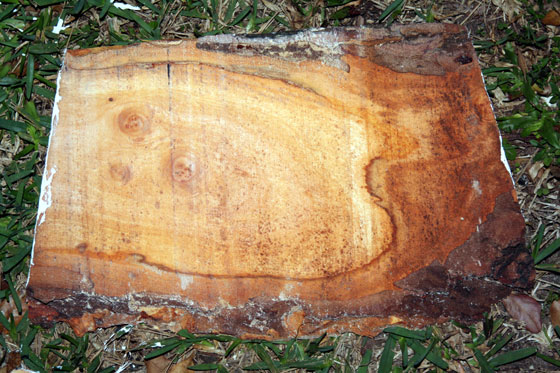
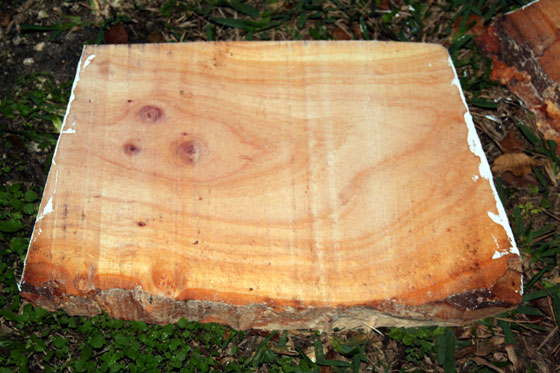
As the wood dries, strange things are happening. The middle is turning purplish pink, and the outer bits are getting more yellow. It may sound nice, but it’s a little gaudy. I don’t know what it will look like when it finishes drying.

I’m not sure what to do with it. I have read all sorts of depressing things about drying wood. People make it sound impossible. I always thought you cut up a tree, let the boards sit for a few weeks, and started working it. Not so. If you don’t seal the ends, it starts to split from the ends in. Then it’s ruined. If you don’t dry it long enough–one year per inch, I’ve read–it will warp and generally go crazy after you turn it into furniture. And drying it yourself is not as good as having it dried in a giant kiln, which is what wood companies do.

I have read that you can dry small pieces of wood effectively by leaving it in a freezer. I think I read that on a museum site, so it’s probably true. Last night, I stuck a little piece of wood in the freezer, and sure enough, by morning ice had been squeezed out of it. You would think the expansion of the ice would split the wood, but I guess wood is springy enough to resist. If that were not the case, I guess we would have entire forests of split trees.

I’ve also read that some people toss wood in their ovens to dry it. I might risk a piece just out of curiosity; I don’t have a lot of confidence in this method.

The bits of wood I’m drying are so small, I could put them in a closet and worry about them in a year.

People are recommending that I get a metal detector. Very good idea. Sooner or later, I also need to invest in a real chainsaw. If I’m going to run around stealing trash and cutting it up on the bandsaw, I’ll need a tool to cut it down to bandsaw size, and a chainsaw seems inevitable. Last night I considered getting a maul, but a chainsaw is easier and better, and it’s useful for things other than preparing wood for woodworking. Also, a maul can chip and send pieces flying into you like bullets. I saw it happen to my cousin. It was amazing; it shot through his jeans, went into his skin, hit his shin bone, and slid down his leg. He had to have it cut out.

By the way, in Kentucky, a maul is called a “go-devil.”

I’m not going to run into nails in the mahogany I find in the trash here. Nobody puts metal in these trees. But I know how life works. As soon as I decide to depend on this generalization, it will fail me. I’ll find the only piece of mahogany in South Florida that has a nail in it.

My neighbors’ trash piles are no longer safe. I wish they would throw out some nice machine tools.

Trash Picker

Sunday, February 22nd, 2009

Today’s Haul

Here’s how low I have sunk, fooling with tools. Today I stole my neighbor’s garbage.

I was driving down the road, and I saw a pile of wood. In a neighborhood full of mahogany trees. I had been waiting for this.

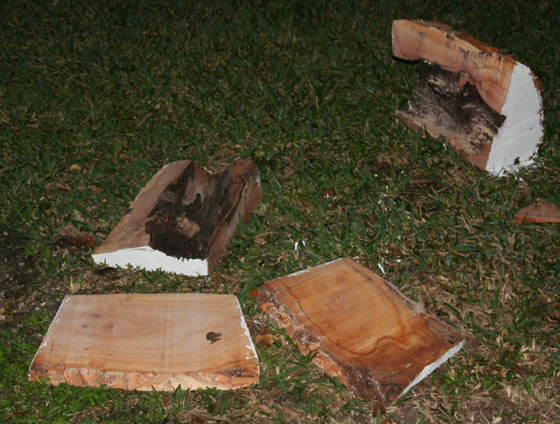
I went back later and took a look. It was a bunch of thick, short, crotchy logs. The bigger ones were all hollow, but it was obvious that a bandsaw could still extract short boards two inches thick, about a foot wide, and between one and three feet in length. Well worth the effort. The only question was whether they were desirable mahogany or somewhat less desirable live oak. That’s about all we have here, when it comes to typical hardwoods.

I kept driving by the pile. I even took a photo. Then later temptation overcame me, and I grabbed a log. I took it back to my lair and tried to stuff it through the 19″ bandsaw, which I had been sure was a too-big tool buy, and DAMN if the thing wasn’t too thick to go under the bearings.

I live in a place where no one cuts firewood, so of course, I have no maul, real (non-electric) chainsaw, or wedges. I managed to trim it down using a blacksmith’s hammer, cold chisels, and a circular saw. Using a 3/4″ bandsaw blade, I popped the log into two pieces, sawed a flat side onto it so I could resaw it, and cut some boards.

I got some advice from the Sawmill Creek crowd. Evidently, when you cut fresh wood, you cut it as soon as possible, and you waterproof the ends to keep it from splitting. All I had was Kilz, so I put that on the ends.

I have to check the bandsaw tomorrow. I’m afraid I may have messed up a new blade. The wood is very wet and easy to saw, but I saw a few sparks. Maybe the hard, crunch bark is not nice to saws. This is not the kind of neighborhood where people drive nails in trees, and I didn’t see any metal anyway, so I don’t think I hit a foreign object.

If this wood turns out to be okay, it will pay for a new blade. Mahogany is expensive, even in a town where people pay yard guys to cut it up and throw it out. And this mahogany has some figuring in it, unlike the stuff at the lumber yard.

I THINK it’s mahogany. It looks and smells like the mahogany my friends and I used to help the trash guys run into a chipper when I was a kid. Can you imagine that? It would never happen today. There are always a lot of trucks in Miami, disposing of tree limbs, and when I was a kid, they let us help, because we thought the chipper was cool.

I’m hoping it’s not live oak. It’s light, even though it’s very wet, and it’s not coarse at all.

Photos:

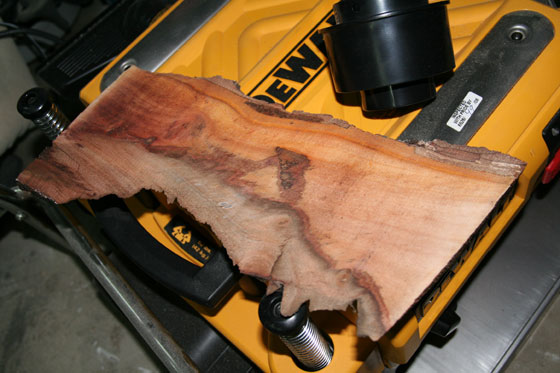
The wood is pink, mostly. Some is kind or orange-yellow. Some of it is spalted, because it came from a rotten log. The boards in the photo are about 2 1/2″ thick, which means I can get maybe five 3/8″ sheets from each one. And I have maybe another 150 pounds of this stuff yet to cut.

The bandsaw is a wonder tool. You just put a log on the table and push, and look what you get. I love it.

Saturday Frittering

Saturday, February 21st, 2009

Nothing Ventured…

I achieved virtually nothing today, but I had fun anyway. I was trying to make a guard for my table saw, and I also finished up my first MDF zero-clearance insert.

Everyone at Sawmill Creek says MDF is great for inserts. What they failed to tell me, or what I failed to read when they told me, was that this stuff is no fun to drill. You get a crater going in and a blowout going out. It looks like the only way to avoid this is to put your MDF between slices of scrap. Then you have a hard time figuring out exactly where the drill hole will be, which matters when you’re putting a set screw 1/4″ from the edge of an insert.

I managed to do an adequate job. The piece of scrap I glued to the back of the insert to stiffen it is holding on, the set screws work, the slots are in the right places, and nothing has exploded.

Working on the guard was a nightmare. The splitter mount on the Powermatic 66 has no room around it, so you can’t really get a wrench on the jam nut. Maybe you could if you took the blade off. EVERY TIME YOU ADJUST THE SPLITTER. You can imagine what a pain this is, when you have to adjust it ten times. I worked around it with channel-locks, which probably saved no time at all. This probably took a solid hour out of my day. Here’s a great lesson: if you have a nut under your table saw top, holding your splitter on, replace it with a wingnut. I plan to do that. It will be more than tight enough, and I won’t have to keep a 9/16″ on the bench all the time.

I learned that a table saw is a wonderful tool for shaping thin aluminum, provided you don’t care how many fingers you have at the end of the day. It’s ironic; I had to do a lot of things that made me very nervous, while trying to build a SAFETY DEVICE.

I had some aluminum angle…I can’t call it “angle iron,” but I don’t know the right name. Anyway, you get the idea. I was able to turn it into useful flat pieces of aluminum by sawing it lengthwise. Then I had to turn the aluminum into a splitter and guard support, and wouldn’t you know it, the first pieces I cut were too short. I should have measured, but this was one of those times when you don’t measure, because you’re sure the pieces you’re cutting are way too long, and you plan to measure when you cut them down to size. I couldn’t believe the splitter was too short. I had to start all over.

I know aluminum can mess up a wood blade, but I had no problems, and I have two dozen blades, so I was willing to take the chance. The blade I used was a Corian blade with about fifty thousand teeth. This is not what you use to cut thick aluminum, but for an eighth of an inch, it was jim dandy.

I had to interrupt my day to check my car’s codes, twice. It’s going “BLOOP…BLOOP.” I figured it was another COP problem, but the scanner says no codes. Maybe there’s water in my gas. Guess it’s time for a trip to Discount Auto Parts. That sucks, but it beats another warranty repair, which would entail handing my car over to thieves so they could sabotage it in order to get me to pay for more work. The COPs are on a special warranty; the rest of the car is my problem.

Reminds me how much I want a pickup. Maybe next month I’ll buy a new Ford for forty dollars and some table scraps.

I have a Wixey angle gauge. I decided to give up and get one, because some gadgets are such labor-savers, you have to be a complete fool not to buy them. Put it on my saw today, zeroed it, stuck it on the blade. Readout: 90.0 degrees. Thank God for that. That’s one tedious adjustment I won’t have to make. I also got a Wixey digital planer readout. In retrospect, that was probably stupid. I would guess a planer is accurate to 1/64″ without the digital thing. That’s probably good enough.

The chicken I fixed for lunch was fantastic. I guess baked chicken is always fantastic, unless you’re the worst cook in the galaxy. It’s not exactly challenging. I’ll tell you what I did anyway.

Winn-Dixie was selling fryers for about three cents each, so I got one. I salted it, hit it with black pepper and cheapo garlic powder, injected it with Korbel Brut mixed with salt, and draped a few leaves of fresh rosemary on it. Stuck it in a Corningware dish, covered, and baked it at 300 for about four hours. When I remembered it was in the oven, it had flattened out as though depressed. That’s because it had gotten too tender to be perky. I left all the fat in the chicken when I baked it, and it melted and formed a gorgeous fragrant pool. And the chicken was nicely browned.

So far, the saw guard design is feeble, but I know what’s wrong with it, and it’s easy to fix. I’ll crank it out soon. After it’s operative, maybe I’ll order a Shark Guard. The shopmade guard will keep me alive until it arrives. The advantage of the Shark Guard is that it has a dust port, which is a real pain to make.

I found a trash pile with what I think may be mahogany logs in it. Not sure. It’s not the best wood on earth; the logs are hollow. But you could still resaw them and get some wood which would be more than adequate to make beautiful boxes. If you take a two-foot log that’s eighteen inches thick, and it’s hollow, you should be able to get boards maybe two inches thick and a foot wide out of it. That’s definitely worthwhile. If it’s live oak, however, it’s not all that desirable. I may go swipe a log and cut it open. Aren’t bandsaws great?

I’m reading up on cutting and drying wood. Might be doable.

Sleep awaits.

My Fabulous Lumber Stockpile

Saturday, February 21st, 2009

One Board

I bought wood today. It’s depressing. I think about all the wood my family has owned, and all the wood I still own in another state, and then I think about what I just paid for a little piece of walnut.

Maybe I’m actually a billionaire.

I got a five-foot-long piece of walnut, 1 3/4″ thick and 7″ wide. And it was about 55 bucks. It has no options. It doesn’t play MP3s or anything. It’s just wood. Hard to believe.

I felt even worse about it until I reminded myself that I actually had 15 feet of walnut. Because I’m not going to use wood 1 3/4″ thick in anything I make. I’m going to resaw it on the bandsaw. I figure 3/8″ is a good thickness for wood you use in boxes. Half an inch is clunky, and a quarter inch is hard to work with. Try putting a spline in a box that thin.

I designed a table saw guard today, so I bought stuff to make that. I went out and stared at the saw until an idea came to me, and I had one that will work. I’m going to make it out of aluminum strips and quarter-inch plexiglass. I hope I can cut plexiglass without making a fool of myself. I have a flush router bit, if all else fails. All those Corian blades that came with the table saw…you would think one of them might work.

The guard I’m making is very simple, and I should be able to yank it off the table instantly when I have to. It will be hinged so you can flop it back over the side. I don’t know how to put a dust port on it, but I’ll figure it out. For twenty bucks, it should be a pretty good guard. It will require me to leave two of my spiffy Irwin clamps on the rear rail of the saw, but I have eight of them, so it’s not a big sacrifice. I can put something else in there when the fixture becomes permanent.

The wood choices at the lumber place don’t seem to be as great as they once were. Let’s see. Oak, poplar, maple, cherry, jatoba, purpleheart, zebrawood, ipe, mahogany, bubinga, lacewood, ash…that’s most of it. I’m not all that excited about funny looking items like bubinga; I think they can look tacky. But the lacewood is an exception. It might make a nice box. I can’t really describe it. You can probably Google a picture.

I picked up some Johnson’s paste wax for the saw top. Everyone says it rocks, so I’ll try it. I also got Allen screws for my new zero clearance insert.

Picked up a chicken on the way home, and I’m roasting it with homegrown rosemary. I didn’t realize how much rosemary resembles pine needles. The smell is really strong. I hope they didn’t sell me some kind of evergreen shrub as a joke. Hemlock, I’ll bet. They got Socrates, and now they’re after me. I’ll bet it’s the Illuminati again. They aggravate the crap out of me. If it’s not the Illuminati sending me unwanted pizzas, it’s the Masons or the Trilateral Commission, toilet-papering the yard. Jerks.

Socrates was a pedophile, so he got what he deserved. I wonder why we don’t hear more about that in college. If Socrates were alive today, his picture would be on every government pervert site in the country.

The chicken is roasting. I shot it full of Korbel Brut. I am no longer ashamed to say that I like Korbel Brut. If you haven’t tried it in twenty years, give it another chance. They did something to it.

Off to the garage.

Why I’m Not Cranking Out Turned Parts

Saturday, February 21st, 2009

Variety Sucks

The machine-tool quest continues to frustrate. I think I know what I’m doing now (to a minimal degree), but I still have to shop. That means waiting. And waiting. And after that, waiting.

I can buy a mill right now. I know of at least one pretty good deal. Mills aren’t that complicated. I want a Millrite or a Bridgeport, in decent shape. But the economy is dissolving, and I’m sure mills are going to get cheaper and cheaper, and I want a lathe first, so I’m not in a rush.

Lathes are a pain. There are five million models, and they come in many sizes. It took me a long time just to figure out that I wanted a 12″ swing and 36″ between the centers. After that, I found out there are lots of options, and you have to get the right ones. For example, you need a quick change gearbox. And you want a big spindle hole, and you may want to avoid a variable speed model, because they tear up.

When a full-size mill becomes available for sale, it’s usually a Bridgeport. All you have to worry about are options and condition and price. When a lathe comes on the market, you have to wade through details. It may be for wood or metal. It may be the wrong size. It will probably be made by a third-rate manufacturer. So every time a new ad pops up, you should expect disappointment.

This is why I have no lathe.

Right now, the best choices I have are two Clausing 5914s. One is local. The other is far away, but it would cost the same amount of money, and the seller is a very reputable dealer. That dealer is in the hospital, so I won’t even see photos of the lathe until he’s out.

Do I want a Clausing? I’m not sure. I’ve read that the drives on these things can have problems. I’ve never seen anyone say something like, “WOW, you snagged a CLAUSING!” They say things like, “It’s pretty good. It should be okay. You can probably find parts.”

Sooner or later, I’ll find one. Then Coral Gables will find out I have a lathe, and they will realize lathes are fun and useful, so they’ll pass an ordinance banning them.

Today I’m thinking of running to the lumber store and picking up some hardwood and maybe enough plywood to make a crosscut sled. I accidentally saw some hideous Internet photos of a table saw injury, and I’m horrified, and a sled is a good safety measure.

I don’t know what to think about table saw safety. On the one hand, I know an awful lot of people get hurt. On the other, I haven’t come across anyone yet who got hurt without doing something stupid. Apparently many users refuse to use guards. And a lot of people don’t use push sticks or even splitters. Forget safety; I can’t figure out how they manage to cut wood, period.

It looks like there are hordes of men out there who buy saws, trash the guards and splitters immediately, and go to work. I think the guy who sold me my saw is in this category. I had to make a splitter for my saw, and it has no guard.

I would like to have a nice guard. I want a Shark Guard, but the guy who makes them runs three months behind, and they are not cheap. I took a look at the photos, and it looks like I could make the same basic thing in half a day, using a plasma cutter, a file, a drill, and a table saw. I think I should do that. It will make it impossible to use my Gripper half the time, but those things are overrated anyway, because you can’t use them on any cut where the Gripper has to go past the splitter. I need to make a decent push stick for cuts like that.

One clever inventor has come up with a riving knife that bolts onto old-fashioned table saws. I saw that, and I ran out to my garage to see if I could do something similar. Sure doesn’t look like it. The device would have to ride on the deal that holds the saw blade, and in my saw, everything is so close together there is no place where you could mount the knife.

Sooner or later, a lathe will appear in my garage. The life will be bliss.

Be Careful When you Exchange Tanks at Airgas

Friday, February 20th, 2009

New Lesson

Airgas has let me down.

I went out to the garage, figuring I’d finish my saw-blade hangers. I fabricated the parts, and I was going to weld them up. I tried to do this a few days ago, but it turned out I had no gas. I had left the valve open.

I hate exchanging pretty new Ebay tanks for old rusty bottles, but I decided I had to get used to it, so I let the Airgas guy give me an exchange. Today when I tried to connect it, my regulator wouldn’t screw into it far enough to seat. I took out the regulator doodad, and I looked at the valve. The threads had shavings hanging off of them. I have no idea how Airgas did it, but they mangled the threads on their tank. It scraped my threads up a little when I tried to attach the tank, but thank God, I had better sense than to force it with a wrench.

And of course, I found this out fifteen minutes before Airgas closes for the weekend.

I wonder if I could just use CO2. I have it lying around in little beer tanks.

I also wonder if Airgas has a whole bunch of ruined valves. I assume they use the same fitting to put gas in that customers use to let it out. Or maybe they don’t. The valve has another side to it, and it has something on it that sort of looks like a quick-release. I suppose that would be faster for their purposes.

Anyway, no welding until Monday. Unless I resign myself to CO2.