Project!
July 2nd, 2009Plus Power Feed
I think I finally have the power feed on the lathe figured out.
Reader and fellow blogger Andy recommended a site that has a few projects for beginning machinists. I decided to take a whack at the soft hammer project. I wanted a shorter one, and I don’t know if I want to put synthetic faces on it; I was planning on plain old brass. But this seemed like a good place to start. I’m probably going to end up with a shorter one anyway, because I cut the stock pretty close to the finished length, and I’m almost sure to lose some.
I have a fair amount of scrap now. I decided to use 1″ 304 stainless. I bought a 6′ bar the other day, because it was fairly cheap. I cut it on the vise, using a grinder and cutoff wheel. It was either that or take the dry cut saw out and set it up in the rain.
The steel cut easily. No problems there. I stuck it in the 4-jaw chuck and cleaned up one end. First I parted a tiny bit off, and then I faced the place where I parted it. It worked fine. It seems like I don’t push the metal hard enough, and it affects the finish, and it slows the work down. So I put a good deal of pressure on the 304, and it worked great.
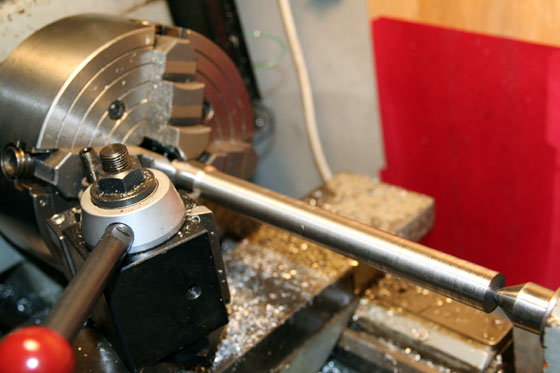
I don’t have any lathe dogs, so I did something that may not be kosher. I center-drilled the tail end of the stock and I slid it out and fixed it so a little bit was clamped in the chuck and the other end was on a dead center. Then I started taking passes by hand, and the results were bad. I knew the tool was centered well, because I had just used it to face the steel, but I had to raise it a little to get it to turn well. Or maybe the problem was shallow cuts. I also increased the cut depth. Whatever helped, helped. But moving the carriage by hand was just not working. It was jerky, and it left a bad finish.
I started screwing with the controls, looking at the notes I had made and the so-called manual. I still don’t quite get it. There’s a speed control on the feed screw, and it has three settings, A, B, and C. B is the fastest. Okay, I’m sure that makes sense.
I kept trying different combinations of knobs and levers, and finally I sort of figured it out. I made a pass that wasn’t half bad.
At first I took 10 thousandths. Then 15. Then I went nuts and took 25 at a shot. Every time I increased the depth, the performance improved.
I wasn’t sure how to reach the final 0.875″ measurement. I haven’t seen any videos or texts explaining that. I know you can sneak up on milling measurements, but on a lathe, going too shallow on a cut will ruin the finish. I decided to go for broke when the calipers said I was 0.030″ away. I cranked the knob 0.030″, and I threw the feed lever, and I turned on the lathe. I ended up within a couple of thousandths. I am as close as I can get without using a mike; the calipers are never better than maybe 0.002″ for me.
Someone warned me about 304 chips, and they were right. This stuff SHOOTS steel at you. It’s like watching snakes try to jump out of a box. And they never end; the chips are three or four feet long before you know what’s happening. I had two bird’s nests so bad I had to stop the lathe.
Now I have a 0.875″ rod of 304 stainless. Tomorrow I’ll try to turn it into something. I don’t know how to do the tapered part. I guess I’ll have to use the compound and set it at the specified angle. The taper is less than 4″ long, so the compound should have enough travel to do it.
My big concern is that when I have to move the work to do other operations, I’ll mar the earlier operations. I suppose planning is the only answer to problems like that, unless you have instructions written in chronological order.
It was very satisfying, and I’m glad to see that the 304 wasn’t a waste of money. Machinists rate metals in terms of how well they respond to tools, and 304 is not a favorite. If it can be worked this easily, I shouldn’t have problems with things like aluminum, 360 brass, and 12L14.
Power feed makes a world of difference. I was going crazy, trying to turn that silly knob smoothly.
July 3rd, 2009 at 1:16 PM
If the round stock is for the hammer handle, why not turn a shoulder onto the end (as long as the brass diameter), and drill a hole for that diameter into the brass head? You could even knurl the reduction for a sort of interference fit. When assembled, cross pin it.
July 3rd, 2009 at 3:42 PM
Second thought, blind hole the brass so you don’t see the handle “exit wound”.