Dry Bones
April 2nd, 2009Relic From the Archives
Can I tell you how great it is to dream of something for decades and then do it?
I am going to get up off my lazy rear end and take a photo of something for you.
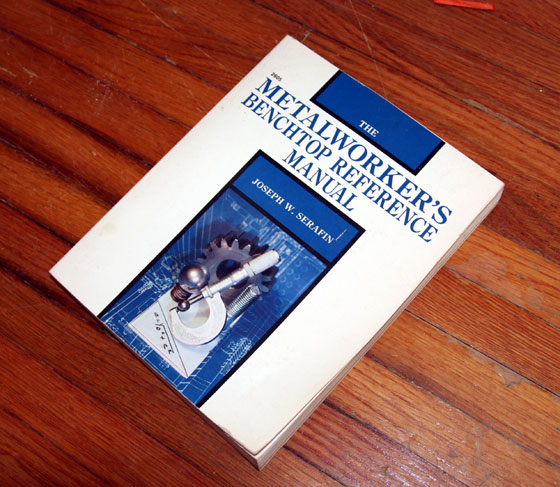
That is my copy of The Metalworker’s Benchtop Reference Manual. I got it about 20 years ago. I’ll tell you why I bought it.
My mother had some stone crab claws. Stone crabs have very thick shells. They are not easy to bust. These days, most sellers crack them before they sell them. That was not the case in the 80s. At least, not at the place where my mother got these claws. She needed help with them.
The standard thing to do is to get a hammer and put the claws on a cutting board, one at a time, and go at it. But that makes shells and bits of crab fly around, and it’s easy to overdo it. My solution? Vise Grips.
It turns out that if you tighten Vise Grips on a crab claw using the screw in the handle, you can break a very tough crab claw by squeezing the handles without much force at all. It’s beautiful.
That inspired me. I thought I needed to make my own crab claw breakers. The Vise Grips worked okay, but it was time-consuming to adjust the screw before every squeeze. I had a couple of ideas for a set of pliers that used leverage.
I went to a local machine shop and paid a guy $35 to make some pliers I designed. They would have worked, but he used 1/8″ mild steel, so they weren’t strong enough.
I knew absolutely nothing about machining. I got a drill press, and then I went to a metal supply place and ordered a small amount of tool steel. You can probably imagine how well that went. The instant a spinning tool hits tool steel (at the wrong speed, with no lube or coolant), the tool steel hardens up until it’s about like a diamond. I managed to get part of the way through the project, and then I quit. It was at some point during this time that I got the manual. It was pretty much the only book I had seen anywhere that I thought might contain a clue about how to make the crab pliers. I saw it in a bookstore one day, and I bought it on a whim.
I never got any benefit from the book, nor did I succeed in creating the pliers. But it shows how long I have been interested in machining.
I am in the process of getting a metal lathe. Readers and people I’ve contacted via forums are giving me all sorts of advice. Everyone said the tooling was what would kill me, and I tried not to think about it until the lathe order was in the works. Now reality is in my face, and I am buying things like fishtail gauges, dial calipers (better than the Chicom jobs I already have), indexed carbide tools, and a tool post. Thank God for China and the used-tool market. Without these resources, there is no way the cost of this effort would be something I could make myself swallow.
Machining experts seem to agree that you should learn turning before you learn milling, so the lathe is probably a good move. But I would still like to make those crab pliers! I could do it on a lathe, if I could get a milling attachment. I’m pretty sure Clausing made about 3 of those attachments, and they have since been sold for scrap and turned into doorknobs. I suppose there’s a work-around. There always is.
I can’t wait to do this. I can’t wait to see the first chip squirting off the surface of a workpiece. FINALLY. This will be even better than the table saw, which, without a doubt, is a life-changing tool.
Maybe I’ll even get to use that book.
I’m convinced that good things like this come from turning back to God.
April 2nd, 2009 at 2:28 PM
I dunno. That looks like a college textbook. Which from my experience, have been uniformly useless.
April 2nd, 2009 at 2:35 PM
It does have pretty diagrams.
April 2nd, 2009 at 9:06 PM
I remember the first time I set up a swiss machine, which is sort of an automated lathe. I had set the speeds and feeds correctly according to the book and started the process. My tooling mentor then came over to look. I said, “Look at these chips! They’re like watchsprings!” He then reached over, cranked up the speed, blue chips started flying, and said: “We’re making parts, not chips.” Production rules.