Hot Cup of Mud
January 13th, 2009Plus More “Coincidences”
I just had a treat which I could not have predicted last week: Turkish coffee. I used to drink it in Israel. They sold it in little funny cans with coffee beans on the label. It’s just coffee ground to a very fine powder. I don’t know if it’s finer than espresso, but it’s pretty fine. The Israelis simply dumped it in hot water, stirred, and drank. That’s what I did today. I don’t think that’s the correct way to do it, but I wasn’t looking for the correct way. I was looking for the past.
It’s not the world’s finest coffee. It’s a hundred times better than instant, but a good cup of espresso or American coffee would be better. But it’s fast and easy, and it reminds me of Israel. I wonder if I can find the Israeli brand on the web.
I have Googled. My best guess was that the brand name was “Elite.” That’s what I seemed to remember. And look what I found!
Click to visit The Jerusalem Gift Shop!
Man, this is an odd coincidence. Funny how those happen to me all the time these days. I feel a little woozy thinking about it.
Check this place out. I know about as much about it as you do, but it appears to be run by Christians in Israel. They have a newsletter about Israel, and all sorts of items from Israel, including this pendant (hope they don’t mind me stealing the picture):
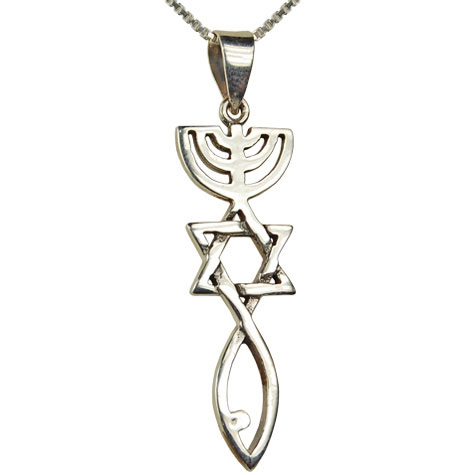
That is fascinating. When my sister and I began communicating again, it was because of Christianity, and almost as soon as we started, she brought me a book by Perry Stone (The Meal That Heals) and a home communion kit with that symbol on it. According to Stone, that symbol is very old, and it was used by early Christians. I suppose there are many Jews who would be horrified by it, but anyway, there it is. You can click the link and buy that pendant.
We are part of prophecy; no doubt about it. The growing interdependence of Christians and observant Jews is a wonder to behold. We help Israel with its physical needs, and the Jews bless us with spiritual enlightenment. Just as Isaiah predicted.
I had no idea I would end up writing about this. I planned to write about coffee.
Check that site out. Wonderful stuff.
More
In case it’s not obvious, in the symbol above, which is referred to as the “Grafted In” symbol, the Magen David is formed by the base of the menorah and the tail of the ichthus. Nothing extra is added.
January 13th, 2009 at 9:30 AM
My Israeli boss buys Taster’s Choice rather than drink the brewed coffee available for free in the break room. He says it’s closer to what he’s used to.
January 13th, 2009 at 12:58 PM
While I was in Vegas (my LEAST favorite place) for the Consumer Electronics Show, I saw a TV ad for the International Fellowship of Christians and Jews. I didn’t know they had TV ads (but I was glad to see it).
.
It reminded me that even in a place like Vegas, people still need the word of God.
January 13th, 2009 at 2:37 PM
Thanks for sharing that website.
January 13th, 2009 at 6:52 PM
Many years ago, when we still got the magazines New Yorker, Atlantic and Harpers, one of them had a series on coffees. It was a most informative and interesting article on something that was then not the BIG DEAL it is today. I wish I could read it again now that we have so many actual choices of coffee, even in small towns like the one I live in. It would be fun to compare all the differences described in the article. Unfortunately it is not something I stored completely in the hard drive called my brain. I do recall that Arabic coffees should be the best.
BTW, we have Jewish/Christians in our extended family.
January 13th, 2009 at 7:45 PM
Here is the correct way and you will need to get a conical shaped pot to do it in. This looks like a small cone that has been cut off half way up and a handle was affixed to the side of the narrow end open top. To make 1 or 3 small demi tasse size coffees the pan is about 3 inches diameter at the base, 2 at the top and is about 3 inches tall.
fill it half way up with water, toss in 1 teaspoon of talcum consistency turkish coffee and same quantity of sugar for each demi tasse you plan to serve, bring to boil and just before it starts to bubble out of the pot, remove quickly from the fire and serve by tipping some into each demi tasse with small quick motions, do several rounds with a bit of coffee in each cup each time, this spreads out the grounds evenly.
Serve immediately, it will settle in 1 or 2 minutes or by the time you can drink without scalding your lip.
Drink it down in small sips until you beging to taste/feel the grounds on your tongue, at which point you circle the dregs around the cup a few times then invert the cup in it’s dish.
Keep yakking with your friends until the coffee that circles the inverted cup lip looks dry (the remaining moisture will have been sucked into the cup by the vacuum caused by the cooling air inside.
If you can lift the cup and saucer by holding the handle it is good luck. With the saucer on the table, break the vacuum and look inside the cup. If you are Armenian or descendant of same (ahem!), you will know how to read the future in the patterns traced by the grounds on the walls of the cup.
This is conservative for American tastes, I use more coffee in mine…experiment.
Enjoy!
January 13th, 2009 at 8:16 PM
Lovely strong coffee with a muddy bottom.
1. when water is at rolling boil, dump in fine ground coffee beans
2. just before this mixture starts to boil over,
remove from heat until it stops boiling
3. repeat steps 1&2 two more times (oddly, the last time it
doesn’t really ever get to the boiling over stage)
4. strain thru a sieve into a thermos (to keep it hot all day)
I use about one heaping T per 8 oz cup but you can experiment to find what you like. I grind my own beans fine, but my brother uses regular old ground coffee.
One of the nice things is that it simplifies life. No need to own a coffee pot. A $2 strainer (~3 inch diameter?) which you probably already have and a pot which you probably already have. And no need to worry about coffee during a power outage as long as you have boiling water.
We called this Arab coffee but I’m guessing the technique is MiddleEastern. I don’t know why 3 is the magic number, but it
really does behave differently the third time. It comes to a rolling
boil but doesn’t start to bubble over like the 1st two times.
January 13th, 2009 at 11:48 PM
Elite is the brand. It was called “botz” (pronounced like “boats”) and it means “mud”.
It was not great coffee, but crappy hot dogs can taste good with the right ambiance. For me, the key was trying to get the right sweetness. If you had a kibbutznik in charge of the work platoon you were on who was a botz-maven, life was pretty pleasant.
Picture of Elite can that you probably remember, below:
http://web.ivenue.com/holonfoods/images/ELITECOFFE50GRAMS.jpg
The Star of David is of more recent popular use than the 6-branched menorah. Jewish headstones until about 1000 years ago would be more likely to have a menorah on it than the Star of David. Sometimes a headstone of a priest/Cohen would have hands in the position used for the priestly blessing (think of a two-handed Mr. Spock salute with the thumbs and index fingers forming a triangle). See http://www.zchor.org/tomaszow/Story9.jpg for an example. My father’s father’s mother’s father has those hands on his headstone.
Isaiah 55:5 is pretty clear that there will be a nation that the Jews will call on and will join the Jews.
January 14th, 2009 at 3:27 AM
The funny little coffee pot you are all describing is an ibrik.
google it for pictures and availability. I found mine in a thrift store described as a plant waterer. The easiest ones to use are solid copper with a long brass handle and are heavily tinned inside. Turkish style coffee is ground finely as flour.
Gerry N,
January 14th, 2009 at 12:37 PM
Steve,
Google “how to make Greek coffee” and about.com has a handy guide. Greek coffee is, of course, Turkish coffee — 800 years of occupation by the Turks left the Greeks with a love of their coffee, although they will not call it Turkish coffee. I know the little coffee pot as a briki (bree-kee). Just use the finest grind on the grinder for your coffee. The Greeks serve it in four different strengths – sketos (without sugar), metrios (medium- 1 tsp sugar), vari glykos (honey sweet), and glykys vrastos (sweet, but boiled more so it loses the froth).
January 14th, 2009 at 5:07 PM
Glykos seems to be the etymological root of the German word for sweet, gluck.
January 15th, 2009 at 3:07 AM
Shalom from Jerusalem,
Thank you for the nice report on our website The Jerusalem Gift Shop
Ian (owner)
http://www.thejerusalemgiftshop.com