I Could Swear That Mirage is Getting Closer
February 26th, 2026Almost There…Again
I learn more about photography every day, and of course, this leaves me more confused than when I began.
Those little mode dials have “AUTO” printed on them for a reason.
Back in around 2006, I got a Canon 350D and a Sigma zoom lens that had “Macro” in the name, so, not realizing this did not make it a real macro lens, I took some closeup shots of things. I thought it was great, but I eventually quit fooling with cameras. I don’t think I realized I wasn’t doing real macro, which means producing an image from a shot that projects the subject onto the lens at at least 1:1 magnification. Not that this matters.
When I started getting back into photography in ’23, I got myself what I thought was a good macro lens: a Sigma 105mm prime that also had “Macro” in the name. I never really got anywhere in it. Macro photography turned out to be pretty hard, for reasons too boring to go into.
Eventually, I learned that there were secrets everyone but me knew. One was that my equipment was not serious macro equipment. If you’re not using an Olympus camera, you are going to have a hard time with macro. I’m going to keep typing “Olympus” even though the camera division is now a separate company called OM System.
A while back, I got myself an OM-1 Mark II, which is the OMlympus (I think this is better) flagship. It’s kind of neat being able to get a company’s flagship model for $2000. Of course, it can’t do what a $5,000 Sony can do, but on the other hand, the Sony can’t do what it can do. It’s a serious professional camera with a unique set of features.
The OM1II will do focus-stacking internally. That means that if you take a photo with a certain setting on, the camera will take a bunch of photos focused at slightly different distances and combine them into one JPG with a greater depth of field. If you don’t use this, you could get a shot that shows a grasshopper’s face clearly while making the rest of him look like grasshopper leg stew.
I got myself a very useful zoom with the camera, but while it’s wonderful, it’s not a macro lens. Today my first real OMlympus zoom arrived: a 60 mm M.Zuiko 2.8 Macro.
To do hard core macro, you should generally use a big light-reflecting device called a diffuser. It’s a big hood that goes over your zoom and reflects it down around your subject. I don’t have one of those yet, but I thought I would try a couple of shots anyway just to see how well the lens and camera worked. As usual, I shot a peach blossom. They are handy, and when they are present, they are often found at about eye level.
Here is one of the test shots I got. Sorry I framed it wrong. I got too close. I was just trying to get any kind of photo, and it serves its purpose.
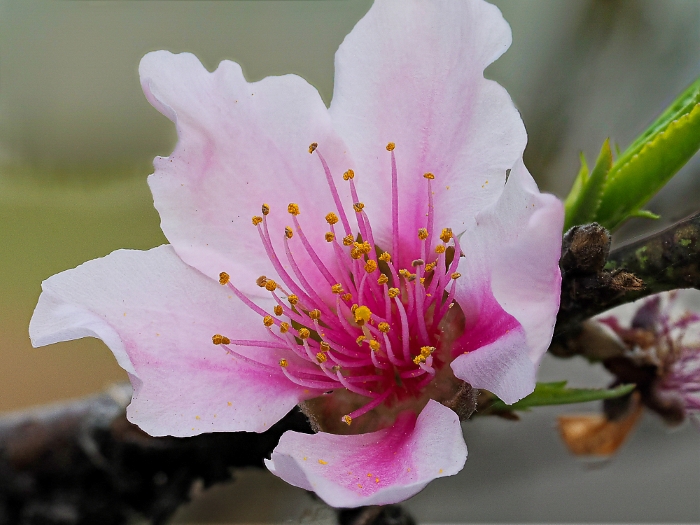
The quality is not great, but I think it goes to show that if I get out there at the right time of day, shoot carefully, and take enough shots, I should be able to get some decent photos.
Interestingly (or, more likely, not) I had to use both Photolab and Lightroom to edit this shot. After all the complaining I did about Adobe’s obnoxious business methods and dishonesty, I decided to subscribe to Lightroom for a year. Photolab is better most of the time, by a wide margin, but Lightroom is full of canned tools that are very helpful when you need to fix common problems. It will fix zits, for example.
This photo came out with a bizarre white strip near the top, and Photolab did not recognize it as part of the picture, so it refused to fix it. Lightroom did it in 4 or 5 clicks. It also removed a strand of spider web very quickly. But Lightroom wasn’t great with lighting or color.
Photolab did a good job of darkening the background and changing the colors. I believe that is not always easy in Lightroom, but I’m not sure yet. It also made the best of the detail and so on.
Lightroom apparently does not reduce images well, so I had to start in Photolab, retouch in Lightroom, and reduce and export in Photolab.
Sadly, this shot was a JPG by the time the OMlympus processed it, and Photolab can’t run its advanced noise reduction on JPG’s. Not a problem with a test shot, but it could be an issue later. If I have noise later on, I could possibly improve it by using the OMlympus’s in-camera reduction, or I could just resort to desktop focus stacking, using the raw photos the OMlympus provides. That would kill part of the purpose of buying the camera.
I found out I may need a pretty expensive flash to continue with this, as well as a diffuser that costs over a hundred bucks. I guess it’s worth it, because this pursuit has driven me nuts.
I have also learned that I should keep the OMlympus beside the bed for those times when my son is being cute after sundown. I have taken shots of him with a Sony A6700, and I got horizontal bands of different degrees of exposure. It turns out this is caused by the flickering of LED light bulbs. The camera’s electronic shutter works in such a way that it catches different parts of the image at different light intensities. You can fix this by using the camera’s mechanical shutter instead, but then you lose the ability to shoot in bursts.
There are clever ways to make the camera shoot under LED’s without using the mechanical shutter, but they are complicated, and I will never remember use them until it’s too late.
Although cheap for a flagship, the OM1II has an incredibly fast sensor. If you set it up to shoot mechanically, you lose burst speed, but the reduced speed is about the same as the Sony’s maximum, so it doesn’t matter. The OMlympus captures images about 10 times as fast.
My understanding is that my Canon Powershot V1 is also capable of shooting under LED’s without a lot of fuss, but I don’t know enough about it to try it yet.
To get back to the main subject, if I keep at this, it is entirely possible that I may create a decent macro or near-macro photo some time this calendar year. That would be exciting.
February 27th, 2026 at 9:22 AM
When shooting burst, how does the OMlympus do with buffering? My old Sony slows down after about 10 shots.
February 27th, 2026 at 11:24 AM
The only way I can answer that is by looking it up. Here is what AI thinks:
“Why it won’t “stall” like the old Sony
Massive Capacity: Even at the blistering speed of 50 fps (with full continuous autofocus), you can hold the shutter for over 5 seconds before it fills. For most wildlife encounters, a 5-second burst is an eternity.
UHS-II Dual Slots: The camera supports high-speed UHS-II SD cards. If you use a V90 rated card (like a Sony Tough G or Kingston Canvas React Plus), the buffer clears extremely fast. You can usually start shooting another burst almost immediately.
Pro Capture: This is the “secret sauce.” The camera can buffer frames before you even click the shutter. When you see the bird take off and press the button, it saves the previous 99 frames, ensuring you never miss the start of the action because of human reaction time.”
But you’re stuck with MFT, and a late-model Sony is likely to have advantages like better focus-tracking.
My understanding is that wildlife photographers love this camera. The zooms are way lighter, and the bursts are great. You just have to be satisfied with that little sensor.