Making Light of Things
February 3rd, 2026Denoising Expert Advice
The photo biz is moving in a good direction. I have some more beginner wisdom that may or may not be correct, regardless of the confidence I have in it.
Somewhere in the web, I wrote about trying higher ISO figures, and I mentioned 2000. A person who responded thought it was funny that I believed 2000 was a high figure. I was just going by what I had been told. One hundred is great. Four hundred is okay. Eight hundred is grainy. Anything past that reflects a desperate desire to get a shot, and the shots will never be as good as ISO-100 shots.
All that turned out to be BS. There are people out there getting very good photographs at 12800 and probably higher.
On a related note, I found out what ISO is. It just means gain, as in amplifier gain. The figures are multiples, so 400 is 4 times as much as the base level, 100. It doesn’t mean the sensor becomes more sensitive as you increase the number. It means the camera amplifies whatever the sensor receives. You can’t make a sensor more sensitive with a setting. If you could, the manufacturers would always start you out at the peak. The sensitivity is an inherent characteristic of the hardware.
People who claim to be gurus will say that an APS-C sensor will give you unacceptable results when you go above 3200, and they will say levels of 1600 or more are “acceptable” or some such. None of that is true, unless you are a zealot who absolutely insists on using whatever the sensor collects, with zero denoising. You may say denoising is basically CGI that replaces your loved ones’ images with those of soulless Pixar characters, but in the age of digital photos, you’re going to end up with a lot of clever manipulation no matter what you do. Even your camera manipulates images. It turns your raw photos into JPG’s very different from the original data. Your phone edits the daylights out of images; how do you think it gets those great shots out of apertures the size of BB’s?
Consider the family photos your parents and grandparents paid professionals to shoot. Look at them and tell me they aren’t retouched to the point of fantasy.
In this era, it looks like ISO should be the least of your concerns, because there is so much you can do to fix it after the fact. Shutter speed and f-stop are the things that shape photos, so ISO should take a backseat.
I have seen all sorts of people telling beginners to shoot in manual mode. They’re insane. I believed it, and then I tried it. By the time you set speed, aperture, and ISO, your opportunity is gone, and if it’s not, you are likely to get at least one setting tragically wrong. Professional photographers use aperture mode most of the time, unless they’re sitting in studios with everything under their control. They also use custom modes they program into their cameras. They’re not out in the field squinting at dials and screens, trying to find 1/500 or f/1.8 before it’s too late, 200 times a day.
I thought I had to use a low ISO and accept whatever speeds and apertures I could get, but that was completely backward. In reality, for nearly all of what I do or plan to do, the best approach is to use automatic ISO with a very generous ceiling, suggest a fast minimum shutter speed, and be firm on the f-stop I want. And I should always use continuous shooting, because you never know what will happen while you’re pushing the button.
In the past, I saw those 1, 2, and 3 symbols on my cameras, and I thought those were for the Asgardian nerds, not me. I was supposed to be a real man and stick to M or maybe Av and totally master choosing settings in the field. I thought the custom modes the symbols referred to would be too complicated to deal with, and they were probably crutches. In reality, manual is what’s hard to deal with, which is why nobody but bad photography instructors uses it.
I decided to try what I thought were high ISO values, to see what would happen. I ended up shooting a couple of very good shots at 2000. They looked hideous as raw images, but Photolab denoised them so well, I wasn’t sure I was looking at the work of a program. I thought maybe I had confused raw with edited.
My A6700 used what I thought were insanely high speeds to get the shots in aperture mode: 1/1250 and 1/4000. I had assumed those were for things like shooting while fishing in bright sun, but I used them at Lowe’s under LED lights and in a dim barbecue joint, and all was well.
In the end, I decided to create custom modes for the A6700 as well as the Powershot V1 I like to take on family errands. The ISO on the V1, which has a 1″ sensor pretty much like 4/3, is set to a maximum of 12,800 now. I have set the minimum speed at 1/500 because my son moves a lot, and 1/250 didn’t always get the job done. I fiddled with a few other things.
I learned that Canon thinks of the minimum shutter speed as a suggestion, which is why I said above that I suggested it. My understanding is that Sony thinks of it as an anchor it really tries to hold onto, so when you say 1/500 is the minimum, it actually means Sony will work hard to take every shot at 1/500. That’s not what “minimum” means to me, but there it is.
I don’t know how much of this is true.
The custom modes seem to be working. We took my son to the doctor today, and I shot some photos under the LED (or maybe fluorescent) lights. They were perfect, except that the speed could have been better for some. Above, I mentioned using 1/500 as my minimum, but that was after the appointment. I was at 1/250 while we were in the office.
Although I don’t like putting family shots on the web, I’ll post the barbecue joint photo. It is not my favorite picture. I didn’t expect much when I shot it, but I wanted to try out my new settings. I believe it came out very well, though. More than well enough to be a keeper.
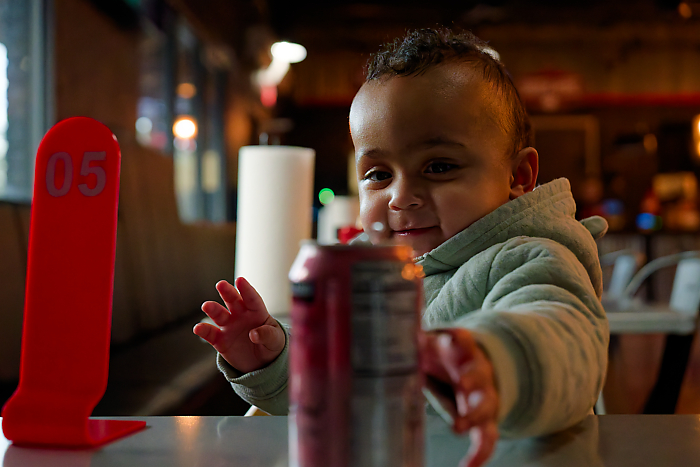
That was taken on the day I decided to try higher ISO’s, and it was later that day that I created custom modes. Today I would have gotten a better raw shot to work with.
The lens is a Sigma 17-40mm 1.8 Art. It’s a $900 lens. I don’t care. Buy it. It is fantastic. If you really want to get into photography, buy this lens first. It will do everything primes from 17 to 40mm will do, nearly as good as the best, and it will shoot in low light. It’s a little heavy, but it’s worth it. If you want a smaller zoom for travel, get the 18-50mm, but it is no substitute for the 17-40mm. It will do the job of three lenses, saving you cash during your first year.
The photo is not bad at all. The bokeh is exactly what I wanted. It doesn’t look like CGI. He looks good, although he looks better in person. I have taken better shots, but this one is all rght, and it helped me understand what the camera could do.
I don’t understand why there is so much horrible advice from bad professional photographers on the Internet. You would think the things I just learned would be common knowledge by now.
You have to be careful when you listen to people who make a living shooting photos. Remember, a lot of the photos on the site Awkward Family Photos were shot by professionals.
I should get a much higher percentage of useful photos now. I already get more than I know what to do with, but more is better. After this, I want to learn how to deal with challenging lighting.
My current philosophy goes like this: get a good camera that has features that help you get shots bad cameras will miss, get lenses that are at least okay, try to get lenses with big apertures, learn to program your camera, do not shoot in manual, let your ISO run wild, don’t shoot at low speed unless it’s for creative reasons, and get Photolab 9 and use its denoising features.
A lot of people say good lenses are more important than good cameras. I think that’s totally wrong. Even bad lenses are pretty nice these days, but low-budget cameras will limit you severely if you try to do anything outside of certain narrow parameters. You want IBIS. You want sophisticated tracking. You want various lighting features.
Yesterday my A6700 told me I was photographing an infant. Not just a person. It can tell the difference. Things like that are very helpful. If you want to focus on a baby, you don’t want your camera to wander off and tighten up on some old guy standing behind him.
If something seriously better than the A6700 comes out next year, I will probably buy it. I can always get more money, but I can’t bring back pictures I missed.
If you’re willing to limit yourself to certain types of shots, you can buy the cheapest Rebel out there and do fine. I’m talking to people who don’t want to be shut down by their own cameras over and over.
I think I’m right about this stuff. Chime in and change my mind if you want. I am eager to hear anything more-capable people have to say.
February 5th, 2026 at 2:23 PM
All I hear is *Charlie Brown adult speak* with the camera stuff.
And I get not being willing to put your family out there on the wide world innerwebs.
BUT. Thank you for sharing the photo of that beautiful baby boy. Oh my heart!!
February 5th, 2026 at 8:31 PM
He is a born supermodel. You should see the really good shots.