Bad Advice Bugs Me
November 7th, 2025The World is Full of Tiny Models Who Never Need Rehab
I got all excited about photography yesterday, so today I went outside and tried to do some macro shots. Macro photography is photography involving little-bitty subjects like bugs and drops of water.
Back when I got my first DSLR, I gave macro a shot, and I got some photos I liked, but they were not amazing, and I did not keep up with it. I had an all-purpose 17-70mm Sigma zoom lens that happened to work okay for macro, but I didn’t know what I was doing, and I don’t recall working hard to educate myself.
When I got married and had to think about family photos, I bought a nice full-frame Sony camera, and I kept my Sigma lens and replaced the camera instead. Probably a bad idea, since I was going to replace the lens anyway, and I suppose a new mirrorless Sony would have been smarter.
I liked the idea of having a lighter, smaller, much cheaper backup camera.
I upgraded to a 2017 Canon 200D, which, oddly, was much more advanced than the 350D I bought 20 years ago. Shouldn’t the numbers get higher, not lower? I also picked up a wide-angle lens for the Canon as well as a better macro lens.
I have a very good macro lens for the Sony, but I like the Canon because it’s way lighter.
I also got on-camera flashes, which you need for macro shots, and I also got a diffuser, which is a big fabric pancake thing that, aptly, diffuses flash light.
I did a little macro work, and if memory serves, it was all bad. I did some studying so I could improve, but I did not follow up.
Today I tried to refresh my meager macro education, and I got out there and took some photos. It went poorly.
The guy I looked to to get me up to speed is a Youtuber whose bag is macro. He said to shoot at ISO 200, use a shutter speed of 1/200, and use f8 for an aperture. He also gave some other tips.
I tried doing what he said. I put my diffuser on. I set my flash up the way he said to. I adjusted my camera to his liking, to the degree that its firmware would let me, and I looked for little things to shoot.
The first thing I went after was a peach blossom. It is probably under an inch from one end to the other. I will show you one of the better shots.
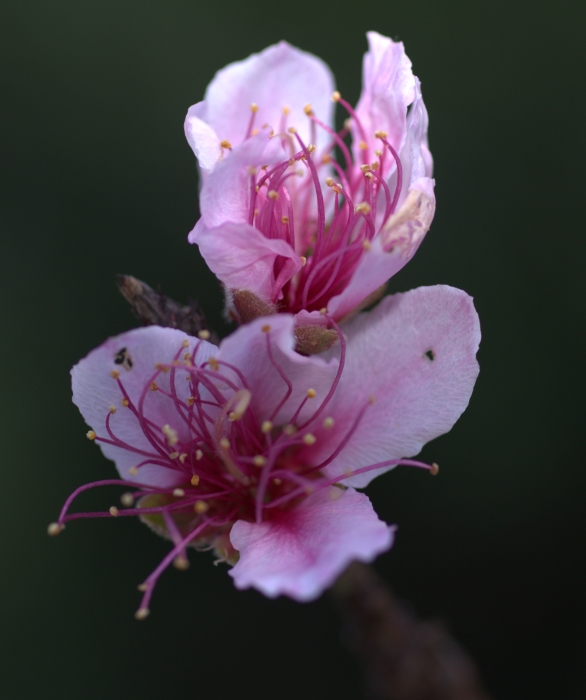
The focus is heinous. Some bits are almost sharp. The rest looks the way everything has looked to Keith Richards since 1962.
I didn’t do anything to that shot except cropping, resizing, and exporting to JPG.
I kept trying. There were some things I could not photograph at all. I’ll post the best shots I got. I cropped them and edited them with Affinity, which is a great program you don’t need a Ph.D. to operate. Forget Photoshop. Maybe it’s great for pros. I don’t know. Affinity is working better for me than Photoshop ever thought of working, and it’s free.
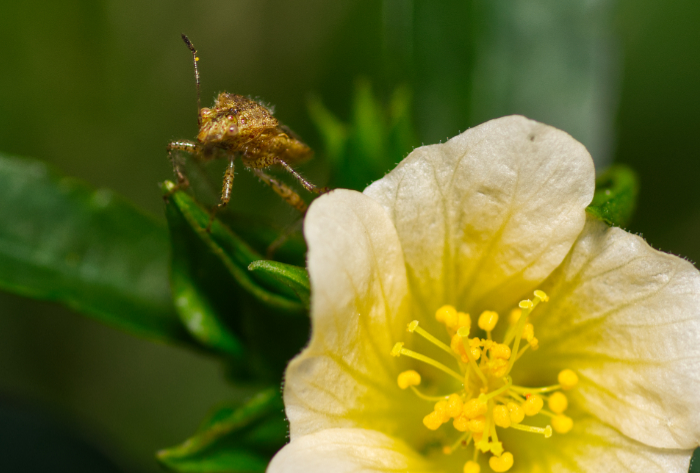
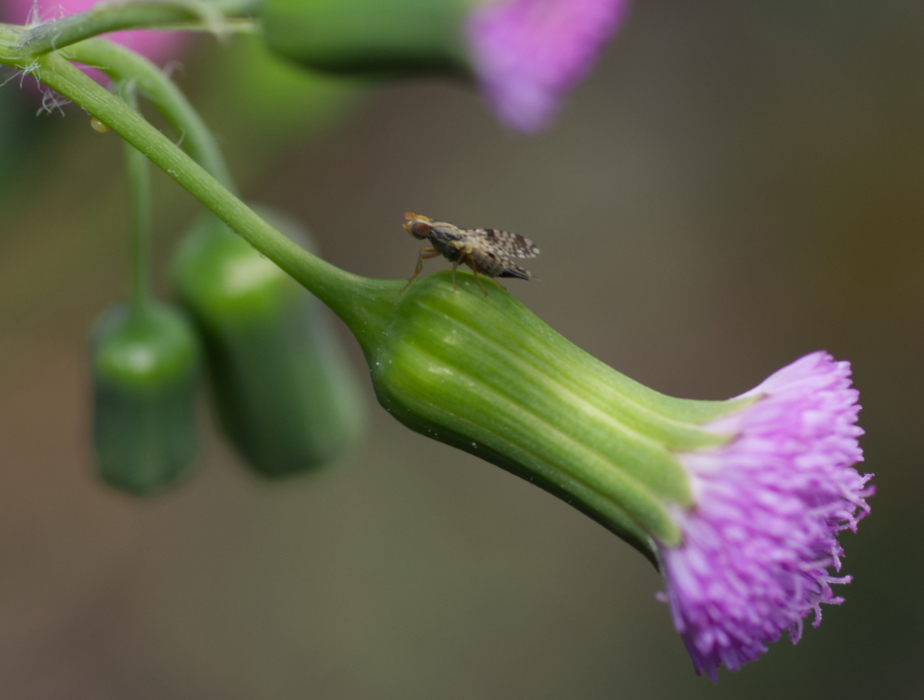
If you know anything at all about cameras, you can see that my depth of field was inadequate. There was no way to make it work. Focus on the bug’s head, and you lose the tail. Focus on the flower, and you miss the bug.
I kept fiddling with the lens, and then I came inside to see if I had anything I could save. You are looking at the best of it.
Here’s something interesting: the first guy has posted his work on the web. I just looked at it. The focus is awful. Half a bug in focus. The other end hazy. Apparently, he is not a very good photographer.
I found another Youtuber, and she made a video about people’s macro mistakes. High on the list: using a low f-stop.
Wow.
She says to go to f22 or f28 or whatever it takes to get the shot. She’s right. Her photos are very, very good.
So why does the other guy keep giving bad advice? I wonder if he needs to be fitted for glasses.
The lens I was using is a Sigma 70mm 1:2.8 DG Macro DG EX, and it’s supposed to be very good for macro, and not just because it has “Macro” in the name. The camera has 24 megapixels. It’s not the problem. The instruction is the problem.
I was going to take the Sony out next to see if I could do better, but I don’t think I will. I plan to use the Canon again and start out at F22, the highest setting. I think I’ll do much better.
I like macro for a lot of reasons.
1. There are probably millions of times as many macro subjects around us as ordinary subjects.
2. Macro subjects don’t cost anything. You don’t have to create backdrops or whatever. You definitely won’t have to pay bugs.
3. Macro subjects aren’t whiny and uncooperative, and they won’t call the police on you or beat you up, which could happen if you do street photos of other people.
4. Macro is perfect for introverts. You never have to accost anyone or ask permission. Or have any of that nasty old human interaction.
5. You can do a lot more macro shots in the time it takes to do ordinary shots. You can walk around your yard and take dozens in an hour.
I expect things to go well once I start doing what actually works.
November 8th, 2025 at 5:59 AM
The trouble with really small apertures is that you lose sharpness due to diffraction. You’re a physicist, so look it up. Depends on the camera and lens, but you might begin seeing diffraction at f/22. I don’t use Canon, so I don’t know specifics there. BTW, I have a friend who used to work for Kodak. He did a lot of tests and concluded that for any normal sized print – 24 inches or so – any camera over 24mp is a waste of money.
November 8th, 2025 at 9:06 AM
A ring flash makes a big difference if you’re doing macro photography. I think you can get them pretty cheap now, compared to what they used to be. You may even be able to get an LED version.
November 8th, 2025 at 10:15 AM
The controversy about macro and diffraction is interesting. I don’t know much about it. The lady who made the video addressed it. She showed some excellent macro photos in order to show that diffraction was not a problem.
I took my only optics course in about 1993.