Pin King
August 24th, 2025I Will Rule This Thing
Yesterday I moved one big step closer to having a working lawnmower.
The gauge wheel pins on my used Kubota ZD326 mower seized with light rust because Kubota made them too tight in their bare-steel bores. In a tight bore, even a tiny amount of rust will exert enormous internal pressure, to the point where a hydraulic press is required to fix it. This happened to me, or rather, it happened to the mower’s original owner, and I was stuck with the problem of fixing it.
The deck has two rear wheels, and they do not turn. The pins don’t move in the supports except when they are moved to adjust the height, and in a flat state like Florida, that may never happen. If they are moved often enough, presumably, the rust problem will be mitigated well enough to prevent seizing, but how often is often enough?
Kubota’s manual calls for zero maintenance of any kind on these pins, so you can do everything the manual says and still have the problem. It has also vexed many tractor owners, because some tractor decks have the same pins.
It’s a stupid and inexcusable bit of failed engineering, and 18 years after the mower was introduced, Kubota still hasn’t addressed it. The parts they sell for the affected decks have not changed, except that the plating on the pins is now inferior. They changed the assembly when they designed the next model, and they were definitely aware of it, because how could they not be?
I drilled one pin out, and it was a nightmare, so when I got to the other one, I cut its support off and put the whole thing in the hydraulic press.
Yesterday, I welded it back on the deck.
Welding was not fun.
One of the cardinal rules of welding is that you make yourself comfortable when you do it. If not, your hand may shake, you may have to change positions, and so on. You need to start with a comfortable positiong with good access and visibility.
In order to remove my deck, I have to turn the rear pins 90°. You can see the problem. The pins were locked. I couldn’t get the deck out without extraordinary exertions. Because the deck was on the mower, I couldn’t see well, access was poor, and I had to bend over in an uncomfortable position.
I got it done, sort of. I needed to replace 4 welds. I replaced three. The other one is under the mower, and I don’t want to flail at it blindly. What I have now is strong enough to allow me to remove the deck, improve the welds, and do the painting.
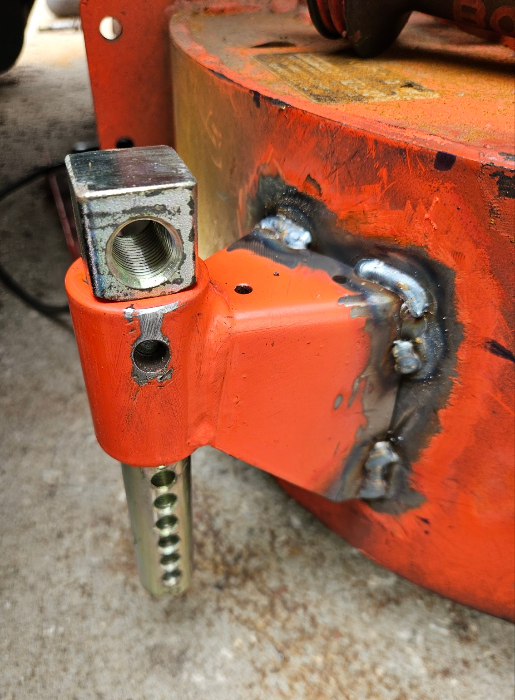
Not the prettiest welds on Earth, but in all likelihood, if I did nothing more, the mower would work just fine with three ugly beads until I died.
Look at that shoddy chrome. Nice work, Kubota.
I am trying to figure out how to prevent future seizures from happening. There are a few solutions.
1. Move the pins every single time I mow and several times during the season. The bore will never stop rusting, so the seizing process will start anew every time I get off the mower and move the pins. I don’t know how long it takes for the pins to seize, so moving them every week seems to be the only safe course. During the off season, I can take them out.
2. Slather the pins with anti-seize.
3. Reduce the diameter of the pins.
Moving the pins is not the answer. I’ll forget, for one thing. Even if I don’t, I may misjudge the necessary interval. Also, it’s a kludge, not a workmanlike solution.
Anti-seize is not the answer. Anti-seize is one of the messiest substances known to man. For some reason, it gets on everything. Worse than grease. I don’t want it all over me and my clothes every time I fool with the pins. It will also trap grit in the bores.
Now that I think about it, I have no reason to expect anti-seize to prevent corrosion. That isn’t exactly what it’s made for. Corrosion is what makes the rust form, and rust locks up the assemblies.
Trimming the pins is the way to go. On the lathe, it’s a sub-one-hour job. I happen to have a lot of copper sulfate, so I can plate the pins so the areas where I cut the chrome off will have some rust protection for cosmetic purposes. Later on, I can look into getting some zinc compound or other to put zinc on the pins.
Now I am looking for information on machining chromed parts. Chromium seems to be right up there with plutonium on the hazard scale. It causes cancer and other things. Chrome plating is very hard, too. So I need to cut through hard plating, or remove it and then cut the steel under it, without poisoning myself.
Removing it with acid would release gas and put chromium compounds into a solution I would have to dispose of, and grinding it off would create a breathable dust.
I think the best thing is to just throw it on the lathe and see what carbide does. The lathe will produce chips too big to inhale. One hopes.
Before I can use the mower or remove the deck, I have to replace the plastic fenders. They are brittle from exposure, and I broke one by applying slight pressure in just the wrong way. The fenders attach to the mower with screws, and the screws go into nylon inserts that push into square holes in the fenders. Incredibly, Kubota sells the fenders without the inserts.
Removing the old inserts from the original inserts is an interesting process. They have little projections that extend outward to anchor them behind the plastic. I got two out using a screwdriver to push the inserts in, and then I realized I could just put the fender fragments in a vise and crush the parts that held the inserts. The plastic explodes, and the inserts fall on the floor.
Some day, I will mow again. And I will know more about this mower than the people who built it. Except for little things like the engine and transmission. But who cares about those, right?