The Trouble With Harry
August 21st, 2025Sometimes it’s not You
I am celebrating because I finally got the right-hand rear anti-scalp wheel shaft out of my Kubota mower deck.
What a nightmare this has been.
The old guy who first owned the mower failed to grease the front deck wheels, so the guy who sold it to me had to struggle to get rusted parts out of the tubes that supported them. That was consumer error. He also failed to remove the rear shafts regularly and apply anti-seize, which was not something Kubota mentioned in the manual, and which was only necessary because Kubota’s engineers created a laughably bad design. That was not the owner’s fault.
The front wheels turn, and their supports have zerks and grease journals. Greasing and reasonably frequent mowing might have prevented them from seizing. The rear wheels do not turn. They sit for years or months in the same position. There are no zerks. There are no journals. If you never have to adjust your mower’s height, and you have this mower, you could end up with stuck shafts.
The rear shafts are just about exactly the same diameter as the interiors of the bores they occupy. This is called a slip fit or transitional fit, depending on how tight the bores originally were. A slip fit, also called a clearance fit, involves a shaft small enough to go in a hole very easily. A transitional fit is very precise but not so tight it requires pressure to assemble the parts. A bore can be pretty snug without becoming a transitional fit. I think. Let me repeat: I took a wrong turn and got a physics degree instead of an engineering degree.
I believe the difference between the OD and ID I’m dealing with is under 0.005″, or 1/200 of the shaft’s diameter.
The shafts are carbon steel plated with what appears to be cadmium. Cadmium was commonly used in years past to prevent rust. The interiors of the bores are plain old steel. You can see the problem here. The cadmium should slow (not prevent) shaft corrosion, but it does nothing to prevent the bores from rusting. It’s also fragile, so it wears off. Then you have steel on steel.
Can you tell I’ve done a lot of research?
If even one part in the assembly is bare steel, the engineering is stupid and doomed to fail in any environment where there are temperature swings and condensation.
The reason my shafts sealed is that water condensed on their upper ends and then seeped down between the shafts and bores. This wet the bores and caused rust. Rust takes up more room than the steel it replaces. In a tight bore, this means you get pressure. You get a rusty shaft and a rusty bore pressing against each other, because there is no room for the rust to expand.
The pressure can become immense. In my case, heat didn’t work, and neither did a sledge or a three-foot pipe wrench.
Often, shafts are pressed into tight bores without adhesives or threads. It is common to press a shaft into a bore with an inner diameter smaller than the shaft’s diameter. This is called an interference fit. Rust can turn a slip or transitional fit into an interference fit.
A deliberate interference fit is not usually a problem to work with. Engineers usually design them so pins or shafts can be hammered or pressed out without trouble. Kubota’s accidental interference fit is different. It is way tighter, because it’s the result of an engineer’s failure to plan, not his careful and competent planning.
I really struggled to remove my left shaft. I knew I could take the support and tube off the mower and use the hydraulic press, but I tried to avoid it. I thought it wouldn’t be all that hard with the support still on the mower. Boy, was I wrong. It took hours and hours of miserable work.
As for the left shaft, I got smart. I cut the support off the tractor today, and I put it on the old hydraulic press.
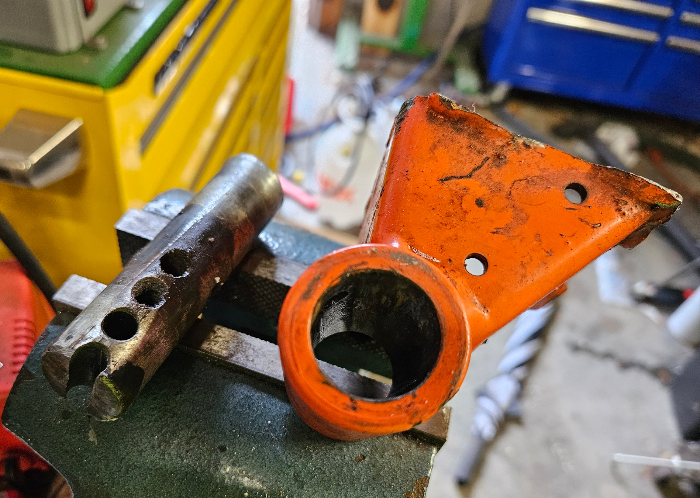
The support is a piece of folded sheet metal welded to the tube the shaft goes through. To use the press, I needed something to support the tube, and it had to fit with the folded metal in place. I resigned myself to making something from metal stock I had lying around. I was going to fire up the mill and/or lathe. Instead, I decided to set the support on an impact socket with the shaft inside the hex end.
This worked perfectly, except for the fact that the ratchet end of the socket was obstructed. If I had used a simple tube, I would have been able to push the shaft all the way through in one shot. As it was, I had to flip the support maybe 20 times.
Talk about seized. The first time the shaft moved, it went about 3/32″ and then acted like it wanted to stop. Not wanting to damage the socket, I started the flipping process. I applied penetrating oil. I cleaned the shaft off between flips. It really did not want to come out.
I don’t think a 12-ton press would have done the job. A sledge didn’t, and my 3-ton arbor press didn’t do a thing.
Eventually, the shaft moved a lot farther, and it loosened up to where the arbor press would push it. I moved to the arbor press, which is easier to use. After a few more flips, I put the support on a vise and used a hammer and punch. Before long, the shaft fell out.
I used a belt grinder and wire wheel to clean the shaft up, and I used sandpaper inside the support’s tube. Then I tried to put the shaft back in. There was still friction. That’s how bad Kubota’s design is.
My John Deere 430 has similar shafts that are very loose. They can’t seize. Because they’re loose, water runs out of the tubes, and they dry instead of accumulating rust. Because of the gaps, the rust would have to be unrealistically thick to make anything seize. Because the shafts rattle a little, the rust can’t grow. I don’t like the 430, but JD’s anti-scalp strategy is completely superior, and they were using it at least as far back as 1984.
Kubota was watching them. That’s what companies do to their competitors. They still didn’t fix their own design.
Here’s a photo of John Deere’s utterly superior and obvious design:
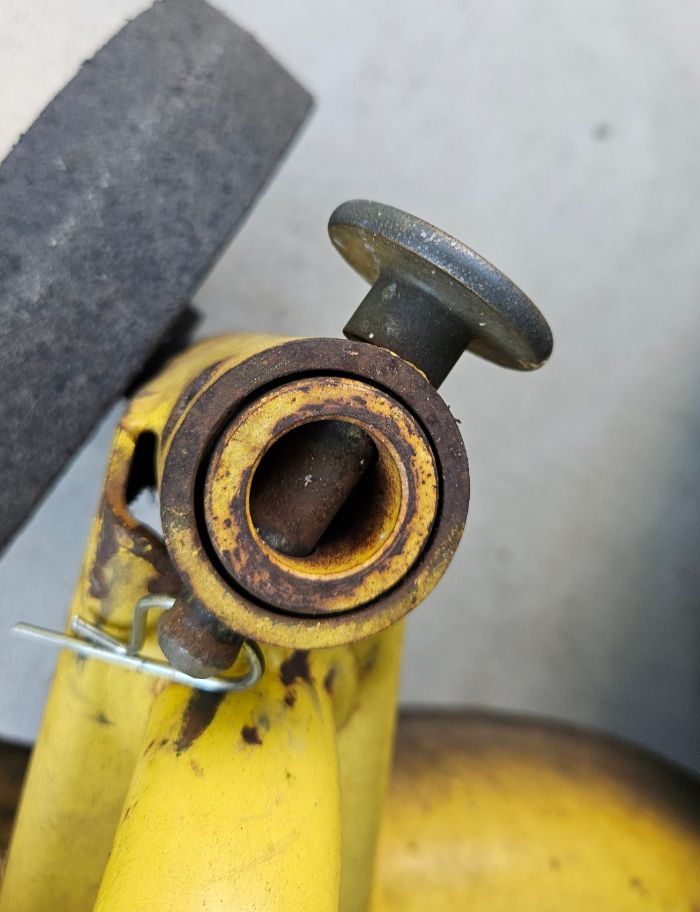
This may be the only time John Deere did something as well or better than Kubota.
The only real difference is the clearance, which Kubota could not figure out.
It just occurred to me that there may have been a patent problem. That is easier to believe than the alternative, which is that real engineers thought tight-fitting shafts were a good move.
I don’t see how you could patent not making wheel support shafts too tight. Surely that was figured out in the 1700’s. The web says there were working metal lathes in the first quarter of the 18th century, so it was possible to size holes and shafts accurately back then. People would have noticed that tight bores caused problems, because people are smarter than monkeys.
I keep going on about how Kubota blew it because when I’ve looked for help on the web, people have gotten really angry at me for saying engineers made a mistake. Engineers, in particular, have gotten mad and said crazy, emotional things.
They are STEM people, and a lot of STEM people 1) don’t really grow up, and 2) lack a sense of humor.
When I was a physics teaching assistant, I was hit in the face with the reality of the STEM personality. It wasn’t much of an issue when I was an undergrad, because I knew people in Miami outside of physics, but as a grad student, STEM people were just about all I had.
All my life, I have made friends quickly, but in a year and a half in a physics department, the only friend I made was my girlfriend. Absolutely NO ONE cared when I left. No one ever visited my apartment. I never saw the inside of any of their apartments. Weird.
I saw the inside of the house where one of my students lived, so maybe that shows they were more normal than my peers.
I migrated to law school, and once there, I was the life of the party. Never lacked for company. Saw other people’s homes. Woke up on another student’s floor because I was so drunk I couldn’t drive home, and I didn’t even know her well. Took people fishing many times. Joined organizations.
I made friends at both of my last churches. I have godchildren. My friends still come to visit, and I left my last church in 2015.
I have probably written about one of my favorite TA’s. His name was Ian. His students called him “Fridge.” He had no facial expressions. He wore exactly what you would expect: non-denim pants and a plaid short-sleeve button-down shirt. Chuck Taylors.
Fridge told me he had no furniture in his apartment. I asked him where he did his homework. He said he held a clipboard and leaned against a wall.
Fridge was very droll, but you wouldn’t want to be his friend.
Then there was Todd. He liked Asian women. A lot. He told me, “It’s not a fetish. It’s a PREFERENCE.” The big smile on his face as he said “preference” was not wholesome. He said it in kind of a breathy way.
He said he was going to move to Japan to teach English. He told me other things I didn’t want to know.
Then there was an obese guy named Rich. The king of the TA office. He tormented other people for no reason. He was obnoxious to me. I think he may have thought this was the way to make friends, like a boy who can’t make himself say he has a crush. He had been in the department for a while, and I never saw any indication that he was friends with anyone.
Come to think of it, I can’t recall ever seeing anyone in that office who was there for social reasons, except for my girlfriend. One TA was married, and I think his wife may have made an appearance. Or maybe he just mentioned her.
Rich had a locking bookshelf, and he kept stealing my head TA’s expensive books and putting them in it. Like he was pulling his pigtails, I guess.
I wasn’t the problem back at the physics department, believe me.
I think the University of Texas (my school) did a horrible job of cultivating new physicists. It seems like most of the people I knew ended up doing other things.
My head TA, Bill, whose idea of useful activity was going on Usenet and telling people they should have read the FAQ before posting, ended up working at a civil engineering firm with no Ph.D., after working hard as a postdoc on accretion disk theory. Another guy left to create video games while I was there. The guy who shared my TA office desk got a Ph.D. in EE in 1999, which is what I should have done. It looks like Fridge teaches physics to high school students, but I’m not sure it’s him.
Rich was considered extraordinarily able, but the web says he is “self-employed” now.
UT really tortured the physics students, undergrad and graduate. The professors were so bad, they generally couldn’t teach poop to stink. They did stupid things like giving the undergrad students lab experiments about topics they hadn’t covered yet. I could not believe it when my lab students told me. I had to do Professor Frommhold’s work for him, in a few minutes here and there.
I’ve written about the quantum professor who gave my class a homework problem he couldn’t solve. Also, UT used an E&M textbook that was famous for making students want to kill themselves. It’s not like there weren’t better books. Jackson’s E&M was more like a hazing tool than a teaching tool. “We suffered with it, so you will, too.”
Jackson didn’t actually explain anything, so he didn’t perform the only essential function of a teacher. He was an idiot. He didn’t teach, and then he followed up with extremely hard problems.
Everyone in my TA office had the ability to get a Ph.D. in physics, including me. I was not the dunce in the room. The guy who seemed slowest is now an experimental physicist. But UT’s way of caring for students was like Roundup’s way of caring for weeds. It was like we had sprung up uninvited, and they needed to get rid of us. Unbelievably stupid.
It’s odd how really smart STEM types are known for doing some things that are brilliant and other things that are incredibly dumb, habitually.
Why would you invest time and other resources on collecting students, find most of them abandoned the entire field because of you, and then continue doing things the same way?
It is possible to teach students physics without abusing them, regardless of what bitter old academics may say. The end product would be a lot more working physicists. I understand the importance of weeding out the weak, but UT also weeded out the strong.
Part of it comes back to the “smartest boy in class” syndrome. Many physics people have had proud moms who showed them off all the time and talked about how smart they were. This makes them crave attention for their intelligence, which partly explains why so many of them get bullied. It makes them annoying. The physical bullying is sometimes revenge for intellectual bullying.
If you can drive off a bunch of students by teaching poorly and making them suffer unduly, you can then go sit with your colleagues and talk about how much smarter you are than the students who left. But it’s not true. Brilliant people leave physics every day. A lot of them do it to preserve their sanity.
Man, I should have been an engineer. It’s much easier. It’s practical. It leads to better jobs. The potential for high income is much greater. The people may be weird, but I don’t think anyone is weirder than physicists. Even mathematicians seem more human.
It’s funny, because my professors at the University of Miami were generally great, except for one ancient, smirking bully named Harry Robertson. The statistical physics guru. He was so sadistic and ineffective, he caused a riot once. Undergrads threw together a furious protest because he failed a huge percentage of them, and I know for a fact that he could not teach. This was before protesting was considered acceptable.
There was no humanity in this man at all. Other people’s feelings and futures meant absolutely nothing to him. He taught my advanced mechanics class, and a bunch of us failed the first exam. We met with him. He showed up in bedroom slippers, he smirked a lot, looked down at his desk, showed us a rattleback toy without explaining it in order to make himself look smart and us stupid, dismissed our concerns as though we were claiming we needed masseurs in class, and left.
To excuse his behavior, he pointed to the one student in the class who was doing well. A Chicom. Thing is, that guy probably had tons of support from China and other Chicom students.
If you think about it, it’s amazing that a statistics expert could claim a large group of students could slip by other instructors for years and then suddenly be exposed as morons by one professor. And that he could claim it had happened more than once. The undergrads he tormented would have numbered in three figures. So suddenly, UM admitted a hundred or more imbeciles, but it hadn’t happened the previous year, and it didn’t happen the next year. Okay, Harry.
Apart from Harry, who intentionally made things very hard for students and then blamed them, my profs at UM were exemplary instructors. I loved their classes. Same for my math and comp. sci. profs. For that matter, I had good instructors in the philosophy and literature courses I was forced to take. My UM instructors were generally much more effective than the instructors I had at Columbia University, now that I think about it.
Physics and math are beautiful and very enjoyable, they can be taught clearly and painlessly, and they deserve good instructors. Not guys who are still trying to get even with young people for being cruel to them in high school.
As for the mower, now I have to clean the parts up, removing burrs and oils, not to mention paint that could get in the way, and I have to weld the support back on the mower. Should be a one-hour job. Then I will apply primer and paint to the affected areas. After that, I should be able to put all my new parts on the mower and forget this problem ever happened.
I did not want to cut the deck up. It somehow seemed risky and almost presumptuous, although it was neither. The support is just a piece of sheet steel, like any other. It’s not like I’m cutting the fender off a Bentley.
There is a Youtube guy named Jimmy Diresta, and he makes all kinds of things. He welded some casters on a project. Usually, you use screws and nuts to attach casters. Using a welder seemed bold. He said, “I am the god of this thing.” He meant that if his welds turned out to be problematic, it didn’t matter, because he could do whatever was needed to fix it.
I would not call myself the god of anything, but I always think of him when I make what seems to be a bold use of tools. I can change it, so who cares? I have welded casters on a bunch of things, and I learned he had the right idea. Welding is better.
When you use screws, if you’re any kind of craftsman, you spend a lot of time locating the holes correctly. You use a punch to make dimples for the drill. Then you have to screw the casters on, using 8 washers, 4 screws, and 4 nuts per caster. With the welder, you just slap magnets down to hold the casters and let her rip. Then you get a cleaner project with casters that can’t fall off.
I can weld the support back on just as well as Kubota. I can make a new support. I can make a new tube. A new shaft. It’s silly to be intimidated.
I am really looking forward to mowing. I think it has been three weeks. I can’t stand the thought of giving up and using the John Deere, which I haven’t sold yet. The Kubota is a dream to use. Way faster. Better cut. Excellent mulching. I get a nice breeze because I sit in front. I don’t worry about breakdowns the way I did with the John Deere. It also holds lots of fuel, so I don’t have to fill it as often.
Nobody wants to be demoted after a big promotion.
As for the engineers who got mad at me, and the ones who claim most bad engineering is forced on engineers by people in management, accounting, marketing, and sales, I have an amazing story.
When the first Corvettes (plastic-bodied cars) were rolled out, they would not start. They had to be pushed out of the factory. Why? The batteries had been grounded to fiberglass.
Darn those accountants and marketers.
Engineers designed the Hindenburg.
August 22nd, 2025 at 3:21 PM
Is it possible that the Japanese engineers, being perfectionists (Probably), didn’t want the posts to rattle? Not that this excuses their mistake, but it might explain it.
August 22nd, 2025 at 5:12 PM
I had an issue similar to this long ago, old British car and all that. I had the steel shaft turned the absolute minimum to make sure it was straight and true, then had the part it fit into honed out and a brass liner (basically a piece of brass pipe) pressed in such that the fit of the shaft to the brass was as you say around 5 to 10 thousandths over, lubricated it all and re-assembled. No more seized shaft issues and I am sure the guy that bought the car 30 years ago is not having any either. Steel on brass has always been a good solution where lubrication is difficult to non-existent. Good luck with it, maybe such a fix is possible for you too unless you drill and tap and put in a grease point, assuming this is possible.
August 22nd, 2025 at 6:53 PM
“Is it possible that the Japanese engineers, being perfectionists (Probably), didn’t want the posts to rattle?”
I have wondered about that. Sometimes sloppy is better.
August 22nd, 2025 at 6:56 PM
“I had the steel shaft turned the absolute minimum to make sure it was straight and true, then had the part it fit into honed out and a brass liner (basically a piece of brass pipe) pressed in such that the fit of the shaft to the brass was as you say around 5 to 10 thousandths over, lubricated it all and re-assembled.”
I should just use anti-seize, but I have looked into chroming in case I decide to slim down the shafts. It looks like the new ones have chrome, not cadmium, on them. I could turn them down and then have the chrome redone. It would probably cost a hundred bucks, but the satisfaction would be considerable.