Put a Coaster Under That Cactus Cooler
February 16th, 2021Sometimes Evolution Goes Backward
My goddaughter had a birthday yesterday, so she and her family came to visit. Five kids, or, more accurately, four and one new adult. This gave me a good excuse to keep working with the fancy new ice cream machine. I made four flavors.
I have totally mastered cherry vanilla and butter pecan, and I have great confidence that my next batches of peach and Heath bar crunch will be perfect. It’s time to ask myself what other flavors I need to make before I stop building my ice cream armament. I don’t need a lot of flavors to be happy. As it is, I will never need to buy ice cream again unless I want a novelty like a Nutty Buddy or ice cream sandwich.
I used a bag of crushed Heath bars from the grocery store. This was a mistake. They’re worthless. They’re not just broken. They’re ground. The biggest pieces are like peas. If I do it again, I’ll buy bars and break them.
Based on Internet research saying most people prefer artificial vanilla to the real thing, I tried fake vanilla in one of my flavors. It was not terrible, but it wasn’t that good, either. Expensive vanilla is much, much better.
Here’s what I concluded: most people don’t know what tastes good. I knew that already, because Budweiser is the most popular beer in the country. The guy who is trying to replace Christopher Kimball at America’s Test Kitchen tried fake vanilla in a blind test, and he preferred it. That should have told me all I needed to know. Kimball was the spine that held the organization up. The new guy strikes me as a cooking school wonder who knows everything about food while lacking the ability to create or recognize success. Many of the bad meals you’ve had at restaurants were prepared by culinary school graduates, so it should never surprise anyone when a person with scary cooking credentials can’t cut it.
People worship James Beard, but his recipes aren’t good. The Joy of Cooking should be called The Joy of Indigestion. It’s the way of the world.
One of my guests suggested I try my hand at peppermint. That should be simple. Vanilla ice cream without the vanilla. Add crushed peppermint candy and mint extract.
I can’t eat chocolate without regretting it because of the caffeine and theobromine, but it is conceivable that I might eat it anyway from time to time in the future. I have an urge to try to duplicate Ben & Jerry’s Everything but the Kitchen Sink. It’s chocolate and vanilla ice cream with peanut butter cups and bits of toffee bars mixed in. An Internet search tells me it also contains white chocolate chunks and fudge-covered almonds. I don’t recall running into those items, but then when I eat ice cream, I don’t study it and take notes.
Making a mixed ice cream would be laborious. I would have to make two batches in chocolate and vanilla and combine them. Not sure I want to go through that for a product I don’t plan to eat.
The machine needs a rolling cart, so I blew $88 on steel. I bought 1″ square tubing with 1/8″ walls. I thought thick walls would make welding less risky. Welders can blow through tubing easily. When I saw the price and lifted the steel, I felt I should have gone with thinner tubing. I’m no engineer, so I made a mistake. It’s not a problem, though. I’ll just have a really strong cart I won’t want to lift.
The plan is to put three wooden shelves in it, and I’m going to use the casters that were left over when I put my smoker on a factory-made cart (which I should have built myself).
In related news, I keep wanting to make new workbenches. My old bench of all trades is extremely sturdy, but I built it before I knew anything. It has no wheels, it’s less than ideal for woodworking, and it should probably weigh 100 pounds less.
I finally bought real blades for my Powermatic 66 the other day, and it got me thinking about a woodworking bench. I started thinking about designs. Fresh from the success of building my steel and wood shooting bench I thought I should go against convention and make a woodworking bench with a welded base.
Woodworkers tend to be true believers, and that means they make everything out of wood. They are hostile to certain new ideas, and they really like bench designs that are hundreds of years old. One was created by a famous Frenchman named Roubo. Another one was designed by an Englishman named Nicholson. Actually, these guys may have simply passed on designs that were already traditional. I don’t know.
These benches are very heavy for two reasons, neither of which has anything to do with function. First, wood has a poor strength-to-weight ratio compared to metal, so it takes a lot to do the same job, and second, the people who designed them knew nothing about designing rigid structures.
A typical woodworking bench will have a solid top at least three inches thick. This gives you a nice, stiff surface to work on, and it allows you to make deep holes that will work with bench dogs and holdfasts.
A holdfast is a steel rod with a hook on one end. The hook has a flattened end. You put the other end of the holdfast in a hole and slide it down until the flat part rests on your project. Then you whack the holdfast and drive it into the hole until it wedges in there. It’s a great invention. Really holds things in place, and it’s quick to use. Unfortunately, it doesn’t work well if your bench is thin.
A bench dog is a cylinder of wood that fits in the same holes holdfasts use. You can pull a bench dog up and rest a piece of wood against it while you work it. The dog will keep it from moving away from you. Again, you need deep holes.
At some point during the last millennium, engineers discovered the torsion box. This is a fancy term for a hollow box with supporting members inside it. You build a lattice of crossmembers and then enclose it in two sheets of material like plywood. What you get is a box which is very strong for its weight, and it’s easy to make it flat by sizing the internal members accurately. Many wooden doors are torsion boxes. Nobody wants a door that weighs 200 pounds.
A guy named Paulk designed a bench top which is a torsion box. It’s pretty neat. The top and bottom are several inches apart, and he put holes in the sides of the box so he could reach in and put tools inside it. That feature alone makes the design brilliant. When I first started thinking about building a new bench, I thought I would glue two-by-fours together side by side and make a thick top. Now I realize that was stupid. I want a torsion box.
Problem: how do you put deep holes in a torsion box? The top and bottom may be an inch thick, but there is air between them. I would want holes with wood around them all the way down.
I thought about it last night. Here’s what you do: you add internal members with holes drilled through them. You only need a couple of rows of holes, so you can add two extra members just for drilling them. The holes would weaken the members, so drilling through members that need to be solid would be bad, but adding extra members wouldn’t hurt anything. In fact, you wouldn’t need members running all the way across the bench. You could use cubes of wood.
Problem solved.
What about making holes in the sides of the bench for access to the storage space? Making holes like that in wood is a pain. Why not use steel?
Make yourself a steel frame from tubing. Put plywood on the top and bottom, screwed in for easy replacement. Instead of a few little holes for access, you could have three sides of the bench wide open. One end would have to be covered by an end vise, and part of one side would be blocked by a vise on the front, but other than that. you would have tons of access for storage and cleaning.
Put the box together. Weld up a rolling base. Attach the base to the wood of the box, not the welded base. Install vises. Done.
Any woodworker who is reading this must be screeching by now.
Would the bench top be too flexible to make a good surface for pounding? First of all, why would you be pounding? Woodworking doesn’t require that. Second, many people already use benches with relatively thin tops, and they are doing fine.
I saw a neat bench on Adam Savage’s Youtube channel. A guy named Andrew Klein gave it to him. Klein works for Magswitch, and he also has a side business.
I was awestruck by the bench. It has a base with four legs made from what looks like 5″ steel tubing with 1/2″ walls. The top is two slabs of hardwood that appear to be 4″ thick. It has two geared twin-screw vises Klein makes and sells. The dogs have steel shafts, and the holes contain magnets so the dogs stay up when you raise them.
The more I looked at the bench, though, the more I thought I saw bad engineering.
I don’t know what the bench weighs. Maybe 500 pounds? Savage was happy about that, but overbuilding is one of the best-known hallmarks of bad engineering. I know; I’ve done it. Weight means increased material, production, and shipping costs. It means increased difficulty in handling finished products. It means waste. It’s a clumsy way of handling problems you can’t address properly because you’re not a good engineer.
If you ever read a welding textbook, you’ll learn that one of the main things that drive the study of weldments is a desire to reduce weight. People who don’t know anything about engineering love to talk about how “beefy” their tools are. It’s like bragging that your car has solid tires made of steel. It’s a demonstration of ignorance. I’m no engineer, but even I know these things. You don’t have to be a Georgia Tech grad to get this far.
The bench has no wheels. That’s insane. I say that as the guilty creator of a bench with no wheels. Why would you make an extremely heavy tool you can’t move without a forklift? Smart shop owners put everything they can on wheels. The more you can move things around, the smaller and less expensive your shop can be without sacrificing comfort or much convenience.
What about the magnetic dogs? At first, I thought they were cool. Then I thought about Paul Sellers. He’s a British woodworker who is very big on Youtube. He’s a real expert. His dogs are bits of scrap wood with springs he makes from coat hangers. I have some I made myself. They work great, so why drive yourself nuts with rare earth magnets?
Now, the vises. They are beautiful, and the cost is very reasonable. They are probably a little better than competing vises from companies like Veritas. Veritas uses bicycle chains to connect and synchronize the screws on its vises, while Klein uses gears, and gears are sturdier and don’t need adjustment. Klein’s vises have transmissions so you can shift into high gear and move them fast.
I thought the vises were neat. Then I asked myself: “How are they significantly better than what I have right now?”
I made a Moxon vise for my bench. It’s a long block of maple with two holes in it. Two long Acme screws run through it, and there are handwheels to turn the screws. I can put longer and wider objects in it than will fit in most factory vises. I can put things in it that reach down to the floor; nothing gets in the way. I can fasten it on objects that are tapered because the screws aren’t synchronized. It doesn’t have a speed mode, the way the Klein vises do, but I have never felt I needed that. If I really want that feature, I can create it using half-nuts.
The Veritas vise is also very good, and unlike Klein’s boutique vise, it’s available. I don’t have to wait for a guy to make it in his basement.
The bench top…beautiful. Tombstone-thick maple with a glossy finish. But what is the purpose of all that weight? Answer: to make Adam Savage feel good. If loving your tool is your goal, buy what you like, but what if you just want to make things?
Savage has already put a big sheet of leather on the bench to protect it, and that shows how shortsighted the design is. A bench is like a pair of boots or gloves. You’re not supposed to protect it. You’re supposed to protect the work. A bench shouldn’t be sanded with 400 grit and finished with 10 coats of polyurethane. It should be bare wood. Imagine fussing with a giant sheet of cowhide every time you use a workbench. Ridiculous.
I made a shooting bench from 2″ steel tubing, a few screws, and some pressure-treated two-by-sixes. You could literally rest a car on it. If it weren’t for the two pneumatic tires on one end, you could never wiggle it at all by using tools on it. It’s way overbuilt. It probably weighs 150 pounds now that the wood is dry. I can lift one end of it and roll it 50 yards by myself. I do it all the time. I should have made it even lighter.
If I made a woodworking bench from the same tubing, it would be just as sturdy. Each leg might weigh 7 pounds. What do the legs on Savage’s bench weigh? Maybe 10 times that? For no reason.
I can use 2″ tubing for the base of my bench. I can put a caster on each corner. I can add feet that lower with screws when the bench is where I want it, so it won’t move when I push on a hand plane. It will feel like the Rock of Gibraltar, I’ll be able to move it unaided, I’ll have a ton of handy storage, and when the top gets beaten up, it will take me half an hour to put a new one on.
I can throw two Veritas vises on it, or I can buy two Moxon parts kits (because I am tired of making the parts). No need to wait for vises with transmissions. Done. Bang. Next problem, please.
I looked into leg vises. Long story short: no. Twin-screw vises are better.
Isn’t it bad to have screws in the top of a woodworking bench? No. Why would it be bad? Don’t plane the screws. Don’t chisel them. Countersink them a little to keep them out of your way. No problem.
I can make one bench for wood and another one for general use. I can put my old bench on the burn pile, using the tractor. If I move, my new benches will roll onto a truck.
I really don’t see the point in reverting to Fred Flintstone design policies. It seems to me that a half-ton woodworking bench is like a big sign saying, “I reject every intelligent thing man has learned since 500 A.D.”
I kind of wonder if I need a wood bench at all. Why not use a welding table? I have thought about buying a real fixturing table made from 1/4″ or 3/8″ plate. It’s a steel torsion box. They’re very popular. Why couldn’t I do woodworking on it? Mounting vises would be interesting, to say the least, but there is no reason why you can’t make wooden projects on a steel table.
Something to think about.
Speaking of Fred Flintstone, I saw a video about Nick Offerman. He’s the actor who played Ron Swanson on TV. Swanson is a hilarious caricature of an old-fashioned libertarian, whereas Offerman is your standard Hollywood liberal with full-blown Trump Derangement Syndrome. After watching Swanson, Offerman is a big disappointment. He’s a gun control nut.
I’ll post a video of Ron Swanson just for fun.
Anyway, Offerman is a woodworker. He has a beautiful shop. You can see it in videos. When you look at his setup, you wonder what kind of furniture he makes. It must be cleverly designed and painstakingly crafted.
Well, not so much. He makes Flintstone furniture. I’ll post a photo.
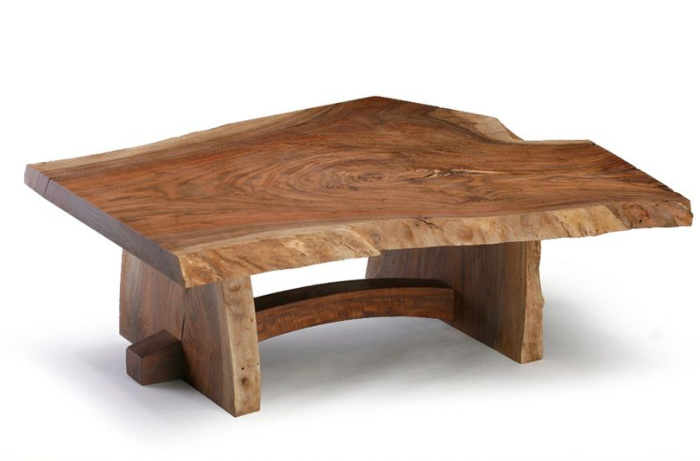
You may think it looks nice. Well, sure. God designed it. Nick Offerman voted absent.
This is a style of furniture which is very popular now. You take thick slabs that could be used to make a lot of quality furniture, and instead of coming up with a real design, you run them through a jointer, fasten them together crudely, slap some Danish oil on them, and call it art. Funny thing: it’s the opposite of art. “Art” means something which has been transformed by the mind of man.
The crude furniture people make now reminds me of the increasing use of the word “rustic” in cooking. You’ve seen it. A “rustic” pizza is a pizza that looks like a kitchen accident because it was made by an unskilled person. “Rustic” means “crudely made due to lack of skill.” Offerman’s table is definitely rustic, although it may be a superficial rusticity. He can probably do a lot better. I hope he can.
I have zero skills, yet given a big enough planer, I could make this table in an afternoon. In gluing extremely thick pieces of wood together, I would waste many pounds of wood which could have been turned into genuine pieces of craftsmanship.
If there is anything good about this style, it’s that it preserves thick slabs of valuable wood until the furniture can be demolished and the wood used in better projects.
Here’s a modern chair made by a guy named Maloof. It’s from the Smithsonian’s collection. Not really my thing, but it’s graceful, skillfully crafted, and pleasing to the eye. Compare it to Fred and Barney’s table, above.
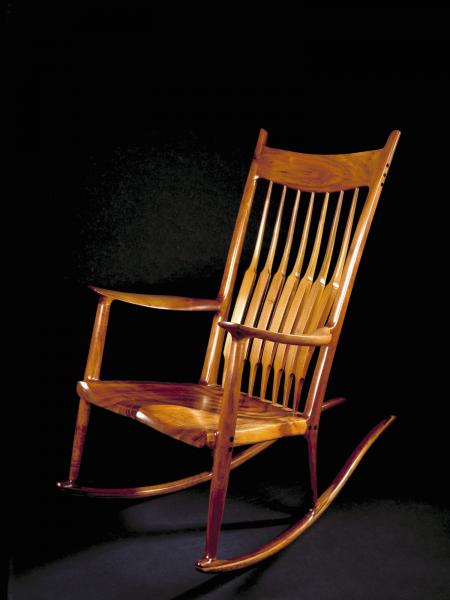
The chair serves to remind us of the difference between art and copping out.
Offerman, like Klein and Savage, has fallen prey to the beefy bug. Instead of a graceful table with a design that required human input, he created a crude device useful mainly for rupturing disks. If God thought like these guys, birds would be unable to fly. A chicken would weigh 40 pounds. All fish would be bottom dwellers. The weight of their bones would glue them to the seabed.
Birds have air inside their bones to reduce weight, but many birds are extremely strong. The other day I saw a video of a cockatoo which probably weighed two pounds, lifting a pumpkin and throwing it off a kitchen counter. That’s not rustic. That’s engineering.
What purpose did Offerman serve here? He didn’t design anything. He found something that occurred under the random influences of nature and presented it nearly as-is. He’s not a maker. He’s a finder.
Offerman’s type of furniture is known as “live edge.” I don’t know why they call it that. The wood is dead. Maybe they didn’t want to call it “rustic edge.”
The idea is that the outermost part of the wood isn’t cut away. You would think it makes every piece of furniture unique, but in reality, it makes them all look the same. Go to Google Images and look up “live edge furniture.” It’s like a giant Offerman exhibit, but he didn’t make any of the pieces.
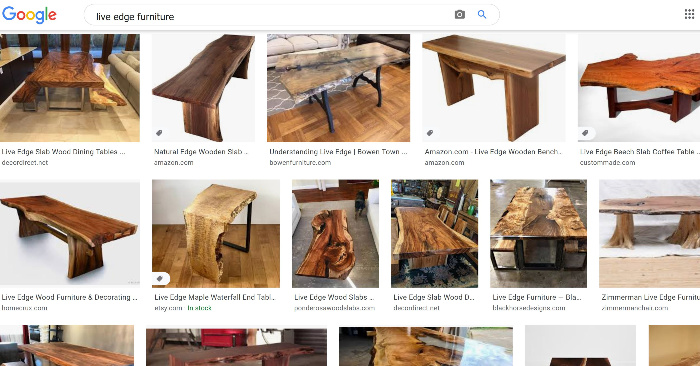
Live edge woodworkers are fungible. One’s work is just like another’s. There is no need for any particular live edge woodworker to exist. Any other member of the crew can step in and finish his work exactly as he would have.
I could swear I hear Ayn Rand shouting at me.
Mr. Maloof is a real woodworker. Nick Offerman is just a guy who stacks slabs.
Nick Offerman is funny, but he’s not on my list of most-admired people. His Trump issues are disturbing, and he nearly ruined Lagavulin whisky for me. It has been my favorite whisky for many years, because it’s the best whisky there is. Offerman’s Swanson character came alone and started drinking it, and now I feel like I should hide my bottle. Remember how you wanted to hide your cowboy boots after Urban Cowboy came out? Same thing. My guess is that Offerman didn’t know what Lagavulin was until he read about it in a script.
I don’t know if I’ll make a new bench or not, but at least I was saved from the beefy bug. An afternoon of Googling did that for me.
It’s time to go blast some squirrels. They smoke up pretty good. It’s fun being a lot more like Ron Swanson than Nick Offerman will ever be.
MORE
Ready for an whale-choking dose of irony? I just learned that the TV character Ron Swanson designed the Maloof chair pictured above. The exact same chair.
I was looking at clips of Ron Swanson in action, and I came across one in which a lady tried to license a chair design Swanson had created. When they showed the chair, I was stunned. I’ll post a photo.
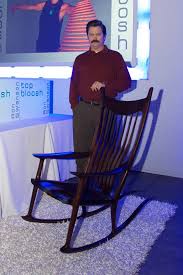
What are the odds?
Does Maloof know a fictional person is taking credit for his talent?
I don’t watch the show, so there is now way I could have seen Ron with the chair in the past. I found the Maloof chair by Googling “chair” along with “Smithsonian,” figuring the Smithsonian probably had a collection of historic furniture.
If ever you needed evidence that Nick Offerman is inferior to his broadcast persona, look no further.
I checked Offerman’s website and found that not all of his furniture is Flintstone tribute material, so it appears that if he ever got his head straight he could conceivably improve his work and successfully ascend the Swanson Pyramid of Greatness.
February 18th, 2021 at 12:06 PM
Steve, fully agreed in all*, and like you, I also failed to install wheels on my workbench, back in ’09 when I built it.
* only minor difference. I gave my bench an overall finish of two coats of tung oil, simply to help resist the tendency towards dry-rot which is a thing here on the Texas Gulf Coast. And every couple years, I’ll give it another quick swipe of the oil. Not “lovingly hand-rubbed”, just a coat and wipe, and it helps seal against the pernicious salt air. Doesn’t hurt that it helps the looks a bit, but that’s a bonus, not “the purpose”.
Salt air is the same reason I’m going to donate my cast-iron Craftsman table saw to the local High School. I can’t keep up with the never ending chore to de-rust the surface, no matter how much Johnson’s Wax is applied. I’ll get a Rigid or Bosch contractor’s saw with a cast aluminum deck, and that’ll be that. Rigid made one I couldn’t afford back in ’09. It had a GRANITE table. Never rust, but I suppose it could chip badly if mis treated.
Jim
Sunk New Dawn
Galveston, TX
February 18th, 2021 at 7:12 PM
I am not sure, but I’m starting to think the best way to prevent cast iron from rusting is to put a tarp on it. It looks like covering a table limits condensation to the point where not much happens. Not sure if cloth or plastic is the answer. I’m doing an experiment with my table saw in order to find out.
It’s funny, but salt was never a problem in Miami, less than half a mile from the bay. Can’t figure that out.
Best way I’ve found to get rust off of cast iron: a Home Depot paint scraper and WD-40 or mineral spirits. Puts sandpaper to shame.