Think Your Water Heater is Okay? Better Zinc Again
January 10th, 2021Anode You’d Want to Read About This
It’s amazing how little normal homeowners know about the pitfalls of home maintenance.
I probably discovered water heater anodes last year, far into middle age, and I am not a stupid person. I wonder how many of my readers know about them.
Your water heater has a long metal rod in it, and the purpose is to prevent the tank from rusting. The rod corrodes, and the hope is that the tank will not. The rod is called a sacrificial anode. You can also find them on boat hulls and engines. If you don’t replace your anode regularly, you may come home to a rusty flood and no hot water.
I don’t know if there is a standard length for anodes. Mine is something like a yard long. Anodes are attached to threaded fittings at one end. The fittings go into female fittings at the tops of water tanks, and the anodes hang down in the water. The upper fitting on my rod has a hex at the top, and it’s 1-1/16″ in size.
Your anode is said to have a lifespan of 3-5 years, depending on the breaks. Soft water eats them faster.
If you’re mechanically inclined, maybe you’re already starting to see what a fun project checking an anode can be.
To get to my anode, I had to remove a plastic cap on top of my water heater. Then I had to dig out and dispose of a considerable amount of foam insulation. When they make water heaters, they’re too busy to put temporary dams around anode fittings when they shoot the foam in. They just fill the whole area up.
I had to use a screwdriver to dig the foam out so I could get to the hex, and when I was done, I had crumbs everywhere. I had to use a vacuum to get rid of all of them, because otherwise, they could have fallen into the tank. From there, I have no idea where they would have gone. I had to drain some water out of the tank to remove the anode, and for all I know, the mouth of the output tube was exposed so it could suck crumbs up and send them into my plumbing.
Here’s what Rheem, the company that made my water heater, says you should do. Turn off the power to the water heater. Open a hot water faucet in the house. Drain a couple of gallons out of the tank through the fitting on the bottom. Dig the foam out of the anode access hole. Put a wrench with a breaker bar on the hex fitting. Remove the anode. Check it. If it’s not looking good, replace it. If it’s okay, but it back in. Use 6 wraps of Teflon tape on the threads.
Obviously, one wonders why Rheem doesn’t put Teflon tape on the threads when they install the rods.
They have a Youtube video in which a well-groomed, chipper plumbing professional replaces an anode in about 20 seconds. He doesn’t mention vacuuming up crumbs. You don’t get to see him grunting while shoving on a breaker bar. They might as well have hired Betty White.
Once I had my foam out of the way, I put a socket with a 4-foot breaker bar on the hex and pushed. Here’s what happened: the water heater turned. The hex wasn’t having any of it. No movement whatsoever. Because Rheem didn’t put Teflon tape on it. The way they tell us to.
If I had kept pushing, I would have broken the PVC pipes going in and out of the water heater. What about having a friend hold the tank? Well, he would have to weigh about 400 pounds. The best I can do around here is a lady who probably checks in at around 125.
Funny; the video guy’s water heater didn’t get up and move like mine did.
Call me a cynic, but what if Rheem didn’t really want you to change your anode? What if they wanted you to give up and just buy a new water heater every 5 years? That would make their policy of over-torquing Teflon-free hex fittings a brilliant move.
Not suggesting anything, of course.
Rheem didn’t count on me and my tools. They didn’t see me coming.
I took my Harbor Freight hydraulic cart and put my portable compressor on it. I borrowed a short air hose from my air-powered hydraulic press/finger brake. I got out my impact wrench. Not driver. Wrench.
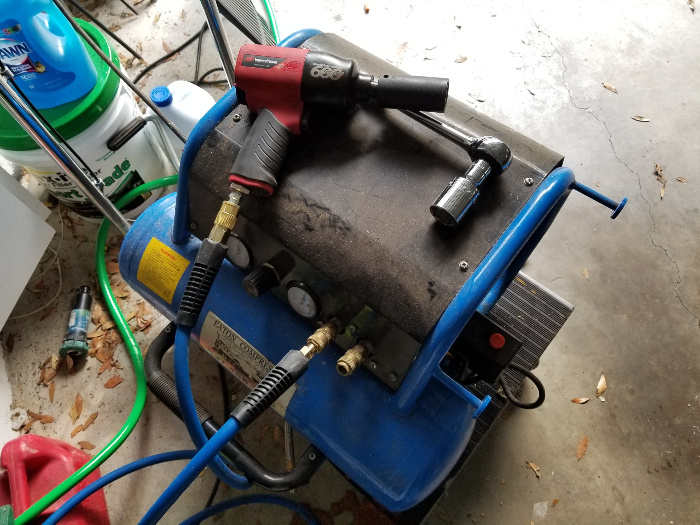
I rolled the compressor to the garage, put an impact socket on the hex, and blasted away until the crud on the seized threads broke and the hex came shooting up out of its prison.
HA. In your FACE, Rheem.
The anode didn’t look bad. I’ll bet I get three more years out of it. I put it back.
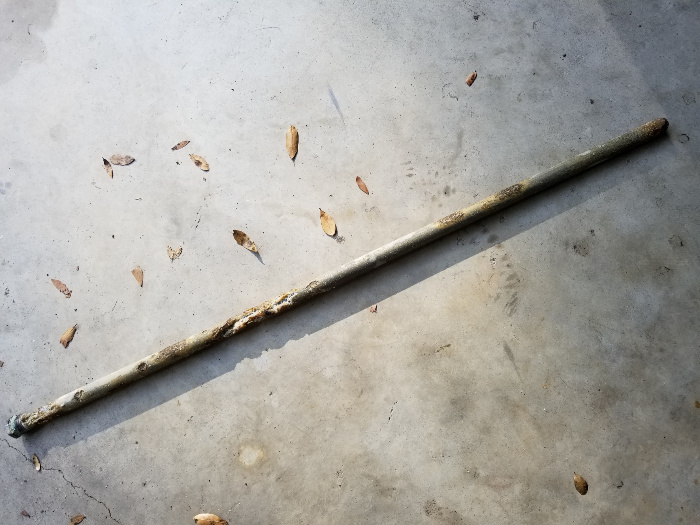
I wrapped it with 6 layers of Teflon tape, and I torqued it to the ridiculous figure Rheem supposedly recommends, which would be about right for putting lug nuts on aluminum rims.
Are you crazy? No I didn’t. I got some anti-seize and applied it to the threads. I tightened the hex with an ordinary socket wrench until it seemed reasonably tight but not likely to be hard to remove next January when I check the anode again. Assuming the rapture doesn’t save me from that job. I turned the water on and watched the hex carefully, and of course, no water came out. Why would it? Water fittings don’t have to be nearly as tight as air fittings, and I have installed tons of air fittings. They don’t have to be torqued down to the point where you burst a blood vessel in your head while turning the wrench, and water fittings require still less torque. I don’t care what Rheem says.
Was it safe to use anti-seize instead of Teflon? Who cares? Over the course of my life, as a result of lubricating that fitting, I will probably ingest an amount of anti-seize so tiny you would need an electron microscope to see it. I don’t sit around drinking hot water from the tap. I could have greased it with Ebola and plutonium and it probably wouldn’t have mattered. On top of that, I Googled, and all sorts of professionals say to use anti-seize. I haven’t seen any class actions yet.
Anti-seize is the correct thing to use when joining dissimilar metals with threads. I doubt Teflon is approved for that. Whether it is or not, I don’t trust it the way I trust anti-seize.
My other water heater is upstairs. There is no way in hell I’m going to carry my compressor up there. I’m not stupid enough to carry 75 pounds up a stairway. Harbor Freight sells a 100-foot air hose for about $11. Guess what I’m going to buy.
I was blessed, by the way. My downstairs water heater was installed in a closet with a 10-foot ceiling. What about yours? How much clearance will you have when you try to take your yard-long rod out of your heater? My bet: NOT ENOUGH. Why didn’t the video guy try to take a rod out of a water heater in a closet with an 8-foot or lower ceiling? Didn’t want to mess up his mani/pedi. That’s my guess.
The sissy.
“Sissy” is a forbidden word these days, so I try to use it a lot.
I would have loved to see him cutting his filthy, rusty, slimy anode in half with a sawzall after removing everything from the closet. That would have been precious.
I really don’t think they want you to change your anode. If they did, they would have made it easier.
When your anode goes bad, if you have a low ceiling or a shelf above your water heater, you’re going to have to find some way to cut or bend the anode to get it out. Then what do you do to get the new one in? I know the answer. They make jointed anodes that look like strings of sausages. You’ll have to buy one unless you want to cut a hole in your roof.
You’re going to have a hard time getting your old anode out if you don’t have an impact wrench. My wrench will instantly spin off fasteners a breaker bar won’t budge, and I had to hold it on my hex fitting for quite a while before it moved it.
Let me suggest something. Maybe it will work. When you buy your next water heater, because you couldn’t get the anode out of your old one, take the anode out of the new one. It should be much easier than removing it after a year of corrosion. Apply anti-seize and reinstall it. Maybe this will make it possible to get it out when you need to. If you have a low ceiling, put a jointed anode in before you install the water heater.
I’m just guessing, but I don’t see how these tactics can hurt.
I’m holy and anointed and all, but I still feel like punching someone at Rheem. If they cared at all, this job would be much easier.