Barrel of Fun
August 31st, 2020Elizabeth Warren Would Love it
I love my Savage 93R for two reasons. First, it shoots sub-MOA for very little money, with nearly no recoil. Second, it has a little Indian chief head on it. Savage got rid of this classic logo a while ago, for obvious reasons. By “obvious reasons,” I mean they chickened out. Maybe they should put a chicken on their rifles.
The other day I cut a piece out of the trigger spring, and then I tested the gun. I posted a picture of the target here. It shows the gun is probably a consistent sub-MOA shooter when you do things right. I don’t always do things right, so I can’t swear to it.
It’s too rainy to shoot, so I have been working on the gun.
Today I cut half a coil out of the trigger spring. I plan to keep going until I like the pull or the gun quits working. I also milled some plastic out of the stock.
Rifle people say a gun’s barrel should be “free-floated” in order to make it accurate. That means nothing touches the barrel forward of the receiver. A free-floated receiver has a very rigid connection to the stock down by the receiver, and past that point, you can slide a piece of paper between the barrel and stock and run it up and down the barrel without hindrance.
My gun probably cost $275, and it has a plastic stock not much fancier than a molded toilet seat, but the barrel was free-floated from the factory, and the stock is rigid, so it doesn’t touch the barrel when you rest the gun on the forward part of the stock. It works, it’s not like some floppy horror stocks Savage has made. I think they make a few disposable stocks because they expect people to replace them.
I was fooling with the gun, and I noticed it was not free-floating all the way to the receiver. The barrel has a fat section adjoining the receiver, and it was touching the stock. The fat part is around 4 inches long. Toward the back, a knob sort of thing projects downward and butts up against a recess in the plastic, so you can’t free-float it where the knob is located, but I had maybe three inches of barrel-to-stock contact I could get rid of.
I tried using a Dremel tool, but it was sloppy work, so I stuck the stock in my mill vise.
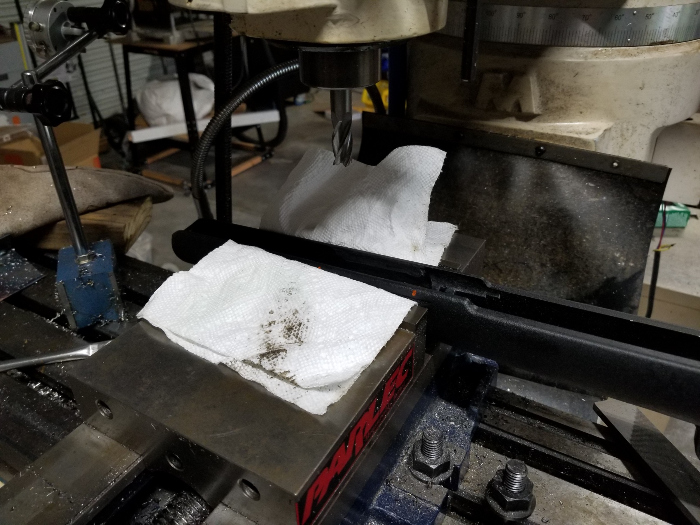
I would say I took about 40 thousandths off the inside of the stock on each side. Now I can run a piece of paper all the way up to the knob or lug or whatever that hangs off the barrel.
Does it matter? Will it make the gun more accurate? I don’t know. It can’t make it LESS accurate, so I figured I should try it.
I could just drop $150 on an aftermarket stock, but why? It looks like there is no reason to do it. The current stock is light, comfortable, and functional, and it’s impervious to water. I feel like I should take it as far as it will go.
Maybe the sun will come out tomorrow. I look forward to seeing what the trigger work, stock reduction, and recent practice will do for me.
August 31st, 2020 at 6:49 PM
I had an excellent morning at the range. I sighted in the last of my new scopes( 2.5-10×44 Bushnell Nitro) on a 20″ ar-15.. I hung a 12×18 splatterburst target at 100. First shot 5 moa low, 1 moa left. Second shot, half moa high, half moa right. Don’t think I’ve ever been that close on the second shot. I took 2 308’s that had been shot once with new scopes. I finished zeroing at 100, then I shot 200 from the hash marks and then dialed them up to 300. I was a couple of inches high at 300 with the SWFA but pretty much right on with my other Bushnell. Not only that, it was 68 and overcast with 18% humidity. I thought I was in heaven. Of course now I have 75 308’s and 60 223’s to reload, but I like that too.
September 1st, 2020 at 3:57 PM
The most common gunsmithing standard for setting up a free-floating barrel, is to glass-bed the receiver *and* chamber section of the barrel, transiting to the free-floated aspect at a point roughly concurrent with the onset of rifling forward of the chamber.
That recoil lug area would be best as a fully-bedded section, to at least 1″ forward of the lug, at minimum.
Now, don’t get me wrong. If, after your relieving the stock all the way back to the lug recess, it shoots like a dream, I’ll stand corrected. Serve me up a nice heaping helping of humble pie, and I’ll dig in with aplomb.
But if the results aren’t to your liking, order an Acra-Glass (or equivalent) kit from Brownell’s. J.B. Weld can work just as well, but it doesn’t come with a neat kit and clear instructions.
Hmm.. yeah, I forgot. You Tube *is* the instruction manual nowdays. No doubt you can find a spot-on tutorial on the bedding process, with moving pictures and sound. Whodathunkit?
/break
A complete change of subject. The pizza recipe in your cookbook is a bit obsolete, I understand?
Last year, we put all new appliances into the kitchen. Now I’ve got an oven that’ll go up to, and hold 550 on the max end.
Would you mind terribly, emailing* me a “current version” of your latest development in that recipe, please? For the crust, primarily, but if you have a recommended sauce, I’ll track that down, too. *(or, just re-update it as a new blog post?)
And I’m seriously looking at building a proper outdoor kitchen on a new deck, out back. It’ll include a wood/coal fired oven, but I’ve yet to decide on which design would give the best all around results. Lots to choose from!
Thanks in advance, sir!
Jim
Sunk New Dawn
Galveston, TX
September 1st, 2020 at 4:53 PM
Jim, as always, thanks for the help.
I watched a guy do a JB Weld bedding on Youtube this week. He put goop under the rear of the action as well as the front. I don’t know if that’s even possible with this gun. I would have to look.
I’m still trying to figure out how to get the scope leveled up with the bore. I don’t think it makes any difference with a 300-yard gun, based on the 20″ drop, but I think doing things right with this gun will prepare me for doing things right with guns that shoot farther.
I keep thinking about the geometry involved, and I can tell some of the things I’ve seen in my efforts at research don’t make a lot of sense. Common sense says you have to have the vertical line in the reticle exactly parallel to an imaginary line between the scope’s axis and the bore’s axis, and the methods I’ve seen generally don’t do that. Then afterward, it seems it would be necessary to have a level on the gun while shooting, because otherwise, you could still end up with a pretty serious deviation at long distances.
As for pizza, the Sicilian recipe is great, but you will have a hard time reproducing it if you don’t have access to Costco and Gordon Food Supply. If not, you will have to make a lot of pizza with different ingredients to find things that work.
My thin pizza recipe is okay, but you might do better by visiting pizzamaking.com and joining the forum.
September 2nd, 2020 at 10:29 AM
They’ve finally got a Costco here on my side of town, so that’s covered. And Gordon’s took over the Glazer Food Service here, so, ditto.
I’ll try your recipe first, and then if necessary, I’ll try a forum.
As for the scope leveling, both Nightforce and Vortex sell bubble-levels that clamp directly onto the scope-tube, and are visible either directly atop the tube or slightly off to one side or another.
They also sell inclinometers, which will tell you how many degrees “up-slope or down-slope” your rifle might be pointing. Important to put into the ballistic computer (electronic or mental), should you find yourself hunting in mountainous terrain. Not so much a FL factor, as a possible Tennessee data point.
As for truing the reticle to vertical, why not give my previously described method a try on your .17 HMR? It’s not as “important” as the 6.5 Creedomore, but it’ll be a good test-of-concept for you, there.
I’ll give a pizza review after I’ve test-driven the thing a time or three. Thanks!
Jim
Sunk New Dawn
Galveston, TX