At Home on the Range
July 5th, 2020The Party is Over; Back to Hermiting
My weekend guests are gone, and I can breathe again.
I was scheduled to have two families show up. A third jumped in, and one of the original families bailed, thinking the increased population density jacked the coronavirus risk up too much. Then the third family bailed because of coronavirus. Then the second family decided to come after all.
Complicated.
I thought there would be 16 people here, so I bought 6 pounds of hamburger, a pack of hot dogs, a couple of smoked sausages, two boxes of Fat Boy ice cream sandwiches, and brownie ingredients. The actual load was 8 people, so let’s just say I have a lot of leftovers. I sent about half of the brownies home with some friends from Pompano, and I think I still have 6 left. I have 3 pounds of ground chuck that absolutely have to be turned into patties and frozen today.
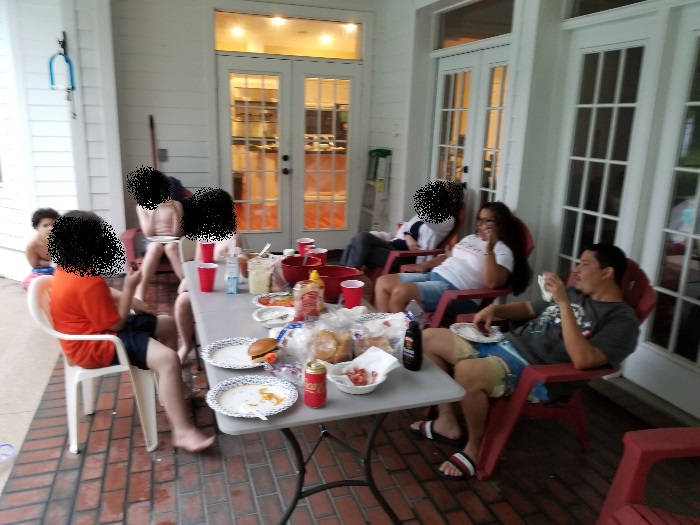
We had a great time. The kids managed to swim a certain amount, between thunder peals. The adults sat in the shade and criticized. There were fireworks. I got one kid to eat his first chili dog.
Last night, three of us had a wonderful prayer session. We prayed in tongues for nearly half an hour first. If I were married, I would be doing this every day. With another person, I mean.
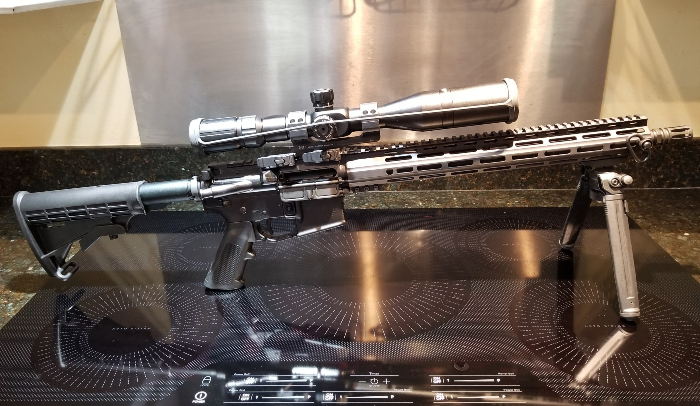
Today I’ve been working on firearms. I can finally say that for once in my life, I’ve set a gun up correctly. Nearly. My AR-15 has a LaRue trigger, a Magpul bipod, a pretty decent quick detach scope mount, and a Primary Arms mildot scope with an illuminated reticle and a sun shade.
Why do I say it’s nearly set up? I have not lapped the scope rings. This is an interesting topic.
Okay. It’s interesting to ME.
Rifle scopes are held in place by rings that are tightened onto scope tubes with screws. This sounds simple, but of course, it is not.
Most people will buy a scope, put the rings on the rifle, put the scope in the rings, get it more or less level, get the eye relief more or less right, and tighten the rings. I’ve done this a number of times. It turns out it’s not the right way to do it.
First, scope rings tend to be machined pretty badly on the insides. They can have all sorts of high spots and low spots, so when you tighten them on tubes, they may not have much area touching the optics. This leads to gouging, and it also makes for a scope that can come loose under heavy recoil. Also, the rings may not be aligned perfectly, even if they’re machined out of a single base. This makes the contact problem worse. I suppose it can also put a bending torque on a tube.
For anything more precise than a $75 scope on a .22 rifle, you need to check your rings to make sure they’re aligned, and you need to see if the insides should be lapped. Lapping means grinding irregularities off with an abrasive compound. You can lap a scope yourself. You get a kit with a bar the size of a scope tube, you put abrasive on the bar, you mount it as though it were a scope, and you work it until the abrasive cleans up the rings. A kit for one size tube runs around $45, and you can get a kit for 30mm and 1″ tubes for $65. I was going to make my own bar, but when you add it all up, it’s not worth the trouble. If you think about it, the most you could save if your homemade tube were free is $65. You would have to pay maybe $20 for steel. Then you would have to machine it. Then you would have to pay almost $20 for lapping compound. It’s a waste of time.
Second, your scope’s rings need to be tightened carefully Too tight, and you can dent your tube and even screw up mechanical stuff inside it. Too loose, and well…too loose. You need a tiny torque wrench to do it right.
I’ve written about this before, but I’ll repeat it anyway because I can make it easier to understand. In fact, I may repeat a lot of things in this post.
Gunsmithing companies make torque screwdrivers, and they’re cheap. Problem: they fall apart. A real torque screwdriver is a $400 tool. Solution: use a real torque wrench instead of a screwdriver. You can buy a 1/4″-drive inch-pound torque wrench for $40 or so. I bought one, and I spent another $3 on a 1/4″-drive 1/4″ socket with a magnet in it. You put whatever 1/4″ hex-drive bit you want in the socket, and you have a gunsmithing torque wrench that will work forever. And there are no batteries.
I got high-end rings for my Viper scope, which I plan to attach to my Ruger Precision Rifle when it arrives. For my AR-15, which is a less snobby weapon, I got a $280 14x scope, not a fancy Vortex. I bought a quick-detach cantilever mount for it. This is a one-piece mount that has two rings cut into it. Presumably, they should line up pretty well, because they were cut by the same tool in one operation.
“Cantilever” means the forward ring is out on a sort of stalk, hanging over the gun’s handguard. Why not just put a ring on the handguard, which has a picatinny rail? This is what the people who sold me the gun did with the first scope I put on it.
Here is what I’m told: the rail on top of an AR-15 has two sections. One is on the upper receiver, and the other is on the handguard. Between the two sections of rail, there is a joint. The handguard hangs out in space, attached to this joint at only one point. If the handguard bends at all, the forward ring moves in relation to the rear ring. Does this actually matter? I don’t know, but a cantilever lets you connect both rings to the part of the rail which is on top of the upper receiver. No joint.
The people who sold me the gun didn’t tell me any of this, and I know why. It doesn’t matter when you’re a doofus who wants to get lit up on cheap beer and shoot golf balls in the national forest. It doesn’t matter when you’re shooting hogs from 50 yards or when you’re shooting junk ammo at the range. It only matters when you know what you’re doing and you’re shooting accurately from long distances. I would guess that 99% of the seller’s customers just want to fool around. For all he knew, I was part of the 99%.
In truth, at the time, I was part of the 99%, and I pretty much told him that. I said I didn’t know anything about the AR-15, and I needed to buy one–even the wrong one–just to have a place to start. What he gave me was completely appropriate at the time, but things changed very quickly.
I have no idea what to do with the scope he sold me. It’s useless for target shooting. I guess you could shoot deer with it.
When I attached the new scope, I didn’t know whether I should lap the rings on the cantilever mount. I didn’t have enough steel to make a bar to use to measure the contact areas inside the rings. I tried making something quick and dirty from wood, but it didn’t work. I decided to mount the scope, order a lapping kit, and worry about it later. After all, it’s just an AR-15 with a factory barrel. I’m not going to use it to shoot Osama bin Laden’s cousins from 2000 meters.
Did I buy a fancy tool to level the scope on the rifle? Uh…no. I’ve been reading a book by a prominent shooter named Ryan Cleckner, and he pointed something out. You can level a scope on a picatinny rail by jamming a flat piece of metal between the scope and rail and making sure it touches both. This will get me within a fraction of a degree. If it’s good enough for him, it’s good enough for me and my non-precision gas gun.
I may want a different bipod eventually, but then again, I may not. I may want a high-end barrel eventually, but then again, I may not. I don’t have any problems with the no-name adjustable buttstock, which seems to give a great cheek weld at just the right height. The handguard is very nice. The rifle is ready to go, as it is right now.
I now have most of my precision rifle setup. The gun is not here, but I have the scope, some ammo, and a nice rifle bag. The rings should be here before the gun, along with the shooting mat. I still need a backpack. When I was taking my shooting class, I was surrounded by guys with suitable backpacks, and it did’t occur to me to ask for a recommendation. I don’t know what to do. I’m not sure how much volume I need. I guess I should go look at backpacks at Bass Pro, check the volume figures, and figure out how much more or less I need.
Long-range shooting can involve a lot of stairs, so the rolling Stanley toolbox I tried to use during the class is a nonstarter. It has to be a backpack.
I’ve learned some great things about 6.5 Creedmoor ammo. The best thing: you can use extremely cheap ammo up to at least 656 yards. How do I know this? There is a guy on Youtube shooting a small gong at 656 yards, over and over, using Sellier & Bellot FMJ. It’s less than 50% more expensive than Fiocchi .223. It’s a wonder to behold.
Most good shooters can’t shoot 1 MOA at 100 yards 95% of the time. Give them 100 rounds, and excluding flyers, they’ll shoot a mess covering 3 MOA. At 656 yards, 1 MOA is something like 7″, and shooting 1 MOA gets harder with distance because of wind and other problems. The guy shooting the cheap ammo was doing 0.6 MOA over a third of a mile away. For practice fodder, that’s unreal. It means he can shoot people in the head economically at a distance of 5 blocks. If he wanted to shoot coyotes, he wouldn’t even have to leave his house. He could just open an upstairs window and scan his area with a telescope.
I kid. He may live in a crowded suburb.
This ammo may not be as accurate as Hornady at 1000 yards, but I won’t always be shooting at that distance. It would be very useful most of the time.
I got some Hornady match ammo, but I also bought a little Sellier & Bellot. With the Kestrel ballistic calculator I bought, it should be no problem shooting Sellier & Bellot up close and then switching to Hornady once I get farther out. I’m limited to 900 yards in this area. Maybe S&B will work fine for everything I’ll be dealing with.
In retrospect, maybe it was an error to get match ammo. Hornady makes a hunting round which is nearly as accurate, and it would be useful if I ever actually got out of the house and located a coyote.
I’m not really sure what my LR-308 is good for. I can pop anything smaller than a deer with the AR-15, and there is no reason why I can’t use the RPR to shoot bigger animals. It’s heavy, but it will work.
I’m still thinking about a second AR-15 in 6mm ARC. If this new cartridge turns out to have legs, I may want to try it. It would be easier to carry while hunting, and it would be better than .223 for just about everything.
I used to think people who hunted with AR-type guns were just trying to make a point. Maybe they were, back then. Anyhow, these days, I can see why a person would use one. They’re handy, they have lots of aftermarket support, the .223 cartridge is great for all sorts of game, and you can take it home and use it to defend your house, unless you want something more reliable.
Maybe I’ll get out and pop off a few rounds today. It will be nice to see a plan come together.
July 5th, 2020 at 4:59 PM
Your LR 308 would be great for training at 200 yds on your property. After shooting 308 with a mil spec trigger your Creedmoor would feel silky smooth.
July 5th, 2020 at 5:08 PM
I think you might enjoy the moron gun thread over at Ace of Spades place. Sunday night at 7.
July 5th, 2020 at 5:31 PM
Sadly, the LR-308 has a LaRue trigger.