Filling Out the 1911 Harem
June 5th, 2020Hope the Girls Get Along
Today I picked up my new 1911. I started my NICS check yesterday between 2 and 3 p.m., and I didn’t receive notice that it was finished until 10 a.m. today.
I can’t help wondering if the FBI is slow-walking checks for people who buy multiple guns in one month. It would serve as a nifty, sleazy way to create an illegal waiting period for people like me who have permits and are used to taking their guns home on the same day they buy them.
I guess some type of incompetence is at the root of the problem. It can’t be anything special about me. I cleared a background check fast on Monday, and if I were having problems because of some red flag or other, it should have come up both times.
Aren’t they supposed to destroy all records of background checks as soon as they’re performed? I’m sure the FBI would never lie.
The gun is very nice. It’s a Smith & Wesson Performance Center PC1911 with weird weight-reducing holes machined into the slide. It has G10 grips so grippy you could use them to file your way out of jail. The bead-blasted finish is gorgeous, and the blue and black coloring in the grips borders on pimpdom.
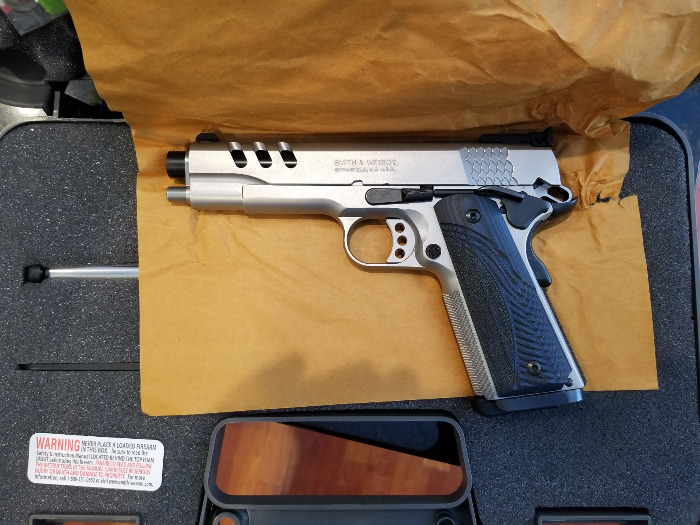
It also has target sights.
I decided to clean it before shooting. People keep telling me I should do this because manufacturers leave crud in new guns. The AR15 I bought on Monday came straight from the manufacturer. They make them in the building where I bought it. The guy who sold it to me said I should clean it.
The PC1911 has what is known as a hard-fit barrel, which means a gunsmith removed metal from the barrel until it fit the gun very tightly. It also has a tight barrel bushing. This is a round part that comes between the barrel and slide. It has an incredibly strong recoil spring. It’s much stiffer than the one in my SW1911.
Taking the gun apart was not terribly hard, but it took some effort because the parts were so close together.
I greased the gun pretty heavily with Mobil 28 precision bearing grease, which, of course, I already had, along with special syringes for shooting it into small cavities. I used to believe the people who said to oil guns sparingly, but I now think they’re ignorant, so this time, I didn’t hold back. Then when I tried to put the gun back together, I had problems. The recoil spring retainer, bushing, slide, spring, and guide rod did not want to work together. I got the gun to a point where everything was back together, but there was no way to rotate the bushing into position so I could shoot.
I wrestled with it for what must have been nearly an hour. I took the SW1911 apart so I would have similar parts to look at for reference purposes. Finally, I got a clue on the web. Ordinarily, you disassemble a 1911 by loosening the barrel bushing first and removing the spring retainer and spring. Some old guy on a forum said the best way to disassemble a 1911 was to remove the slide stop first. It removes tension from the spring. If it works when disassembling, it ought to work for assembling. I removed the slide stop, and the gun finally came apart. After that I was able to put it together correctly.
Some modern 1911’s have features the old World War Two jobs didn’t. Some of the features make them more accurate, but they can make them harder to strip and reassemble. A fighting soldier could die if he took too long to put a pistol together. There is no way the Army would let you have a pistol that fought you for 45 minutes. I see why the old-style parts were made the way they were.
Once I got the new gun together, I took my other 1911’s apart, cleaned them, greased them, and put them back together. I’m anxious to see if the heavy grease is helpful. I don’t know why I ever listened to people who said LESS lube was better. It makes no sense. Grease attracts grit, but so does oil, and a guy on the web pointed something interesting out: grease forms a barrier to keep grease out. Also, grease doesn’t fly off in all directions when you shoot, and it doesn’t drip onto your clothes.
The new gun is heavier than my SW1911 even though it has holes in it to lighten the slide. I wonder where the extra metal is.
I tried using the new assembly and dissassembly method on my Colt .38 Super, but it didn’t work. I learned something about guide rods. John Moses Browning originally put short rods in 1911’s, but many manufacturers later went to full-length guide rods. The Colt has a short rod. The Smiths have long ones. The spring in the Colt can bend and cause problems if you try to install the slide with the barrel and spring already attached. The rod is too short to keep the spring straight.
So now I have to strip the Colt one way and the other guns another way.
Supposedly, the short guide rod does not adversely affect accuracy or anything else. I saw a guy online making a very good case for the superiority of short rods. It’s much easier to assemble a gun with a short rod.
When I saw the difference between the Colt and the Smiths, my first instinct was to get a long rod for the Colt, but now I’m wondering if I should get short rods for the Smiths.
I have to get this thing to the berm tomorrow. I’m going to shoot it beside the older gun and see if either gun shoots better for me.
A lot of bullets, powder, primers, and brass have arrived, so I have to get started on that stuff soon.
It’s all coming together. The berm and I have a hot date.
June 6th, 2020 at 4:29 PM
“The new gun is heavier than my SW1911 even though it has holes in it to lighten the slide. I wonder where the extra metal is.”
Maybe the S&W has a lot of MIM and MIM is lighter, and the new one doesn’t? I did a quick search but couldn’t find anything about it, but S&W 1911s do seem to have a lot of MIM.