Express Your Shelf
February 27th, 2020Finger Brake Goes into Action
Today I used my finger brake on a large project for the first time.
If memory serves, I bought the brake last year. It’s from SWAG Offroad, a company that sells innovative, inexpensive metalworking tools. They send you a kit, and you weld it together yourself. Then you put it on a Harbor Freight 20 ton press. If you’re smart, you also install an air jack on the press so you can use a compressor to drive it.
Last year, I built a stand for my arbor press. I’m still not finished building it. The press is on the stand, and it works fine, but the stand doesn’t have a catch bin for broaches (which fall through the base of the press when you use them) and it doesn’t have a storage shelf. Today I used the finger brake to build a shelf.
I wanted a 1/8″-thick shelf with upturned lips at the sides and back. The stand has 4 31″ pillars, and the idea was to put the shelf among them about halfway up. The shelf had to be recessed several inches to avoid obstructing workpieces that protrude beneath the press.
Most hobbyists have no way of making a thick metal shelf with a lip, and even if they can pull that off, making a shelf with lips on more than one side is much harder. You have to have a brake to make the lips, and it has to be a finger brake in order to make more than one lip in close proximity. A brake that can only make 24″-long lips, to give an example, is useless if you need to make a 24″ lip on one side of a piece and 8″-long lips on the sides perpendicular to it. A finger brake lets you adjust the length of the bending fingers so you can make bends in different lengths, and by removing fingers, you can also adjust the brake so it doesn’t mash existing bends when you make new ones. You just remove fingers until your existing bends have clearance.
You can buy small finger brakes from Shop Fox and so on, but they only work on thin metal. If you’re happy making things from 18-gauge steel, which is very flimsy, and you don’t mind paying over $600 for this limited capability, a stand-alone brake is fine, but SWAG Offroad’s brake will let you bend 1/8″ steel 19″ long, and it only costs $400. It will let you bend 3/8″ steel in shorter lengths, which a small stand-alone brake won’t do at all. You can use it to make heavy brackets and vehicle suspension parts.
Today I made a 15″ by 12″ shelf, and I got it ready for the brake. I was nervous about trying it, because once you screw up a bend like this, you’re committed. You can’t fix it easily. It would require an anvil and an acetylene or oxy-propane torch. I would have had to scrap the shelf had it not worked.
I shoved the shelf into the brake, aligned it as well as I could, and went for it. The result was a little out of spec, but I was able to grind it and make it work.
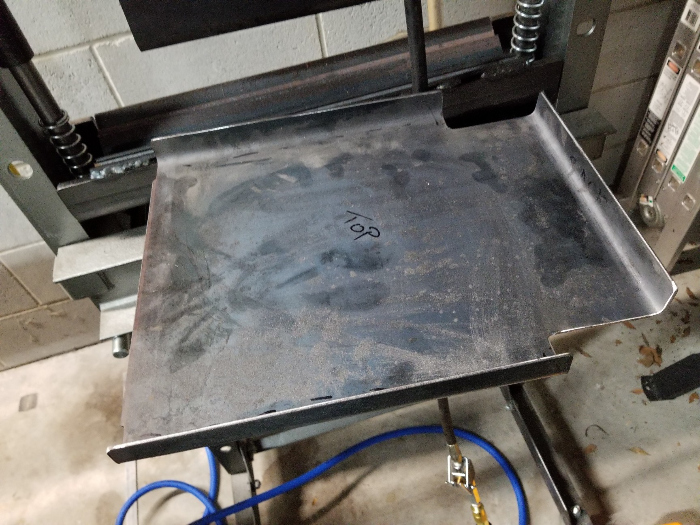
I learned a few things.
1. Finger brakes stretch metal a lot. If you have a 14″-wide piece of metal, and you put lips exactly 1″ high on two opposing sides, the resulting workpiece will be wider than 12″. How do you figure out how to measure and position things to get accurate results? I don’t know. I suppose you have to bend a bunch of practice pieces and take notes.
2. You can align things very well by holding them with one hand, lowering the dies to the metal, and watching the rear of the brake. You can use a hammer to bop things into alignment before the fingers tighten up to the point where you can’t move the workpiece.
3. If you want sharp bends, you need to make or buy bottom dies. The kit comes with a bottom die which is made from heavy angle iron, and it doesn’t produce sharp bends. I might be able to get better bends by using my milling machine to put sharp corners inside pieces of angle iron. I can set them on top of the kit’s die.
The finger brake is a phenomenal tool. It opens up possibilities you could never achieve with welders and machine tools alone.
I’m hoping to weld the shelf into the stand tomorrow. I may massage it some more to compensate for the errors and make it look better. After I get it done, I’ll finish the catch bin, and then the stand will be ready for paint. Then I can get started for the mobile base for my dry saw.
The finger brake takes skill and practice to operate, and it has limitations, but overall, it’s a transcendent shop tool. It will let you do things almost no hobbyist could do 10 years ago.