Ace of Base
February 22nd, 2020I Feel so Competent
Today is a day of triumph. I completed a mobile base for my cutter grinder, and I mounted the grinder on it without killing myself. Although I came close.
My grinder is a Gorton 375-4. Wild guess based on what I’ve read: it’s about 50 years old. They say you can do just about anything with it, including making a fluted drill bit or end mill from scratch. I don’t know if that’s true, but it’s supposed to be capable of many things, including sharpening the ends and sides of end mills.
When I started learning about these machines, I read various figures for their weight. Some people said they weighed 550 pounds. A guy on a forum claimed the real figure was below 300. He said he unloaded one from his vehicle by himself. The freight bill for my grinder listed a weight of 490, including a very heavy pallet.
When I began thinking about a mobile base, I thought, “One guy lifted a machine like this out of his truck and onto the ground. He has to be right about the weight.” Based on that misconception, I designed a very simple X-shaped base with casters. The base adds something like 5 inches to the height of the grinder.
The X design is extremely appealing for a number of reasons. First, it’s the cheapest, simplest, lightest way to create a base which is wider than a machine and can be installed using bolt holes at the machine’s corners. Second, it only requires 8 tubing welds, 4 of them short. Third, because of the small number of welds, it won’t have a lot of warpage issues to fix.
Tubing is smart because, unlike ever-popular angle iron, it’s extremely rigid. I made a base from heavy angle iron once, and it jiggled like Jell-O.
I decided to put 4 holes in the base for bolts. These would go through existing holes in the grinder’s stand. I chose to weld nuts to the underside of the base to receive the bolts. This made it unnecessary to struggle with loose bolts while trying to attach a dangling grinder to the base. It lowers the risk of death by crushing somewhat.
I chose to weld the casters to the tubing instead of bolting them in place. Welding is fast. Locating and drilling holes is very, very slow. Bolts also have heads which stick up in the way. I got the welding idea from Jimmy Diresta, a Youtube whiz. Sure, I marred up my new casters. So what? They cost something like $22 for a set, and anyway, no one will see the welds under the base.
It took me about 10 minutes to install the casters. It was wonderful. Bolts would have taken maybe 90 minutes.
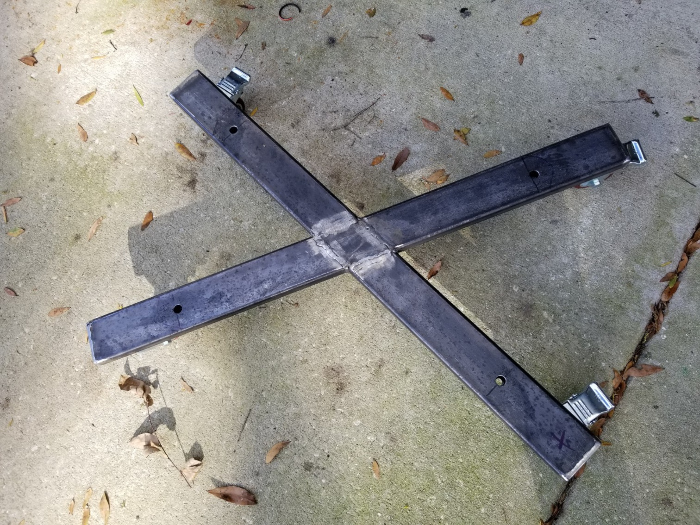
Building an X-shaped rectangular base is much, much harder than building a square one. When I started out, I thought the grinder’s stand was square. When I measured it, I found that the bolt holes were on 20.5″ by 13″ centers. This drove me into the realm of trigonometry. For a former physicist, the math was simple, but doing the measurements was not. I had to make an angle jig on the band saw. I could not cut straight across the tubes to make recesses so they would fit together, so this limited my use of the milling machine and band saw. I had to use an angle grinder. Locating the holes was impossible using measuring tools. I had to lower the grinder onto the base, mark the base with a Sharpie, lift the machine off, and cut the holes.
Lifting the grinder was interesting. First of all, it does not weigh 250 pounds. The guy who believed that must have been posting from a mental hospital. I lifted it with my tractor, using a strap, and I can tell you it weighs a lot. I think the shipper’s number is correct. I think he actually weighed it. Subtracting about a hundred pounds for the packing and pallet, the grinder probably comes in at a little under 400 pounds.
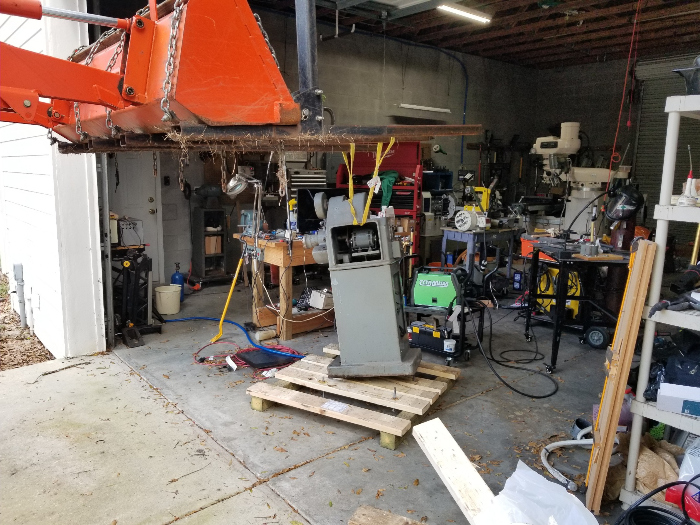
The weight is concentrated on the right side, toward the front. This is bad, because it makes the grinder easy to pull over…on the operator. It also means that when you lift the grinder, it tilts sideways. When you put it down, it tries to lie on its face. You have to put one corner down and then swing the tractor to rock the grinder back on its feet.
I did not enjoy working on the grinder while it was in the air. My strap will hold 1200 pounds (working weight), but I don’t care. I was nervous with all that weight swinging around. Working around a lifted unsupported load is a good substitute for stool softener. It’s nerve-wracking. Besides, even if the strap holds, the tractor can always blow a hydraulic line, dropping the grinder in a hurry.
When I got the grinder onto the base, I found that my bolts weren’t long enough. I only had two bolts in the shop that were the correct length, so I put them in diagonal corners. When I lowered the grinder, it rolled around very well. The base is extremely strong, too. It doesn’t sway one bit. As for safety…I am not satisfied. You could not push this grinder over from a standing start, but a determined idiot could get it rolling, hit an obstruction at speed, and put it on the floor.
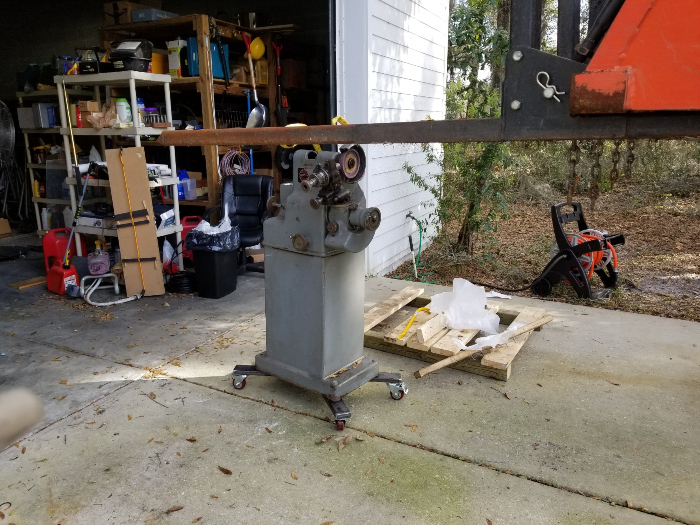
If the grinder weighed 250 pounds, I would not be concerned. It would be less top-heavy and easier to control. At 400 pounds, it’s harder to deal with.
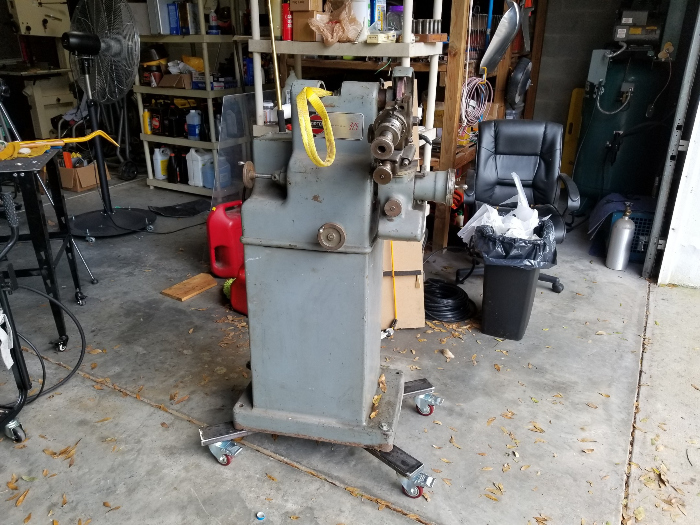
I’m thinking I may redo the base. When I first started considering this, I thought I would have to start from scratch. Then an idea came to me. I can get two long pieces of tubing and run them across the short ends of the base, on top of the existing tubing. The long pieces can extend past the existing tubing. I can remove the casters from the old tubes and put them on the new ones. This will give me a much wider base, and it will also lower the grinder by an inch. If I want to, I can put tubing spacers between the old tubes and new tubes, lowering the grinder even more.
This mod would be very simple. I could do it in one day. I may go for it. The alternative is to make a really big rectangular base with room for a toolbox beside the grinder. Rectangles are less elegant and more work, though.
The base isn’t painted. It is impossible for one person to install it without destroying paint. Maybe truck bed coating will work. Also, I don’t want to paint it until I’m satisfied with it.
Even though I may make changes, I’m very happy with this project. It’s very good, and it only took three days. I’m getting much better at making things. In the past, I used to hear about people making things like welding carts, and I thought it wasn’t worth it to try, because I would do such a bad job. This week, I was thinking about buying a second Vulcan cart from Harbor Freight, and without thinking about the difficulty, I thought, “Why should I do that when I can make a better one in a couple of days?”
That’s nice.
Now that the grinder is mobile and therefore out of the way, I can move on to my next mobilization project: the dry saw. I’m always leaving it on my lift cart. That’s no good. It has to have its own cart. I already have the casters.
I have no idea how to run the grinder. I fixed the bearings, so I guess it’s time to start learning to grind things.