Reel Progress
February 18th, 20201″ Flat Bar is the Duct Tape of Hot-Rolled Steel
Things are going very well in the workshop.
I’ve been working on my compressed air system. I got the tubing and drops set up, and then I started working on details. Earlier this week, I sat down and made a list of things I needed, and I got on the web to see where I could find them. Some things were available at Home Depot. Some were available at Lowe’s. Some were available at Northern Tool. No store had everything.
I started putting things in online shopping carts in order to keep track of them, figuring I would then use the shopping carts to make a list so I could get in the car and buy these things locally. After a very long time, I got frustrated with the effort, so I looked at Amazon. They had everything I needed, much cheaper.
What was I supposed to do?
It’s a bummer to see the Internet eating local businesses (even chains like Sears and KMart), but what can you do? It’s the future. You don’t want to be like an old 1930’s coot who refused to have a phone installed in his house. You don’t want to be like Snap-On’s remarkable CEO, who just told investors Snap-On isn’t interested in the Internet. The way we shop has changed permanently. As long as they don’t make me take the mark of the Beast, I’m not going to fight it.
I placed an order a day or two ago, and today everything arrived.
My system has three drops and an air hose reel. Actually, one of the drops is connected to another reel, so I guess I have three drops and two reels. I have an air-powered finger press brake and an air-powered planishing hammer. I wanted to hook them up to one drop, while providing a third coupler for one of those little coily air gun hoses.
I found an interesting product. It’s a manifold, but they call it a splitter. One one end, it has a male industrial air plug. On the other, it has three female universal quick couplings. They cost $20 at Lowe’s, but Amazon sells the same thing, probably from the same factory (as people often say concerning Chinese goods), for $11. I had a female coupler sticking out of the drop by the finger brake. I replaced it with a 3-foot snubber hose and put the splitter at the end of it. I then put a 6-foot snubber (Amazon) in the splitter and hooked it up to the finger brake.
I didn’t want to plug the splitter, which is a rigid part, into the female coupler that was sticking out of the drop. That would have given me about 8″ of poorly supported metal sticking straight out of the wall. The short snubber hose gave me a flexible connection and also added more length to the splitter.
I also got a drain extension for the compressor. When you use a compressor, water condenses inside it. At the end of every day, or more often, you have to open a valve at the bottom of the compressor tank to let the water out. This reduces rust. The valve on a new compressor is about 7″ off the ground, under the tank. It’s no fun to reach down there to open it. I put a 12″ steel hose on my compressor today. I still have to bend over to open the valve at the end of it, but I don’t have to get on my hands and knees. Very nice. Some people use electric valves that open automatically from time to time. I don’t think I need one.
My final achievement was the stabilization of my biggest air hose reel. Far as I know, all reels are Chinese, and none are sturdy. Mine has a set of rollers the hose passes through, and the rollers are supported by one thin sheet metal arm. It flexes when I pull on the hose. Annoying and not good for the reel.
Today, after I got my press brake hooked up to the air supply, I made a brace for the reel and attached it to the wall. I used the brake to bend two tabs into the ends of a 1″ by 1/8″ steel bar about 30″ long. I drilled holes in the tabs. I attached one tab to the reel and the other to the wall. Now the arm holding the rollers doesn’t flex. The little piece of metal that actually holds the rollers moves a little. Maybe I’ll fix that, too.
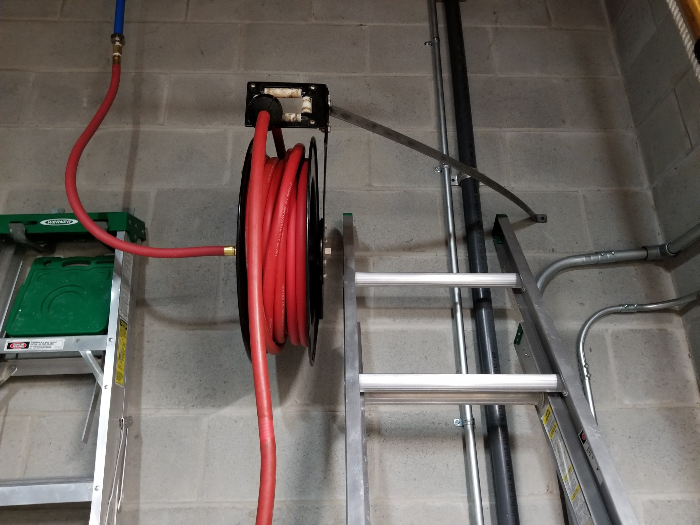
As you can see in the photo, I didn’t do a good job of estimating the angles needed for the tabs at the ends of the brace. As a result, the brace is flexed. I think this makes it stiffer, however, so it’s not a flaw. It’s a feature. Isn’t that what Microsoft always says? I saw it coming and did not do anything about it. I hoped the stress in the brace would do what it’s doing. Point for me.
Like bags of sold-by-the-pound fasteners from Tractor Supply, Tapcon screws, and a Harbor Freight drill index, flat steel bar is one of the greatest things you can keep in your shop. I buy it when I buy metal whether I have a plan for it or not. I know I’ll end up using it for something. Today when I was buying metal, I asked for 60″. The guy cutting the metal cut me 36″ by mistake. He thought he would have to put it in with the drops and start over. I told them to go ahead and cut me another 24″ and not worry about it. I didn’t pick 60″ because I needed that length. I picked it because that was the longest piece I could conveniently put in the car.
The air-powered press is a godsend. Without air, you have to pump a lever about a hundred times in order to shape anything. With air, you press a trigger and wait 10 seconds. Very nice.
It’s hard to think of anything I need to add to the air system, with the possible exception of a larger compressor. Well, that’s not true. I still don’t have a little coily air gun hose. But Amazon sells them, and of course, they’re cheaper than Lowe’s. And they come with a plug on one end and a coupler on the other.
Regarding the planishing hammer, I bought it for one reason: it was on sale. Harbor Freight slashed it to $89, and at that price, it didn’t matter whether I had a use for it. I knew the next time I saw the same model, it would be over $200, and I knew I wanted to learn how to use a planishing hammer. Done deal.
A planishing hammer stretches metal. You can turn a flat disk into a metal dome, for example. If you really want to, you can turn a flat piece of metal into a motorcycle fender, but it would be very slow. Mainly, planishing hammers are used to smooth out metal workpieces you’ve created with other tools.
Obviously, I need those tools.
I don’t see myself springing for an English wheel any time soon, but there is a cheap alternative. You can shape metal with a hammer and a bag full of sand. I might go for that. It would be fun to be able to make things from sheet metal. Look around you and see how many sheet metal items your house contains. If you can do sheet metal work, you can make custom lampshades, belt guards, chain covers, and lots of other common items which are otherwise unobtainable.
I now have steel for a tool grinder mobile base, and I also have steel to complete my arbor press stand. I’m going to add a storage shelf, which I plan to trick out with 1″ vertical flanges at the sides and rear to keep stuff from sliding off. I’m hoping I can bend them correctly on the press. This shows what a nice tool the SWAG Offroad press is; with a typical press, it would be impossible to bend a 14″ length of 1/8″ steel to a nice sharp right angle, but the SWAG press will do it if you can summon the skill.
My other addition to the press will be a removable catch bin. It will sit under the forks of the press, and it will catch broaches that fall through. I bought a 5″ length of 4″ square tubing. I’m going to weld a bottom in it, and it will be the bin. Then I’ll weld some bar to it and put some hooks on the stand to hold onto the bar. Think of those old bars they used to use on village gates in old movies. It will work. It’s been done.
The grinder base will be an interesting job. I’ve decided to use 1″ by 3″ tubing. I’m going to arrange it in an X pattern under the grinder. The ends of the X will extend past the bottom of the grinder, and I’ll weld casters to the bottoms. I got the welding idea from Jimmy Diresta, a Youtube whiz who welded casters onto a band saw base. If I weld, I won’t have to spend an hour and a half measuring and drilling so I can use bolts, and I won’t have to spend half an hour installing the bolts.
The big problem with welding is that I won’t be able to paint under the caster plates. Or maybe I will, but welding will not be kind to the paint. Maybe I can touch it up later. It’s not like people will be coming to my shop to look under the base, so I don’t think it matters.
In order to make a flat X, I have to cut material out of both tubes so they can interlock. To do that, I’ll have to know exactly where to cut, and I’ll have to get the angles right. The base is not square, so I can’t just use 90° angles. I had to do a little trig. It appears that I need 65° angles. It may be tricky to get it right.
The grinder has holes for bolts. I plan to run bolts through the holes, through the tubing, and into nuts I’ve welded onto the underside of the base. This will make it unnecessary to hang onto the nuts while I install the bolts. It should be pretty sweet.
I made a mistake when I bought the casters. I thought I was buying a set with 4 swiveling wheels. If you put non-swiveling wheels on an X-shaped base, parallel to the tubing, the base won’t move. The wheels arrived, and it turned out I had two that didn’t swivel. I ordered new ones. I thought about sending the ones I have back, but then I thought some more. I’m always putting wheels on things. It will be nice to have a set of casters on hand before I start another project.
My final buy for today was a roll of clear plastic shelf paper from Lowe’s. It was very cheap. I got 20″ by 30′ for $13. I couldn’t beat that anywhere. It’s for the trays in my Harbor Freight tool cart. When I bought the cart, I thought I would be clever and protect the trays. I applied heavy coats of Flex Seal to the insides of the trays. Then I found out Flex Seal will dissolve in almost anything. If you put rubber or plastic parts on a surface painted with Flex Seal, there is a good chance the solvents in the other materials will melt the Flex Seal, gluing your parts to it. While Flex Seal melts easily, the only thing I’ve found that removes it fairly well is turpentine. My plan is to remove as much of the Flex Seal as I can stand to and then install the clear plastic shelf liner. This should protect the trays fairly well, and because it’s clear (not the universal black generally used for tool drawer liners) it will also give good visibility instead of seeming to swallow small parts.
A number of plastic drawer liner materials don’t get along with rubber and plastic. It’s a real issue.
The cart’s main weakness is the fact that the wheels are too close together, which makes it a tipping risk. Harbor Freight had to reinforce the bottom with two metal strips, and in order to save money, they made them narrow, put them pretty far inboard, and used them as mounting areas for the casters. I’ve been thinking I might get a couple of strips, attach them in better locations, and reattach the casters. This would make the cart less tippy. Better yet, I could attach two lengths of 1″ by 3″ tubing across the bottom of the cart, extending past the sides, and then put the casters on the tubing. This would be much, much better, and it would be very easy. It would cost about $15.
I really like the cart. It was $39, and I think they gave me the 20% discount even though the coupons say tool carts are excluded. It’s somewhat flimsy, but not too flimsy to do its job. A lot of people modify these carts and get excellent results. I may continue to jazz mine up, just to see what I can do. It would be nice to have several points on the sides for hanging angle grinders. They’re always in the way, and they are extremely useful, so you can’t just put them away.
I have the 3-shelf cart. I’ll post a video that shows how people have modified the 2-shelf version.
If I keep fiddling with the cart, I may reach the point where adding better casters, or at least better wheels, makes sense.
If I end up using the cart for machining accessories, as I plan to, I’ll have to get a second cart for general cart purposes. Who didn’t see that coming?
Things are going so well, I may not completely lose my mind when the hot weather sets in and the bugs come back. The shop may be so great, I’ll be content with the big fan and a can of Off.
February 20th, 2020 at 11:44 AM
“Some people use electric valves that open automatically from time to time. I don’t think I need one.”
Ridiculous.
February 20th, 2020 at 7:20 PM
They make indoor bug zappers. Of course I own one. I’m just that redneck, despite living right in the middle of Cincinnati, OH.