Honeyfaked
November 26th, 2019Welcome to the Real Clone Wars
I can’t resist a puzzle.
I decided to try my hand at faking a Honeybaked ham, using a ham from a local store plus whatever I had in the kitchen. I think it will be very good.
INGREDIENTS
1. Honey glue
1/2 cup orange blossom or other light-colored honey
2 tbsp. prepared yellow mustard
1 tbsp. butter
2. Sugary crust
1 cup caramelized sugar
1 cup dark brown sugar
1/2 tsp. salt
2 tbsp. cloves
1 tsp. nutmeg
1/4 tsp. allspice
First, I had to make caramel sugar. It did not really work. I put sugar on a pan and baked it at 300°. After a couple of hours, it began to turn brown, but it also started to melt, which it’s not supposed to do. I think the pan got hotter than 300° because I had it too low in the oven. It would probably work better if I put the pan on a high rack with a sheet of foil on the rack below it to keep radiant heat off the pan.
I scraped as much of the sugar off the pan as I could and chilled it to solidify it. Then I ground it in a coffee grinder (so I didn’t have to drive 10 miles for more sugar). I got caramel dust. I was shooting for granules.
I figured I could fix the problem by mixing it with brown sugar, which is granulated, so I did. It worked reasonably well, but it was not the answer I wanted.
The measurements for the crust spices are as close as I could get while working frantically and making mistakes. I was surprised to see that the crust needed salt, because earlier today, it did not seem to work.
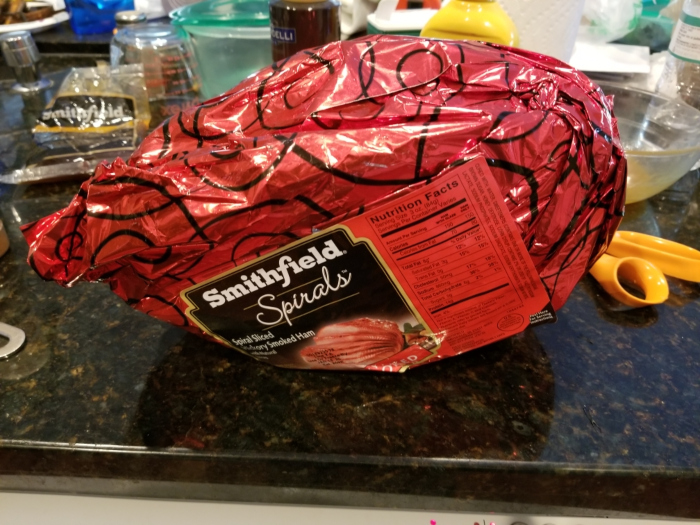
When I opened up my ham, I saw my first challenge. It was floppy. Spiral-cut hams are not very stable. I tied it up with twine to make it hold its shape, and it worked pretty well.
I turned the cold ham downward so the cut part was on the bottom. I covered it liberally with the honey mixture. Then I patted the crust stuff all over it.
It didn’t look too good. The finely ground caramel sugar looked like chalk dust. I was afraid it would be like mud. Also, the color didn’t look like the old Honeybaked hams I remember. It was sort of beige.
After the ham sat for a few minutes, the juice soaked through the crust. Suddenly the color was perfect, at least where the juice had finished soaking in.
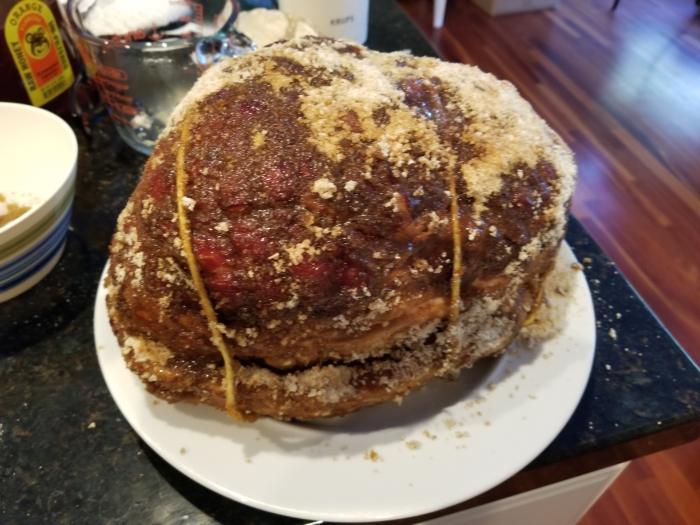
I slapped the ham on a plate, covered it with foil, and put it in my spare fridge. It has two days to do its thing.
Why didn’t I bake it? Because it was already baked.
Honeybaked does not bake its hams after applying the crust. How do I know this? Because the crust on mine has no cuts in it. A ham can’t be cut until after you bake it. The ham was obviously baked, sliced, and then covered with crust ingredients.
If their hams were baked with the crust in place, the crust would not be crunchy. It would melt.
I think the honey coating may have been a waste of time. A lot of it slid off, taking the mustard with it. I’m not sure yet. Maybe it’s better to put mustard powder in the crust mix and forget the honey and butter.
The flavor of my creation is wonderful. Whether it turns out to be a good clone or not, it should be very nice, as long as the sugar doesn’t fall off or melt completely.
The underlying Smithfield ham is fine. It’s tender and tasty, and it’s already spiced. No problems there.
The ham came with a packet of glaze. I decided to try it, to see if the pros would shame me. I almost spat it out. It was disgusting. It had a chemical taste to it, as though someone had contaminated it with mop water. Do NOT use the glaze packet that comes with a Smithfield ham.
Now I have around 14 pounds of ham, including one bone. Not sure what I’ll do with it. Do I keep my homemade version for myself and start eating it tonight, or do I share both with my guests? The Honeybaked ham is guaranteed to be okay. Mine still has not passed the final test, so maybe I should withhold it.
I think it’s safe to say I will never buy another Honeybaked ham. There is no reason to. Preparing a crusted spiral-cut ham is obviously very easy, and you can save $60 doing it, which is astounding.
I may try darkening the crust with a torch, since people who claim they worked at Honeybaked say this is what the chain does. Unfortunately, I have seen people lie before, claiming they have KFC’s secret recipe and so on, so I don’t know how reliable the torch info is. I can’t do it with the twine on the ham.
There is a lady who claims she has the real Honeybaked recipe, and she published it. Sure, sweetheart. The company just tells random employees its most important secret. That totally happens, because unlike every other food company with secrets, Honeybaked somehow needs to tell grunts and peons everything.
No, here is what Honeybaked does. They mix their ingredients behind closed doors in a single facility, they ship the mix to stores, and no one who works at a store has ever been involved in the mixing process in any way. Take that to the bank. I guarantee it. Anyone who claims to have the recipe is pulling your…ham.
If people actually had the recipe, they would look at Honeybaked’s $80 hams, realize they could get rich selling the same thing for $40, and open stores. That has not happened. Whenever a company overcharges dramatically for a product or service someone else can provide, someone else provides it, fast.
If you try making a clone, mix a test batch of the ingredients and try it on a ham sample first. I’m concerned about the amount of powdered cloves I used.
Maybe you can find a source of granulated caramelized sugar. I’m too lazy to look. It would save you some pain.
I’m glad I found out about caramelized sugar. I can think of a lot of uses for it. The burned sugar I already knew about is bitter, and caramel flavor without bitterness is a good tool to have.
Even if it turns out my recipe needs work, it’s still time for you to join the ham revolution. Nobody should ever pay $80 for a spiral-cut ham.
More
I decided to try using a torch on the ham. I was wondering how to get around the twine, but then I realized that as long as the ham was face-down, it would support itself without help, so I cut the twine off. I should never have tied the ham up. It was unnecessary.
I applied the torch. I didn’t want to blacken the ham, but I did want a little burning here and there, and that’s what I got.
Here’s what I think: it’s a mistake to burn the crust at all. Something in the ingredients–maybe cloves–does not react well to burning. Maybe it’s the nutmeg. After all, people smoke clove cigarettes, and they don’t complain. Whatever it is, it gives off a non-helpful odor when it burns.
I think the key is to heat the crust until it starts to melt and then hardens into a sort of scab. Then stop.
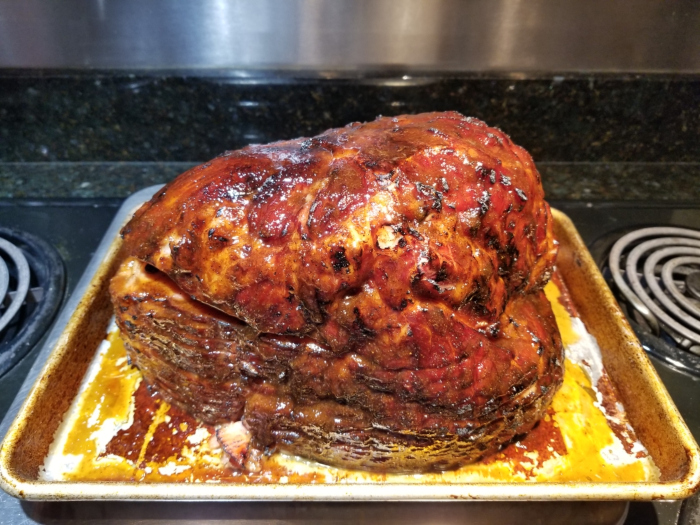
After the torching was done, I found neat little crust flakes came off the ham when I fiddled with it, just as they used to back when I ate real Honeybaked hams. There was a little bit of the burned flavor in the ham, and I could do without that, but it was still pretty impressive.
Apart from using too much heat, I can’t find anything to complain about. The ham tastes wonderful. I hate to say it, but a little voice keeps telling me to get another one and see if I can do the torch bit more skillfully, just to show that Honeybaked can be defeated with ease.
If I do this again, I’ll let the ham sit and drain for an hour before I start. Smithfield packs its hams in water, and they release it after you cut the bags off of them. If you don’t release it into a pan, it will be released into your crust.
This has been a great experiment. Very empowering. It will be a long time before anyone sees me spending $11 per pound for ham again.