Machine Day Draws Near
October 14th, 2019Big White Box Installed on Wall
Today I hung my phase converter on the workshop wall. This is one of the last major steps on the way to getting my machinery moved here.
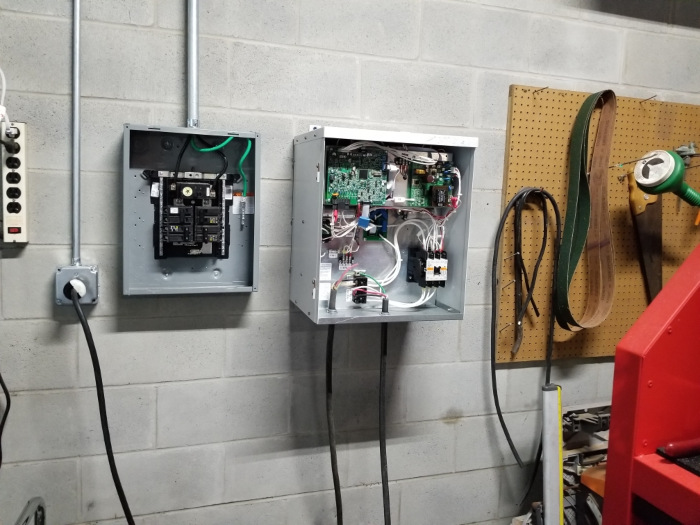
My lathe has a 7.5-HP 3-phase motor, so it has to have a phase converter or variable frequency drive (VFD). A VFD that will run a motor that big is very expensive, and I don’t trust VFD’s all that much. I’m willing to spend $250 on one, with the knowledge that it may go nuts in a few years, but a VFD for a 7.5-HP motor costs a lot more than that. It’s not something I want to replace.
How do I know the phase converter won’t go nuts? I really don’t, but it’s from a well-known company, and I have not heard anything about phase converters flipping out and dying.
The phase converter probably weighs 50 pounds. Could be more. I had to lift it and slip two eyes on the back over two screws about 6 feet off the ground. It’s surprising how hard it is to do that with 50 pounds.
I must correct myself. I looked it up. It weighs 75 pounds. No wonder lifting it was no fun. I took the door off, so that killed a few pounds.
Now I feel better about my physical condition. I try not to lift anything that could hurt me, and this thing, while not pleasant to lift, didn’t seem to reach that threshold.
The phase converter mission was delayed because I needed to figure out where I was putting my machines. It’s difficult organizing a shop, especially when you don’t want to spend $150 on wire for each new outlet you install. Copper got really expensive when China rose out of poverty. They did a lot of building, and buildings need wire. If I were to redo the run to my workshop in really heavy wire for 200-amp service, the wire–four pieces–would cost over $1300, and that’s from a discount place. I checked out of curiosity.
There are a lot of ways to organize a shop. You can lie down and try to picture things where you want to put them. That’s not very reliable. Grizzly.com has a neat tool that allows you to create a virtual shop and put little machine icons in it. It’s clunky to use, however, and you find yourself trying to make up shapes because Grizzly’s available shapes don’t cut it. You might find yourself making a 3′ by 2′ box and calling it a welder.
The little shapes are not labeled, so that’s another knock on Grizzly’s software. The shapes don’t look all that much like tools.
I read that the Navy uses little paper cutouts to arrange carrier decks. The explanation was that it was faster and easier than using CAD. I decided to try it. I moved little cutouts around on graph paper, and it seemed to work. When I came up with arrangements I liked, I took pictures. I’m pretty advanced.
I want to put two more 20-amp outlets on the wall where the phase converter is hanging, along with two 50-amp circuits. I want to put two 20-amp outlets and one 50-amp circuit on the opposite wall. I want to run a 40-amp circuit to the area where the air compressor will be. After that, I should be all set.
It appears I can get away with using Romex. People told me you couldn’t put it in conduit, and I’ll need conduit to install wires on my concrete walls, but they were wrong. Short runs of indoor conduit are fine for Romex. I plan to run conduit up to the trusses and then send Romex over them. This will allow me to do a lot less conduit work.
The preexisting wiring was done this way, so I should have known it was kosher.
I figure it will be one more week before the outlets are in, and maybe I’ll be able to put my machines in early next month. Maybe sooner. I don’t really need to wait for the wiring.
I’m very eager to get the mill, lathe, and compressor back. You really have to have these tools if you want to get anything done.