Strapped
July 13th, 2019My Fancy Sheath Gets Fancier
My leathercrafting adventures have not ceased.
I bought some sheath knives because I really wanted…I mean “needed”…them. The sheaths didn’t work for me because they were made for belts. I wear suspenders. I wanted sheaths that would fit in the accessory pockets of Carhartt jeans.
I got me a 12” square piece of leather from Amazon and made two sheaths, and they turned out to be perfectly okay, except for one thing. My Entrek Beaver…I mean my Entrek Roid-raging Mega Jaguar…fell out the other day.
The Mega-Jaguar (I can’t accept “Beaver.”) is a heavy knife with a heavy handle. I made a sheath which was tightly molded around it, hoping it would click into place and stay put. The weight of the handle apparently overcame the tightness of the sheath, and the other day I heard a tinkling sound while I was walking on my concrete driveway. The Mega-Jaguar had fallen out. I didn’t see anything wrong with it right away, but later on, I discovered a mashed place on the handle, and later still, I found microscopic chips on the edge.
I had to either make a new sheath or fix the old one.
The answer was a retention strap with a snap. I got on the web and looked up snaps.
Here’s how snaps work. A snap has four parts. It’s really two rivets. One rivet is the male part, and the other rivet is the female part. You have to get a rivet-setting tool, which is a steel rod with a little rounded tip, and you also need an anvil, which is a little bar of steel with several round depressions in it.
The whole business, including snaps and tools, is probably under $20. I can’t recall exactly.
You punch a hole in your leather. You take one your rivets, and you put one part of it on each side of the leather. You rest one side of the rivet in the anvil, and then you bang on your setting tool. It flares a little metal thing in the rivet, and you have half a snap, permanently attached to your leather.
Yesterday, having dropped my beautiful handmade knife in the driveway, I finally got around to making a strap. I also removed all the stitching from the sheath, removed the cheap aluminum Chicago screws I had used to attach the pocket clip to the sheath, and replaced everything. The first time I stitched the sheath, I did a job which was perfectly sound, but it didn’t look all that great, so I wanted to improve it.
Here is what I ended up with.
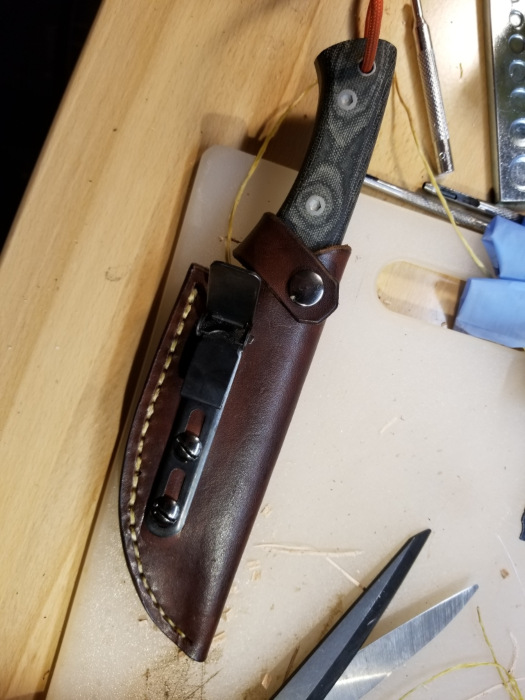
If you’re planning to use Chicago screws in leather, buy Tandy brand screws. Don’t fool with the crummy aluminum ones. I bought a bunch from a company called Grizzly, and they seem to be pretty bad.
I had a problem finding screws which were the right length to go through two pieces of 8-ounce leather. My solution was to make a little leather washer for each screw, to take up the excess length. It worked extremely well. The washers don’t slip at all when I tighten the screws.
The sheath is perfect now, and by “perfect,” of course, I don’t mean perfect. It’s not an example of great craftsmanship. But it’s only slightly worse than many store-bought leather items, and I was able to design it my own way instead of buying some piece of junk off Amazon and trying to make it work.
Last night, I worked on the knife’s blade. I have very nice DMT diamond stones, but I used cheap diamond hones from my kitchen. They’re easier to use, and the knife can’t tell how cheap they are. They put a perfectly fine edge on it. If you put on your reading glasses and squint in strong light, you can detect the places where the chips were, but they will disappear after one or two more sharpenings.
I had a piece of 300 sandpaper on my indoor workbench, so I grabbed it and polished the dented place on the knife’s handle. It looks very good now. I may polish the other side of the handle to make it match perfectly!
To hone the blade, I took a great tip from a reader. I used a leather strop with diamond spray. I bought the spray from a business called Sharpening Depot, I think. It’s a tiny little bottle full of a milky substance which contains 1-micron diamonds.
Initially, I charged my strop with green honing compound, and it worked perfectly well, but these days, people go for the diamond spray, and I can see why. The green stuff contains wax, and it accumulates on knives and interferes with the cutting action until you remove it. I had to stop stropping and use acetone on my knife every time I wanted to see if I was done sharpening.
Last night, I put acetone on a paper towel and used it to clean the strop instead of the knife. I pretty much obliterated the green compound, but it wasn’t helping anyway. I sprayed it again with diamonds, and it worked very, very well. It’s also fast. When you give a clean strop 8 or 10 strokes, it begins to turn black from the steel that’s coming off the knife.
Now what do I do with the green compound?
I would like to put diamond spray on an MDF wheel and strop using my buffer. It would be much easier to maintain the correct angle on a buffer. I could also put a cork belt on my 1×42 grinder and charge it with diamonds. That would probably be better.
Of course, I already have the cork belt.
The knife cuts like crazy now. It seems to want to bite into things.
I like the kitchen hones because they’re quick and easy to use, and they’re also light and handy. Diamond stones are heavy steel plate. I won’t even consider a wacky machine like a Tormek. I don’t want to have to run for a machine every time my knife gets dull. Maybe a Tormek is better. If so, hooray. I still don’t want one. My knives are sharp enough to scare me already. I don’t think it would do me much good to make them sharper.
When you sharpen a knife as much as possible, you end up with a very fine edge, and it sort of disappears as soon as you start using the knife. You start out with a knife that’s freakishly sharp, and after a few cuts, it’s merely very, very sharp. Is very, very sharp really that bad? It’s the best you can do unless you want to sharpen your knife several times a day. At least, I’m pretty sure that’s how it works.
I’ve sharpened plane irons until they were like razors. Use them for a very short time, and they’re not like razors any more, but they cut very well nonetheless. The whole game is not about perfect sharpness, which disappears quickly. It’s about excellent sharpness which lasts a long time.
People buy crazy things these days to get things sharp. Waterstones. Tormeks. In the old days, when a woodworker wanted to sharpen his plane or chisel, he didn’t have nutty sharpening tools, and he didn’t sharpen anything to 8000 grit, but he still did excellent work.
I’ve made two sheaths. Now I need one for my Benchmade Bushcrafter. It’s quite a knife. My hat is off to Benchmade.
I want to buy more knives, because if you like knives, that’s what you do. I think I should make my next knife, though. I can buy all sorts of high-tech steel, and I can send knives out for heat-treating. I should be able to make a stainless knife as well as anyone, and now I can also make sheaths.
I have to force myself to use my expensive knives, because I’m afraid to ruin them. If you can make your own knives, that fear goes away. There are a lot of $300 knives out there, but I consider a $150 knife expensive. I should be able to make knives from excellent steel for between $50 and $100 each, and I would get exactly what I want.
The ability to make knives and sheaths is pretty neat. If you have a reasonably well-equipped garage shop, you probably have nearly everything you need. If you have a drill press, an arbor press, and a 2×72 grinder, you’re most of the way there.
I don’t think any shop is well-equipped without a 2×72. It’s an incredibly useful tool. It’s amazing that they’re not more popular.
When I get the Bushcrafter sheath made, I’ll post a photo.
July 13th, 2019 at 9:50 PM
If you’re going to get into knifemaking, see if you can get some BD1N steel, but only if you can find a heat treater to get it to 63 HRC. It’s very corrosion resistant and at that hardness level it should have amazing edge retention.
July 13th, 2019 at 10:01 PM
I used to work on a paint line at a GM assembly plant.
I sanded paint jobs before they went into the reflow ovens.
I had a 6″ sponge disc with 600 grit sandpaper discs held on with adhesive.
My wife was due with our firstborn. We intended to have him at home.
I had bought surgical scissors for the umbilical cord.
I also bought a wood inlaid brass bolstered folding pocket knife for the same purpose.
I sharpened it daily on the sanding pad (with a light oil). I could shave the hair on my hand and arm with it.
When the day came, it would not cut the cord easily.
I had to hack at the cord a few times before it separated!
I gave it to him on his 18th birthday.
July 14th, 2019 at 9:49 AM
The knife or the cord?
July 14th, 2019 at 10:09 AM
You owe me a keyboard. 🙂
July 14th, 2019 at 2:54 PM
Last summer at Boy Scout summer camp I sat in and observed woodworking and leatherwork merit badge classes. I grew up, sadly, in an environment where unless one’s efforts might lead to a Nobel Prize, it wasn’t worth pursuing. In high school, I excelled in chemistry in paper and pencil work but was terrified of wet activities where my lousy small motor skills would put me at a disadvantage versus other classmates. (My large motor skills, by contrast, led me to my state high school track and field tournament all 4 years and to striking out a total of 5 times from ages 9 through 37 in all the Little League, Babe Ruth Ruth League and softball games I played.) I’ve gotten to a point in my life where I realize I don’t need to be perfect on my first try. Ended up carving a nifty owl neckerchief slider. Also made a belt I was really proud of… which I realized was upside down after going to the camp store to buy a buckle for it. Made lemonade out of the lemon and turned it into a personalized duffel bag strap that will outlast a lifetime’s worth of duffel bags.
I plan to return to that camp next summer for my son’s last BSA summer camp and making a sheath looks like a good project. I’ll have to bring a template of a fixed blade from home, though, as BSA has a 4″ folding knife limit at camp. They allow fixed blades for actual camping. BSA summer camp is more merit badge oriented and the boys eat in a dining hall and sleep in permanent pup tents on cots.
We haven’t confronted the gays and girls issue in BSA, as I’d yank my son out at the first hint of indoctrination. Our troop is an Orthodox Jewish unit, whose Sabbath and Kosher requirements seem to repel left-leaning Jews who are ashamed of Leviticus. Glad he’s aging out in less than 17 months. Tragic how the left ruins everything it touches.
July 14th, 2019 at 2:58 PM
Had a dream where I won a Nobel Prize in science. My wife and parents were in the audience. I finally expected a compliment from my father. His first words were “Lots of people have won Nobel Prizes… why can’t you be the first to win two?”
July 14th, 2019 at 7:12 PM
Make a sheath for a folding knife.
https://www.amazon.com/Folding-embossed-basketweave-4-5-5-25in-SH1132/dp/B004QB4WZI?SubscriptionId=AKIAILSHYYTFIVPWUY6Q&tag=duckduckgo-ffab-20&linkCode=xm2&camp=2025&creative=165953&creativeASIN=B004QB4WZI
July 14th, 2019 at 7:48 PM
I think stubborn umbilical cords probably call for the band saw.