Regaining my Bearings
July 5th, 2019Pawn Shop Beauty Purrs Like a Kitten
Today has gone well.
A while back, I bought a Baldor 332B buffer with a Baldor G14 stand. I paid $250. You could probably buy this combination new for $1100, not including the safety switch that was bolted to the one I bought. I felt $250 was a very good deal.
When I got the buffer home and turned it on, it rumbled. It didn’t squeal, which is what I would have expected from bad bearings. It just seemed unbalanced, like it wanted to move in a circle in the plane of the wheels’ rotation.
I put a dial indicator on it and turned the shaft, and it showed less than a thousandth of runout. When I turned the motor on, the indicator went nuts, suggesting something was seriously wrong. A bearing that causes problems at 1800 RPM may work very nicely at 20.
I ordered myself some stuff from Caswell Plating, which is a magnificent website for anyone who wants to buff or plate things. I now have assorted good-quality compounds plus enough wheels to allow me to avoid mixing compounds on the same wheel. I also ordered some sealed NSK bearings.
Today I put the bearings in. As usual, I made mistakes which taught me new things.
Grinder and buffer bearings are pressed onto armature shafts. They aren’t held on by collars. Baldor will make a grinder shaft a certain size, and then they will install bearings, the internal diameters of which are actually smaller than the diameter of the shaft. The use presses to shove the bearings onto the shaft, and the inner races of the bearings have to stretch to get over it. This creates a tight fit.
I had to push the old bearings off and push the new ones on. I should have used my arbor press, which is a fairly sensitive tool, but it’s not on a stand right now, so I used a hydraulic press. It’s easier to put up a photo than explain.
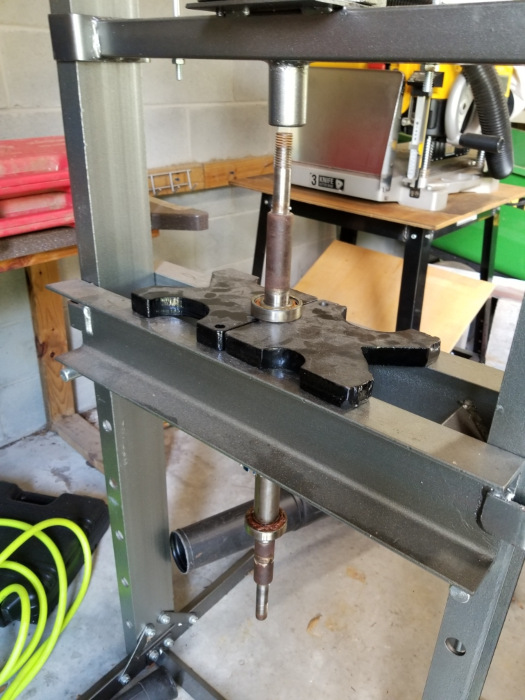
The first time I tried to press a bearing off, I didn’t clean the shaft first, so the bearing got hung up on the rust and crud. That was a dumb mistake. I put it back in place and reinstalled the armature. Then I ran the buffer and used an old grinding belt to remove the rust. After that, I polished it with emery cloth.
I put the shiny new armature in the hydraulic press and put 3-in-One oil on the armature and let it run into the bearings. They came off with no problems. The reverse procedure shoved them right back on.
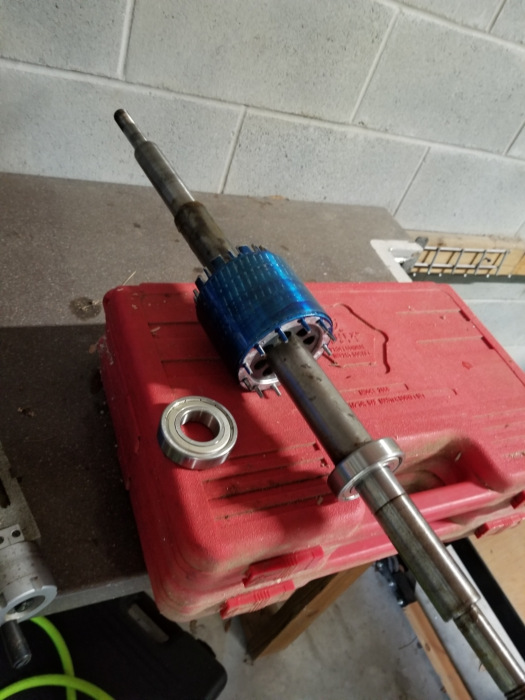
Everyone should have a hydraulic press. At $160 from Harbor Freight, they are too cheap NOT to buy.
By the way, that red thing is a plastic case for Taiwanese impact sockets. It’s what all top buffer mechanics use to hold their armatures. The dust is imported from Austria, and it has special protective qualities.
Putting the buffer back together was no problem, and now it runs very smoothly, without rumbling. The bearings were definitely bad.
I stuck a couple of wheels on the buffer for a photo op. Still trying to decide whether I should clean it up. I could remove the pins holding the nameplate on, give it a neat paint job, and put the plate back on.
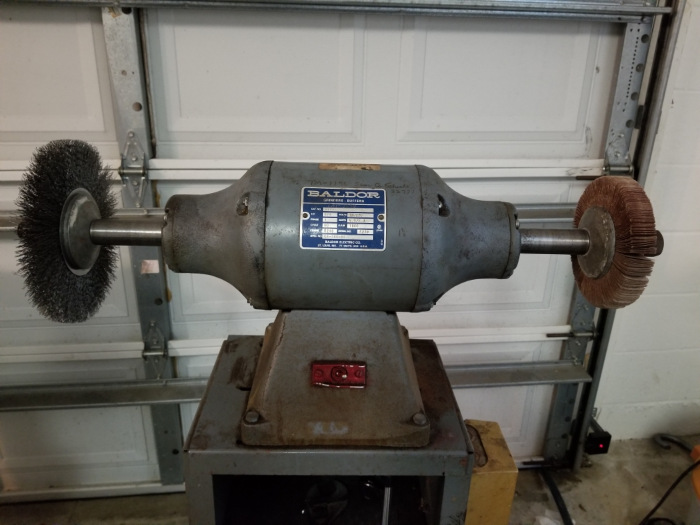
Now I have to figure out what to do with it. The Baldor stand is not good by itself. I can use it as it is, and I’ll probably be fine, but it’s not a brilliant move. Buffers are extremely dangerous. Unbelievably dangerous, considering how tame they look. I need to have a stand that will provide some resistance to movement.
I am not willing to screw the stand to the shop floor. I don’t have a floor plan together, so I know I’ll be moving the buffer, and I don’t want a workshop floor full of holes. My plan is to make a heavy wheeled base from plywood. I also plan to put a foot switch on it so I can turn the buffer off in a big hurry without reaching toward the wheels. The current safety switch requires you to fumble around with your hand not far from the wheels.
I’m thinking I may also throw a rope over a truss and attach it to the buffer. That will keep it from going anywhere if it decides to ramble. Not ideal, but much better than nothing.
You educate yourself, you do what appears to be reasonable, and you live with the risk. That’s how life works when you have tools.
I read a fascinating safety analysis written by two engineers, and they focused entirely on things like guards. Apparently, buffer movement is way down on the list of dangers. They concluded that guards make buffers more dangerous, which is amazing. They did tests and found that an object tangled in a buffer wheel can go around the buffer several times in spite of guards. It can also reach a linear speed over 10 times that of the wheel, so 420+ miles per hour. The possibility that a buffer might fall over doesn’t seem nearly as scary.
While I was learning about buffers, I learned something disconcerting: it’s unsafe to buff the insides of things with bench buffers. It’s much easier for a buffer to catch something when you buff the inside. If you were to buff a metal hoop, for example, the buffer might take it out of your hands and start spinning it. Bench buffers speed up buffing certain things, but they’re not for every job. When you have things that aren’t safe for bench buffers, you have to look to handheld tools, even though they’re slower.
I only have one really good handheld buffing tool. It’s an air buffer, which is like a die grinder that holds buffing tools. When I say “really good,” I’m not telling the truth. My 17-CFM compressor, which is enormous by home shop standards, can’t keep up with it. You buff and stop and buff and stop. It looks like I need to get an electric die grinder. They’re actually superior. They don’t quit over and over, and they have more torque.
So. New tool. More wheels or buffs or whatever. It never stops.
In other news, something very exciting happened today. I performed a healing. I was alone, so I didn’t get to heal someone else, but still, it was great. I woke up, and my shoulder was sore. It’s a chronic thing. It doesn’t prevent me from doing anything, but it’s annoying. I think it’s referred pain from my gallbladder, which has had minor problems. I don’t think my shoulder has had a physical problem of its own. Gallbladder issues often cause shoulder and back pain.
Anyway, I have been watching all sorts of healing videos. This morning I told the pain to leave, and I put my hand on myself and so on. I felt my shoulder a few seconds later, and the pain was almost gone. I kept working at it. Sometimes when you get a divine healing, you only get part of it at first, and you have to go on. This happened to Jesus, so it’s not a sign of failure. Anyway, I can’t find the soreness now.
The Bible says God will perfect (complete) that which concerns me. That’s in a psalm. It’s true, so there is no reason to stop when a prayer is partially answered or a curse or blessing doesn’t come to pass in its entirety.
I’ve healed myself (sloppy language, since I’m just a conduit) many times, but this time, it was very dramatic and fast.
I keep hoping God will use me to heal other people. I really hate spirits that cause problems that seem incurable, and I hate the fact that most Christians think doctors are better than God.
Maybe tomorrow or Sunday I’ll work on a buffer stand base. I have some ideas.
July 5th, 2019 at 8:37 PM
You might make some hinged telescoping tripod legs to extend when in use.
July 6th, 2019 at 11:26 AM
Or I could just put a childproof fence around the buffer to keep me from getting to it.
July 6th, 2019 at 11:57 PM
🙂