Good Grief?
January 18th, 2019Welcome to my Cleaner, Quieter House
My dad is in an ALF, and my first day of freedom has begun. Or has it?
Yesterday, I got him situated, and I didn’t get home until around 7:30 p.m. His bedroom still contained a pile of laundry that needed to be washed. I just got around to it this morning.
We have a very modern washing machine, and that means the machine is not very good. It’s slow, and in order to make sure clothing really gets washed, you have to use the “bulky” setting. I also use bleach on his sheets, and I include a pre-wash cycle. One load takes over 90 minutes.
When I got up, his breakfast dishes were still by his chair in the living room. He had covered the plate with newspapers, so it wasn’t visible, and he has…had…a habit of leaving his water glass and coffee mug on the TV table all day, so when we left for the ALF, nothing had been put away. I just put it all in the dishwasher.
I have to shampoo his bedroom carpet again. I will need to clean his bathroom several times in order to feel confident about it.
I am reminded of the days following my mother’s death. I got her clothing out of the house as quickly as I could. I didn’t want there to be a disturbing shrine full of useless things that only served to make us feel bad about her dying. I tried to fix things so it looked like the family had moved on. After a person dies, certain reminders can hurt like a finger jabbing an old sore.
If you want to honor the dead, keep some photos and videos and leave it at that. Redecorate their bedrooms. Do not buy an urn and keep ashes on the mantel. You shouldn’t drag other people into a never-ending festival of conspicuous, demanding, off-putting self-pity. When I’m sure my dad is never coming home again, I’m giving his bedroom furniture away as soon as I can.
Am I cleaning up after the dead again? It feels that way.
I didn’t think I’d miss my dad very much. For one thing, he was making me miserable with selfishness and groundless anger, and for another, I expected to visit him several times at the ALF. Nonetheless, now that the pressure is off, I can feel things it was masking. It feels strange to know he isn’t here. This is a big house. We needed it in order to make caregiving bearable. Now it feels a little cavernous. When I walk by his bedroom door, I feel as though he should be in there, and then I remember that he isn’t.
I’ve been thinking about what I’m feeling. Most of the time, when you have an unpleasant emotion, it means there is a problem that needs to be fixed, so I’ve been looking for a problem. Did I do the wrong thing by moving him instead of getting a CNA? Did I pick the wrong ALF? I thought about my feelings for a while, and I had a realization: what I feel is grief, and grief tends to generate denial. I may not have made the best choice, but what I did was okay. I can always make changes later.
Among painful emotions, grief is exceptional, because it doesn’t mean somethng needs to be fixed. You’re not supposed to look for the cause and make it right. You’re supposed to experience it until it goes away on its own. It’s not a disease to be cured. It’s as normal as birth and death. Maybe it’s a good thing. It reminds you that you have a heart, and it helps you remember how very serious life is.
If I brought my dad back, maybe some of the grief would go away. He would have to go back soon, though, and while he was here, I would still have some grief. A demented person, though breathing and speaking, is partly dead. A lot of a dementia patient is gone forever, which makes sense, because parts of my dad’s brain have, literally, died and disappeared. I have been feeling a certain amount of grief over my dad for a year or two.
There are nice things happening. It’s not all bad. I no longer have to go through the house looking for things to clean with bleach. He isn’t touching things and leaving e. coli and other things on them. I can put the flatware back in its drawer instead of keeping it hidden so he won’t lick food off of it and put it back. I’m not wondering what kind of hygiene crisis will occur today. I’m not dreading unpleasant conversations, except for the one we may have when I visit him later.
Maybe I can take down the little signs I’ve put everywhere. “DO NOT WASH ANYTHING BY HAND.” “DO NOT USE THESE DISHES.” “DO NOT LOCK ME OUT.” They are disturbing reminders of his illness and his absence. If I take them down, though, am I not nailing him into his coffin, in a way? To take them down is to say, “You’re all finished. You’re not coming back.” Leaving them up makes me feel like I can resurrect him.
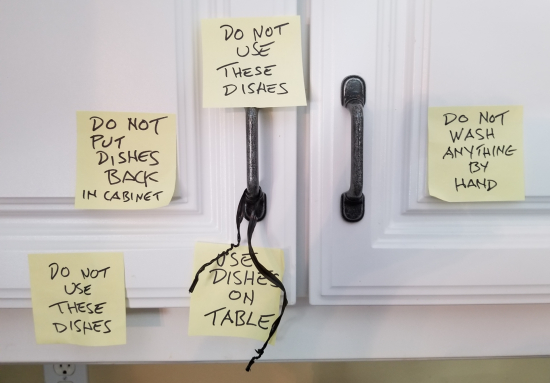
Things would be much better if he were a self-aware person. He insists on clinging to denial. He says he doesn’t believe he has dementia. You can say that’s the dementia talking, but he said the same thing back when he was still mostly sound. The year he retired, he knew perfectly well he had dementia, and he told his doctor and me that we were wrong. He is still sharp enough to know what his problem is. He doesn’t know his address, he can’t use a computer, and other people show up to bathe and dress him. To put it harshly, even to a demented person, those are very good clues.
Because he won’t admit the truth, he has to look for explanations he likes better. My selfishness is high on the list. He brings that canard up, and then later, when he feels better, he tells he what a great son I am. He seems disappointed when I don’t hug him and break into tears, but then I’m the same guy who was accused of the worst kind of selfishness earlier.
I wish he would say, “I know I have a very serious problem. I know you can’t take care of me, and that I have put you under great stress. I know that if I stay in the house, you will be a prisoner, and you won’t be able to get anything done. Don’t feel bad about it. It’s not your fault. I know you didn’t cause my problem, and you have done a great deal for me already. I understand.”
Thank God I’m not caring for my sister as well. Two denial-and-accusation artists would be too much. She is much, much worse than he is, and she also hates me and wishes she could erase me and my memory from the earth.
Some people rely on God to fill their needs, and others use other people up, discard them, and look for fresh hosts. There is literally no limit to the suffering my sister would allow me to experience in order to prevent her from having to accept the consequences of her life of toxic words and actions. My dad is not as extreme, but he would be willing to live here and let me pour myself into him until my life was ruined.
I’m going to quit writing so I can run out to the ALF and spend some time with my dad. I don’t know if it will go well, but I want to find out if the move will improve our relationship, as I am hoping. If not, it will be his choice, not mine.
I plan to take him a Bible. Can’t hurt.
January 18th, 2019 at 6:30 PM
“…and others use other people up, discard them, and look for fresh hosts” — I’ve known people like this, to my cost.
January 18th, 2019 at 9:44 PM
Of course, you are grieving. You have been grieving all along. You have much to grieve.
You are, and have been, losing a parent. Even bad parents are loved by their children. Sometimes it doesn’t happen, but in your case you have honored him. You have respected that what he is, is in no way what you wished for him to be, but he is the one who gave you life, a tortured one at that. Some people believe those who are like him are mentally ill, or as others have put it, possessed by demons. But he is/was your father and you have a right to grieve.
I am happy for you that you have come to this realization, take your time, grieve. When he really passes you will have a new wave of grief, for it will definitely be over.
I say don’t take those signs down until you feel comfortable with it. The old saying ” it isn’t over, till it’s over” is true. Don’t be shocked when you feel relief and grief at the same time, it is normal. And the Bible, at this point you don’t know whether his limited belief was true, but give him a Bible.
As always, you have my prayers.
January 20th, 2019 at 6:31 PM
Thanks for the support, Ruth. I hope you and your husband are well.