Groot Expectations
July 2nd, 20183D Printing Almost a Reality
This week’s exciting development: I am now a big 3D printing expert. And my opinion of the whole enterprise is even more negative than it used to me.
I want to be good at CAD. It’s useful for CNC machining. It’s useful, period. You don’t need CNC in order to have uses for CAD. You can design stuff with CAD and build it with files and grinders if you want.
CAD is good. Printers use files that come from CAD. Printing will make me better at CAD.
I also want to be able to print a useful part from time to time. Most things that come out of 3D printers are unbelievable useless crap, but you can also design metal parts in CAD, print them in plastic, and see if your design makes you happy before committing. You can use printing as a step in designing metal parts, but plastic is strong enough for some parts, so you can also print certain things which you can use.
I ordered an Anet A6 printer. This is the upgraded version of the Anet A8. Right away, you can see that the 3D printing collective has issues. Why would an upgraded version of something have a lower model number? And what is Anet going to call the printer that comes after the A0? The -A1?
The A6 arrived last week, and I started assembling it on Sunday. They send you a box containing stacked styrofoam trays full of parts, and you get to put them together. There are no written instructions. You get a USB drive with a PDF file. I think the drive may actually be a micro SD card in a USB adaptor, but it’s in a USB port right now, so I don’t want to take it out and check.
The instructions aren’t perfect, but there are very good Youtube videos.
I would say I have another two hours of assembly to go. It’s about a 5-hour job. Am I complaining? Yes. Well, no. If the printer came assembled, it would cost a lot more.
I’ll put up a couple of photos. One is the printer by itself, with the print bed installed upside down. I’ll fix that. The other is my assistant, Johnathan. He lives in one of my storage closets. He gets fed as long as he continues performing menial tasks for me.
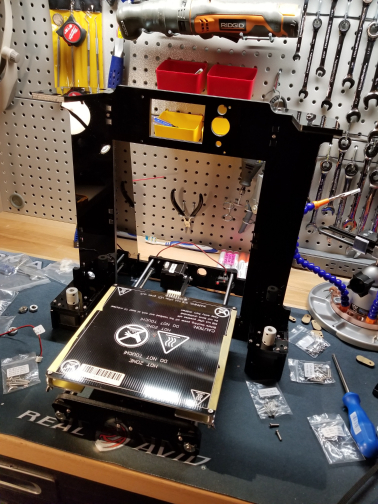
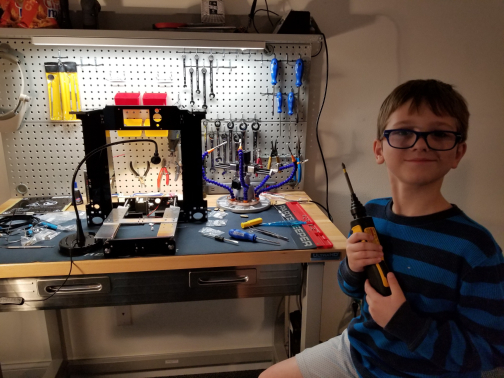
Actually, he belongs to my friend Amanda. He is her youngest son. He likes building things from Legos. Working on a 3D printer is a step up for him.
I spelled his name right, so don’t correct me in the comments.
Notice how well the new workbench is serving me. It’s a joy to use.
The printer’s frame is made from black acrylic. They cut it into useful shapes with a laser or something. Maybe I should have bought a laser instead of a printer.
The sheets arrive covered with paper decals. The acrylic is manufactured with a big protective decal layer on each side. You have to peel it off every part. This is why the printer takes 5 hours to assemble instead of three.
I may get the printer running today. In anticipation, I’ve been looking at videos. The news is not all good.
The first thing that surprised me is this: it takes forever to print things. I’ll post a video in which someone prints–get ready for this–a giant orange Baby Groot. Dolls are very big among male scifi/comics fans. Troubling. Anyway, the Groot has two parts, and each part took around 5 hours to print.
Will the things I make take that long? Not for the most part. I expect to print a lot of small items. Still, 5 hours! Man! What if I need to print something big, and I have to make several versions to get it right?
I’ve also learned that printing is not precise. I’m not sure what kind of tolerances you can expect. From looking at things on the web, I get the idea that you would be lucky to stay within 5 thousandths of whatever it is you’re trying to print. That may not sound bad, but it is. Imagine you’re printing a knob to go on a 1/4″ shaft, and it’s supposed to rely on friction. If it’s 5 thousandths too big, it will slip, and if it’s 5 thousandths too small, it won’t go on the shaft.
Based on what I’ve seen so far, I expect to find myself using drill bits and sandpaper a lot.
I may have a way to mitigate the time problem. I’ve noticed that people tend to print solid objects. By “solid” I mean “not hollow.” They’re filling their prints with plastic that doesn’t do anything but add weight. It’s stupid. I’m wondering if I can create designs with a lot of hollow space to avoid wasting time and filament.
Here’s another bummer: prints fail a lot. You can set up a job that takes three days to print and have it go crazy late on the second day. After that, the printer will keep wasting filament on a doomed print while you’re off somewhere looking forward to handling the finished item.
A web printing guru says the smart thing is to rig a camera up so it sends you video of the printing process. Then you can shut it down when it goes sour.
I sort of hope printing hobbyists don’t see this, but here goes: I am very disappointed in them. It looks like all most of them do is turn machines on and print other people’s designs. I saw an instructional video today, and the guy in the video had a lot of ridiculous garbage on the shelves behind him. How many skulls and unicorns does a grown man need? What is that junk good for?
It’s like painting by numbers, which, I should stress, is a perfectly legitimate hobby. If it makes you happy to print Thanos heads all day, go for it, but you’re not really learning anything. You’re also filling your living space with things that will motivate people to apply unkind labels to you.
Here’s what I wonder: who is creating the designs people use? I have CAD, but there is no way on earth I could create a Groot doll. CAD uses lines and simple curves. Can you imagine how many tiny lines and curves are in a Groot doll? Someone must be sculpting these things by hand and then scanning them into CAD programs. I don’t know how it’s done, but your 12-year-old 3D-printing nephew isn’t designing plastic skulls by himself. If this is true, then what are most printer owners really accomplishing?
It looks like there are people who use printers as tools, and there are other people who don’t learn anything from 3D printing except how to assemble rickety machines and make them function.
Home 3D printing technology is still in its wobbly infancy. That’s what I take away from all this. The machinery has huge limitations, and part quality is not great. It will be a fun, cheap way to improve my CAD and Gcode knowledge, and I’ll get some useful things printed, but 3D printing is closer to the realm of Ron Popeil than that of Haas Automation.
July 2nd, 2018 at 6:00 PM
It does my heart good to see that happy kid helping you. Every kid needs a favorite uncle, and you can fill that spot. Good for the kid, good for you.
My nephew Johnathan, would find nothing wrong with your spelling.
July 2nd, 2018 at 6:06 PM
My Boss wanted to send me to a school on a very expensive 3D printer from one of our largest vendors. 3 weeks of prerequisites and 2.5 weeks of class that involves air travel so I can’t come home on the weekends.
NO
Told him to shanghai one of the youngsters than would love to travel to the wrong coast
July 3rd, 2018 at 10:36 AM
Guess you’ll have to buy your own Groot.