Group Theory
June 9th, 2018I Really do Have a Screw Loose
I had a little fun today. The rain we’ve been having for about a century has dried up somewhat, so I got to take the Savage A22 out and shoot. It now has a Nikon Prostaff 3×9 on it. I wanted to check the scope, and I also wanted to see what I could do with Remington Golden Bullets.
Golden Bullets attract a lot of criticism. They’re dirty, and they have a reputation for failing to fire, plus poor accuracy when they actually go off. Remington started selling “new and improved” Golden Bullets at some point, but some people say they’re still crap. Golden Bullets would be a godsend if they worked well, because they’re cheap hollowpoints. Hollowpoints are more humane when you hunt small animals. They do more damage. It would be good to have a cheap round that works equally well for practice and hunting.
I set up my folding table in the pasture, along with my cheap Caldwell front rest and my new rear bag. I’m not sure a rear bag is a big help. A front rest or bipod makes a huge difference when you’re trying to be precise, but I can hold the butt of a gun pretty well without a rear bag, and rear bags are something of a pain to use.
I’ll show you my target. I used it for a lot of things, so there are many holes. Only two groups are important to this blog post.
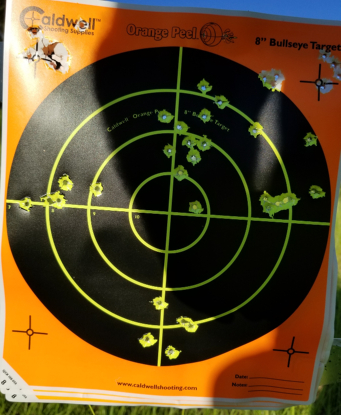
I started shooting, and after I found the paper and got sighted in, I shot 6 holes that connected (right side of target, halfway up). That’s pretty good. Maybe 7/8″?
People say they shoot 1 MOA with .22 rifles at 50 yards, and that’s a half-inch group, but people lie a lot, and they shoot groups of very few rounds (as few as three) and then bury their bad groups. I shot a 3/8″ group today at 50 yards, and the the next shot opened it up. I won’t go around saying I shoot 0.75 MOA (3/8″ at 50 yards) with Golden Bullets.
The .22 LR round is not inherently accurate, compared to an insanely accurate round like the .17 HMR. Also, .22 rounds are manufactured cheaply, so it’s not like you’re getting match-grade ammunition when you shop. I don’t know what the cheap-ammunition potential of the .22 is at 50 or 100 yards, but I’ll bet it’s not over half an inch at 50 yards for 5 rounds.
I was quite happy with 6 rounds that connected, so I kept shooting, thinking I was onto something. My groups went nuts. It was bad. I didn’t know what was going on. I thought I had screwed up my trigger technique. One thing was certain: it wasn’t the scope. I had used blue Loctite to hold the scope base screws in place. I was sure I didn’t have to check. But I did.
The scope base screws were loose. All four of them.
I tightened the bases down and shot again, aiming at the little cross at the top left, by the Caldwell logo. As you can sort of see, the group (9 shots) was pretty tight.
After that I had to drive back to the house for something, so I called it a day.
I should add that I had two failures to fire, and I could not find firing pin marks on the rounds. I need to investigate that.
What did I learn?
1. The Nikon is very nice. I paid $89, and I feel like I got a good deal. The glass is clear. I’m not sure I’ll be able to focus on anything closer than 50 feet, though. I may have to read the manual. I hate doing that.
2. Remington Golden Bullets are not that bad when used in rifles. I think I can get near-half-inch accuracy at 50 yards from a bench, so I should be able to do an inch or less at closer distances when shooting animals. That’s good enough for most squirrels.
3. Golden Bullets are more than adequate for pistol practice at 7 yards. I want ammunition that will stay under one inch at that distance, because otherwise I won’t be able to tell flyers from bad shooting, and a round that will do 1 MOA at 50 yards will definitely do one inch at a seventh of that distance. Golden Bullets are more accurate than I am, and if you want to learn anything while you’re shooting, you need a gun and ammunition that will shoot better than you can.
Now I have to decide on a sighting distance, stick to it, and learn how to adjust my aim for shorter ranges. I read that squirrel hunters should zero their scopes at 75 yards. Interesting article. Something about the error being fairly small at a wide range of distances.
I don’t look forward to sighting a .22 at 75 yards, because I’m not sure it will group well enough to allow me to figure out where to move the reticle. Five clicks left…four clicks down…three clicks right…two clicks up…I’m afraid I’ll go nuts chasing problems caused by the ammunition itself. One nice thing about a really accurate rifle is that you always know how many clicks to move.
I’m going to lighten the Savage’s trigger. I think I wrote about that. New springs for the A22 and my .17 HMR are on the way. I love a light trigger. As long as it’s safe, it can’t be too light for me.
Tomorrow I hope to do some pistol shooting, and I want to shoot the Marlin 60 with the new peep sight. I have to try to maintain a serious practice schedule. Everyone gets rusty between sessions.
In a few months, I hope to be a much better shot.
June 12th, 2018 at 12:11 AM
I just went to the Tech Sight site and saw the rig that you got for the Marlin. Excellent.
I had recommended that you design and build your own. What you got is likely better than one could ever make. Even then, it would cost far more than the Tech Sight product.
After you get it sighted in at your optimum distance (o.d.), just cross check the impact zone a bit closer than your o.d. and also a bit further out than your o.d.
If I were sighting it in, I’d select a distance that would be the absolute furthest distance that I would allow myself to shoot. My o.d. would be somewhat closer than that.
The reason for doing it that way is that closer than your o.d. means “aiming a bit low.” Shooting further than your o.d means “aiming a bit high.”
Probably, you’ll be shooting within a half minute of squirrel at either distance.