Archive for the ‘Tools’ Category

My New Angle

Saturday, January 31st, 2009

Heat & Brute Force

I hit Home Depot for the purpose of buying casters. While I was there, I picked up a bar of 2″ by 3/8″ steel and some MAPP gas.

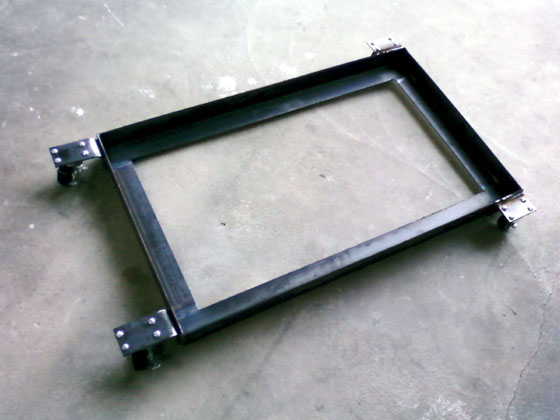
I want to use 2″ swiveling casters with brakes on one end of my saw base. But to do that, I need 3 3/8″ of distance between the far end of the caster base and the side of the saw base. That means something has to hang way out over the floor, unsupported. If you use angle iron, the part the caster screws into will be fine, but the part that extends down from it will prevent the caster from turning. Clearly, the best option is a piece of flat stock with a right angle in it. You put the horizontal part at the top, weld the vertical part to the saw base, and attach the caster to the underside of the horizontal part. The problem is the right angle. How do you create that?

My hope is that with MAPP gas and my vise, I should be able to make a reasonably good right angle. If the lengths of the angle’s legs are a little off, I can fix it with the grinder, the dry cut saw, or the plasma cutter. I just have to make them overly long to begin with.

I have never used heat to bend steel before. I saw Indian Larry do it on The Discovery Channel, however, so I feel that I have sufficient training. His crew was making twisted forks for a bike, or maybe it was a twisted sissy bar. They put a square bare in a vise, heated it with a torch, and turned it with breaker bars. The little job I’m doing should be considerably easier. I don’t even need sharp right angles; they can be pretty round.

How Big is Big Enough?

Saturday, January 31st, 2009

Common Sense Militates in Two Different Directions

Here’s an interesting Craigslist ad: CLICK. It’s a Bridgeport mill with CNC stuff on it. The CNC bits need repair, however.

Last night I was thinking about tools. I was thinking about how I had finally learned my lesson: NEVER BUY SMALL. I’ll tell you why this was on my mind. I bought what I thought was a gargantuan compressor, but it turns out to be just about the minimal size for sandblasting. For a few hundred more dollars, I could have had a 7.5 HP model which would have been better. And it would run on the same size circuit and take up the same amount of room.

I’ve also started to come up against the upper limits of my MIG welder. I bought 1/8″ and 3/16″ steel for my saw base, and 3/16″ is the biggest I can do without going to flux-core wire.

People assured me I was overbuying. Well…WRONG. I barely went big enough.

Here’s the funny thing. Right after I thought about the lesson I had learned, I started thinking about how I should go look at the Millrite milling machine I had located. Because a Bridgeport is just too big.

I immediately sensed the contrast between the two trains of thought. 1. I have been stung by buying small tools. 2. I should buy a Millrite because it’s small. I felt like I was getting a message.

But I’m still not sure what to do. I have no idea what I can do on a Bridgeport that I can’t do on a Millrite. And I wonder how much more expensive (if at all) Bridgeport tooling is.

Service Outage

Friday, January 30th, 2009

I am Back

My Internet provider was messed up all day. I wasn’t able to buy a single tool!

Well, that’s not totally true. I managed to get to Home Depot and pick up a square, a flap wheel, and a wire wheel.

Big Globs of Bubbly Metal

Thursday, January 29th, 2009

Saw Base Developing

My adventures in welding continue.

I cut more parts for the saw base, and I managed to get a fair amount of the crud off of them, and I got out the bench grinder and made everything as nice as I could. Then I did some practice welds, resulting in a beautiful sculpture. And I lined up the base parts, fired up the welder, and welded.

Without gas.

I guess when you turn off the gas, enough remains in the system to let you do a few welds. I checked the regulator gauge before I started, and I saw pressure. But during the first weld that counted, the gas ran out, and I got some very interesting results.

I turned on the gas, started up again, ruined a contact tip, and so on. Eventually I realized I should rely on the pictures on the little chart on the welder door, instead of the numbers, which are apparently wrong. And I managed to weld three corners of the base fairly well. The one I screwed up will work. I did extra welding on it, and I did some grinding. Hey, it just has to stay together. It’s not going to have all that much force on the part I screwed up.

I found out I weld better with +2.5 reading glasses under the helmet, because I’m so close to the work. But my biggest problem is smoke. I don’t understand why clean metal would smoke, but it’s happening, and I can’t see the welds very well. I have to stop and start. I hope I’m using the right wire. Surely it’s not flux burning.

I can’t say I’m totally pleased, but the base will work. Tomorrow I can get casters, and then I’ll be able to take measurements and weld on the tabs the casters attach to.

Maybe I’ll make another base, just for the practice. I need it. I swear, I’m going to start driving around looking for metal in trash piles.

I can’t believe there are people who seriously suggest using hydrochloric acid for rust removal. What a farce. I suppose I could get naval jelly next time. Or Ospho. Cleaning the metal is the worst part of this job. A reader suggests electrolysis.

I have to get this finished. I watched Mark Duginske’s bandsaw book, and I’m dying to use my bandsaw, but I can’t use it without the base. The cord won’t reach the new 220 outlet.

Geez, After I do the welding, I have to get this thing cleaned up and paint it. It never ends. Now I have something to do with my surplus grill paint.

I think I want to make a mouse table. I compute from a recliner, with a little table on my right for the mouse. The table I use is okay, but I could make a better one, and it’s a good small project. After a box.

Do I have any hope of drilling 3/8″ holes in mild steel with a hand drill? I never used to worry about things like this. I just picked up the tools and tried. I have to have holes for the casters.

I will succeed eventually. You just watch.

Easy Lunch For Lazy Fat Men

Thursday, January 29th, 2009

Wing It

If you’re a guy, and you hate to cook, but you bought my book anyway just because you love me, let me reward you. Here is the lunch I just ate. It takes no skill at all, and boy was it good.

Buy a package of six or eight chicken wings. Salt them and sprinkle them with garlic powder. Preheat your oven to 425. Put the wings on a broiler pan and bake them for one hour. This is the recipe from the Frank’s Red Hot label. Obviously, it’s for non-breaded wings.

Wash a medium-sized baking potato and rub it with salt. Poke a few holes in the skin. Nuke it for 5 minutes. Turn it over. Nuke it for 5 more.

When the chicken is done, put it in a bowl with a tablespoon of bacon grease. If you have butter, add a tablespoon of that. Soak the chicken thoroughly in your favorite mild hot sauce (Texas Pete or Frank’s, maybe) and toss it in the grease so it gets coated with everything. If there is grease in the bottom of the broiler pan, add that.

Jam the potato full of sour cream. Pour the stuff in the bottom of the chicken bowl on top of it.

I also heated up a can of greens.

This was totally delicious. If deep-fried wings are better than baked, the difference is beyond my powers of detection.

I have been fooling with welding. Someone astutely suggested that my needle scaler might be a good tool for removing…scale. So I tried it. It works, but it dings the metal up a little. I finished up with a wire brush, and things look okay. I also tried hydrochloric acid. You won’t believe me, but when I took the metal out, it looked like the areas with scale had developed rust, and the rusty areas were rust-free but covered with scale. Seriously.

Sandpaper does absolutely nothing. A wire brush works okay, but it’s slow.

I think sand-blasting is the best answer. I should spring for a blaster and a refrigerated air dryer. I’m too cheap to get a cabinet. I’ll just blow sand into the yard.

Here’s something I can’t figure out. Where does the liquid go when you use an air dryer? Does it drain out of the machine somewhere? Hmm…web sources say it does. I guess that must be one reason these things cost so much. It must be a pain, building something that will drain water out of chilled, pressurized air, without releasing the air.

I should go ahead and drive to Harbor Freight. Water was squirting out of the needle scaler.

The Barbecue Superhighway

Thursday, January 29th, 2009

There are no Ribs

I may have found the answer to my rust removal problem: hydrochloric acid. The same stuff I use for taking zinc off steel before welding. It’s cheap, it’s easy to find, and supposedly, it works. So I’ll be giving that a try later.

I want to make one thing clear. I am not angry at the people who call me a tool addict. No, I’m just sorry for you. Because it’s so sad, that you think I have a problem. You’re the ones who have problems. You really should get help. And I’m saying that without anger, because I’m too good a person to let rancor get the best of me. And I’m fine, really. And…hey, I think I need a backhoe. I better check Ebay.

Call me “Nathan Hypertherm.” Apologies for subjecting you to Kennedy demagoguery.

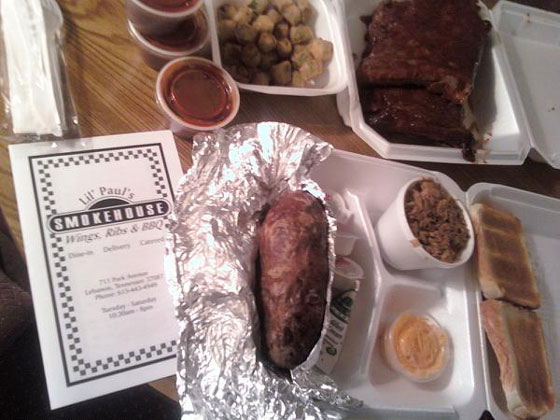
Mike called last night. Thank God I was home. He was on the road in Lebanon, Tennessee, and he needed barbecue, and it was getting late. I offered to get on the web and help. Google offered about five restaurants in his area. I brought up a map and steered him to Li’l Joe’s Smokehouse.

It was just like The Matrix. “Operator, I need ribs. FAST.” “I got you, man. Take the next right and proceed three blocks.” Fortunately Joe Pantoliano was not there to pull the plug out of Mike’s head. Mike got to the restaurant right after they had closed due to slow business, and he persuaded them to sell him a pile of takeout. He got ribs and a barbecue baked potato. This is a potato stuffed with butter, sour cream, and pulled pork. He promised to email me a photo, but maybe Agent Smith intercepted it. Or even stole the potato.

AGENT SMITH: I’d like to share a revelation that I’ve had during my time here. It came to me when I tried to classify your potato and I realized it’s not actually a side dish.

MIKE: How about I give you the finger, and you give me my potato?

Actually Mike is more like Morpheus. “Mikeus.”

MIKEUS: You are a slave, Stevo. Like everyone else you were born into bondage. Into a prison that you cannot taste or see or touch. A prison for your stomach.

STEVO: I’ll take the blue pill. And this cheesecake.

MIKEUS: I’m trying to free your belly, Stevo. But I can only show you the door. You’re the one that has to walk through it. If you still fit.

STEVO: You can’t scare me with this Gestapo crap. I know my rights. I want my phone call. Hello, Pizza World?

Something like that.

It’s so depressing. Mike eats pretty much whatever he wants, and I had oatmeal for breakfast again.

Off to Home Depot.

Cutting and Grinding

Wednesday, January 28th, 2009

Plus a Revelation

I learned a few interesting things today.

1. It’s best not to grab a 4 1/2″ cutting wheel while it’s moving.

2. Plasma cutters are lots of fun.

Yes, I have a plasma cutter. I didn’t mention it when I bought it, because at the time, I was tired of hearing about how I needed an intervention. Okay, shut up. It’s not like I’m hiding new tools because I’m an addict and I’m in total denial. It’s not. It ISN’T. Oh, like you never bought a new tool. You’re just as bad as I am. You’re the addicts, not me.

Actually, that is completely true with regard to a whole bunch of you.

I guess people are shocked to learn that I don’t tell every single detail of my life here. Or maybe they’re just relieved.

Anyway, I bought this thing, and I never used it because I was flipping out over the clean/dry air problem. I got one of those filters that holds an element that looks like a roll of European toilet paper, but I never got an air dryer because every time I tried to figure out what kind I should get, I went crazy from confusion.

Today I slapped the toilet paper thing on and fired the cutter up. I figured surely it wouldn’t get soaked from the few cuts I planned to make. I also figured I could open it up and let it dry out between uses. Why not? If you use the machine once every two months, surely you can get away with that.

That thing is a blast. And easy to use. The biggest challenge is to move the gun fast enough to keep up with the cutting. You have to move fast to keep from making gouges in the metal, but you have to go slow enough to retain control. It’s like a light saber for metalworkers.

I wore shorts and tennis shoes while I used it, but I also wore my welding helmet. The manual was very confusing. I’m positive the shorts were a bad idea, but while the cutter came with weird little glasses, the manual seemed to recommend a welding helmet. I don’t think it darkened. The manual also recommended hearing protection. Which is weird, because this thing just hisses a little, and that’s from the air coming out of the gun.

I think the water had an effect toward the end, after a bunch of cuts. The cuts got sloppy. Maybe I was doing something wrong. Whatever. It was still great. As much as I love the dry-cut saw, there are some things that are hard to do with it, because of the geometry. You can cut a 4″ square steel bar in half with it, no problem. But put angle iron in it in the wrong position, and it can flip the workpiece out of the vise and do awful things. Also, it makes tons of pointy swarf. I found a solution to that. I blow it out into the driveway and wet it with the hose. By the next day, it has rusted to the point where it’s not sharp enough to be a problem. Little things rust really fast. I don’t know where it goes after that. Maybe the swarf fairies come pick it up.

What a time-saver the plasma cutter is. Zip, zip, zip, and you’re done. Setting up takes ten times as long as cutting. And the cuts are accurate to within maybe a sixteenth.

I cut the main members for the bandsaw base, and then I used a hand grinder to fine-tune the coping. I used a long piece of uncut angle iron as a gauge to see if the pieces I was cutting would fit. Then I found out something disturbing. Home Depot steel is not shaped the same as North River Drive scrap yard steel. The work I did on one piece was fine when mated up to the Home Depot steel, but it was way off on the scrap yard steel. So I decided to make it to Home Depot specs, and tomorrow, I’ll buy another piece of Home Depot metal, to finish the base. It’s easier than driving up to the river.

Now I just have to cut the remaining piece, file everything smooth, remove rust and scale, and weld. I plan to practice on some of the crap I ended up with after today’s work.

I spent about a year on this stuff, and I am aware that I could have done it a lot faster, but when you’re a hobbyist, the process is the objective.

The plasma cutter, not the welder, is the reason I have a 60-amp circuit in my garage. If you’re a tool person, I highly recommend you buy a plasma cutter, because you will have to run a huge circuit, and after that, you will have a lot more tool options.

I’m not sure why I grabbed the cutting wheel while the grinder was running. One nice thing about getting old is that your hide gets tough. I have a very interesting rut on my finger, but it didn’t bleed. When I was a kid, it was a lot easier to cut and burn me. I am not sure why that is. These days, it takes some effort. I still remember picking up a skillet I had just seasoned in a 500-degree oven. I didn’t even get a blister. Of course, I put it down pretty quickly once I realized it was hot.

I would not bet money on the mobile base welding up correctly, but I’m learning a lot and having fun. And the sparks freak out people who drive by the garage.

I Need a 200-Pound “No Trespassing” Sign

Wednesday, January 28th, 2009

Miami Manners Strike Again

Today I’m going weld again. I hope. My efforts to create a rolling base for my bandsaw produced poor results, to put it mildly, so I got another piece of angle iron, and I am psyching myself up to give it another shot.

I wish I knew of a good way to remove rust and scale without a lot of effort. I don’t have a sandblaster yet. Last time, I used a drill with a paint-removing wheel, and it does a great job, but it takes an eternity. Maybe I should use sandpaper this time.

The milling machine question keeps rolling around in my head. First I wanted a drill press. Then I wanted a Millrite, because it would take up roughly the same amount of room and do more things. Then I wanted a Bridgeport, because it was only a little bigger than the Millrite, and I knew there was no possibility that I would ever need anything bigger.

I am now tempted to go look at the Millrite the local dealer is selling. The compelling reasons for buying a big used mill were economic. Little mills cost as much or more and do less, and it’s hard to find good used ones, and the new ones cost more than big used mills. And if you resell a little mill you bought new, you can forget about getting your money back. Although a lot of Craigslist and Ebay dreamers don’t seem to realize that. “TAIWANESE MILL/DRILL! USED IN PRODUCTION SHOP FOR 5 YEARS! PAID $3000 NEW! WILL TAKE $2900!”

Yeah, okay. I’ll be in touch.

It amazes me that people who sell used tools think they can recover almost all of their money. Warranties and years of added use are very valuable; a buyer who isn’t getting these things is entitled to a huge discount. If you’re not saving a buyer a minimum of a third of the cost of a new machine, you’re overcharging. Really, half is the minimum.

Anyway, yesterday I realized that the Millrite will fit better in the space I have, it will almost certainly do everything I want for at least a couple of years, and when I get tired of it, I can sell it without taking a big hit. If I can get the price down a little. So it doesn’t really make sense to try to cram a bigger machine in there. I can get one later, at little or no added expense. I assume most of the junk that goes with it will work with a bigger mill.

The biggest job I can foresee at the moment is milling the heads from my Harley. They’re pretty small. I don’t mean shaving them down to increase the compression. I mean fixing the bad factory geometry that impedes gas flow. It’s a Harley; surely I don’t have to explain that the engineering is bad.

By the way, can anyone tell me what the lever settings on an aftermarket petcock mean? I had to replace the pathetic Harley unit, and the new one (Golan) points in three directions: back, sideways, and forward. The directions don’t say which means what.

The big mill question is, how do I evaluate the machine? I have received a lot of useful tips, ranging from, “If it runs, buy it, because nothing serious ever goes wrong with milling machines,” to, “If you can’t have it tested by MIT and NASA, you are almost certain to bring home a machine that is only valuable for scrap.”

I exaggerate, but not as badly as you think. People on forums literally say you can buy a machine that is so worthless it has to be scrapped.

A lot of old machines come from teaching environments. My best guess is that they would be better buys than industrial machines. Although I do have visions of Beavis and Butt-head in shop class, playing Rock ’em Sock ’em Robots with the equipment.

I got some pointers on checking machines out, but ultimately, a leap of faith will be required.

I also need to buy some rocks. There is a house going up across the street, and the folks working on it need gentle reminders not to park here. A cracked differential would fill the bill nicely, and a couple of big rocks are the way to achieve that goal. Miami is incredible; people will stand in your face and tell you they’re entitled to park in your yard (on your popup sprinklers) because the strip by the road belongs to the government. That isn’t true, and even if it were, that’s how trash acts. It’s not acceptable. In other words, it’s perfectly acceptable in Miami, but in a civilized area, it would get you shot, and there would be no possibility of an indictment. This is why rocks and concrete yard ornaments are such huge sellers here. They’re all over the place. In other parts of the country, they are unnecessary, because people know how to behave.

I spent some time yesterday Googling gorgeous homes in the middle of the state. Cheap. Huge. Not surrounded by contentious barbarians who are constantly at each other’s throats. Oh, yes. It WILL happen.

By the way, I did not delete my blogroll. It’s hosted at Blogrolling, and evidently, they are having problems. I can’t even log in to check on it. Hopefully it will come back to life soon.

Industrial Index

Tuesday, January 27th, 2009

Deals to be Had?

Anyone heard of Index brand machine tools? Guy in Central Florida has a couple of mills. I tried to look them up on Practicalmachinist, but you can imagine how many posts contain the word “index.” I did see some favorable material. Supposedly, these are better than Bridgeports, but they sell for less. And the company still has parts, and the service is great. Down side: Bridgeport is like the Chevy 350; anything you need for it can be found easily.

Metalmaq in Hialeah has one. Looks like it has seen some hard times: CLICK.

My Degree May Have to be Rescinded

Monday, January 26th, 2009

Compressor Confusion

Figure this out for me. I’m elaborating on an earlier post.

The classic air dryer for cheap metalworkers is the Maxhootue/Harbor Freight job. Same compressor, different sellers. “Maxhootue” is an Ebay user who sells them. They are rated up to about 21 CFM @ 140 psi. I keep my compressor’s pressure switch set at 175, and I never raise the output pressure above 125, although I suppose there is no reason why it couldn’t pump more than 21 CFM at the lower pressure. It’s probably at 90, now that I think about it.

I don’t really know how much it blows. It does 17.4 at 175. Presumably, the pressure and volume relationships are linear and so on (Ideal Gas Law), so you would think it would go up to maybe 25 CFM at 125 psi, with nothing connected. I am too lazy to use “calc.”

These things are made in China, but everyone, without exception, seems to like them.

Right now–do not ask me why–Grainger is selling a bigger drying machine for the same price as the Ebay job. It’s a Speedaire. Probably also made in China, but somewhat more reputable, and there is a local dealer I can raise hell with if it craps out. The Speedaire will do 40 CFM at 175 psi.

The odd thing about these machines is that they seem to work better at higher volume rates. It’s as if the big thing limiting the capacity is the compressor, not the dryer. Jack up the psi, and you get more CFM, and the dew point remains the same.

Okay, wait. If that’s how it works, then either compressor is fine for my needs. The figures must describe the unit’s ability to pass air, not its cooling ability. That would explain why more pressure gives more dry air, with no penalty for shoving more molecules through the system.

Now my head hurts. What if my compressor blows LESS air at 125? If it works the same way as the dryer, that’s what you’d expect.

Maybe I need to put bigger fittings and a bigger hose on this thing. Curtis recommends 3/4″ pipe for 20 cfm.

The Curtis materials say this thing blows over 16 cfm pretty much regardless of pressure, so I guess the 125 psi figure (assuming I’m not choking the machine) is about 16. How can that be? You would think it would suck matter in at the same rate, all the time, so it should also blow it out at the same rate, so you would think lower psi would equal more CFM. BUT APPARENTLY NOT.

Hmm…if they’re measuring at the inlet into the tank, it would make sense. No, it wouldn’t. Geez.

I am going to go dig out my diploma and confirm that I really have a degree in physics. Maybe I imagined it. I can’t believe I’m confused by this crap.

Anyway, I’m wondering if there is any point in getting the Grainger machine. The cost is the same, and it will be murderously effective even if I upgrade to a bigger compressor some day, and it probably has a warranty that actually functions. And resale should be high. On the down side, it weighs twice as much and is about the size of a 15,000 btu unit air conditioner. The Ebay thing appears to be roughly the size of a PC tower case.

Dew Point?

Monday, January 26th, 2009

How Low?

Here’s a tool question.

Sooner or later, I want to get an air dryer for my compressor. It will blow up to something like 17 SCFM at 175 psi. I keep the output at 125 psi or lower. It rarely goes above 95 degrees here, and it is extremely unlikely that I would trouble myself to work at that temperature anyway. The lowest temperature I am likely to put up with is probably 60 degrees, although it’s possible that I will move farther north, and that there may be times when I would want to use the compressor at lower temperatures. I very much doubt it, though, because I’d probably put a heater in the shop.

What dew point do I need? It looks like the choices are 38 and 50 degrees Fahrenheit. I don’t see myself doing any painting, but plasma cutting and sandblasting are likely to happen.

I think the little Harbor Freight machines are probably good enough. Everyone seems to like them. But sometimes you see something really nice on Ebay or Craigslist, for less money.

Saturday Weld

Saturday, January 24th, 2009

Problems

Wow, am I a bad welder.

I watched my MIG video again, and I got my metal ready, and I turned on the welder…and I made a disgusting mess. Spatter was all over the place. I ruined a tip right away. Then I realized I hadn’t turned the gas on.

Okay, new tip.

I started over. Not much better. I couldn’t see a thing. Very frustrating. When I stopped welding, the second tip was ruined, and there were big gloppy hunks of metal on the weld.

Evidently when I set the voltage and wire feed, I got my fractions mixed up in my head. I set it for 3/16″ instead of 1/8″, so the voltage was too high.

I turned everything down to what appeared to be the 1/8″ settings. Still couldn’t see diddly. Ruined a tip. Wandered around the joint.

Since then, I’ve been getting a lot of grinder practice. My theory: if you can grind really well, it doesn’t matter if you can weld.

Bad theory, I guess. Although adequate for a crappy mobile base.

I don’t know what’s going on. Maybe I have the helmet adjusted wrong. Maybe I read the wrong scale on the gas regulator.

I’m going to look the welder manual over, and then I’m headed to Home Depot for more nozzles and maybe even some overpriced metal to play with. The truth is out there.

More

Turns out the wire feed was too slow. Because I weld about once every eighteen months, I had forgotten how fast you’re supposed to go, and I was sure I was flying, so I slowed the wire feed down and moved the gun slowly. This caused the wire to melt back into the contact tip. This is known as “burnback.”

Bummer.

Precious Metal?

Friday, January 23rd, 2009

Not on North River Drive

I had a wonderful adventure today. I wandered up by the Miami River and got me some metal for a bandsaw base. On a reader’s recommendation, I went to a place on 20th street. Man, do they have a lot of metal up there. Seems like every business in the neighborhood sells metal and/or buys scrap. There are giant piles of rusty ferrous stuff and aluminum all over the place. It’s not far from the general area where one would look for machine tools, so I may go back next week.

I got myself some angle iron. Shouldn’t they call it “angle steel”? Anyway, I got some. I got 64″ plus 40″ of 2″ by 1/8″, and I got 13″ of 2″ by 3/16″. I think. Total cost? Under $26.00. Home Depot cost? I don’t know. But let’s put it this way: MORE. If they had what I wanted. And they would not.

I’m planning to miter-cut this stuff and make a box about 32″ by 19″, and then I’m going to use the heavier piece to make four tabs which will serve as attachment for casters. I’m a little nervous, because I’m wondering if I have this right. If I miter the cuts, I’ll be doing a butt weld on each corner. I hope that will be strong enough. Maybe I could weld a piece of scrap across each butt weld on the bottom.

I’m also wondering if 1/8″ will be rigid enough. I figured it would be, because the steel on my mobile saw base is very thin, and it’s not even angled, and it works.

We’ll find out, I guess.

It didn’t occur to me until I had bought the metal that mitering might be a problem. I can put it in the dry-cut saw at an angle, no problem. But to get a 45-degree miter, I have to set it on its base, with one wall sticking up perpendicular to the saw blade. This is a no-no for dry-cut saws. You’re supposed to lay the angle iron down so the V-shape is upside-down. This makes it more stable as the saw cuts.

I suppose a jig is the answer. HA. More fun for me.

I almost don’t care if it works. If the metal is too flimsy or whatever, it will give me an excuse to get welding practice, and I didn’t pay much for the material.

More

Working with tools is full of surprises.

I was trying to figure out how to cut a 45-degree miter in angle iron, without situating the iron improperly in my dry cut saw. It turns out there is no reason to try. The correct way to weld a 90-degree turn in angle iron is to cope it.

I don’t have a picture, but it’s easy to describe. Hold two pieces of angle iron at 90 degrees, in the position they would be in if you made a joint. You can’t do it, because the bottom parts collide, and even if they didn’t, the end of the vertical part on one would butt up against the side of the vertical part of the other. So you remove the parts that get in the way; take out the redundant metal. Remove a square piece from the horizontal part of one piece, equal in width to the total width of the angle iron. Then trim the vertical part of the piece you took the square out of, so it will fit inside the angle of the other pieces. You only cut one of the pieces of angle iron. Weld and pray.

Oh, forget it. Here’s a Youtube:

Tool Escalation via Rationalization

Friday, January 23rd, 2009

I Must Own All Tools

Is this a beautiful day, or what? It’s too cold to sweat, it’s too dry for the mildew to grow, and the sun is out.

I appreciate the information people have sent me on milling machines.

It’s funny how my “needs” have changed. First, I thought I needed a drill press. Then I learned that a mill would do 98% of what a drill press would do, plus a whole lot more. And I learned what a good drill press costs; if you don’t spend at least $600, you are not buying a lifetime machine that will do metal and wood well. And $1000 is more realistic. That’s a lot, just for holes and sanding.

So I started looking at mills. I was pretty excited about small “mill drills.” Then I learned that they cost roughly the same amount of money as huge mills that will do almost anything, because there are lots of used industrial milling machines out there. And I’d be willing to bet that a 40-year-old industrial mill will outlast a brand new Chaiwanese mill/drill, and I know it has a better resale value.

I thought a Millrite would be a good choice, because it’s big enough to do a lot, but you can fit it in a garage fairly easily. But then I learned that they don’t cost much less than Bridgeport Series I mills, which are better and probably easier to get parts for.

It looks like there is a price envelope, including shipping and taxes, of $1500-$2500, no matter what I buy. You can spend more, but this seems to be what you should pay for a good used machine, if you’re willing to fix it up a little.

One big problem: I am incompetent to evaluate a used milling machine. Jdunmyer sent a link to a helpful site, but even if I applied the information, I would probably make mistakes. Also, a lot of the deals out there are beyond my normal driving range, so I can’t really get to them to look them over.

I keep reading about backlash. I’m not totally positive what this is, except that it introduces error into table movements. It sounds like you crank the table to a certain position, and then it backs up on its own. It’s supposed to be a problem on old machines. Can you correct it? I do not know. Can you work around it? I do not know.

Maybe the best thing is to get a cheesy drill press and use it until I get a deal in which I can have confidence.

Here’s an interesting buy. Someone in the Tampa area has a Bridgeport mill which can be had for $1250, meaning it can be in my garage for maybe $1700. The ad has expired, but I have a feeling they would relist it. It’s 3-phase, which is good, but it has a 3-phase feed motor, too, which means I’d have to replace it and use 2 cords, or I would have to find a way to run both motors from a VFD, or I would need a VFD plus a converter for the feed motor. I guess that would be a problem with any 3-phase mill that has a second motor. Do I even want a feed motor? Can you use a mill as a drill press when it has a feed motor?

There is a local dealer with a Millrite, but they want $1950, which seems very high. A lot of people pay two grand for these machines, but many people pay half of that, and the economy is not good, and it’s not going to get better for a very long time, if ever. Prices on used industrial equipment should be plummeting, unless the Chicoms and Indians are buying it for export. I very much doubt that they have any interest in it. They make their own equipment much cheaper.

A guy in Texas has one for a grand, but when you add the other expenses, it’s $1700, and it appears to be pretty old, and I can’t inspect it.

The nice thing about a mill is that it should be the last really big tool I’ll ever need. I could always add a lathe eventually, but I should be able to get by without it very well.

I think I’m finally in a position to make a few things, or at least I will be when my bandsaw table pin arrives. I have been occupied with other stuff this week. I may run over to Shell Lumber and see what they charge for hardwood boards. I really need some metal for a bandsaw base. I think I’ll just make a frame with 2″ angle iron (not perforated) and then cut small pieces of angle iron for tabs through which I can run the bolts for casters. I assume angle iron this big would be sturdy enough. Each tab would have to support about 110 pounds, even with work on the table.

I don’t understand how the stabilizing doodads on my table saw’s HTC3000 mobile base work. They are supposed to rotate little feet down onto the concrete to stabilize the saw, but when I screw the feet up as high as they will go, they are still so low they would raise the saw quite a bit if they were lowered. And that means there is tremendous resistance when I try to use them, so it appears to be impossible to make them work. The plastic levers that operate them would snap. I don’t really need them. The saw’s four other feet have brakes. But I wish they worked.

A guy with a welder and some cutting tools (i.e. me) can make a nice mobile base with locking feet. A guy with a welder and some cutting tools and a mill can make little cammed things that lower the saw and stabilize it. Unfortunately, that guy is not me.

Not sure how I’m supposed to get the saw off the ground to lower it onto the base. I think my hoist will do it, but there is always a possibility that 367 pounds will pull the garage roof down. Probably not. The saw has a weird eye in the top of it. Is that for lifting? I don’t know what else it could be for.

My Incra V27 miter gauges arrived. My bandsaw had no gauge when I bought it, and the table saw had two really bad ones. These look good. They’re supposed to be very precise, and you can adjust the slop with a hex wrench. I can save the old ones for permanent jigs or something. The one on my portable saw is okay, but I don’t believe in moving accessories from one tool to another when it’s avoidable.

Lots of stuff to think about today. Lots to do. But it sure beats thinking about how I can’t do anything because all of my tools are Chinese junk in a little Rubbermaid toolbox.

Also, I have a great idea for a new book.

There Used to be a Garage Here

Thursday, January 22nd, 2009

More Mill Thoughts

I keep staring at the garage, while a little voice in the back of my head whispers “Bridgeport…Bridgeport…Bridgeport.”

Fortunately, I came up with a good answer. The tooling and accessories for these things are probably insanely expensive. Yes…yes…they have to be. They’re BIG. Don’t contradict me. Besides, a Bridgeport takes up like 6.5 by 5 feet, whereas a Millrite is more like 4 by 5.

It seems like all good milling machines cost between $1000 and $2000 dollars, so it’s irritating to think that I’ll end up with a small one.