Archive for the ‘Tools’ Category

Hog Spinner Finished

Wednesday, December 21st, 2011

Stunning

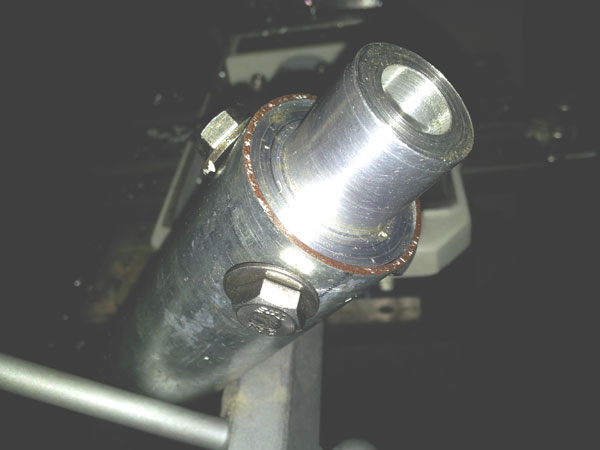
The Hoginator II pork lathe is now fully armed and operational. I finished machining the hubs, and I mounted them on the spit.

The bearing on the motor end is almost certainly unnecessary, and it added a day to the job, because I had to work very hard to get it aligned with the shaft. I also had to get the hub diameter just right, so it would mate with the bearing without being impossible to insert or wobbling due to excess slop.

I still like the bearing, because it takes the load off the tinier-but-supposedly-more-than-adequate bearing in the motor itself. And it looks cool. It could be important if I roasted a big pig. My first effort will be between 40 and 50 pounds. This machine shouldn’t even notice that.

If I were doing this again, AND I were not so determined to use crap I already had, I would get a longer pole to put the bearings and motor farther from the fire. I might still break down and do that. Machining the hubs is work. Drilling the pole is pretty easy.

I sprayed the upright tubes with Eezox. They were so pretty after I brushed the rust off with a grinder. I had to protect them.

I still have to make a charcoal pan.

Anyway, this thing works great, it breaks down for storage, and it should last forever. I’m happy.

New Lathe Running

Monday, December 19th, 2011

New Hotness Beats Old Busted Iron

I got the 7 x 14 running, and I’m very impressed.

Let’s see. What can I put here in case someone else Googles the problems I had? “Big Dog 7 x 14 lathe quick change tool post Tormach stud remove.” That ought to cover it.

I have a Tormach quick change tool post in 0XA size, and the lathe comes with a very nice but undesirable turret post. I had to take the turret post off the compound in order to mount the Tormach. The turret post sat on an upright stud threaded into the compound. That stud was too short for the Tormach tool post, so I had to remove it and put the Tormach stud in. As everyone knows, a stud has threads on both ends, so you can’t use a wrench on it.

The turret post lever screws onto the stud from on top, so obviously, it can be threaded onto the stud. The Tormach tool post has a flange nut on top, with the same thread. This gave me the working equivalent of two hex nuts. To remove studs, you use a tool I don’t have. When you don’t have that tool, you use two hex nuts. You thread them on the stud and torque them against each other, and for some reason, that makes them grip the threads. Then you turn one of the nuts with a wrench, and that turns the stud.

So I did that, and out came the stud. Now the tool post is mounted. Little Machine Shop sells a milled-down cross slide for mini-lathes that use a quick change tool post. I believe the idea is that turret posts let you get lower on the work. I don’t know if that has any relevance to Big Dog lathes, since they’re different from most small lathes. It seemed like I had plenty of room with the existing cross slide.

I should add that the turret post looked really nice. The lever cover was plastic, but other than that, it looked very well made. Sharp lines and shiny finishes.

The 3-jaw chuck that came with the lathe looks very good. I have not measured the runout yet, but it appears to be machined as nicely as my Phase II chucks, and if it’s as good as they are, it will work fine. It only holds objects smaller than two inches in diameter, unless you turn the jaws around. That’s something I’ll have to do, as soon as I figure out where the numbers on the jaws are. I don’t want to put them back in the wrong order.

The lathe has what appears to be a for-real tachometer. Inside the gearbox, there’s a flange on the spindle, and the flange has a hole in it. There’s a little reader in there, and the flange rotates through it. I guess it looks to see when the hole is going by. Anyway, if they went to that much trouble, it must be the real thing, instead of some kind of estimate based on current flow or whatever.

I ordered a handheld Chinese tachometer off Ebay before I realized the lathe had one built in, but I need it for the Clausing, too, so it was a good buy. I can also use it for the drill press. It’s not here yet. It was about $14, including shipping. From the little experience I have, I am starting to wonder if it’s even necessary to know your spindle’s speed, since it pretty well tells you when it’s wrong, but I guess I’m not qualified to say.

I got 34 RPM on the low end. The top speed is 2500. At 34, even I should be capable of competent threading. I don’t look forward to changing gears by hand, but it would be such a rare thing, I think I can stand it.

The lathe spins nicely, unless (like me) you turn it on with the jaws out of whack. I assume that means it’s going to be a little lumpy when irregular parts are chucked.

The change gears are nylon. I rented a mini-lathe video by an expert named Jose Rodriguez, and he said the nylon gears on his old min-lathe were nylon, too. He managed to get some metal gears, but he didn’t use them, because the nylon jobs didn’t break or wear noticeably even after years of heavy use. I guess I can live with them, too.

I happen to have an old round-nose tool I ground from 1/4″ tool steel or cobalt (can’t recall). I cleaned it up and stuck it in the tool post and faced an old Home Depot bolt I had lying around. Everything worked very nicely. I tried out the half nuts, and the tool moved smoothly toward the headstock. The facing went well, but the cheese-like Home Depot metal stuck to the tool when I used the half nuts, so the finish was dubious. Doesn’t matter, since I wasn’t doing anything useful.

The compound has a bit of a gritty feel when I move it, and I notice oil oozing out of the joints when I rock it, so I would guess that the underside could stand some cleaning and polishing, and the gibs may have to be tightened.

I have carbide tool holders on the way. They’ll set me free to do what I want.

This lathe is easier to use than the Clausing. I’m not sure why, since it has pretty much the same controls. Maybe it’s because everything is so close and handy, and because I don’t have a heavy 8″ chuck spinning near my head while I’m trying to use it. I usually use a Skinner 4-jaw chuck on the Clausing, and it must weigh 50 pounds. I don’t think I’ll ever get used to having it spinning right in front of me.

I think this is going to be a huge convenience. Big lathes take more effort to use, apparently. Suddenly I have something to think about, in case I get rid of the Clausing and upgrade. Going to 13 by 40 won’t be a big difference, but from there to 14 inches is a big leap. The machine weight goes from around 1600 to 2500 pounds, and I assume the tooling is also heavier and more aggravating to use.

Having played with this thing, I think it would be a great tool for anyone who wanted to learn about machining. If you’re really worried about money, you won’t want to buy a small lathe AND a big lathe, but if you can afford to have both, I think the small lathe is the better starting point. You can tool it up inexpensively, you can do all sorts of things with it, and if you decide you don’t want to use it as your primary lathe any more, you can CNC it.

I really look forward to receiving those cutting tools.

New Chinese Girlfriend

Monday, December 19th, 2011

Petite and Finely Turned

The new lathe showed up. It’s a Big Dog 7 x 14.

They ship by Fedex, and the lathe was palleted and also enclosed with a cardboard box, styrofoam, and a wooden frame over it. The driver removed everything but the box and put it on the pavement, and I rolled it into the garage on a handtruck. It’s supposed to weigh about 90 pounds, but it maintained an impressive grip on the earth when I tried to lift it. I guess my total lack of an exercise regimen is paying big dividends. I put a little effort into it–something I always prefer not to do–and up it came. It’s sitting on my workbench.

It looks surprisingly nice. Chinese mini-lathes generally come buried in red (appropriately) grease, but this one just had a little cosmoline or something similar on the exposed surfaces. I cleaned it in about five minutes, using a paper towel and alcohol. I’m going to put Vactra on it, since I have no guidelines to the contrary.

I’m very surprised at the quality of the workmanship so far. I haven’t seen any problems yet. My Chinese mill never had any defects, but the parts are all from Taiwan, so that isn’t a big shock. The lathe is pure China. It was made by a company called Real Bull.

I can’t tell you how happy I was to see the steady rest and follower rest sitting on the ways. I still have no rests for my Clausing. The other day, a 12″ Clausing rest sold on Ebay for about $480, which shows you how ridiculous parts prices are. A rest for a 7″ Chinese lathe is something like thirty bucks, I believe.

Looking at this lathe makes me wish I had never seen the Clausing. The Big Dog is ready to go. No damage. No wear. And if I want to add stuff to it, all the parts are available, brand new, at sane prices. If it were the size of the Clausing, parts would cost a lot more than mini-lathe parts, but they wouldn’t cost what Clausing stuff does. Besides, the Chaiwanese manufacturers don’t consider rests and drill chucks and other such items “accessories.” They come WITH the tools.

I’m adding about three hundred dollars’ worth of stuff, but I could have turned this thing on right out of the box and started machining.

I think I may make myself a promise. If this thing works out, and if I can’t get the Clausing working to my satisfaction, next year I’ll give up and get a Chinese or Taiwanese 13″ lathe. Life is too short.

I really don’t know what goes on in the minds of the people who insist it’s better to buy American. If someone is willing to sell you a quality American lathe at a price a hobbyist can afford, it generally means the lathe is a mess. A new Clausing 5936 would probably cost $20,000 (without accessories), if such a thing existed. I paid $2200 for one nearly as old as I am. Sometimes an eccentric will die, and his like-new lathe will end up in an estate sale priced at $500, but if you wait for things like that to happen, well, you’re an idiot.

I seriously think the China-bashing may be rooted in slavish support for labor unions. Union members tend to be pretty rabid in their efforts to destroy competition, and that would certainly extend to former members on Internet machining forums.

There are no new American manual lathes, unless you include Sherlines and Taigs, which are tiny. There are no union jobs lost when you buy from Shop Fox or Enco. You can’t advance the cause of union socialism by buying a used American lathe, but you can advance the cause of Chinese capitalism by buying Chinese.

People said I was stupid to pass up “reconditioned” American mills. Oh, man. Talk about wrong. For four grand, I could have had one of these things delivered, minus the DRO and variable speed. What does “reconditioning” mean? It means they paint it, grind the table down, and scrape the ways, pretty much. To me, that sounds like buying a car with 150,000 miles, just because someone painted it and gave it a ring job. What are the bearings like? How much longer will the motor last? Does the spindle have runout from 50,000 hours of use, and if not, will it develop during its first year in your garage? No way to know.

Over my years of trying to gather info on machine tools, I’ve noticed that two guys get a lot of respect. One is Frank Ford, and the other is Forrest Addy. They both come down on the pro-China side, when it comes to tools for newbies.

Rotisserie Takes Shape

Thursday, December 15th, 2011

Shiny Metal Good Mask for Cluelessness

I made a lot of progress on the pig motor today.

I decided not to use welds for all of the fabricating. I had a steel plate scrap I planned to use as the mount, and it turned out it had some holes in perfect locations for bolts, so I decided to bolt it to the steel-tubing upright that will hold it up. It also has a couple of curves that make it fit snugly against the tubing, and they should add rigidity.

I took a piece of square tubing Val Prieto gave me, and I cut it to length using the grinder. I have faster cutting tools, but the grinder was handy, and it’s a little more artistic. Then I put a wire brush on the grinder and cleaned the metal. Wire brushes on drills and drill presses are pathetic compared to the ones that fit on grinders. Take my word for it. The only problem is that they throw bits of sharp wire all over the place, and they can actually fly in curved paths, so you really need a face shield AND goggles.

I opened up the holes in the plate. They were too small for 5/16″ bolts. This was not fun. Holes in sheet metal don’t like being opened up with drills. My drills kept catching. Surprisingly, they also caught when I drilled a fresh hole. I have no idea why. I ran the drill slowly and used pipe threading oil.

I used the drill press and my snazzy South Bend vise to drill holes in the tubing, and then I mated the tubing and plate, and it was beautiful.

I realized I needed reamers. That’s what you use to open existing holes and make them round. I’m trying to find out what kind to get.

Incidentally, I found out there’s an amazing tool called a bridge reamer. You’ll love this. If you’re doing what I did tonight–drilling a bunch of holes that have to line up and take bolts–a bridge reamer is what you need. Apparently it takes your crappy, misaligned holes and makes them pretty and makes them line up. I think. Anyway, that’s what the Enco catalog implies. I need a couple of these things. If they work as advertised, they would be incredbly useful. Making holes line up is not easy.

I only put one hole in the plate. I installed the motor and tightened the nut, just to see how it would look. I can’t put the other holes in until the bearing is installed. The bearing will tell me where the holes have to be. If I do it now, I could be off by an eighth of an inch, and then I’d have to commit ritual suicide.

Here are some bad phone photos.

The bearing will rest on a horizontal piece of square tubing perpendicular to the motor shaft. The tubing will be welded to the side of the upright tubing.

You can’t see it, but there’s a lot of room to the right of the motor. I’m going to get a light switch and put it there, in a nice box. That will allow me to turn the motor on and off.

I’m working on the charcoal pan. I found aluminum sheets today for about $14 each. They’re only 24″ by 36″, so I may have to use two. I would prefer this to galvanized. They won’t rust. I keep reading that aluminum will take the heat of barbecue charcoal. I hope that’s right. I can do a test tomorrow with a small piece of aluminum.

The motor shaft is a little loose in the 1/2″ hole in the hub I made. On top of that, it has a key instead of a flat spot. That means I have to make a keyway. I plan to do that by sticking a ground tool in my lathe tool post and pulling it in and out of the hub. But I think I need to make a new hub, because the looseness will be a problem. Unless the bearing allows some movement (search me; I haven’t seen it yet), I think any eccentricity in the pole’s fit will cause problems when the motor operates in its rigid mounting. If there is play in the bearings, I’m fine as I am.

I love the way that polished steel looks. I want to paint it, but that’s pointless because the burro will gouge it up. I think I may season it like cast iron. I’ll throw it in the oven with oil on it. It will look good, and it won’t scratch like paint.

The steel plate has to be shaped a little, because the bottom edge is rough from plasma cutting. I think I’ll use the bench grinder. Then I’ll clean it up and blast it with truck bed paint, which should last forever.

The other end of the apparatus will be a joke. A bearing, a T-shaped piece of metal, and some bolts.

It looks like this is going to work, and when it’s done, the whole thing will fit in a very small space. The burros go back to Val until the next pig event.

Stay tuned for more updates.

More

This is really sad. Someone just suggested I use step drills for enlarging holes. He’s absolutely right. And I already have them! I can’t believe I didn’t think to use them.

Cheap Cutting Fluid for Aluminum

Thursday, December 15th, 2011

Hope it Works

I learned something interesting the other day. You can use diesel for cutting and tapping aluminum. I haven’t tried it yet, but a machinist recommended it to me, and I’ve seen it elsewhere on the web.

I’m mentioning it because a lot of people recommend WD40, which costs over $14 per gallon. I just got a fuel-safe container plus a gallon of diesel for about $11.

I will post my observations after I try it.

As the Pig Turns

Wednesday, December 14th, 2011

Techno-Hog Rumbling to Life

The pig project is going to take a big leap today, assuming the motor arrives. I’m going to mount it on the supports. The bearings aren’t here yet, so I can’t machine the spit ends to fit them.

I don’t have a link to the motor I bought. I think Grainger discontinued it. But I can show you one just like it, except for the speed. Imagine this motor, running at 6 RPM with 250 inch-pounds of torque.

CLICK TO SEE MOTOR.

Naturally, I did not spend that much. Knock 80% off that figure.

I didn’t want the angled shaft, but now that it’s on the way, I think it’s the best choice. It’s easy to build a platform parallel to the spit support, which is what an angled shaft requires. A straight shaft means a platform which is perpendicular to the support, and that means welding.

I have to figure out what to do for a charcoal pan. I’m thinking I may just get a cheap galvanized sheet and bend the sides up. I know some people moan about zinc fumes being released, but Val Prieto uses galvanized, and so far, nobody important has died. I’ve also noticed that Lodge makes a chimney starter from galvanized, and it’s also common in barbecue stuff in England.

I would be perfectly happy to use bare steel, but it’s not like it falls from trees.

I’m a little nervous about achieving success. I’m researching to make sure it’s okay to roast a pig without an enclosure. I can recall three rotisserie pigs cooked at Mancamp. One was turned by hand, and it sat in a makeshift oven built from stacked cinderblocks. The oven had plywood on top to hold in heat. The advantage there was that in addition to heat from below, the pig got a nice 200-degree sauna. The other two pigs were not enclosed to any great extent.

I guess I’m worried about nothing. The Mancamp pigs were fine. Here’s a video of two Filipina ladies roasting a pig, and you can see it’s out in the open. If I had two ladies like that, I wouldn’t need a motor.

I had concerns about the spit speed, but I’ve learned that some rotisseries turn at much higher rates.

The new lathe will be here on Monday. I’m tooling up. I’m a little annoyed, because I thought I picked the best one, and I just found out it may lack a nice feature. In the past, small Asian lathes had metric screws on the compounds and crossfeeds, and they were marked with inaccurate imperial graduations. I believe the idea is that they pretended one inch is 25 millimeters, whereas it’s actually 25.4. So I guess you get a movement of 25 millimeters when you want one inch. Or maybe I have it backward. Anyway, Micromark claims it has the only lathes with “true inch” wheels and screws.

It shouldn’t matter much, since the final dimensioning is never done with wheels, but it’s irritating.

I don’t know if it’s possible to make a really accurate screw on my own lathe. I guess it should be, but I have a feeling it’s not easy to make one that works easily but doesn’t have tons of backlash.

I better get myself to the store. I have to make sure I have a pig by next weekend. I still haven’t decided what to put in it.

This should be a good time. It will be an interesting mix of Christians and highly tolerant backsliders. I think we’ll get along, as long as the food is okay.

God is Too Good

Saturday, December 10th, 2011

Sometimes it Seems That Way

What a day I’m having.

I made a second aluminum hub for my pig roasting spit. It’s nicer than the first one. I had the cutting tools too high on the first shot, so I got chatter. Now the finish is very good, even though I’m using carbide. I have no idea what I’m doing, and I’m too lazy to look things up and do it right, so I learn a lot from experience.

I threaded the bolt holes on the hub, but I fouled the threads on two of the bolts. I didn’t know that aluminum swarf could become one with a steel bolt, but apparently this is a hazard of threading. It must be, since it just happened.

I knew aluminum had a very low melting point compared to stainless, so I tried to fix the bolts by heating them with a plumber’s torch. I got one of them red hot and then tried to put a nut on it. I gave up. That stuff is on there for the duration. But after I did this, I picked up the nut with my bare hand. I didn’t realize how much heat had gone into it.

I felt that I had burned myself on the pad of my index finger. I hate that. Such a useful finger. It had that flat, shiny look burned skin gets, and it hurt pretty bad. But I remembered something the Holy Spirit told me a while back. I was lying in bed, and I kept hearing the words, “You are protected” in my head.

What the heck, right? God has instantly healed me of two kidney stones while or shortly after praying, and a few weeks back when I started getting a cold, he took it away in a couple of hours. My sister is still alive (and in total remission), a year and a half after being diagnosed with extensive small-cell lung cancer; I prayed a great deal about that. I decided to pray about my finger. I “reminded” God of what he had told me. And I started thanking him. The finger still felt like it was in the process of blistering.

Guess what? My finger is fine. It has been around half an hour. I have no pain at all. I can use the finger. I can put pressure on it. The skin doesn’t look flat and shiny any more. I went and looked at it in the light, because I was so amazed. It looks like any finger that has been working with tools all day.

I just don’t know what to say. I told God I would tell people about it. You have to do that. I’ve heard preachers say you should make a monetary sacrifice when God does something for you. Maybe that’s true; I tend to discount it these days. But you definitely, DEFINITELY have to tell people.

Now you’ve been told.

Here’s something funny. I went to a machining forum and mentioned the pig work I’m doing, and several people expressed concern about the galvanized pole I’m using. I had to reassure them. I’ve done this a bunch of times, and Val even has a big charcoal pan made from galvanized. It doesn’t cause any problems.

The funny thing is that Og dropped by the blog the other day, when I wrote about lathes. Og and I are both hard-headed. Well, he’s persistent and determined. I’M hard-headed. Anyway, we had a big fuss over the hazards of backyard galvanized pig tools a few years back, and here I am discussing them right when he happens to be dropping by.

I guess zinc is like religion and politics. One of those things best not discussed socially.

Hoginator II

Saturday, December 10th, 2011

Rise of the Machinists

The Holy Spirit has been teaching my friends and me about the importance of love and mutual support, so we are trying to spend more time together. We decided to try to get together on Noche Buena (Christmas Eve) for a pig roast. I’m hosting. I decided to built a roaster.

I found an unbelievable $380 motor on Ebay for $78 plus shipping. It has 250 inch-lbs. of torque, and it turns at 4 RPM, so it’s a dream come true. I’m making the spit from a length of 1 5/8″ galvanized fencepost. I machined a hub for one end, with a socket for the motor shaft. I found cheap pillow bearings on Ebay, so I’ll have one at each end of the shaft. I still have to make the second hub.

Today I drilled and tapped three holes in the hub, and I bolted it to the spit. Check this out. It’s gorgeous. I somehow messed up the 120-degree angles between the holes, but it won’t affect the function.

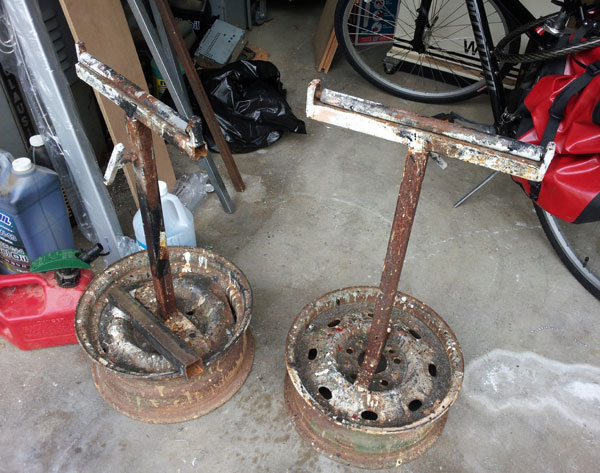
Out of the blue, my buddy Val Prieto offered to let me use two “burros” his dad quit using. These are amazing devices. Each one is a car wheel. They have steel tubing welded to them, standing upright in the centers of the hubs. The tubing has smaller tubing inside it, so it telescopes at the top. The smaller tubing has crossmembers welded to the top, with steel rollers. I won’t need the roller things, but I can use the bases to hold up the motor and pillow bearings. Take a look.

This is going to be wonderful. Those burros will allow me to make very small attachments for pig roasts, and they won’t take up much room. All I need now is a piece of galvanized sheetmetal for the charcoal.

Renewal of Tools

Tuesday, December 6th, 2011

What’s a Good Swarf-Removal Shampoo?

The Holy Spirit is unpredictable. I suppose that’s one reason we’re supposed to let him inhabit us and tell us what to do. It keeps Satan guessing. The written law was considerably more predictable. It telegraphed our punches. It was still more than adequate to make a fool of the enemy, notably at the crucifixion, but the Holy Spirit himself has more flexibility, and he can tailor our actions to each situation, with more specificity.

Why mention this? I think he told me to buy something for myself. He has done this before. Probably many times, I guess, but I’m thinking of one particular example. I was driving on US1, and I started thinking about an Epiphone guitar I had read about, and I felt like I had to make a detour to Guitar Center and pick one up. I found myself saying, “Okay, I’ll buy it.” I walked in and asked if I could take a look at a Riviera P93. The workmanship was surprisingly good. It had features I wanted. And I had always wanted to see what an ES-style guitar was like. Sold. I didn’t even play it in the store.

It turned out to be an amazing guitar. I play it more than any other. The playability is so good, it’s shocking. The pickups were not great, but I put Lollars on it, and now it’s a monster. It’s a perfect blues machine. A little raw, a little dark, and highly expressive.

You can always rationalize when you buy something you want, and it’s easy to get confused and think God is in your own desires, but this was different.

Yesterday, I felt the same bizarre compulsion. And I was thinking about mini lathes.

I have a Clausing 5936. It’s an excellent lathe, crafted to insanely high standards, but it’s not practical for everything I want to do. Trust me on this–I know more about it than you think, even if you’re a machinist–making metric threads on this thing is a nightmare. Just getting the parts costs hundreds and hundreds of dollars, and you can’t get them, anyway. Finding a steady rest or follow rest at an acceptable price is impossible. A taper attachment…you might have to mortgage your house. Of course, if I had listened to Og, I’d have a Chinese lathe, and it would have all the stuff I need, but that’s another story.

I decided to put a DRO on the lathe, and I plan to follow up with an ELS (Electronic Lead Screw). The DRO is in progress. It will make the lathe easier to use. The ELS is a device which is about halfway to CNC. In other words, it’s a computerized, motorized apparatus that guides the lathe, but it doesn’t require CAD and whatever else CNC requires. And you can still use the lathe manually.

An ELS will let me cut any threads I want, and it will do tapers. But it’s a hellish project, and I know it will take a long time to get it together.

Yesterday I felt a very strong urge, and I have since ordered a Big Dog 7×14 mini lathe, plus a little bit of tooling.

This thing is big enough to do just about any threading project that interests me, and it’s small and portable. It comes with rests, a drill chuck, a 3-jaw chuck, change gears, and other stuff old iron usually lacks. Oddly enough, it might be very useful when I’m working on the ELS conversion on the other lathe. It should be a big help to me.

What will I do with it when the ELS is set up? Danged if I know. I believe the Clausing will eventually be easier to use and more versatile than the Big Dog. I suppose the small lathe will be better for anything requiring a rest, up to a certain size.

I have a quick change tool post on the way, plus a couple of random lathe doodads, but because I have the Clausing, I already have a lot of stuff I’ll need. Much of it works with any size lathe. I have tool blanks, measuring tools, acid brushes, a fish, cutting fluid, and so on. The tooling is cheap, which is extremely liberating. The tool post set, which is all steel, was $130.

I’ll have to get a 4-jaw chuck. Life without one is unthinkable.

The mill is benefiting from the lathe DRO. The mill came with a Sino DRO, from China. These things are very cheap, but they work. I have never seen anyone complain about the reliability. Sadly, it was a 2-axis DRO, and I wanted a z readout. I found a guy in Singapore who sells these things, and he said I should buy a 3-axis Sino display, plus a z scale for the mill and two scales for the Clausing. I could put the new display on the mill, and then I could install the z scale. After that, I’d have enough stuff left over for the lathe. Sold. The mill already has the new display on it, and I’m working on the z scale. It’s doable, even for me. The lathe will be a pain, but it will work.

I might as well point out that there was no reason at all to try buying a DRO here in the US. The guy who sold me my mill is unreliable; he still owes me a part. He sells Chinese DROs. I got a 3-axis DRO plus three scales shipped from Singapore for $520. That includes a huge $100+ shipping fee I could not get them to reduce, so the parts themselves cost me around $400. The mill guy would have charged at least $595, plus shipping, and who knows if he would have vanished again. The seller in Singapore was polite, fast with his responses, super cheap, and very helpful with tech advice. If having Asians take over the world means getting this kind of service and pricing, maybe it’s not such a bad thing. It looks like we deserve it.

There are better DROs out there, if you have to have the best. For me, this thing is a phenomenal deal.

I’m also working on the x power feed. I have a feed made by Align, a Taiwanese outfit. Over time, the handwheels required more and more inward pressure before engaging, and now they don’t engage at all. The power feed doesn’t seem to do anything. I’m trying to get it apart so I can see what’s going on. The US representative for Align has not replied to my email yet, nor has the manufacturer. People on forums are giving me tips. I guess it will work out eventually. If I have to replace the entire thing, the most I can possibly spend is $375. I would not want to do that, but it proves the problem is not catastrophic.

It’s supposedly a pretty good power feed. Cheaper than Servo, of course.

Within a few days, I should have a 3-axis DRO and a working power feed (or I should be waiting on the right part to fix it). It’s just a matter of persistence and prayer.

Pizza Pump

Thursday, December 1st, 2011

Buy This Immediately

This is genius. I’m about to make pizza for lunch, but I’m frustrated with opening #10 cans of commercial sauce and then having to deal with the excess. It occurred to me that there ought to be some kind of dispenser made for this purpose.

Guess what? There IS. Check it out at this link.

Apparently, you open the can, attach that thing, and pump your sauce out like ketchup. That ought to isolate the sauce from mold and stuff for quite some time while the can is in the fridge.

I may have to get one.

It Worked a Whole Lot Better in Mathematica

Thursday, December 1st, 2011

Dang

Lately, when I’ve taken my birds out or while I’ve relaxed after guitar practice, I’ve watched a show called Rocket City Rednecks, on the National Geographic Channel. I’ve also watched a show called Mad Scientists, which follows it.

Rocket City Rednecks is about five guys in Huntsville, Alabama. Some of them come out of the space program. For political reasons, NASA was divided up among various states, which is why rockets go up from Florida and receive support from Texas. Huntsville is one of the places NASA invaded.

One of the guys has degrees in physics and various types of engineering. Another is a physics Ph.D. The rest are less educated, although two are machinists, and the oldest one was a machinist for NASA, which presumably means he knows a few things.

The idea is that the main guy, Travis Taylor, gets crazy ideas involving scientific and engineering projects, and he gets the other guys to help him turn them into reality. Generally, they get one weekend per project. They have day jobs, after all.

I thought this was a pretty cool show, because it demonstrated that Southerners are not all morons. Some of NASA’s talent came from places like Princeton and Nazi Germany, but some came from the South.

I don’t like the word “redneck.” My mother taught me that it was a slur. There are a lot of bizarre etymologies out there, but the most likely story is the one she told me: a redneck is someone who works in the sun and has a red neck. When you say “redneck,” you’re making fun of people who work at menial jobs. Still, a lot of people are trying to turn it into a positive, like “queer.” Maybe they’re right.

Let me see if I can recall some of the projects. Once they tried to create an electronically-fired rifle array to shoot frozen watermelons out of the sky, to show how we might prevent asteroids from hitting the earth. They also turned an old RV into a Mars vehicle and even created a pee recycling device from 2-liter bottles. They made their own bulletproof Iron Man suit, and they also created a submarine and took it down 15 feet in a quarry.

It’s pretty neat, but now that I’ve seen a lot of the episodes, I’m a little disappointed. You would think that with two physicists, plenty of engineering training, and two machinists, they’d be able to do anything. But sometimes they make mistakes that should have been obvious, and the projects generally don’t look too good, even for weekend jobs.

Here’s an example. When they made the submarine, they decided to use a plastic fertilizer tank. This is an HDPE (I assume) tank that holds 300 gallons. It has thin walls. It’s a cube.

Here are the problems that surprised them. 1. The tank walls had to be reinforced against water pressure. 2. The original design, which involved two tanks, required over a ton of ballast. 3. CO2 scrubbers made from ordinary paint pails failed and leaked when submerged and subjected to external pressure.

I realize these guys were just fooling around, but I think they should have done better than that. Water pressure and buoyancy are two very simple concepts. Two physicists should have seen those problems coming, and it’s amazing that they thought a plastic tank was the way to go.

I thought about this for a few minutes, and right away, I realized plywood and propane tanks would have worked better. Plywood is cheap, and it’s very rigid. You can build a box in any shape you want, and you can waterproof it easily with resin and fiberglass, or even tar, in all likelihood. If you check around the web, you’ll see that this works. It’s already been done. Propane tanks are very easy to cut up and weld–much easier than plastic–they’re rigid, they have weight to offset buoyancy, and they’re inherently waterproof. And again, ten seconds of Googling will confirm that they make decent submarines. Someone beat me to the idea a very long time ago.

The pail-scrubbers never should have existed in the first place. They could have made scrubbers from short sections of 10″ PVC pipe, sealed with pipe dope and cement. Problem solved. And figuring that out does not make me a genius.

I’ve also noticed that they don’t use tools the way professionals do. A pro will use serious tools like mills, lathes, various air tools, plasma cutters, hydraulic presses, and so on. These dudes seem to rely a lot on stuff you can get at Home Depot. That’s fine. Unless you’re holding yourself out to be the real thing.

They also built a radio telescope built from a heavy fiberglass satellite dish (eleven feet in diameter) held up over a pit. They used three ropes to hold it up. The ropes were attached to wooden poles. To lift the dish, they pulled outward on the ropes. They were surprised the dish wouldn’t rise very high, and that one pole bent. I wasn’t surprised. If you know first-semester physics, you know how much tension it takes to raise something that rests on a rope. It’s huge, and it goes to infinity as the rope approaches horizontal. That should have been obvious. It’s amazing that they thought ropes were a safe choice. I would have used cables. No, I would have used much taller poles. That would have obviated the whole problem.

It seems to me that they should either admit they’re not that hot at practical applications, or they should go a little easier on listing their credentials.

The problem, I suppose, is that the show requires one type of skill set, and the cast offers another. A physicist can do all sorts of amazing things on paper, but a nut who works out of his garage for ten years is likely to put him in the shade when it comes time to throw down. Paper and reality are very different.

When I was a physics TA, I helped administer the department’s lab test, which was a real horror. It was one of those sadistic tests nerds put together, thinking it’s fine to give an A to someone who gets 17%. Never mind the needless frustration they put people through.

One of the questions involved an iceberg shaped like a traffic cone with no base. A long, skinny cone, in other words. If you have any common sense at all, you’ll think this is funny. The idea was to calculate how much of the skinny end would float above the water.

Yes, a whole troop of grad students thought a cone of ice would float in a vertical orientation, with the skinny end up. I immediately realized that would not happen. I am sorry to admit that I thought the fat end would go up, and that IS one possible stable configuration, but the truth is, it would float on its side unless the water was completely calm, and the integral determining the volume of the exposed slice would be pretty hard for an undergrad in a hurry.

Why point this out? To show that physicists are stupid? Yes. No, of course not. It shows that you can know a whole lot about equations and laws and still have no clue about the world those abstract constructs depict.

I used to see this all the time when I helped students with their homework. They’d calculate the speed of a dropped ball, and it would come out to the speed of light, and I would have to ask them if that seemed reasonable to them.

When I was at the University of Miami, one of my fellow undergrads pointed out that the grad students were using lead sinkers to anchor the lids of their lunches when they heated them in the department microwave. You can imagine how much the microwave liked that. It said a lot about the huge gap between earth and their education.

To prove my point further, I will refer back to what I said about nuts who work in their garages.

Mad Scientists is about a guy who builds stuff for fun. A garage nut if ever I saw one. He has done this for a long time, and now he travels around meeting other amateur inventors with neat inventions. He looks at what they build, and he challenges them to use their skills to do things that are a little different. For example, he had an autogyro builder turn a plane into an airboat. He had an ultralight builder create an electric plane which would actually leave the ground.

Here’s the important thing. The Mad Scientist guys do a better job than the physicists and machinists. They build stuff that works, and it doesn’t look too bad. They use real tools. They know how to use them properly. They use good materials and components. Their projects are less ambitious, but common sense is part of aptitude. And I think they’d do a better job even if they were building subs and Mars vehicles.

I’m sad to admit it, but when it comes to National Geographic novelty gadget shows, the yankees are beating us, even without degrees.

I guess people in Huntsville are going to have to get creative as NASA retracts, and maybe that’s why the show exists. I hope they do well with it. I think they need to bring in some people with practical experience, and they ought to go back and fix the projects that failed.

Anyway, never assume an expert knows what he’s doing. Maybe that’s my theme here. If experts knew anything, the Fanny Mae mess would never have happened, and we would have known how sad Saddam Hussein’s WMD program was.

Shun Overpriced Knives

Thursday, October 27th, 2011

The Shakti Stones of Cooking

A while back, I mentioned Mundial knives. I used some while working in a commercial kitchen, and I thought they were great, so I bought a few.

I bought a Santoku with a hollow-ground blade (divots running down the side to make food fall off), a 14″ slicing knife with the same feature, and a cleaver. I was hoping the cleaver would be as good as the amazing $10 job I got from The Wok Shop, only stainless.

The cleaver turned out to be pretty heavy. You can’t cut vegetables with a thick knife, so the cleaver didn’t work for me. A thick knife will be hard to push through tough vegetables like potatoes and yuca, regardless of how sharp it is. You’ll have to push until the food gives, and then you may cut yourself when the knife finally busts loose. My Wok Shop cleaver is very thin, so it’s easy to cut film-like slices of just about anything. The Mundial cleaver seems to be very well made, but it’s not tough enough for meat, and it’s too thick for vegetables. I decided to follow up with a stainless Forschner cleaver, which is much better, but still a little thicker than I would like. The Wok Shop still rules. Best kitchen knife I’ver ever owned.

The santoku is also well made, but it just doesn’t work for me. Something about the shape of the blade. My regular knife is a Forschner chef’s knife, and it’s perfect. The curved edge works wonders when you rock the blade. It’s thin enough to cut vegetables well. The handle is great. It takes an edge in a few seconds. The santoku is too straight, and food doesn’t really fall off the sides of the blade. It doesn’t have enough weight to work for things like mincing. I may go back and order a chef’s knife. The Mundials I fell in love with were chef’s knives. It’s funny; many Americans are convinced that the Japanese are always right, but I’ve found European-style chef’s knives to be much more useful than santokus.

The slicer is great. Zero complaints. I probably should have bought a smaller one, though. They come in three sizes, and I went with 14″ because I have had problems with slicing knives being too short. I think the best answer is to have a long one and a short one.

I went on the web and said a few things about the Shun knives (made by Kershaw) that I had bought. I didn’t expect to make Shun-lovers angry, but that’s what happened. It’s funny how people will get angry when you criticize a product. You would think they had given birth to their knives.

I had a Shun santoku and a cleaver, plus a Tojiro nakiri. I found them useless. The Shun site states that Shun knives are dishwasher-safe, but chunks fell out of my knife when I washed it. The cleaver was short, way too thick, and poorly balanced, and after the santoku incident, I knew I could not put it in the dishwasher. The nakiri was just stupid. I cannot understand why they exist. Thick and fragile. I gave away all three knives. They were taking up space and doing nothing for me.

Shun-worshipers told me I was a “moron” for putting my knife in the dishwasher. I guess Doug Kershaw is a moron, too, because his website says the knives can take it.

I don’t get the Japanese-knife-adulation fad. The knives are extremely well made, and the quality is attractive, but they just don’t perform. What good is a tool that doesn’t work? You could make a chef’s knife with a gold blade if you wanted, and I’m sure it would be pretty, but what’s the point if you can’t cut anything with it?

The Kershaw site says that while Doug will not actually put a voodoo hex on you for using the dishwasher, it’s better to hand-wash. And they even give instructions for doing this:

The best and easiest method is simply to wash the knife using a damp sponge and mild soap right after you use it. Make sure you do not run the sponge-or your hand-directly along the blade at any time. Towel-dry the knife and let it air dry for a few minutes before retuning [sic] to its proper storage.

Good Lord. Is it a knife or a sick baby? Here’s what I do with my Forschners and Mundials: toss in dishwasher, turn on, flop in front of TV. They never chip. They are just as sharp as Shuns. They don’t cost much. You can even get them with color-coded indestructible NSF handles. The choice is obvious.

I’m thinking I should get a couple more chef’s knives, so I will be able to go back and forth between ingredients without spreading germs. Imagine buying enough Shuns to do that. Three knives…$400. I could have forty carbon-steel cleavers for that.

Picture yourself working with, say, four Shuns. When you’re done, you have to pick each one up, find the “mild soap,” wash it the way nurses washed Richard Pryor after he burned himself, set it aside to air dry (!), and then put it away in your special Japanese knife kimono or whatever. I don’t know about you, but I work hard in the kitchen. I’m not just slicing “boil-in bags.” When the night is over, I want OUT. I can clean four Forschners in four seconds. Dump in machine; turn on.

I will never buy a sissy container to protect my knives, unless I need something to carry them around. I use a magnetic bar on the wall, just like a real chef.

I still have to hand-wash the cheap cleaver, but it’s worth it, because that thing BURIES a Japanese cleaver. I can sharpen it in thirty seconds, to the point where I can hold a paper towel in my left hand, wave the cleaver through it with my right, and watch half of the towel drift to the floor. It crushes garlic. It tenderizes meat. It works as a shovel. It minces effortlessly. It’s so good, it’s weird and inexplicable.

People say I misunderstand. Japanese knives are great if you TAKE CARE of them. Excuse me…I thought they were supposed to work for ME.

It’s really this simple: they don’t work better than cheap knives, they cost much more, they are much harder to maintain, and they are extremely fragile. Where, in all that, is the reason for buying them?

I think I know what’s going on. Insecure people like buying stuff that validates their existence. The Shun people are probably just like the guys who spend $10,000 on CD players and claim it’s worth it. If you have Shakti stones under your clock radio, you will probably love Shun knives. A fool and his money…

I know Alton Brown recommends them. Of course, they PAY him to do that.

Tools are confusing. Sometimes the pricey ones pay off. Sometimes they’re money sinks for the weak-minded. I have been sucked in more than once.

Here’s an illustration of the choices people face. You want sharp knives, right? You can spend billions (small exaggeration) on a machine called a Tormek. Some people who own them will swear they’re essential. Other people will insist you buy expensive Japanese water stones, which you have to keep in containers of water, which, I’m sure, get funky after a few days in the garage. But it turns out there is a sharpening method which is better and cheaper, at least for some applications. It’s called the “Scary Sharp Method.” You buy a piece of flat glass and some sandpaper, and you go to town. Probably costs $20 for supplies that will last five years. Personally, I use a coarse diamond hone and a fine ceramic hone, and the results are spectacular. But you can see how confusing it can be.

A knife’s edge is something that only lasts a short time, anyway, and no one can tell how you sharpened it when they look at the food. You shouldn’t spend an hour trying to get an edge that will be gone after three heavy cooking sessions. Manufacturers know this. Non-Japanese cutlery makers know how to make knives just as hard as the Japanese ones, but they also know that hard knives are brittle and hard to sharpen, so they deliberately limit the hardness. If you think it costs a lot of money to make a hard knife, go to the hardware store and check the prices on files, which are extremely hard.

You can spend a million dollars equipping a kitchen. But you have to ask yourself: what kind of stuff do they use in restaurants? Mundial and Forschner. Aluminum pans. I use Update International cookware and old cast iron from Ebay, and my food is so good it shocks me. Sometimes quality matters, and sometimes it doesn’t. Money ALWAYS matters.

The more in love people are with their tools, the less capable they are of producing results. That’s a rule of thumb arising from my own observations. A lot of people love appearance more than substance. I’ve known dozens of “writers,” but most never wrote much of anything. Most people who own Ferraris don’t know how to drive them. Do you love doing what you do, or do you love thinking of yourself as the type of person who does it? A real cook will do better with tools from KMart than a Food Network fanboi will do with All-Clad and Le Creuset. This is why we have the expression, “The proof of the pudding is in the eating.”

It’s pointless to write this. Some people are incapable of looking past tool quality. If it’s made really well, it must be the right thing to buy!

Get yourself one of those Wok Shop cleavers. You don’t know what you’re missing.

Build Your Own Tokamak

Wednesday, October 5th, 2011

Youtube Provides the Know-How

Yesterday I put up a post about academic lectures on Youtube. There is some incredible stuff available. It’s the real thing; just like being in a class.

I didn’t mention the coolest thing I found. The India Institute of Technology has 5411 lectures on Youtube. Don’t laugh. Indian math and science is no joke. Evidently, they want to make education available to the poor at no cost. The courses even have syllabi and reference material.

Last night I watched this lecture on Classical Mechanics, presented by Professor V. Balakrishnan.

I also found a ton of stuff from MIT. The impression I get is that MIT doesn’t seriously expect people to become educated; they don’t put everything they have online. But it’s still great material. One of the advantages is that it can build your confidence in your ability to compete at a top school.

I may be spending a lot of time on Youtube this year.

U. Tube

Tuesday, October 4th, 2011

Get Your Degree in Comical Groin Injuries

I can’t believe it. Technology is actually turning out to be useful to me.

When I was a kid, people ignored each other for the TV. If you went to someone’s house, the family might possibly grunt when you walked in, but that was about all you could hope for, because they preferred the TV–which was always on–to you. Now things have changed. Instead of staring at the TV all day, we stare at the phone.

People use cell phones about as wisely as they use TV. When broadcast TV became a reality, we were told it would be great for education and the arts. We would learn from it. We would see great musicians. What a crock. We watched garbage like Gilligan’s Island all day. As if we were allergic to valuable real-life experiences. As if we resented God for making our lives so long and full of potential.

Now we stare at stupid Youtube videos. Skateboarders injuring their private parts. Cats turning on the washing machine. We also play really dumb video games. We listen to stolen music. And of course, we find time for porn.

The thing is, Internet-connected phones really do have the abilty to transform our lives, IF we can quit watching girls on trampolines and the Hampsterdance for a minute.

I guess those are old references.

I’ve been trying to fix up my math and physics skills. I have a degree in general physics, a math minor, and a year and a half of grad school, which means by now I should be an only-moderately-bad physicist and mathematician, but one still equipped with about 9,000 times the mathematical skill and knowledge of a sane human being. I let my skills evaporate, so now I’m building them back up. So I can make an important contribution to the world. By building loud tube guitar amps.

Today I was studying complex analysis, and I came across hyperbolas, and I didn’t remember too much about them, so I started looking for info. Lo and behold, I found a Youtube video by a guy whose handle is Khanacademy. His name is Khan, and his mission on earth is to make a good education available to anyone who has access to Youtube. And he is far from alone.

I started watching his videos, but I realized it was horribly inconvenient to be tethered to my comfy recliner while I watched, so I decided to check him out on the cell phone I bought on Sunday. I upgraded to an Iphone-y Samsung Droid phone, which means I have a screen big enough for video. I had promised myself never to use the Internet unless I needed to send an email and request an ambulance or a Coast Guard cutter, but having the resolve of a hamster on crystal meth, I caved instantly and tapped the Youtube icon.

Minutes later, I was slouched comfortably on a sofa with some spare earbuds plugged in, watching Mr. Khan tell me all about hyperbolas, after which I got the lowdown on ordinary differential equations. It was magnificent.

He has a very good lecturing style, which doesn’t hurt.

Suddenly the idea of forking out cash for data doesn’t seem so nutty, nor does the idea of watching postage-stamp-sized video. This thing can help me redeem the time I would ordinarily waste. You know. Those times when you’re doing something monotonous that doesn’t require serious attention. Like driving on the expressway.

Okay, that was a joke. I guess. How about standing in line at the Post Office? Waiting for your car to be washed? Sweating out one of Florida Power and Light’s daily power outages?

This is really neat. If someone like Khan put videos together with a decent book, he could have a bona fide college-quality course on the web. As it is, a textbook and a Schaum outline will get you through the woods.

I’ll tell you what. If you have a PC and a cell phone and you’re still ignorant, you have no excuse at all.

This Week’s Toy

Wednesday, August 10th, 2011

Fresh From the Time Capsule

Someone on a forum asked for photos of my damaged Powerstat 116 autotransformer. Since I have them, I’ll put up a blog post. Here she is.

It looks so good, it’s freaking me out.

It looked perfect on Ebay. Naturally, the Postal Service was not satisfied with that, and the seller packed it so badly the boys in blue had no problem wrecking it. It must have landed on the socket side, because the rim of the socket was shattered, and the terminal board lost its lower corners.

I have been dithering about keeping it or sending it back. I am told the plastic stuff is Bakelite, which is very hard to mend, supposedly. I got a lame response from the seller, so I tried to put it back together with super glue for plastic. Surprisingly, it worked. Here you can see the mend. The cracks are highlighted because there is excess glue that needs to be taken off.

I couldn’t make myself give up on it, because it’s so strange to see a product roughly 60 years old, looking this good. And I paid about 20% of the cost of a new one.

Actually, there are no new ones. The models that came after this have three prongs. I can get a replacement terminal board, but they don’t stock these old 2-hole sockets. I’m going to have to modify a Home Depot receptacle and cram it in there. I hope the machine still looks pretty when I’m done. I shouldn’t care, but come on. That’s a neat-looking variac.