Archive for the ‘Tools’ Category

Extremism in the Pursuit of Manliness is no Vise

Monday, April 18th, 2016

Apologies to Whomever

I’ve been fiddling around with the Moxon-style vise I made for my workbench.

A Moxon vise is, of course, named after Mr. Moxon, and it’s just a board with two holes, two threaded rods, and two handwheels. The rods go through the board, the wheels go on the rods outside the board, and when you tighten them on the rods, the board squeezes stuff against your workbench.

The photo will make it obvious.

You can buy a kit to make a Moxon vise, but that would be lame, so I had to make one from scratch. That meant buying rod with Acme threads on it, and it meant putting inside threads on a couple of cast-iron wheels. I blogged about that already.

I was not all that happy with the threading. I made my own tool to do it, and it worked, but I was learning, so I did not do a great job. The wheels functioned, but not like they should have. I resolved to do it over, and I got new wheels.

One day I saw a good deal on an Acme 3/4-6 tap on Ebay, and I got weak and bought it. Tapping is much easier than single-point threading. Instead of using a lathe to do a million spiral cuts inside your work, you drill a big bore and tighten the tap into it. Threads done.

I got the tap and bored it out to about 0.590″, which–I cannot stress this enough–is the bore size I got after looking in numerous places.

Later I found out the correct figure is 0.610″, unless my current sources are also wrong. This would explain why my first two wheels weren’t right. I was starting with a bore that was too small, so even if the raised threads were right, the valleys between them would not want to go through the wheels.

But to get back to the tap, I stuck the wheel on the lathe and turned everything by hand, and it was a horror. The tap just did not want to turn. It was horrendous labor.

I got it partway in and decided to move the work to the drill press, and I rigged it up so I could turn the tap with two wrenches.

When I was finally done, I pulled the tap out and found that I had created a really big bore with no threading inside it.

Here is the funny part. The Ebay ad said the tap was a “stub Acme” tap. I figured, “Okay, that means it’s not a long tap.”

The 0.001% of my readers who know what stub Acme means are laughing really hard right now. The rest will Google the term and pretend they knew. Stub Acme is a type of thread used on hollow tubes. The threads are shallow. That means you have to start with a way-bigger hole. If not…smooth bore.

There is one nice thing about stub Acme. A stub Acme internal thread will work okay with a regular Acme external thread. You can thread a stub Acme nut on an Acme screw. Just don’t apply too much pressure, because there isn’t a whole lot of contact.

It works okay for a Moxon vise, so I was able to do another wheel and combine it with the better of my single-point wheels and come up with a vise that works. My plan for the future is to get two more wheels, bore them to 0.610″, and single-point thread them. But that can wait.

My vise is a little weird. Typically, a Moxon vise doesn’t open far, and the rods are fixed in place. Because they don’t go in and out of the bench, you don’t want them to stick out too far. They get in your way. I thought that was silly, so I fixed my screws so they could be screwed in and out of the bench. That means I can get an object maybe a foot wide into the vise, and when I’m done, the screws go back in.

The big problem with this is that turning the oily screws in and out by hand is not fun.

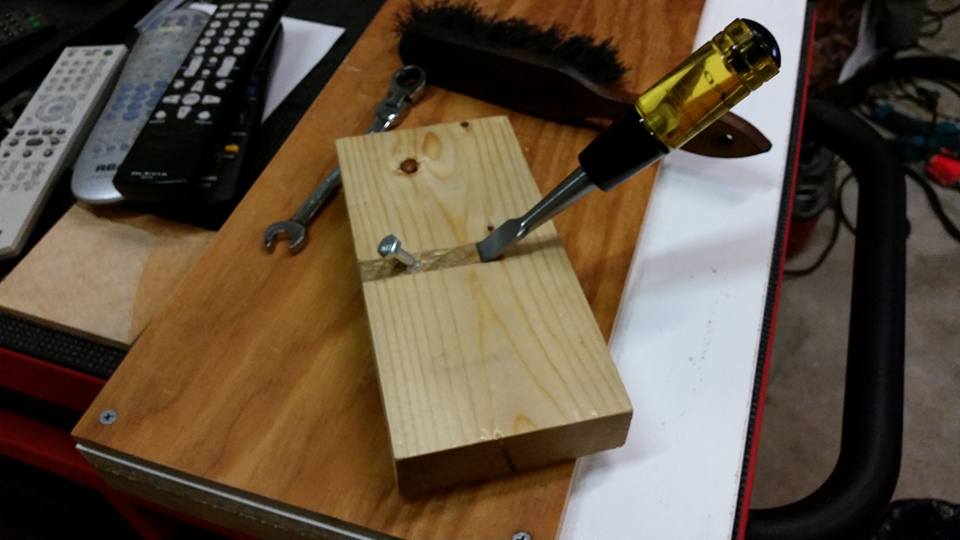
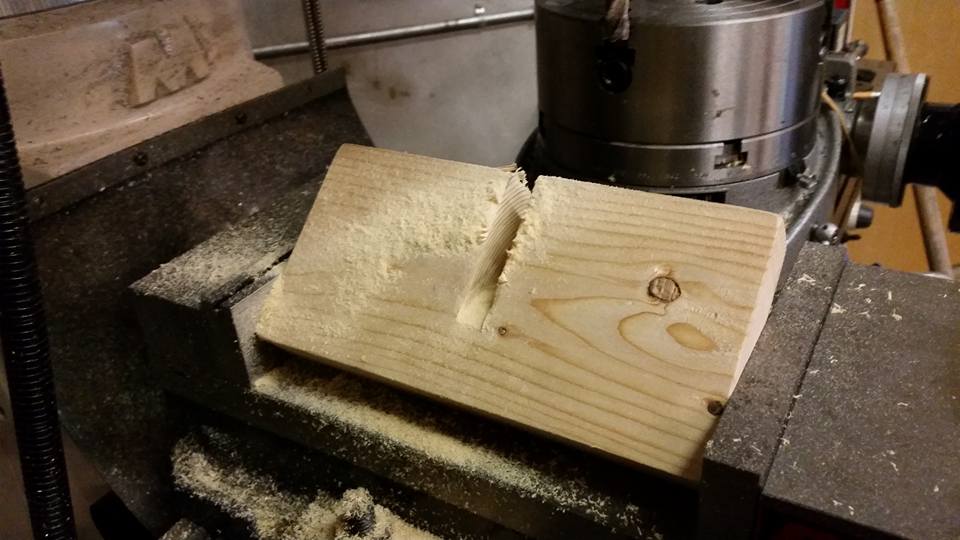
Today I fixed that. My original plan was to mill hex ends on the screws and use wrenches to turn them, but I decided to try something easier. I drilled two holes in the ends of the screws, perpendicular to their axes. Now when I want to move the screws in or out, I pop an Allen wrench in the holes and use it as a tommy bar. Simple and relatively cool.

If you really want a superior wood vise, get a Record or something similar. For a hundred-odd bucks you can get something really nice. But the Moxon is fun, and it has a very long jaw, which can be a plus.

I will put up a photo of the vise so you can see what I did.

04 18 16 moxon vise screw with hole for tommy bar reduced

One day I will get out of denial and do another project: a woodworking bench with a welded metal base. Woodworkers love wooden benches, but the reality is that metal is better. It’s way lighter. You can put a wooden top on a metal frame and save tons of work and weight.

My current bench probably weighs 300 pounds with the mechanic’s vise removed. It has a pleasantly solid feel, but hey, there’s a reason mankind started building things out of steel. If I make a steel base, it will be easy to put wheels on it. There will be more room under it to store stuff. I can simply replace the wooden top whenever it falls apart.

Woodworkers will excommunicate me. You know how people are.

Here’s a video of a surprisingly calm and likable Jamie Hyneman making the case for metal. He seems less irritable without his partner. That makes sense. I can see how dealing with Adam Savage would be like having a live squirrel turned loose inside your clothes.

I am Not Completely Stupid

Monday, April 18th, 2016

“Completely,” I Said

I am waiting for a guy to give me an estimate on fixing the garage door on the rental house. My general contractor wanted about $1800. I’m guessing a reasonable price would be more like $100.

The door has a big dent in one lower corner, and some of the support stuff behind it is bent. I don’t see $1800 there. The door does not have to be replaced. It just has to be repaired. Even if it were replaced, I believe the cost of a new door would be more like $800, based on Internet research.

When we agreed to hire the contractor, he assured me orally that the house would be completely ready to move in, once the things in his proposal were done. Little things like the $1800 garage door and the $1200 shower enclosure must not have appeared essential to him. He isn’t even including shower rods.

I refused to tell the garage people the price the contractor quoted me. I said I didn’t want to tell them it was ten dollars and have them come back with $9.50. Common sense.

I don’t like it when workers ask what other people bid. It’s an open admission that they’re trying to stick it to me. I know you’re trying to cheat me; be tactful about it. Or you could be totally forthright. You could say, “Are you stupid?” I could then say, “Not completely.” And you could bill me appropriately.

The contractor’s people are working on the house now. I assume they will be there when I show up to parade the new garage guy through. Will the contractor be upset? Ask me about something I care about. It’s not my job to give “safe spaces” to tradesmen who charge me money and deal with me at arm’s length.

This is how competitive bidding works. It’s not about feelings. I have to get that door fixed, and instead of including the job in the contract, the contractor surprised me with a bid. He started the bidding process, so he should not be offended to see it play out.

You makes the rules; you lives by the rules.

Now I have to fill the time until the garage guy contacts me.

The contractor also tried to charge $400 for a new toilet in the mother-in-law room. I went over to see what was wrong with it, and it worked perfectly. I sent the contractor’s girl an email asking what the exact problem was, and she said their plumber had unclogged it, but that it was still slow to fill. And of course, I care a lot about how long a tenant has to wait for a toilet tank to fill up. That toilet has been slow since 1945. Its performance will not shock anyone, and what’s time to poop?

Do I even have to say that this is bad customer relations?

If something isn’t broken, you don’t ask for money to fix it. If you think something is broken, and you ask for money to fix it, and then you fix it for nothing in two minutes, you tell the customer instead of hoping he goes ahead and pays you.

I could never give this guy a reference.

In other news, I have a big achievement to report. I have concocted my own daily shower spray. No, it’s not for me. Would that it were. It’s like Clean Shower, except it doesn’t cost three dollars per bottle.

I had been using soap scum remover and a sponge mop. It worked great, but it was a pain. I tended to get water and soap scum remover on my clothes, and it was just not a quality experience. I decided to get some daily shower spray and see what happened.

If you’re not familiar with this stuff, I will explain. You spray your shower every day (the manufacturer hopes), and the spray dissolves soap scum before it can form. Your shower never gets dirty enough to need scrubbing. In reality, you can spray less often and still win.

It worked great, but a bottle lasts three days. Even with laziness and missed days factored in, that’s $250 per year. Seems like a lot of money for shower spray. Also, the fragrance in some of these products is overpowering, and it fills your house. It’s like being hugged by 50 elderly aunts at once. You know those flowery perfumes older women love.

I found some online recipes. The problem is that recipes for substitutes for household cleaners are generally thrown together by people who are not chemists. They just guess. Sometimes they guess wrong, or they put superfluous stuff in their recipes.

I tried a recipe that had vinegar in it. I don’t recall whether it worked, but it made the house smell like salad, a thing I scorn. Fail.

I found another recipe. It contained dishwashing liquid, dishwasher rinse agent, alcohol, and hydrogen peroxide. It seemed to affect the scum, but it wasn’t as good as the real thing, and I wondered about those ingredients.

Hydrogen peroxide, in particular, looked dubious to me. Maybe it eats soap; I don’t know. But it struck me as the kind of thing a person would throw in there on a whim.

I also figured the alcohol was unnecessary. It’s just a solvent, and I have no reason to believe it works particularly well on soap.

I made a new batch when the first one ran out. I left the alcohol in, just because I like spraying things with alcohol. I removed the peroxide. I doubled the dishwashing liquid, and I kept the rinse aid. I also added six ounces of Zep no-scrub soap scum remover. The whole purpose is to dissolve soap scum, right? Why not use what works?

You’re on the edges of your seats, right? And you’re not even paying for this.

This stuff appears to work as well as the real thing, and I believe it’s pretty cheap. It will be cheaper still when I remove the alcohol. I use it every other day, and I have not had to scrub the shower in quite some time.

Here it is:

6 ounces no-scrub soap scum remover
1 tablespoon dishwashing liquid
1 tablespoon dishwasher rinse aid

Put this in a one-quart spray bottle and fill the empty space with water. That’s it. You just spray the shower walls and floor after you get out. The dishwashing liquid costs nearly nothing, and the soap scum stuff costs 20% of the price of a full bottle of same, or maybe 50 cents. The rinse aid is also cheap. So I guess this puts you at a total of around 75 cents. That puts your cost for spraying one big shower at what? About sixty bucks per year? ACCEPTABLE.

It’s not like scrubbing your shower is free. You have to use products for that. They don’t fall from the sky. If you can avoid scrubbing by paying sixty bucks, you have scored, my friend.

If I knew what was in soap scum remover, maybe I could bring the price down more. It seems to be diluted lye. Maybe I should use a small amount of oven cleaner instead of soap scum remover!

I suppose I could read the label.

Does it really matter if I pay $250 to keep the shower clean? Of course not, but you know how it is. I feel better about spending a thousand dollars and getting a good deal than spending two dollars and getting ripped off.

This is why I quit going to Five Guys. They charged me $16.34 for a burger, fries, and drink. I can afford that, but I can’t enjoy my food when I feel like a moron.

DISCLAIMER! DISCLAIMER! DISCLAIMER! I promise nothing. This spray may blind you and cause severe birth defects such as red hair, outies, and “fivehead.” I have no idea.

You will want to start with a clean shower, because this spray probably won’t have much effect on caked-on soap.

Now if I could just find a way to prevent my body from ejecting 5000 hairs onto the white tile floor every day.

I guess that guy will get here eventually.

More

The gigantic garage inquiry is over. The results are not exactly surprising.

The door does not need to be replaced. It has some mashed-up bits on the inside, where an idiot backed into it, but it’s not visible from the street. The lower part of the door can be screwed together to work correctly. Cost: 0.

There are some little problems with the opening system. It’s ancient, and the remotes have disappeared. The wall switch is gone, and so is the wiring. Cost to fix: $215. Cost for a whole new opener with remotes and switch: $300.

So, yeah, $1800 is a little high for a door for a one-car garage.

The city may get on its high horse (I think it’s glued there) and insist on a newer door that meets hurricane standards, but then again, it may not. If it does, it’s another $900. It may sound crazy, but my thinking is that it’s better to let the inspector have a look at the old door before assuming he’s going to condemn it. Either way, the worst-case scenario is a $1200 expenditure, not $1800. I realize contractors have to mark things up, but 50% does not seem reasonable.

Debts

Wednesday, March 2nd, 2016

You Can’t Assert a Right You Don’t Have

A long time ago, my dad bought my sister’s house. He had already paid for most of it; his intention was to give it to her. He bought her out because she had ruined the place, and he was in trouble with the code enforcement people.

We started renovating it, so he could rent it out. The process was slow and full of problems.

Everything but the outer walls had to be replaced. People don’t believe me when I tell them how badly the house had been damaged. I shot video and took photos, because I knew people would not be able to grasp the magnitude of the destruction. After she left and took everything she could salvage, we spent four figures on removing junk, all of which went to the dump.

09 10 16 dead roach hanging at barbarossa

New floors (and subfloors). New drywall. New appliances. New wiring. New roof. New lawn. You name it. It all had to go.

The problems we ran into were ridiculous. We hired a contractor with glowing recommendations, and he did a tremendous amount of substandard work and then left. Neighbors who should have been thrilled to see work going on complained about the construction mess, and we had to fight the city. Construction was eventually halted because the work was no good, and the house was designated “unsafe.”

It took months to get that fixed. The City of Miami does not care if you lose everything you have while they wait to issue permits. They will literally let you go bankrupt before they will speed anything up. They sat and did nothing, and there was no way to motivate them.

Then Florida Power & Light decided the electrical service had to be switched from “residential” to “construction.” They never said what that meant, but for weeks and weeks, they refused to do anything to get the change made. They can’t be fired, and they have no competition, so it doesn’t matter to them if you lose rent money for two or three months.

We hired a new contractor (with glowing recommendations), and he was slow. He made a lot of excuses. He kept billing for new things.

The walls had been replaced, but because the first contractor didn’t follow the code, the new walls had to be replaced.

During all this time, I was praying and using my supernatural tools, but things kept getting gummed up. I did not understand it.

One day last week, I thought about the price my dad paid for my sister’s interest, and I realized something: one part of her payment had been held up.

When he bought her out, he held a mortgage on her part of the house. She developed lung cancer, and instead of saving money, she had spent everything she had. She had not bought health insurance. She started out with very expensive treatment. When she was broke, she came to my father and asked him to foot the bills. To teach her a lesson, he made her sign a note for six figures.

When he bought the house, the mortgage was part of the deal. He was supposed to record a satisfaction of mortgage and let it go. But when I brought it up to him, he refused to do it. I didn’t argue with him, because it was between him and my sister, and I didn’t want to wade back into the snake pit. I knew he would never hold her accountable for the debt, so I didn’t think it mattered.

Last week, I sat up in bed and realized that in God’s eyes, the house still belonged to her.

The house fell apart because it belonged to a proud, malicious individual who brought curses on herself. It seemed to me that the construction problems came from this root. Any spirit sent to destroy her possessions would still have the authority to do damage.

I got up the next day and made him sign a satisfaction of mortgage. I took him to get it notarized, and I recorded it by mail.

Why write all this? Because the house has gone nuts since I recorded the mortgage. Whenever one of us visits, there are several workers there, putting the place in order. That’s new. In the past, we would go over and see no sign that anyone had been there in weeks. We could not get the city or the contractor moving.

The contractor has stopped being belligerent and unreasonable. Things I thought were not being done are being taken care of. The stress is gone.

The reason I write about this, potentially subjecting my sister to criticism, is that God taught me something wonderful: our actions matter. Life doesn’t instantly fix itself when you accept salvation, and it doesn’t necessarily fix itself when you develop a strong prayer life (my expectation). You also have to find out what you’ve been doing wrong. You have to admit it candidly, without excuses (or as we like to call them, “explanations”), and you have to ask for help correcting things.

Maybe you have debts. Maybe there is someone you treat badly. Maybe you owe someone an apology. The most likely problem of all is pride coupled with denial. You have to ask God about these things and get his help putting them right. Until then, you’re bailing a boat at one end while water comes in a hole at the other.

My old churches, Trinity Church and New Dawn Ministries, did not teach accountability or repentance. They taught that if you believed God and gave preachers money, everything would work out. As a result, Trinity can’t pay its bills and New Dawn is a tiny, failed church in a rented room, after years of yammering about the prosperity gospel.

The pastors of these churches, personally, are failures, so the people who follow them are failures. The failure of Rich Wilkerson, the pastor at Trinity, is less obvious, because he borrows and hustles, but the church is not prosperous. No one who has a lot of debt is prosperous. They just look good until the bills come due.

This can be extremely helpful to you, if you take it seriously and put it to use. Start asking God what you’re doing wrong. If you think you’re not doing anything wrong, ask him to get off the throne, because obviously, it rightfully belongs to you.

I experienced something truly wonderful yesterday. I have been unable to make myself pray consistently in the middle of the day, and it has been a real problem, because prayer is like food. You can’t do it once and then forget about it. You have to do it over and over, at relatively short intervals. When you neglect it, things start to go badly, like the battle in which Moses held Aaron’s rod over his head. When he held it up, the Hebrews did well. When he lowered it, they started to lose.

I have been praying and praying for help with this. I like to pray at around 5 p.m., because it’s a good midway point. I try to go at least 20 minutes in tongues. I keep asking God to give me grace to do it. I don’t need willpower; that brings pride. I need supernatural help.

Yesterday I had a burger, and then I sat on the couch for a bit, to watch something stupid and digest the food. I started feeling euphoric. I thought it was just my blood sugar going up, but then I realized it was supernatural. I felt peace and joy, and an absence of stress and anger. I knew it was God, resting on me, so I gave in to in and started praying. It was great. I felt him moving, doing various things. I knew things were being ordered and harmonized. I was getting correction.

I can’t say enough about it. Being in God’s presence is a gift and an honor you can’t buy with money or earthly power. There is no way to get it unless you please God. People simulate it with drugs and alcohol, but those things don’t compare, and they always come with a cost that exceeds the benefit.

In summary, it has been a really good week, and I expect things to keep getting better. I hope people listen and try the things I’m doing so they get what I’m getting.

Music continues to go well. Sometimes I feel sure my hands are going to swell up and refuse to cooperate, but when practice time comes, they are always ready to go. I am starting to sound a little bit like a musician from time to time.

Last time, I wrote about my old “Wingman” amp. It started life with two output transformers and four 6BM8 tubes, for a total of 15 watts. Recently, I took two output tubes out and got a nice sound, so I decided to rehabilitate the amp.

I was not sure whether I should go with two tubes and 7 watts or four tubes and 15 watts. I played around, switching tubes in and out. I learned that I had the wrong rectifier (5Y3) in it, so I put a bigger one (5AR4) in it, and the sound got even better.

I have all sorts of amp parts lying around. I have a bigger power transformer, which I intended to put in the Wingman, thinking it would clean things up. Somehow, I had gotten the idea that four tubes added up to 30 watts, so the new transformer was the correct size for that amount of power. I found out I was wrong; it was only 15 watts. I checked the existing power transformer, and it was rated for 15 watts. I was all set!

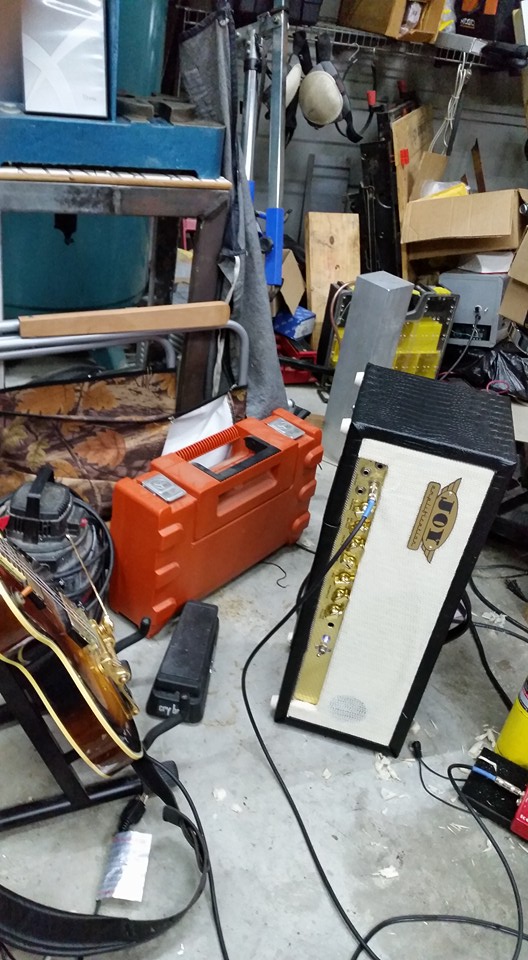
I cleaned the amp up and built a new cabinet for it, and here it is.

02 29 16 wingman amp with new cabinet and nameplate

The sound is very clear and warm, very much like the four-EL84 Rocketman amp I designed, but I would say it breaks up a little earlier. Not sure. In any case, it has a singing quality which is hard to describe. When you play through it, it’s like the guitar becomes a wind instrument, like a muted trumpet. It’s exquisite.

I have been modifying my pedals, and I decided to open up my Way Huge Fat Sandwich distortion pedal to see what I could do to cut down the gain. It turned out I had the internal drive pot set too high, so I turned it back down and fired the amp up. Magnificent. Like listening to an angel cry. Warm, round, expressive…marvelous. I liked it so much I found a second Fat Sandwich on Ebay, used. Now I’ll have one in the garage and one in the house.

I have bought a lot of pedals, but it’s not because I want a lot. It’s because I want a few really good ones. You have to try a fair number in order to find what you want. And even then, I had to open them up and change parts.

The amp parts I still have are going to have to go somewhere. I believe the best move is to build one more Rocketman, since the first one is a little rough, and I may make another Wingman. After that, I will be set for a while. I have a couple of speakers I need to put into a cabinet, so that’s also on the list.

For quite a while, I’ve been asking God to show me the things in my life that please him. I’ve been asking him to restore them, repair them, replace them, make them work, and so on. I ask this for everyone on my prayer list. The stuff with the amps and guitars seems to be his answer. Very nice.

I am not out of the woods yet, but at least I know I’m in the woods! That’s more than most charismatic Christians can say. They go down with the ship, thinking the Coast Guard is a minute away when it’s actually still at the dock.

As always, I hope this is helpful. Let me know if it bears fruit in your life.

Per Diem

Friday, February 12th, 2016

Sufficient Unto the Day are the Blessings Thereof

I have nothing but good news to report. At least for me.

I thought I was saying something positive, but now that I’ve typed it, it looks sad.

It is sad.

When I was working on a kibbutz in Israel, I spent time pruning olive trees. They told me that in order to get one productive tree, you have to plant about 800 trees. About 1 in 800 produce olives. The rest are cut and burned.

Is that true? Search me. I only know what they told me.

People are not much better off than olive trees.

Americans are very spoiled. We used to honor God fairly well, and he made us rich and strong. We still have a lot of wealth piled up, as a result of our former humility and gratitude. Because of this, and because we are isolated geographically, we think the world is a nice place. Most of us are only familiar with the US, and things here are good, so we think the world is okay.

The world is not okay. It’s a horror. There are people all over the globe who don’t have running water or electricity. In 2016. People die from diseases that can be prevented with soap. Freedom is fairly rare. Slavery is common. Look around. The world is a mess.

We tend to see the world as a pleasant place in which we spend time trying to be good until we move to the next level. We see it as heaven’s anteroom. In reality, it’s much more like hell. It’s hell’s roof, literally.

Satan runs the earth. Jesus said so. He called Satan “the god of this world.” That’s why things don’t work well here. That’s why there is pain and injustice. We elected Satan and made God an alien.

God interferes with Satan’s work a lot, but Satan still holds the lease.

Most people serve the devil all their lives, obeying the compulsions of demons and their flesh, and then they die and go to hell to burn, like the 799 olive trees that didn’t bear fruit.

God probably designed olive that ways on purpose, as a symbol. In the Bible, trees symbolize people. Olive oil is God’s anointing. Fruit are people who develop in God’s kingdom. They are future trees.

The primary purpose of our existence is reproduction. We are like eggs, and we have the potential to become God’s children (not just his creations). Most of us are like eggs that are never fertilized and wash out with a woman’s monthly fluids.

If you don’t produce fruit, there isn’t much purpose in keeping you around. There is even less purpose in helping you. It would encourage you to continue walking in rebellion.

God told me powerful things almost thirty years ago, and I basically spat on them.

He owed me nothing. I was not his child. I was like a deserving convict on a penal island. By “deserving,” I mean deserving of punishment. He reached out to me, and instead of showing gratitude and amazement, I decided his gifts were unimportant and optional. So I wandered around, weak and lost, much longer than I had to.

He told me to pray in tongues a lot every day. That, alone, would have made me a success. But I put it off and inserted around 15 years of dead time in the center of my life.

A few years back, he started giving me grace to pray in tongues, and I reached a point where I prayed for hours every day. I started receiving real power and revelation, and my status changed. Now I’m much stronger than I used to be; I’m like the Karate Kid after discovering Mr. Miyagi and listening to his wisdom. The enemies that used to beat me are taking a beating, themselves.

That’s very good. But I can’t transfer it to other people.

I’m just like God. All I can do is persuade and urge. People are just as stupid as I was, and they do whatever they want. They are incredibly blind.

God has a way of making us suffer with the problems we have inflicted on him, so I can see why life is like this. He couldn’t tell me a thing, and now I can’t tell other people anything.

I don’t think it will change. The pattern is not going to change before Jesus returns. Most people will harden their hearts and go to hell. On the other hand, there is no reason why God won’t let me reach more people. The ratio of rejection to acceptance is not going to change, but if you reach more people, the absolute numbers can increase. If you only change 1 in 800 people, and you reach 8000 people instead of 800, you get 10 instead of 1.

Something to wonder about.

To get back on point, I have positive things to report about myself.

I feel like I’ve achieved escape velocity.

In the oversimplified physics they teach to undergrads, they tell you that if you’re on a planet, and you move upward fast enough to give you kinetic energy greater than the potential energy you will accumulate as you leave the gravity field, you will escape and leave the planet. That means you’ve reached escape velocity. Gravity may still be pulling on you, but you’re going to win.

It doesn’t really work like that, because of air resistance. But it’s still a neat analogy.

I believe I have reached the point where I am not going to lose any more.

Last year, I believe it was, I received the words, “I will have total victory for now on, because you are for me.” I believe I have that right. Does that mean I’ve never lost a video game since then, or that I always find a great parking space in front of the store? Does it mean I’ve never cut myself since then? Does it mean I never have to take medicine? No. It just means I eventually come out on top, in every conflict.

That’s good enough, believe me. That’s all anyone can ask. A friend of mine said something the other day, and it gave me confirmation. She said the Bible says no weapon formed against the servants of God will prosper, but it doesn’t say weapons won’t form. I’ll take it.

The 34th psalm confirms this, saying, “Many are the afflictions of the righteous, but the Lord delivereth him out of them all.”

I keep getting delivered. There are plenty of annoyances in my life, but they aren’t making any headway.

The other day I was arguing with someone who is very crabby, manipulative, and childish, about a minor inconvenience he had had to endure. He was essentially asserting that it was my job to make his life free from all discomfort and effort. I argued a little, and then I remembered my supernatural tools. I spoke defeat to him and to the demons that use him against me. I spoke it right there in front of him, quietly, while he wasn’t paying attention. That was the end of the yelling. Instantly, he started cooperating, and we resolved the issue. I won. God’s authority overcame the problem.

This kind of thing happens to me all the time. It won’t work if you don’t have faith, and you won’t have faith unless you’re praying in tongues every day. But it does work.

The things that are happening with my hands are extraordinary. I’ve written about how God has allowed me to play instruments, even though I used to have swelling, pain, and stiffness from guitar exercises. The adventure has not stopped.

Over the last few weeks, there have been a number of times when I’ve awakened and felt like my hands were swelling and starting to be a problem. I sat up and prayed in the Spirit, and I spoke defeat to the illness and the spirits that caused it. I spoke defeat to my own flesh and said it was forbidden to harm itself or to have joint issues. Every day, I have been able to practice without problems. I have had slight discomfort at times, and I have a tiny bit of detectable swelling in one joint, but that’s all.

I have spoken defeat to the spirits of joint problems during the day. I’ve actually said, “I’m too strong for you now,” and, “You don’t have enough juice any more.” Not glorifying myself; just acknowledging the work God has done in me.

I have even picked up the flattop guitar and the mandolin again. These are instruments that wreck your hands. The strings are very stiff, the action is horrible, and the picks are like quarters. I play both every day, and my hands feel better today than they did weeks ago.

I’ve found that God won’t always destroy a problem instantly, for good. There are some enemies you have to crush every day, just as you spray your house for bugs once a month. Hey, as long as they stay crushed, I’m ecstatic. I can play my instruments, and I have extra motivation for prayer and submission. What’s not to like?

I’ve been fixing my amps up. I got my old Fender Bassman clone cleaned up, and I use it for practice. I also revamped my “Wingman” amp, which is a Bassman front end with two 6BM8 tubes for output. I used to have two output transformers and four tubes on it, but it sounded flubbery when driven, so I removed one transformer and two tubes. Now I love it. It sings.

I just need to make wooden cabinets for them now.

A Christian buddy of mine–the former head of the armorbearers at Trinity Church– has decided he wants to learn guitar, so we are going to work on a new amp. That will be a lot of fun.

He has been dealing with the sudden challenge of prostate cancer. Instead of going the TBN/Osteen route and blaming the devil and claiming it’s not his fault, he acknowledged that he opened a lot of doors with a lifetime of sexual sin, and he took responsibility. He has ramped up the prayer in tongues. He is very excited about seeking correction and subduing the flesh. It’s wonderful to see.

The amps give us an excuse to hang out.

I feel that God has said that music will be my last great adventure. I certainly hope so, because it’s the only one I ever really wanted.

It’s very hard to get used to being blessed. Yesterday I prayed for God to help me with it. An inability to trust your blessings and put your weight on them reduces the joy you get from them. I want to settle into it.

My left hand feels wonderful. There are a lot of things I’d like to do on the guitar, but a little part of me says, “That will be the straw that breaks the camel’s back. That will put you in the doctor’s office, and dust will start settling on the guitars again.”

I prayed for God to help me with this, and faith rushed through me.

I realize how much I deadened and contaminated myself when I was living for Satan. I often feel like I’m at the bottom of a well dug in granite, sealed with hardened material I packed in from above. I feel like I buried myself down there, under a column of petrified excrement. I did not understand how I was supposed to live or how good life was supposed to be, so I created my own ridiculous, counterproductive, weak defense mechanisms and hid down there under them, waiting for death.

Traditional Christianity teaches us to suffer and wait. In reality, the Holy Spirit wants us to have hearts and minds like God’s. That implies healing and restoration. You can’t be like Jesus if your heart and mind aren’t whole! It doesn’t make sense.

God will rebuild you from inside. It doesn’t matter what you’ve done. It doesn’t matter how much time you have left. True, you probably won’t make as much progress if you repent at 90, but you will make progress, and it will be worth it.

Only God has the solvent that will penetrate and dissolve the column of crud you’ve piled on top of yourself.

Apart from salvation, this is what we should be pursuing. Forget the TV money lies. If you have this, the money and women and so on that other people crave won’t matter to you.

I am offering my testimony, even though I am tempted to hold it back in case my hands swell up again. I am putting it out there. This is what God has done for me, as of today. Every day, his method works. If it worked yesterday, and every day so far this year, surely it will work tomorrow and every day for the rest of my life. I’ll take the chance that I might have to retract all of this, just so you will be encouraged to set out on your own voyage.

Pray in tongues every day, speak defeat to your flesh and the spirits that want to control you, exalt the Holy Spirit, and ask God for correction and healing. It works. It’s free. You can do it from your couch. You don’t even have to tell anyone.

Or you can be like me and come back in about 15 years.

OOPS

I have to apologize. My brain must have been in the wrong gear. I worked on ALMOND trees, not olive trees. I was told that only one almond tree in 800 bears fruit. I suppose, then, that you can disregard my guesses about olive oil and the anointing and so on.

Aaron’s rod was almond wood.

Gross Examination

Tuesday, October 6th, 2015

The Billy Mays of Advanced Math?

Still fiddling with math and physics.

I’ve had the strangest sensation lately. I feel like I’m inside RLM, the math/physics/astronomy building at the University of Texas. This is the building where I worked and went to classes when I was hoping to get a doctorate. I guess I spent 20 hours a week there.

The people were really dreary. I’m not the most outgoing person on earth, but I could not make friends there. Could not do it. Everywhere I go, I manage to make friends with at least one person within a month. Not the physics department.

The guy who shared my desk in the TA office was okay, and there was a Navy guy who became an experimental physicist. He had a harder time with the work than I did, and I thought he was going to wash out, but he made it and I didn’t. There was also a guy I sort of talked to occasionally. He had a thing for Asian girls So much so that he planned to move to Japan to teach English.

Oh, my God. I just Googled him, and he’s a physics professor. In Tokyo. He has been busy.

I never made a dent socially while I was there, and I suffered pretty badly, but I miss certain things. I miss teaching. The kids I taught were not as odd as the grad students, and it was nice to know that I was good at something.

RLM is named for Robert Lee Moore, a famous mathematician from Texas. I Googled him the other day and found out. I’m sure I saw his name on a plaque whenever I entered the building, but I don’t recall.

Moore is famous for math, and also for racism. He refused to teach black students back when UT was forced to accept them. They still named a building after him. If you wear a Dukes of Hazzard T-shirt to your quantum mechanics class, you’ll probably be told to turn it inside-out, but you will still be expected to sit in a building named after a maladjusted, hateful, racist crank.

I looked around on Youtube for some complex analysis lectures, to help me remember what I used to know so well. I found Herbert Gross. If you’re a student, you have to check this guy out.

He appears in old black and white videos published by MIT Open Courseware. The video quality is about like old Andy Griffith shows, so I figured he was filmed in about 1960, but the videos are from the early 1970s.

He’s a magnificent teacher.

I don’t know for sure, but the impression I have from all my years of study is that teaching pedigree means a lot.

There are certain things people who study a given subject should know; things they will be expected to know, even though you don’t have to know them in order to be good at the subject. You can make up a series of lectures and teach a subject well without referring to other people’s lectures, but you are likely to miss various characteristic anecdotes and examples that are commonly taught.

I think this is because many instructors can trace their roots back to instructors who were seminal, just as piano teachers claim they can trace their roots back to Liszt. Wolfgang Pauli, or whoever, included this or that bit of information in his lectures, so his students went on to include it in theirs, and so on.

Studying under people whose lectures conform to common standards is helpful, because you will run into instructors who expect you to know things that are commonly taught, and they may put these things in assignments on on tests.

I guess that was a long digression, but the feel I get from watching Herbert Gross is that he developed right in the thick of the math/physics/engineering community in the northeast. He seems to know exactly what’s important and useful, as though he has heard it himself via a long practiced tradition.

He’s apparently still alive. Either that, or he died and no one remembered to remove his website. He was still around last year.

I don’t know if my guess about him is right, but I think it’s definitely smart to try to learn from people at places like MIT or Harvard or the University of Chicago when possible, before taking a chance on people whose pedigrees are unknown.

His videos are wonderful. He really flies, but he is exquisitely prepared, so everything he says is clear. If your instructors stink, check him out. I wish to God I had had Youtube back in my day, when I was watching my Japanese professor point at different expressions and say things like, “Jees one, jees one, all same.”

If you don’t understand what that means, we are in the same boat.

One nice surprise is that I don’t struggle. I guess that makes sense. After all, this material used to be easy for me, and it should be in my brain somewhere, waiting to be reactivated. I fast-forward a lot. But I do have to do problems, because understanding is not the same as remembering with the kind of familiarity required for actual work.

I don’t know why math was easy and physics was hard. Maybe it’s because math is easy, and physics is hard.

He refers to vector analysis (multivariable calculus) in his complex analysis lectures, so I am checking that out, too. Luckily, he has lectures on both topics.

I don’t know where this is going. If I can just get back to the point where I can look at a graduate physics text and have some understanding of what it says, it will be a huge relief. I feel much better about my brain. I am starting to feel smart again.

Life isn’t about self-confidence, but you shouldn’t doubt yourself wrongly, especially in your heart.

I hope the videos are useful to people. Forty years’ worth of MIT students can’t be wrong. Totally. Not about everything.

Weird Science

Thursday, October 1st, 2015

My State is Solidifying

What interesting times I’m having.

I keep getting deeper into physics and electronics. It’s not something I expected, and it’s not going the way I would have predicted.

For years I’ve had dreams about my time as a physics grad student at the University of Texas. I hated these dreams, but I couldn’t stop them. I would find myself returning to my apartment north of the city. My things were still there. The apartment was different in the dreams. It was gigantic. It was disorderly, too. The kitchen was a mess. Not dirty, but stuff was out on the table and counters. There were messy rooms with all sorts of tools in them.

I would wonder why the company that owned the apartment complex hadn’t thrown me out, since I hadn’t been paying rent.

I would find myself walking around campus, attending August meetings in preparation for the new school year. I wasn’t really part of it, though. I was like a ghost, observing but not really joining.

I did not like the dreams. I knew things weren’t right. I wasn’t ready to go back to work. I hadn’t planned or made arrangements. I was just there, with no warning or preparation. I didn’t feel that I could make it work. I was on my own.

I prayed for God to take away the dreams.

Losing physics was the most painful thing that ever happened to me. I spent three years in Texas, and I didn’t make a single friend, except for a girlfriend. The students in the department were very disagreeable. They were cold. Many were arrogant and snotty, as you would expect boys to be after a twenty-odd years of having their mothers show their brains off to their relatives and friends. The instructors didn’t care at all about the students. The administration was like a machine in a far-off country that transmitted its decisions over a cable. Completely impersonal.

I arrived in Austin in 1994, about three years after returning to college. I had gotten tired of trying to sell houses, and I had tried to enroll at the University of Miami. Because of my problems at Columbia University, they made me go to Florida International University, a local school, to prove I was serious.

When I first decided to go back to school, I figured I would be a lawyer, because it was an easy job that paid well. Then I saw the horrible classes pre-law students took. Boredom epitomized. I decided to become an avian vet, so I signed up for calculus, chemistry, and physics.

I had problems in calculus, and then I remembered that I had failed math in high school. I didn’t really know algebra. I started studying algebra and calculus at the same time, and I went from a 40 on the first test to a 100 and an 97 3/4 on the last two.

UM admitted me, and I started taking courses very quickly. I took courses at the same time as their prerequisites. A guy who taught my second physics lab course ended up sitting next to me in classes, because I progressed to the point where I could study with grad students.

I got burned out in the last year, not surprisingly, and they put me on Ritalin. By the time I got to UT, I had adjusted to the drug, and it didn’t work as well. I was taking huge doses. Up to 120 mg a day. They put me on other drugs which drove me crazy, and I could not make myself study. I had to drop a class.

The department wanted me gone. I guess they were used to seeing people wash out. They didn’t care at all. They did almost nothing for me. They made some small accommodations, and the impression I got was that they were just trying to avoid an ADA suit. They had already been in trouble over that.

I was more alone than I had ever been, and I was losing the thing I thought would save me. A couple of infantile grad students gave me a hard time. I put up posters advertising my services as a tutor, and one of them got in the computer, changed the posters to make me look like a fool, and put them up all over the physics building.

I lost to people I should have beaten, and there was nowhere to turn. The drugs kept me awake for days on end, even after I quit taking them. I had thought I had found my place in society. I thought physics would save me. I was really good at it, and I had every reasonable expectation that I would get much better, but I wasn’t going to get the chance, no matter what I did.

I had test anxiety. I remember taking a test in graduate quantum mechanics. There was a simple problem I could not solve to save my life. After the test, I walked back to the T.A. office, which was shared by various students. I wrote the problem on the board and solved it, just like writing a grocery list. It took a couple of minutes. It was simple. I could do it in the office, but not during the test. Imagine the frustration.

When I prayed, I felt as if the prayers bounced off the ceiling and reverberated around the room. God refused to help me. Or rather, he helped me by turning away from me.

I was trying to do my own thing, with virtually no prayer life. Without submission or confession. In pride.

I never walked in the door of a church in Texas. I only prayed because I was miserable and wanted help, and I did it rarely.

When I returned to Florida and went to law school, it was failure. Anyone can be a lawyer. My family is full of lawyers. It was the dreadful default option, like hell. Other people were proud to be in law school. I was ashamed of it, but there was nothing I could do.

Law turned out to be pretty pleasant, but that didn’t erase the pain of losing physics. I never cared about law. I never wanted to do it.

Over the last few weeks, strange things have been happening. I’ve written about it already. I’ve been watching solid state physics lectures. That’s the class that killed me in Texas. For a long time, I’ve wished I could beat that class, even on my own, just to know I didn’t lose permanently.

I’ve been watching Sandro Scandolo’s lectures for ICTP, the International Centre for Theoretical Physics. I ordered a gray-market copy of the Ashcroft-Mermin book, Solid State Physics. The worldwide standard is a terse book by a guy named Kittel. Ashcroft is easier to understand. Yesterday I found a book of solved problems. It’s not easy to find solved-problem books for graduate-level physics. If you Google “Mihaly,” you’ll find it.

Suddenly, I feel different. I feel like a scientist again. I have the same feeling I used to have when I walked the halls of RLM, the physics building at UT. I can’t explain it. I feel as though I’m there, doing what I used to do. I feel like I can pick up a few things and regain my competence.

UT made me feel as though I were incapable of doing physics. I know that’s not true. No one can start as a math illiterate and end up in a top-tier graduate school in three years without the ability to handle the material. But you know what the Bible says: “A crushed spirit, who can bear?”

Law is easy. I’m sorry if that offends lawyers, but it’s true. If you have an IQ of 110, you can be a lawyer. If you have an IQ of 120, you can be a good lawyer. Those are not high scores. As my evidence professor used to say, to pour water on the burning egos, “You’re just smarter than the average bear.”

Law was just something to do to bring checks in the door. There was not a lot of dignity in it, given the way it entered my life.

I hope I can get through one semester’s worth of solid state. I think that will stop the dreams.

I feel like God has taken his foot off my neck.

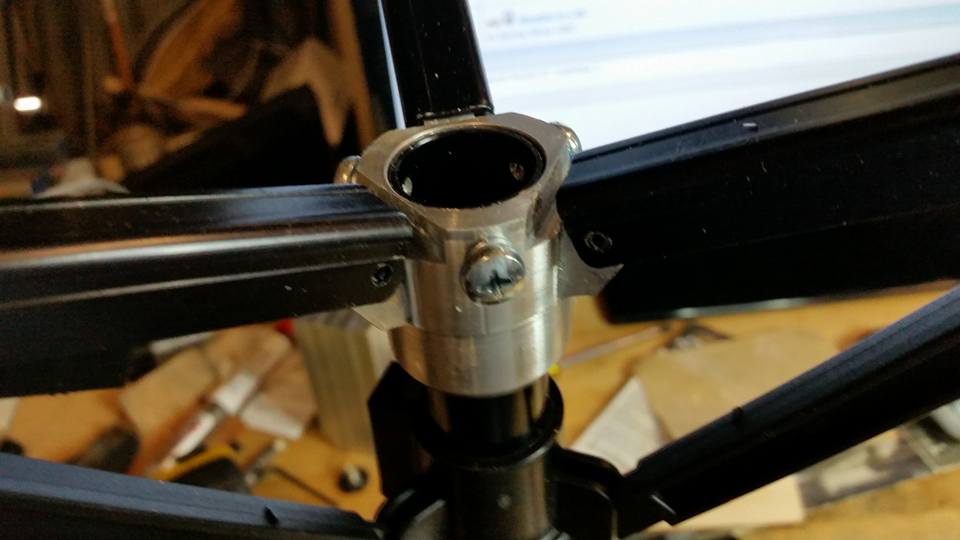
Before I go, something I machined. My dad broke a tripod he bought for his laptop, and he asked me if I could fix it. I checked, and they don’t sell the part he broke. I had to make it from aluminum. It’s not beautiful; making it pretty would have increased the time expenditure from half a day to a day and a half. But I had no problems making it, and it’s much better than the plastic it replaced.

09 30 15 laptop tripod part installed with final operations done

Nerd Tools

Tuesday, September 29th, 2015

If You Can’t Learn in 2015, You are Beyond Hope

Today a few things about my progress in various areas.

First off, I found an incredible circuit analysis video.

As I have mentioned before, I have been trying to get back into (“back” is a kind exaggeration) electronics. I started watching MIT’s free online course, 6.002.

I found the book pedantic and tedious, and the professor didn’t explain things all that well. I started using other sources and compiling a notebook.

I came to realize that the MIT guy was not doing a good job. He taught things that were not useful, and he omitted things that were very useful. He may have a brain the size of a Subaru, but he is not the perfect teacher.

When you study electronics, you want to know what people who work with circuits actually do. You don’t need to learn a bunch of crap that only manifests in the real world in the homework problems of students.

Over the last week, I started writing my own method, and yesterday I checked Youtube for resources. I found this video:

You won’t believe it until you watch it, but this guy sums up six weeks’ worth of college lectures in 90 minutes, and he does it slowly.

The MIT guy taught me things that I can’t use. He told me about the “lumped matter discipline” and…other stuff I don’t remember. You don’t need to know all that. It’s filler for pedants. If you take out the junk he incorporated and you add some great things he left out, you get the video above.

Take a look. If you learn the material in the video, it will make any other class you might take make sense.

I’m sure there are huge benefits to the MIT course, once you have your legs under you, but you have to start with a solid foundation.

The video guy recommends LTSpice, which is a free program that lets you draw circuits and then run them in a virtual…space or whatever. Easier than breadboarding. I have the program, and the learning curve seems pretty flat. I was able to turn it on and draw a circuit without studying. You can find it by Googling.

I’m also enjoying a graduate-level solid state physics course. This is the course that killed me as a physicist. Well, this and quantum. I got burned out, and they had me on ADD drugs that made me nearly crazy, and I got a D in solid state.

The professor who taught the course was awful, and the department at UT Austin was not helpful at all. It was a horrible experience, losing physics. A slow-motion trainwreck on a locomotive with the brake lever welded open. Of course, even though UT was not exactly nurturing, it’s my fault. I was out of God’s favor because I chose to be.

It would be wonderful to master this course and do problems successfully. Just a closure thing.

I found this guy on Youtube. It’s easy to find undergrad physics on the web, but graduate stuff is less available. Someone uploaded his videos, and they came up in a Youtube search.

His name is Sandro Scandolo, and he teaches at an instution called ICTP, in Italy. Even if you don’t know physics well at all, if you’re technically inclined, you will enjoy the first lecture. His style is wonderful. Patient, conversational, and very organized.

ICTP has a website, and if you burrow around in it, you can find other graduate courses. You can download them as flash or Apple movies. I leave finding them to you.

I plan to watch the whole course, even if I don’t do problems. I am smart enough to understand this stuff even if I don’t take the time to put it to work. Simply understanding it will make me feel better.

If you want technical texts for home study, I can recommend two resources. First, Scrib’d. You may have moral qualms about it, so caveat emptor. It’s a site with zillions of PDF uploads. You pay nine bucks a month. Much of the material is not copyrighted, so you can read it without feeling bad. Another resource is Amazon Marketplace. When you look for a hardcover text that costs $200 in the US (they have gone up that much, believe it or not), you will often find links to people who sell gray-market paperbacks for under twenty bucks. Same books. No infringement. I have two of them, and a third is on the way.

If you go crazy and decide to study solid state, get Ashcroft. I also found a book by a guy named McKelvey. Very nice. Kittel is a torture device. Naturally, it’s the book UT used. I still have my copy. I should waterboard it.

People say Kittel was a genius, but that doesn’t mean he could write books people could actually learn from.

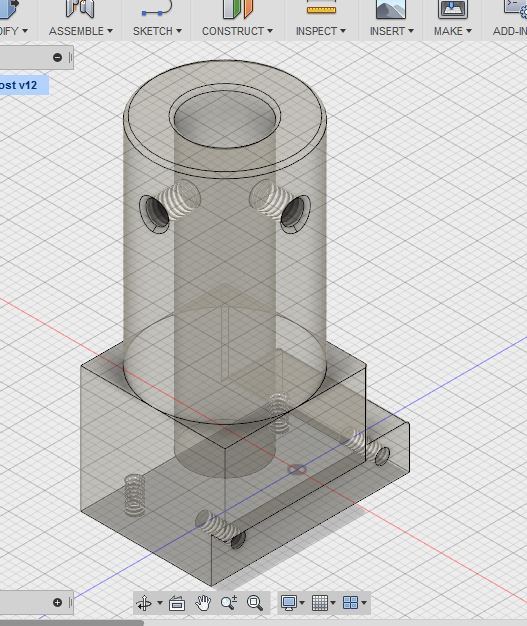
CAD is going well. I have no complaints about Fusion 360. I’m sorry I paid so much for Alibre and Dolphin, but I did my best to find good programs, and that’s what I came up with in my first attempts. I’ll post a jpg of a part I’m making.

09 22 15 Fusion 360 Lathe Tool Post with extraneous crap removed

I’ve always sneered at 3D printers. Now that I can do CAD and send files to a printer, I sort of wish I had one. I checked into them last week, and I found that I was right to sneer. They’re still toys, and they make rough parts made of weak materials. If you have $500,000 you can get a really nice one that makes things you can use, but I think I’ll pass.

Maybe I should get a crummy one now just so I’ll get to know the technology.

The Autodesk Fusion 360 forum is a lifesaver. That, alone, makes it worth downloading and using. I tried CNCZone when I was struggling with Alibre and Dolphin, but the kids on that forum tend to be nonhelpful and self-absorbed, and they can also be rude.

I am back to music study. I returned to Sightreading.com. I recommend it. It produces random pages of music for practice. They’re not tunes. Just notes. It’s helpful because you will involuntarily memorize tunes as you work on them, and once that happens, it’s not sightreading. You can’t memorize random junk, so it keeps the proper area of the brain working.

That’s all I have right now. I hope it will be useful to someone.

One Bad Turn Deserves Another

Friday, September 18th, 2015

Exploring the Habits of the Chinese Woodchuck

I know I am a renowned CAD/CNC genius, so you probably think that’s all I do. WRONG. I’m still working on my plan to become a woodturner.

I used to look at guys who had lathes and think they were mentally ill. Okay, that’s an exaggeration, but I thought they were kind of silly compared to men who did regular woodworking. Whatever you call woodworking that isn’t turning.

I thought, “These are eccentric old coots who drive around stealing stumps out of people’s garbage so they can make bowls you can’t actually use and Christmas ornaments their relatives throw out.”

That was actually correct.

Nonetheless, I had to use my metal lathe to make an oak bench dog the other day, and I realized I was wasting half of the machine’s potential. And woodturning produces useful things as well as strange crap. Often people who don’t turn wood use flat or rectangular parts in places where round parts will work better.

I started looking around and asking for advice on forums. The forums where I haven’t been preemptively banned yet for asking stupid questions.

I found out that a metal lathe will work quite well for wood. In some ways, it’s vastly superior to a wood lathe. It’s a billion times more ridgid. You can use the carriage to make precise parts. You can make threads with it.

I think I’m out of things it can do better.

Anyway, the pluses outweigh the minuses, so it’s definitely worth doing.

In order to make it work, I needed a tool rest. This is a thing that clamps on the lathe’s ways. A T-shaped “T rest” sits on it, and you rest your turning tool (“chisel”) on the T rest when you cut wood.

On a metal lathe, you use a heavy steel or iron tool post to hold tools for you, and the carriage moves the tool. On a wood lathe, you slide the chisel back and forth on top of the T.

There are chintzy ways of using a metal lathe tool post for a rest, but they’re stupid, so I decided to make a banjo.

Now you wonder what that means.

A banjo is the actual base of the tool rest. I’m pretty sure. It’s the part that sits on the ways.

Don’t ask me why they call it a banjo. Maybe it gets on people’s nerves and repels women.

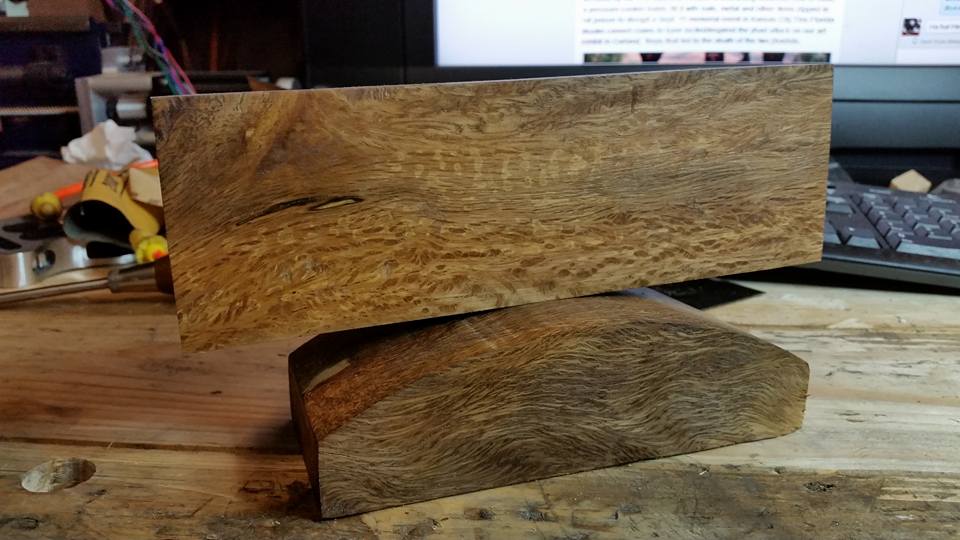
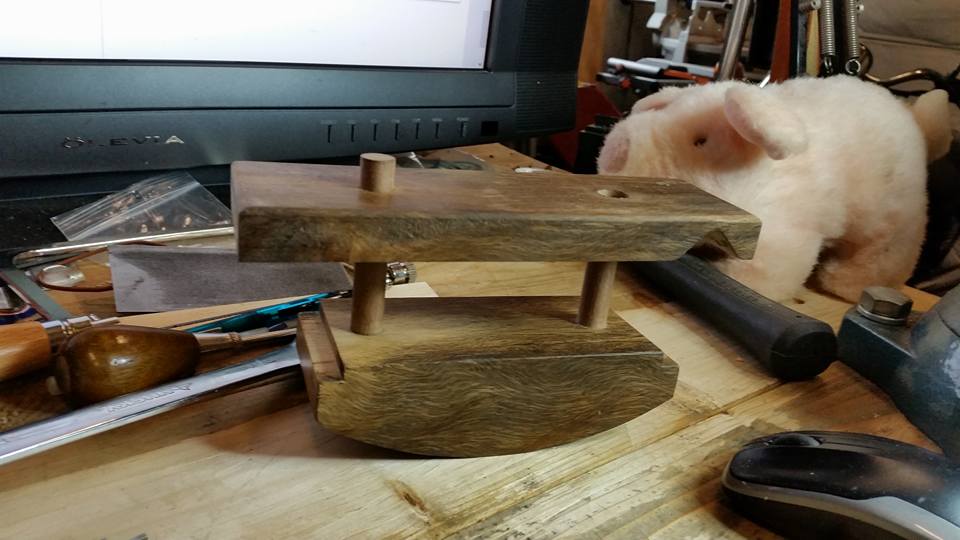
I had some live oak trash lying around, and I decided to try to make the base of the banjo out of it. I sliced open a fairly green log and cut some pieces out on the table saw and band saw. Then I turned some pegs on the lathe and stuck them in one of the big parts. They go through two holes in the other parts, and they line the base up with the clampy thing that goes under the ways.

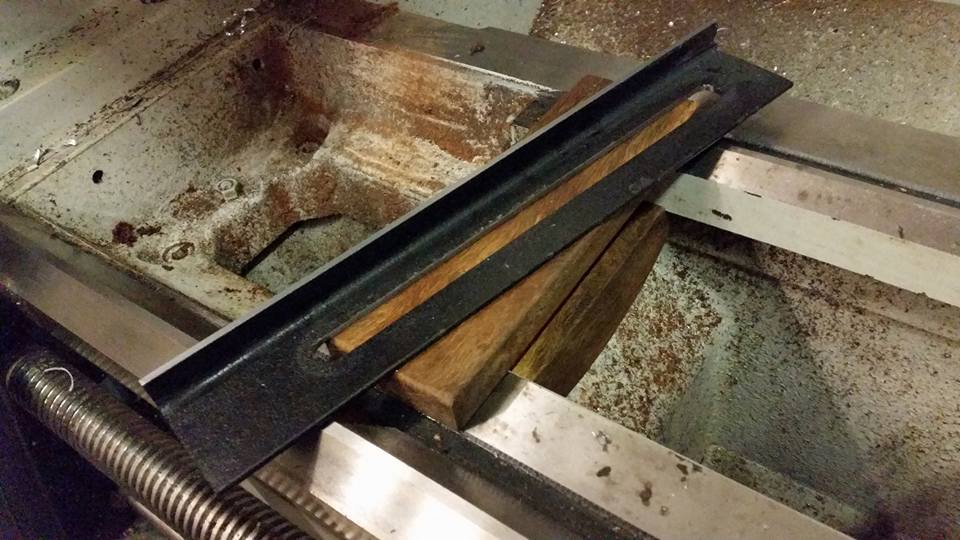
Some photos may help.

09 11 15 live oak for lathe banjo

09 13 15 live oak lathe clamp with pins added

09 18 15 lathe tool rest in progress after machining flat banjo deal

That last photo is a piece of angle iron I worked on today. I will fix an upright tube to it, with a set screw in it. The T rest, which I don’t have, will sit in the tube. I will run a 1/2″ bolt through the wooden base, and when I want to move the metal bit, I’ll loosen the bolt. Then I’ll clamp it down to fix it.

The live oak surprised me. It’s supposed to be garbage. They say it cracks and warps, but it hasn’t split since I cut it, and it doesn’t appear to be moving. It’s like titanium. I have to wonder if it’s stronger than aluminum.

I think the pegs are red oak. Not sure. I needed dowels, and Home Depot was out, so instead of a 36″ dowel that cost five bucks, I bought a 72″ roller handle for six bucks. The wood in the roller handle is really nice. Do they have red oak in China? I don’t know.

I’m planning to rig up a base for the T rest tube tomorrow, and then I’ll install the tube and start thinking about a rest. Maybe I should just buy one.

Chisels are not expensive. I learned a few things about them.

First, there are two main types of chisels. The first are carbon steel, also known as “crap.” That’s not exactly true, but carbon steel dulls fast. It will give you a nice finish, but you have to sharpen it a lot. The second type of chisel is high speed steel (“HSS”), which is what metal lathe tools are made of. It’s a lot harder, so it holds an edge better.

Second, there are two types of HSS chisels: Chinese and not Chinese.

You can get fairly good Chinese HSS chisels at Harbor Freight, or you can buy a brand called Benjamin’s Best, which is probably the same thing. People say they work okay.

I read some disturbing things about Chinese chisels, so I decided to look for some old Murican jobs. I found that old HSS Craftsmans were not hard to find, and they didn’t bring much money, so I sniped a set of 12 on Ebay. They will do unless and until I decide I need something else.

I also ordered a Supernova chuck. This is the biggest expenditure, by far. It was $175. That hurts a little, but consider the cost of a good metal lathe chuck that isn’t a Chinese compromise.

The wood chuck (woodchuck?) is probably Chinese, too, but I’m pretty sure that, unlike the Chinese metal lathe chuck, it’s not a compromise. It’s what a real lathe guy would use.

Anyway, for maybe $400, I should be totally tooled up, apart from minor elective doodads. That’s not bad at all.

I don’t plan to get heavily into this. I just want enough junk to do whatever little jobs come up. And I might do a little artistic turning. I may join the herd of eccentric garbage pile thieves. I already scoped out a pile of sea grape wood in front of a vacant house.

You can use a wood lathe to turn stone. How cool is that?

Here’s a guy whose work I really like. Don’t watch the video if you are a man, unless you’re immune to temptation. You might find yourself on Ebay in a day or two.

Wood lathes sell cheap on Craigslist all the time. Not trying to pressure you or anything. You know you want one.

I’ll post an update if I ever get this working. Something might happen as early as tomorrow.

Con-Fusion 360

Thursday, September 17th, 2015

Behold my Box

I got some comments on the post about CAD problems, so I am here to tell about my progress.

The basic problem was that I had a good CAD program, a good CAM program, and no way to move files from one to the other. Alibre Design 2012, my CAD program, has a built-in upgrade incentive: you can’t use the files for anything. The formats will not export to CAM. My other CAD/CAM program, Dolphin, apparently has a CAD module which people consider nearly worthless. This is like having a jet with a blind pilot and a navigator with no tongue.

I went to the forums and got two suggestions: Onshape and Fusion 360. These programs are free.

When I checked the programs out, I learned some things, and I ruled Onshape out pretty quickly. Both programs have cloud storage. I do not like “the cloud.” There is no cloud. There are only servers, and if your stuff is in “the cloud,” that means it’s on someone else’s server, and that person, not you, controls it.

If you want to work on your own, without involving the cloud, you are working “offline.” Onshape does not support offline work.

If you work for a big company, and you have a T1 connection at work, or whatever kind of connection it is that they have now, and your Internet connection never goes down, AND you don’t mind having no privacy and no control over your data, then Onshare is probably great. On the other hand, if you live in South Florida, and the Internet goes out every time it rains, and you might want to design things without effectively submitting them to DHS for approval every time you work, then maybe Onshare is not for you.

I’m sure DHS can see anything it wants in my PC right now, but the idea of simply giving up all pretense of privacy is unsettling. And what if they decide my new pressure cooker design is a bomb, and they decide to confiscate it? What if I decide to design gun parts for 3D printing? What if they decide I’m not allowed to use the Internet because I refuse to eat new Gay Pride Rainbow-Colored Doritos (a real product)?

I just don’t like it. I don’t like the cloud.

I downloaded Fusion 360 and tried it out. It appears to be pretty good. So far it’s more intuitive than Alibre, and at $0, it’s cheaper by $400. It supposedly has CAM as well as CAD, but all I’ve done is draw a box with a hole in it, so I couldn’t tell you anything about that.

Fusion 360 is made by Autodesk, and it’s absolutely free, with all the bells and whistles, unless you start making money with it. Even then, you have to make $100,000 before they start charging you. I think I’m safe.

When you make a design, you can export it and put it on your PC, and you can use the program without an Internet connection. The files you create can be used by other programs, so you’re not an orphan if you somehow lose the use of Fusion 360.

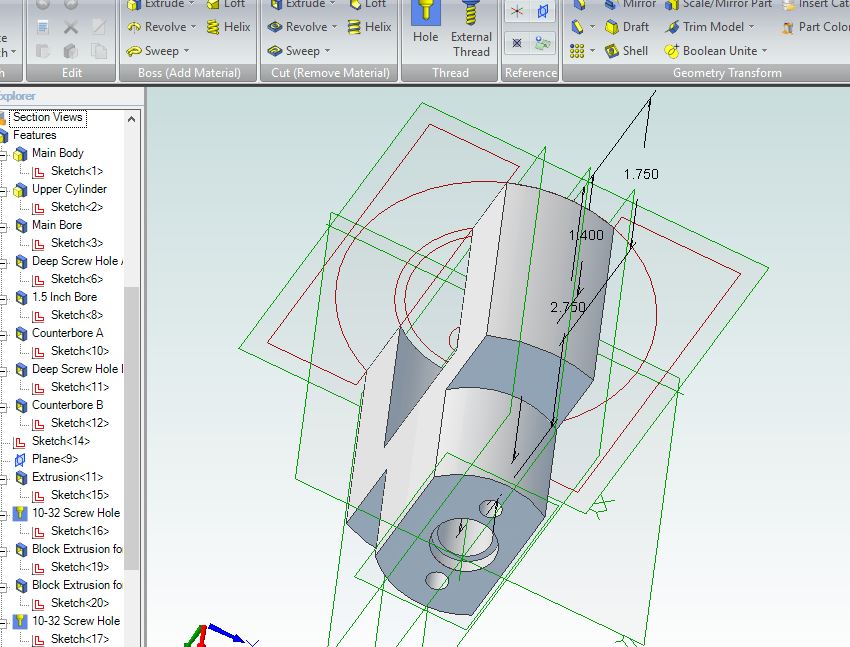
I hate to show off and make people feel inferior, but here is the box I made. That only took like 3 hours.

09 17 15 fusion 360 box Capture

A couple of commenters suggesting Draftsight. I’m sure it’s wonderful. I can only master one CAD/CAM program per day, but I will try to look it over.

The people at Dolphin seem very nice, but I am not yet seeing the value of their program. Perhaps I’m wrong.

I will update if I get anywhere with this. Right now I have to go arm the pressure cooker and smoke some Cuban cigars.

Oh, wait. Those are legal now, right?

CADZOOKS!

Wednesday, September 16th, 2015

I Should Have Taken up Knitting

I’m having fun today. And by “having fun,” I mean, “pulling my hair out and fantasizing about beating software engineers with a two-by-six.”

I have been trying to get up to speed on CAD and CAM, and it has not gone well.

A long time back, I bought Alibre Design, which is a modest CAD program. The interface is nice, and the learning curve is not terrible. They offered it for a low price, like a hundred bucks. I forget.

I learned how to draw parts, and then later I made a CNC lathe. And I found out that Alibre Design does not produce drawings that can be used for CNC.

You can imagine how crazy that is. We are in the midst of a CNC/”Making” revolution, and the primary reason for the existence of CAD is to tell machines how to make stuff. Creating a CAD program which doesn’t work with CNC is like creating a bladder with no openings in it. It is a recipe for suffering.

Last year I went crazy and bought Dolphin CAD and CAM. This is a set of programs that will take you all the way to the lathe or mill, pretty much. And because they have a special module for lathes, I figured it was the way to go. And the price was merely exorbitant, not astronomical. A lot of CAD and CAM programs have four-digit price tags, which is why people torture themselves with open source crap that takes ten years to learn. Dolphin was three digits.

I did not realize how annoying Dolphin’s CAD interface was. Alibre has 2D and 3D in the same window. You draw a part in 2D, and then you view it and rotate it, easily, in 3D. Dolphin is just 2D, unless I missed something. It’s not that easy, looking at a 2D drawing and visualizing a 3D product, especially if you can’t draw more than one side of the part.

As far as I can tell–and I may be wrong–Dolphin forces you to make a different drawing for each side of a part. Imagine doing that for a complex part. Highly aggravating.

Alibre only exports drawings in AD_PRT and STL format, and these formats are dead ends. I found a way to convert STL to DXF using a program called Blender, and you can import DXF into Dolphin. I’ll show you why that was a waste of time.

First, an Alibre part I drew.

stepper mount Capture

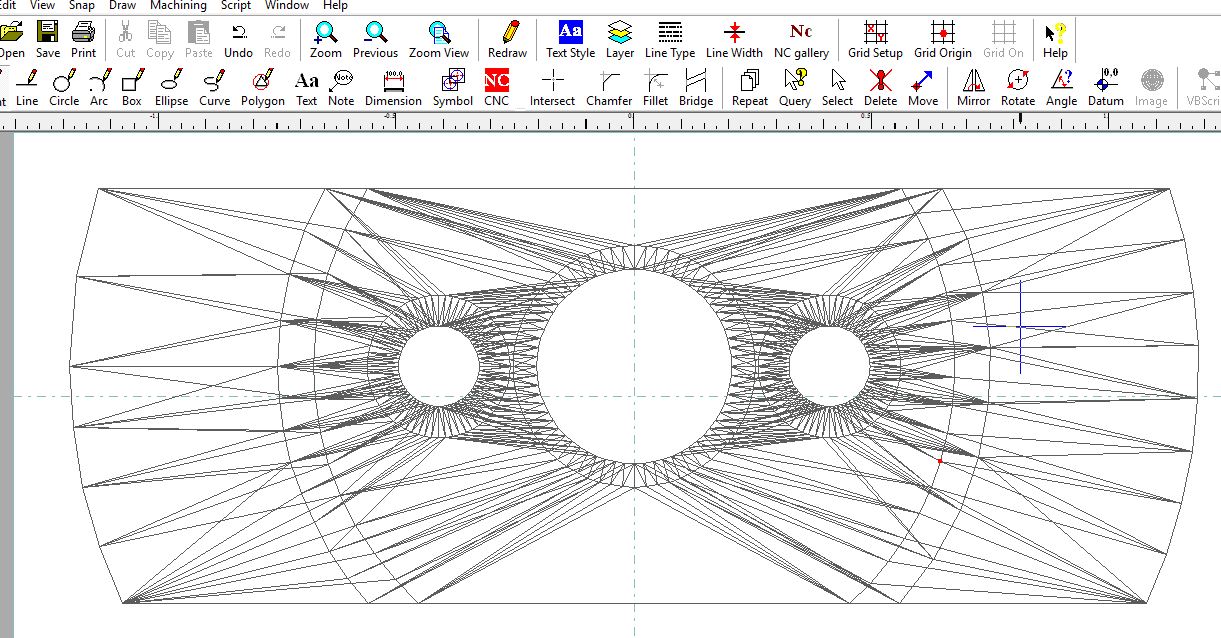
Now the drawing that came out when I exported to Dolphin.

stepper mount dolphin CAD abortion Capture

That’s all you get. That side. The other dimensions are gone.

I had to call Geomagic (the Alibre people) today about a licensing problem, and–this will shock you–they wanted to sell me new software! Yes, I was amazed, too. I asked them about the crazy format problem, and the lady said they used to have a program add-on that allowed file conversion, but it was “no longer available,” meaning, “We do not want to give it to you.” Great. I never heard about it.

She said the latest Geomagic Design (successor to my program) was only $400. Yes, because to me, $400 is like three cents is to ordinary mortals. It means nothing to me. I scoff at it. But I let her send me a download link so I could look at it.

I fired it up, converted the drawing to a format Dolphin likes, and imported it into Dolphin Partmaster 3D.

Again, I don’t know what I’m doing, but I think PM3D is useless for CAD. I could not find any CAD tools in the program. I believe all it does is import files, let you view them, and export them. I opened the part file, and PM3D allowed me to export 2D drawings from it. I chose a view that would work for a lathe, and I sent it to Partmaster CAD, which is the 2D program. Here is what I got:

dolphin CAD stepper mount 2D Capture

That is actually useful. I would have to trim it a little, because you’re not supposed to use both sides of a lathe profile in a CNC program. After all, the lathe only makes one cut, and it affects the entire surface of the round part. But it would work. I think.

Now I’m highly annoyed, but at least I can see a way out of this mess.

I don’t know what to do, but one thing is for sure: for the 15-day duration of the trial period, I will be using Geomagic to export everything in sight. Maybe I can find a cheaper solution before the time runs out. That would be nice.

If I can get this working, I’ll put the CNC lathe on its own cart and see if I can actually use it once in a while. That would be great.

After I give in and buy the new program–probably 10 minutes later–someone will tell me about a free program which does the same thing.

That can’t be helped.

Shelf Actualization

Tuesday, September 8th, 2015

I am Lathe to Complain

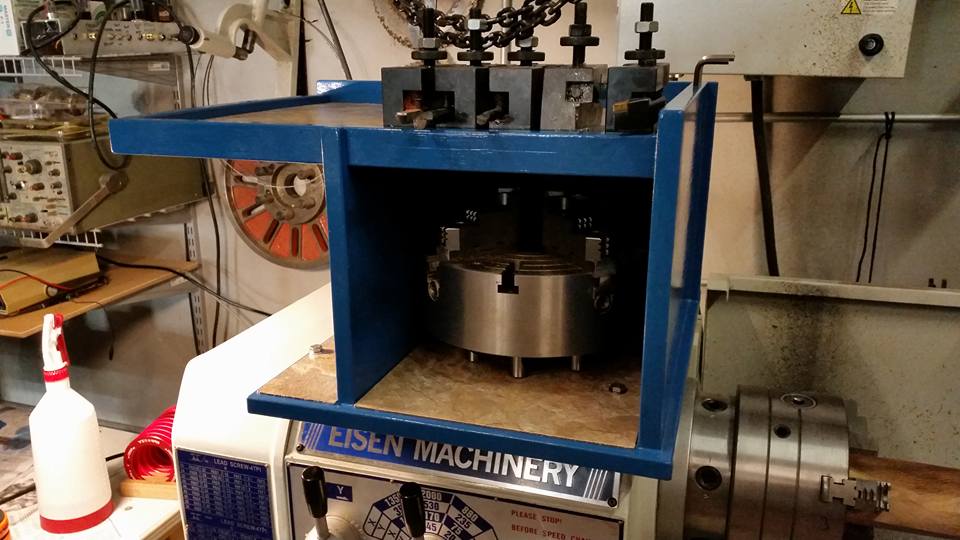
I feel like I need to put up a picture. I am finally almost done with the lathe shelf. Here it is.

09 07 15 lathe shelf on lathe still needs touchup

Don’t ask me why, but the camera picks up imperfections that are barely visible to the naked eye and makes them look huge. If you were here in person, you would think the shelf looked pretty good. Or at least you would say that, while backing away from me slowly. If you were smart.

Someone suggested there would be a problem changing chucks, because the key that turns the cams is obstructed. This is the one thing I didn’t think about. The one thing I didn’t think about that I know about as of today. But it turns out the key has enough freedom to open and close the pins, so I’m good. I can’t change the headstock oil without removing the shelf, but I knew that going in.

Fitting the floor tile was interesting. I learned that the upright parts of the shelf are not totally straight. Or the sides of the tiles were not totally straight. One or the other. I trimmed the tiles using a #4 hand plane. It works great.

Another interesting thing to be aware of, if you ever try to lay tile or anything else in a corner: you have to round off the corner of whatever you’re installing. The inside corners on the shelf are not sharp, but outside corners of things can be very sharp indeed, and they protrude and cause problems. In this case they would have lifted the corners of the tile up.

I am not totally happy with the adhesive that came stuck to the tiles. The wood under the tile is bare, so you would expect a good hold, but in some places it seems to want to rise up. I may have to look into an additional glue.

This will be great. It will get a lot of crap off of the floor and the table saw extension, and it will keep things where I can find them in a hurry. Notice the Allen wrenches. I drilled deep holes into the side of the shelf, just big enough for the two wrenches I use most. I may add new doodads to hold tools such as chuck keys. That would be helpful.

Some day I may sand the shelf down and improve the finish, but right now I have to get on with my life. I can’t dedicate another week to this thing. I still hate painting. I don’t know how anyone manages to do it right. I can sort of handle a spray gun, but brushes are beyond my comprehension.

Home Depot never has fasteners stocked or sorted correctly, so I could not get M8-1.25 x 65mm bolts to hold the shelf down. I had to buy 70mm bolts and grind them down with the bench grinder. Annoying. I had to modify fender washers for the bolts on the left side so they would not bang against the side cover. I made them D-shaped using the belt grinder, which is one of the three or four greatest tools in the universe.

Now I have to make a rolling cabinet for the CNC lathe. After that, I may pick up a few items and try woodturning.

I leave you with a clip from Tiny Trailer Workshop. If you don’t love this, you must not have a Y-chromosome.

Shelf Improvement

Saturday, September 5th, 2015

Painting Isn’t for Everyone

I am sitting here waiting for paint to dry.

I have been struggling to get the garage workshop working, as you know if you keep up with the blog. I believe it’s a metaphor for my own inner transformation.

When you get involved with tools, you have to accept a bitter truth: before you can use the tools to do stuff to other things, you have to use tools to work on your tools to get them ready.

I guess it sounds discouraging, but there is no way around it.

There are a number of things you can buy at the hardware store and then use without preparation, but it’s surprising how many things don’t work until you fix them up.

Consider chisels. You can buy a set of perfectly good ones today at Home Depot, but they won’t be sharp enough to use. Also, Home Depot doesn’t sell the tools you will need to sharpen them. Can you believe that? What could be simpler than a chisel? You would think they would be plug-and-play.

To sharpen a chisel, you need some kind of abrasive tool, and you need at least three levels of grit. You can use a bench grinder to do the rough sharpening, if you’re highly skilled. Then you have to go to a water stone or a diamond stone. Then you have to go to a stone with a grit rating somewhere above 4000.

In order for a Home Depot chisel to be considered ready to use, it has to be able to pop tiny hairs off of you, just like a razor.

I don’t know why Home Depot doesn’t sell decent sharpening tools. Probably because the average chisel user does very crude work.

I have lots of tools, but I haven’t been able to use them as much as I wanted to, because I didn’t prepare them or myself. So now I’m working on it.

On a spiritual level, I’m doing the same thing to myself.

People love to say that Jesus said, “Judge not,” meaning, “Never criticize anything anyone else does.” That’s not true. What he really said was that we should judge ourselves first, and he made it clear that once we did that, we were supposed to judge others so they could benefit from our advice. He didn’t say we should take the logs out of our own eyes and then go home. He said that when we took the logs out of our own eyes, we would then be able to help others take the splinters out of their eyes.

When you beg God for correction and humility, you’re taking the logs out of your eyes.

You shouldn’t expect things to go all that well until you begin accepting correction. Before God straightens you out, you will be led by the flesh, not the Spirit. You will not want to do God’s will. You’ll want to do whatever Satan tells your flesh to do. You will not have the spiritual fruit of self-control. So God will not have much interest in helping you. It would be enablement.

As you accept correction, the spirits that have controlled you your entire life will lose their power, and the Holy Spirit will gain ground inside you. Then you’ll start to have strength and success, because you’ll be doing things God supports.

Prayer in tongues is a constant flow of correction, so it’s vital. We are surrounded by stupid voices all day, every day. Prayer in tongues is God’s answer to that.

One of my shop problems is a lack of provision for lathe tool storage. I have a bunch of heavy lathe tool holders, plus two huge chucks. I also have Allen wrenches and other junk. I need to have this stuff near the lathe, and I need it to be handy, but tossing it on top of the headstock and dumping it on the table saw extension have turned out to be poor solutions to the problem.

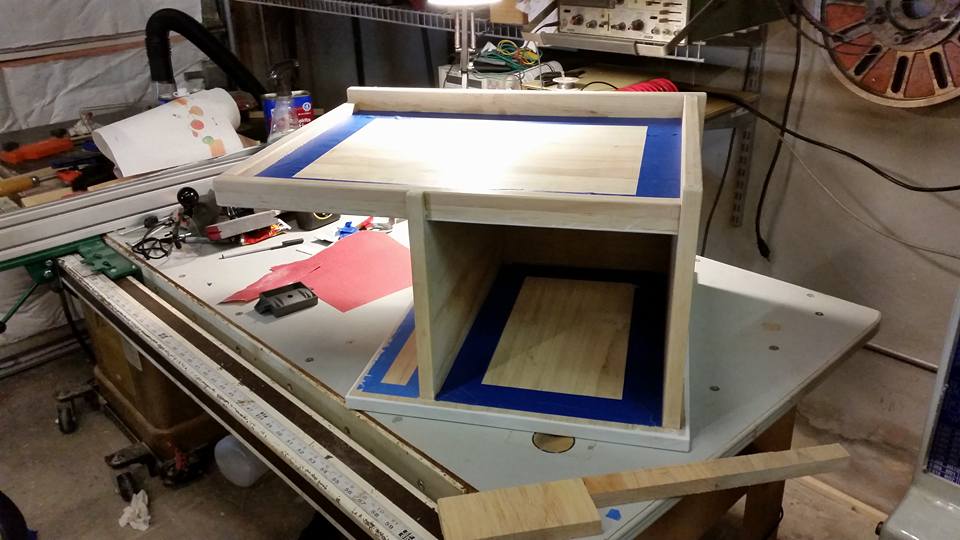
I knew that other people had created extended wooden shelves to enlarge the tops of their headstocks. I decided to create a box with a shelf on top. The box would hold whichever chuck I was not using, and tools would go on the top shelf.

You can’t imagine the nightmare that began when I started work on this.

First of all, the thing needed to be about 17″ long in the shortest dimension. Trees are very skinny these days, so you can’t just walk into a store and ask for a board 3/4″ thick and 17″ or more wide. You have to use plywood, which looks crappy, or you have to make your own boards. Like an idiot, I chose the latter route.

To make a wide board, you have to take two narrow boards and glue them together side by side. This is more complicated than it sounds. You have to use a jointer on the edges that mate. Then you have to use a hand plane to put slight indentations on those edges, to create a spring joint.

A spring joint is what you get when you put glue on two concave surfaces and clamp them together forcefully so they touch. You remove a few thousandths of an inch from the edges of two boards before you glue them up. You can’t even see the concavity.

When I made my first board, I did not understand the purpose of spring joints, but now I get it. If you have two boards that aren’t concave, when you push them together, you may get a gap at one or both ends. It will be a tiny gap, but it will show up when you sand and paint the wood. If you make a spring joint, the boards will touch at the ends, so you won’t get gaps there.

It took me days to make enough boards for the shelf thing. I guess the reason is that I don’t have a lot of clamps. I would use three long clamps to make a board, and while it set up, I would be idle, because I couldn’t clamp a second board together.

Once the boards were made, I had to use planes and a scraper to get rid of the microscopic lines where the boards came together. I learned a great deal about plane marks.

When the boards were made, I had to use the table saw to cut them to size, and then I had to use a shooting board and a plane to make them truly square. In the process, I found out that my Incra table saw miter gauge was not square, so I had to fix that.

After all of that, I had to do some routing. I needed tongues and dadoes to fasten the boards together. My mistakes drove me nuts.

For one thing, a router bit in a router table will push wood away from your router fence if you push the wood from left to right. I did not know that. I thought that if I used a little force to hold the wood against the fence, I would be fine. That was totally wrong. The boards would move away from the fence a sixteenth or so, opening up the dadoes. It was infuriating.

Thank God, I was making the dadoes narrower than the boards that went in them. This makes the joints harder to see. That meant the big router gouges were covered when the boards went into the dadoes. But it was still annoying.

I also learned that you have to plan the way the grain of your boards runs when you design your piece. If you have end grain against long grain, you can’t glue it, because the end grain will suck up all the glue. It’s okay for joints that don’t receive stress, but other joints will require some sort of joinery, such as dadoes, to provide new gluing surfaces where long grain meets long grain.

I learned that soft wood is horrible. It’s harder to work than hardwood.

If you use a chisel on hardwood, it will cut it cleanly. If you use a chisel on softwood, going across the grain, the wood may compress and tear instead of cutting. It’s like using a bread knife to cut a stack of Kleenex.

If you use a router bit in hardwood, it leaves a clean edge behind. In softwood, you may get a furry edge that needs to be sanded a lot.

Scrapers, which are incredibly useful, don’t work very well on softwood. That’s annoying, because they’re great for cleaning up glue lines and erasing plane scratches.

You also have to be careful about making grooves, slots, and dadoes in softwood, because if you get too close to the edge of a board, you will have a very thin wall of softwood on the outboard side, and it won’t support your tongue very well. Also, the router may kick the wood completely out when you’re making the dado.

I learned that poplar is stupid.

Poplar is a hardwood, but it’s not hard. It’s not a softwood, but it’s a soft wood. It’s about like pine in its consistency. I used some in the shelf because I thought it was the cheapest hard wood available, but it turned out to be a bad buy. It’s more expensive than pine, and it’s actually softer than the better pine grades. It’s very ugly, so it has to be painted. And it has all the problems pine has when you start trying to shape it.

I’m not sure what poplar is good for, but you can get clear pine for the same price, and it looks better.

It took me forever to get the shelf together, and then I had to deal with painting it. That’s where I am right now.

I wanted to use a tough blue paint that would shed oil. I decided to go with oil-based Rust-Oleum. I really wanted to do it right. But it looks pretty bad right now.

First of all, even though the primer I used is supposed to work fine with oil-based paint, there are little places where the paint just does not want to stick. I’m going to have to give it like 10 coats in those areas. Second, this paint is the farthest thing from self-leveling. It leaves huge ripples behind, and sanding doesn’t seem to budge them. Third, it drips like crazy.

I’ve also had problems trying to get up to speed with the art of painting, itself.

I’ve never been able to get a grip on cleaning brushes. I’ve generally thrown them out. The paint always goes way up under the ferrule, and you can never get all of it out. It takes a huge amount of thinner to clean a brush, and it’s a pain to deal with.

I got some instruction. It turns out you’re supposed to prepare a brush for painting by soaking it in mineral spirits. This goes up under the ferrule and takes the space paint would otherwise occupy. It will keep the paint from going up there and hardening. I can’t believe I got this old and didn’t know that. No one told me! And you can look at websites all day and never see this information.

I found a video that explained it, but the guy in the video took the brush straight from the mineral spirits to a container of varnish and started painting. I had to ask about that. Obviously, it’s wrong, because the thinner on the brush will thin the paint you’re trying to apply. So you have to get the excess thinner off the bristles. Something he should have mentioned, right?

No wonder people consider brushes disposable.

I have been working on the paint for days, and it’s still not done. I finally decided to settle for a garage-grade finish. Maybe once the shop is working properly, I can make a new shelf. But I have to get this thing done and use it, or I will lose my mind.

I would really like to do things right, but I’m going to have to start accepting my limitations. Once in a while, “okay” will have to be an acceptable substitute for “perfect but unattainable.”
09 01 15 lathe shelf ready for paint

In other news, my new old church is getting weirder.

They have a prayer line. I used to be part of the prayer team. They’re supposed to call a conference line three times a week and pray for the church and so on.

I quit the team months ago. I felt like they were praying in an ineffective way, without solid guidance from the Holy Spirit. You’re not supposed to pray for two seconds for everyone on earth. You’re supposed to let the Holy Spirit choose your battles. You pray for the things he tells you to pray for, the way he wants you to do it. They were taking kind of a shotgun approach. Also, most people weren’t showing up. Usually there were only three people on the line. The pastors and the “house prophet” didn’t participate regularly, which makes you wonder what the pastors were being paid to do.

A lot of people wonder what the pastors are being paid to do. The impression many people have is that during the week they do absolutely nothing but go to the spa, travel, and visit restaurants.

I didn’t say anything critical when I left the prayer line. I just quit and said I felt like I should be doing something else.

I have a friend from the Panhandle, and she has been very good to the church. Although she wasn’t a member, she helped them financially and drove down to visit from time to time, and she was a hard core prayer line warrior.

Last week, the pastor’s wife changed the prayer line number and didn’t give it to her. Something about wanting to confine participation to church members. To be clear, she was deliberately cut out.

You have to realize, this woman was not my puppet. She wasn’t calling the prayer line and telling them how bad the pastors were for rejecting me. She was just praying. But now she’s out.

They cut another person out. She’s a young woman with some type of mental retardation. I don’t know what the proper name is. It’s not Down Syndrome. She’s very sweet, and she is a very sincere Christian. She has visions. She sees angels. She wanted to be on the church’s dance team, but they wouldn’t allow her to perform. I don’t know why. It’s not the Bolshoi Ballet. It should not be hard to qualify. If you’re not good enough to dance for God, at a tiny church which is currently failing, where, exactly, can you expect to be accepted? You can’t shoot any lower.

She and her mother eventually left the church. But the young woman continued with the prayer team. Sometimes she was one of only two people who called in. Now she’s out!

How a preacher can want FEWER people to pray for a church is beyond me. That’s a new one in my experience. The church is sinking. They are losing dedicated people. Their planned moves to bigger buildings got squashed. The air conditioning in the tiny room where they meet is out, and knowing the landlords, it may be another two weeks before it works again. It appears that their orphanage in Haiti has gone nowhere. The prayer team is nearly gone. Is this really the time to ramp up the ostracism?

I don’t know what to think about it, but I’m glad I got pulled out.

My plan for my own life is to keep asking for correction. It’s working beautifully. It makes life easier, except for painting. It’s what we all need. It’s what Jesus died for.

I can’t do anything for people who are convinced they’re already perfect. If God’s methods of improving people involved grabbing them against their will, opening them up, and replacing parts, it would be easy to help others, but unfortunately, most of it relies on their willingness to listen.

As for me and the people close to me, we keep getting new revelation, and things keep improving. I feel better. I have more success. I worry less. Doors are opening so I can get out of Miami.

I have learned that when there is an area where I fail consistently, God is trying to teach me a lesson, and when I finally learn it, he will let me move forward and succeed. This is what happened to the Hebrews under Moses. They walked in circles and died in the desert, but the ones who had not rejected God’s counsel were allowed into the Promised Land.

I still have no interest in joining a new church. Maybe some day.

If I get this crazy shelf put together, I’ll put up a photo. I can’t wait to see it on top of the lathe, with all my junk stuffed into it.
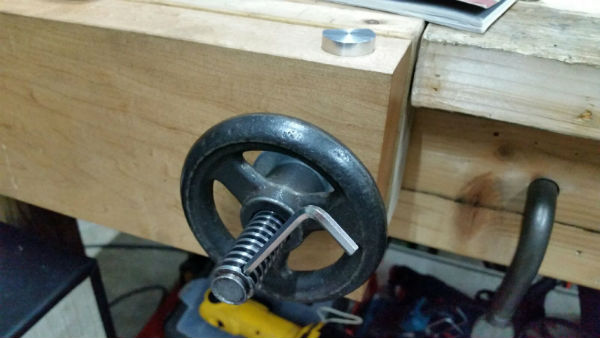

Cry Havoc! And Let Slip the Dogs of Bench

Friday, July 17th, 2015

Wood That I Could

Today I learned something disturbing about hand planes.

A while back, I found that I had the ability to hand-sharpen stuff with remarkable accuracy. I proceeded to fix up the blades of my old hand planes. I made edges that were either perpendicular to the length of the blades or, in the case of a blade that was originally sharpened way off perpendicular, nearly so.

I was happy. The blades looked pretty good, apart from the gouges my early efforts made, and they were literally like razors. I planed with them and felt great joy.

Then I saw this guy.

His name is Richard Maguire, and he goes by “the English Woodworker.” Good luck getting a trademark on that in the USA.

When I watch him, I keep expecting Eric Idle to pop out of a refrigerator.

He uses hand tools and does lots of neat work. He makes a living making workbenches. He knows a great deal about weird old tools.

A week or so back, I heard him say something about “cambering” plane blades. This means that instead of a straight edge, you create a convex arc. When you put the blade in the plane, the center is slightly lower than the edges, so it hits the wood first.

I waved my hand and decided to write him off as an eccentric. Because I had done so much work on my blades.

Today I was reading up on planes, and I read some credible stuff that said that it was necessary to camber plane blades. Not optional. Not optimal. Necessary.

The problem is that if you don’t do this, the corners of the blade will be level with the center, and they will cut just as deep. Where the blade ends, the cutting stops, so you get a tiny rabbet. Not the kind you surprise your kids with at Easter and then turn loose in a park when no one is looking because you’re tired of cleaning the cage. A rabbet is a straight cut in a piece of wood with a 90-degree wall.

I guess calling a miniscule gouge a rabbet is an exaggeration, but you get the point. You’re trying to make a piece of wood smooth, and you leave long scratches in it.

Today I removed my vise from my bench so I could flatten the top a little. There are six boards in the top, and the third one in was pretty warped. I started planing it, and I saw the scratches, and that’s when I started reading up.

Then I read up on how to put a camber in a plane blade. Some people call plane blades cutters or irons. I am not that particular.

It turns out that if you sharpen by hand, using whetstones, you have to push really hard on one side while you sharpen it, and then you push really hard on the other side. Over time, the sides get cut more than the middle, and you get a very wide arc.

So I spent like 3 hours resharpening my blades. I found that once you start to get close to the arc you want, you can perfect it by switching the pressure from one side of the blade to the other during each stroke.

You can buy jigs and machines to do this stuff, but then you’re a loser and a girly man, and I wasn’t having that. And I don’t want to have to drag the woodworking equivalent of the Electrowhocardioshnooks out every time I want to do something.

So here is the bench now. The last two boards are covered by important woodworking tools such as my computer monitor and CNC lathe, so they’re not flat yet.

07 17 15 workbench flattened with hand planes

My big project for the weekend is to put the vise together. I am hoping UPS came through on its promise to deliver the acme screws and nuts today.

I also ordered some holdfasts. These are bent pieces of wood, like the hooked ends of crowbars. Dang…I just realized I could have bought crowbars and sawed them in half. Anyway, you drive them into holes in the top of your bench, they get wedged in, and pads on the ends of the hooks hold your wood down.

I will have to make holes for these things. Unfortunately, the bench top is only 1.5″ thick, and that’s half an inch too thin for holdfasts, so I will have to attach a board under the bench to make the holes deeper.

Once this is done, I will be able to hold wood down properly while I work on it instead of sitting on it or holding it down with my face.

The bench is getting surprisingly nice. You wouldn’t want it in your living room, but stuff no longer rocks when it sits on it. I could build a new top in two days, but I like doing modifications. It allows me to get practice without screwing up anything expensive or important.

I plan to use the holes for bench dogs, too. These are little cylinders of wood that sit partway in the holes, held up by friction, and keep wood from moving sideways. You can put a vertical thing in your vise’s moving jaw, put a piece of wood against it, and tighten the vise until it drives the wood into one or more dogs. This holds it in place. You can also use a bench dog, a holdfast, and a batten. But I am too lazy to tell you what this means.

I have learned an amazing thing, which I already suspected. Human beings have the ability to detect things their senses can’t really pick up.

For example, when I was sharpening the blades, I was creating deviations from straight that amounted to maybe four thousandths of an inch. To be really sure what was happening, I would hold the edges up to a machinist’s square and look for light between the rule and the blades. But before I put the blades up to the square, I already knew, pretty much, what I was going to see.

When I was planing, I had a carpenter’s square, which I used to check the wood for flatness. But I found that when I ran my hands over the wood, the high places, which were maybe five or ten thousandths high, felt positively swollen. They were very obvious.

Don’t ask me to explain it. I can’t.

Let’s see. What else?

I made a router plane. A router plane is a tool with a blade that projects down from a flat body. You use it to even out the bottoms of dadoes, which are like two rabbets facing each other. In other words, a dado is a slot with vertical walls and a flat bottom.

07 16 15 homemade router plane with set screw added

There are a million router planes on the market, and none are cheap. I was very confused when I shopped. Then I saw this guy.

That’s Paul Sellers. He is merely AN English woodworker. To be clear. Anyway, he says you can make a working plane by driving a chisel through a board. So I bought a chisel and gave it a shot. But I found that making a chisel sit level in a round hole was iffy, and on top of that, I expected the hole to open up quickly with use, so I decided to make a board with a flat hole through it.

In order to do that, I had to make a slot half an inch wide, at 35 degrees to horizontal. Then I had to fill the slot most of the way with a piece of wood half and inch thick. The finishing touch was a set screw, which I made by cutting a quarter-inch lag bolt in half. I can move the chisel back and fort to adjust the depth of the cut, and the screw holds it in place and forces it to level itself against the flat bottom of the hole.

I cheated in the worst way possible. I used the milling machine to make the slot. Doing it with woodworking tools would have been a nightmare. I finished with planes, butchering the wood in the slot pretty badly, which proves my point.

I almost killed myself making this infernal object, but I did finish.

Does it work? No idea. I don’t have any dadoes at the moment. That’s not the point. I wanted to make it, and I did.

Now I may have something that will function while I either choose or make a real router plane.

07 16 15 using milling machine to cheat on router plane

I know you find this fascinating. Let me just say this: you’re welcome.

Bench Trials

Monday, July 13th, 2015

A Certain Amount of Bleeding is Good for You

I have been fiddling around with my workbench.

I built it in maybe 2007. I did not know what a workbench should be like, so I guessed. I used pressure-treated four-by-fours for the legs. I put horizontal two-by-eights in several places for added rigidity, and I covered it with two-by-sixes laid flat.

I did not know much about joinery or routing, so I made an interesting choice. I took a router and made tongues and grooves on the boards that made up the top, and I shoved them together. The outermost boards had screws holding them down, and they held the other boards in place. I put one additional screw near the end of each inner board.

The tongues and grooves were not too good. I think I didn’t understand the importance of milling wood to make it flat and straight. When you have boards with curved edges and various types of warpage, they don’t mate up all that well. Now I have a few cracks that things fall into. Screws and drill bits, mostly.

The irony is that I thought the joinery would prevent things from falling. I didn’t want stuff to fall down between the boards and go right through so they landed under the table. Now it falls and gets stuck half an inch below the level of the top, and it tends to get covered with sawdust and other crap.

Yesterday I dug around between two boards and found a drill bit I had been missing for weeks, plus an unusual screw that fell out of a rotary table.

The workbench has its issues, but it’s very solid. You could literally park a car on it, if you could find a way to fit it.

It’s not a real woodworking bench. It’s just a general-purpose bench. I stuck a heavy 5″ mechanic’s vise on the left front corner, and I didn’t add any features that would help me work on wood. No dog holes. No wood vises.

Much later, I learned what woodworking benches were like.

Internet hobbyists are probably not the greatest guys to ask for advice when it comes to benches. Most of them have never had to make a wooden item in order to put food on the table, so they don’t know a whole lot about efficiency or what really works. They like benches that look fancy and have lots of cool joints in them. And sometimes they use hardwoods, which is apparently a mistake.

I’ve been studying up on this. Evidently, crummmy wood like pine and fir is the best choice for a workbench. It’s cheap. It’s relatively easy to work. You can glue long pieces together and make huge laminated boards without quality jointing; the wood is soft enough to deform when clamped, closing any gaps caused by warpage. You don’t need to run it through a jointer, which would be a chore.

Also, you should not sand a workbench top and make it super-pretty. If you do, stuff will slide around on it because it has no grip. Professional woodworkers will actually fix their benches when they get too smooth. There are planes made for this purpose. They have toothed blades. You take the plane, and you deliberately rough up your gorgeous surface so cabinets won’t slide off and shoot across the shop.

Hobby woodworkers tend to make benches with tops that are way too thick. When a top gets more than 3″ thick, you will start to have issues when you try to use holdfasts. A holdfast is a bent rod that goes through the top. It has a flat clamping surface on one end. The other end is straight. You push the straight end down into a hole in your bench, and it gets wedged and holds your work down flat so you can butcher it. If the hole is too deep, it won’t want to wedge.

On the other hand, a thin (1.5″) top like the one I have is bad, because it won’t work with many vises. An example is the Eclipse 10″ vise, which is a Czech copy of a vise made by Record. This thing is supposed to be screwed to the underside of a thick bench, with over a foot of hardward projecting horizontally underneath. The fixed jaw goes against the edge of the bench, and it’s pretty deep. If the side of your bench is 1.5″ high, you have a problem. Also, if you have a vertical board under the edge of your bench to support the top, you will have to cut holes in it for the vise hardward.

I have two vertical boards a few inches apart.

Seemed smart at the time.

I am not planning to make a new bench right now. I can’t think of an excuse, so I will just admit I’m lazy. Over the last day or two I’ve learned things that make it less intimidating, but during that time I made a choice to work with what I have, and I made substantial modifications, so I want to see how far I can go with the existing bench.

In my Google-powered research, I learned about something called a Moxon vise. This is a fat board maybe two feet long, with two acme screws in it. You put a screw through each end and mount a dial on the outside, and when you want to hold something, you put it between the board and your bench and tighten the screws.

It’s not rocket science, but it has a following, and to me, it looked a lot easier than performing major surgery so I could install an Eclipse.

Usually, these vises have screws that don’t move. The dials are threaded on the inside, so they move toward the bench as you tighten the vise. That leaves two huge bars of metal hanging out of the bench at waist level at all times, waiting to gouge you every time you walk by.

No. That will not do.

I decided to make a version with screws that turn. That would move everything close to the bench when the vise was closed.

To do this, I needed a fat fixed jaw pretty much flush with the side of the bench, and that meant hacking off the ledge that hung over the side. Here’s a photo of what I did with an ordinary saw from the hardware store, followed by a flush-cut router bit.

07 11 15 bench with cutout for wood vise

I am not great with a router, and the bench top (my reference surface) was not all that flat, so I got a few gouges. But I had to fine-tune it with a scraper and plane anyway, so to a large extent, the gouges went away.

I needed wood for the hole. I had a couple of really ugly two-by-sixes rotting in the backyard, so I cut usable pieces from them jointed and planed them, and glued them together to make one board.

07 11 15 cheesy pine glued up for bench vise jaw

I drilled some holes in them and made recesses for screws, and then I attached them to the bench with lag screws. The result is really nice. I can’t stop looking at it.

07 12 15 moxon vise fixed jaw attached to workbench

I wanted a hardwood moving jaw, for some reason I don’t recall. I paid good money for three feet of maple and then cut it down, removing all the cracked and useless wood that always seems to come with lumber yard items. I plan to drill screw holes in it and add it later.

I also picked up a piece of 36″ threaded rod and two nuts. The usual choice is acme thread, but that’s not available locally, and I saw a piece of 3/4″ 60-degree threaded rod just staring at me at the hardware store, so stupidly, I bought it. Then I found out it won’t work.

I mean, yes, it will work, but the pitch is much finer than the pitch on an acme screw, so it will take a billion turns to open or close the vise a few inches. Also, 60-degree threads don’t work well with half-nuts.

A half-nut is a piece of metal with threads inside it, but they only go 180 degrees. If you took a nut and sawed it in half across the opening, you would have 180 degrees of threads, and you could drop it directly onto a threaded rod and get it to engage. You wouldn’t have to screw it in, because the nut would be open.

If you have two half-nuts, you can close them around a threaded rod in order to get a nut that works. When it’s closed, you can move the rod back and forth through the nut by turning it. When it’s open, you can move the rod freely without turning it. You can use half-nuts for quick-release devices. Open the nut to move the vise jaw (for example) quickly. Close it when you want to use the screw and apply force.

Lathes use half-nuts to move their carriages when machinists thread things. You turn a lever, the nut closes around a turning screw, and the carriage moves as the nut moves up the screw.

A 60-degree thread is sloped, obviously, so when it’s in a half-nut and you push or pull it, some of the force will be transferred outward, and the half-nut will try to open. Acme threads are pretty square, so they are less troublesome.

So now I have 36″ of useless threaded rod. I found acme rod online, and three feet of it are on their way to me now, complete with nuts.

This is too bad, because I had all sorts of neat ideas for a half-nut quick-release mechanism. But if you have acme threads, you don’t need a quick-release mechanism all that badly, because the coarse pitch makes things move pretty quickly as you turn the screw.

A famous woodworker named Paul Sellers has a series of Youtubes showing how to make a workbench top. It’s really not that bad. You plane a few pieces of cheap pine or fir just enough to make glue stick, and then you clamp them side-by-side. Eventually you get enough solid wood to make a benchtop, which you can plane and adjust.

It would be even easier for me, because I have a jointer and planer. I don’t insist on doing stuff by hand.

Nonetheless, I feel I should keep working on the bench I have, because it’s great experience. And if I have a bench that works, it will be there to use when I make a better one.

I have ideas for filling the cracks. I have an idea for a swinging TV arm to move my monitor out of the way when I need to use the whole width of the bench. A tail vise would be nice. Dog holes. A thin hardwood covering for the pine, to make the holes slower to open up and become useless.

It keeps getting better. To add the vise jaw, I had to move my power strip down low, where it should have been to start with. Putting a power strip at waist level sounds smart, but then you bump into it all the time, and you will step on the cords and pull them out.

The vise jaw is really beautiful. It goes to show that you can make very nice things with cheap wood. It looks much better in real life than in the photo. Makes me want to make more things out of inexpensive pine.

The photos show a lot of bright-looking areas. Those are places that have been planed. My planes are amazing; even the cheap one I restored. They whiz along like nobody’s business. I can actually do useful work with them. I am thinking of driving strips of wood into the bench’s cracks and planing them fair with the top.

It’s nice to have tools. It’s even nicer to be able to use them and get results.

If this project goes anywhere, I’ll post more photos. In the meantime, quit watching garbage on TV and eating Cheetos. Turn on Youtube, open a book, and learn a few things.

It won’t kill you.

What’s Worse Than a Dull Saw?

Monday, July 6th, 2015

A Dull Saw Cutting in the Wrong Place

The Garage of Shalom has significance that goes beyond tools.

I turned back to God because I was suffering the consequences of my own mistakes, not because I cared about his kingdom. I wanted to change–a little–but that wasn’t the main thing that motivated me. Mainly, I felt that I was losing when I should win, and I was tired of it.

It wasn’t all that long–maybe a year–before God made me understand that human beings were ruled by iniquity, and that I needed to rid myself of mine. But I still thought a lot about money and succeeding at the things I wanted to do. I believe I saw cleaning myself up largely as a means toward that end. I didn’t see correction as the end.

I would not say I was a mercenary person. If I were, I would be practicing patent law right now. But change was not my top priority.

What I have found is that the more I focus on internal correction, the more things around me become ordered. They matter less, which may seem odd, but they fall into line anyway.

I had a bunch of tools. I had tried getting into tools in fits and stops since about 1985, and things had really taken off in about 2007. I got a big table saw that year. I got a MIG welder. Before too long I had a lathe, and I was thinking about a mill.

I couldn’t really use these tools, though. I hadn’t laid the groundwork. I didn’t have enough storage. I hadn’t spent enough on accessories and dust collection. I spent money on the relatively glamorous stuff and skimped on the boring things that made it all work.

Over the last year or so, correction itself has become the thing I want most, and suddenly, the garage is coming together.

I fixed my planer so it produces almost no dust. I made new parts for my jointer’s fence and finally connected the dust port correctly. I shimmed up my table saw extension so large parts don’t jam when they slide over it. I ordered new wheels for my drill press and band saw so the defective ones that were on the mobile bases wouldn’t cause me problems. I added a new rolling tool box. I got a proper shop press.

Things are moving right along.

Last night I sat in here watching tool Youtubes. This is probably the best use there is for a television set. The educational potential of the Internet is unlimited. It sure beats slumping on a couch with a giant bag of Cheez Doodles, watching imbeciles pretending to be vampires or superheroes.

The thing I love about this place is the peace, and you can’t have that without order. The floor is relatively clean (and I can see it). There are horizontal surfaces around me which are not completely covered with junk. Almost all of my tools are stored properly. The mess is mostly confined to one small area I call “the devil’s corner.” But that corner looks better and better with time.

It’s really something; sitting in a shop I ordered (with God’s help), having total strangers teach me for nothing. It’s so much better than being in the house, thinking about all the things I would be doing with my tools if only…

For a long time, I have been wary of becoming a person who works ON tools instead of working WITH them, but the truth is, you have to work on the tools before you put them to use. Otherwise, you end up working on them while you use them, and in the process, you waste time, damage the things you work on, and get off-mission. Learning as you go is desirable and unavoidable, but when it makes it impossible for you to do the thing you originally showed up to do, it’s too much.

If I say I am a tool, I invite sophomoric remarks, so I will say that I am an instrument. I was created for a use. I can’t do what I was created to do unless I have been aligned and sharpened and cleaned. If I go right to my mission without preparing myself, I’ll do a terrible job, and I am likely to do more harm than good.

To use tools well, I have to fix the tools before I approach the work, and to accomplish my purpose, I have to be repaired and armed to a sufficient degree before I begin. I don’t have to be perfect, but I have to be serviceable.

This is what Jesus meant when he said we had to take the logs out of our own eyes before trying to take splinters out of other people’s eyes. He wasn’t saying we should not judge people. He was saying that we needed to judge ourselves first, so we would see clearly when helping other people.

The “judge not” crowd doesn’t really care about self-righteousness or love. They have two main motivations. The first is to be excused from the conflict that arises when we stand up for what is right. People want to hang around with their ungodly friends and be accepted, so they want an excuse to chicken out; they don’t want to have to speak when someone else is making a mistake. They crave popularity. The other motivation is a desire to keep sinning. They see salvation as a license to use drugs, engage in every type of sexual sin, and generally lead ungodly lives, and they don’t want that taken away from them. They want God’s approval AND a life of sin.

Avoiding conflict, in and of itself, is not a worthy motivation. It’s cowardice. I know; I’ve done it many times. Clothing it in God’s word is even worse.

We are expected to examine ourselves continually and confess our imperfections to God. If we don’t do this, we will have problems. We will get diseases. Many of us will die. We will be defeated and dominated by ungodly people as a matter of routine. We will be like woodworkers who came to work with dull tools. Useless and weak.

Here is what Paul said:

But let a man examine himself, and so let him eat of the bread and drink of the cup. For he who eats and drinks in an unworthy manner eats and drinks judgment to himself, not discerning the Lord’s body. For this reason many are weak and sick among you, and many sleep. For if we would judge ourselves, we would not be judged. But when we are judged, we are chastened by the Lord, that we may not be condemned with the world.

The reason communion is called “communion” is that it is an opportunity to become like God; to have characteristics in common with him. To be one with him. It’s not about salvation. You can’t be one with God if you are ruled by iniquity. You can’t be free of iniquity unless you confess it and ask him to rid you of it. When you take communion, you’re supposed to judge yourself so you can be improved. If you don’t, God will do it for you, and you don’t want that.

Every one of us has a workshop inside him, and we are supposed to put it in order. We are not supposed to do this alone. God does most of the work. Most of our work is humility, honesty, and faith. You will have a hard time finding anyone in the Bible who impressed God by working hard.

The more work you do on your shop, the more you can do with it.

People who aren’t ready for money beg God for money and try to force his hand with moronic prosperity offerings. People who aren’t ready for spouses beg God for them. Women who have no business having babies beg God for children. We don’t spend much time asking God to make us ready for the good things we want. We practice the Miley Cyrus version of Christianity: give me money and power while I’m still a child, so I can destroy myself and become a notorious idiot.

Peace doesn’t come from money or achievement. It doesn’t come from marriage or raising kids. It comes from submission to God. You should put inner correction at the top of your wish list, if you want to receive the things that are on the top of it now. Otherwise, they will be curses to you.

I look forward to seeing the good things that come from accepting correction, but what I really want is the correction itself. If I have that, my other needs will be taken care of, because I will be the kind of person God can trust with good things.

If you look at scripture, you will find that this advice lines up with it, so quit sending money to TV preachers and practicing positive thinking. Those things don’t work in the long run. Do what God actually told us to do. That ought to work, shouldn’t it?

My church is about to rent a new building. I think it’s a terrible idea. A big house in Miami will have an electric bill of four to five hundred dollars a month. It costs money to mow grass and trim hedges. Everything costs money. The new church is probably as large as five big houses, and our attendance is getting smaller. I know of a big family that won’t be with us much longer. Where will the cash come from? You don’t move to a bigger building when attendance is shrinking. Someone has to pay for it.

On top of that, renting is slavery. You’re paying someone else’s mortgage. You’re buying someone else a building. You can’t leave. You can’t stop paying. You serve the landlord and his property manager.

People think mortgages are unavoidable. Is that true? Does that sound like faith? Is God unable to give us money to buy things outright? Perry Stone has a huge ministry, and he pays for things up front. Is his God better than yours?

I know an excuse when I hear one. A lease is better than nothing, but it is far from optimal, and it should be considered a sign that you’re doing something wrong.

We want the big building, but we don’t want to listen to correction. The music needs to be turned down. The services are too long. There isn’t nearly enough prayer. Very few people are praying in tongues. There is no discernment. There is no self-judgment. We have no foundation, but we think we can build a big temple.

Yesterday we were told that we will have to give more. Actually, we don’t have to do anything. And we can’t. Most people in the church are poor, and because they accept the prosperity gospel instead of God’s keys to prosperity, many are going to stay poor. How are they going to pay a four-figure electricity bill plus rent plus salaries? We have services where about forty adults show up. Something like forty percent of the church’s most devoted volunteers tithe. Can sixteen or twenty people of low to moderate income support a big building?

We don’t have the kind of gifted speakers who can pack churches. We don’t have a music team that can keep people happy for ninety minutes. A churchgoer may not mind listening to certain speakers with rare talents talk for two hours, but we don’t have anyone like that. Our music team doesn’t rehearse much, so, to be brutally honest, they’re doing a C job, and the volume level gives people headaches and tinnitus. We don’t examine ourselves, so we keep doing things that hurt attendance. But somehow we expect people to fill a new church. They’re not filling the one we have!

Is that unbelief? No, it’s honesty and clarity. Yes, Moses and the Hebrews crossed the Red Sea when things looked impossible, but they didn’t jump in on their own initiative. They waited for God to send them. You can’t expect God to support you when you’re wandering around in a place where he never sent you.

Imagine what would have happened had Paul disobeyed the Holy Spirit and gone into Asia Minor to teach. He probably would have been tortured to death, and no one would have been converted. You can’t draft your own mission. It doesn’t work that way.

We don’t examine ourselves, so we’re walking into a trap. Maybe God will pull us out of it in spite of ourselves, but I almost hope not, because that would encourage us to continue being proud and unteachable in the future. If you want to hurt a wino, don’t drive past him with your windows up. Pull over and give him a hundred dollars. He’ll be lucky if he survives the night.

I can’t reach everyone. Maybe I can reach you. I know it will pay off for you. It’s paying off for me.