Archive for the ‘Tools’ Category

Kubota’s Keeper

Monday, August 11th, 2025

Curb Your White Knight Privilege

It has been a trying month, but things have gotten a lot better.

It looks like I accidentally poisoned Marv, my African grey. He appeared to be at death’s door twice. He spent two nights in the hospital. Over the last week or so, he has consistently gotten stronger and feistier, however.

Yesterday, I heard him fall off the perch. This is not all that unusual for greys even when they are well. They get overly ambitious when they climb. Marv became very weak and wobbly after he was poisoned, however, and it is wearing off slowly. I think this made him fall.

It’s not a big deal when a parrot falls off a perch. Because volume and weight increase with the cube of linear measurements, and strength increases with the square, small animals weigh a lot less for their size than animals with greater linear dimensions. For example, a horse that is two times the size of a pony will weigh eight times as much. Weight is most of what determines how dangerous a fall is, so small animals can fall from great heights without harm. You can throw a mouse off a tall building without hurting it, and a man can survive a fall that would kill a horse. A short fall won’t usually mean much to a parrot.

Still, a parrot can get banged up in a fall if he does it just right. I have seen Marv with little bruises and even black eyes over the years.

During the afternoon, I saw a bulge on Marv’s neck, and I had no idea what it was. I Googled, and my best guess was that it was an air sac rupture. Air sacs are weird cavities in birds’ bodies that connect to their lungs. An air sac rupture is not always a serious injury, and they usually heal on their own, but web sources suggested it was worth a vet visit, so we left the house at about 7:30 p.m. and got back at about 2:30.

Bottom line: it’s probably no big deal. They gave us an anti-inflammatory which I don’t plan to give Marv because it’s dangerous, and they sent us home.

Of course, the vet who saw him didn’t know much about birds. This is the big problem with parrot medical issues. Generally, if you have an emergency, you will end up with someone who isn’t trained to fix the problem. She was able to call other vets, though, so I think we are okay.

Interesting thing: the standard remedy for a ruptured air sac has changed. A rupture causes air to be released under the skin, so your bird blows up in the area of the injury. A small hole in the skin will deflate the bubble. They used to tell bird owners to poke their birds carefully with needles, but now they say to leave the bubble alone, because if you pop it, air continues to come out through the rupture, interfering with healing.

Marv already looks better, but he is still wobbly. He will be seeing a real vet later this week. Best I could do.

I lay hands on him and declare his healing, and I praise God, who said that if we lay hands on the sick, the SHALL recover. Not “might.” God is true to his word, because he is his word, and he is the truth.

I have also been slaving away, fixing the used mower I bought. As noted earlier, the deck has 4 one-inch pipes that hold anti-scalp wheels, and all of these pipes galled to the parts inside them. The seller or the old guy who originally owned the mower used heat to get the stuck parts out of the forward pipes, but it came to me with the rear wheel shafts lodged firmly. I found out when I tried to adjust them.

I tried everything anyone could possibly suggest, other than cutting the pipes off the mower and mounting them in my hydraulic press. That is coming.

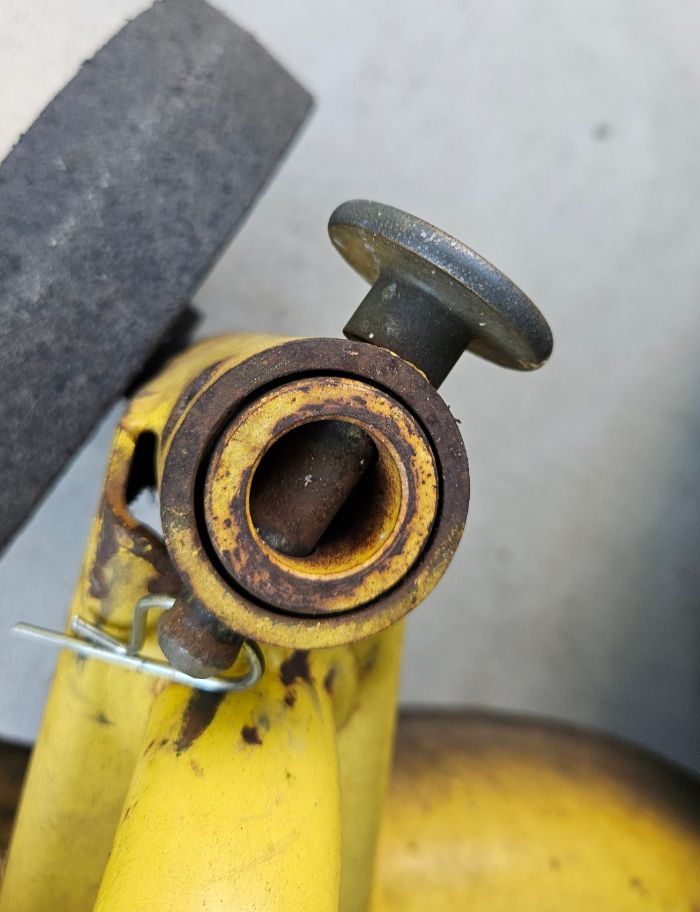
Kubota’s design is really, really stupid. There is no room between the shafts and the bores, and everything is made from carbon steel. In a humid climate with temperature swings, water condenses on metal over and over during the year, and on a vertical shaft, it’s going to run downward. That puts it inside the pipe holding the shaft, where even a thin film of rust will unite the parts as though they were welded.

At first, I thought an air hammer would be overkill. I used a sledge, heat, and cold, and then I tried the air hammer, which did nothing. I tried a three-foot pipe wrench. Of course, this was after letting penetrating oil soak in for days.

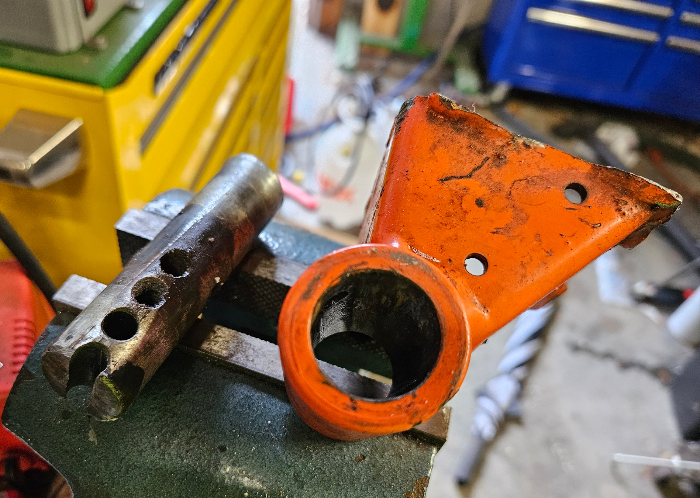
I ended up drilling the left shaft out, killing my cordless drill in the process. I was using about a 1″ bit.

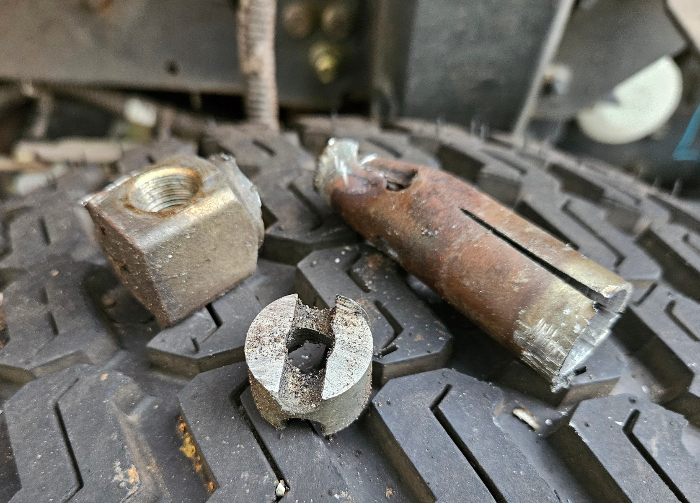
The drill left me with a pipe inside a pipe. I used a carbide burr, hacksaw, and sawzall to cut the pipe from inside. I ended up putting a punch between the inner and outer pipes, and I hammered to peel the inner one off. Eventually, I heard a clanging noise and saw something brown on the ground. It took me a second to realize it was the shaft. I was so used to feeling like it would never come out, it was hard for me to accept what had happened.

The miserable thing was barely rusted. Just enough to turn the shaft brown. It felt smooth. That was enough to lock it into the mower. It was covered with oil, showing that penetrating oil doesn’t do any good in some circumstances. Most, I would say.

This process involved work done over several days in the blazing sun. I strained my back in the process.

I was hoping to avoid cutting the other pipe support off the mower, but now I am committed to it. I can slice it off, put the whole business on the press, mash the shaft out, and weld the support back on in a day. That looked like a lot of work before I tackled the first one. Not any more.

I have lots of tools, and I can do lots of things, but sometimes it’s hard to take the leap and do what I can do. I know I can cut this part off my mower and put it back, better than before. It still feels wrong, somehow, but I have to do it. Sometimes I tell myself, “If you’re not willing to use your tools, sell them.”

The seller seemed like a very earnest guy, but it looks like he committed fraud. People are disappointing.

The final (!) parts for the mower arrive tomorrow, so there is hope I’ll have it together for the weekend. I hope so. I really do not want to revive the old John Deere.

People on forums are angry with me for saying Kubota’s anti-scalp-wheel engineering is stupid. It’s amazing how people white knight for big companies that don’t care about them, while persecuting fellow consumers they abuse or let down.

Brand loyalty is like a mental illness. If I say Kubota’s engineering is stupid, and you have a good counterargument, it’s fine to present it. Getting angry with me because you love Kubota makes no sense. Kubota isn’t your mother. It’s not Jesus Christ. It’s a faceless company that has no feelings. It doesn’t care about you or anyone else.

I tend to think inappropriate emotional investment in businesses is a sign of both immaturity and low intelligence. You won’t see many septuagenarian mathematicians getting in fistfights in bars because one roots for the Gators (a business) and the other roots for the ‘Noles. It’s the kind of guys who drive lowered pickups with tinted windows, loud pipes, and everything blacked out. The kind of guys who let their rottweilers run loose and get tattoos advertising Harley-Davidson.

That last thing has to be difficult to bear now that Harley-Davidson has become a major promoter of sodomy and cross-dressing.

Here’s something I find weird: people get in fights over the college teams they root for, even though no one in their families has gone to college. I have two University of Miami degrees, and I see a lot of people who clearly didn’t go to college, displaying UM paraphernalia. I have no interest in that stuff, so why should they? I have never been to a UM game, except once when I was in high school. My ultimate Frisbee team played theirs, and they killed us, although they were smoking weed on the field.

UM is a private school, which makes it even weirder. You can say you root for UF because it’s your state’s school and your tax dollars support it, and this would almost make sense to some people, but why root for a private university that doesn’t represent a city, county, state, or nation?

If you bleed green and orange, drive down to UM and ask for free season’s tickets. See how UM feels about you.

If you refuse to talk to your brother-in-law because he drives an F250, there is something wrong with you. You failed to develop to full adulthood. If it makes you mad when someone says Dodge diesel pickups have weak transmissions, you have a lot of growing up to do, but it probably won’t happen.

Getting angry at companies is perfectly reasonable. It’s normal to get angry at anyone who mistreats you. It makes me angry when companies let bad engineering a child can correct slide, causing it to fall on my head. There is no excuse. It also bothers me when a product flaw causes many people suffering and expense, and the company lies and says it’s not a known issue.

Praising companies doesn’t do much good at all, but criticizing them makes them better. They’re not like people, who draw strength from encouragement. Praising companies breeds an entitlement mindset and causes them to take consumers for granted.

People have tried to tell me a consumer should follow the manual and grease the rear shafts on my mower’s deck. Wrong. It’s not in the manual or the shop manual.

They’ve tried to tell me it’s just common sense to grease the shafts, so a person who doesn’t figure it out on his own is to blame when his mower locks up. That is SEVERELY wrong. The engineer is to blame.

1. Good engineers foresee obvious problems and take reasonable steps to prevent them from arising. Kubota didn’t do this. They made their shafts too tight. Other mower companies don’t do this, and their decks last for decades. A tight fit isn’t necessary or helpful.

2. Grease isn’t intended to prevent corrosion. It’s for lubricating moving parts. Anti-seize is the correct thing for galling prevention.

The rear shafts on my deck aren’t moving parts. For lubrication purposes, a part that moves rarely is not a moving part. The shafts have no zerks or journals. If you put grease on one, it would have to be coated by hand, end to end. Grease doesn’t distribute itself on stationary parts.

The shafts only move when you need to change the height of your deck, which could be once a year or never. The shafts lock in place after an amount of corrosion that could easily take place in one off-season.

Some guy claimed a mower would cost $40,000 if Kubota did the things I suggested. I asked him how much it would cost to change a few lines of code on a CNC machine to make the shafts slightly thinner.

He came back with an appeal to authority; his own. I didn’t understand how industry worked, but he did because he had seen it, so I had no right to speak. Removing 0.050″ from the diameter of one part would call for meetings and all sorts of other corporate turmoil. It would cost Kubota hundreds of thousands.

I told him Kubota had designed and built an entire new model after mine, full of changes much bigger than making a shaft thinner, and I asked him why it didn’t cost $40,000.

He got mad and insulted me. I’m not the one who made him walk into a door.

Imagine if the world of industry worked the way he claimed it did. “We’re thinking of replacing the 2026 Dodge Ram with a 2027 model.” “NOOOO! We’ll have to charge $200,000!” Somehow car companies manage to make changes every year. Bigger changes than thinning down one shaft.

My mower’s model comes in two versions. One before a certain serial number, and one after. The price of the mower didn’t change.

People argue with me, not because I’m wrong or rude, but because I gored their sacred ox. Kubota good, therefore anyone who criticize it very bad enemy. Must take down. Sing Kubota company song over dead body.

Another guy got mad at me, saying I was bashing all engineers. I got him to admit he was an engineer.

Engineers are wonderful. Bad engineers and bad engineering are not. I wish I had gotten an ME and an EE instead of a physics degree. I love what engineers do. I admire their accomplishments, but because I said they often did stupid things, which is so obviously true it’s almost a tautology, he felt threatened.

I took my mower’s starting system, which causes many people horrible problems, and I did and published what is probably the only thorough analysis on the web. Thanks to me, people with bad control modules can Google and make their motors run in 10 minutes. I revealed the simple answer to the deck’s galling problem, which other people have dealt with. I found a cheap source for the nylon push rivets Kubota dealers charge $2.60 for, and I revealed it on a forum. Cost: $.03 each. But I’m the bad guy because I won’t run into battle behind the Kubota flag with my chest painted orange.

I don’t care if Kubota goes bankrupt. I just want good machinery for everyone. Kubota can make it, or a company that destroys Kubota with better products can make it. I am not Kubota’s keeper.

I love Kubota products. I should stress that. My tractor is great. My zero-turn is utterly superior to my John Deere garden tractor. But nearly every complex product has flaws, and in many cases, they are stupid flaws, even when the companies that make the products are generally exemplary.

The flail mower I ordered has arrived, and it’s sitting in the driveway. Tomorrow I have to put it together and try it out. I look forward to seeing it run, because the bush hog is crude and difficult to work with.

Meanwhile, the house is a mess. I took the kitchen apart in order to paint, and then Marv got worse, so I stopped. I was in the process of fixing the pool, but I found myself driving back and forth to the animal hospital. The mower problem took up my time. The weather was unbearable for a couple of weeks. I am really hoping I can come back to life now.

Enduring the Summer of my Discontent

Monday, August 4th, 2025

Weeds and Woes

Times have been challenging of late here at the Armed Northern Florida Compound.

I accidentally poisoned Marvin and had to drive back and forth to a veterinary hospital in Gainesville several times. The zero-turn mower I thought was a bargain turned out to have a couple of problems that will require a lot of work. The temperature has approached or hit the hundred-degree mark nearly every day. And my wife is pushing to get the kitchen painted.

Marvin is fine. He gets stronger every day. What a relief. But the stress took its toll on yours truly. I went out to do outdoor work a couple of times during the last week, and I had to come back in. I felt weak. I was drained.

It made me think of my grandfather. My aunt died in May of 1994; the first of his children to go. My grandfather died in June, after losing his temper at a trashy tenant farmer and running after some cattle that got out. The night after the incident with the cattle, he had a heart attack, and he was gone after a few days. The cardiologist told me her belief was that the stress of losing my aunt caused a lesion of some sort to develop in a coronary artery, and the fracas with the tenant farmer caused it to come loose from the wall and block circulation.

Marvin is just a bird, but I really love him, and he has been with me since 1996. Over the years, I have had nightmares about bad things happening to my birds, and when Maynard died in 2021, one of the things that made it hard to bear was the fact that it was something I had dreaded–irrationally, I had thought–for a long time.

It was like having intrusive thoughts about a big shark behind you while swimming in your backyard pool, and then being bitten.

It’s possible to be hurt more by the death of a pet than the death of a person. It doesn’t mean there is something wrong with you. Different factors determine how any death affects you. I felt very bad when my mother died, but I knew it was coming, my mother was at peace with her fate, there was nothing I could do about it, she had accepted responsibility for all the cigarettes, I had a long time to get ready, and it was not my fault. It wasn’t as painful as Maynard’s death, which was sudden and preventable.

When Marvin started having seizures the other night, it was Maynard all over again, only worse, because I thought he might die in my hands, without even making it to the vet.

I have told my wife about my grandfather, and I told her to go easy on me for a while. I don’t want to push myself too hard too early.

Her prayer life is subpar these days, and it affects my welfare. The baby is an extremely powerful distraction. I am working with her to get her back up to speed. I know I am getting the short end of the stick at the moment, but this is actually normal for husbands. In a healthy, godly family, the husband and father is the one who makes the most sacrifices. Women love denying this and claiming the title of martyr, but men give more than women, unless they are substandard men.

It’s not something to resent. With authority comes added obligation. A marriage in which the woman has to do everything for the man, as though he were another child, is a sick marriage.

The mower has two anti-scalp wheels on the rear corners of the deck. They looked fine when I bought the mower, but I have learned they are stuck in place, and it is obvious the seller knew about it. They are held on two shafts that go down through little pieces of heavy pipe welded vertically to the deck. The ID of the pipe is about 1″. For some reason, Kubota practically made the clearance between the shafts and the pipes an interference fit. Then it made the shafts and pipes from steel, guaranteeing galling in wet or even humid weather. This was very bad engineering. In order to prevent galling with a fit like this, you really have to take the shafts out occasionally and put anti-seize or something on them.

An interference fit is what you have when you have to shove something in order to get it to go into something else. It means the OD of the inner thing is actually bigger than the ID of the outer thing.

Kubota didn’t even put grease fittings on these pipes. The wheels aren’t supposed to turn right or left, so I guess Kubota saw no need to call for grease. It might have prevented the galling.

The shafts have to move up and down in the pipes for adjustment purposes, but they are essentially welded in place. I tried a three-foot pipe wrench, penetrating oil, an air hammer, and a plain old big hammer, and nothing has moved the shafts at all.

I started drilling one of the shafts out. I ended up frying a nice Makita cordless drill after I got to what I believe is a 7/8″ bit. I now have a crude pipe I made myself, inside the deck pipe. I would guess I put 6 hours of work in, in the ruthless sun, bent over most of the time. Not smart.

I can now get a die grinder burr and a sawzall blade in there, so when I feel better, I plan to use both to weaken the remaining shell of the shaft until I can grab it with pliers, bend it, and pull it out.

Then I have to work on the other side.

I also broke one of the mower’s plastic fenders.

The mower came with a fuel problem. When I ran it on the left tank, it choked periodically. To fix this, I had to take the tank off and clean it out. The tank sits under a fender, and the fender is a bear to take off. I found I could loosen the fender and wiggle the tank out, but as I was doing this, the fender split.

I was wiggling it gently, but it looks like the sun had made the fender extremely brittle. The $200 fender, that is.

Now I have two new fenders coming. I could have glued the old fender together, but it would have looked awful, and the plastic would still be brittle. I should have everything put in order in about 10 days. Until then, I have to decide whether to run the mower with one fender and a bunch of stuff missing or fall back on the John Deere.

I have a flail mower on the way. I bit the bullet and bought one. I was concerned about the China tariff deal, not to mention inflation. Every time I have put off a big buy like this, the price has gone up before I gave in.

I need to be able to deal with my weeds, and the bush hog is not the right tool. It’s huge, it’s extremely dangerous, it cuts very crudely, and I just plain don’t like it. A flail mower should cut anything up to 1.5″ woody stems, and it should do it safely, leaving pretty fine clippings, closer to the ground than a bush hog.

The mower I got is a ditch mower. That means I can use hydraulics to extend it to the right of my tractor, and I can also tilt it up 90° for hedges or down quite a bit for ditches. The main thing I like about tilting it up is that it will give me access to the underside so I can work on it without lying on my back or something.

I keep thinking about buying a John Deere 4520 or 4720 tractor from the pre-emissions days. These are supposed to be very good machines, and they have considerably more grunt than my Kubota without being much larger. Maybe next year. Or maybe this year if inflation keeps hammering us.

Used tractor prices have plummeted because no one cares about the pandemic any more. People are going to work and making things and selling them, so getting a new tractor is easy, and that makes used ones less desirable.

I detest John Deere because of the way it treats customers, but I don’t have a lot of options unless I want a Buck Rogers post-emissions tractor. Which I don’t. JD should keep making parts for the 4520 and 4720 for at least another 15 years.

In around a week, I should have my flail mower, and by the end of the ensuing week, my zero-turn should be back together. Then I’ll have a couple of months of mowing before the grass and weeds go dormant, and then I can rest, during the months when the weather is cool and working on a lawnmower would actually be bearable.

We’ll See Who Controls Who

Sunday, July 13th, 2025

You Can’t Stop the Signal

The clouds have parted. Today I got my Kubota mower to start and run normally. Sort of.

When I bought the mower, the seller had no trouble starting it and putting it on his trailer. Then it started acting up on me, and then it quit starting altogether.

For reasons I consider stupid, this mower has a very complicated starting system. I can’t imagine how much worse it would be if it ran on gas.

You can’t just say, “It won’t crank, so it’s part A.” A given problem could be caused by any of several bad parts. I decided to start out by looking at fixes that were easy and/or cheap and/or highly likely to work. When that didn’t work out, I got systematic. I studied and worked with AI, and I came up with 5 possible problems. There are others, but these were highest on the Occam’s Razor list.

I wrote out a list of problems and the ways I should approach them. Then things got worse and worse. I would work on one problem and find out it didn’t help. Then I would work on another one and get the same result. All this time, the list was dwindling, I was suffering, and I was getting closer and closer to the most expensive problem on the list: the mowers $330 electronic control module (“ECM” or “controller”).

Everything has to be computerized these days. My toaster is computerized. It’s not clear WHY everything has to be computerized, but it’s definitely true. Don’t question it.

Cars are full of computers now, and the disease has spread to small ag and landscaping machines. As you probably know, these computers cost a lot, losing one is a crippling blow, and manufacturers stop making them after a while, so you could end up with a useless machine simply because the computer is no good.

Somehow tractors and mowers used to run without computers, but trust me; they can’t run without them now. Just believe. Don’t think.

Originally, I thought my controller was important. I thought Kubota would not put it in a machine unless it did important things. It turns out I was totally wrong about that.

I thought the controller managed everything. Engine speed. Gauges. The transmission. Whatever. Because who would have an expensive, proprietary controller made if it didn’t do important things?

Last night, I went deeper into the starting mystery. I got out the schematic for the system. I wrote up my own analysis. You can read my analysis and understand everything about the starting system.

What I learned was annoying. The controller serves only two purposes. It prevents the mower from starting if the lawyer switches aren’t just right, and it also tells the mower to shut down when you turn the key to the off position.

I’m not kidding. It’s totally unnecessary. You can make the switches and the shut-off solenoid do their thing with analog parts of the kind Radio Shack used to sell.

CORRECTION: I forgot to mention the third function of the controller. It runs a horn that goes off when the mower overheats. You can rely on this to protect your investment. Or you could just look at the temperature gauge once in a while.

The key tries to send a signal to a relay. If it succeeds, the relay relays the signal to the starter, and the mower starts. The controller butts in and decides whether the relay is allowed to send the signal. If even one of the 5 safety switches is in the wrong position, your mower goes nowhere.

A relay contains an internal switch. The controller operates the switch, and the switch sends the signal to the starter. If you short the switch terminals, you cut the controller out of the game. It has no say. It’s like an enraged Karen, screeching at you from behind foot-thick glass. The mower starts and runs.

Shorting is exactly what I decided to do. I need to mow my yard regularly without long breaks due to starting problems. The weather is like the weather in an air fryer. I don’t feel like spending another week or two covered in mower grease, removing and installing parts and finding out it doesn’t help.

Because I always have wire and spade connectors around, like a normal person, I made a short wire with a spade on each end, and I shoved it into the receptacle the relay ordinarily goes into. The mower started and ran like a champ.

The safety switches did not work, so I had to be careful not to do obviously-stupid things. I didn’t start the mower with the transmission or blades engaged. I didn’t jump off the mower while it was moving and lie down in front of it. Things like that. It was challenging.

When I was done, I had to get off and push a little lever on the engine to shut it down. Whew. That was hard. The lever is always exposed, and it’s easy to reach.

Will I ever get around to putting the safety switches and key shut-off in order? Maybe. It should be very simple with cheap components.

If the controller is no good, I don’t think I should replace it, because it costs a lot and could go bad again, and I would rather not depend on Kubota to keep making them. Parts prices keep skyrocketing, and that’s another factor. If the mower can be made to work without a controller, I should fix it so it doesn’t need one.

I don’t want the parking brake switch because I can’t understand why it exists. Why do you need the brake to be on when you start the engine? With the brake off, the mower could roll downhill, but then it could do that whether you start it or not, and if it’s going to roll downhill, you should notice this before starting it, because the mower will be…rolling downhill.

The other switches make some sense. You don’t want the mower starting in gear or has the blades engaged, because it’s bad for the mower and makes you feel stupid. I don’t think that little starter will successfully crank the engine when the transmission or PTO is engaged, though. That would be some starter.

Because you sit on the front of the mower, the seat switch is a good thing to have. It is possible to fall off and land in front of the mower, and without the switch, it could keep on going, and then you would be julienned. The seat has a belt, though, so it’s not like the switch is necessary.

My John Deere’s seat switch shuts the motor off when you dismount, no matter what. That’s horrible. The Kubota only shuts the motor down when the blades are engaged. That’s fine. That’s how it should be done. The mower shouldn’t quit every time you have to get off to move a stick. You should be able to stop the PTO and leave the motor running.

I can make a circuit to shut off the fuel with the key. It’s more complicated than jumping the starter relay, but it’s not hard, either. Or I could just install a shopmade cable that allows me to pull the shutdown lever from the seat.

Bypassing the controller will never, ever cost me any useful function, but it will save me the horror of trying to test it, as well as the horror of paying for a new one if the old one is bad.

Why did Kubota make the controller? They must have had some reason for making an expensive, unrepairable part that does things cheap, easily-repaired parts can do.

Figuring out whether the controller is no good is not easy. Wire connections inside the plug and receptacle can fail. The ground can fail. Relay problems and ignition switch problems may look like controller problems. Kubota’s workshop manual doesn’t list any ways to test a controller, so their mechanics don’t know how to do anything with them.

I guess you can turn your ignition key and see if the controller sends a signal to the starter relay, but it could fail to do that because of a well-hidden problem in the wiring harness. That happened to one guy who wrote about it on the web.

In order to be sure the controller is bad, you really have to buy a new controller, plug it in, and see what happens. If the mower runs, the controller was bad. If not, you learn nothing at all, you still have a puzzle to solve, and you have a dirty part the dealer won’t take back.

The controller is dumb. That’s what it boils down to. It protects Kubota’s lawyers and does nothing a simpler set of components can’t do.

One great thing about learning that the controller is idiotic is that it tells me my fuel-delivery problems have nothing to do with the controller. The mower was slowing down and almost stopping, randomly. I looked this up, and a bad source told me it could be caused by a bad controller. This is not true. It might be true in a car or some other machine with a real computer, but it’s not true in the case of Kubota’s rinky-dink lawyer toy. The controller can’t affect the fuel supply unless it cues the shut-off solenoid at the wrong time, and if it did that, the mower would stop, not slow down.

I thought I needed new fuel filters, so I ordered some. On a recommendation, I also put Clear-Diesel in both tanks. Today, the right tank ran like a Tesla on cruise control, but on the left tank, the mower slowed down. That tells me the fuel in the left tank is probably bad. If the filters were bad, the mower would run badly on both tanks.

I don’t know if Clear-Diesel will help the left tank. If not, I can always dump the diesel in the woods. I mean in a proper receptacle.

I ordered new relays because one of mine tested bad. I later learned the reason it tested bad is that the manual is wrong. It told me to expect an impossible resistance across two terminals. I think the Japanese guy who wrote the Japanese manual also wrote the English manual, and I think he was drunk the whole time.

In case anyone else out there has a ZD326 or ZD331 that won’t start, I’ll paste what I wrote about the starting system. You can find the workshop manual online in PDF form. I don’t promise what I wrote is correct, but I promise it’s a lot better than your wild guesses.

KUBOTA ZD326 STARTING CIRCUITRY

Some of this material is repetitious because it makes it easier to understand. Wire color codes follow at the end.

OVERVIEW

The starting system’s main parts of interest are the ignition switch, ECM (controller), starter relay, starter (includes solenoid), two NO motion lever safety switches, one NO seat safety switch, one NO PTO lever safety switch, and one NC brake safety switch.

N=normally. O=open. C=closed. “Normal” means the mower will not start.

PURPOSE OF ECM

The ECM’s only purposes relevant to starting and running are 1) to monitor the safety switches and either agree or refuse to tell the starter relay to start, and 2) to power the relay that shuts down the mower. When the key is turned to the stop position, the ECM closes the shut-off relay for about 10 seconds, cutting off fuel.

The ECM also makes the horn blow when the mower overheats, but there is an independent temperature gauge on the control panel.

The ECM does not do anything essential, like making the engine run correctly. It can be bypassed completely if necessary. The ECM is not likely to fail, but if everything else has been checked, and the symptoms are consistent with ECM failure, it has to be replaced. It can’t be repaired without extraordinary effort.

A failed ECM can cause the mower to refuse to crank or stop. A failed shut-off solenoid can prevent the mower from starting and stopping, but it can’t prevent it from cranking.

A bad ground or other connection can simulate ECM failure.

The ECM has 9 connections.

OR = positive from PTO switch
BR = positive to starter relay coil
GB = positive from left motion control lever switch
WL = power to shut-off solenoid.
B = ground
YR = positive from seat switch
RY = positive from ignition switch terminal AC
WB = positive from brake switch
RW = positive to shut-off relay coil

RELATIONSHIP OF IGNITION SWITCH TO ECM

The ignition switch has a rotating conductor (terminal B) which is turned by the key and always hot. It is always connected to the R positive wire. When turned to any position other than off (glow plug, start), it is in contact with terminal AC, which can be considered the ignition’s ECM terminal.

Terminal AC is connected to the ECM (controller) and all safety switches (motion lever, seat, PTO, brake). The motion lever switches are in series, so 13 (right) is connected to RY and AC, and 14 (left) is connected to the ECM, providing positive input. The path goes AC-RY-left switch-right switch-ECM.

NORMAL START PROCEDURE

To start, close every switch except the brake switch (levers at rest, PTO off, operator in seat), and open the brake switch by applying the brake. Turn the key partially, letting the glow plug heat if needed. Then turn to the start position and hold until the engine starts.

BYPASSING SWITCHES

The brake safety switch is normally closed (NC). All others are NO. Because it’s NC, the brake switch can be bypassed by pulling the connector and covering it. To bypass the other switches, you have to jump them.

HOW IGNITION SWITCH WORKS IN GLOW PLUG POSITION

When the ignition switch is turned partially, it first connects hot terminal B to both terminal AC and terminal 19. Terminal AC feeds the ECM via the RY wire, and terminal 19 runs the glow plug lamp and glow plug.

Terminal 19 is not significant for starting, running, or stopping the mower. Current goes through terminal 19, the lamp and plug, and then to ground. The mower should start and run fine when 19 is out of commission unless the glow plug is needed.

IMPORTANCE OF TERMINAL AC AND RY WIRE TO STARTING

The RY wire that goes from terminal AC to the ECM sends signal through all safety switches along the way. The safety switches all get positive from RY.

IF TERMINAL AC IS BAD OR WIRE RY ISN’T LIVE, THE MOWER WILL NOT START BECAUSE IT WILL ASSUME A MOTION LEVER SWITCH OR THE PTO SWITCH IS IN THE WRONG POSITION.

THE ECM HAS A SINGLE GROUND, AND IF IT FAILS, THE ECM WILL NOT WORK, CAUSING STARTING AND STOPPING PROBLEMS.

HOW IGNITION SWITCH WORKS IN START POSITION

When the ignition switch is turned past the glow plug position, it disconnects 19 and connects hot B to AC and terminal 50 (BY). Terminal 50 feeds voltage through the BY wire to the starter relay. If the relay is closed, the voltage goes out through the BW wire to the starter solenoid. This is the voltage that tells the starter solenoid to turn.

The starter relay is closed by the ECM (not the ignition switch) through the BR wire. The current exits through the relay coil to the B wire (ground). Don’t confuse the B (black) wire with the ignition switch B terminal.

To start the mower, the ECM needs to see safety switch positive at YR (seat), OR (PTO), and GB (left motion lever in series with right). It needs to see RY positive next to the brake switch WB input. If it sees positive at the input from the brake switch (WB), the mower will not start. WB should be neither positive nor negative when the mower starts. No input.

STARTER RELAY

The starter relay is #6 in the manual’s diagram. It connects to BR (ECM), BY (ignition positive, terminal 50), BW (positive signal to starter), and B (ground) wires. It has 5 connections, one of which is not used. It switches between two poles; off (87A, dead) and on (87, BW). In the rest state, the switch connects the dead pole. Terminal 87 is the BW wire which goes to the starter solenoid.

Terminals 85 (BR) and 86 (B) send ECM juice through the coil. They are connected to the BR (ECM hot output) and B (ground) wires. The B wire is not important for analysis, since it never changes. A positive input has to be connected to BR in order for the relay to close, and the ECM does this. BR exits the ECM next to OR, if the schematic is any indication.

When the relay closes, it connects the relay switch’s BY wire (positive input from terminal 50) to the BW wire that feed the starter solenoid. This starts the mower.

On the schematic, from top to bottom, the starter relay connections are:
1. ECM – BR
2. Ignition switch – BY
3. Starter – BW
4. Ground – B

Jumping BY and BW should bypass the ECM and start the mower without harming anything. UPDATE: I tested this, and it works just fine.

The shut-off solenoid can also be set up this way, but you have to put in a timer or a momentary switch, because if the solenoid is always trying to shut off when the key is in the stop position, the battery will drain.

The manual shut-off lever is easily reached at the right rear of the mower.

TESTING RELAYS

All three relays on the mower are the same. You can test resistances to see if they are working. The manual’s test resistances are wrong.

Resistances: 85-86: ~90 ohms (coil)
87-87A: infinite
87-30: infinite
30-87A: 0 ohms

REMOVING IGNITION SWITCH

Use a pin spanner to turn the outer switch cover to unscrew it. Remove the cover over the motion lever arm switch. Remove all screws from the control panel so it is loose. Push the ignition switch down under the panel, pull it out between the panel and fender, depress the tab on the connector, and remove the switch.

DISASSEMBLING IGNITION SWITCH

There are two tabs on the sides of the switch housing. Pull them outward while pushing up on the key cylinder (keyhole). It helps to put a small object in a vise and rest the key cylinder on it while you pull the tabs and push the switch down.

By comparing the ignition wire colors to the switch’s terminals, you can figure out which terminal does what and how to check resistances to see if the switch is good. Removing oxidation from the copper contacts can reduce excess resistance.

WIRE COLOR CODES

B black
BR black/red
BW black/white
BY black/yellow
G green
GB green/black
L blue
LW blue/white
OR orange
ORL orange/blue
P pink
R red
RB red/black
RG red/green
RL red/blue
RW red/white
RY red/yellow
V violet
W white
WB white/black
WG white/green
WL white/blue
Y yellow
YL yellow/blue
YR yellow/red
YW yellow/white

Feynman ex Machina

Friday, July 11th, 2025

That Little White Thing Behind the Grass is my House

The Kubota mower saga continues. The mower which was supposed to be my deliverer has become my captor, forcing me to spend hours and hours working on it. Yesterday I had to come up with a new strategy to fix it.

Clearly, this means I have to discuss Richard Feynman.

Being smart is a good thing, obviously, but it has its drawbacks. It can actually cause you to behave stupidly in practice. If you go through life figuring things out effortlessly or having answers just come to you, you can find yourself floundering when a puzzle is actually challenging, because you haven’t done what less-intelligent people do when confronted with hard questions. You haven’t come up with logical strategies to solving problems. As a result, you may find yourself struggling with problems people with less brains cope with more easily. You sit there waiting for answers to come, cycling through ideas that have already failed, like a bear pawing at a combination lock.

Richard Feynman claimed his IQ was 125. And Oprah claimed she lost like 150 pounds in about a month without drugs. Feynman had an impish sense of humor, so I guess this was one of his little jokes, intended to upset less-intelligent people who knew their IQ’s were up in the 180 range and make them wonder how Mr. 125 had left them in the dust.

I don’t think his IQ was 125, but I think that if it had been, he would have punched above his weight because of his approach to thinking.

I read a story he wrote about ants. He saw ants marching around in a dorm room, and he started asking himself why they did certain things. Using bait and some other handy objects, he was able to do several experiments and uncover some pretty remarkable facts about ants. He was systematic. He developed logical approaches. He didn’t sit back and think, “I’m a genius, so I’ll know the answer in a minute regardless of what I do.”

I thought about that story yesterday after a most miserable day working on my new mower in the heat and roasting sun. It was starting intermittently when I got it, and then it just plain quit, and I had to start hot-wiring it.

When I looked for answers, I decided the smart thing was to take care of the easiest and/or most likely and/or cheapest fixes instead of getting into a lot of diagnostic drudgery. If they worked, great. If not, I would have new parts in my mower which couldn’t hurt anything and might help it stay running longer without problems.

This kind of approach only works when you get lucky, which usually happens for me, but in this case, didn’t.

Having suffered considerably in the process of replacing two safety switches that were likely to have failed but actually hadn’t, I decided to change course and take the Feynman approach. I went to AI sites, I looked at the workshop manual, and I tried to make deductions and formulate a plan.

I came up with 5 problems that could prevent a mower from cranking. The seat switch had been bypassed, and the crude, bubbastic bypass connection could be failing. A safety switch on the brake, the PTO lever, or one of the mower control levers could be bad. The starter or solenoid (one indivisible package) could be bad. The starter relay could need replacing. Finally, the ignition switch could be no good.

It was also possible the mower’s electronic controller needed replacing, but that was too unlikely to consider at this point.

By the time I made the list, the switches on the PTO lever and brake had already been replaced needlessly, and I knew the starter and solenoid were fine, so I moved on. I tried to come up with a smart sequence of things to look at.

The seat switch splice had to be my first stop because it could get me going in 5 minutes. It seemed likely to be the problem because the mower had started once after I moved the seat. It was also an extremely simple fix. Find the splice and redo it with a wire nut. Tools not required.

Number two: the starter relay. This was not as likely to be the culprit as the safety switches, but checking it with an ohmmeter was a 10-minute job requiring the ohmmeter, a wrench, and a screwdriver.

Number three: the safety switches. The remaining switches were not nearly as hard to replace as the ones I had already worked on, but they were harder to deal with than the relay, so I would leave them for later. Testing them would be simple. They had to be open for the mower to run, so I can just disconnect them.

Number four: the ignition switch. Kubota didn’t make a point of creating handy test points for people with bad ignition switches, and getting the switch out to test it is unpleasant. I could test it by opening a connector on the wiring harness to expose a couple of conductors. That would be more pleasant than removing the switch, but still unpleasant. The switch worked fine in every position except the start position, so I figured it was probably okay.

Today I identified the starter solenoid by the colors of the wires going into it, and it took me two minutes or so to get it out. The manual lists the proper resistances between the terminals, and the relay failed one test. I went to Ebay and ordered three new relays (the mower uses the same kind of relay for three things), and they are on the way. They’re $10 each, and if one has failed, the others could be on the way out.

Will the new relay get my mower running? No idea, but it should. I can test my theory by moving one of the other relays to the starter position. One relay only controls a horn that goes off when the mower overheats, so I can do without that for a few days.

I should have switched the relays after testing the bad one, but what can I tell you? It’s hot outside. Feynman would be ashamed of me.

If the relays don’t help me, I have to test the safety and ignition switches, and after that, I have to consider the possibility that a $332 controller has bitten the dust. I think I tested the relay correctly, though, and the mower can’t start if it’s bad, so I have every reason to think I will not need a controller.

I caused myself a lot of very unpleasant and unnecessary work by guessing at the mower’s ailment. If Feynman were here, he would have gotten where I am in two days. Nobody could do it faster except someone who is familiar with Kubotas. Two days is how long it would take to understand the starting system, including an hour or two to come up with a plan.

I should try to take the Feynman approach to problems from now on, during what little remains of my life. Prayer first. Then research and logic. I can’t get back all the hours I’ve spent nullifying my intelligence by hoping answers fall out of the sky, but I should be able to benefit to some limited degree.

Grass Assassin

Wednesday, July 9th, 2025

Victory Delayed is Sweet When it Arrives

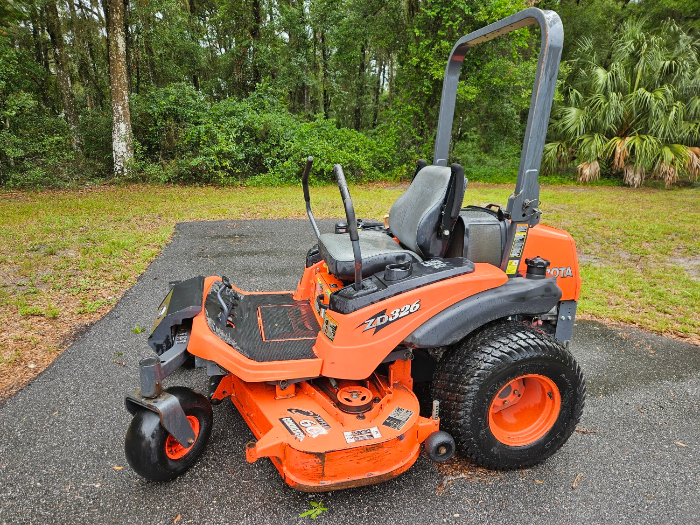
Time for an update on the used mower I bought. It’s a 25-horsepower Kubota ZD326 diesel zero-turn.

I should begin with the mower’s age. I sent what I thought was the serial number to Kubota, and they said it was made in 2015. I thought that was great, because it suggested the mower had well below 1,000 hours. Someone has burst my bubble, however. I have been informed that the number I found is the number for the part it was attached to: the ROPS (Roll Over Protection System). A ROPS is a roll bar.

Kubota likes to put serial numbers all over the place. My deck has one, the mower itself has one, and they even put one on the ROPS.

The ACTUAL serial number is a little more than twice the ROPS number, so this is probably a pre-2010 mower. I have not checked yet.

If this mower was in use for 15 years instead of 10, in serious residential use, it should still come in at under 1,000 hours. Maybe less than 500. But I would rather have a 2015 mower than a 2009 mower.

The first time I tried to start the mower, I failed. I found it would start if I fiddled with things and tried starting it a few times. I was able to mow the yard the first time I tried. On Saturday, three days ago, fiddling didn’t work. I couldn’t mow. Fiddling hasn’t worked since.

I thought the mower wouldn’t start because I had failed to put the PTO lever in the right position. The PTO lever has a safety switch on it so the mower blades don’t start turning when you start the engine. I found out this was not the problem. I’m not sure what the issue is, but I have bought some parts, and I am going through the starting system bit by bit.

I replaced the safety switch on the parking brake, and that didn’t help. I have ordered other safety switches so I can replace them. There are switches on the levers you use to steer the machine.

I eventually learned how to hotwire the mower, so I am able to mow while I go through the process of fixing it.

When I hotwired the mower today in order to mow, I thought things were going great, but then it stalled when I moved the control levers. Through trial and error, I found out that I had to bypass the brake switch in order to keep the motor running. As soon as I moved the levers with the switch installed, the motor died. I don’t know what this means yet, but the mower runs with the switch unplugged, so I will be able to mow until I figure things out.

It looks like I installed the wrong part. The safety switches on this think look alike. Some are open by default, and some are closed. Not a big deal, since the old switch tests fine and can be put back in.

I could remove the switch permanently. I don’t need a parking brake switch. My mower isn’t going to roll across Florida while I try to start it. If I lived in Colorado, maybe I would want to keep the switch. This particular switch is not needed in order to make the mower run. If you remove it, the mower starts and runs fine.

Getting to the PTO safety switch is not easy. The mower’s control panel is on the right fender, and a bunch of things go through the panel. Wiring for the idiot lights. Two levers. A big, stiff knob that controls the cutting height. In order to change the switch, you have to remove the panel, and to get the panel off, you have to remove the knob.

The problem with removing the knob is that it is held onto a thick shaft by friction, and it does not want to come off. I tried doing it as gently as I could, and I broke one side of the knob. I believe the right way to get the knob off is to remove a cotter pin from the shaft, down under the fender, but getting to the cotter pin is hard because…the control panel is in the way. I think it can be done with the right long-nose pliers, which I probably have.

I had to order an $11 knob and the decal that goes on the knob and lists the cutting heights.

Believe it or not, I’m making all this sound a lot easier than it was, and I’m leaving a lot of suffering out.

Oh…hey…I just found out the cotter pin is really a clevis pin. That makes things a lot easier. I don’t have to bend a clevis pin closed in order to pull it out or insert it.

I’ve also had to deal with fluids. The guy who sold me the mower put too much fluid in the hydraulic system, so I had to remove and throw out half a gallon of expensive Kubota SUDT2. He also put maybe 12 ounces more oil in the engine than was needed, so I had to drain it into a pan. I don’t know whether he changed the fluid in the deck gearbox, so I’ll be doing that shortly. It’s not hard, so it will be fast. IF ALL GOES WELL. Always add that.

Today I got the mower going, and I mowed quite a bit. Then the mower started slowing down, as though it were going to die. I thought this might be because I had run one of the tanks dry on the previous outing. This mower has two tanks (don’t ask me why), and you have to switch from one tank to the other when your first tank is empty.

When a diesel goes dry, and you start it up again after restoring the fuel flow, you may find there is air in the system somewhere, and depending on the diesel, it will clear the air out on its own, or you will have to do it yourself via a process which may be horrible. When my mower started stumbling, I hoped it would push the air out without help.

The mower slowed down more than once, and it kept speeding up again, so I thought the air was being eliminated. Eventually, though, I had to switch tanks. Then the mower ran well…until it didn’t. When things got bad, I started heading for the house, and the mower died in the driveway, blocking my car in the garage.

I figured it had to be the fuel filter. I looked it up, and a bad fuel filter can make a diesel with a governor slow down temporarily. It will increase the throttle to try to compensate for the reduced fuel flow, but if the flow gets bad enough, the motor will die anyway.

Does my motor even have a governor? No idea. There must be something in there that keeps the maximum RPM’s down, because this mower is supposed to mow at full tilt boogie.

I read and read, and eventually, I started to wonder if I was the problem. Maybe I had simply run out of diesel on the last tank, AFTER having air problems with the first.

I have looked at the owner’s and workshop manual a lot, but I never bothered to read about the fuel gauge. I figured I was smart enough to read one on my own. That may have been a fateful bit of hybris.

This mower has a fuel gauge on the control panel. It also has a yellow idiot light with “RH TANK” printed beside it. I didn’t really think about what this meant. I didn’t look at it much at all. I figured the fuel gauge measured the fuel in whichever tank I was using, and that if the idiot light went on, I was on the right-hand tank.

It turns out the fuel gauge is only for the port, or secondary, tank. You’re supposed to run on the starboard tank until the idiot light comes on. It means that tank is low. Then you switch to the left tank, and the gauge tells you how much fuel you have left until you’re stranded.

I now think I had air in the lines, switched to the right tank, and then ran it dry while assuming it had plenty of fuel in it. The gauge read full.

The mower sat in the driveway for maybe two hours while I tried to figure things out. I put some fuel in each tank, started the mower, and took off. It did slow down briefly, but it kept going.

The diesel in the tanks looks pure. I don’t think the fuel filters are clogged. I ordered a couple anyway because new diesel filters are always a good idea. Kubota put them in a funny place, so changing them will take at least 30 minutes. IF ALL GOES WELL. I am learning.

Tomorrow a lot of parts arrive, so I will be changing switches, the armrests, and a few other things. I plan to dump the oil but keep the filter, since it’s new. I think the seller used 40w, which is probably okay in this climate, but I want to put synthetic 15w-40 in it, as the manual suggests. The small amount of 40w, if that’s what it is, in the filter won’t be enough to mess up the properties of the 15w-40.

I’m going to check the ignition switch. I don’t see why I need one, so if it’s hinky, I may replace it with a momentary switch I already have.

Everyone who likes stealing mowers knows how to hotwire one in 10 seconds, so it appears the only person the ignition switch prevents from running the mower is me. And a mower with a momentary switch where the ignition switch used to be would be a lot easier to identify for the police. Not that they ever make any effort whatsoever to recover stolen goods.

I was only able to mow about 60% of my yard today. The parts I mowed looked fantastic. The John Deere never saw the day it could cut this well. Or maybe it did, but I didn’t know how to make it do it. The cut is flat and pretty, and I can actually tell where I’ve already mowed. With the John Deere, I had to guess.

I bought mulching blades, but I think I might send them back. I’ve only used this mower 1.6 times, with standard blades, and it has minced my oak leaves. I feel like dropping to my knees and thanking God. The JD simply could not do this. Don’t ask me why.

Those leaves were a source of what seemed as if it would be eternal torment. Gathering and burning them was a job for Sisyphus plus Hercules. Nearly undoable. My John Deere mulching kit made a big difference when the mower actually ran, but not like the Kubota. I am now confident I can end my leaf problem permanently just by riding around on a lawnmower. I’m almost afraid to believe it.

The leaf debris is still with me, but it seems like 80% of it has disappeared. I don’t know where it went. I used to have thick carpets of dead leaves, and the leaf fragments I now have seem to have maybe 20% of the volume.

No one but me could ever understand why having the Kubota disintegrate my leaves is such a big deal to me. You would have to have been there when I bought a $600 leaf blower and tried making piles which I raked and put into a wagon or utility cart and hauled off and burned. You would have to have been beside me when I went to a mower store and nearly let a guy convince me a used 48″ gas mower would do it. I brought a landscaper out here for an interview. I nearly bought a $1,500 towed leaf vacuum.

Nobody ever told me, “Get a big-ass commercial diesel zero-turn, and your leaves will disappear.” This, in a county where you can hardly toss a dwarf without hitting a zero-turn on a trailer. It seems like every third vehicle on the road is a pickup pulling landscaping tools. Why couldn’t anyone give me the answer? Didn’t they know?

The Kubota moves twice as fast as a tractor like the John Deere. That makes a big difference. It makes a 60″ deck mow like 120″. And it turns in place, so you don’t have to sworp out in wasted loops every time you turn around. You just stop at the end of a strip you’ve mowed, turn where you are, and mow a strip next to it. I thought a zero-turn might mow twice as fast as a tractor. No; it’s faster than that. You move faster, and you travel a much shorter distance.

The mower puts a lot of filth in the air, and about half of it lands on me, but this was also true of the John Deere. Nothing can be done. I take my boots off in the garage, and I take my clothes off in the laundry room, which has a tile floor which is easy to clean.

I bought myself a fancy dirt biking mask to keep everything out of my eyes. The manufacturer is a company called Wolfsnout. They also make foam dust masks. I ordered one of those, too. They say you can breathe freely with this mask. Not true. When I put it on, I breathed like Heavy D on the slopes of Everest, and my nose ran into the foam. I can’t make it work. But a stretchy neck gaiter works well with the mask. My eyes use to be a mess the night after a mow. Not any more.

Tomorrow may be the first day I use the mower without major annoyances. I may have to hotwire it again, but I have reasonable hopes it will finish up the yard without dying.

If this thing turns out to have severe hidden issues that make it a horror to deal with, I might actually snap and spend $19,000 on a new one. Life is short, and I can only take so much. I realize I can pay a crew for over three years for that kind of money, but I am utterly fed up with mowing struggles, and I am going to see an end to them no matter what it takes. This is the single most annoying problem I have as a homeowner.

I could get a new gas mower that would do the same thing for $13,000 but I am ALL DONE WITH GAS. When I say I’m not going back, I feel like one of those guys who rushes the police, with two shots left in a rusty .22 pistol he stole from his grandmother, screaming he’s not going back to prison. I understand them. I’m not buying another big gas carb I have to rebuild every year. I’m not dealing with another rusted gas tank. I don’t want to buy any more ethanol-busting additive than I already have.

I’m old. I don’t need this. My son doesn’t need an inheritance. He’s good-looking. He can be a model.

The Grass Really is Greener When the Mower is Orange

Saturday, June 28th, 2025

Kubota-San Bring Honor to Humble Yard

I managed to half-mow with my newly-acquired Kubota zero-turn today. It was glorious, until the rain shut me down.

I wrote about buying the mower yesterday, so I’ll just link to that instead of doing my usual recap. Maybe readers will be happy to bypass the tedium.

I got advice on some forums. The people on one forum were generally congratulatory, except for one sourpuss who somewhat rudely claimed the mower was probably stolen. His evidence was that the seller and I could not find a serial number on it.

I think the sourpuss may have been bummed out because somebody else seemed to have gotten a pretty good deal.

As it turns out, the mower does have a serial number. I found it today. Grok seems to think this mower was made in the late 2000’s. I haven’t been energetic enough to narrow it down.

If the seller were a thief, I would have to give him a D. He advertised the mower on Facebook under his own name, sold it from his own house, delivered it using his own truck, and signed an affirmation that it belonged to him in a bank with lots of cameras.

The more I look at the mower, the more I think I did all right.

I know what wear looks like on power equipment, and I also know what rain and sun damage look like. I don’t see much wear on this mower. I don’t see any rain damage. I do see sun damage. The total package is consistent with a storage method typical of Northern Florida. A lot of people here put tractors and other machines in pole barns with no walls. The sun comes in sideways, but the rain is blocked.

The mower has a few parts that are clearly sun-damaged. The plastic grips on the levers are bleached, and so is the seat belt. The plastic armrests are eaten up. That’s about it. Parts that would rust if exposed to a lot of rain are not rusted.

The first mow went really well. I did take out a couple of shrubs and part of a piece of ground cover, but I’ll get the hang of it. I had to quit because it rained.

Before I could mow, I had to dump a lot of fluid. The seller overfilled the transmission. I had to use an oil sucker. I found out I am no good with a siphon. On the up side, the fluid doesn’t taste that bad.

I would estimate he was off by half a gallon. It hurt to dump that expensive SUDT2 (~$35/gallon last I checked) on a bothersome stump, but I was not able to catch it all in a clean container.

I have trouble getting the mower to crank. At first, I had the PTO engaged and didn’t know it; the relevant decal is gone, so decals are on my shopping list. The second time I had trouble, the mower started when I reduced the throttle. I don’t know if there is a cutout for a high throttle setting or what. I also fiddled with the seat a little. This mower’s lawyer switch (stops the engine every time you get off) is cut, so it could be that something in there is shorting. I would have cut it myself, so I am happy the switch is dead.

People say these things don’t give the best quality of cut, but I guess those guys are pros. I am just trying to hold the jungle back and shred the oak leaves. The cut I got looks fantastic to me. No windrows, no clumps. Nice and flat. I don’t think I need the missing scalping assemblies I mentioned yesterday. I didn’t hit any concrete. I think the first owner removed them deliberately.

I cut my backyard and side yard before the rain came. The deck really blasted cut material out. I am planning to cover the chute to improve mulching, but I haven’t done it yet, so I flung clippings way out into right field. Based on what I saw, I think mulching blades and a chute cover will handle my leaf-mulching just fine. For that matter, as it is, it may be good enough. I have ordered mulching blades, though, and I plan to use them.

The speed was wonderful. Seemed like it took half as long as the John Deere. It would be faster if I knew how to use a zero-turn. I kept slowing it down to keep from hitting things.

The seat suspension is nothing to write home about, but I don’t sit on it all day, so I’ll get over it.

I see why the first owner threw out the deck’s pulley covers. This thing is a bear to clean after mowing, compared to the John Deere. The deck was buried in grass, leaves, and dirt, and it went in under the floorboard. I opened the floorboard hatch and spent a lot of time blowing crud out with a small leaf blower. Cleaning stuff out from under pulley covers would have made the job worse.

I thought the ROPS might be bent because the clamp knobs were mangled, but I got them off with a strap wrench, and the ROPS is fine. I plan to keep it folded most of the time because I have to mow under trees. I don’t know why the first owner kept those twisted, broken knobs. They made it look like he had done something awful to his bar.

I have not opened up the control panel to see if the hour meter wiring is okay, but since the idiot lights use the same wires, I would guess that it is. I suppose I’ll have to get a new electronic meter. The one I have is mechanical.

My online parts cart is filling up. I would go buy this stuff locally, but two big companies have taken over the Kubota business here, and they can’t be bothered to create a decent website. I can go hunch over a counter with a guy who has no idea which parts I need, or I can figure it out myself while sitting in my recliner.

I wish I knew how many hours the mower has, but it is clearly in good shape, and because all of the damaged parts are cheap and inconsequential, I should be able to put it right for under $400. Or I could leave it as-is and get the same performance.

You wouldn’t think a lawnmower would be this big a deal to a man, but I am heavily traumatized by the needless suffering I put myself through with the John Deere. Now I plan to see if I can find a collector to snap it up. I will take his money while holding my hand over my heart and speaking in low, reverent tones. Yessssss, what a wonderful piece of old American iron. Yessssss, it deserves to be restored to its former glory. Yessssss, $2500 is a small price to pay for a piece of history. Get it out of here.

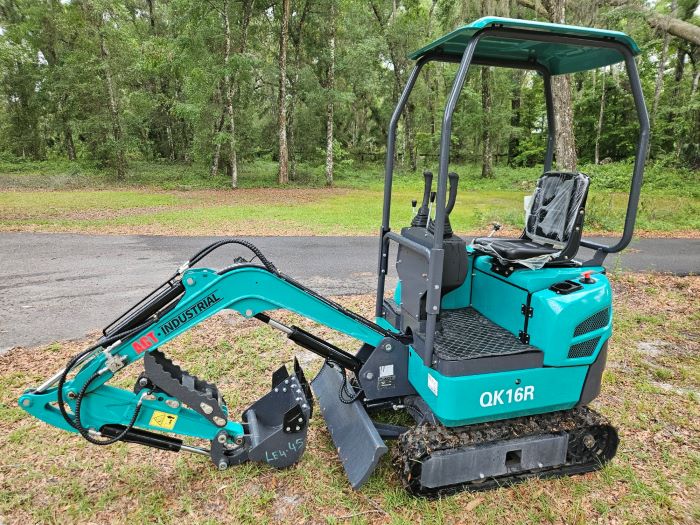
Now I have to decide whether I’m man enough to find a big Kubota tractor to replace the one I have. And I keep dreaming of a 6-ton excavator.

Meet 1700 Pounds of Turf-Shredding Joy

Saturday, June 28th, 2025

Finally Getting Off the John

The big day may finally be here. I may be getting a “new” used diesel mower to replace the old John Deere 430. I can’t contain my joy. I found a deal I like on the web.

I say “may” because I’m used to getting bitten in the butt with respect to Internet deals. As well as everything else. You know how it is. People buy stuff out from under you. The things you think are good deals turn out to be junk. I will say “may” until the mower is in my driveway.

I still marvel that people love the John Deere 430 so much. Say anything bad about it on a landscaping or farming forum, and you may be challenged to a duel. “They run forever.” “They’re bulletproof.” People routinely pay $3,000 for 430’s in reasonably good shape, in spite of the fact that the newest ones are well over 30 years old. Mine is 34.

I have a lot of bad things to say about my mower, although I can’t complain at all about the smoking deal I got on it.

First, the deck weighs about 350 pounds, and it has to be removed in order to change the blades or the oil. You can jack the mower up if you dare. Personally, I don’t want to climb under a 1500-pound mower with a short wheelbase when it’s reared up at 45 degrees.

Removing the deck is a horrible chore. It’s supposed to be quick and convenient, which it probably was in John Deere showrooms with new mowers that had no corrosion and which had been carefully prepared by mechanics. To get the deck off, I have to remove one deck wheel, turn two other wheels sideways, remove some pins that don’t like to come out, turn a lever that doesn’t like to turn, jack up the front of the mower, probably do some other things I forgot, and drag the deck out by brute force.

Putting the deck back on is just as difficult.

Having moaned about that, I would now like to moan about the unavailability of new parts, which have always been way overpriced. A few years back, Deere started discontinuing commonly-replaced parts the mower really needs in order to function. First, it was the grille. Eventually, they got around to replacing their proprietary, non-repairable hydraulic cylinders. Now the muffler ($450, if memory serves) is off the menu. The deck is also unavailable.

With that behind me, I will now complain about the difficulty of working on the mower. Everything is cramped. Things that should be easy to replace are hard to replace. To add hydraulic fluid, you have to pour it into a tube with an inner diameter of maybe 3/8″. That is simply amazing.

One belt runs the water pump and alternator, and changing it is like doing a heart transplant through a dirty keyhole. While lying on your back. Everything is hard to get to, you can’t swing a wrench, and none of the bolts want to turn. And you have to take the tractor’s whole seat-and-fender pan off.

Finally, I hate the throttly thing. This mower has a hydrostatic transmission, which means you use one control to change the speed and direction. It’s a shift lever on the dash. When mowing in a yard like mine, you need to change speed and direction a lot, and modern mowers use things like pedals and control bars to make it easy.

I guess zero-radius-turn or “zero-turn” mowers got their name from the fact that they use the drive wheels to do all the turning and traveling. They’re like wheelchairs. To turn, you make one wheel go faster than the other. To rotate in place, you reverse one wheel and make the other go forward. You don’t have to move to turn around.

Going from forward to reverse or changing speed with the Deere is jerky and generally no fun. It’s not easy to control, and you have to take one hand off the wheel.

I’ve had to repair the Deere a lot. I have suffered repeatedly. It has broken down in annoying and unexpected ways, it has done it repeatedly, and working on it is on par with laboring in a salt mine. I want to let it go.

UPDATE

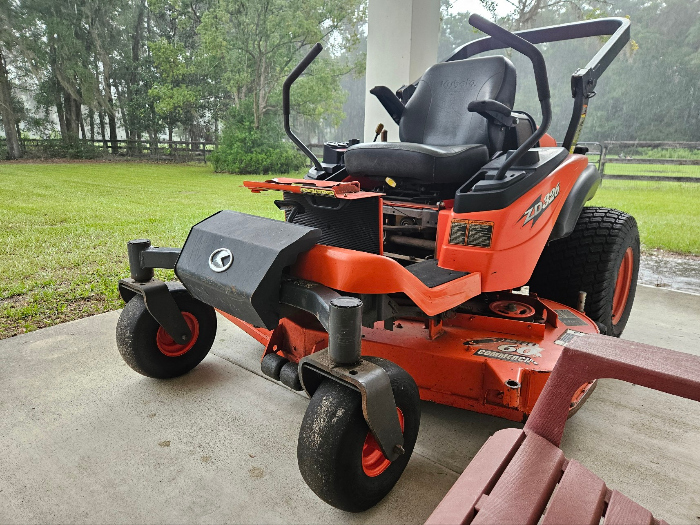
I made a deal on the “new” mower, and it’s in my driveway. It’s a used Kubota ZD326S with a nice diesel engine and a 60″ deck. A zero-turn. As my buddy Mike says, a MOWER, not a TRACTOR.

The ad said 229 hours at a very low price, so I got excited. I went out to see the seller today, and of course, when I ran the engine, the hour meter did not move. And while the mower looked very good, it was pretty clearly not a 229-hour mower. The seat had some wear, the seat belts were somewhat bleached, and so on.

The seller was a very nice guy. He said the mower had belonged to his wife’s grandfather, who had died not long ago. He said grandpa used it to mow a couple of acres at his home.

He kept telling me he didn’t know much about the mower, so I looked it over fairly well. I had him jack up the deck, I looked in the hatches, and I had him to through all the functions with the engine running. It sounded perfect, and nothing exploded.

He had just put new tires on the mower, plus fluids and deck belts, so he wasted a lot of money before deciding to sell it. The tires cost over $300 for a pair. Insane.

He said he didn’t know anything about the hours. Judging by my own Kubota tractor, which I bought at 1100 hours, I would say the mower is between 500 and 1000, so it should have another 2000 in it, given good care. If anything goes seriously wrong when it gets old, it’s not a complex machine, so most things that are likely to go bad can be fixed.

It was lacking two front scalping wheels, along with the little shafts that hold them. I can get the parts for $210. He says the dealer told him he didn’t need them.

When he jacked the mower up in his driveway, oil dripped from the bottom of the crankcase, and I thought it was time for me to go home. It turned out he had overfilled it and forgotten to clean it off, so when he jacked it, oil ran off the top of the engine. This explained why it ran for several minutes with no drips before the front end was raised.

The underside of the deck looked very good. Still some traces of paint.

He spontaneously offered to knock a grand off the price, and I decided to take it. I got it for around $3000 less than the market price for a mower with a working hour meter and documentation, so unless something is horribly wrong with it, I can’t get burned. I really need a good mower that will last decades, I have been looking for months, and this was no time to let the perfect be the enemy of the very good. Mowing season is here, and I can’t face another session with the John Deere.

If this mower could be had new, it would cost about $18,000. A new really good gas mower like a Scag Tiger Cat II would cost $13,000 or so, the motor would probably fail by 750 hours, it would have to be refilled very often, and I would have to deal with the pitfalls of ethanol.

My best guess is that this thing is a peach, well worth sprucing up. There are a couple of dinged-up parts I can replace. I can touch up the paint here and there.

Because it was raining today, I was not able to run the mower much. I mowed a few yards and then put it out of the rain. I was flabbergasted. The old JD has a 20-horsepower engine, and the Kubota is rated at 25, but it feels more like 20 and 40. The engine ran perfectly smoothly, unlike the Deere’s Yanmar, which shakes the tractor. It seemed to run at a much higher speed. When I cut grass, it blasted out the chute in a shower of startled clippings. The cut it left was flat and smooth, unlike the Deere’s wake of ridges and lumps.

I had thought my lawn’s irregular appearance was mostly due to the nature of the awful grass, but it looks like the mower was the problem. Maybe it was running too slowly to really KO the grass, and I need to take better care of the air filter, or maybe the JD just doesn’t turn its spindles as fast as a Kubota.

Grok thinks the Kubota’s blades turn faster, but it isn’t sure.

The Kubota did all this while moving much faster than the Deere. I should be able to halve my time in the roasting sun.

I’m going to get a set of mulching blades and close off the Kubota’s chute to see if I get respectable leaf-pulverization. If I do, I am set for life. Oak leaves are the bane of my existence.

Kubota makes a mulching kit for the ZD326, but it gets complaints. It isolates each blade in a separate compartment, and this confines the clippings a little too well and makes the mower bog down in heavy grass. I was hoping to get a kit and modify it to make it breathe a little better, but when I looked under the mower today, it looked like it was already set up the way I wanted it. It had curved steel panels that surrounded but didn’t completely isolate the blades. That might work.

I’m getting Gator G6 mulching blades for it and hoping for the best.

If it’s reasonably dry tomorrow, I’ll take the Kubota out for a spin and see how she does. As long as it does what it did today, I will consider myself a satisfied customer.

I have felt wonderful ever since I got the mower home. Relaxed, knowing my old mower will no longer be a source of uncertainty and torment.

Sometimes I wonder if I spend too much, and other times I wonder if God thinks there is something wrong with me for not spending more of what he has given me to improve our lives. The John Deere was a bargain, and it functioned, but it also made me suffer over and over with breakdowns and repairs and maintenance that were extremely unpleasant. Maybe I should have bought a Kubota 5 years ago.

I discussed it with my wife. She thinks I should spend to make things easy for myself. I told her to remember she said that if she ended up getting a job at 60, but she said that would never happen, because God always provided for us.

I think I was pretty frugal, buying a used diesel. I couldn’t touch a new one without coming close to $20,000. Home Depot’s best mower is a gas Cub Cadet that costs $3,000 more than I paid and has a cheesy Kohler engine. Not even a Honda. Its deck is 10 gauge. Mine is 7 gauge. The John Deere’s looks like 10, gauge for that matter. The Cub Cadet is likely to be scrap at 1,000 hours, but I’ll have at least that many more to go.

I love diesels. I wish everything had a diesel engine.

For the first time in maybe 5 years, I am looking forward to mowing the yard.

Oh, BOY

Monday, June 23rd, 2025

The Opposite of Peter Pan Syndrome

My buddy Mike sent me a link to a video about Jackson Laux, and I was very impressed.

The web says Jackson, or maybe I should call him Mr. Laux because he is so grown up, is 9 years old. He is Internet-famous for his love of tractors, especially John Deere. He has appeared in lots of videos. He has a spic-and-span shop. He has multiple tractors. He can talk all day about them. Their strengths and weaknesses and so on. He really enjoys what he’s doing.

As a Christian, I find Mr. Laux interesting, because he helps me understand what most parents do wrong.

When I was a kid, my dad made very good money. I should know, because I have all the money he never spent. So we went on vacations to Europe to broaden our minds, right? We had music instruction, tutors, and all sorts of help with interests that could be lucrative and fulfilling later in life, right? Well, no. My dad was cheap. We had furniture from discount outlets in the Carolinas. We had cars we got at cost from my mother’s father’s dealership. My sister and I didn’t have much in the way of toys. Another kid down the block gave me hand-me-down toys and clothes. When we traveled, we went to see my mom’s family in Kentucky or we went to the Keys, which were a short drive away.

My hobby was TV. My dad’s hobby, which consumed hours of his life every day. I sat in front of TV sets and ate ice cream.

I had interests, but it never occurred to me to ask my parents to support them. To them, every non-necessity they bought for me was either a toy or a gift. Frivolous. The only exceptions were books, which they didn’t mind paying for, and two banjos. They would never have bought me tools, a tractor, a welder…no way. They would never have put $10,000 in an investment account and taught me what to do with it. They would never have bought me a rental property and helped me manage it.

You go to school. You get B’s or better. You become a lawyer or maybe a doctor. That’s what you do. This was their limited understanding.

My mother didn’t have much in the way of vision, and neither did my dad, but he was worse, because he didn’t care. He didn’t spend time with his kids. He had no idea who our teachers were or what subjects we were taking. He forgot our birthdays. Once, he came home drunk, with no idea it was my birthday. I was using a music stand my mother had bought for $8.00. When he realized what day it was, he asked me how I liked my gift, and he didn’t buy me anything else.

My mother made some effort to interest me in science. I’ll give her that. She enrolled me in a mail-order program that sent me little science kits. She tried to interest me in coin collecting, which was dull, given that there was almost nothing available to spend.

Here I am, an adult with a thousand interests. Writing. Music. Machining. Welding. Cooking. Science. Engineering. Maintaining my land. Building things. Photography. And my parents never managed to set me up with a single activity. Not one! Yes, I got banjo lessons, but the banjo is a dead-end instrument, and music lessons are nothing if you don’t learn to read and write music.

Photography is actually a very profitable profession if you have the gift, and by now I know I have it. I have taken a lot of excellent pictures. I could have made money with cameras.

My parents failed. Now let’s look at my buddy Mike.

He has two sons, and they started life near where I live. Mike spoke to one of their teachers. According to Mike, regarding his son, the teacher said, “He be real smart.”

When he saw the pickle his sons were in, Mike moved to New Hampshire, where they have better public schools. When one of his sons turned out to be a gifted football player, he moved to the DC area and put him in a famous sports high school. When the time came to think about college, Mike’s son was connected with scouts. He didn’t become a pro in the usual sense of the word, but he did receive a free college education, and he is a happy, very successful adult.

Mike lived across the street from me, and his parents didn’t do much to start him off in life. His mother died when he was about 16, and his dad’s involvement with him dried up. His parents can’t take credit for the way he raised his sons, and neither can his wife, who gave him custody during their divorce and then ran off to pursue her career. Mike’s sons are doing better than he did. Mike had to learn to hustle when he was their age, taking whatever job was available or creating his own jobs.

Mr. Laux did not get a job at age three and save and invest and buy tractors and a shop. No one has told me this. I know it because I’m not an idiot. No little kid does that. Even Mozart had an aggressive manager. Mr. Laux’ parents encouraged him in his dream and also financed it heavily. They paid for everything. They knew the difference between spoiling a kid with toys and investing in his future.

As a result, barring unforeseen problems, Mr. Laux will be self-supporting when most kids are rotting their brains with video games and dope, and he will not have to waste 4 years and hundreds of thousands of dollars at a university where he will be pushed to become an antisemitic, God-hating, emasculated, demon-worshiping, drug-using, socialist pervert, given a useless degree in English or History, and then relegated to a cubicle farm.

I will have my son’s back with regard to any wise pursuit that interests him. That doesn’t include getting an English degree or starting a band. He can study STEM fields. He can start a business. He can learn to invest. I’ll help him learn instruments and languages. I will never tell him things I buy that are related to his wise pursuits are frivolous or that he should think I’m generous for buying them. That would be like telling him I’m generous for paying his pediatrician.

I wish I could go back in time about 50 years and give my autopilot parents a good talking-to. It might have given my mother ideas. My dad wouldn’t have paid any attention, because he didn’t care. I wish I could go back and talk to my young self, but I was underdeveloped and hardheaded thanks to my parents, so I don’t know if I would have listened.

I might have listened. I remember a few times in my past when appalled strangers who knew my parents were blowing it told me things that stuck.

My parents didn’t know God. They never heard from the Holy Spirit. We didn’t pray together. I rarely saw the inside of a church. They imparted virtually no wisdom to me. They didn’t cultivate a single useful habit in me. I didn’t have the natural character to raise myself properly. It’s a wonder I’m not living in a refrigerator box.

Who Freed More Men?

Friday, June 20th, 2025

Abraham Lincoln, or Rudolf Diesel?

I have put around three hours on my tiny Chinese excavator, but I have to report I haven’t made it to China yet.

I wonder if millennials will get that. “What does digging have to do with China?” “I don’t know. Should we be offended or just go somewhere quiet and invent a new gender?”

I put $5,000 into this new machine, figuring it would be very handy around the farm. As of today, I think it will be useful enough to justify keeping it, although it has some problems.

As I noted in another post, and as may or may not be true, these machines have gas engines that run very fast, and they are said to be based on diesel machines with engines that run slowly. The actual figures are 3600 and 2050 RPM. The scuttlebutt is that the Chinese did not change the hydraulics to cope with the higher RPM’s, so these excavators pump fluid too fast, resulting in jerky movements that take a lot of skill to control.

Whatever the reason, the jerkiness is there for sure.

The controls allow you to lower and raise the blade, move each track independently, curl and uncurl the arm and bucket, raise the arm, spin the excavator on its tracks, and use the hydraulic thumb.

The jumpy nature of the machine is fairly manageable except when you use the tracks. There is one stick for each track. Moving it forward makes the track go forward, and pulling it back gives you reverse. Moving the sticks in different directions makes the excavator turn.

One of the big problems is that if you try to go forward or back without great care, the excavator may jump. This jerks your body in the direction opposite to the machine’s progress, and that makes you pull the sticks in the direction that makes it stop or go the other way. Then you naturally push to resist the jerking, so you start it moving again. The result is that you bounce. Forward-stop-forward-stop-forward-stop. It’s like riding a mechanical bull.

I’ve looked into solutions.

One is to replace the hydraulic pump with a slower one. The pump puts out around 0.37 cubic inches per revolution at 3600 RPM’s, so moving to something like 0.20 would make it more like a diesel machine running at 2050. But the tracks would be unbearably slow. As it is, it’s almost motionless at full speed.

The pumps are cheap and easy to replace. I should be able to do it for under $150. But if I want to use the excavator at the other end of the farm, it could take an hour to get there.

It would be great to find a little diesel engine that would work, but I think that’s a pipe dream.

I do not like gas engines, and I am sure this excavator’s carburetor will cause me problems eventually, but the price was very good, and I don’t expect to need the excavator often enough or in a big enough hurry to make occasional failures intolerable. Hope I’m right.

As for capability, the excavator is pretty weak. A Youtuber says these machines can lift something like 550 pounds, which is very little. The bucket’s curling cylinder isn’t strong enough to make it dig into dirt unless it’s pretty loose. You have to rely on the arm.

I’ve also gotten the excavator stuck on sandy ground. The tracks flat quit turning. I have read that this may be caused by a bypass valve that protects everything when the excavator is held in place by dirt pressing against the underside, but it’s hard to believe that happened in the relatively flat place where I was digging.

Breaking through roots is not possible if they’re over maybe an inch in diameter. That surprised me.

As I probably said before, it’s like having two men with shovels. It’s not going to move the stump of a hundred-year-old oak, but it will dig a hole in cooperative ground about as fast as two men, and all I have to do is sit and work the controls.

I can’t smooth things out when I’m finished. It’s way too jerky for that, and the bucket is small anyway. I would have to go back over everything with the tractor bucket and probably a shovel.

The earth-moving ability of two men with shovels is good enough, believe it or not. I have been out there with a shovel, myself, and it was not pleasant in 95-degree weather with blazing sunshine, high humidity, and no breeze. The excavator is not as great as I thought it would be, but it is great.

As for other machinery, I tried to buy a used 60″ diesel zero-turn today, but the place advertising it lent it to a customer, so I could not see it. I left contact information, but they have not gotten back to me yet. I wanted a Kubota, and this machine is a Gravely with a Kubota motor. I like Kubotas because they have built-in jacks for changing the blades, but they are hard to find at good prices, and I am tired of waiting. Gravely supposedly makes tougher bodies, and I can always use my floor jack.

I feel better about buying machines because I used Grok and ChatGPT to do financial analyses of the cost and return. Grok said continuing to use a mower would eventually save me $75,000 in landscaping payments, which could actually be true.

I should be able to keep a diesel mower going until I die, and I would guess that would save me $6,000 2025 dollars per year. Call it $150 per week and something like 40 weeks per season. That’s $6,000 per year in labor costs saved, so over 20 years, $120,000. If I live longer, I can always get an apartment.

I could get a used gas mower, which would be much cheaper. Then I’d have the giant hassle of ethanol problems, and I would have to buy and install a new engine every 750 hours, so at 80 hours per year, starting with a used mower, I would have to buy and install at least two engines, at a cost of something like $4,000 2025 simoleons. A used diesel engine should outlive me with no major overhauls.

A used gas mower would be maybe $2,000 cheaper, but it would cost me $4,000 to replace the engine, so an eventual net loss of $6,000, and it would be a horrible product I would hate, compared to a diesel. And it would burn a lot more fuel.

New gas mowers cost more than used diesels, which makes me wonder why anyone buys them. I don’t even understand why professionals buy them. Of course, I can’t assume every man who cuts grass for a living knows a lot about smart investing.

I know this is the kind of thing people say in order to rationalize impulse buys, but here it is anyway: AI helped me realize I would be throwing money away if I did not buy a diesel mower. Of course, I could keep the one I have running for maybe 5 more years, but I just can’t face doing the maintenance, and this mower is very slow. Changing the oil and sharpening the blades are torture, and a new mower should be able to shave off over a third of my mowing time.

This mower may die for good unexpectedly. The hour meter was frozen when I bought it (Surprise!), so for all I know, it has 4,000 hours on it. Important parts are rapidly being discontinued, it has already broken down three times, and I could find myself presented very suddenly with fast-growing grass and the need to buy a mower quickly.

Given how hard it is to find a mower at my leisure, I know that would be unpleasant.

I looked into mowers a few years ago, and I decided to be smart and keep my old mower going. Guess what happened? Prices of new mowers went up maybe 30%, and the value of my old mower dropped by around $2000. And I got to continue suffering needlessly. All that time, I could have been riding a better mower.

AI also thinks a real excavator, like 11,000 pounds, would pay for itself. I could do a lot of beautification and repair, and I would get a tax deduction. And it would be fun.

I could get something pretty good for maybe $25,000. It’s not that hard to make $25,000 worth of improvements on a farm with an excavator.

The final idea AI liked was getting a bigger tractor and a flail mower, but I didn’t point out that I already had a tractor which is adequate. My tractor will do most of what a bigger one will do, but it will do it a lot slower, and I will have to help it by getting off and doing more manual labor.

People like to say a small tractor will do anything a big tractor will do, slower. Not actually true.

You know who says that? Guys with small tractors. Especially guys who couldn’t afford, or were too cheap, to get bigger ones. The 50 million guys in the US who bought 25-horse John Deeres and Kubotas. Some made the right decision, because some properties don’t require big machines. Others doomed themselves to unnecessary misery and failure.

I can wait instead and make the most of what I have. And of course, the cost of a new tractor will go up, and the value of my old tractor will go down.

I’ve also realized that machinery expenditures are not lost. A good used machine is an investment. You can sell it if you have to. It’s not like a trip to Singapore or a year’s worth of restaurant meals. It’s not like a new machine, which depreciates off a cliff the second you buy it (12-25% for machines with top resale value). A used machine may depreciate, although the way things are going, it may not. Many appreciated during the Bidencaust.

It probably won’t increase in value like a piece of real estate or shares of stock, but it should beat rapidly-shrinking cash by a wide margin.

I believe that if I pick up a couple of useful machines that will enable me to keep my property up without dying of heat exhaustion, in the end, I should be way better off than if I had paid tradesmen or spent thousands on rentals. My property will look a lot better and possibly be worth more. My own suffering will be greatly reduced. It sounds pretty good.

I’m glad I bought the small excavator. It is already proving useful, even if it’s rough around the edges. If it turns out I’ve overestimated its usefulness, I’ll be able to get every penny I paid back out of it. Not bad.

Dig This

Wednesday, June 11th, 2025

Think I’ll Paint Winnie the Pooh on it for Nose Art

With some trepidation, I am making a third effort to write this blog post. The first time, I started and then drove to Walmart, and when I got home, the Notepad window I was using had disappeared. Ironically, I have gotten used to using Notepad because my power used to blink while I was using a browser and WordPress. Notepad saved a number of essays. But it only does that when you save your work manually from time to time, and I quit doing that a long time ago, probably because I developed some faith in my backup power supply.

The second time I tried to write this post, my wife knocked the cord out of the back of my PC with a mop after I wrote maybe 500 words. I’ll bet they were great.

One more time, from the top:

I am pleased to say that I now have an excavator of my very own.

I have wanted an excavator for years. My farm has a lot of problems excavators are the best tools for fixing. Tree stumps. Not-quite-buried rocks that dent my mower blades. Holes that need to be dug. Trees that should be pushed over instead of being felled with saws.

An excavator is an amazing thing. You can use one to make beautiful, very deep holes with clean vertical sides and flat bottoms. You can dig long trenches with them, and you can fill the trenches in very quickly. You can tear unwanted trees up. You can dig up and lift boulders.

For digging, an excavator is like a number of sturdy potential deportees armed with shovels, fresh from the parking lot at Home Depot, except it won’t case your house and come back later to steal your jewelry and oriental rugs. And it won’t try to vote in your elections.

Why didn’t I buy an excavator sooner? Because I am cheap. I would rather watch my property deteriorate than part with a sum I wouldn’t really miss.

That sum is around $25,000. That’s about as little as you can hope to pay for a 6-ton excavator that isn’t ready for the scrapyard. You can go cheaper, but you should expect to have a lot of down time and repairs.

I didn’t spend $25,000. I spent $5,000. For a brand-new excavator. How did I pull that off? Well, I compromised. A little. I shaved a little bit off the desired tonnage. About 80%, give or take. And I went Chinese.

For some time, the Chinese have been making little-bitty excavators weighing as little as 1500 pounds. Real manufacturers make small excavators, too, but theirs are fancy and have diesel engines. The Chinese go bare-bones, and they use the sort of engines Briggs & Stratton makes. Like big lawnmower engines. Gas-powered.

I used to see tiny excavators going up and down the road on trailers, and I thought they were silly. I couldn’t believe they were worth buying. I was sure a 1-ton excavator couldn’t pull a tree over, for one thing.

Recently, I saw a video that changed my mind. A huge Youtube star bought a used Chinese excavator for $3,000, and he loved it. This is a guy who owns huge track loaders, dump trucks, bulldozers, skid steers, and diesel excavators. He knows all about the real thing, but he enjoyed a Chinese toy.

He did things with it that surprised me. He lifted a tree that had to be 40 feet long, and he drove off with it.

I thought that was pretty neat. I started thinking I had made the perfect the enemy of the good. So what if I ended up with an excavator that couldn’t take a tree down? It would still be great for little stumps and digging out rocks. It would work for digging holes, like the one I need to dig to fix my gate’s car sensor.

I looked around, and I found out Chinese baby excavators started at around $6,000 for the bare minimum. But then I got lucky. I saw an ad for a brand-new excavator with 15 horsepower and a hydraulic thumb. Price: $5,000. The manufacturer charges $8500, including shipping.

How was I supposed to say no to that? The excavator in the video had 12 horsepower and a stationary thumb, and it was still wonderful. The one in the ad was a lot better, and because it was new, it probably wouldn’t fall apart for at least a year and a half.

Incidentally, these machines used to cost more. For some reason, the market is flooded with them. I don’t know if Trump scared the importers into dumping them or what.

A Kubota the same size retails for about $29,000. A Kubota is a WEE bit better, and by “WEE bit,” I mean “a lot,” but it’s not $24,000 better.

Today I drove out and looked at it, and a couple of hours later, it was in my yard. Here’s a photo.

It’s a monster, isn’t it?

It really works. It’s not quite as strong as I had hoped, and it doesn’t break through roots the way it needs to in order to dig fast in Northern Florida, but on the other hand, it digs much faster and better than I can, and while it digs, I don’t get dirty or sweaty. I don’t get sore. I don’t strain my back. I can dig all day. In the past, I used to go a couple of hours and then quit and expect to feel sore the next day.

This machine can go down 65 inches. That’s really something. I believe the deepest hole I ever dug in my life was about 30 inches, and it was a horrible experience.

I have a couple of partially-buried rocks I really want to get rid of. The tractor couldn’t do anything, even when I used a subsoiler to go around it. I am planning to use the excavator to go down 65 inches, and if that isn’t enough to loosen them up and allow me to pull them out with the tractor, I’m going to rebury them and paint the tops bright pink so I quit running over them.

Actually, I might use the rotary hammer and wedges to break the tops off of them. That would be good enough.

It’s not fun to use. Yet.

The controls are not intuitive. It appears it will take me a day of practice to get to the point where I’m not doing things like lowering the bulldozer blade when I think I’m curling the bucket. Also, the machine’s movements are very jerky. You push the levers carefully, trying to ease into motion gradually, and at first, nothing happens. Then the excavator leaps into action. It’s like riding a mechanical bull. Hard to predict. You can actually throw yourself out of the machine if you aren’t careful.

I have read that these little excavators use the same pumps diesel excavators use. Gas engines run at higher RPM’s, so supposedly, this results in too much fluid pressure. I don’t know if it’s true.

A guy who claims he sells these machines says the problem is that the manufacturers don’t adjust the pressure well at the factories. He says you can fix it with a simple gauge and an Allen wrench.

I’m going to improve my skills and see if that fixes the problem, and if it doesn’t work, I’ll look into pump adjustment.

Some people think cheap Chinese hydraulic fluid makes the machines jerkier than they should be, and they also say it should be changed right away anyhow, because it’s no good and may also have bits of metal in it after the machines have run a few hours. I plan to hit Tractor Supply tomorrow and buy real fluid.

I don’t know if this excavator will be of any use with my big stumps. Maybe if I’m patient. But I have a bunch of little ones, and I also have a lot of shrubs I want to rip out. It will be great for those jobs.

Just about all the parts that may go bad are available on Amazon, and they are cheap. I don’t have a warranty, but at this price, and given the simplicity of the machine and the cost of parts, I don’t care.

If I decide I don’t like it, I can probably get most of my money back out of it, so there is not much of a down side. I might lose two grand, but I’m sure I can do more than two grand’s worth of work before I do.

Today I realized I needed to think more about machinery that does work for me. If I’m going to continue living in the country, I mean. I’m strong now, but old age is just about here, and people don’t stay strong forever. And my time has some value, even if it isn’t much. There is a lot to be said for turning a hard two-week job into a one-day job you can do sitting down, especially when you have a wife waiting for you to finish and move on to the next chore.

I could just pay people to do things. I would hate to feel helpless, though, and paying people isn’t always cheaper than buying equipment. For example, I can buy a used diesel mower for $9,000 and use it until I die, with only only routine maintenance. I can’t find anyone who will charge me $9,000 to mow my grass for that same period. I would go through that in a couple of years.

I am considering upgrading my tractor for $30,000 minus whatever I get for the old one. That would include buying a flail mower that could probably replace my garden tractor for lawn work. A bigger tractor would make things go much, much faster and easier. If I had to pay people to come out and cut and move trees instead of using a tractor, I would probably end up spending more over time. I was quoted $800 for felling one tree and then walking away.

I like the idea of showing my son how to do manly stuff. I once competed in a fishing tournament on my dad’s boat, and his partner hooked a sailfish. The drag was loose, and he needed to turn the drag knob to tighten it. It was a spinning reel with a knob that had a right-hand thread. I told him to tighten it, and he had to ask me which way to turn it.

My son will never have to shame the family like that. Imagine a grown man not knowing which way a screw turns. Willy Loman said it best, to another character who marveled that Willy had put up a ceiling: “A man who can’t handle tools is not a man. You’re disgusting.”

My son’s dad will be able to teach him welding, machining, basic electronics, painting, forestry, how to run and fix a tractor, how to run a diesel yacht, fishing, shooting, reloading, how to run woodworking machines, how to make a real pizza, and how to run a tiny Chinese excavator. Maybe a bigger excavator some day. I’ll be able to teach him basic car repair, so he won’t have to pay people to change his oil or do his brakes.

I keep hoping my son forgets about college and starts a business that begins with a trade and ends with a fleet of trucks or machines and a stable of employees.

My wife gets annoyed with me sometimes because I don’t like to pay people, but I can’t believe what some tradesmen charge. Home Depot wanted $200 to install two blinds. That’s 4 holes and 4 screws. A chimney guy charged me almost $400 to go up on the roof and give me an estimate.

She practically begged me to hire painters, but when we did our own painting, she had to admit our work was better than the pros’ who came before us, and it was free. We probably saved $3,000, and we still have to do two stairwells, two baths, and the kitchen. Imagine what that would cost.

I can’t believe what painters charge. I used to paint entire apartments for $300 plus materials, and I did good work.

I started working on one of my buried rocks today. Tomorrow I’ll get back to it. I’ll be disappointed if I don’t get it out; for all I know, I’m digging around a tiny projection on a rock that lies under the whole neighborhood, like a wart on a whale’s butt. But at least I’ll be able to say I found out and didn’t chicken out like a soy-eater and pay a big strong man to do it for me.

Oil Crisis

Thursday, May 22nd, 2025

A Baby’s Butt Should Only Have One Crack

Now that I am an expert on all things baby, I have decided to formulate my own proprietary baby butt grease.

Baby maintenance is mysterious to me, because while the human race has been around a very long time, we are convinced we have to have a fair number of recently-invented products in order to keep babies from disintegrating. If they’re necessary, how did we survive so long without them?

One possible answer is that we didn’t survive. Historians don’t seem to be very good at their jobs, and no one knows for sure, but they think somewhere between 20 and 50 percent of medieval babies never got to see that first birthday cake.

The population of the world grew extremely slowly in the past, proving that lots of people didn’t get old enough to reproduce.

The grease thing seems particularly odd. Secular people keep telling us we’re animals, but is there any other animal that refines lubricants and applies them to its young? Probably not.

Human beings aren’t stupid, so we have probably been greasing babies with things like animal fat and olive oil for thousands of years.

It’s odd that they need it. What happened to evolution? It was supposed to handle things like this.

My wife started our son out with Vaseline, which Zambians apply to their entire bodies. She tries to get me to do this to myself. It makes my skin crawl. The thought of sticking to my clothes and leaving stains on furniture and sheets is too much for me. Anyway, they use special Blue Seal Vaseline over there. It’s thicker than the stuff we get here. You can find it on Amazon here, but of course, it’s crazy expensive.

Vaseline gave the boy pimples, so now she limits it to his diaper area.

Incidentally, you can get super-thick petroleum jelly very cheaply if you order a dozen containers, which is a reasonable move if you have a baby. The brand name is Dynarex, and hospitals use it.

We also tried Aquaphor’s special diaper rash healing ointment, but like Vaseline, it’s not the kind of thing you want all over your baby.

I had an idea. I was familiar with lanolin. I had used a lanolin and ethanol solution to lubricate shell casings, and I had also used a lanolin and mineral spirits solution to prevent rust on tools. I knew lanolin was amazing. It gets into your hide and forms a barrier that is hard to wash out, and it really keeps the moisture in.

Know what you’re buying when you buy skin lotion? Something someone developed as a lanolin substitute. Lanolin is THE skin moisturizer. The gold standard every other moisturizer tries to imitate.

I started mixing lanolin into a diaper cream Zambians use, and it works very well. But I don’t want to pay for African diaper cream, because obviously, there are things here that will work just as well. Also, the diaper cream has perfume in it.

Someone help me understand why manufacturers put perfume in baby products. Generally, they smell fine without perfume, and the rest of the time, they smell like poop and urine, so perfume isn’t going to help. When a baby smells like a full diaper, it’s time to clean him up.

Perfumes are irritating. They can make adults’ noses run and irritate their eyes, and babies are more sensitive than we are.

Johnson & Johnson sells baby shampoo with perfume in it. It’s not supposed to sting babies’ eyes. Well, I’ve gotten it into my own eyes, and it stung just fine, so my belief is that babies do not need weird industrial fragrances in products that come close to them.

Johnson & Johnson also makes baby oil, which is perfumed mineral oil. It smells very nice on women, but on babies, it’s a waste of money. It’s at least twice as expensive as pure mineral oil, which won’t make your baby sneeze.

I got the bright idea of combining pure mineral oil with lanolin. Lanolin is thick and sticky, like honey, so you need to cut it with something thin in order to get it to spread easily.

I read that beeswax was a popular ingredient in baby greases, so I ordered some of that, too. It’s supposed to form a strong barrier and fight bacteria.

I picked up mineral oil locally, and my beeswax has been here for over a week, but the solid lanolin I ordered is still not here. It went to Jacksonville, then Denver, then North Carolina, and then Georgia. Who says government workers are incompetent? Not me. That’s for sure.

I’m going to fiddle with these ingredients until I get a thin, spreadable lube that goes on easily and still does the job. He won’t sneeze. His eyes won’t water. He’ll also be getting the very best ingredients, which is not true of most factory products.

The Aquaphor stuff costs over a dollar per ounce, which is ridiculous. You would think I was greasing Jeff Bezos.

I have around $50 invested. I will probably have to invest another $20 over the next year, and that should give us 12 months of excellent results. That sure beats between $50 and $100 per month, which is what we have been paying. For inferior stuff.

I don’t know if I’ll be able to convince the wife to give up the Aquaphor. She really likes it for fixing irritated skin on his crotch. I’ll bet I can convince her, once she sees the results.

Another skin-saving tip: do NOT buy Aveeno baby wash and shampoo. Not unless you want to tan your baby’s hide and get a product suitable for making baseball gloves.

My wife bought this stuff because it came from a trusted brand, and it had “baby” on the label. Then our son’s skin dried up so it resembled the seat of a Cadillac that had been baking in the sun since 1975.

You can grease your baby to restore his skin’s oils after Aveeno rips them off, but putting moisture back into skin is never as effective as leaving it in.

I was going to throw the Aveeno out, but it’s so strong, it knocks tractor grease right off my hands. Not kidding. It cuts right through anything oily and removes it. Like pure Castile soap. Which may be what it is.

I keep it by the utility sink to clean my hands after I get dirty grease on them. I have to follow it up with lanolin, though. My skin is very tough, but if a soap is extremely strong, it can make it crack eventually.

Aveeno makes at least two varieties of this soap. One says it has shea butter in it. That’s not the one we got. We got the one that’s more like brake cleaner.

I will never understand why they made this product.

What do I use instead? Walmart liquid hand soap. Their house brand; Equate. This is more or less the same as every other brand of liquid hand soap. In fact, it comes in nearly the same bottle as the Publix brand. The label claims it moisturizes, which must be true, because I wash my hands 3,000 times a day with no problems. It also says it’s antibacterial. Whether this is true or not, the bacteria presumably get rinsed off with the soap, so I don’t care.

I give our son a lot of his utility sink showers, so I am pretty familiar with the Equate soap. I put him in his little shower throne thing, I hose him down with warm water, and I wash him with about 7 pumps of soap. That’s it.

It does a good job of dissolving filth, and his skin looks better and better all the time.

My hands also look and feel great.

Guess what it costs. Guess. I’ll tell you. It costs 5.9 cents per ounce. Not a typo.

When I hoist him from the sink, I put him on his belly, grease the rear of his body, flop him over, grease the front, let him sit a minute to soak up the excess, dab him with a towel, and jam him into a fresh diaper and romper. Done.

Now you know how to clean and grease a baby extremely well, while saving a ton of money on products that don’t really work.

It’s sad that companies prey on mothers. Most mothers want good stuff for their babies, and because companies know that, they jack up their prices and make dishonest claims. If it costs more, it must be better. Conversely, products that are less expensive must be harmful and even dangerous. You’re a bad mother if you endanger your baby with Equate soap! There must be a reason why everyone recommends the pricey soap.

Well, there is a reason. They’re wrong. That’s the reason.

Unlike me, most people have kids when they’re young and going through a phase of their lives when they aren’t as affluent as they will be later. In view of that, targeting them with overpriced baby products is pretty offensive.

I give the diaper companies credit. They seem to put out really good products at very fair prices.

While I’m saving the babies and mothers of the world, I’ll add that you should not buy a baby tub. Not if you have a utility sink or bathtub.

Baby tubs can cost over $50 with all the cute matching accessories. They work reasonably well. They’re useful if you don’t want to wash poopy butts in your kitchen sink.

On the other hand, a baby in a tub stews in its own poo because a tub doesn’t give bathwater anywhere to go. Also, a baby tub is a pain to set up and use.

We got a plastic sink chair thing and a faucet attachment with a sprayer and hose. The baby sits on the chair, and I hose him with the sprayer. It’s fantastic. The soap/poo solution goes down the drain, and he loves being sprayed. Because he’s down in a sink, he has never been able to pee high enough to hit me or anything in the laundry room. It’s a beautiful thing.

Actually, he managed it when his mom was bathing him. I have asked other dads, and apparently, mothers just don’t have the pee-management gene. They get nailed all the time, but dads learn to avoid it.

When he’s not in the sink, the support gadget can be lifted out and set aside. It’s perfect. We haven’t used the tub in weeks.

I expect the lanolin to arrive tomorrow, and after that, my son’s butt should experience a golden age of smoothness and softness. If I come up with any more amazing butt innovations, I will be sure to tell the world.

Is it Disappointment if You Knew it Would Happen?

Monday, May 5th, 2025

Immortality’s Secret Curse: Continuous Annoyance

I have a story other tool users can relate to, and maybe they will enjoy pounding their heads against a wall along with me.

I wanted rear remotes for my tractor so I could run a flail mower. Here is what I wrote last week:

The remote kit I ordered is supposed to be easy to install. HA. I reserve judgment due to painful experience with such claims.

Smart guy.

Now I will digress and write about George Bush 2.

In the 2000 debates, Bush 2 and his opponent Al the oil millionaire with the giant house that consumes as much energy as a medium-sized city were arguing about something, and Gore said something really stupid which was intended to appeal to airhead voters who think with their ovaries. That includes the men.

I don’t recall what it was, but the basic theme of his debate performance was that the world should be soaked with estrogen and everyone should love one another, stand in the sun all day singing and holding hands, and pet gay undocumented unicorns. Fantasy twaddle no rational person could accept.

Bush 2 looked weary as he started his answer. He said, “I know how the world works.” Then he went on to explain how irrational Gore’s demagoguery was. After that, he lost the popular vote.

I can relate. I know how the world works. The older I get, the better I anticipate unnecessary problems caused by typical human faults. If the contractor says your project will cost $20,000, it will cost at least $40,000. If he says it will be done in a month, give it 9 months. If the government says a tax will be small and temporary, it will become huge and permanent. If your fiancee says she has been with three men, round it up to 30. The warranty on your product will not be honored. Your insurance claim will be denied. You will use your timeshare twice and then spend the rest of your life trying to get rid of it.

The racial slurs that were painted on the college dorm you read about were actually painted by the minority member and/or deviant who complained about them. The infuriating story you just read about Donald Trump’s insensitivity and cruelty will turn out to be totally untrue. Global warming will turn out to be mild and caused by nature, not progress, and it will improve crop yields and reduce hunger.

Greta Thunberg will never marry unless she marries a woman.

If we are going to get real here, I should just say it: I am getting better at prejudice.

But is it really prejudice? “Prejudice” means judging before knowing the facts. My prejudices are based partly on common sense and partly on innumerable past experiences endured by myself and others. That means I have facts to back me up. Can it be prejudice if you already know something about a situation because you’ve seen the same basic scenario in the past?

Also, you can’t be prejudiced unless you’ve made a firm decision. Judgment has to have occurred. Suspicion and resultant behavior intended to guard against anticipated problems aren’t really prejudice. If I’m willing to have my mind changed, I’m not prejudiced. I’m just a smart person who has a well-founded opinion.

If a swarthy guy with a pickup truck, whose appearance is consistent with gypsy blood, comes to my door and offers to blacktop my driveway with a few buckets of coating he has left over from another job, I’m going to a) tell him to get lost and b) look around to see if he has stolen anything. That’s not prejudice. That’s intelligence and wisdom.

When people used to try to reach my elderly father so they could offer him investments, I intercepted the calls and told them off. Sometimes, and this is not to my credit, I said unbelievably gross things about their mothers and their sexual activities. I did that to make sure I offended them so badly they never came around any more. I knew what they were trying to do. Didn’t I? Well, maybe not. It’s completely possible the investments they were selling really were amazing opportunities that were going fast, and maybe they really did pay off 10,000-fold. Even though they were so hard to sell, rude guys in boiler rooms had to spend long hours making cold calls to gullible old people in order to unload them.

I didn’t know for a fact that they weren’t actually going to make investors rich, and if I buy a Powerball ticket, I don’t know for a fact that I’m going to lose. Am I a bad guy if I behave as though I knew? How much evidence do I need? Aren’t two-billion-to-one odds enough?

I was thinking I would buy a flail mower last week or this week, contingent on getting my remote kit installed. I have a mower picked out. Did I buy the mower? No. Like Bush 2, I know how the world works. I wanted to make sure the kit worked for me.

These kits are simple to install. The company that makes them says every kit is customized to fit the tractor models their customers own. An easy 30-minute job!

Right.

The kit came. The instructions were not detailed. There are almost no pictures. One picture showed parts installed in a manner that would have been physically impossible unless M.C. Escher installed them.

Go look up M.C. Esher. I’m not explaining.

There as a correct way to install the impossible parts, and I found it. Then I was supposed to remove two hoses from my tractor and install two new hoses.

The first hose I had to remove was on the “power beyond” port. I think I know what that means, but I didn’t check, because I didn’t care. If it worked, I didn’t need to know what it meant. In a photo in the directions, the PB port was off by itself on the side of my tractor’s loader valve.

In reality, the port was jammed up against another port, and the coupling on the other port was large. It was so close to the PB port, I could not get a wrench on it.

Score one for prejudice.

I would just take the coupler off, switch the hoses, and put the coupler back on. No problem.

Oops. Problem. The genius who designed the coupling put two flat faces on it for a wrench to grab. Not the usual 6, which would have cost another 60 cents to machine. I had to find the right wrench and turn the coupling about half a degree at a time until I could get it loose enough to remove by hand.

The old hose on the PB port had an elbow that wasn’t in the photo, allowing the hose to go around the corner of my tractor’s deck. The new hose would not go around it, so I had to work to put it on so it contacted the deck as lightly as possible.

I attached the new hose LOOSELY. I did not put the coupler back in.

I know how the world works.

The directions said to put the second hose on a T fitting the old PB hose attached to. They said to run it from there to the new valve, which was mounted to my tractor’s roll bar. The new hose was about 43″ long.

I couldn’t help noticing that the distance from the T to the valve, taking necessary curves into account, was more like 78″. There was no way to make it work without threading the hose through other dimensions and making it come out through a wormhole.

No problem. I would go to Tractor Supply and buy a new hose.

Tractor supply had hoses long enough, but every last one had a male NPT fitting on the ends. I needed female JIC.

No problem. I would buy adaptors.

They didn’t have adaptors.

No problem. I would go online and find them elsewhere.

They weren’t in stock anywhere close.

No problem. Someone told me to go to a car parts store and have a hose made. I called around. The Tractor Supply hose cost about $27, so a custom hose would be maybe $45, right?

Two places quoted me about $130.

I ended up contacting the kit’s manufacturer, and they were very nice. They said they couldn’t actually measure every model they sold for, so they relied on outside information that wasn’t always correct.

Oddly, this was not mentioned prominently or otherwise on their website. They claim to sell premeasured custom kits, not wild guess kits.

They said they were shipping a new custom hose.

That was Friday, the day after I was supposed to be able to install the kit in 30 minutes. This is Monday. I haven’t received any notice that the part has shipped.

I’m thinking I’ll get it by Thursday, because they say they ship stuff by two-day air, and PREJUDICE tells me they didn’t ship it Friday and won’t ship it today. They already have my money, so what’s the hurry?

This kind of thing has happened to me too many times to remember.

I think about things like this in connection with movies and TV shows about characters who are immortal. I don’t think, “Wow, that must be great.” I think, “How would they stand seeing the same bad things happen over and over?” “How would they stand seeing human beings lower themselves to meet expectations thousands upon thousands of times?” “How would they be able to keep themselves from slapping people who told them the same transparent lies they had been hearing several dozen times a year since mastodons roamed the earth?”

I think an immortal would be a lot like a veteran cop. Imagine what a cop’s mind is like after 25 years. “I didn’t do nothing.” “That’s not my dope.” “I was going to bring his car back.” “I didn’t hit her, but I may have touched her.” “I.D.? Not on me.” “I’m going to sue!” “I’ll have your badge!”

“She provoked me. She was wearing a MAGA hat.”

Being an immortal would be like living among three-year-olds. “It was already like that!” “I didn’t touch it!” “Fluffy ate the doughnuts!” Over and over and over. And every time, the person trying to lie to you would think he had come up with a new and original tale you had never heard before.

Imagine how weary Yeshua must have been after three decades here.

If everything goes well, I should be using a new flail mower by Friday, so let’s call it the Friday after that.

It’s amazing how long 30 minutes can be.

Mow Money

Wednesday, April 30th, 2025

Cleaning up Baby’s Inheritance by Spending It

Today’s exciting news, apart from learning that babies like being lifted by their ankles, is that I am getting a flail mower for the farm.

Just about every farm has weeds, saplings, and grass that need to be cut. The traditional tool for crude cutting is the bush hog, more properly known as a rotary cutter or brush hog. “Bush Hog” is actually a brand, but it has fallen into common use to describe a type of implement.

I have a bush hog. It’s like a lawnmower with a blade nearly 6 feet long. I drag it behind my tractor. The ends of the blades are hinged so they can swing out of the way if I hit a stump or a rock.

I don’t like it.

The cut is very rough. It tears things instead of really cutting them. It can’t be adusted below something like 10″. It’s huge and bulky. It makes the tractor hard to move around. It’s hard to attach and detach.

It’s very unsafe. If it hits a loose object, it can launch it so fast it flies a hundred yards or more. The sheet metal on the sides of the bush hog are very thick, but there is a torn escape hole from an object the previous owner hit. You can put your fist through it. I wonder where it landed.

You can’t use this machine safely within maybe 150 yards of your house or anything or anyone else you don’t want to hit with a missile.

Enter the flail mower.

These became popular in Europe before the US. A flail mower uses a horizontal drum that has hinged hammers attached to it. They are shaped sort of like tiny hoes. Some people say they’re shaped like duck feet. The drum spins at very high speed, and the hammers annihilate everything they hit.

Depending on the type of hammers used, a flail mower is supposedly capable of cutting grass nicely enough to maintain a golf course. I assume that means the fairways, not the greens. Depending on the size of the mower, it will also take out trees up to 4″ thick. Mowers for small tractors are typically rated for 1″ stems, but a lot of people go slowly and cut bigger stuff.

A flail mower will not fling supersonic missiles. It’s small and easy to maneuver. As a bonus, with some added hydraulics, it can mow at an angle all the way up to 90°, so you could actually trim the side of a hedge with one.

In the US, flail mowers originally caught on for tough jobs, so people with tractors under 100 horsepower continued using other implements. They were commonly bought by municipalities, counties, and states to maintain rights-of-way and so on. Over the last couple of decades, small mowers have become popular with people like me.

I would like to have a flail mower to wipe out stubborn stands of blackberries and other weeds in my pasture and woods. I would also like to use one to mow the majority of my yard. Perhaps all of it.

My yard is made up of bahia grass, a very hardy yet ugly and thin type of ground cover. It’s not a real lawn at all. Like nearly all houses out here, mine has only rudimentary irrigation. That means I can’t have a thick, soft lawn a person could actually sit on or walk in barefoot.

I suppose people around here choose bahia because it’s the only thing that won’t die during dry spells.

My grass is so ugly, when I mow it, often I can’t tell where the mower has or hasn’t been. A flail mower ought to be more than adequate for mowing this mess.

I can get a cheapish flail mower that always sits right behind my tractor. I don’t want one. I want to be able to move the mower out so it can go under hedges and so on. I can get a flail mower that can be shifted horizontally by hand, but I don’t want that, either. The implement world is full of tools that can be adjusted “quickly and easily” by hand, and they are scams. I’m sure some of them work, but the rest are very difficult to operate. I have a “quickly and easily” removable deck on my lawn tractor, and it takes up to 90 minutes to get it off, using a bunch of tools.

I could get a hydraulic “side shift” mower I can move to the side with hydraulics, but to get a good quality product at a price I’m willing to pay, I’d have to get something smaller than I want. And I wouldn’t be able to tilt it downward to deal with ditches and so on.

Add it all up, and I pretty well have to get what is known as a ditch mower. This is the one that tilts vertically as well as moving out to the side. The really good ones are Italian and cost $8000. Forget that. The best thing I am willing to spring for is a job offered by a company that sells imports that are better than the general run of Chinese stuff but much cheaper than Italian products.

In order to do this, I will have to put additional hydraulic outlets on my tractor. These are called “rear remotes.” It doesn’t have any rear hydraulics apart from the hitch. I will have to add two more controls. I ordered a kit, and it will be here tomorrow.

Here’s some advice: if you’re buying a little farm, find yourself a TYM or RK tractor. “RK” stands for “Rural King,” the farm store chain. TYM is a Korean company that makes excellent tractors at very good prices, and they make RK tractors.

My tractor is a Kubota, and something like it would probably cost about $35,000 new. It has 38 horsepower, and the loader only lifts 1500 pounds. It’s very limited. You can get a much more powerful TYM or RK for less, with a loader that lifts something like twice as much. And it will come with rear remotes.

Is a Kubota better than a TYM? I don’t think so. People who have TYM’s say great things about them, and they are frequently seen selling with high hours, which suggests they last a long time. I think the expensive brands are ripoffs, pure and simple. You don’t get much of anything for the extra money, and it’s not a little money. It’s a great deal.

Kubotas are made in Japan. TYM’s are Korean. Massey-Fergusons are made in India. So are Mahindras. John Deeres are made all over the world. America doesn’t make any tractors under 100 horsepower, and it hasn’t in a very long time. Decades. You can’t get an American tractor, and there isn’t much point in insisting on Japanese. All the big tractor exporters except China make good stuff.

I don’t know why backward countries make good tractors. Maybe it’s because food is extremely important.

I like TYM because of the powerful loaders. I have had to leave things behind and go back for them many times because of my Kubota’s weak loader.

If I were starting from zero, I’d get at least 50 horsepower. Once you get into that area, you can run just about anything you will need on a small farm. You won’t have to search and read attachment specs as much.

A 55-horse tractor is roughly the same size as mine as far as footprint goes. It would be just as easy to deal with.

My Kubota cost me $11,000, and it came with a John Deere diesel yard tractor and an EZ-GO gas cart, so it was a deal. It also came with the bush hog and a hay spike, plus some really bad bucket forks. It has been great. But I could have done more work faster and more easily with 55 horses.

I have what I have, and I don’t want to spend $33,000 on a new TYM, so I guess I’ll be getting a small flail mower.

I should have done this a long time ago. I was pretty cheap, and I was always afraid the world would collapse and I would end up eating bugs and grass. I didn’t want to spend anything. I guess investing in a really good mower would be better than cash and securities in an apocalyptic situation, but anyway, this is where I am.

The remote kit I ordered is supposed to be easy to install. HA. I reserve judgment due to painful experience with such claims. I have already located a mower locally, so once the remotes are in, I should be able to mow by next week. This will make the pasture more useful for both the cattle and me, and if it turns out I can mow the yard, too, even better. I have been trying to find a deal on a used diesel zero-turn, but it hasn’t been easy.

In unrelated news, my son is doing well. He is somewhat above average in height and weight, so he probably won’t grow up to be a jockey. He has discovered his hands, and he grabs things and moves them around on purpose.

The down side of discovering his hands is that he uses them to slap his mother. He gets very angry with the milk runs out, so he swats his mom like an angry teenager kicking a Coke machine that ate his dollar. We have been told he isn’t smart enough to be angry yet, but I don’t believe that.

Overall, he is a lot more cheerful than he use to be. I almost never wear earmuffs when changing his diaper now. He has also learned to poop without screaming.

Babies have to learn how to poop correctly. I have written about this before. Unfortunately, when babies are very small, about 75% of discussion about them has to involve poop.

Some babies push from above while clenching down below, creating an obvious conflict. Nothing comes out, so they get frustrated and scream. In our case, the screaming lasted up to half an hour, so we are glad he’s not doing it now. He just growls.

The screaming is ending, but now he poops gigantic poops that overflow onto everything around him. He has had up to three blowouts in one day. I thought we weren’t changing him often enough, and I argued with my wife about it, but she turned out to be right. That had to happen eventually. She said his poops were too big. I changed him one morning, and a very short time later, he let out a batch that was so big, it came out through a leg opening. Starting from nothing.

We tried different diapers. Bigger diapers. Checking to make sure we put diapers on perfectly. Doesn’t help. If he’s going to go Vesuvius, there is nothing we can do to contain it. Hopefully, it’s just a phase.

He “eats” a great deal. Like sometimes 9 ounces at once. I would say we don’t know where it all goes, but from the paragraphs above, it’s pretty clear that we do. He is gaining weight in a hurry.

At night, he goes nuts and feeds maybe once an hour. This may be what experts refer to as “cluster feeding.” Whatever it is, we are happy about it, because we think he didn’t get enough nourishment during the first month.

He seems to know who we are now. He has defined our roles.

Mom is the comfort parent. She feeds him directly. She coddles him. She lets him nap with her. He spends more time with her than with Dad. When he gets tired of Dad, he wants Mom, fast.

Dad is the fun parent, the tough parent, and also the celebrity parent.

Dad wrestles with him, lifts him by the ankles, jiggles him around to make him laugh, makes faces at him, and generally amuses him. Dad burps him using musical rhythms in order to make him understand music. Dad exercises him, which makes him laugh. Dad is a carnival ride. Dad is very exciting. So exciting, after a few minutes with him, it is sometimes necessary to throw up.

Dad is also the one who insists it won’t kill our son if the sun hits him in the face for two minutes. Dad made him lie in his bassinet and cry when he was getting spoiled. Dad made Mom turn the AC down in the bedroom because cold baby hands are better than crib death. Dad makes him do “tummy time” even though he shrieks like he’s dying. Dad does not care.

Dad is the celebrity because he spends less time with the baby. My son will actually sit on his mother’s lap and stare at me like a teenage girl watching Taylor Swift walk into Walmart. He lights up and flops around. He becomes joy. At this point, Mom becomes a supporting player. Furniture.

He can see us across a room now, and he watches us. He also likes certain objects. It’s hard to get good phone photos of him because when the phone comes out, he stops smiling and stares at it. My friend Mike said he does this because he sees us looking at phones all the time and he wants in on it.

He’s more fun than ever, because he is more proactive now. The other day, I put my hand on his belly while I was changing him, and he grinned, wrapped both hands around my hand and wrist, and held on like I was his special blanket.

He also tries not to cry, which is a huge blessing. It’s important for men to learn not to make other people miserable with whining. Men who cry all the time are sissy losers. We were right about this in the Fifties. Men who cry expect everyone else to solve their problems. You can cry if you feel sorry for someone. You can cry tears of joy and love. Crying because you got fired or dented your car makes you a pansy.

Men are supposed to be defenders and problem solvers, shouldering burdens for the weak. We’re not supposed to BE the weak. What are the women and children supposed to do when Dad is a fragile fruit who weeps when his soy latte is too cold?

My son soothes himself now when he’s upset. He jams several fingers in his mouth and sucks. He loves the fingers. He won’t accept a pacifier any more. That is fantastic.

He can’t talk, obviously, but he tries all the time. He thinks he’s talking. When he says things that sound like words, I repeat the actual words to him. He says things that sound like “okay,” “hi,” and “hello.” I repeat those a lot.

When I feed him, I use my free hand to teach him numbers. I make a circle with my thumb and fingers and say “zero.” Then I go through the other numbers, straightening one finger at a time. Some day, he’ll catch on.

It’s stupid to teach your kid numbers without mentioning zero. Zero is important.

It can be hard to show him numbers when he feeds, because sometimes he grabs one of my fingers and squeezes it until he’s done.

As he gets smarter, dealing with his boredom becomes more challenging. We are going to get him a playpen. I can’t wait till he gets really interested in toys. It will be wonderful when he can crawl, so he’s not just lying on his back waiting to be entertained.

I bless him in Yeshua’s name all the time. Never forget Isaac and his sons. I curse the people and spirits that are against him.

We have to get to work on his younger sibling. We don’t want them to be too far apart. It will be interesting going through this a second time.

That’s our situation. We love the life we have. God has been extremely indulgent.

The Blood of the Lamb and the Word of Their Argument

Tuesday, April 1st, 2025

Even Mormons Can do This

I just watched an interesting video from a Youtube channel called “SO BE IT!” It’s a Messianic channel from Israel. The people who run it go around trying to convince Jews to accept Yeshua. It’s a nice channel, but I have not seen them win anyone over.

Their low rate of success is not surprising to me, because they rely on a natural tool, not supernatural ones. They rely on debate.

Debate does not bring people to Yeshua unless it is accompanied by action from the Holy Spirit. We know from the Bible that our faith in God is a supernatural gift. The Bible also says no man can please God in the flesh. You can’t decide to be a Christian your own and pull it off without supernatural help. To be an actual Christian, you have to receive faith and revelation from the Holy Spirit.

Yeshua said something interesting about the Jews of his time, and it applies to Gentiles as well. He told the story of a beggar named Lazarus, who lived outside a rich man’s house. Both men died. Lazarus went to be with Abraham in the underworld to wait for Yeshua to free them, and the rich man went to be tormented. The rich man asked Abraham to send Lazarus to talk to his brothers to keep them out of hell, and Abraham said, that if they didn’t believe Moses and the prophets, they wouldn’t be convinced if a man came back from the dead.

Abraham was talking about Yeshua and another man named Lazarus, not to mention the people who rose from the grave in Jerusalem on the day of the crucifixion. Yeshua raised the second Lazarus from the dead (John 11), and the religious Jews plotted to kill Lazarus, even though Yeshua was the one who raised him, and he pretty clearly did it by God’s power. Yeshua himself was raised from the dead later. Most Jews didn’t believe either of them, and the people who arrested and beat the Messiah and had him tortured to death were Jews. As Yeshua said, they were like their fathers, who murdered the prophets.

Yeshua worked all sorts of miracles, prophesied, and proved religious leaders woefully (literally woefully, because woe followed) wrong about doctrine, but most Jews didn’t listen, because they did not receive supernatural illumination. They let their natural minds and emotions–the flesh–rule them, and the flesh isn’t equipped to believe in Yeshua. It is, however, equipped to believe in rules that turn religion into a game where the goal is to score the most points.

In the video I saw, a Messianic was talking to a chassid about Yeshua, and it started to be obvious that the chassid followed the Lubavitcher Rebbe, a famous rabbi who died a long time ago and was believed by many to be a “candidate” (odd term) for Messiah. The Messianic asked the chassid if he was part of Chabad, the Rebbe’s organization, and he said he was.

Chabad is interesting, because part of its mission is to prevent Jews from accepting Yeshua. They have a sort of script they follow, composed of arguments “proving” he can’t be the one. It’s all argument, not divine revelation and not miracles or prophecy, so it’s very much like the things the video’s creators say to Jews they want to reach. Flesh against flesh.

The Rebbe was mythologized while he lived. There were a lot of stories about his genius. Some people who have looked into it claim he was just a very smart guy, not the Einstein-level intellect some would say he was.

He was a civil engineer, and skeptics say he didn’t accomplish anything out of the ordinary before he quit to become a rabbi. Civil engineers design parking lots and overpasses. They’re not Tesla-grade engineers whose accomplishments rival those of great scientists. How brilliant can an overpass be?

When I was in school, electrical engineers were at the top of the engineering heap in terms of brains, but maybe that has changed as computer science has evolved. Anyway, you’re never going to see a civil engineer win a Fields Medal or Nobel in any field.

Christianity doesn’t tout Yeshua’s secular accomplishments, because there probably weren’t any. We believe he was a handyman, or tekton. Amos was a vinedresser. David was a shepherd. You don’t have to be Isaac Newton to be a great man of God.

The Rebbe was Chabad’s Great Jewish Hope RE Messiahhood, but he died, and his body rotted. This should have ended his candidacy, because Jews are very firm in their believe that the Messiah can’t die before he fulfills his mission. They also say the Messiah can’t be divine, because that would be idolatry. Mainstream Orthodox Jews say Yeshua can’t be the Messiah and that anyone who accepts him is a “Christian of Jewish birth.” No longer Jewish. “Canceled.”

A big problem arose when some Chabadniks started worshiping the dead Rebbe, davening at his burial site. Some said he was going to be resurrected, but that didn’t happen. Now, some Chabadniks are claiming he’s not in the tomb. They say he is alive, and his father-in-law is buried there. So he is about to turn 123, presumably in good health. And for some reason, he is hiding himself like Howard Hughes.

In any case, a little Googling suggests that a big percentage of Chabadniks now think Schneerson is the Messiah. And some believe this even though they also admit he’s dead. They think he will come back to life to resume his mission, bringing about the Messianic Age.

This is all problematic for religious Jews who insist Yeshua is not the Messiah because he died without completing his mission. If this rules out Yeshua, it rules Schneerson out, too.

What about praying to a dead man? Catholics do that, and it’s clearly idolatry. It attributes divinity to human beings other than the Messiah. Isn’t praying to Schneerson a confession of his divinity? If so, isn’t it idolatry by accepted Jewish beliefs? See Saul and Samuel.

If Schneerson can come back, why can’t Yeshua?

I’m sure defensive arguments have been constructed since Schneerson’s deification. I know that much about human nature. I promise you, they exist. I don’t know what they are.

So now, for some people, the argument isn’t over whether the Messiah is divine or has died or can be resurrected; it’s over which divine, deceased Messiah can be resurrected to fulfill his mission. Very strange.

The book of Daniel appears to predict that the Messiah will come before the destruction of the Second Temple, which was wiped out by the Romans quite a while before Schneerson was born in 1902. I’m sure there is an argument to the contrary.

Yeshua worked a lot more miracles than Schneerson is claimed to have worked. Yes, they say Schneerson worked and is working miracles. People say he appears to them. Like Mary among the Catholics. Mary isn’t the Messiah or co-Messiah or God. She sinned. She had sex. The Bible shows she had at least 5 children, because Yeshua had at least two brothers and at least two sisters. People aren’t supposed to worship her or listen to spirits that appear and pretend to be her. A spirit appeared to Mohammed, and look how that worked out.

A claim that Schneerson appeared and did something miraculous certainly seems like a claim of divinity.

Anyway, I’m a lot more impressed by the miracles of Yeshua. He created enough wine for several people to bathe in. He healed every kind of illness, openly before crowds. The apostles healed lots of people in public, and some still do.

It’s all pretty interesting, but no one will pay any attention to what I say unless the Holy Spirit comes to them and opens their eyes. God could kill me, raise me from the dead, and have me tap dance in their living rooms, and it wouldn’t matter.

Often I have wondered why preachers and other Christians prevented me from getting anywhere when I tried to be helpful in churches, and I have wondered why God didn’t clear a path for me to reach people after giving me so much to tell them. Today it occurred to me that there comes a time when God’s big priority is saving the people he has instead of adding to their numbers.

I thought of the ark. God didn’t give Noah a powerful ministry and send hundreds of thousands of people to hear him and be converted. He told Noah to save his family while he drowned everyone else. Methuselah and Lamech died the year the flood came, so they didn’t drown. It was as if God waited until they were gone.

In any case, Noah probably could not have had a great ministry, because the people of his time were like today’s people. Arrogant, cruel, idolatrous, greedy, libidinous, and so forth. There was no way to reach them. Had their been, the flood would have been canceled.

People are very angry and cruel now, and that leads to provocation. Provocation is a form of temptation, and the Bible calls the tribulation (not the entire apocalypse) the hour of temptation that will come on the whole world. Surely God will take his people out of here before we are pushed so hard we become as vindictive and cruel as the people around us. We are already considerably more like them than we used to be.

Bad Cop Dad Needs to Turn up the Bad

Saturday, March 29th, 2025

I Can’t Just Say “It’s Seven O’Clock Somewhere”

Today I woke up–the last time I woke up, I mean–at about 12:20 p.m. I guess you could say my leadership in the area of getting the household on a workable schedule is not what it could be.

The heir apparent is resisting sleeping in the bassinet again. Pretty sure this is his mother’s fault. She let him sleep in the bed for several days without telling me, and he got spoiled immediately. He would yell like crazy when she put him in the bassinet. I fixed this problem. I told her to let him cry, and it changed his disposition for the better in one day. I think he is reverting because she is getting around the no-sleeping-in-bed rule by letting him fall asleep with her in bed during the day.

There are two layers of resistance I have to deal with. His and hers.

He will sleep if she fills him up with milk and lets him pass out. She takes his unconscious form and moves it to the bassinet, and he keeps sleeping. But it just so happens we run out of milk between 10 p.m. and midnight, so guess when he finally fills up? The wee, wee hours.

Now it sounds like I’m talking about a different subject.

I have realized that I, a male, have to take over the feeding plan. I started buying protein shakes and bars, and we have a big can of pure protein powder on the way. If the web is giving me the straight poop, we need to try to get something like 100 grams of protein into the wife every day in order to keep the baby fed, and to put that in perspective, a large egg has 6 grams, so 100 grams would run, what, seventy-five dollars?

I am also pushing her to drink water. She forgets.

We have to build up a reserve so we can knock him out–I mean feed him responsibly–regardless of the hour.

It’s not that easy getting food and drink into my wife. If you told me I needed to drink half a gallon of water, I’d drink one half-liter bottle in 15 seconds, a second within the next minute, and the rest would be drunk within no more than 45 minutes. Wouldn’t mean a thing to me. For some reason, my wife is different. It takes her several minutes to drink one bottle.

The baby appears to take after me, to put it mildly. She says he drank 7 ounces of milk in one feeding yesterday.

She has a hard time with pills, too. I have no problem swallowing a half-dozen huge supplements at once, but she has trouble getting one large capsule down.

I don’t know if my wife has an accurate picture of the lifestyle she signed on for. The web says women should pump milk 8-12 times per day. In other words, normal sleep isn’t even something they should consider. The goal shouldn’t be to have a pleasant life during the first three months of a baby’s life. It should be to get the job done and accept a schedule most Chinese factory slaves wouldn’t trade for.

Sometimes she expresses shock or dismay when she finds out what she has to do. My response? “You decided to have a baby.” I tell her I know she is suffering, but it serves no purpose to discuss it as though there were a way around it. There isn’t, so discussion just promotes an escapist mindset and delays getting down to necessary tasks. The only productive thing is to do what you have to do.

I take jobs off of her. I tell her I understand this is a tough time for her. I try to make sure I’m not pushing too hard. But I am not going to stop, because if I do, there will be chaos.

After another month, things will get much easier. We just have to get there.

I have learned that when I know I absolutely have to do something unpleasant, I will get up and do it. If I think there is a way around it, however, I will waste a lot of time pitying myself and trying to craft an escape. This is why I tell my wife there is no way to avoid her tasks. It’s why I remind her she chose this challenge. In the end, it makes things easier on her. When she resigns herself to what she has to do, the peace it brings her is obvious, and it ends contention between us.

She needs me to reinforce her. She almost always knows what has to be done, but temptation creeps in, and she dithers. If I reinforce her, she stops dithering and bucks up.

I plan to take this approach with the boy, too. Unless he’s an exceptional kid, he will try to find ways to weasel out of things. My mother used to enable me when I shirked, and it did my character a lot of harm. It made me mushy and lazy. My son will pick up his toys and put them in a box. He will sit down and do his homework. He will take whatever shots I tell him to take. If he tries to get his mother on his side and divide us, he will wish he hadn’t.

This is what husbands and fathers are supposed to do. When my dad was stern with me, often it was for selfish reasons. He wasn’t a completely worthless father, but a lot of his parenting–perhaps most–was based on a desire to get out of parenting and get back to the TV. Often, he was also motivated by anger. He was often tough about the wrong things. When I’m tough, it’s not because I’m angry or I want to be excused from doing my job. I take stands because I know how things will deteriorate if I don’t. I don’t enjoy it. I don’t do it for myself.

A long time ago, my dad and I anchored his boat in Honeymoon Harbor south of Bimini. We had guests. In the evening, I checked some bearings, and it looked like our anchor was dragging. We seemed to be headed toward the shoals to our south.

I told my dad, and he didn’t want to deal with it. Getting a big boat off of sand would have been very difficult, and it would probably have cost a lot of money, but he wanted to sleep. I said I couldn’t go to bed until we knew things were okay. He said there was no point in both of us staying awake, so he turned in for the night.

A father can’t act like that. He has to be the person who takes the most responsibility, stands up, and does the hard, thankless jobs.

A while back, a tropical storm came close to us, and we got a lot of rain. I realized one of our roof gutters was overflowing. I had cleaned it out recently, but I had underestimated the amount of leaves that had fallen since. They had clogged things up.

I climbed out a window in the rain and sat on the roof scooping leaves into a bucket so I could dump them on the grass below. I fired up a leaf blower and shot air up the downspouts to blow leaves out. I got a ladder out and used it to scoop up leaves I couldn’t reach from the roof.

I told my wife to call the EMT’s if I fell.

It was no fun at all, but it absolutely had to be done in order to avoid a huge water intrusion that could have cost thousands in the end. Nobody else was available to help. Waiting wasn’t an option. There was no way around the job. It’s an example of the type of challenge that requires you to shut up immediately and get to work.

I just talked to the wife, and I told her no more breastfeeding in bed. She agrees. She wants to sleep, so she is open to ideas. She is more amenable to being led when her approach is causing her trouble.

Now it’s time to get up, attack the protein problem, attack the scheduling problem, and fix it so we don’t get up in the afternoon again tomorrow. I failed this week, but with God’s help, I should be able to get us back on track quickly.