Fried Screwdrivers & Bandsaw Adjustments
February 3rd, 2009Success!
The bandsaw WORKS.
I wheeled it out to where the cord would reach the new 220 socket and plugged it in. Nothing happened. I removed the disconnect between the socket and the breaker, and I started fiddling with the wiring. POOF, I smoked a Craftsman screwdriver. How can that happen when the disconnect is out? It can happen when you wired the circuit wrong from the disconnect to the socket.
Now I’m out one cheap Philips screwdriver. I suppose Sears would honor the warranty, but it’s not honest to return stuff you destroyed out of stupidity. Which is very clearly what happened here.
I shut off the breaker, fixed the wiring, and started again. The saw ran!
I turned it off and got out Mark Duginske’s book, and I started tuning the saw.
First, I took off the silly 3/4″ blade that came with it. I could not fold the stupid thing up, so I dumped it on the garage floor. I installed the new 1/4″ blade and got it adjusted. Then I checked the book’s instructions on folding bandsaw blades, and I sort of got it folded, but the loop was bigger than I wanted. Oh, well. Not everybody has the remarkable spatial aptitude required to understand a bandsaw blade. It’s like a Moebius strip with rabies.
I think I understand why the seller chose to sell this saw instead of his Grizzly. I am pretty sure nobody in his business had the slightest clue how to make a bandsaw work, so when this one acted up, they decided to get rid of it. Name an adjustment. They had it completely wrong or didn’t even try.
The thing that holds the upper guide bearings was out of place…by about HALF AN INCH. This is like missing a parking space by six feet. In case you’re a BMW driver and you do that all the time, I’ll clarify. It’s bad.
The thrust bearings weren’t even close to right. None of the bearings under the table were anywhere near where they were supposed to be. One was so far back, it had probably never been in contact with a blade.
The blade guide post wasn’t square to the table, either. I had lots of fun fixing that. I also had to grease the guide post rack, gears, and screw, and I had to get the fine dust out of the mechanism so it would move.
Why would anyone spend over $1300 on a tool and then fail to learn how to maintain it? This tool looks like it was used ten or twenty times. After that, they apparently gave up. All they had to do was buy Mark Duginske’s book.
I fired up the saw and tried it out. I ripped a piece of scrap to see if the rail gauge was correct. It was perfect. Right on. I finished up by applying a whetstone to the blade’s rear edge. I don’t have one of those cute little stones with a handle, so I grabbed something I used to use to sharpen fish hooks.
I like the bandsaw, although maybe I could have been more aggressive in my choice of blades. The 1/4″ blade I got will take tight turns, and it’s supposed to be a good compromise blade, but it’s pretty slow. I can see why people run to the bandsaw instead of the table saw. There’s no push stick. No ear protection. No kickback danger. Very little dust. And you can use your hands.
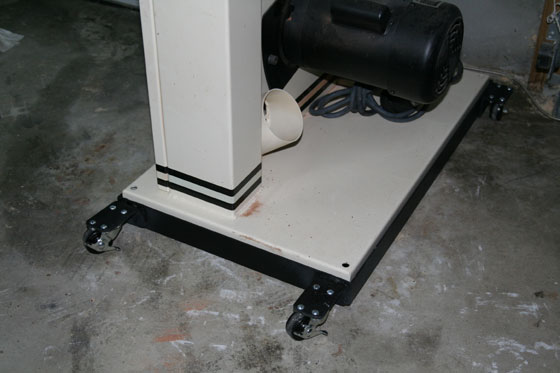
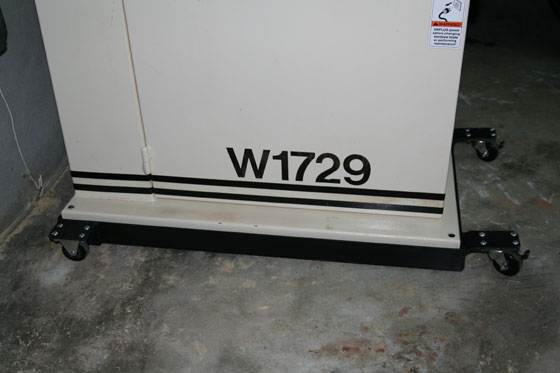
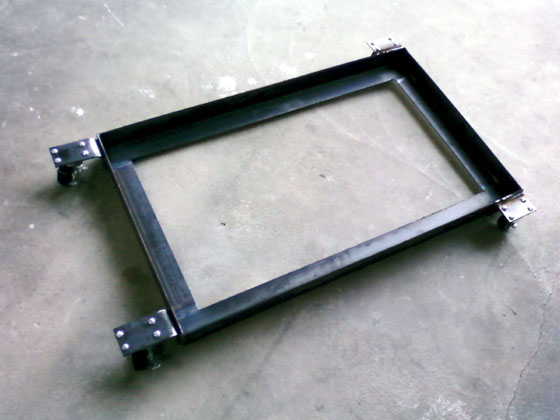
I don’t know if this is a particularly good saw; it’s Chinese, after all. But it seems to work fine, and it has a great capacity. And now, thanks to me, it’s PORTABLE. Can’t beat that. I think I got a better deal than I realized.
I’m really disturbed now. The table saw works. The bandsaw works. The planer sled is built. I may have to MAKE SOMETHING. I am running out of excuses. No, wait! I still need a sander! Yes…yes…a pneumatic sander! And a drill press! No, a milling machine! THEN maybe I can get crazy and make…a picture frame or something.
Oh, hey! I can make new inserts for the table saw! That would be fantastic! I’d actually be able to use my Microjig splitter!
Life is sweet.