Archive for the ‘Math Science Tech’ Category

Chickens Beware

Friday, August 26th, 2016

I Will Rule You

I’m working on my second knife. I haven’t finished my first knife, but I’m making a second one anyway, because I can save on shipping if I have two knives heat treated at once.

I’ve learned more interesting stuff. Here’s a surprise: Damascus steel is crap.

You may not know what Damascus steel is, so I’ll tell you. It’s a type of folded steel invented in Damascus, Syria. Not. No one is really sure where the name “Damascus” comes from, but it is believed it was invented in India. Probably their last major contribution to technology since perfecting the tech support line.

To make Damascus steel, you take one or more pieces of steel and heat them in a forge. Then you beat on them with a hammer and fold them over. You keep doing this until you have a whole lot of layers. If you do it 20 times, you have 2 to the 20th power layers, which is probably around a million, since it’s 1024 squared.

Damascus steel looks really cool. It looks like damask fabric, as a matter of fact. Don’t know if that’s a coincidence. Oops; I’m wrong. I Googled. The fabric I’m thinking of isn’t damask. Right now it would be helpful to have a gay man I could ask. Anyway, there is a fabric that looks like Damascus steel, and I have no idea what it is.

In any case, Damascus steel is shimmery and weird-looking.

There are lots of mythological claims about Damascus steel. People say it holds an edge like nothing else, and that it’s so flexible you can bend a sword to a ridiculous angle without breaking it. They say it’s the best steel imaginable, and if you stare at it long enough, it cures baldness. In a fight, it’s even better than boots of escaping.

Sadly, none of this is true.

As a famous knife-maker pointed out, if it were true, industry would make heavy use of Damascus instead of the actual amount of use it makes, i.e. none. It would be used for dies and drill bits and cutters. That doesn’t happen. Toolmakers use things like tool steel, which is infinitely better suited to the job.

People have the idea that Japanese swordmakers had all sorts of lost knowledge about steel, and that they used the folding technique to make incredible swords with steel far superior to European steel. In fact, the folding process was needed because Asian steel was crap. Folding distributes or removes the impurities or something.

You have to apply common sense here. We live in the age of men who created the space shuttle. We probably know a few things that were unknown to ancient people who lived on cow manure and their own children.

There are also lots of arguments about what’s “real” Damascus, but it appears pretty certain that we make it as well as the ancients did, and that no important knowledge has been lost.

I’m glad to know this stuff, because now I can write Damascus off my list of things to master. I’ve seen Youtube videos of guys making it in their garages, and I thought, “Well, if I want to make really good knives, some day I’ll have to do that.” I guess I can forget about building a forge. Damascus looks really nice, but it rusts, it’s expensive, and it’s not very good, and I would prefer to make knives that work well. I want the kitchen knives to be dishwasher-safe. I want to be a knife user, not a knife nursemaid.

I found a dude who makes a bustling living charging $1000 or more per knife, and guess what he uses. Good old 440C. He also uses other stuff, but if 440C is good enough for him–ever–then it’s good enough for me. It’s better than Damascus, and it’s certainly better than most of what you will find at Bed Bath & Beyond. And it’s not too expensive.

My second knife is yet another birds beak knife. I didn’t have a lot of steel left to work with, so it had to be something small, and I figured my second design might be better than the first. The outline is mostly done. I still have to sand off the milling marks, make the cutting edge, and drill it for Corby fasteners, which are little metal bolts that go through the scales.

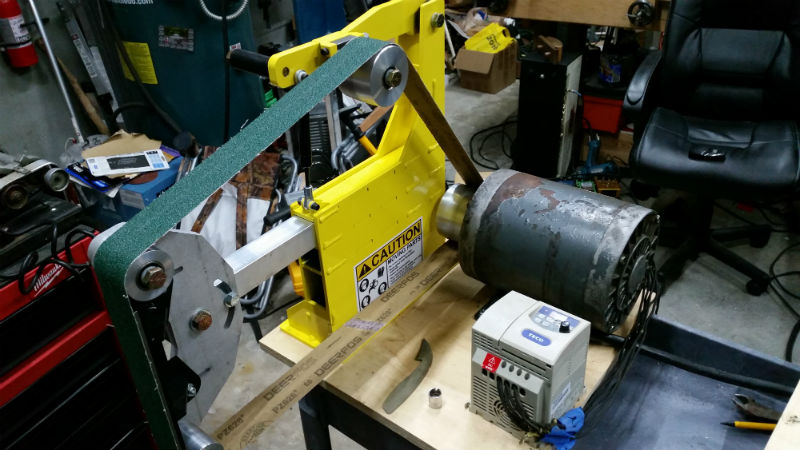
The 1×42 grinder is battling the steel remarkably well, but it probably cuts 10% as fast as a 2×72. The temptation is getting to me. In one week, I could have a 2-HP motor and VFD (already on hand) driving a grinder which would put a contour on a knife in five or ten minutes instead of one to two hours.

I can’t describe the degree to which I envy people who have surface grinders. The milling machine did a great job of removing scale from the second blade, but it left mill marks, so I still have a lot of sanding to do. A surface grinder would have knocked it out in a hurry.

Milling flat, crooked, thin steel is not easy. At least for me. It’s hard to put in a vice or mount in clamps. Properly, I mean. You can mount it in ten seconds, but getting the waves out of it is a problem. When I was done milling, I had a piece of steel that was still wavy, and the mill went to different depths on different passes, so it left me plenty of work to be done by hand.

You can clamp crooked steel down and mill it flat on top, but then when you flip it to mill the other side, it can bounce back into its crooked shape. If you manage to mill both sides flat and parallel, it may still be slightly bent when you take the clamps off. It’s annoying.

A knife doesn’t have to be laser-straight, but it should look and feel straight when you use it.

I haven’t decided whether I want to keep doing this. It’s easy and fun, but simple jobs tend to become boring with time.

In any case, I should have some really excellent kitchen knives pretty soon, and I may get ambitious and make myself a nice folder. I was even thinking I might take my Gerber Gator II apart, throw the soft 420 stainless blade out, and replace it with 440C. I like the handle.

If I feel like it, I can even etch a trademark and other stuff into blades. There’s a little inexpensive machine out there that allows you to print stencils for etching. That sure beats hammering my initials into it with lettering punches.

If this looks interesting to you, consider getting a big belt grinder. Learn from my suffering.

I’ll post a photo of the latest blade so you can say charitable things about it.

08 21 2016 birds beak knife drilled small

I Sing of Firearms and a Paperback

Thursday, August 25th, 2016

PULL!

I am still plugging away at The Aeneid. It’s like having a disease that goes into remission and comes back, over and over. It’s the herpes of literature.

I am around 60% of the way through it. I started the Mandelbaum translation over at the beginning because the Mackail translation I bought by mistake was so bad.

The boredom is crushing. Yesterday Virgil pulled one of the classics-author moves I hate the worst: he listed everyone who was going into a battle.

Do we really need this information? Do we really need to know that Warrior Queen Frisbee marched to war accompanied by columns of short-haired women who secretly dreamed of being police officers? Do we really need to know that King Phlebitis of Hydrangea wore the lionskin his grandfather Uvulus stole from the lair of Buttafuocus the Thracian Balrog? No, we do not. Not all details are essential, and that goes double when you’re making it all up.

Virgil is an astoundingly bad writer, and I don’t give him a pass. Sure, he lived a long time ago, but he didn’t invent writing. He had read works by other people. He had heard people tell stories orally. He knew what boredom and clumsy pacing were. He had Homer to learn from. He could have avoided Homer’s mistakes, but he decided to repeat them.

A week or so ago, I was inclined to forgive Virgil and look for the good in his work, but now I just want to smack him.

How do classics scholars stand their lives? I guess it’s not that bad once you’ve read everything in the catalog. It’s not like new classics are popping up every month.

I can understand why people became classics scholars decades ago. They were afraid of Vietnam and Korea. They had to stay in school in order to keep their draft deferments, and not everyone is smart enough or talented enough to get into something like engineering or music. If the alternative to reading Virgil were running around the jungle dodging bouncing Bettys and punji sticks, I guess Virgil would look pretty good. But how can people force themselves to study this stuff when the alternative is…a normal life doing something relatively interesting?

At the moment, Aeneas is about to go to war with the Italians. His ridiculous, childish gods are behind it. Zeus wants to help him, but Zeus doesn’t wear the pants on Olympus. His wife Juno is doing her best to get Aeneas killed. She has stirred the Italians up against him, hoping they’ll take him for a ride and fit him with a cement toga. She wants him whacked.

What is the point in worshiping these idiots if they’re just going to make you more miserable? It’s a complete ripoff. You can’t make them happy. If one of them likes you, the others hate you. They need family therapy, but they’re working their issues out on the Greeks instead.

Let’s give the real God his due; if he’s on your side, everyone in heaven is on your side. He doesn’t have a crazy wife who runs around behind his back, messing with the people he loves. Come to think of it, that sounds a lot like Satan. The devil is basically the Glenn Close character from Fatal Attraction, played by Liberace.

Shakespeare said hell had no fury like a woman scorned. He was wrong. That’s exactly the kind of fury it has. If Satan were a human woman, he’d be vandalizing our cars and calling us at work a hundred times a day. His apartment would be full of group photos with God’s face torn out of them.

No one is crazier or more tenacious than a jilted woman. They never show mercy, and they have no shame. It doesn’t bother them that their campaigns of vengeance make them socially radioactive and ridiculous.

I’m surprised a woman didn’t invent the suicide vest.

Aeneas doesn’t need Jupiter to help him conquer Rome. He needs Jupiter to slap his wife down. She’s a walking reality series. She should be tied to a rock with Prometheus, wearing an orange jumpsuit.

Okay. I feel a little better now.

I have Ovid on deck, and my copy of The Inferno is also ready when I need it. I don’t know what these books are like, but if they’re more entertaining than the phone book, they’ll be a big move up from Virgil.

No wonder I didn’t finish this stuff when I was in college. I forgive myself. I wonder if the serious students actually read this junk. Barack Obama and George Stephanopoulos were major grubs at Columbia; they were both in my class. I wonder if they read these books.

Maybe Obama read the books, and that’s the reason no one remembers him. He was in either the library or a padded room.

I think I may become the only person in history to complete the reading. I’ll bet the professors only read the Cliff’s Notes. Who would know the difference?

It’s too bad I didn’t realize the liberal arts weren’t for me. I thought high verbal test scores and some writing talent meant I had to take literature and writing courses. That was stupid.

I guess I did realize it, because I became a biology major the year before the deans and I agreed it was best I take a year off. But my family was driving me insane, and I had no study ethic to begin with, so that effort crashed and burned. Oh, well. It would have been nice to get into something I actually liked.

This experience is like the two years I spent learning salsa. I felt like a social failure because I hated to dance, so I took lessons, went to clubs, and even wrote extensive instructions. When it was over, I still didn’t care for dancing. I’m glad I’ll never have to do it again. I’m spending months reading the classics, and when I’m done, I will have conclusive proof that the classics are not my cup of nectar.

Maybe the brush I paint with is too broad; I don’t hate all old books. I like Voltaire, Rabelais, Shakespeare, Racine, Francois Villon, Marot, Moliere…it’s mainly the Greeks and Romans that make me want to carve an escape hatch into my skin from the inside.

I don’t like Dickens much. Windy. As I understand it, at least some of his works were published piecemeal in newspapers, so he had ample motivation to prolong them. Also, his work is depressing.

When I get done with Virgil, I may throw a party. Now that I think about it, it may take me so long that when I finish, Carnaval will be underway in Brazil. I could just hop on a plane. I wonder where I can get a giant papier-mache head around here.

Do not read Virgil. Okay, that was over the top. Read it once and then put it in your attic. It’s not entertaining. It’s not illuminating. You will not enjoy it. Get it done and move on.

I’m going to go take some Advil now.

Good Morning, Heaving Pukes

Thursday, August 11th, 2016

I Miss Newspapers

I really have to quit checking the news as soon as I wake up.

Today I awoke and checked Drudge. I found a link to a story containing another link to a 2015 Milo Yiannopoulous story (I don’t even care if I spelled that right) about the destruction of the Nick Denton online empire. I went through a typical daisy chain of links, from one story to the next. By the time it was over, I felt sick to my stomach.

I’m not one of those people who say they feel sick to their stomachs when they really don’t. I mean I felt physical nausea.

Nick Denton created a site called Fleshbot. It was a porn site. I have certainly looked at porn, but I don’t know much about Fleshbot, except that it was very successful. Porn dealers are like drug dealers; their audiences can’t control themselves, so they keep showing up. It’s not hard to get rich selling something people can’t turn down.

Denton went on to create a bunch of oddly named sites that did well: Gizmodo, Gawker, Jezebel, Jalopnik, and Wonkette (possibly the most famous fake blog in history) are among them.

I’m not positive Fleshbot came first. You can check.

Anyway, the Denton conglomerate was (and is) a very sleazy operation. It exudes slime.

As everyone knows, Hulk Hogan killed the Nick Denton cancer. Hogan was videotaped committing adultery, and Gawker either published or linked to the video. Gay billionaire Peter Thiel, who had been outed by Denton, backed a lawsuit. Hogan won, and Denton was handed a fatal multimillion-dollar judgment, which is being enforced.

I’m going to check this time…I was right…YIANNOPOULOS made a list of people who should also sue Denton. It’s quite impressive.

Denton’s crew published a story about a man named Geithner–not a public figure, according to…Mr. Y….and suggested he hired a gay prostitute. They accused actor James Franco of raping a man. They helped leak a Quentin Tarantino script before the movie was produced. They published a lot of nude celebrity photos obtained from criminals. They published voyeur photos of the genitals of male athletes, without the consent of the athletes. Imagine how their wives and kids must feel.

The Internet tends to make people feel invincible, and it brings out their cruelty and arrogance. Denton’s lackeys developed a pattern of tormenting people online, for amusement as well as money, and as far as I know, the Denton apparatus has never expressed significant regret or a serious inclination to examine itself and make corrections.

The Yiannopoulos story appeared on the Breitbart site (Breitbart, himself, was no paragon of dignity or kindness), and the Breitbart site contains links to disturbing social media posts. It’s also full of poisonous comments from people on both sides of the political spectrum. I kept clicking, and I ended up reading a Slate story which was so mean-spirited I decided it should be my final destination for the morning.

The Slate article’s title: “The Heaving Pukes Who Write Gawker and Wonkette.”

This is public discourse in 2016. Slate is not a Blogspot site written by a tipsy anonymous accountant who likes to knock a few back after a ten-hour workday. It’s not a tabloid site. It’s the 2016 equivalent of a 1985 magazine you might have found in supermarkets.

“Heaving Pukes.”

The amazing conclusion I drew from my few minutes of websurfing was that I had underestimated the vileness of the Internet.

That makes sense, when I think about it. The godless leftist side of the Internet, which makes up maybe 80% of the bandwidth these days, is much more vile than the rest of the web. I have never been inclined to spend time on leftist sites. Even when I was behaving badly myself, I was put off by the astounding obscenity and cruelty of the leftist Internet. That means I didn’t get a representative sample of the Internet’s content. As bad as my experience was, it was filtered.

Many people have spent more time reading godless garbage than I have, and a lot of them don’t mind it. They don’t mind when a lesbian crazy threatens to sexually mutilate a conservative writer with her teeth. It doesn’t bother them when someone threatens to have sex with another person’s dead skull. Cruelty and filth bring them pleasure. They titter and smirk.

That’s what America is good at these days; tittering and smirking. We are losing our manufacturing capacity, but we have the Internet, The Family Guy, South Park, Deadpool, and The Hangover.

Man, this place is sick. And of course, I used to contribute to the sickness. I sowed; now I’m reaping.

People need to step back and think about what they’re making of themselves. This is not going to end well. And even if there were no lawsuits or other worldly repercussions to think about, what about the inward cost? What about the penalty of simply being the kind of person who swims gladly in a world of vomit?

To Shakespeare, the worst price a villain paid was to be a villain. People don’t understand that concept. Do you really want to wake up at the age of 60, hung over, in a bed that smells like cigarette ashes, with no real friends and nothing to show for yourself except herpes and a monument built from congealed bile? That’s the future for Internet denizens who love hate.

Unless you’re mentally ill–maybe even then–you can’t hate other people habitually without coming to hate yourself. Hate is a habit that operates without your conscious consent, and when you don’t give it a target, it will find one for itself. When you’re not ideating about cruelty to others, you will find yourself inwardly contemning and ridiculing the creature you have made of yourself.

You will be right.

America is like a hate slingshot. With the help of the Internet, we have been building up hate energy. We have been embracing, approving, and feeding our cruelty. We have outed ourselves as cruel, the way gays out themselves as gay, and like gays, we’re proud of what we are. We are pulling the slingshot pouch back. One day we’re going to release it without the buffers of keyboards and monitors. We will act directly, with our hands and feet, not just our words. We are being turned into the kind of people who can put other people in gulags and death camps.

Where do you turn when the world rains burning sulfur? Earth didn’t come with an escape pod. There is no natural shelter. When America turns into a killing field, there will be no other America to flee to. This was the last refuge. You better give yourself to God and find his protection while you still can. You’re not going to develop that kind of relationship with him overnight. It’s time to get started. It may be too late to get everything you need.

I feel like turning the Internet off and going to live in a hole, but the hate culture has penetrated TV and daily life, so it wouldn’t protect me completely. Increasingly, the world is an extension of the Internet. What do you see when you turn on the news now? Tweets, Facebook posts, and Internet videos. You might as well plug into the Matrix and stop eating solid food.

America is not going to change for the better, but you are not America. You can take measures that will affect yourself and your family. I plan to keep moving forward. What’s behind me is not worth the trouble of turning around.

One Bad Turn Deserves Another

Sunday, August 7th, 2016

Parts is not Parts

The lathe is still driving me nuts. Actually, I think Fusion 360 is the culprit.

I took a 7×14 mini-lathe and turned it into a CNC machine. It should be possible to cut parts to within maybe three thousandths of spec on this thing. So far, that has not worked out.

I had problems adjusting the steps-per-inch figures on the screws. I more or less got past that. Then I had problems with backlash compensation. Now the screws work reasonably well, but I am having lots of trouble turning ideas into parts. CAD and CAM are holding me back.

If I had a mill, I’d be sitting pretty. There a bazillion CNC mill jockeys out there, and the people who make software bend over backward to help them. I would have lots of resources to call on. Because I have a lathe, everyone is pretty much hoping I will go away and die.

Perhaps I exaggerate.

Anyway, as I’ve said before, CNC lathes are not that common, and it’s hard to get help.

I can draw stuff in Fusion 360 CAD. It’s a non-intuitive, somewhat annoying program, but as CAD goes, it’s a breeze. I can also create tool paths and G code using Fusion 360 CAM. What I can’t do is get the x-axis to work right.

No matter what I do, the CAM program decides to move all the x stuff toward me by about a third of an inch. Here’s the result: if I design a cylinder 1″ in diameter, and I try to make it from a 1.25″ piece of stock, the cutting tool won’t even touch it. It will move back and forth maybe 1.30″ from the lathe’s axis, doing nothing.

Here’s something weirder: the x issue doesn’t pop up when I’m facing. The word “facing” refers to putting a flat surface on the right end of a part. To face a part, you have to push the tool halfway across it. If you’re facing inward, as I am, you have to start at the outside and push the tool all the way to the center. My lathe does that, and it’s an x-axis process. When it tries to reduce the diameter of a part–also an x thing–it misses the part completely.

The x-axis works for some things, and it’s useless for others.

People are telling me it’s because I have Mach3 set up for radius measurements and Fusion 360 set up for diameter measurements, but that’s wrong, because compensating for that when I start the lathe doesn’t help, and anyway, it wouldn’t explain why facing works perfectly.

I accomplished quite a bit today, even though I’m still not able to make Fusion 360 turn out parts. I learned a lot, and I managed to enter specs for my cutting tool into the program. One measurement is off by a few degrees, but it looks like it’s the best I can do in this program, and it will probably never make a difference, since the very tip of the tool is the only thing that touches the work. Turning the tool insert 3 degrees in the xy-plane amounts to nearly nothing.

I will keep poking people until they give me answers. If necessary, I will just annoy them until they do the work themselves to make me go away.

The big lesson, which is really being driven home now, is that smart people do not build CNC lathes. You buy a commercial CNC lathe, you buy a mill, or you build a mill. Listen and avoid my pain.

Tony Stark is an Amateur

Friday, August 5th, 2016

Behold my Creation

Yesterday was a big day, tool-wise. I used CAD to design a part, and I managed to make my CNC lathe cut something using the design.

Notice I did not say I got a proper part; just that I got the lathe to use the design I made.

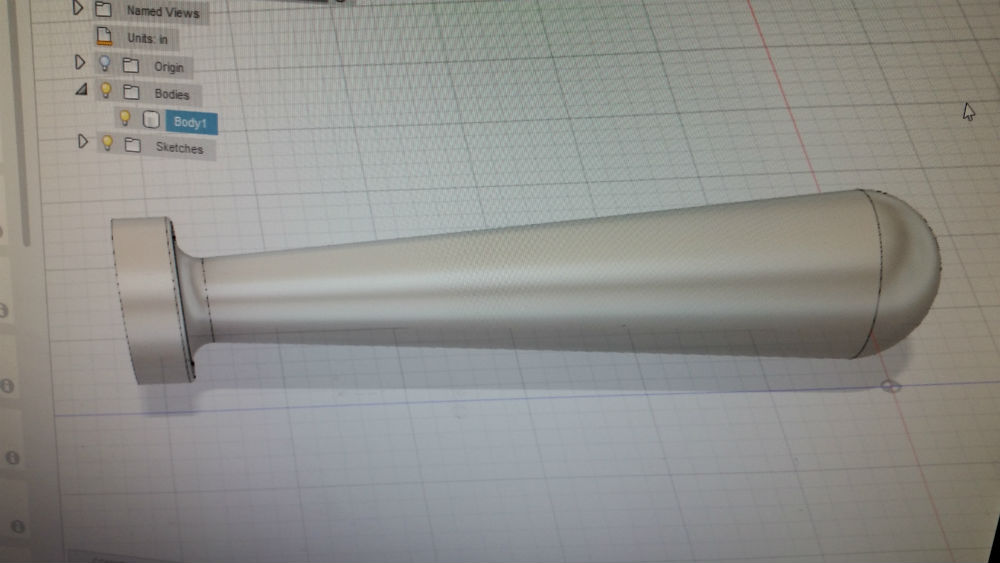
Here is the design; I’m not sure why I used a cell phone instead of a screen grab, but anyway:

08 05 16 first CNC design attempted on lathe in Delrin - fusion 360 screen web

That’s a tool handle. I don’t need a tool handle, but I figured it was the sort of thing I might want to make in the future, so I designed one.

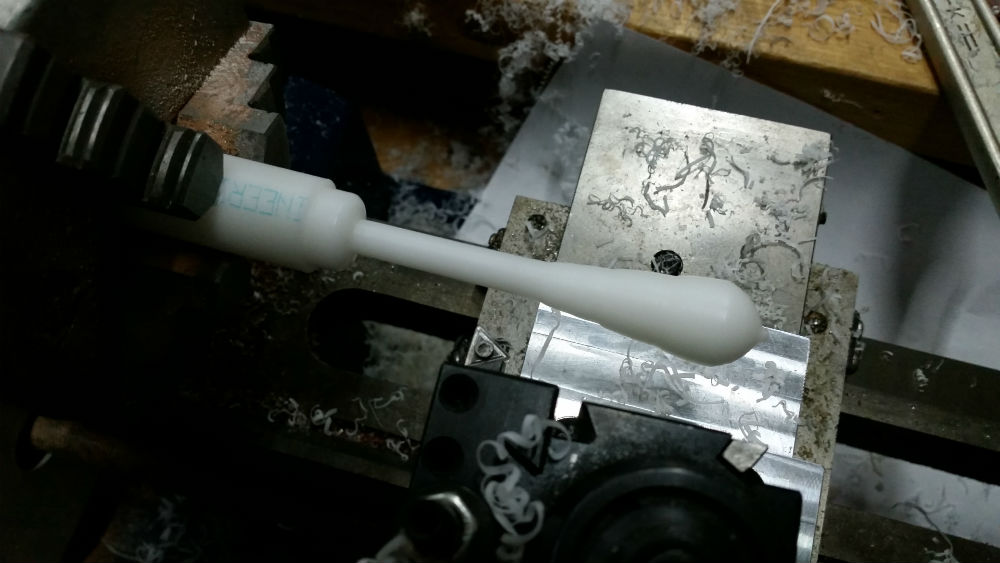
Here is the part I actually cut:

08 05 16 first CNC design attempted on lathe in Delrin - actual part web

As you can see, it’s a wee bit off.

Here is how CNC works, at least in my mind. You draw a part in a CAD program. You open the file in a CAM (computer-aided manufacturing) program, and it tells the computer how to write a Gcode file that goes to your controller. The controller–in my case a board–tells the machine motors what to do.

Essentially, the CAM program turns a picture into a path a tool follows as it cuts.

Last night, I learned that it gets even more annoying. I use Fusion 360, Autodesk’s free CAD/CAM program. In Fusion 360, you have to create something called a “setup” before you make your Gcode, and you also have to come up with a file called a “post processor.” I found this definition online: “The software that converts CL-file CAD/CAM data to specific machine tool commands is called a Post Processor.>

I don’t know what “CL” means, but I’ll let that pass.

The post processor communicates with the machine control program, which is the software that tells the control hardware what to do.

I guess this is not easy to follow. I’ll make a list.

1. CAD file
2. Setup
3. Post processor
4. CAM program ==> Gcode file
5. Control program
6. Controller
7. Motor amplifier
8. Machine motors

I think that’s about right.

Numbers 6 and 7 are pieces of hardware. My controller is a KFlop board, and my amplifier is a KStep board. The amplifier takes control signals from the controller and turns them into current that drives the motors.

LinuxCNC and Mach3 are control programs.

It’s a mess, isn’t it?

Fusion 360, like just about everything else in the CNC world, does not like lathes. At least it doesn’t like hobby lathes put together in garages. As a result, the creators made no effort–none–to make it work with Mach3’s turning software. That means it lacks a Mach3 lathe post processor file. I had to go dig one up. Other people had the same problem, predictably, so they came up with files that seemed to work. “Seemed.”

Installing a new post processor file in Fusion 360 is not fun. The program hides the location of its processor files. The trick is to open an existing file in Fusion 360’s editor, and it will display the path to all of the post processor files. Then you can move your file to that folder manually. Which I did.

There were problems.

First of all, the setup utility in Fusion 360 is not easy to work with. You have to set it for turning, and then you have to describe the uncut stock to it. You have to program a coordinate system into it, so it doesn’t run backward. You have to describe the tool you’re using. All the while, Fusion 360 will try to reset things after you’ve set them yourself. I have to get some help with that.

It uses language I don’t understand. I know about things like clearance and depth of cut, but Fusion 360 gets into “overlap” and “smoothing” and so on. It defines terms for you…sometimes. The way you bring up the definitions is to hover over stuff you don’t understand. If you’re lucky, an explanatory popup appears. But sometimes you’re not lucky.

I did the best I could, and I sent the Gcode to Mach3. I had three major issues.

First, the x-coordinates don’t work. I kept telling the machinery where the tip of the lathe was supposed to start, but it kept deciding the +x side of the work was an inch closer to me than it really was. This meant that if I ran the program on a 3/4″ piece of Delrin, it missed the work entirely.

I wanted to see something happen, even if it was wrong, so I lied to the machine about the x location, and my lying wild guess was about 0.100″ off. As a result, the part is a lot skinnier than it should be. Not a catastrophe. I’m happy it exists at all.

Second, the cuts are way too deep. In Delrin, which is plastic, a mini-lathe can do a 0.100″ cut without crashing. Try that in steel. No way.

Third, the Gcode crashed my controller. I think it died when it hit a G0 command. I looked G0 up, and all I found was “rapid positioning.” Whatever it means, the lathe stopped moving, and the control board locked up and had to be restarted. The part was not finished.

Now I have to know: did the code kill the controller, and if so, is it a controller problem or a Mach3 problem? If it’s a controller problem, then the post processor I found is no good, and I have to find out how to fix it. I already know Mach3 and the controller get along. So basically, I need to go to MIT for three or four years and then come back and solve the problem.

I’m happy, regardless. I designed something. I turned it into a part. That’s progress.

Life is not all peaches and honey, however. I got some news about my sister. She left a homeless shelter at some point this year, and no one knows where she is. Yesterday a letter arrived, at an address she left long ago. Someone showed it to me. I can’t say what it was about, but it was bad news for her financially and in other ways. It will catch up with her eventually.

I used to be concerned because she had been disinherited. I used to pray for her inheritance to be restored. Now I know that was not a good idea, and I understand why God didn’t agree with my prayers.

It made me think, and it helped me understand some general truths about wealth.

I’m not sure people think clearly when they make their wills. They work hard all their lives, and they store up wealth that can be a tremendous help to their descendants. What happens when you leave that kind of gift to a person who has immense debt, or who spends profusely? It’s as if you put it in a pile and set fire to it. It vanishes.

Think about it. What if you have two kids; one has zero debt, and the other owes someone $500,000? Say you leave $250,000 to each kid; what happens? Immediately, half of your wealth is gone. It’s as if you never had it. The creditor takes it, and then the broke kid goes to the other kid and tries to get the rest of it, bit by bit.

If you have more than one child, and you cut off the children who have debt, their creditors can’t do a thing. You never owed them, and neither did the other children. The wealth is insulated from attack. It’s common sense, but people don’t seem to think about it. They leave money to children who are essentially bags with no bottoms. It goes right through them and into the hands of other people.

People sometimes favor their irresponsible children, saying they “need” the money. That’s like saying Charlie Sheen needs more coke. If you want to be Santa Claus, give money to people who have nothing. If you want to conserve wealth and bless your kids, give it to people who look after what they have.

Children who have debts feel they’re more entitled to inherit. That’s just denial.

The conviction that you have to give handouts to people indiscriminately is also denial. It can make their problems worse and add to yours, especially if the people you give money to are abusers you used to pray to be freed from. It’s like inviting a vampire into your house.

It’s a bad idea to grab a tar baby once you’ve gotten loose. You’re asking for whatever misery ensues. Who will you blame? Will you go to God and ask him to free you again?

Some people have to keep repeating mistakes, and often, helping them is so costly, it doesn’t make sense. It’s not even help. It’s even worse when the people you try to help are folks who spend their time insulting you, lying to others about you, and scheming to take things from you. Generosity and compassion are extremely important, but you have to be very careful. You wouldn’t want to lend the bum on the corner money for bolt-cutters to rob your house.

I remember a time when I considered marrying someone who had debt. I didn’t know about the debt; I didn’t ask. Love conquers all! Thinking about money is tasteless and coarse!

That was stupid. Man, I was an idiot. I should have asked. If you marry someone who is debt-free, the cost of the wedding and honeymoon is your only immediate expense. If you marry someone who owes $100,000, you are immediately on the hook for the marriage, the honeymoon, and…$100,000. No one with any sense would spend a hundred grand on a wedding, but people do it every day without knowing it.

Instant cost of marrying debt-free spouse: $5000, if you’re sane. Okay, I didn’t include the ring.

Instant cost of marrying big spender: $105,000.

No.

Also, the debt a wastrel has at the time of marriage is just the beginning. It’s a tiny tumor that hasn’t blossomed yet. It will get much bigger eventually. No irresponsible woman ever decided that marriage was her cue to stop spending.

Marriage isn’t about money, but debt is slavery. It’s hell. Marry a slave; become a slave.

Jesus said those who had a lot would receive more, while those who had little would lose what they had. It’s true. People build or destroy, in every area of their lives.

I’m grateful for the people I can help. The rest just make me shake my head. I certainly hope I can be helped.

Blessings only go to people who can be blessed.

The Bible talks a lot about the fatherless. That’s me. You can have a father and be fatherless. If no one passes wisdom on to you when you’re young, you are fatherless. It’s disgraceful to be my age and to be surprised by wisdom other people accept at the age of ten.

God is a good father. He doesn’t just give you stuff you crave; that’s what pimps do to hookers. He teaches you. He improves you. He changes you so you have productive habits and thoughts. I wish I had known him decades ago, but, of course, fatherless people don’t have the wisdom to understand that they’re fatherless. I wasn’t interested.

I hope I still have enough time left to benefit from the things God shows me. If not, at least I get to relate them to younger people.

More Reasons to go Back in Time and Beat my Younger Self

Sunday, July 31st, 2016

The Golden Screw

I am still working on my CNC mini-lathe.

It seems that one of my big problems was misunderstanding the purpose of CNC. I thought of CNC as something intended to allow machinists to cut shapes which are difficult or impossible in manual machining. There is some truth to that, but CNC is also intended to save time.

Back when I was working on a kibbutz in 1984, I stupidly chose to be a grapefruit picker. The kibbutz had a CNC factory, and I could have learned a lot there. One of the volunteers said there was a machine they called “the golden screw.” You put a piece of brass in, and shortly thereafter, you pulled out a finished part with threads on it. A hungover teenager from Germany could do it. Machinists were not required.

I suppose it illustrates the deep purpose of CNC: to avoid paying any more for labor (or anything else) than absolutely necessary. Paying a skilled machinist a high wage for performing lots of operations on a brass part could raise the retail price to a hundred dollars or more. Paying a kid virtually nothing to shove parts into a machine and take them out is cheaper. And the faster the machine works, the cheaper it will be.

Earlier this year, when I started trying to get my lathe to work, I was confused because it seemed my references had a strange obsession with speed. There was a lot of information about making the lathe zip around like the Flash looking for an outhouse after a pie-eating contest. I thought it was bizarre that a person who made parts in his garage would care that much about speed. Of course, I failed to consider the fact that most CNC users are not in garages. They’re trying to make money.

If you have a $100,000 CNC lathe, I’m sure speed is no problem. It should be made to take it. But if you convert a manual machine, things are different. The machine has a limited tolerance for jerking and accelerating.

I had problems with the lathe skipping steps, sua sponte, in Gcode programs. I learned that it somehow decided to omit steps it couldn’t handle. Also, the couplers that turn the screws rely on friction, so if you make the motion too snappy, they can spin without turning the screws.

Last night I was working on getting my x-axis steps-per-inch and backlash figures right. I tried to cut a rounded end on a piece of Delrin. The lathe wandered off and crashed into the work. It skipped the steps that pulled it back from the work, so it kept moving forward.

The reason for this was that I had raised the motor’s velocity. The lathe decided to skip certain steps. When I lowered the velocity, everything worked.

Now it appears that I can machine things to within a few thousandths of spec, which is an improvement. The lathe works well enough to make parts, and that means it works well enough to be used as a teaching tool. So I have to have new goals.

First of all, I have to get on top of CAD and CAM. Mach3, the program that runs the lathe, offers prefab wizards for simple operations, but you can’t type in “door knob” and get a part. If you want to make anything more unusual than a screw, you have to draw it in CAD and send it to the lathe.

I am capable of drawing parts in Fusion360, Autodesk’s incredible free program. Now I have to find out how to get those parts to my contoller.

I also need to learn about tool placement. When you turn on a CNC lathe, the tool has to know exactly where it is, and that’s not as simple as it may sound to a person who isn’t a machinist. Locating something to within a thousandth of an inch is a job. If you have to use more than one tool on a part, you have to locate more than one tool.

Some people make revolving tool holders. You can put a right-hand tool in one mount and a threading tool in another, and you can program the controller to rotate the appropriate tool into place at the correct time. It won’t work unless you know where the tips of the tools are.

I don’t need a rotating tool holder; I should be able to get by with a turret or quick change tool post. But even then, I’ll need to be able to index everything accurately and tell the lathe where the tips will be.

By “index,” I mean there will have to be something on the lathe that forces the tool holder to fit perfectly into a preset position. Whatever this reference object is, the tool holder will “index” against it.

I don’t think a motorized tool holder makes sense for me. It will cost much more time than it will save. I’m not in a hurry, so I don’t mind programming pauses into my programs that will allow me to change tools manually.

I’m closer to getting the threading problem fixed. If I had known that my KFlop controller required two inputs for threading, I would have bought something else, because Mach3 likes one input. I have the KFlop, so I have to make it work.

I’ve had problems trying to find optical switches for it. I will need to mount a disk on the spindle with a slot in it, and I’ll need two slotted switches mounted at 90 degrees to each other. I kept trying to find a switch that would provide the KFlop with the required 3.3-5V input. I looked at datasheets, and I couldn’t understand why they didn’t list output voltage.

Of course, I was looking for a figure that doesn’t exist. I was looking at switches, and switches put out whatever voltage you feed into them. If you buy a rocker switch, the literature will list a maximum voltage, but beyond that, V-in equals V-out, so the datasheet won’t give you an output voltage.

I figured this out after asking some questions on a forum. It should have been obvious. The problem is that I had preconceived notions about transistors. Optical switches use transistors to provide output, and I am used to thinking of transistors as voltage amplifiers with a gain higher than 1, so I just assumed the switches made their own decisions about output voltage.

After all this is done, I’m going to want ball screws. The screws I have now are just too aggravating to work with. I keep trying to pin down the correct figure for steps per inch, but it’s elusive, and I think the screws are the reason. A setting that works fine in one trial will be slightly off the next time.

You would think you could rely on simple math, starting with the pitch of the screws, but I got bad results that way.

I am told I need fat screws, because they work better than skinny ones. I keep checking Ebay. It looks like it’s going to be a minimum of $150, all told. But it beats chasing numbers I will never catch with ordinary screws.

The lathe is not going to be the answer to my turning prayers. It will be wonderful for threading and for turning shapes that aren’t plain old combinations of cylinders, but it won’t be a milling machine. It seems like a milling machine would have been way more useful.

I suspect that even threading would be easy on a mill. You could make a threading cutter and make it go around a vertical workpiece, or you could put the workpiece in the spindle and run it past a stationary cutter. Maybe. I know they make CNC rotary tables for mills, so you should be able to mount workpieces in them and rotate the work that way. Anyway, the lathe is not looking like the optimal choice.

Oh boy. I was right. I just found a video.

Who wants to buy a lathe?

I exaggerate, but you can see what I’m saying.

Regardless of whether it makes sense, I will get this thing working. Maybe some day I’ll be able to make a little CNC milling attachment to go on the carriage, allowing me to mill things as big as 2″ by 2″. Hooray.

The C programming is going fine, although I had a strange problem. I wrote a program and got it working. Then I modified it, and it refused to change. It compiled fine, but it continued to do what it did before I modified it. Deleting the executable file didn’t help. I can’t figure that out.

I changed the source file name and compiled it, and it works. I can modify it.

It’s like the executable for the program that won’t change is stuck in my computer somewhere, refusing to leave.

If I produce anything useful, you can bet you will hear about it here.

Welcome to the Age of Virgin-Shaming

Wednesday, July 27th, 2016

Your Body; the Left’s Choice

I knew better, but I clicked on a link to The Washington Post. I have only myself to blame. The headline I clicked said, “As a young evangelical, I believed a bestselling book that warned me to stay ‘pure’ until marriage. I still have a stain on my heart.”

Weird way to write a headline.

You really have to see the core “argument,” in order to believe it:

Purity culture taught me that I ought to be passed down from father to husband, more an inheritance than a human. I was taught that men are my cover and my shield, when for the most part they have been the ones causing damage through molestation, rape, and abuse. I was taught that my holy calling was to open my legs for one and only one and bear him children. Barring that, I was to keep them closed and never express desire or lust or fear or longing. So many women in my life cracked under the untenable pressure, often giving up on God all together. Others were forced into marriages with men who hit them and hid their abuse behind another message of the church borne from purity culture, that God hates divorce.

Are you kidding me?

This isn’t a Christian led by the Holy Spirit. She’s probably not a Christian at all. It reminds me of the famous Internet comment lead-in: “As a lifelong Republican,” which means, “As an extreme leftist who posts comments, pretending to be conservative.”

Maybe there is a church out there somewhere that teaches women they are their fathers’ possessions. I have never heard that doctrine. I’m pretty sure it disappeared during the Renaissance.

The line about women “forced” into marriage is classic victimhood spiel. Who “forces” women into marriage in 2016? I mean, not including Muslims? This isn’t the Middle Ages. Christian parents are some of the most passive people on earth. A typical evangelical would rather walk off a pier than “judge” his daughter or tell her whom to marry. The “judge not” crowd has us penned into a dark corner, like Moonies at an airport. The devil talked us into unilateral disarmament.

Is it possible that there are non-Christian women who slept around a lot and still ended up in abusive marriages? Just maybe. Call me crazy, but I believe that. Or maybe Mike Tyson was a virgin when he got hitched.

Suddenly, purity is human trafficking. Fathers and husbands of pure brides are pimps. Insane. We have entered the age of virgin-shaming.

But it’s not surprising, from a woman who clearly feels hostility toward men (not the typical evangelical attitude). She says, “I was taught that men are my cover and my shield, when for the most part they have been the ones causing damage through molestation, rape, and abuse.” Did Rachel Maddow write this?

It’s a remarkable thing. Suddenly promiscuity is wise, and purity is perilous and foolish. If you can believe things like that, there is probably no lie you can’t swallow.

If you aren’t baptized with the Holy Spirit, you can be persuaded to believe things that go against doctrine and your upbringing. You have weak walls. This is why Jesus told the disciples not to do anything until he gave them power.

I looked at the comments, expecting to gag, but even the Post’s readers were not completely on the side of sleaze. That surprised me.

I keep getting these not-at-all subtle reminders: “America’s goose is cooked. Stop thinking about fixing it.” I have stopped. I will not resume. It’s like the feeling you get when you realize God wants you to stop trying to reform someone who has already decided not to listen. Often it’s okay to let people destroy themselves. God does it every day.

You’re not really letting them destroy themselves; you’re just acknowledging that you can’t help them.

I got some interesting comments about The Aeneid, which is now high on my list of least-favorite books. One commenter pointed out that it’s actually a poem, and that prose translations suck the life out of it. Another person said I should consider a different translation.

These comments make sense. Imagine reading The Rime of the Ancient Mariner in prose form. Not something I would look forward to. It would be a terrible book. You would have to change everything about it to make it digestible.

The translation I quoted in an earlier post keeps rhythm and rhyme in the poem (I am assuming the original rhymed so I don’t have to look up the Latin). It’s considerably more palatable than the version I’m reading. It’s broken up into short lines, which makes it less imposing. My translation is just a wall of letters.

I wanted to use the translations Columbia College used, so that’s what I bought. I’m sure they have a good reason for subjecting students to the version I have. Just like they have a good reason for coed showers.

My new strategy is to use my phone to read the book. The screen is small, so it breaks the prose up into little pieces that cause less pain going down. But maybe a different translation is the way to go. I’m not going to remember this stuff anyway, so it shouldn’t matter much. I just have to convince myself I’m not cheating.

Sooner or later, I have to tackle Don Quixote, which weighs a good pound and a half in paperback. Maybe I should give it a pass. I had to read it for another course at Columbia. There was a strange old guy who was held out to be a great genius, and his Don Quixote course was a Columbia College staple. I failed to perceive any signs of genius–I thought he was boring and barely coherent–but then you don’t have to be Marilyn vos Savant to do well in the Liberal Arts. You just have to memorize well and pretend you agree with your warped leftist teachers.

Maybe he was a different person if you dealt with him one on one, but everyone I knew thought he was an empty suit. Nice guy, I think. Smiled a lot. A LOT. It was a little strange.

He kept calling Don Quixote “the quicksut.” No idea what that was all about.

I may get yammered at for this, but it seems like Spanish-language literature is not on the same level as literature in English, French, German, whatever language the Scandinavians write in, and Russian. There goes my diversity merit badge.

Spain-boosters always cry, “Cervantes!”, when you say this. I don’t think Cervantes was all that good; Rabelais did the same kind of thing with much more skill and erudition. If you skip forward a few centuries, you run into Borges and Gabriel Garcia Marquez. I like Borges okay, but I thought Four Hundred Years of Solitude was windy, coarse, and pointless. The world is bad. Babies get eaten by ants. Okay; what are you trying to get at?

It may be that Spanish-speaking authors get an automatic push to the front of the line, like black directors. Okay, I apologize. Spike Lee really is a genius. The only reason his stuff goes straight to DVD is that the general public is too unsophisticated to appreciate Oldboy.

I didn’t know that movie existed until thirty seconds ago. It does exist, right?

If Spanish literature were really good, you would see a wall of translations when you walked into Barnes & Noble in America, just as people surely see walls of translations when they walk into bookstores in Spain. If it’s good, it will be translated. Publishers like money. They like new markets for old merchandise.

Maybe Spanish literature is to French literature as Spanish brandy is to cognac. As everyone knows, the French have accomplished huge things in literature, as well as math and science. I’m sitting here trying, and I can’t think of a theorem, law, or principle named after a Spaniard. France, though…Poisson, Cauchy, Descartes, Pascal, Ampere, d’Alembert, Lagrange…and they invented the bidet. Maybe.

I guess the Spanish had other things on their minds.

Spanish brandy is really bad, by the way. I got fooled into buying it once. It was said to be the equal of French XO, at a fraction of the price. Don’t you believe it. I bought something called Le Panto, and it tasted like it had been made from cooking wine that had been left outdoors in troughs for a month. I did not finish the bottle. I’ve also tried Gran Duque D’Alba, which is like a cheap domestic brandy with sugar in it. I paid forty bucks for a bottle, as a gift. Never again. Now I get Korbel’s top offering, for $19. It’s excellent.

I hope Virgil is behind me soon. When this ordeal is over, I will be able to say I read the whole book, and that will put me in, I would guess, an exclusive group making up perhaps 2% of the people who took Lit. Hum.

The quicksut himself would stand up and applaud.

I Can Haz Aeneid?

Tuesday, July 26th, 2016

Reading the Classics in the Age of Instant Electronic Gratification

I managed to get free from The Symposium. What a disgusting experience; an entire book dedicated to predatory gay relationships, with a side order of specious, disappointing argument. I’m so glad I’m finished with it.

I’m now working on The Aeneid, Virgil’s book about the founding of Rome. In case you’re interested, Virgil had a last name. His full name is Publius Vergilius Maro. Sounds Italian. Maybe he wore shiny suits without vents.

“Hey! You leanin’ on my chariot?!”

I was hoping for a quick read, but according to Amazon, the book has 400 pages. It makes me wonder if I want to go on living.

I say “according to Amazon” because I don’t have a hardcopy yet. I ordered one, but I got a head start using Kindle. I’m using Kindle for PC, and it doesn’t show page numbers, so I’m not sure what’s going on. I do know this: after one 30-minute session, I’m 1/12 of the way through it.

It makes me wonder how anyone survives Columbia College. According to the syllabus, you get one week to read this book. I read faster than other people, and it will clearly take me six hours to get through it, not including side excursions to look things up. So for a real student of average ability, let’s say ten hours, all told. How are you supposed to cope with that while carrying at least three other courses?

More and more, I understand why people use Cliff’s Notes.

I do not like The Aeneid. It is extremely boring. It is very badly written. I guess that’s heresy, but we always cut the ancients more slack than we do contemporary writers. Homer was a terrible writer; he was verbose, repetitive, and totally unfamiliar with structure and pace. Plato is somewhat better; his big problem is his subject matter. Virgil is a horror.

Shakespeare was magnificent. Voltaire wrote well. Rabelais wrote well. I’m not prejudiced against all dead writers.

Unfortunately, I found a page on Columbia’s website that suggests I may have to read stuff beyond the list I already have. They provide a list of all the works known to have been read for Lit. Hum. since the earth cooled. If the list is correct, my 2015 syllabus doesn’t cover all the junk I chose not to read a thousand years ago, when I was supposed to. I may have to read The Golden Ass (totally serious) and a number of other things I would rather use as doorstops.

What drives a person to become a classics scholar? How can they take the pain? Maybe it’s not so bad, because there aren’t that many classics. It’s not like Virgil is still writing in a converted barn in Vermont. If he were, we could hire someone to bump him off. But that won’t be necessary.

Check this out; it’s some text from Virgil:

Arms, and the man I sing, who, forc’d by fate,
And haughty Juno’s unrelenting hate,
Expell’d and exil’d, left the Trojan shore.
Long labors, both by sea and land, he bore,
And in the doubtful war, before he won
The Latian realm, and built the destin’d town;
His banish’d gods restor’d to rites divine,
And settled sure succession in his line,
From whence the race of Alban fathers come,
And the long glories of majestic Rome.
O Muse! the causes and the crimes relate;
What goddess was provok’d, and whence her hate;
For what offense the Queen of Heav’n began

I didn’t bother looking for a good place to end the excerpt. It doesn’t matter; the point is to show you what I’m dealing with. The above bit comes from a translation Columbia doesn’t use. It was handier to access for copying. Can you imagine sweating through 400 pages of that?

Here’s something that will chill your bones even further: many of the paragraphs are over a page long. That’s inhumane. It must be due to translator ineptitude. I doubt Virgil used paragraphs at all.

I don’t care what you’re writing; you can break it up better than that. Long paragraphs are for the lazy and the uneducated.

There must be 500 words to a page. It’s crammed in there as if paper were platinum. To get another turgid word into a page, you would have to grease it and use a hydraulic press.

No one actually enjoys reading this crap. No way. They can pretend all they want. No one wants to read 500 convoluted words that add up to, “Aeneas raised his sail.”

I guess two things have to be considered. First, ancient people had almost no entertainment, so they probably wanted books to be as long as possible. They were probably like people who didn’t want Breaking Bad to end. When your book ended, you went back to your grimy, unpunctuated, hopeless potato-eater existence. Second, they didn’t have a lot of works to compare. Maybe they thought Virgil did a fine job.

You don’t read books like this one in order to enjoy them. You read them to gather information which, it is to be hoped, improves your mind.

That’s not true. In reality, that’s a loftier motivation than most of us have. We really read them (or the Cliff’s Notes) in order to get grades and get dreary classes behind us.

It appears that writing is a lot like blogging. The earlier you started, the more likely you are to receive attention and praise, regardless of the quality of your work. If Virgil wrote The Aeneid today, he’d be held for observation and banned from owning a computer.

I’m forcing myself not to look, but I’m afraid Dostoevsky is in my future. I have tried to read him before. I thought it would kill me. You read a paragraph, and you pause to regain your strength. You read another paragraph. You look out the window. You read another paragraph. You flip to the end of the book to check, and yes, it’s 900 pages long.

Maybe I’m secretly (or not so secretly) a lowbrow. Maybe I need the pop-up Aeneid. Maybe I need a version edited by Don Simpson and Jerry Bruckheimer, with car chases inserted in random locations. I want the Nicholas Cage Aeneid: Gone to Rome in Sixty Seconds.

Here’s what my review of Citizen Kane would look like:

The best thing is to think of these books as trips to the dentist. It’s impossible to enjoy many of them, so why try? You don’t come home disappointed when you don’t enjoy getting a filling. Fillings are good for you. Spinal taps are good for you. Having a gangrenous leg amputated out in the woods with no anaesthetic is good for you. Don’t feel bad about not enjoying it. Just lie back and think of England.

The problem is that so many people pretend to enjoy boring books. They make the rest of us–the honest ones–feel guilty. I’m not afraid to confess my inadequacy. This book is boring. I do not like it. If that bothers you, shoot me. Pierce me with a dart from Phoebus’ gilded bow.

It could be worse. I could be Kanye West, a self-proclaimed “proud non-reader of books.”

Maybe he’s not crazy after all. Maybe he’s right when he says he’s a genius.

He also said, “I would never want a book’s autograph.”

I’ll just leave that there.

I don’t enjoy Charlie Parker, either. Shoot me some more. I proclaim it from the rooftops. His music sounds like hailstones falling on a cement patio. I don’t care if it’s brilliant. I don’t turn on the stereo to be lectured.

Perhaps I have now purged to the point where I can force myself to read more. I wish Virgil were still alive. I would create a very scathing Internet meme with his picture on it.

Don’t buy this book. Read the Cliff’s Notes. I absolve you.

Pajamas are for People Who Sleep

Saturday, July 23rd, 2016

Thiel Ushers in a New Age of Republican Surrender

I did not watch the Republican convention. Not that interested, and I have a lot of things I prefer doing. But I did read some of Peter Thiel’s remarks. He is a homosexual businessman, and he founded Paypal. He is also the man who killed Gawker and bankrupted Nick Denton. He helped Hulk Hogan sue Gawker into the dirt.

Among other things, he said this: “I don’t pretend to agree with every plank in our party’s platform. But fake culture wars only distract us from our economic decline, and nobody in this race is being honest about it except Donald Trump.”

“Fake”?

Here’s another gem of deceit:

“When I was a kid, the great debate was about how to defeat the Soviet Union. And we won. Now we are told that the great debate is about who gets to use which bathroom. This is a distraction from our real problems. Who cares?”

A lot of people care, and Peter Thiel knows it. Girls and women in locker rooms care. Parents care. Christians care.

This is another example of Republicans trying to own gay and vigorously deny God. And it’s another example of our unfortunate determination to insulate ourselves from God’s protection.

It reminds me of George W. Bush’s naive, self-destructive efforts to convince Democrats he wasn’t divisive. He talked about “crossing the aisle.” He extended his hand across the aisle on many occasions, and he got it bitten off. The Democrats didn’t see him as moderate or inclusive. They saw him as weak, and they treated his overtures the way a boxer treats his opponent’s defense flaws.

RNC leaders don’t have faith in God. They are cynical, secular, realpolitik-oriented materialists. When they have setbacks, they don’t fast and pray. They hold strategy meetings, and they look for secular solutions. A big percentage of Republican voters are believers; people like Priebus and Norquist see us as starry-eyed suckers, to be herded and manipulated. They would love to see us give up God completely so they could make the platform changes they really want to make.

They’re not that interested in policy. They’re interested in getting rich and holding onto power. When you develop the habit of assuming, by default, that people are motivated primarily by the desire to get money and hold onto power, you will find that the world makes a lot more sense. As the Bible says, “The love of money is a root of many evils.”

I went to law school with Reince. I barely knew him, but I knew his crowd well. He was just another ordinary, ambitious guy who ran for silly class offices. No one admired him for his principles. No one I knew looked up to him. When I see him on TV, I don’t see anything new.

If the RNC bigwigs thought they could get more votes by putting support for partial-birth abortion in the platform, they’d do it in five seconds. When it comes to homosexuality, they did a little math, estimated the numbers of votes they might lose or gain, and gave Thiel a call. It’s that simple. Principle was never a consideration.

Christians have some power in the party, but it’s disappearing. Soon the Republicans will lose their status as the unofficial party of Jesus. They’ll be the party of business and law enforcement. They’ll be like the people who say, “I’m fiscally conservative but socially liberal,” which is code for, “immoral and stingy.”

No one cares about God. No one really believes he won’t be mocked. We take him about as seriously as Catholics take the Pope.

It’s a sad spectacle. Thank God watching it develop from the sidelines won’t kill us.

I don’t know how we’re supposed to prepare for the sex-centric, perversion-embracing world of the near future. Does God want us to stay home all the time, to avoid the visual pollution? I can’t figure out how he’ll handle it. Sex with younger and younger people will be accepted. Sex with animals will be accepted. Stranger and stranger practices will be commonplace. It will be very hard to turn on a TV or walk down a city street without being smeared with filth.

One of the wonderful things about using sexual corruption to hurt human beings is that it hurts them from without. You don’t have to take part in it to be a casualty. You just have to see it. Even if you see it against your will, you are fouled by it. The devil made a great choice when he chose to use sex against us. It literally makes the world intolerable for us, unless we live in bomb shelters.

A sexually immoral person has the advantage in a corrupted society. He or she can go anywhere and do anything. You don’t have to worry about catching corruption when you already have it. The rest of us will have to find ways to avoid exposure to corrupted people. Not easy.

When perverts take over a beach, they say, “If you don’t like it, don’t go to the beach” (he beach funded by your taxes). If they take over the sidewalk, they say, “Don’t walk on the sidewalk.” Your territory shrinks and shrinks, until it becomes impractical or illegal for you to exist anywhere.

I wonder if other countries are having this problem. Do the British allow naked people to walk the streets, the way New Yorkers and San Franciscans do? Is it legal for two men to marry in France? Are large numbers of Germans piercing and mutilating their genitals?

The press always tells us we’re behind the sin curve. Whenever they want us to do something stupid, they say Europeans are doing it already, and that they make fun of us for not doing it. And Americans are just like kids who can’t resist peer pressure. If France jumped off the Empire State Building, we would be likely to follow.

You can’t find out what’s going on by relying on the press.

Now that we’ve given up on sexual morality, it’s reasonable to expect us to give up on other moral positions. Maybe abortion will be next. People think different types of sin aren’t connected, but they are. The spirits that drive them work together. The spirits of homosexuality serve as anchor-baby spirits in the Republican party. They’ll help the others get in.

Trump would love that analogy, except…he supports homosexuality. Fine; I’ll vote for him. Sometimes you have to eat from a filthy bowl. Sometimes you have to eat at Pharaoh’s table.

It seems like the more clarity I get, the crazier people around me get. It’s like it’s leaving me and going into them.

Here’s what I want from Trump: temporary protection and a little time to improve and do whatever God wants me to do. With any luck, I will have been struck by lightning by the time he leaves office. I don’t want to be elderly in Sodom.

I have no interest in changing humanity. I will be used to help a few individuals, but I accept the fact that America is going to self-destruct. I’m grateful for that. There are a lot of nuts out there who think they have to fight all the time. Islamist terrorists are great examples. So is the guy in Norway who shot all those kids. I don’t have to fight, because the battle to change America has already been lost. I just want a comfy couch and a fridge full of food, as far as possible from the lunacy.

I used to fight via blogging. That was dumb. Blogging is a carnal tool. There is no strength behind it.

I remember being part of the conservative Blogosphere. We linked to each other frantically. We loved our little victories; we thought they were so important. We exposed Dan Rather. Yay. Now we have other people doing the same things he did.

We were angry all the time. We never had peace. We exchanged angry emails. We posted angry Photoshops. A total waste of time. And anyway, Pajamas Media killed it with greed, elitism, and a very poor understanding of the way the Internet works. I predicted it. I thought predicting it was important. It probably wasn’t. It certainly didn’t make a difference.

I wonder if people I know are still immersed in vitriol and squabbling. I know the gutted, hamstrung conservative Blogosphere is nothing like it was, but I don’t monitor things. I looked at a well-known (formerly well-known) blog the other day, and I could almost smell the anger, cruelty, filth, and atheism rising from my monitor. Before that, the last time I looked at a conservative blog was months earlier. I don’t even know what they’re talking about.

A long time ago, I took a psychology course, and the instructor taught us something interesting. If you put rats in a cage and shock them, they attack each other. The lesson was this: frustration causes anger, and it will make you look for a villain to punish. If you can’t find the guilty, you will go after the innocent, or at least the relatively innocent.

That’s what fighting about politics is: a bunch of rats attacking each other because they can’t see the individuals who are shocking them. We blame people. We ignore the spirits who pull the strings. People are certainly responsible, but they aren’t the prime movers.

It’s weird to see Americans give up so completely and quickly. It’s weird to see us move from one viewpoint to its opposite in a short time, with no admission of hypocrisy. It shows how useless and weak people are without the Holy Spirit. No wonder Peter denied Jesus. If the Romans had pressed him, he would have driven the nails. So would I, without God’s help.

My advice to everyone: lower your expectations of America. Expect it to rot and die. Focus on getting yourself fixed. Choose the only battle you have a chance of winning. It’s worth it.

Better to be on an ark surrounded by bloated, drowned bodies than to be outside being eaten by birds and crabs.

Who Says the Greeks Don’t Want no Freaks?

Friday, July 22nd, 2016

History says Otherwise

I’m thinking about technology today.

I read something interesting this morning. Edward Snowden, the fugitive hacker who lifted the rock off of our government’s slimy, Constitution-killing surveillance programs, accepted a visit from journalists. He told them to put their phones in the refrigerator. Why? Because that way, if Barack Obama turned the phones’ microphones and cameras on, he would see nothing but beer bottles and cold pizza.

It’s funny to me, because I’m one of those rare people who avoid showing their phones and tablets things they don’t want seen. I do not use the phone on the toilet. When I say things I really don’t want it to hear, I put it in a drawer. I don’t think anyone is interested in what I do–today–but it’s good practice. You never know who will develop an interest in the future. There are a lot of actresses out there who wish they had kept their phones in drawers or their drawers on.

Apparently, Snowden knows the government does, in fact, listen to us and watch us via our phones. Confirmation. If only we could turn the tables. I suppose we would spend a lot of time throwing up, though.

I worry about tech privacy in some regards, and in others, I’ve made a conscious decision to give up. Privacy was one reason I got rid of Facebook and Twitter; I thought it was a bad idea for everyone in the universe to know what I had had for lunch every day for the past three years. On the other hand, I accept the fact that the government tracks all of my driving, because I can’t do anything about it. I also blog, knowing that what I write will surely be used against me in the future. I use email and a cell phone, knowing my communications are stored away somewhere, by people I find disgusting.

In the law, we have a concept we call “ex post facto,” which means something or other in Latin. It looks like “from after the fact,” but then I got a D in Latin. It means you can’t punish someone retroactively, for breaking a law you make today. It doesn’t seem to work very well. Bill Clinton taxed people retroactively. But we do rely on it. We sort of assume the legal things we did in the past won’t be used against us in the future.

One glaring problem with the policy against ex post facto punishment is that it depends on laws that can be changed in the future. If you pass a law saying ex post facto punishment is okay, then it doesn’t really matter what the law said a day earlier. You’re on the hook. You can change the law, but the past is carved in stone.

Another problem is that it doesn’t bind private individuals. If the general public decides to persecute you for past deeds of which they approved when you performed them, there isn’t anything you can do.

In the future, people like me will be persecuted and probably prosecuted for legal self-expression. In 2025, it will probably be possible to take all sorts of legal action against me for things I said legally in 2014. It will definitely be possible to take social action; it already is.

That’s life. Maybe “smart” conservatives will take down their blogs and beg for forgiveness. Maybe they’ll make convenience conversions to liberalism and atheism. It worked for Arianna Huffington. Of course, assimilation didn’t work too well for Jews under Hitler, so maybe we can’t do anything now to save ourselves.

Everything is documented now. We swim in evidence.

File all this under, “That’s tough.”

I’m also thinking about programming. I wrote a little about this a few days ago. I got my CNC lathe to work, sort of, and then I found out the program that came with it, which tells the motors what to do, isn’t very good. I’m sure it’s great for mill users, but lathe users are the red-headed stepchildren of CNC, and hobbyists are also red-headed stepchildren. Maybe that makes me a red-headed step-grandchild.

Anyway, the program depends on a lot of files written in the computer language C. The manufacturer admits that you should know C in order to deal with his invention. That’s not a knock on the manufacturer. Surely getting the electronics and software to the point where they are was a Herculean task. I don’t want to abuse anyone for failing to take it further.

I do not know C. I had a small amount of interest in programming in the Nineties, but it withered and died. While I was getting my physics degree, they made me take a Pascal course, and that’s about all I’ve done, apart from hacking php, css, and html files in order to blog. I did that hacking very clumsily, by trial and error. I didn’t know what I was doing.

I don’t know why my advisor told me to take Pascal. It was a MONUMENTAL mistake. I looked Pascal up, and it’s not very useful. For the most part, it’s a teaching language. Here is a quote from Wikipedia:

Initially, Pascal was largely, but not exclusively, intended to teach students structured programming.A generation of students used Pascal as an introductory language in undergraduate courses.

Pascal was used in the development of some Apple products, but, hello, just about everything else in the world is based on C or a related language. Teaching future programmers Pascal is like teaching UN interpreters Esperanto. A complete waste of time. And my experience has proven that. I believe I wrote one or two programs in Pascal back in the deep past, for purposes I no longer recall, but today I am, essentially, a programming cripple. That’s where Pascal got me.

My undergrad advisor at the University of Miami was a great instructor, but he gave me some really bad advice. He told me grad schools didn’t care about the physics GRE, so I shouldn’t waste time studying for it. Yeah…okay. The Pascal suggestion came from him, too.

I love MOOC sites. “MOOC” stands for something I don’t remember, but it basically means online education. I decided to check Udemy, Edx, and Coursera for C courses. I didn’t see anything I liked. There were a lot of C++ and C# offerings, but I read that these languages were not really C or helpful to C users, so I blew that off.

I decided to check Youtube, and I found a couple of good offerings which I will not link to. The best one for barely sentient beginners was run by a user called Thecodingschool or something similar. I started watching and doing exercises, but I soon realized they were crawling. It would take me a year to get anywhere. I looked for a book.

Amazon had a number of offerings. I looked at them and decided the one I wanted was a beginner’s guide by a guy named Kochan. As luck would have it, it’s available at an online lending library, so I am using that. I may buy the book or a Kindle version, though, because the library thing is hard to read.

The thing that surprises me is that I’m doing very well. I am finding C very easy. Pascal was a different experience, even though it’s basically the same thing. When I wrote Pascal programs, my absent-mindedness drove me up the wall. I left characters out or put them in the wrong places, and I would spend ages reading the same code over and over, looking for the booboos. This time I’m making mistakes, but finding and fixing them isn’t nearly as bad. I can’t explain why.

The book has programming exercises in it. I can’t stand them. It’s just too boring; when an activity is too dull, it slides off the brain like a blunt instrument. I had to make it more interesting, so instead of doing the exercises, I do things that are different but related to the exercises.

I can’t resist making the code silly. I think that’s hardwired into me. Here’s a program I wrote yesterday:

#include

main ()
{
//int dancer, prancer; This didn’t work. Apparently you can’t divide two integers and get a float.
float dancer, prancer, vixen;

printf(“Enter a number: “);
scanf(“%f”, &dancer);
printf(“\n”);
printf(“Enter another number, if you can think of one: “);
scanf(“%f”, &prancer);
printf(“\n”);
vixen = dancer / prancer;
printf(“Here is %0.2f divided by %0.2f (to six places after the decimal), and that’s exciting: %0.6f.”, dancer, prancer, vixen);
fflush(stdin);
//If you leave fflush in, the program stays open and waits for you to enter a key before giving you the final
//”enter any key” message. You have to hit 2 keys in order to make the CMD window close.
//The values %d and %i mean “integer.” They are fungible.
getchar();
/*Here is another way of adding comments.*/

}

As you can see, I’m using the programs to do little experiments to answer questions, and I take notes inside the programs, to help me remember. Here, I tried to divide one integer by another and produce a float, which is a number that extends past the decimal point. The computer didn’t like it.

It beats printing “Hello World” over and over. Now that I think about it, my “Hello World” program was actually, “Hello, Fat Jackass.”

Sorry.

You have to do something to keep yourself awake.

My feeling now is that if you have to watch videos in order to learn this, you might as well kill yourself, because it will really hurt.

I’ve learned something new. A lot of our modern machines can be penetrated with programming. C, supposedly, is the king of languages for operating machinery. That includes robots and so on. So if you want to do anything really interesting with motors and whatnot, C is for you. Maybe I’m wrong, but that’s the impression I get from what others say.

I also found out that you can buy little robots and write code for them so they do stuff. I guess this is how we ended up with self-driving cars invading our privacy. There is a language called Pbasic, which I refuse to capitalize, which works with certain popular microcontrollers. You can get yourself an inexpensive robot and Pbasic it all over the place. I don’t know how much C would help a person who needs Pbasic, but it probably can’t hurt.

I plan to look into that if I ever get the lathe functioning correctly. I feel like it would make me feel less intimidated by the machinery around me. Maybe the computerized toaster and portable phones would tense up and start to sweat when I came into the room. That would be nice.

In other news, I completed Thucydides and started in on Plato’s Symposium. My short take on Thucydides: the Athenians were evil, disgusting people. They whined and moaned about excellence and virtue all the time, but they kept slaves in their homes, they destroyed other cities, they slaughtered untold thousands of people just for getting on their nerves, and they were colossal thieves. They were right up there with the Nazis. I have zero respect for them, even though I acknowledge their mental achievements.

The small amount I’ve read recently tells me I probably did not read The Symposium when I was at Columbia University, because I think I would remember the revulsion it engenders.

When I was at Columbia, I thought gay sex was just fine. I was not much of a Christian. I would not have been offended by the Athenian predilection for sodomy. What would have bothered me is the predilection for boys. The Athenians didn’t prey on their equals. They sodomized small boys and teens who were weaker and less informed. Even in my younger days, I would have been bothered by that.

The Symposium starts out with a long discussion of “love,” and by “love,” it means the phony, self-deluding love between an erastes (older sexual predator) and an eromenos (younger victim). If erastes looks familiar, it’s because it’s related to the word “pederast.”

A man (presumably a real person) stands up and says there are two types of love; a high kind and a low or common kind. The heavenly kind is the love a predator shares with a victim who is old enough to have sprouted the beginnings of a beard, and supposedly, it is largely based on a desire to help the younger victim improve himself. The low kind is the love a predator shares with a younger boy, who is simply a sexual device intended to satisfy lust.

This reasoning reminds me of the bilge spewed by molesters in Internet chat rooms. They say we don’t understand their pure, altruistic love. They say it’s good for the kids. They say kids consent, which is surely true sometimes. We still put the molesters away, and in prison, criminals still rape and kill them.

Somehow we’re supposed to accept this from the ancient Greeks, while we imprison people for it today. That’s crazy. It’s the same. Man’s laws change; that which is evil remains evil.

It’s remarkable that we have studied this work in our universities for so long. I can understand how it would have been popular in my youth, because universities were already pretty gross at that time. But I don’t understand how it could have passed inspection in 1900 or earlier.

My skin crawls when I read the book, but I want to get it over with, so I will continue. I think this is the book that mentions the cave and the ideal forms and so on. I will take whatever profitable information it has to offer and try to forget the rest.

Incidentally, people who get their Greek history from the movie 300 may be surprised to learn that the Spartans weren’t the big military power in ancient Greece, and they weren’t the leading sexual predators. The Athenians topped them (poor choice of words) in both regards. In the movie, Leonidas calls the violent, imperialist Athenians “boy-lovers,” but Plato’s book tells us the Spartans had a reputation for “common” love, or sex with very young boys.

I look forward to getting past the Greeks. I ordered Ovid and Vergil, so I will be reading the Romans before long.

If You Can’t Stand the Heat, Burn Down the Kitchen

Wednesday, July 20th, 2016

Gagging of Conservatives Continues on Social Media

Today I see that leftists are celebrating censorship again. This time the victim is Milo Ya…I’m not even going to try to spell it. It’s a gay conservative who works for Breitbart.com.

If I’m ignorant about the dispute that led up to the censorship, it’s not completely my fault. Milo was banned from Twitter, and whatever he said that upset people is now deleted. I Googled around, assuming every far-left Internet nut on the planet had screenshotted his offenses, but I can’t find any of it. Makes you wonder if he actually did anything wrong.

I don’t care about Milo’s work. I don’t know anything about it. I tried to read a movie review he wrote (the new Ghostbusters, and in all honestly, it was not very good. It verged on unreadable. There was no organization, and he didn’t produce many facts. It seemed that the article was a series of nearly unrelated paragraphs, in which he restated his dislike of the movie.

I know a tiny–and I do mean tiny–bit about Milo himself. He is gay, and he is provocative. He does things to upset people. Conservatives are giving him a ton of promotion. My educated guess? They want to say, “We’re gay, too. You don’t own gay.”

It won’t work. In America, conservatism is inextricably bound up with Christianity, and God does not have a rainbow sticker on the gates of heaven. It may be helpful to Christians if larger numbers of gays vote for conservative candidates, but if the conservative movement abandons God completely, we lose much of our incentive for supporting it. I would vote for a Christian-friendly Democrat before I would vote for a God-hating Republican. That choice doesn’t seem to come up, though.

Minority Republicans get a certain amount of promotion, too, and surely part of the reason is to remind minorities that you can be non-white and be accepted among our ranks. That’s somewhat more legitimate than promoting gays. Race doesn’t have to be a mental state; you can be black or purple or orange and be 100% on board with the conservative ethos. Non-whites do not change us. Homosexuality is different. When homosexuals enter the group, automatically, we have to change our positions in order to accommodate them.

Here is what people love to call “the narrative” in post-2000 America: Milo got into a Twitter fight with a Ghostbusters actress named Leslie Jones, and she is black. He bullied and tormented her on Twitter, he posted racist tweets (is “tweet” capitalized now?), and he reposted the racist tweets of others. She complained, and Twitter gave him a lifetime ban.

I can’t find his racist tweets. Someone dug up a 2015 racist tweet from Leslie Jones, but that’s all I’ve seen. I have seen some abusive tweets from people who took his side. Welcome to the web. Michelle Malkin gets worse treatment every day of her life, and has for years. I will never forget the comment from the loon who threatened to mutilate her genitals with his or her teeth.

Maybe Milo is a bad guy. On the other hand, there are some truly vile accounts that never get in trouble. Spike Lee sent black racists after the parents of George Zimmerman, and they had to leave their house. It’s my understanding that it’s okay to root for terrorists on Twitter, too.

A lifetime ban is going to be hard on a guy who is billed as a major website’s “tech” editor. It’s like telling a motivational speaker he’s banned from hotel ballrooms. I have a feeling it won’t stick, but maybe it will.

It’s an interesting story.

When the Founding Fathers wrote the First Amendment, they did not intend to protect porn merchants, in spite of what you may think, given the way it has been used. They had ONE major goal in mind: to enable people to speak about political matters. When you strike at political speech, you strike at the heart of the First Amendment.

The First Amendment was motivated by the behavior of British kings, who had been known to publicly castrate and disembowel people who said things they didn’t like. If you had tried to blog in England in 1776, they would have castrated and disemboweled you in front of a jeering crowd, and before you died, they would have fried your genitals and internal organs in front of you. Simply for saying the king was wrong.

There was no Twitter when the Constitution was written. You could publish a newspaper, or you could write a book or simply stand up in your local bar and mouth off. It was very much like life in the 1980’s. No one depended on the Internet to make his voice effective. There was no danger that half of the population (the left half) would have a tremendous communication advantage over the other half, because of access to a medium provided by corporations. That has changed.

In 2016, merely being allowed to speak to your neighbor or wear a T-shirt does not put you on an equal footing with others. You need Twitter, Facebook, Youtube, blogs, and whatever else is out there. With social media, Milo was able to make a noise comparable to the noise someone like Lena Dunham can make. Without it, he may as well go home and yell into the toilet.

It’s not easy for leftists to violate the First Amemdment, which protects people from government censorship. It’s very easy for them to violate the spirit of the First Amendment and nullify it through private censorship. It’s a beautiful thing. If you like censorship.

For a long time, I’ve been saying that conservatives would eventually be driven off the web. The liberals who run companies like Facebook and Twitter are immune to First Amendment challenges. Blogspot belongs to a liberal-run company; blogs are not safe, either. Milo’s case shows how easy it is to silence us.

Things were different a few years back. Blogs were big. Remember blogs? I don’t mean corporate websites pretending to be blogs. I don’t mean The Huffington Toast or Wonkette. I mean sites like this one. Most blogs were run by individuals who had no corporate affiliation, and many of the top blogs were operated out of studies and bedrooms. That ended some time back. The big blogs are fake. They’re run by companies that pay for promotion. Many of them pay writers. We were allowed to sit at the big boys’ table for a while, and then they came and kicked us out. Predictable. I know, because I predicted it.

Real blogs are not very important now. We have become addicted to “free” social media sites. Does it really make sense to call any site that tracks you and feeds you ads “free”? Anyway, we loved the convenience and the instant audiences. So we gave up our autonomy.

Now we broadcast our opinions at the pleasure of leftists. They can unplug the machine whenever they like, and there is nothing we can do. If we sue, they can say, “We don’t have to obey the First Amendment. We are not the government.”

Can we complain? I don’t mean, “Are we able to complain?” It looks like we are losing that ability. I mean, “Do we have a right to complain?” I don’t think so. We put our own heads in the noose. Did we really think atheist tech nerds were going to give us a fair shake? Besides, people like me warned everyone.

If you can only speak in private, the First Amendment is useless. That’s the future we face. We will be pushed out of liberal-run forums. Then they’ll find a way to come after blogs, which are, after all, hosted by corporations.

Interesting times.

It reminds me of the problems people have when they lose their driver’s licenses. The courts always remind us, “It’s a privilege; not a right.” You don’t have a Constitutional right to drive. But if you can’t drive, you might as well be crippled. In most parts of the country, pedestrian status will make it impossible for you to compete in the job market. You don’t have a right to Tweet, either, and if you depend on Twitter to make money, you better kiss the ring.

What if the conservative movement can be persuaded to divorce Jesus? In that case, everything changes. Conservatives will persecute Christians right beside liberals, and presumably, Christians and Jews will be the only ones who are ostracized. Any way you slice it, Christians will be pushed aside.

What can you do? Nothing. So I don’t get upset about it. I just blog my observations and wait for them to be proven right. I am thrilled to be disconnected from social media, and I have no plans to fight anyone about social media abuses. I don’t care about things that are doomed to fail. It’s a waste of the space in my heart.

Resistance is More Futile Than Ever

Saturday, July 16th, 2016

Thinking About Resistance is a Crime

As part of my continuing efforts to document the decline of Western civilization, I would like to say that today I looked briefly at a Miami Herald story and saw several lust-based clickbait items.

When a major newspaper (a phrase soon to be an oxymoron) tries to make money by tempting readers to click on photos of women in their underwear, they can’t credibly say things like, “We are experiencing momentary difficulties finding equilibrium in the new Internet-based media paradigm.” It’s more accurate to say, “We are a bunch of desperate rats, looking for a dock line we can climb to safety.” Or maybe, “We will happily eat our own babies in order to save our jobs.”

I guess the English reached this point a long time ago, with topless women in popular newspapers. I should be surprised it took longer for it to spread to the Internet and the rest of the world.

In a few years, we will probably have to drive past billboards featuring full-frontal nudity on the way to work. After that, we’ll have animated porn billboards. Then we’ll get too jaded to see even that, and advertisers will have to resort to snuff films.

What happened to the world? I miss it.

I’ve learned to avoid The Daily Mail’s site. It’s virtually impossible to go there without seeing some inappropriate part of Kim Kardashian’s worn-out, boring anatomy.

I don’t know what’s going on with the Internet, but I assume the problem is that no relatively reputable media outlet has figured out how to make actual money with it. If the Internet worked economically, there would be no need to post clickbait offering peeks at upskirts and wardrobe malfunctions.

I remember making fun of Arianna Huffington, because I said her site would never make money. Oddly, I was correct, but she got rich anyway. I didn’t understand the way corporate accounting worked. She created an unsuccessful site, paid herself from money taken from investors, kept the salary, and then sold the project to a company with deep pockets. Now they pay her for her invaluable consulting services. That’s my understanding of it.

Your Internet project does not have to work to make you rich. It just has to attract investor money, which you then take in the form of nonrefundable payments. When the company craps out, you don’t have to pay back your salary or bonuses. You say, “Sorry about that, but my $50 million salary from a nonfunctional enterprise was justified. I did show up four hours a day.”

I wonder if St. Andrew Breitbart understood this when he helped start The Huffington Post. I don’t think saving the universe was his main priority. And yes, he worked for her AFTER she had her Road to Damascus moment and instantaneously became a Marxist. Don’t make excuses for him based on her earlier incarnation as a pretend conservative.

What worked for Arianna won’t work for everyone. Sooner or later, someone has to be the final owner of every website. Someone has to be the one who is holding the hot potato at the end of the game. The trick is to be the one who starts the game. The Miami Herald and The Daily Mail can’t sell their crappy sites to new people; the sites are inextricably unified with the Herald and the Mail. You can have The Huffington Post with Arianna as a paid consultant who isn’t exposed to financial risk. You can’t have The Miami Herald’s site with The Miami Herald insulated from debt.

Maybe what I’m saying sounds crazy, but think about this: Amazon didn’t make a profit until recently; it took about twenty years. Jeff Bezos is one of the richest men on earth, and for most of his company’s history, his corporation was losing money. People kept propping Amazon up because they thought it would turn a profit in the future. It’s starting to look like that’s true; unfortunately, people are also propping up a lot of sites that will never do well.

You don’t have to succeed to get rich. You can be a huge failure and be rich. You just have to find people stupid enough to invest in a project that will give you payments you don’t have to refund.

The Wilkerson family–the people who run Trinity Church here in Miami–are great examples of the art of failing successfully. The church always has money problems, but the head pastor has a very expensive house in Miami’s ritzy Golden Beach neighborhood, and his son managed to wangle a reality TV engagement. The people who attend the church stay poor, and the church is a mess with a huge mortgage, but the Wilkersons are doing fine, as far as anyone can tell.

Most–well, many–people would refuse to start a business they intended to bleed and abandon, and people like that don’t get to ride on the parasitic gravy train. Others don’t mind at all. They think anyone who believes success is an essential ingredient of success is a sucker.

Making money is always easier for people who have no conscience.

To get back to the irritating proliferation of filth on the web, it forces me to consider the high probability that I will have to disconnect myself entirely in a few years.

Will the government allow us to do that? No. Not when the statists finally crush our resistance. You’ll have to have a Facebook account, and you’ll have to have an electronic device with GPS with you all the time. If you cover the camera lens or disable the microphone, Mommy Uncle Sam will call in a trice to scold you and “offer” to help you fix it.

Wait and see.

You’ll have to be plugged in all the time, “for your own good,” and you’ll have to expose yourself to a certain amount of content, some of which will be other people exposing THEMselves.

Oh well.

I guess I better stop ranting. I just heard a text come in.

I Don’t Accept Cookies

Thursday, July 14th, 2016

Buckets of Pure Cocaine Would be Safer

The weight-maintenance-cookie plan was a disaster of Hindenburgian completeness. I have firmly concluded that it is not possible to adjust my calorie intake using cookies made from my own recipe.

I was doing just fine using Oreos. I ate three or four a day, just to take the edge off and restore my mental functions. I figured there was no reason better cookies wouldn’t do the same thing, cheaper and more enjoyably.

The batch of cookies I made from scratch is completely gone. It vanished in two days. I could not stay away from them. They taunted me They jeered at me. And now they are no more.

Lesson learned. Night before last I picked up a new bag of Oreos, and yesterday I put them to use. I went through a grand total of three. Oreos just don’t have the temptation punch my own cookies have.

The oatmeal cookies I made were stupendous, but now I can’t have them. One more recipe I can’t use. Dang it.

I wonder if I could come up with a recipe for mediocre cookies. Probably not. It seems like anything that comes out of a home oven beats anything that comes from a plastic bag.

Oreos have gone nuts. Things got weird thirty or forty years ago when they came out with “Double Stuf” Oreos. Someone at Nabisco realized fat people were only buying the cookies for the filling. Now they have “Mega Stuf.” Next they’ll have “Pure Stuf” or “Gallon Can o’ Stuf.”

They have birthday-cake-flavored Oreos now. Wonder what that’s like. Do they come pre-sprayed with spit, to simulate the blowing out of candles?

American consumers are not hard to please. The buying habits of chubby ladies prove this.

When I was a kid, Nestle started selling raw cookie dough so incredibly lazy people could use it to make cookies. At some point we all accepted reality: fat girls were buying it to eat out of the tube. Now you can buy ice cream and protein bars made to taste like raw cookie dough.

Prefab cookie dough is very popular, but the thing is, it’s not good. I don’t know what Nestle puts in their dough to serve as shortening, but I’m confident it’s not butter. The dough tastes sort of like toothpaste with sugar in it. People love it anyway.

My cookie experience shows how things really are: the supermarket junk we think is good is actually pretty lame. We like it because we’re lazy. The British have a saying: “Hunger is the best sauce.” I would say laziness is second best. When you get off your rear end and make real cookies, or even cookie dough, you understand the depth of the compromises you’ve made in the past.

God has given me more strength to turn food down, but there are some things I still have to stay away from. I can’t keep bags of fun size Snickers in the freezer. I can’t keep miniature Reese’s cups on the coffee table. And I can’t keep homemade cookies anywhere near me.

I feel like he’s helping me get off caffeine again. A long time ago he showed me that caffeine destroys peace. I quit drinking it. But when I had to take over my dad’s business affairs, I jumped off the wagon. The boredom of using Quickbooks and straightening up chaotic files was more than my mortal frame could stand. Now things are more orderly, and I have to give up the crutch. I do not want to spend the rest of my life feeling peppy and cheerful until noon and then crabby and crotchety for the rest of the day. I don’t want to have to take Benadryl to get to sleep.

God changes peoples habits, and it seems like he really hits hard in the beverage department. You find yourself cutting way back on alcohol. Sugary sodas turn into occasional treats. Fruit juices are just sugary soda without the gas, so they’re not the answer. That leaves coffee and tea, right? Wrong. Caffeine.

Today I’m going to get a bag of decaffeinated coffee beans. I can’t drink room temperature bottled water at breakfast every day. I am not ready for that.

I’m still fooling with the CNC mini-lathe. I got it to function with Mach3, the most popular home CNC machine-running program. I haven’t been able to get it to work with KMotionCNC, the nerdier, learning-curve-heavy free program that came with my controller board.

I think the people who made the board don’t care about lathes. They’re not going to come out and say that, but it seems to be true. Their program comes with a little viewing window that shows you an animated movie of your cutting tool at work. It’s set up perfectly for a big milling machine, but if you try to scale it for a lathe, it looks ridiculous. The software doesn’t give you a way to fix that.

The documentation that came with the boards says you need to know the computer language C in order to really understand what the software does. For that reason, I looked around for C courses yesterday. I tried Udemy and Edx. I wasn’t too impressed. C is an old language, and if I understand things correctly, it has morphed into newer languages like C++ and C# (C sharp). The online course offerings for plain old C aren’t that great. I decided to settle for a Youtube course.

The instructor said I had to get a compiler called Dev-C++, which is free. Right away I had problems. He uses version 4-something in the videos, and the current version is 5-something. It looks and works a little differently. So far I’ve been able to figure it out.

A compiler is a program that takes the code you write and turns it into program files. For example, you might write 30 lines of C or Pascal or whatever code, describing a program that lets you enter two numbers and then adds them and prints the result. You feed this into the compiler, and an “exe” file comes out the other end. When you want to experience the thrill of adding two integers, you double-click on “add.exe” or whatever you named it, and the program appears in a little DOS window (assuming it runs in DOS).

The first (only) language I learned was Pascal. I had to learn it in college. I used a compiler made by Borland. It was called Turbo Pascal. Dev-C++ is surely capable of much bigger things than Turbo Pascal, but to the user it looks pretty similar.

I learned a few things that were almost, but not quite, interesting. For example, the nerd term “ported” is a corruption that comes from “portable.” When you move a program from one OS to another, it’s portable, so you are–nails on a blackboard sound–“porting.” I can’t actually remember the other things, so I guess they truly were not interesting.

Here is how much interest I have in programming: zero, or even a large negative number. But if it will help me not have to go to surly, condescending nerds for help with technical stuff, I am all for it.

I’m still trying to figure out what kind of screws I need to make the lathe work well. At first I thought any ball screw would work. Then I found out some ball screws are very crude, so buying such a screw would fail to help or even make things worse. Then I found out there are levels of accuracy, designated “C” this or that, and I learned that most affordable screws were C7, which didn’t seem good enough.

After that, I read that the rigidity of the machine and the skill of the user make more difference than the quality of the screws. Is this true? I don’t know. The truth is a jittery target that skitters away every time I try to draw a bead on it.

A guy who supposedly knows a whole lot claims a plain old Acme screw will do fantastic work if you set it up right, and he says rigidity is more important than worrying about the number that comes after “C.” So maybe I need to buy a C7 screw in a big diameter; 3/4″ or better. I can do that for around a hundred bucks, if I go Taiwanese.

I’ve wondered why Acme screws were not considered useful. If I machine manually, I can get accuracy within a thousandth of an inch, relying on Acme screws and hand dials. Somehow that is not possible with a machine tool. You would think the computer would get better accuracy out of a screw than I can, but it looks like it doesn’t.

The topic is insanely complicated. Good screws aren’t the end of the discussion. For really accurate machining, some people use “screw mapping.” As I understand it, this means examining the screw with precision instruments and recording all its imperfections, so the computer will know to apply the correct compensation at every point on the screw.

Obviously, I am not going to do that. If I can get parts to measure within 0.002″ of spec, I will be the happiest man on earth. I’m not making crucial parts that prevent hydrogen bombs from going off. I don’t have to have perfection.

Now that the machine functions, I have to figure out how to design parts. I have a workable CAD program. I have to decide how to turn the CAD files into Gcode Mach3 can digest. I’m using Fusion360, from Autodesk, for CAD. It’s free. Not sure if it goes past CAD. I should design a part and see where I have to go with it.

Some day when I have room, I’ll get a mill. It will be a real CNC mill. I won’t spend my life on Ebay looking for bearings and screws. I’ll just place an order and wait for the machine. That will be nice. It doesn’t have to be big. Just sort of mid-sized, and it has to be something I can operate without pulling my hair out.

The CNC lathe will be very useful, but if you want CNC, what you really want is a mill. In fact, if you want to machine, period, you want a mill. I do not understand people who claim lathes are better. Most of the time, when you need a part, it will be something a mill can make easily, yet which a lathe can only make with weird, denial-reinforcing attachments.

If you want to make pens all day, sure, get a lathe. You’ll wish you had a mill, though.

Whatever you do with CNC, buy lots of plastic. You do NOT want to practice on metal parts. You will crash, and the crashes will damage your machine and cutting tools. Plastic will give, and it will provide a nice buffer between your mistakes and your checking account. Also, remember you can run programs in an animation window with the motors turned off. If the program looks funny in the animation, you do not want to run it with the motors on.

You can practice with wood instead of plastic, but it makes a mess.

Is this information useful to you? My hopes are not high, but I don’t care, because writing it was a very effective means of procrastination. I got what I wanted.

CNC Rider

Saturday, July 9th, 2016

C What I Have Done

More progress on the CNC front.

I’m sure I already said I ordered some acetal rod for CNC practice. If not, now you know. For less than ten bucks, Zoro Tools sent me six feet of it.

Acetal, also known as Delrin, is a very tough plastic. It feels and looks like polyethylene. It’s so tough, they make gears out of it. I used it this afternoon.

Today I had a couple of goals. One was to get my backlash correction working, so the lathe would not wander all over the place while it cut. The other was to get the initialization code fixed so the motors wouldn’t disable every time I looked away for ten seconds. I believe I accomplished both goals.

CNC is an interesting thing. I got very excited about it in 2014, because I saw that it should–SHOULD–change the world by giving ordinary citizens the power to make all sorts of things in their own homes. Guns, for example. But I may have expected too much from the technology.

There is no reason why a big outfit like Microsoft can’t come up with a program that allows relatively unskilled people to design fairly complex parts and turn them into code so computerized tools can make them from raw materials. There is no reason why a big outfit like Samsung can’t make a machine that reads the code and creates what you designed, without a lot of bugs and accidents. These things have not happened, though, because demand is not there yet.

Right now, real CNC is not plug and play. You can buy a 3D printer, which is one kind of CNC tool, and you can make stuff all day, but if you’re like 99.98% of the people who own printers, you won’t be able to make anything useful. You won’t be able to design new parts worth a damn, because CAD is hard, and even if you did, they would be printed in crude, flimsy plastic.

Recently, someone wrote an article saying 3D printing was “dying,” and he said something like, “Eventually you get tired of printing out little plastic skulls.” This is what people do; they buy printers, they download files other people wrote, and they print worthless knickknacks. You can do better, but you won’t do it on a $300 printer, and you won’t do it without acquiring some skills.

If you want a CNC machine tool, which is infinitely more useful than a printer, you will have to either lay out some serious cash or find an incredible Craigslist deal with a seller who has no idea what the tools are worth. If you can get a decent used mill for several thousand dollars, you’re doing very well. Then you have a giant mill that takes up half of your garage, and you have to learn manual machining, CAD, C, Gcode, CNC machining, and God knows what else.

You can get a CNC router, if you’re happy being unable to work in metal. I don’t see the point.

To make it work, you will have to get a ready-made CNC machine, or you will have to put a lot of stuff together. Then you have to learn how to make it run. I don’t mean making it make things. I mean you will have to learn things like how to make the motors run at the right speeds, moving in the right directions. It’s not easy. Believe me, there is no one-sheet “Quick Start” primer that will get you on your feet.

I didn’t buy a machine made for CNC. I did a conversion. I had to get two computer boards to make my lathe work, and then I had to make a cabinet for them, install a power supply, make the manufacturer’s software work with the boards, and make the software and boards work with the lathe. Then I had to make the software work with Mach3, which is probably the closest thing we have to Photoshop or Word for CNC. It helps people who aren’t programmers run CNC tools.

After all that, I had to make all of it work with Windows 10, which is a terrible operating system when it comes to connectivity and drivers.

I had to do all this, just to create a machine that functions. Making new parts with it that are more complicated than drumsticks…that’s still down the road.

The manuals for my computer boards are horrors straight from hell. The guy who wrote them is an engineer, which means he is not really a human being. They probably seem very straightforward to him. To me, they seem disorganized, vague, incomplete, and misleading. And I can’t say anything bad about him. He had a Herculean task to perform. It’s a wonder he did it as well as he did.

So anyway, home CNC has astounding potential to put manufacturing power in the hands of ordinary people, but it hasn’t come through yet. It’s at the stage where computers were when people made them from kits, using soldering irons. If you want to be a CNC hobbyist, giving up your other hobbies is a really good idea.

CNC is having a big impact on people like me, but people like me aren’t that common. It won’t really explode until an average guy can take a prefab, user-friendly, plug and play setup and start making parts in a couple of weeks. That’s probably five years off. It can be done. If the Mach3 people had as many software engineers working on it as Bill Gates has working on the next bad version of Word, it would have happened already.

It will be a while before printing your own household items will be as common as printing your own annoying family newsletters. But it will happen.

Here is the part I made today. You are probably wondering what it is. Me, too. But I made it, and I had very few problems. I wonder why I didn’t try machining acetal sooner. It’s very useful, and the finish is incredible. I used a pointy Chinese carbide tool with, essentially, no radius, and this thing is so smooth it looks like it came out of a mold.

07 09 16 CNC mini lathe Delrin doodad from successful axis test

I’m still wondering what’s up with the steps/inch settings. My x screw is supposed to do 1/25″ per turn, and the motor makes 3200 steps/revolution, so you would expect 80000 steps/inch. Measuring the lathe’s movements, I came up with 79760. Explain that. Maybe the screw is actually metric, and it only approximates an imperial pitch. Hmm…what if it’s 1mm per turn? That would give me 78740. Who knows?

The lead screw is not metric. Definitely. Probably. It’s American. It moves 1/2″ per turn, which comes out to 6400 steps/inch. But I have to use 6321. I haven’t figured that out.

I had a horrible time getting the screws right. I kept measuring the movement of the lathe, doing math, and adjusting the motors. I finally realized the lathe motors jumped every time I turned it on. This jump wasn’t recognized by the computer, so it threw everything off. The guy who makes the boards told me, “Oh, yeah, the boards do LEAP ON THEIR OWN every time they come on, and it happens all the time because I put code in the program that makes them time out and go dead.” I am paraphrasing. I had to look through the C initialization program and try to figure out which part of it meant “time out and stop,” and then I had to figure out how to rewrite it so the motors would always stay on. I succeeded at that, and things started to fall into place.

I also had issues with the backlash stuff. You can’t just tell a machine, “Add 0.005″ of backlash.” Backlash always has to be taken off the same side of the screw. You apply a correction when the lathe moves in one direction, but not the other. You have to be consistent. So I had to root through the manual and find out where to put the correction. It turns out that if you have a KFlop board, the backlash correction is only added when you move in the positive direction. Good to know.

Keeping the motors on all the time makes it impossible to locate the tool manually, turning the motor dials. I had to learn how to use the “jog” controls to move the tool into position. That was a nightmare. The z jog was like a rocket launch. I found it unusable. I wondered why anyone would ever try to use it.

I got my screws accurate to within 1 part in 500, and then I tried to run a simple program, and the lathe jammed. I had to turn it off. The tool just rammed the work, like it was mad at it. Finally, I found out the acceleration figures for the motors were too high. If you set your acceleration too high, the motors just ignore commands. Like, “Are you kidding? I’m not doing that.” So if five lines of code, which the motor likes, say, “Go left,” and five other lines it hates say, “Go right,” it just keeps going left.

It turned out I had the Mach3 acceleration figures so high, they were roughly comparable to the acceleration of a rifle bullet leaving the chamber. This is why I had jog problems. And guess what? You have to put acceleration figures in Mach3 and also in the software that comes with the board. So pitfalls abound.

Anyway, I made this white thing, and I’m really happy with it.

Now that I know the lathe will function, I can pay for a Mach3 license and get the full version of the software, and I can think about ordering a z axis ball screw. I also have to get to work on the spindle encoder thing. I’ll need to buy hook spanner wrenches. You can never have enough tools.

CNC is great, but if you want to get into it at your house, you will still have to play Robert Goddard, even though CNC is over 50 years old. If you decide to do it, go with a mill. Don’t even think about a lathe, because you will be ALONE. Even a router will be easier. A mill is the best CNC tool, though, so that’s what you should get.

I’ll bet no one read this far. I don’t care. I love my shiny new part.

Hello Again, Mr. Chips

Saturday, July 9th, 2016

I Will Beat This Thing if it Kills Me

I have been trying to rehabilitate my wayward CNC lathe. I built it in 2014, and for some reason, I quit working on it. I don’t recall the final straw, but I know that I was frustrated with the motor setup, and I was disturbed to learn that the screws that move the carriage (one of which cost a ton of money) were not adequate for good machining.

I started working on it last week, and I learned a few things.

First off, the screws aren’t that bad. The screw on the x axis (toward and away from the operator) is accurate to within a thousandth or so, which is about as good as I will ever need it to be. The other screw (z, or left and right) can be made accurate to within a couple of thousandths, which will do for 98% of hobby projects. I would be better of with ball screws, which have no significant backlash, but I don’t need them at this stage. Better to put my effort into making the motors and programs work.

Second thing: ball screws are getting cheaper and easier to find. I should be able to replace the z screw for under a hundred bucks, and the x screw, if it needs to be replaced at all, will be less.

Third thing: you don’t need a compound rest on a CNC lathe. A compound rest, for those of you who haven’t stopped reading already, is a second slide on top of the main carriage slide. The main slide, or cross slide, moves the tool toward you and away from you. The compound sits on it, and it can be swiveled, so it can move the tool in all sorts of directions in the horizontal plane.

A compound is very useful in manual machining, but with CNC, it’s a problem, unless it’s connected to a computer. The computer needs to control all movement and know where everything is, and that doesn’t happen with a compound that isn’t wired up. You have to leave it in one position all the time, so the computer knows where it is. That means it takes up space for no reason, and because compound rests are inherently wobbly, it adds error.

I took mine off and replaced it with a nice aluminum block. I was really happy with the block. It’s probably the first thing I’ve ever machined successfully, in one try, with no errors.

07 03 16 CNC mini lathe with new cross slide mount

Now if I can just get the lathe to work.

The little flat part that projects in front of the tool post is probably not necessary, but I left it there in case I found a need to mount additional stuff. You never know.

Fourth thing: if you use a KFlop controller, like mine, you will not be able to do threading without two spindle inputs. Mach3, the program just about everyone uses, will let you observe your spindle’s movements with a single sensor that, obviously, sends a signal once every rotation. The KFlop isn’t having that, so I have to rig up a two-sensor thing.

The mini-lathe came with variable speed and a tachometer, so it has a spindle sensor already. There is a disk around the spindle at one end, and there is a hole in the disk. The disk runs through a caliper-looking thing which contains an optical sensor. Every time the hole goes through, the sensor sends a signal to the tachometer, and the lathe tells me how fast it’s going.

The CNC plans I bought say to buy a new sensor and install it on the spindle. The sensor is inductive. That must mean it has a coil in it. Anyway, you mount a small flat piece of metal on the spindle, and every time it passes the new sensor, it makes current run through the sensor, telling the controller what the spindle is doing. When I realized the lathe already had a sensor, I decided to try to hack into it and connect it to the KFlop. That’s when I found out it won’t work. Now I have to put a second disk on the spindle with two cheap optical sensors at 90 degrees to each other.

I still can’t get the software to work right. That’s largely because I made a lathe and not a mill. You have to be stupid to make a lathe, because no one does it. Because there are so few hobby CNC lathes, there are very few people who can help you with problems. Also, the people who make the KFlop do not provide computer code for two-axis machines, so you may have to learn to alter C programs to work in two dimensions.

Aggravating.

Nonetheless, things are moving right along.

I have one problem which is strictly physical, i.e., not in software. I crashed the lathe a long time ago, and now it tends to sputter. I changed the brushes on the motor, and it didn’t help. The old brushes were fine. I am now wondering if I damaged the contacts on the switch that changes the lathe from forward to reverse motion. Anyway, it’s one more thing to fix.

I bought a long piece of Delrin rod from Zoro Tools. I figured it would be more forgiving than aluminum when the lathe crashed. We’ll see. And Delrin is very useful stuff.

In other news, I am learning a lot about dementia. This week I realized that dementia is like dissection. It shows you what’s under people’s skin. It tells you what’s inside them.

My dad keeps having problems with his prescriptions, which I dole out for him, putting everything in a pill organizer. His doctor is supposed to keep them flowing to him by mail, by keeping his refills up to date. The supplier is supposed to send new pills automatically. Over and over, they screw up. I call the supplier, and they say the doctor didn’t update the prescription. I call the doctor, and they tell me to talk to the supplier. No one ever says the obvious thing, which is, “We are incompetent. Sorry. We’ll fix it.”

He ran out of one of his medications, and there was turmoil for about half an hour.

He can’t keep the names of the companies that supply his drugs straight. He can’t remember who sends the prescriptions. He became very angry and agitated, and he kept asking me the same things over and over. I was very calm about it; this is a problem that literally takes 30 seconds to fix. You make a note to call the doctor and the prescription people, and you go on with life. He kept telling me he couldn’t have this chaos in his life, and he was clearly upset that I wasn’t upset.

I had a sudden realization: he enjoys being angry and upset. It brings him pleasure. He doesn’t like to see it end. In the instant I saw that, a lot of things from my childhood started to make sense.

Most people don’t like being upset. When they get upset, they look for solutions to put an end to it. My dad never did that. When he got angry, he looked for ways to prolong it and spread it to other people. He used to get mad at people he couldn’t rattle. He thought there was something wrong with them. He had an employee he criticized for being unflappable; he found the man extremely frustrating, just because he didn’t burst into tears or share in the hysteria. I didn’t understand that. Now I do.

My house was always full of stress and yelling. When we would ask him to calm down, he always said, “Don’t tell me to calm down!” Now I see why he did that. He was enjoying himself.

You couldn’t tell him you were sorry and have an end to the problem. Even if you fixed the problem on the spot, he kept going. He didn’t stop until he got tired, and that could take hours. Sometimes he would run down and stop, and then it would start up again later. Sometimes he resumed days afterward.

I can’t believe I never saw this before.

It shows how harmful bad habits are to older people. When you’re 50 and you still have it together, you can change. When you become demented, forget it. People can’t help you with good advice, because you can’t receive it. All they can do is try to limit your suffering. And theirs. By spending less time with you.

Whatever you’re hiding from your kids today will eventually be so obvious it might as well be on a billboard.

Awareness of the problems my parents and grandparents have or had is not useless. It can’t help them, but it can help me. These things are caused or exacerbated by spirits, and those spirits leave the dead and prey on their descendants. As is so often the case, I am presented with a situation in which I can be blessed through others, yet I can’t bless them in return.

My dad’s potential to change and enjoy life is limited, and my sister is a lost cause. I don’t even know if she’s alive. The strange thing is that I’m not agitated about it. Many Christians have the idea that you’re never supposed to stop weeping and worrying over people; that’s a huge lie. We are supposed to be blessed, and you can’t be blessed if your life consists of perpetual handwringing over people who choose, habitually and over a course of decades, to harm themselves.

The Holy Spirit killed Ananias and Sapphira; people forget that. Peter spoke curses to them, and they died on the spot. He didn’t weep. He didn’t beg them to change. I’m sure he wasn’t happy about what happened to them, but the Holy Spirit tells us which battles to fight and which to drop, and he apparently chose not to have Peter wear himself out on Ananias and Sapphira.

We don’t know what people did for them in the time leading up to their deaths. They may have fasted and prayed for them every day for months.

I pray for my dad every day. I do what I can in the supernatural, and I make his life easy. That’s plenty of effort; I’m doing what I’m supposed to. Results can’t be guaranteed; I am not responsible for them. I am content.

I have more peace now that I understand what’s going on. That’s good. It’s bad when other people can’t be blessed, but I’ll take my blessings just the same.