Archive for the ‘Math Science Tech’ Category

New Tool Knowledge

Saturday, December 10th, 2016

Try to Contain Your Excitement

I keep learning things about tools. It’s astonishing how much there is to learn about using the few simple items I have in my garage. People who really know tools must have stores of knowledge comparable to engineers.

A week or two back I created a new handle for my blow gun. Then something happened that required me to switch a tool from one air compressor to the other, and I realized I had a male fitting on the end of one hose and a female fitting on the end of the other. I could not switch tools without switching the fittings on tools.

This one left me scratching my head. Surely there was a right way to do this. Everyone else uses male or female fittings, but not both.

I kept thinking about the pluses and minuses, and I realized female was the way to go. If you put a male fitting on the end of a hose, the compressor will discharge every time you remove a tool. A female fitting will have a valve in it that shuts the air off.

Here’s the question: why did I have a male fitting on one hose? I must have asked about the correct fitting a long time ago, when I got my first compressor. I must have had the right information. My best guess is that I installed a new hose, ran out of fittings, and used what I had. Then I forgot to get a new fitting.

Anyway, whatever the explanation is, here is the answer: put a female fitting with a swivel on the end of your air hose.

In researching this, I also got into the subject of different types of air fittings. I know of three types, offhand: automotive, industrial (I think it’s also called “mechanical”), and universal.

In the past, I never thought about the type of air fitting I was buying. I just assumed they were the same. Then I found out about the different types, and I had a new research project on my hands.

Which is the best kind? NO ONE KNOWS. People do whatever they want. Believe it or not, there are regional preferences. In some areas, you want automotive, because that’s what everyone else has. In other areas, you want industrial.

To make things worse, there are rarer types. Some are supposed to provide superior flow.

A guy on a forum provided a great solution to my problem: universal female coupler and industrial male couplers. A universal female coupler will work with all male couplers. I went to Home Depot last night and got me a universal female coupler.

The replacement hose I bought is a Flexzilla. I agonized about which brand to get, and finally I decided to give Flexzilla a try. It’s bright green, so if you step on it, it will be a choice and not a mistake. It has no memory (I can relate). It’s light. I like it. If I hadn’t gotten a Flexzilla, I would have gone with rubber. Poly is too stiff.

I found out that machining coolants are more complicated than I thought. When I started, I learned to use WD40 on aluminum and Ridgid threading oil on steel, and that was about it. The other day I picked up a fantastic indexable end mill from Shars (where low-budget machinists shop), and I found that the finish varied, so I started looking into the problem. That’s how I ended up reading about coolants.

First, let me say the cutter is great. The big gripe with indexable cutters (cutters with several carbide inserts in the end) is that they give poor finishes due to minor differences in the heights of the cutting surfaces. I cut a piece of mystery steel, and the first 75% of the performance gave me an astonishing silky surface. Better than I could ever get with an end mill. The problem is that the finish got worse after that.

I am not knocking the product. It proved it can do a great job. I recommend cheap Shars indexable end mills. I paid a little over $30 for a 2″ mill complete with three no-name inserts, and it works. Check prices on American indexable end mills and see why I’m so happy.

I was cutting with a light application of Ridgid oil, even though a lot of people don’t use oil with carbide and steel. I read up on it, and I found a couple of sites that said interesting things. First, coolants and lubricants may be counterproductive. Second, it may be possible to grind HSS tools for aluminum that require no lube at all. Two different subjects (aluminum and steel).

One site said that liquid coolants chill carbide edges as they land on them, causing tiny stress cracks. Then the edges break down prematurely. The site suggested that the wear you avoid by using coolant is outweighed by the damage the coolant does. It said something about commercial shops spending 16% of their machining budgets on cooling and only 3% on tooling, which suggests the coolants cost way too much.

I don’t know if it’s true. I plan to throw some steel on the mill and find out.

Another site said clearing chips was the most important part of preventing finish issues. That sounds likely to me. The part I was machining had little swirling scratches on it, and I know they weren’t caused by the inserts. I think they were caused by bits of metal caught under the inserts. If that’s true, then I can get a beautiful finish on steel simply by blowing air on parts as I cut. It will blast the chips out. I think the oil may have made the finish worse by making chips stick to the metal.

A company called Kool Mist makes little devices that blow a mist of air and coolant on parts as you cut. I’m thinking I may get one and omit the liquid. It would blow chips away from my cuts. I’m positive I don’t need anything other than a light squirt of WD40 for aluminum, and it may be that I don’t need any liquid at all on steel.

I read that stainless is too gummy to cut without coolant, so I guess you just have to accept that.

To get back to the HSS/aluminum thing, I find it hard to believe that it’s possible to machine aluminum dry. It’s impossible with carbide in a mill, because the aluminum welds itself to the cutter instantly. I’ve never tried HSS dry on a lathe, but you can get away with carbide, although the finish is bad if you don’t lubricate.

I’m wondering what kind of rake I need to machine aluminum dry with HSS. Maybe I can find the info online.

I don’t think I want to machine that way as a habit, because I love carbide. You don’t have to grind it. Grinding lathe cutters takes a long time. Carbide inserts last forever in aluminum, and you can get a very nice finish. If I start messing with additional HSS tools, I’ll want to get more tool holders, and they weigh about ten pounds each. I feel like HSS is an answer to a problem I don’t have.

Why did I get into this quest? Because I failed at fly-cutting. A machinist I respect told me to fly-cut with high RPM’s, so that’s what I did with my mystery block. The edge of the bit kept wearing down as I cut. I had forgotten this crucial information: he was referring to aluminum, not steel. When I finally did it right, I had to turn the mill at about 100 RPM, which is ridiculous, and the finish was not that great. The end mill flies through work, and the finish is superior. Done deal.

Remember the treadmill my neighbor threw out? Probably not. I have the motor out, and I may want to machine the shaft to take a new pulley. A forum guy warned me about a potential problem. He said that if you take the armature out of a permanent-magnet motor (like a treadmill motor), the magnets will instantly demagnetize, resulting in reduced performance. Like life wasn’t complicated enough. He said you have to put a piece of steel between the magnets when you take the armature out.

This led to more research, and I learned some stuff.

In the dank, dreary past, many magnets were made from an alloy called Alnico (aluminum, nickel, cobalt, iron). If you shake it too much, it loses magnetism. If you drop it, it loses magnetism. If you take an armature out of a motor with Alnico magnets, it loses magnetism. Engineers designed iron objects known as “keepers” to insert in motors to prevent demagnetization when motors (or similar devices) are disassembled.

I found a couple of sites that said that Alnico is history (unless you play the guitar). Now cheap magnets are made from barium-ferrite powder, which can be cast in useful shapes. Barium-ferrite is supposed to be way less snowflaky than Alnico. More than one website told me it does not require a keeper.

The motor I have almost certainly has barium-ferrite magnets, because the next step up is rare earth, and rare earth magnets cost a lot. So I should not need a keeper (not the magnet kind). But the forum guy claims he ruined three treadmill motors just by removing the armatures briefly. So now I’m thinking I should find a piece of pipe and make a keeper, just to avoid the issue.

My small belt grinder has an armature that has been removed, and it works fine. I asked some electronics nerds on a forum, and they claim no keeper is required.

My advice: if you take a treadmill motor apart, use a keeper. Maybe it’s unnecessary, but it definitely won’t hurt, and it will cost you nothing or about two bucks.

What else have I learned? Let’s see. Belt grinders are fine for grinding HSS bits, but the bench grinder is faster, and it’s probably cheaper. Belts wear out fast.

Deburring…I learned about deburring. This means the removal of sharp burrs from metal parts. I have a worn-out belt on my small belt grinder, and I’ve been using it for deburring. It’s fantastic. One or two five-second passes will put a beautiful soft edge on a part. Try it. Don’t even bother with files. They’re for losers.

That’s all the earth-shaking information I have at the moment. I’ll leave you with a video of a guy using an indexable end mill to make a giant steady rest.

New Toys; New Projects

Wednesday, December 7th, 2016

Too Lazy to Post Photos

I have a few things going on in the shop. Figured I may as well write.

First of all, the woodturning tool rest is all finished. I haven’t used it yet, because I am thinking about dust collection, and I haven’t decided what to do about holding the tailstock end of the work.

When you turn wood in a lathe, you hold the left end in a chuck or some kind of spur, and the motor, which is at that end, turns the wood. The right end sometimes has to be supported, too. For that you are likely to use a live center. That’s a thing that has a point or some other grabby structure on the inboard end, to hold onto the wood.

To use my existing tailstock, I would have to extend the wood across the lathe’s carriage, and that would be a pain. I think I’ll make something that clamps in a tool holder. I’ll have to align it every time I use it, but how often will that be?

Dust collection is supposedly impossible with a lathe. You just reduce the mess as much as you can. I don’t have a dust collector. I have a shop-vac, which is made for a different job. A shop-vac makes air go fast in a small tube. A dust collector moves high volumes of air through a bigger tube. This is what I’m told.

Because there is no hope of good dust collection anyway, I think I’ll try the shop-vac. I plan to get a dust hood, which is a flat, rectangular piece of plastic shaped a little bit like a funnel. You aim it at your dust, and you hook a dust collector up to it. I think I’ll rest one of these upright on the lathe bed, with the hose going down through the openings. It should help a lot. At least it will get the big chunks.

I bought a two-tier welding cart, and I learned a lot about this type of product.

When you buy a Miller or Lincoln welder, you get a serious industrial product made in America, except maybe for the strange items Lincoln sells at Home Depot. I don’t know about those. If a cart comes with your welder, it will probably be a dubious item made in China, from Chinese sheet metal.

My welder came with such a cart. It works fine, but it’s not the greatest cart on earth. It’s a little short, so the tank bumps against the welder. Also, the sheet metal could be stronger where the tank sits. There are little locating tabs around the tank base, and they bend easily.

I also have a plasma cutter, which is similar to a welder in size and weight. It didn’t come with a cart. You can screw wheels to the bottom, but then you have a plasma cutter with no area for tool storage, and it’s way down on the ground.

I got an email from Eastwood, the company that sells reasonably good Chinese tools for working on cars. They advertised a two-tier cart. You can put a welder or plasma cutter on each tier, and it holds two tanks. The weight capacity is 350 pounds, I believe. It looked good, but it’s Chinese, so I looked at other products.

I found out that you can pretty much forget about finding a good US-made welding cart. Cornwell makes one (it may be Chinese, but it has Cornwell standing behind it), but they only sell them from Cornwell trucks. I’m not going to chase some guy in a truck. I ruled that out.

There are a zillion two-tier welding carts on the web, and almost all are the same model, made in China, rebadged. The weight capacity is not great, and they get mixed reviews. I decided to give up and go with Eastwood.

The cart arrived, and it took an hour to put together. It had one defective part, but I’m going to make them replace that. Basically, it’s a nice solid design. It has two shelves of fake diamond plate backed up by horizontal supports. The shelves aren’t bulletproof, but the supports are very strong, so the shelves are more than adequate. It has hooks for holding cords. It has tubes for TIG rods. It also has two trays to hold little items like consumables.

It will hold two large gas bottles, and it uses a wonderful system of sturdy steel hoops.

They must have had issues with the rear wheels and axle, because now it comes with a thick steel rod and two very heavy wheels with bearings.

I put my plasma cutter on the bottom and my welder on the top. Suddenly my garage seems twice as big. What a relief. I highly recommend this product. They say welders are supposed to build their own carts. I could not have made anything this nice, and the parts would have cost what I paid for the entire cart. Go ahead and make a cart if you want. I feel like I got a deal.

I would say the footprint of the cart is about 3′ by 2′, so it’s not small, but it will seem small once your welders, cords, and bottles are off of the floor.

In other news, a neighbor blessed me by throwing out a treadmill. I put it on my truck and hacked it apart. I came away with a 2HP motor and a linear actuator. There was also a lot of metal I might have used for welding, but I didn’t have any place to put it.

I am now working on a control apparatus for the motor. My first treadmill motor came with an MC-60 control board, and for that, all you need is a potentiometer. The current treadmill has an MC-2100 board. People on the Internet insist it requires a PWM (pulse wide modulation) input. I found a schematic for a simple add-on circuit, and I’m waiting for the parts to get here.

I’m thinking I’ll make a mandrel with a 1″ shaft and make myself a two-buff variable-speed buffer. Do I need one? OF COURSE. What don’t I need?

I did some research, and it looks like you want 5000-9000 SFM on a buffer, so I’ll want 8″ buffs and a fair amount of speed. The shaft has to be thick because buffers need long shafts, and long thin shafts wobble. With a long shaft, you have access to deeper areas on parts, and you can also mount sanding drums on the buffer.

Should be pretty cool. If I go through with it.

I also learned that you can use a 2×72 belt grinder to drive a buffing attachment. You buy a 2×72″ drive belt (not abrasive), and you make a buffing attachment that fits on the end of a tool arm. The belt drives the attachment. You can use it for anything that will work on a small arbor. It’s brilliant. Some day I want to try it. Depending on the VFD and the size of the pulley on the attachment, you can get a crazy-wide range of speeds.

Last thing: I’m turning a chunk of mystery steel into a bench block. I found it in an abandoned warehouse. It’s about 3″ x 2″ x 4″. I tried to fly-cut one side, and I learned this: fly-cutting is not for steel. With a 3″ fly cutter and an HSS bit, you have to do something like 90 RPM, and that takes forever. I burned up my cutting bit several times. With aluminum, you can run flat-out, but steel is not as friendly.

I suppose I could put a quality left-hand lathe tool in the cutter with a carbide insert, but for the moment, I’m going with an indexable 2″ end mill from Shars. I happen to have a box of TPMR inserts I bought by accident (no screw holes), and they will work with this end mill. It should be a lot better for steel, although the finish may not be fantastic.

A bench block is like a miniature anvil. You put it on your workbench and rest things on it while you work. You can put a groove in it to hold long things horizontally, and you can put vertical holes in it so you can drill things on the bench and go all the way through them. It’s a nifty item to have, and making it is good machining practice.

That’s about all I have at the moment. I may post photos later when I have more time.

More: Eastwood Rocks

The cart I bought from Eastwood had a minor defect, as I mentioned above. I got on the phone with them and told them about it. The cart has four tubular supports that hold the top shelf. Two are big tubes which are part of the cart’s frame. The other two are smaller tubes, maybe 5/8″ in diameter. On my cart, one of these tubes has crooked threads in the end, and it’s about 1/4″ too short. I had to shim it with washers to make it work.

Guess what Eastwood’s solution is? They’re sending me a new cart. They can’t pull the part and send it, and they don’t want the old cart back. Translation: free cart. I can fix the old one. It already works with the washer shims, but I can weld two ends in a piece of steel conduit and thread them, and it will be a perfect replacement for the defective support. I can even paint them black so the part looks OEM.

This is sweet. I don’t need two welding carts, but the cart doesn’t know it’s a welding cart. I can put my bench grinder on it, and I can put a buffer on the bottom shelf. I can put up to 350 pounds of stuff on it. I can even store extra gas bottles on it, if I choose to get into TIG or something that requires gases other than Argon/CO2.

Eastwood is kind of a neat company. They specialize in finding low-cost stuff that works reasonably well, and they are very aggressive about courting customers and making them happy. They’ve put a lot of self-help videos on Youtube.

I have a free 2HP motor, a free treadmill motor, a free linear actuator, and a free welding cart. What else do people want to give me?

Nineteen Eighty-Four, Plus Thirty-Two

Sunday, November 27th, 2016

Welcome to Wrinklevision

It’s nice to be able to write about earthly things once in a while. I still live here, after all.

This week I underwent a passage of sorts. I got a real TV. What does “real TV” mean in late 2016? I admit, I’m not completely sure, but I can list a few things.

1. Flat panel
2. High definition (1080p or better)
3. Connects to Internet
4. Allows nerds to film you naked

Number four isn’t essential, but it appears to be a reality. Many TV’s have cameras in them (God only knows why), and nerds have found ways to activate them remotely. So if you’re going to walk around the house naked, wear a mask and work out. As for shutting down the microphone, you will probably have to go in a cut a wire.

If you still have a prehistoric TV with a picture tube, you’re in for a surprise when you upgrade. You’ll have to pay someone to haul your old $2000 Toshiba to the dump. No one wants a 200-pound TV with wheels, no matter how great it was back when you used it to watch [TRIGGER ALERT TRIGGER ALERT] Buffalo Bill shoot Indians. There are a few kooks out there who have uses for them, but you won’t find one. If you take it to Goodwill, they’ll tell you they don’t want it.

I was using what I thought was a huge TV to watch Youtube and a few cable shows. It has a 42″ screen, and it’s 1080p. I moved up to 55″, and the new TV has something called “Ultra 4K,” which is even more detailed than what we currently call “high definition.” It’s so detailed, you can pretty much forget about finding any programs shot in Ultra 4K. Now that I think about it, I’m not sure why they sell these TV’s.

High-definition TV is already causing problems. Have you ever tuned into the HD version of your favorite news show? It’s shocking how the female newsreaders look. Remember that perfect skin? Where did it go? Actresses over the age of 30 must be losing their minds over HD. They should call it “Wrinklevision.”

The TV has Wi-Fi built in, but it doesn’t have a webcam, so I wear whatever I want, and I slouch. Why do you want Wi-Fi? Simple. It lets you connect your TV to the Internet and download video, without playing with cables.

The new TV has two remotes. Don’t ask me why. One is a tablet. It’s actually a very nice tablet. It has no cameras, so, again, I won’t be popping up on porn websites, and it has 16MB of memory. It’s bigger than my phone. It’s so big and bright, I use it to read Kindle books.

The tablet remote can be used to locate and stream Internet video. You push a little icon, and whatever you see on the remote goes to the TV.

To be honest, this feature has not been useful to me yet. I mainly watch Youtube, and if you watch Youtube, you really want a mouse. I have a cable running from the PC to the TV, and I use the TV as a monitor when I watch Youtube. Works great. But some people rely on services like Netflix, and as I understand it, the tablet is nice for that kind of video.

The main thing that makes the TV wonderful is its combination of size and resolution.

I don’t know a whole lot about shooting video, but I have come to realize that big TV’s and amateur videographers are changing our notions of how much stuff should appear on a screen at one time. I am guessing here, but presumably, when TV cameramen and directors shoot things, they have to think about the average TV screen, and they limit themselves to scenes that won’t drive viewers nuts. For example, you would not want to watch the chariot scene from Ben Hur on a 5″ screen. They must leave a lot of things out. Amateurs appear to be unaware of the limitations of viewing screens, so they pack enormous amounts of material into scenes.

When I watch a machining video, the uploader may show a huge percentage of his shop in each scene. There may be lots of things in the shot I need to see. If I stick with a 48″ screen, I’ll need to be within 8 feet of the TV to see all the good stuff well. With a 55″ screen, I can sit across the room, on the couch, and see everything clearly.

The bigger screen also increases the size of text, so if I want to go through Youtube videos and look for things I want to watch, I can read the titles. I don’t have to go to the TV and squint.

I think amateur videographers, who don’t know what they’re doing, are pushing us to bigger screens. At least those of us who watch their videos.

I said I was using the tablet to read Kindle books. Guess what? I can use the TV, too. It’s so big, I can sit on the couch with my feet up and read books comfortably. No reading glasses! I like Kindle for books I don’t care enough about to buy in paper form, and for books I can’t find anywhere else. The big screen makes reading them a pleasure. It also works for Scrib’d.

The tablet is a strange accessory, but I keep coming up with uses for it. I can check my email while I watch TV. If I see something interesting on TV, I can Google it on the tablet. Crazy.

The tablet’s Wi-Fi is much faster than the Wi-Fi on my phone and my old tablet. No idea why.

I watched a couple of high-definition movies on the TV, and while it’s considerable nicer than fuzzy low definition, it’s not overwhelming. Every once in a while, a little voice inside me says something like, “How did Ben Affleck get in my house?”, but it’s not a constant gee-whiz experience.

I haven’t tried running CAD on the big TV. I may need a new video card, because Ultra 4K sucks up a lot of processing power. I do look forward to it, though. Anything that allows me to sit a comfortable distance from my monitor is a blessing.

You’re thinking the TV cost an arm and a leg. Not really. I didn’t go for the $3000 jobs that probably have functions that would make a HAL 9000 envious. You can get Ultra 4K for way under a grand.

I’ve always thought people who had big TV’s were silly, because TV is a waste of time, but now there is finally a decent selection of worthwhile things to view, and there is a reason why a big screen makes sense, so I joined the club.

Sooner or later, as I have said for years, there won’t be phones and Internet and TV. There will just be the Internet, and it will do everything. The new TV brings me one step closer to that bizarre paradigm. In a way, it’s a disappointment, because I don’t really want cable TV premium channels, and when TV is fully integrated with the Internet, HBO and Showtime will be ubiquitous. I suppose the same will be true of the really dirty channels.

We’re all being united by a disturbing, invasive network of wires and radio waves, and privacy is a thing of the past. It’s very bad, but you can’t do anything to stop it without unplugging and basically sitting in the dark. I suppose I may want to do that eventually, but until it reaches that point, I intend to enjoy the new technology.

My TV is giving me traffic reports I didn’t ask for. Arggh. This just in: “Gloria Estefan Reacts to Castro’s Death.” Every time I pause it, it tells me things I don’t want to know, and half of it is advernews or possibly journotainment. “BREAKING NEWS: YOUR SEARCH HISTORY, CREDIT REPORT, FAMILY DOCTOR’S UNENCRYPTED FILES, CRIMINAL HISTORY, AND BANK ACCOUNT BALANCE INDICATE WE MIGHT BE ABLE TO GET YOU TO BUY THIS WRENCH!”

Oh well. You take the bad with the good.

MEDIOCRE!

Saturday, November 5th, 2016

Witness Me, Blood Bags

Sorry for the Mad Max references. I couldn’t resist.

What an awful movie.

To get back on track, I had a couple of good experiences this week, and I felt like I should share.

Since about 2007, I have been trying to become proficient with tools, and I’ve bought lots of stuff. Table saw. Three lathes. Milling machine. Plasma. I’ve had a lot of fun, and I’ve also done lots of very, very bad work. It turns out owning the tools is not the same thing as being able to use them. What an unpleasant surprise.

Sometimes I do good work, though, and I improve all the time. Occasionally, something happens that makes me feel like I’m making progress.

Lately, I’ve been watching a lot of tool Youtubes. There are some wonderful providers out there. They’re just regular guys, shooting video in their garages and shops. They do marvelous work (sometimes), and they share what they know. These Youtubes certainly beat the garbage available on network TV. I think. I don’t actually watch network TV, other than Agents of S.H.I.E.L.D.

I’m not sure who hosts the current crop of late shows. I know Jimmy Fallon and that other guy have shows. I had his name a second ago. Kimmel! He has a show.

There are still some tools I would like to have. I want TIG and an acetylene rig. I want a surface grinder. I would love a CNC mill more than life itself. But from watching the videos and seeing what professionals get by with, I realize I’m not doing too bad.

This week, while I was watching tool videos, I had a wonderful realization: the guys in the videos were doing things wrong. They did things I could do better. Now that I’ve said that, I can’t say who I was watching, because for all I know they Google themselves.

One guy is a professional machinist, and he uses manual tools. By that I mean he doesn’t use CNC. He has been working for maybe 20 years. He has a huge TIG machine, a stick welder, and a bunch of machine tools.

He was making a part for a machine, and it was a long job. Lots of videos in one playlist. He did a lot of things I couldn’t do if you held a gun to my head, but he also did things I can do, badly. He oriented parts in inconvenient and inefficient ways while machining. He used the wrong tools for certain jobs.

I felt great about that, not because he screwed up, but because my perception of his mistakes showed that I had learned a few things, and that I was not as hopeless as I had thought.

He machined a long part, and I would guess the ratio of chucked metal to unchucked metal was 1:6. It was way out there. Ordinarily, you want at least a third of a part to be in the chuck, so it doesn’t fly out and kill you. I was practically punching the couch, hollering that he could just center-drill the far end and put a live center in it for support. It would have taken two minutes.

I watched a CNC guy do his thing. He has wonderful tools and a clean, spacious shop that makes me swoon every time I see it. I can’t believe he makes a living with that much empty floor space. You could literally roller skate in his shop. Anyway, he’s great with CAD, but when the time came to machine a part, he made workholding and locating errors I would not [necessarily] have made, and he sometimes did things the hard way. The part he ended up with was not that great.

I can’t mention his name, either.

It’s nice to feel borderline competent.

The CNC guy had a part in his vise, and one end was a few thousandths lower than the other. What do you do when that happens? You loosen the vise and bump the part until it’s level. Hello? You can use a screw jack. You can use a shim. You don’t just leave the part sitting there, because the measurement isn’t critical. Saying a measurement isn’t critical is like saying an ugly loaf of bread is “rustic.” It means “I am not very good at this.”

I’m not picking on him, because let’s face it: he knows a thousand times what I do. But it’s great to know I could have offered him a useful suggestion.

Now that I think about it, I had another similar experience. A guy was “restoring” (painting) an old lathe, and it took him forever to realize a wire brush was better than a putty knife for removing paint.

Why do people call paint “restoration”? How would you like it if you went in for a knee replacement and the surgeon painted your leg and sent you home?

If you’re not scraping or grinding your machine to remove the wear, you’re not restoring. Deal with it.

I love watching these guys. I learn a great deal every week. I even ordered a couple of their promotional T-shirts, to support their channels.

Maybe this week I’ll get back to CNC and make the lathe work. I’m 99% of the way there. I just have to conquer one programming glitch which has proved to be elusive. Then I can order a proper ball screw and make the lathe accurate.

Then I’ll still wish it was a mill. Oh well.

Guess I’ll go out in the garage and move things around until I can see the floor. Maybe I can get a few things done this weekend.

More

To make up for all the criticism, I’ll post one of the videos I’ve enjoyed. This guy has a hilarious, but typical, problem. A relative wants something fixed, and HERE YOU ARE, WITH ALL THESE TOOLS AND NOTHING TO DO.

He’s not one of the people I mentioned above.

Cult Movies and Abrasive Tools

Friday, November 4th, 2016

I Wish Mitch the Kool-Smoking Mormon Were Here

I have my belt grinder in more-or-less usable condition.

It was quite an ordeal. Jobs like this remind me of what Charlie Baltimore said in The Long Kiss Goodnight: “Yeah, well, that’s the thing about being a secret agent, Mitch. Nothing is ever simple.”

I love that movie. Brian Cox should have gotten an Oscar for the scene with the dog.

I ordered a metal box for the VFD, because you can’t mount a VFD in areas where metal filings and abrasive dust are loose in the air. Had I been aware VFD’s were so fragile, I would have ordered a KBAC VFD with it’s own little hazmat suit. I had to pay over thirty bucks for a metal box from BUD Industries.

The box had knockouts all over it, and you can’t screw anything to a knockout. I had to cut a piece of aluminum channel on the band saw and then turn it into an adaptor plate using the mill. I then had to drill and tap holes in the plate so I could screw it to the box and screw the VFD to the plate.

I got the VFD installed in the box, and then I had to run the AC and motor wires to it. That was fun. I had one knockout that refused to move, so I had to spend half an hour ripping it out and polishing the hole with a rotary tool.

The plan was to have this: 250V plug ==> cord ==> box ==> VFD ==> motor wires ==> VFD. I got it all put together, and then I had to deal with the control panel.

No one wants to use a tool that has a control panel inside a metal box with no windows. It’s a pain. Luckily, I had a VFD with a panel that detached. You can run an ethernet cable from the VFD to the panel, and you can put the panel out in the dangerous world of grinders and dust, where it’s easy to reach. This was my plan.

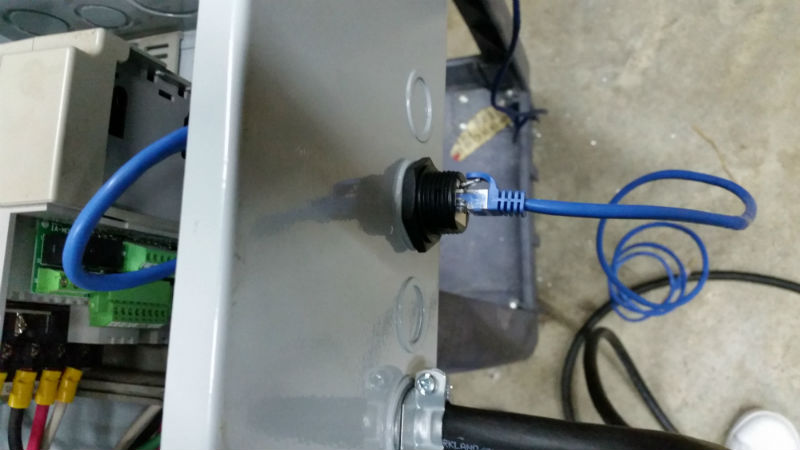
How do you run an ethernet cable through the side of a steel box. You don’t. You have to find a special coupling that has an ethernet jack on each end. You mount it in the box, and you run a short cable from the VFD to the coupling. Outside the box, you run a long cable from the coupling to your control panel.

Here’s the coupling.

11-04-16-vfd-enclosure-with-ethernet-coupling-installed-02-small

Ordering this stuff is simple, right? No. First you have to know what to call the coupling. I finally found that out, and then I was able to search on Ebay. Almost no one in the US sells these things. I finally found one, and then I had to wait for shipping. I also found two cables at Monoprice, which allows you to buy cables in any length you specify. Neat.

Today I finished throwing it all together. I put the coupling in the box, and I ran the cables. I made a little aluminum mount and screwed it to the grinder platform. I screwed the panel to the mount. I was ready to go.

I did one other thing I’m happy about. I put a twist-lock plug and receptacle between the VFD box and the motor, so if I have to work on this thing, I can break it down into two major parts without opening anything up. Very nice. I love using twist-lock plugs on motors. I don’t know how OSHA feels about it. They are welcome to drive out here and give me a citation.

My final accomplishment was programming the VFD so the cooling fan didn’t run all the time. The VFD box is not vented, so a fan inside the box will actually heat it. Not good. Also, it wears out the fan. I found a programming parameter that makes the fan turn on when the VFD is hot. I have to wonder why that wasn’t the default setting. Why would a cold VFD need air?

I couldn’t find an ideal location for the panel, so I just put it in front of the grinder, out of the way of the belt. We’ll see if it blows up. Here’s a photo.

11-04-16-vfd-panel-mounted-on-grinder-platform-small

This is excellent. I now have an abrasive cart with two variable-speed belt grinders. What useful machines. I actually used them to make the aluminum panel mount. Abrasives are seriously underestimated. If you can’t grind and sand, you’re handicapped.

Now I guess I can make knives.

On to the next challenge. The excitement, as always, is palpable.

You Incontinent? You Press 3! We Send Diaper!

Thursday, November 3rd, 2016

My Telephone Circle Becomes Less Diverse

I guess I’ll sound giddy and foolish for saying this at my advanced age, but here I go: I’m in love.

I just upgraded from DSL to cable Internet access.

For years, Comcast bugged me to get rid of my old landline/DSL provider and add their service to my cable package. I told them to get lost, because I knew that traditional phone lines were way more reliable after hurricanes. The cable people used to take forever to get back on their feet, but the phone company either stayed in service or recovered fast.

I’m working to get out of this area now, so I don’t think I’ll be here for the next hurricane season. I don’t care if the lines come down. I moved over to Comcast, and I’ll be saving a pile.

It had to be done. I was getting like 4,000 telemarketer calls every day. I didn’t actually count them, but it definitely felt like 4,000. “Hello? You need diaper? You diabetic? We have supply for you!” It was killing me.

Internet and wireless companies are great about squashing telemarketers. A genius who was tired of robocalls invented a system that routes all of a person’s voice calls through a screening system that checks them against a blacklist. He named his company Nomorobo. If a caller is on the list, the call doesn’t go through. Unfortunately, landline companies aren’t that great about working with Nomorobo. I had to make a switch in order to be eligible for the service.

I talked to a phone company rep, and she didn’t even know what robocalls were. My best guess: she has no landline. She and I live in different universes.

I don’t really understand the no-landline crowd. Cell phones are unreliable. They drop calls. You can’t have extensions, so you have to carry the phone everywhere you go. You have to keep your phone on all the time in case of emergencies. The timing of cell calls is messed up; when you talk to people, you step on each other’s words. I have to have a landline. The cell is just for moving around.

Anyway, when I changed my phone service, I had to change my Internet service as well. The speed difference is incredible.

I didn’t know I needed more speed until I had it. Sales people used to call me all the time, bragging about their Internet speeds. I didn’t care. I don’t steal movies or music, I think video games are for metrosexual punks with saggy pants, and I don’t like Netflix, so why would I need fast Internet? I was happy in my Slowsky world. But these days, websites are packed full of truly worthless garbage that makes them slow to load. They’re no better than the websites we had five years ago; they’re just bulkier and noisier. Whatever. I was starting to be annoyed with waiting.

On top of that, I made some Youtube videos, and it was taking me eight hours to upload each one. No, no, no. Not acceptable.

It’s nice to see Drudge load almost instantly instead of taking an interminable 20 seconds.

I used to try to avoid loading Drudge too often, because I knew Breitbart worked for Drudge, and Breitbart didn’t like me. I was afraid he would get some of the pennies generated from the ethically questionable automatic page reloads. Now that he’s gone, I let it reload at will. I figure his widow and kids can use the money.

I’m still working the kinks out of the system. I can’t use my email server, and the most convenient cable line in my house won’t work with the modem, but I guess I’ll be okay. I can’t wait until the phone lines move over.

The telemarketers have been a real challenge. I work on reducing my anger all the time, and telemarketers are incessant provocations I do not need. The other day one called and asked if I was “one of the diabetics” in the house. I said, “We’re all diabetics here. We also have constipation, flat feet, and leprosy. Like your mother.”

I guess that’s funny, but I was not happy with myself. Now that Nomorobo is in my future, maybe I’ll get a break from my tormentors so I can continue working on my character.

I’ve made all sorts of progress cutting out profanity, too, but just when I seem to have forgotten a really choice expression, a telemarketer calls, and I remember it.

Most of my phone calls are telemarketers. Not some. Most.

I wish I had their home numbers.

No I don’t. Forget that thought.

I feel like ranting about the ridiculous overstuffing of websites, but I will try not to. I hate having videos come on without my involvement (in spite of my add-ons and browswer settings), and I really don’t need to see animated GIF’s all over the screen when I’m trying to read a news story. If your site has music that comes on automatically, or it has an introduction video, you should be dropped in a hole in a glacier. That’s just how I feel.

Okay, okay. I repent.

I’m pooped. I’ve been on the phone with tech support for about a century today. I had to write to release the pressure.

I hope the Nomorobo tip helps a few people. It works for cell phones, too. It’s too bad they can’t fix it so it sends electric shocks to the callers.

I repent.

Everyone Knows it’s Windy

Thursday, October 6th, 2016

At Least People Stopped Saying “Hunker”

Hello from not far outside the cone of aggravation.

It’s a little after 9 a.m. here. I can’t tell what to make of the weather. If you look outside, there is no rain, and nothing is moving. I would say the wind is below 5 mph. One weather site says the wind is 18 mph, and another says 8 mph.

The forecasts I’ve found vary widely. Some say we will have a long period of wind above 60 mph, which is enough to cause considerable destruction. Others say sustained winds will only hit the mid-forties. That would be much better.

I am inclined to believe the tamer predictions, because the pessimists are already wrong.

I just heard a few raindrops.

Now it’s raining. I’m sure it will come and go. That’s how it works.

Anyway, if the bleaker predictions are already off by 10 mph, they will probably continue to be off. Sure hope so.

The projected storm path has moved eastward a little, and now it looks like the eye will land north of Palm Beach, somewhere in Palm Beach County. I would have preferred Greenland, but I’m very grateful it’s not hitting me.

If the winds stay under 50, there is a very good chance I won’t lose electricity or phone service. If that happens, I’m golden. I don’t care about the traffic lights or the obstructed roads. I can sit at home and eat lunch meat. I do care about cold showers and enduring the misery of 24-hour profuse sweat.

The Maslow Hurricane Hierarchy of Needs goes like this:

1. Electricity
2. Water
3. Internet/wireless phones
4. Telephone (wired)
5. Transportation
6. McDonald’s breakfast

Actually, you can put anything you want after 5. Compared to 1 through 5, all things are equally trivial.

In a really bad storm, you could put “Shelter” at the top, or maybe “Life.” Andrew pulled the roofs and ceilings off of people’s houses in the middle of the night.

The phone used to be more important than Cyberia (3), but those days are over. They ended almost silently. Did you notice? Now there are many people who don’t have land lines. If you have Cyberia, you have communication, news, and a lot of entertainment. The temporary loss of a land line won’t hurt you much.

Where I live, we don’t receive white-page phone books any more. That’s really something. Also, it appears to be impossible to get directory assistance. When you call them, they give you a machine that can’t understand the names you ask for, and after a few tries, it hangs up. Also, cell phones are generally unlisted. I wonder if people are aware of these things. In a world where we are inundated with information and stripped of privacy, it is now almost impossible to get a person’s phone number.

I decided to fast and pray today. I am speaking defeat to the storm, and I am asking God to destroy it, send it out to sea, and keep it away from the property of the people who belong to him. Maybe it would have been smarter to do this three days ago, but I didn’t feel led to do it until today.

Prayer is the only option right now. We haven’t developed a machine that eats hurricanes yet.

The storm looks pretty bad, from a non-me-centric perspective. They think it will hit the coast and then follow it north, sweeping it like a demonic Roomba. If the wind and surge are severe, there will be a huge amount of property destruction. Usually, a hurricane will hit the coast, and then it will go inland and die, or it will cross the state, pop out on the other side, and go somewhere else. This one is trying to slide up the coast, hitting many of our most densely populated areas in serial fashion. A path like that would multiply the storm’s destruction; it would be one storm that does as much harm as several.

I’m interceding for God’s people; that’s about all I can do, and of course, it’s the most powerful thing anyone can do. I hope the suffering is very limited. Nothing is worse than having your home or business screwed up by a hurricane.

I’m grateful for the motivation to pray. God keeps reminding me of this: when you feel unsteady or worried, it’s just hunger for prayer in tongues. It really is that simple. When I do it enough, things work. When I cut back, the shipworms start to bore into me. I can’t complain when things go badly, because I have the power to prevent it.

If we all belonged to God, we wouldn’t have to worry about natural disasters. We wouldn’t have to worry about illegal aliens, terrorism, sexual-confusion fascists, or persecution. America has rejected God, so we get what we sow for. I wish it were otherwise, but prophecy proves we are not going to win. The world will continue to rot, and we will be removed from it so God can sanitize it. In the meantime, we have to do what we can, gathering new people to us and fighting the problems our rebellion creates.

I keep feeling like the end is closer than we think. I want to see the world last long enough so we can maximize the harvest, but I truly look forward to the end of the rot and violence.

I’m pretty old now. My life is as good as over. There are more years behind me than in front of me. I may have thirty or forty years to go; I hope God removes me from this place before that much time passes.

It would have been nice if I had done more with my time, but I’m glad I won’t be here too much longer. My future is a world without hurricanes, riots, diseases, bills, and vexatious people. I wish I could take a furlough and visit it now!

We caused this hurricane. We caused terrorism. We caused the leftist takeover of America. The smart thing is to admit your role in it to God, repent, and try to serve him. He’s not going to fix America, but he will make your life much easier, and he will give you a future to retreat to when it’s all over.

It’s 9:40, and we still have eight mph. I hope to see you on the other side tomorrow!

More

It’s 11:20. The forecast says the wind is 20 mph, but it’s not. It’s 10. Every so often, a few drops of rain fall as something passes over, but it goes away in a minute or less.

I’m pretty happy with the way things are turning out. I misunderstood a forecast yesterday, and I thought we were going to get high winds at dinner time, so everything that has happened, or failed to happen, since then feels like a bonus. Now I understand the forecast correctly, but the winds are still over an hour late. Winning! I guess. Suffering delayed, like justice delayed, is denied.

If the forecast is correct, this storm will never get more than maybe 70 miles closer to me than it is now. I certainly hope that’s right.

I found an online distance calculator, and it says Matthew is about 190 miles away. That’s from me to the eye. The smallest distance I expect to see will be around 120 miles. That’s well into the tropical-storm-force area, but I’ll be on the nice side. The wind pattern on the west side of the eye doesn’t extend out as far as it does on the east. From the online wind pictures (the ones that show how far out the winds extend), it looks like I won’t be far inside the tropical-storm-force area.

I’m writing because I’m bored.

It’s 11:42 now, and we’re up to 12 mph.

Thanks for your prayers.

1:14 P.M.

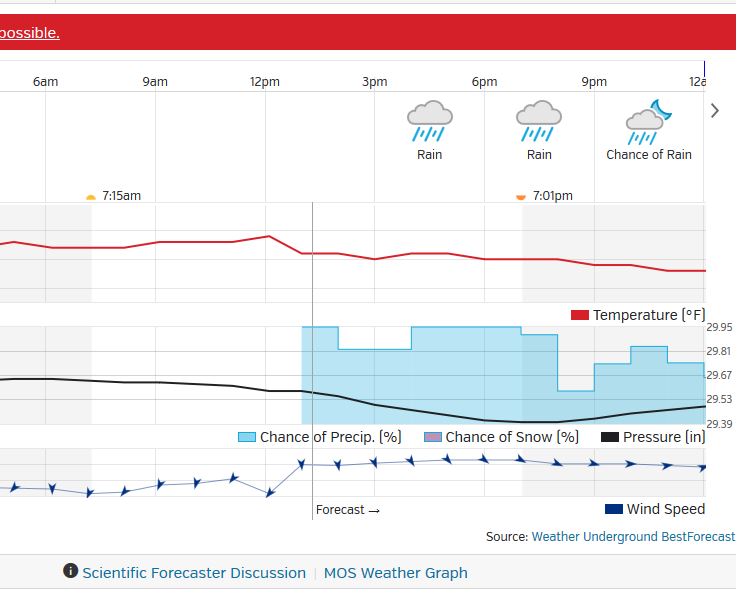
The craziest thing is happening. I keep waiting for the wind to increase, but it doesn’t. I’ve been watching the forecast graph at Weather Underground, and they are changing it retroactively to cover up the failure of their predictions.

Take a look at this capture. See the wind graph near the bottom? You will note that it kicks upward sharply after 12 p.m. That upward bit used to be somewhere around 11 a.m. They moved it to the right when the forecast failed. It’s still wrong. It’s after 1 p.m., and nothing has happened.
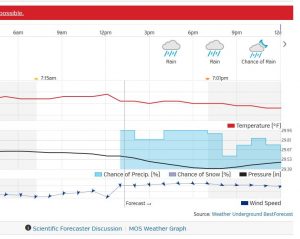
10-06-16-hurricane-matthew-weather-underground-forecast-capture

Higher on the page, above the capture, there is a wind indicator. It went to 27 mph a while back. Now it’s at 10. We were supposed to have winds of over 40 mph by now.

Based solely on the geometry, I can’t see how things can get really bad. The storm is passing by us tangentially, so the distance between the storm and me is changing relatively little as it moves. It’s not going to get a whole lot closer on this course. Fifty or sixty miles can make a big difference, but not that big.

The storm track is also moving east. It’s headed for Cape Canaveral now, and that’s not very close to the Palm Beach County destination they were predicting earlier in the day.

Man, I hope it keeps moving east, for my sake and everyone else’s. I had a power glitch a while back, and I thought I might be losing electricity long before I had thought it possible. I would rather not eat in the dark, and I really don’t want to have to try to sleep without air conditioning or a fan. I just washed my sheets.

I am going to keep praying and so on. The results so far are wonderful.

2:02 P.M.

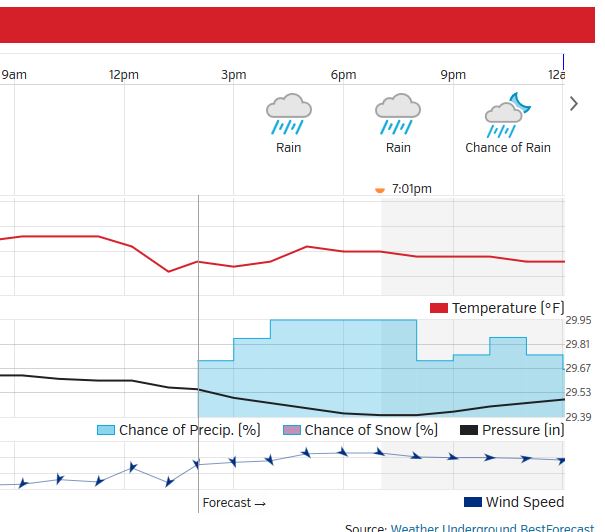
I thought people might say I was lying about Weather Underground changing its forecast retroactively, so here is another capture.
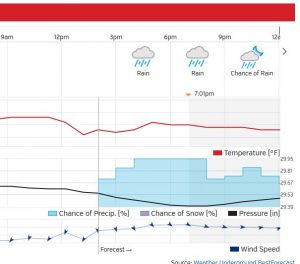
10-06-16-hurricane-matthew-weather-underground-forecast-capture-02

I just captured that.

Take a look at the upturn in the wind graph. They moved it. It used to start at 12 p.m. Now it starts at about 1 p.m. But 1 p.m. is long gone, and there is no wind. The wind indicator says 11. They got it wrong again. Will they move it again?

I am not criticizing Weather Underground. I love that site. I’m just proving the forecasters were very wrong. I was supposed to have high winds two hours ago.

I just checked the NHC’s site. The storm is NORTH of me. I’m not kidding. The current latitude is 25.7 N. I’m at about 25.4. That means the storm has already passed me. It doesn’t mean it can’t get closer, because the storm is moving northwest, but the forecast track doesn’t take it much closer to me than it is right now.

I don’t know what to make of this. I am fasting, praying, and speaking defeat, but this is a whole lot better than I expected. I have had ZERO…ZERO adverse effects from the weather so far. It’s very pleasant outside, if you don’t mind drizzle.

Maybe things are going to go much better than I thought.

2:59 P.M.

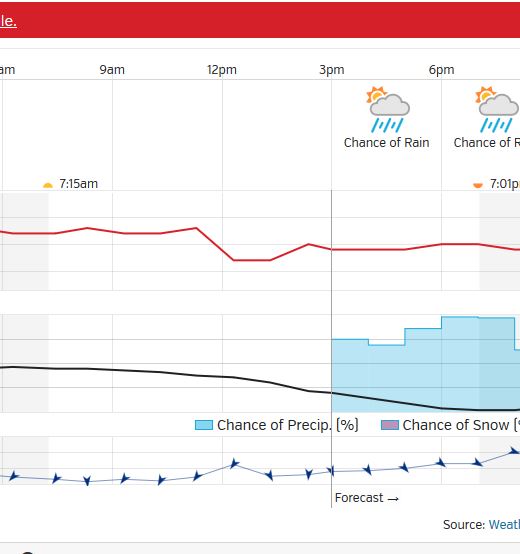
As further evidence that I am not insane, let me present another screen capture from Weather Underground. They just killed the forecast for afternoon wind. Take a look and compare to the other screen caps.
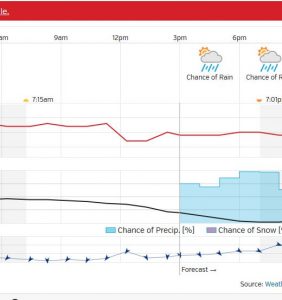
10-06-16-hurricane-matthew-weather-underground-forecast-capture-03

As you can clearly see, they no longer predict significant wind before 6 p.m., and after that, it peaks at 40.

I know prayer works, but this is just spooky.

I took a ruler and lined stuff up on the monitor, and it sure looks like the tropical-storm-force area will miss me by 15 or 20 miles. It’s incredible. Maybe there is something I’m missing, which would be obvious to a meteorologist, but I sort of doubt it.

5:03 P.M.

People in Miami are getting bored, sitting indoors while nothing happens. A friend called, and since the storm didn’t seem to be accomplishing anything, he came over for a prayer session.

At a time when the wind was supposed to be at 50 mph.

People are surfing off North Miami Beach.

No complaints here. Things are quiet, and the roads are clear. It’s nice to drive without traffic for once.

8:33 P.M.

I give up on this hurricane. It has been a complete failure.

It’s 8:33 p.m., and the real-time wind measurement on Weather Underground’s site is 17 mph. According to the little forecast graph, the wind should be at its peak now. The graph thinks the peak is something like 37 mph. Whatever you say, graph.

My best guess is that the folks at Weather Underground will go back and revise their forecast again, to make it look as though they had gotten it right. I don’t understand this. What’s the point? No one needs a rearcast or a postcast. We are already familiar with past events. It serves no purpose to try to predict them. It certainly isn’t challenging.

I am done hedging my bets. I’ll just say it: I have seen the worst this storm has to offer. I feel confident about that. It’s way up by Palm Beach now.

It’s really something. Where I live, it’s not unusual to have power outages due to wind when there are no hurricanes around. Today a hurricane blew right by me, and the power is fine.

Enough about me. Matthew is still a big threat to people up the coast.

According to the news, people in evacuation zones are not taking the storm seriously. That’s a big mistake. Before the storm arrives, you can get in your car and leave. That provides a false sense of security. By the time things get bad, the roads may be closed, and it may be impossible to drive due to flooding or wind. Then where are you? Stuck, hoping the roof doesn’t come off. And the cops can’t get to you to help you.

Concrete blocks hold up to hurricanes just fine. They stood up to Andrew. But a lot of people have houses built from various types of ticky-tacky, and they can do upsetting things like falling over. My guess is that the farther you get from South Florida, the weaker the houses are, because no one up north worries about hurricanes.

The thing that makes the difference in dealing with hurricanes is experience, and people who have never seen a city destroyed don’t have experience. They don’t know what it’s like to be unable to go outside and walk ten feet. To a person like that, a drunken hurricane party seems like a great idea. There are probably half a million people sitting in their living rooms right now, with extremely unrealistic expectations about the way things will go if Matthew hits.

On top of that, a huge amount of property is at risk, and losing and replacing property is a miserable thing to go through.

I’m going to bed at the usual time tonight, but until I conk out, I plan to pray for the people Matthew hasn’t visited yet. I hope you will join me. I also plan to pray that if God delivers them, he does it in a way that leaves them with a healthy respect for danger instead of a juvenile sense of invincibility. I will pray that his help glorifies him and helps people see their need for him instead of convincing them they’re fine without him.

One day, Christians who are close to God will leave the earth, and people won’t realize we were one of the main reasons things went as well as they did. They won’t know our prayers helped hold the earth together and prevent God from afflicting or abandoning them. They won’t feel it when God’s help leaves them, but once he’s gone, things will turn very sour. They’ll know something is wrong when problems they used to coast over kill them or destroy what they have.

I was talking about this today with the friend who came over to pray. Supernatural affairs are like economic affairs. When it comes to money, a certain percentage of the population works and creates wealth, and the rest are leeches who destroy and consume. When it comes to the supernatural, a certain percentage brings God’s blessings and protection down, and the rest benefit just by being near them. Sooner or later, supernatural socialism will come to an abrupt end, because the supernatural red-staters will be unhooked from the plow and taken to the barn. That will be a horrible thing to see.

I hope my prayers do some good. Might as well do some good while I’m still here. I remember what Jesus said: “I must work the works of Him who sent Me while it is day; the night is coming when no one can work.”

As long as we’re here, the sun is shining.

Quick mathematical observation: Matthew has high winds, but here’s something no one is talking about. There is a big difference between hurricane-force winds and maximum sustained winds. If a storm has maximum sustained winds of 130 mph and it has an area of hurricane-force winds 50 miles wide, it doesn’t mean everyone within 25 miles of the center will get 130 mph. The highest winds are just outside the eye, very near the center. Unless the storm comes very close to land, we shouldn’t expect extremely high winds to hit Florida. Matthew could get very close and never manage to blow harder than maybe 75 mph on land. If prayer pushes this thing ten miles off the coast it will make a huge difference.

Andrew surpassed 160 right where I’m sitting. Completely different scenario.

Food for thought.
Q: Who Owns the Night?

Tuesday, September 27th, 2016

A: Who Created it?

Last night I realized there had been a change in my life. I’m pretty happy about it. I am no longer having bad dreams.

For a long time, I had bad dreams most nights. To make things worse, I had the same dreams over and over.

Often I dreamed I was back in Austin, Texas, where I lived when I was in graduate school studying physics. I got burned out and quit, and apart from my childhood, it was the most miserable time of my life. I was separated from God. My prayers didn’t go anywhere.

In the dreams, I went back to my old apartment, which was, mysteriously, still mine. I would find huge rooms hidden in it. It was full of great tools. The space and the tools sound nice, but the apartment was a depressing mess. Things were piled up on the furniture; it was as if I had left in a hurry, after living like a slob.

In the dream, I had no friends in Austin. That’s what it was like in real life, unfortunately. The physics guys were very socially inept, and a lot of them were downright creepy. Some were full of anger, possibly because of all the wedgies and red bellies they received while they were growing up. In the dreams, I felt the isolation of Austin again.

When I went to law school, I had lots of friends. I still don’t understand the physics personality.

Sometimes I dreamed I was in a big airport, which I took to be DFW. I never actually got anywhere. I was just moving around in the terminal, as though changing planes. When you’re on a journey, you don’t want to spend an entire day in an airport. You want to board a plane, fly, get off, and do whatever you wanted to do at your destination. I never flew or arrived. I just walked, past endless book kiosks, smelly bars, and Cinnabon stands.

I also dreamed I was back in college. I would find myself walking around on campus, or going to and from campus. The disturbing thing was that it was late in the semester, and I had forgotten about one or two courses. I had dropped them, but I hadn’t filed the paperwork, so as far as the school knew, I was just failing. I kept wondering what I was going to do. I wondered if they would give me a break.

I hated these annoying, persistent dreams. Life was getting better and better, but my nights were unpleasant.

It wasn’t the first time I had been plagued by bad dreams. When I was young–say before the age of eight–I had nightmares every night. I would find myself at parties, surrounded by relatives I loved. When they came close to me to greet me, their bodies would twist apart so they were unrecognizable. They were impostors, sent to scare me. I also dreamed a pure white devil would come up through a manhole under my bed and torment me; sometimes he chased me in a van. He always had a big smile. Making a defenseless child suffer brought him glee.

My worst dreams took place while I was awake. I would wake up and see enormous bugs, snakes, and lizards climbing all over the bedroom. They were on the walls, ceiling, floor, and furniture. They crawled over me on the bed.

One night I woke from a nightmare and yelled for my mother. When she got to the bedroom door, she suddenly shrank in size, down to a height of two or three feet. It showed me she was powerless to help me. That was the point.

It’s wonderful to have peaceful dreams again. I’m not sure what the significance is. I believe spirits that have access to us give us bad dreams. I’ve been attacked by spirits during dreams.

Sometimes I wish my dreams were less vivid. When I’m awake, I remember visiting places that don’t exist. Sometimes I have to ask myself whether I went to a certain place or just dreamed it. It can be very hard to tell.

It seems like I’m going over a hump. Behind me, there were a lot of bad experiences I had to go through in order to be corrected and made strong. Ahead of me, there is more peace and help. I feel that way during the day, not just at night. I expect things to continue to improve.

If you lack peace, there are spirits behind it. You can count on that. If you ever get into the presence of God, you will feel overwhelming peace. That proves that anxiety and agitation come from the other spirits. They are not like him. Other spirits nag, threaten, and manipulate you. They try to make you afraid not to obey. God offers you peace and rest in exchange for preferring him.

You should always be aware that anyone who torments you in order to make you comply is doing evil. God doesn’t work that way. It’s beneath him. God wants free consent. He does not like coercion. Something to think about when other people try to get you to do things.

I would go further than that. If anyone has the power to coerce you, and they use it, there is a kink in your relationship with God. He is jealous; he doesn’t want anyone else to be your master or your father.

I don’t have complete peace, but things get better all the time. I have plenty of incentive to continue, and I have overwhelming incentive not to go back. Some ex-cons are willing to die before being sent back to prison; I feel that way about the powerless life I led before I started doing things God’s way. You can have this planet. You can have the prestige and riches. You can have the fame. Just give me my peace and power.

My Latest Attack of Stupid

Friday, September 23rd, 2016

I Should Probably Quit Cussing the Innocent Now

Man, this is embarrassing.

For days, I have been trying to get my 3HP 3-phase motor to work with a 3HP TECO variable frequency drive (VFD). I have had no end of problems.

The drive kept pooping out at high RPM’s. I could not figure it out. I disabled DC braking and did all sorts of other things. I got really intimate with the Chinglish owner’s manual. I changed this setting. I changed that setting. I even made a new drive pulley for my 2HP motor, in case I had to go back to it.

Tonight someone suggested there might be a “wiring fault.” I could not figure out what he meant, but I went back to the motor itself, to check what I could.

It was wired for the wrong voltage.

Many 3-phase motors come ready to accept either 230V or 460V. Or 220V or 440V. For some reason, we can’t seem to settle on a number for voltage which is double the usual American household voltage. Sometimes we call it 220; sometimes we call it 250. Whatever. A lot of motors come ready to handle twice OR four times the standard wall socket voltage.

When you use a motor, you have to fiddle with the wires coming out of it in order to make sure it knows which voltage is coming. I didn’t do that this time. I’ve dealt with a number of 3-phase motors, and none showed up wired for 440. Or 460. Whatever. It was always 240.

The one I just bought was wired for 460.

The motor wanted twice the voltage I was giving it, so naturally, it kept running out of joie de vivre.

I feel so stupid. I should have checked this carefully.

Now I have to add to my Google legacy, for other belt grinder owners. Yes, you CAN run a 4-pole 3-phase 3HP motor at 120 Hz on a VFD. You can probably go somewhat higher.

I rewired it. It runs great. It has a ton of power. I’m happy.

With that behind me, here is an obvious question: do you really need a 3HP motor on a 2×72 grinder? My feeling is that you don’t. I fired up a 2HP motor tonight, and I had a hard time bogging it down. The 3HP motor is significantly stronger, but I can’t say I felt like I needed the added grunt.

I think you want 3HP if you plan to go above 5000 FPM, for sure. To do that, I would want a pulley over five inches in diameter, in order to avoid revving the life out of the motor. The added torque of a 3HP motor would allow you to work very aggressively at high belt speed, in spite of the tension you would lose to the big pulley.

The thing is, if you shop for motors on Ebay, you’re likely to find a 3HP motor for the same money you’d pay for 2HP, so why not go for it? The only real down side is the weight. Moving a motor that weighs over eighty pounds gets old.

This grinder is unstoppable now. It is a seriously impressive machine, by garage-doofus standards.

Guess I should make something with it.

My Crowning Achievement

Friday, September 23rd, 2016

Pulley Nearly Finished

I guess everyone is wondering how to make a crowned pulley for a belt grinder.

I am still mired in the belt grinder project. I’m sort of thinking my best bet is a 3HP 2-pole motor, but I have a 2HP 4-pole motor sitting around, and I want to test it to see how well it works. Maybe it’s the answer.

I tried the 3HP motor at 167 Hz (5000 feet per minute on the belt), and the VFD couldn’t deal with it. I know for a fact it can run the 2HP motor that fast.

It’s too bad I don’t know much about electrical motors. I sort of suspect that the people who have been giving me advice don’t know much either. Some have told me that when you double the speed of a motor, you halve the torque. I have no idea whether that’s true or not. It’s not that easy to find information on 3-phase motors online. I am planning to try to educate myself, but I haven’t succeeded yet.

I had a drive pulley which fit the 2HP motor, but I bored it out to fit the 3HP motor, so I can’t use it on the small motor. That meant I had to make a new drive wheel. Simple, right? Turn a 4″-thick pulley on the lathe, bore a hole, add a set screw…done. Actually, that would probably work, but I wanted to be totally certain the belt would track correctly, so I made a crowned wheel. I finished it a few minutes ago. But for the set screw hole, it’s done.

I have read that you only need one crowned wheel on a machine to make the belt track, but everyone seems to use crowned drive pulleys as well as crowned tracking pulleys, so I don’t want to rock the boat just yet.

Making the pulley was a bit of a pain. In case someone Googles the process in the future, I will leave some information.

First of all, as I said above, you may be wasting your time. You may be able to use a cylindrical pulley. Check it out, if you can.

Once you decide to make a crowned pulley, you need to know a couple of things. The crown doesn’t need to go all the way to the center of the wheel. You can just crown it toward the outside. How far toward the outside? I don’t know.

Also, for a 2″-wide belt, you want about 0.030″ of crowning. That’s radius, not diameter. Sadly, I didn’t pay attention, and I took 0.030″ off the diameter. I forgot that my lathe reads diameter measurements, not radial ones. I’m sure it will still work, though, since there is a ton of slack in the suggested measurements.

I did not have 4″ round aluminum stock lying around, so I used 4″ square stock. That was fun. I had to cut 3.5″ off on the band saw, and then I had to put it in the 4-jaw chuck. I turned part of it down to a 4″ cylinder (slightly smaller due to inevitable chucking error). Then I drilled a hole deep enough for the motor shaft. After that, I crowned one end.

The crowning job was simple. I set the compound slide to around 1/2 a degree, so it would come toward me very slowly as I moved the tool toward the headstock. With this setup, I could start the crowning cut 0.030″ into the work, and it would back out completely as I cut about an inch toward the headstock. This worked perfectly; I had a cylinder with one end that was very slightly tapered.

Then I made my mistake. I parted the cylinder off of the square bit.

I should have crowned the other end at that point, because it was firmly chucked, and everything was completely concentric with the lathe’s axis. Oh, well.

Because I now had a cylinder with one cruddy-looking, parted-off end, and it wasn’t chucked, I had some extra work to do.

First, I chucked it, used a dial indicator to get it concentric, and faced the rough end. I knew this was the best grip I would ever have on the part, so I took this opportunity to bore the hole to size. I opened it to 5/8″ with an S&D bit, and then I finished it up with a boring bar.

It’s frustrating, boring things to size when you can’t test fit them. The motor could not be lifted onto the lathe, and I could not take the part out of the chuck without messing things up. I had to run between the lathe and motor with dial calipers, which are not all that accurate. When it was all said and done, I was still a thousandth or two over the size of the shaft. A totally snug fit would have been nicer, but what I got was perfectly acceptable.

When that was done, I had to shove the part way out in the chuck’s jaws, with the tapered side toward the headstock. That means the chuck was gripping a tapered part. Usually, this is a really bad idea, because chuck jaws are very straight. If a part is smaller toward the headstock end, the jaws will only grip farther toward the tailstock, and if you don’t get a good grip, the part can move or even fall out. But the taper on my part was very small, I am brave, and I am too lazy to make an arbor or take other extraordinary measures to get it perfect.

I managed to put a taper on the exposed end, and then I rested a straightedge on the wheel and rocked it to see where the crown’s apex was. It was a bit off center, so I used emery cloth to sand the wheel until there was no pointy apex and the crowning appeared symmetrical.

Great.

With all that done, I had to put a 3/16″ keyway in the wheel.

Keyways are tight slots made with broaches. A broach is sort of like a really thick saw blade that only cuts in one direction. You use a special bushing to hold it in the wheel, and you push it with a press.

In Youtube videos, this is really easy. People use crummy, small Chinese arbor presses and broach things in no time. That didn’t work for me. It will work with a thin wheel, but the thicker a wheel is, the more pressure you need. Earlier this week, I broached a 1/4″ keyway, and I had to use a 20-ton press. Today I broached a 3/16″ keyway, which should be easier, and my 3-ton arbor press was just barely enough.

I learned something disturbing: broaches aren’t made for fat wheels. If a wheel is too thick, a broach will not be finished cutting when you push it until the end is flush with the top of the wheel. I had to put a punch on top of the broach and push it the rest of the way through. On top of that, I had to broach it from both sides. Very aggravating. A 1/4″ broach is maybe 1.5 times as long as a 3/16″ broach, so the smaller your keyway is, the more likely you are to get stuck.

I finally got it done, and now I have a beautiful wheel that needs a set screw hole. Once that’s done, I’ll throw it on the little motor and fire it up.

I suspect this wheel is actually better than the one I bought, and having made it myself, I can see how hard it is to make one with accurate dimensions.

I still have the little motor the Post Office broke. The seller filed a claim, and they paid it. He didn’t want the motor back. The Post Office didn’t ask for it. Now it’s here, with one broken bolt hole. I managed to get the fan working, so the motor can be used. I’m almost afraid that if I turn it on, the Post Office Fraud Squad will swoop in and arrest me.

I don’t know what to say about that. They did screw up the motor, and it was non-functional. It’s still seriously damaged, so I didn’t get what I paid for. But I feel weird, sitting here with a working motor I didn’t pay for.

I guess all parties are happy, so let the good times roll. And even if it works, I plan to replace it, because the broken base is depressing to look it.

The information I have received about motors and speeds and VFD’s has been inconsistent and tinged with ignorance, so I’m still going by trial and error. Anyway, I should be up and grinding tonight, and then I’ll have more data.

I’m excited that I can make crowned pulleys. I’m even more excited to know that I probably don’t have to.

Some day, possibly years from now, I will post a photo of a finished knife I made.

That’s all I have. You can stop pretending to be interested now.

Sparks Finally Flying

Tuesday, September 20th, 2016

Your Tentative Guide to not Making Stupid Mistakes About Belt Grinders

I continue learning things about belt grinders, sometimes too late to capitalize. I might as well keep documenting my discoveries so other people will benefit.

To get everyone back up to speed:

I bought an Oregon Blade Maker 2″ x 72″ grinder. I set it up with a VFD and an 1800-RPM motor. I found out that you need an enclosed motor (TEFC or TENV) to do it right, because the crud the grinder throws will get into open motors and kill them. I bought a new TEFC motor, and the Post Office broke it. I bought a second motor, and this time I went to 3HP. The other motors were 2HP.

I might as well point out that I use “1800-RPM” to describe any motor that has a speed anywhere near 1800. The actual speed of a 3-phase 4-pole motor running at 60 Hz will be somewhere below 1800, but the difference isn’t worth getting worked up about.

Okay.

I did a lot of research, trying to choose the right motor. Some guy who is a big banana on a knife-making forum claimed 1800-RPM was the way to go. Something about 1800-RPM motors being built better with regard to the stress of high speeds.

Right away, I should have realized that didn’t make sense. But I trusted him.

I don’t know a whole lot about electric motors. When I was getting my degree, we went through the principles of electric motors, but the things they teach you in physics are generally a long way from practical. That’s why we also have engineering classes. Not the same thing.

I was too lazy to sit around studying the 3-phase motor; I figured any guy who has the awe and admiration of a whole bunch of people on a knife forum ought to know which motor to use.

A person with common sense would have looked at the motors that come with turnkey grinders; they’re 3600-RPM motors. Dohhh!

Arbitrarily, I had decided I wanted the belt to move at 5000 feet per minute (FPM). With a 4″ drive pulley, that required 4775 RPM. With slippage, that’s probably not quite accurate, but that was the figure I chose. To get 4775 RPM, I would have to run the motor at 167 Hz, or almost 3 times the motor’s rated speed.

I didn’t think this was a problem. I knew the bearings were probably good for over 14,000 RPM. The armature–the thing that turns inside the motor–was probably made to the same specs as a 3600-RPM armature, and at 4775 RPM, it would only experience something like 1.7 times the centripetal force. I didn’t think it would fly apart.

The 2HP motors I had ran around 40 pounds. I found a wonderful deal on a 3HP model with nearly the same NEMA frame as one of the 2HP jobs. “Hey,” I figured, “same frame…can’t weigh much more.” WRONG. It’s 84 pounds. Also, NEMA frame specs don’t tell you the overall length of a motor casing. This motor is maybe four inches longer than the others.

The new motor was a real joy to carry to the garage and hoist onto the grinder cart.

I got the motor going, with a lovely jury-rig wiring job, just to make sure it was okay so I could kiss the Ebay seller goodbye. It ran fine up to 150 Hz, but after that, it decided to slow back down on its own. The 2HP motors hadn’t done that.

I went to Practical Machinist, a forum I dread. These guys can be ruthless to hobbyists. But they know a lot. They told me I was lucky the motor hadn’t blown up. I think they were wrong about that, but they also said the motor would probably act as a frequency filter at high speeds, killing the speed. They said the torque would also drop off pretty badly.

I can’t have that. Daddy needs his torque.

No word on why the 2HP motors didn’t act crazy.

What do I do now? I can get over 3500 FPM as it is, no problem. I can also make a new 6″ wheel, which will get me to whatever 3/2 of 3500 FPM is. Okay, I’ll work it out, since it’s a two-second math problem: 5250 FPM.

If I go to a 6″ wheel, surely the force applied to the belt will be 2/3 of what it was (at a given RPM figure) at 4″. That’s just basic physics. On the other hand, it will be going 2/3 as fast at a give FPM figure, and if torque drops with speed, then there ought to be some compensation.

You can see why I need an engineer. They have little books with tables that answer questions like this. Physicists have to derive the answers using calculus and tensor analysis and God knows what else.

One reason I went to 3HP is that I wanted to start with something strong, so it would make up for any losses I had due to the VFD or overclocking or…whatever. I believe 2HP is the most common size motor for a 2×72, but people who use belt grinders seem unanimous: get 3HP if you can.

Now I have to make a decision: leave it alone, make a 6″ wheel (cost of metal: $33), or get a 3600-RPM motor.

I think I’ll just use what I have and see what happens.

The weird thing is, my second motor helped pay for my third one. The seller refunded my money, included shipping, and the Post Office paid his claim. Now I have a free 2HP motor. The Post Office isn’t coming to take it away. That means I can put it on Craigslist, where I can surely get $50 for it.

The big motor only cost about $130, including shipping. It’s a magnificent motor; the unit itself was only $65, which is ridiculous. If I choose to sell it, I can fully expect to recover almost all of what I paid.

Summing up, it doesn’t really matter what I do. In the end, changing motors might run me $100, net. By that I mean the most I can expect to put into a motor, after all the deductions and whatever are included, is about $100. I would probably make money by selling the motor I have and buying a new one.

If you want a 2×72 grinder, here is my advice:

1. Don’t build one unless you’re incredibly handy and have free metal. A nice grinder costs only slightly more than the parts required to make it.

2. Get a 3-HP TEFC or TENV motor.

3. Use a VFD.

4. Make sure the motor’s rated speed is 3600 RPM.

5. Don’t worry about getting an inverter-rated motor, because nobody else does. If the added cost is not much, sure, go ahead and get one, but in practice, you will probably never have a problem with a random 3-phase motor of good quality.

If you have an OSHA shop, I’m sure they don’t do what I did. I mounted the grinder on a board and put the board on a foam shop cart which has a 250-pound shelf capacity. I don’t plan to fasten it down. It’s heavy, and it’s not going anywhere. I could push it over if I really wanted to or I was just stupid, but those things don’t apply, so I don’t intend to worry about having a top-notch professional imbecile-proof installation.

04-20-16-belt-grinder-with-new-old-reliant-motor-mocked-up-small

Sadly, I have even more advice.

I looked into crowning, which is what they do to at least some of the pulleys on a typical belt grinder. This will sound crazy, but if you make a pulley bigger in the middle (with a “crown” like a crowned road), belts will try to move toward the crown, not off to the side. This helps them track well. If you have a belt grinder, and it’s not made with tremendous precision, you will want to have at least one crowned wheel.

There are people out there who do great business selling crowned aluminum wheels to knife makers. A lot of folks can make a non-crowned wheel, but making a crowned wheel is intimidating, so the appeal of having it done for you is obvious. I fell for it myself.

If you have a lathe, you can make a crowned wheel, fast. The guys who sell crowned wheels tend to use CNC to make wheels with a rounded profile (radiused from one end to the other). That’s not easy to do on a manual lathe. But you don’t have to do it. In fact, you can make two very shallow straight cuts on a wheel and take it straight to your grinder.

For a 2″ wide wheel, you want the radius (or maybe it’s the diameter; look it up) to be about 0.030″ less on the sides than it is in the middle. I haven’t checked, but I have read that you need about a 0.5-degree angle to do this. That’s simple; just use your compound slide.

If you want, you can pretty it up with a file so it looks round.

You do not want to cut all the way to the middle so the pulley has a pointy ridge in the center. It’s unnecessary, and it doesn’t work as well.

Here’s a jim-dandy link that will tell you what you need to know, while correcting whatever errors I made while trying to paraphrase it above: CLICK.

If you have a VFD, you will want to make sure flying crud can’t get in. You may want to build a box for it, or just move it away from the grinder.

I think that covers it.

Oh…also, don’t buy a grinder with a platen as your first tool. Get a contact wheel 8″ or 10″ in diameter. That’s what most people use most of the time when making knives.

I may be mistaken about some of this stuff, but it’s a lot better than what I thought I knew a week ago. You can’t trust knife makers when it comes to tools, because they don’t know much about them. They make wonderful knives, but that doesn’t make them tool experts.

Welcome to the Popular Mechanics Swimsuit Issue

Saturday, September 10th, 2016

Introducing Our First Model

A few people actually commented on my last blog post, which involved a motor I cleaned up for use with a grinder. Now that I realize what a giant hit my motor essays are, I have decided to post another photo.

Here is the motor, sitting on the platform I have to re-drill and repaint, with the variable frequency drive I have to put in an enclosure.

09-10-16-belt-grinder-and-painted-motor-small

You have to admit, it looks nice considering what it used to be. The new used wave spring I ordered arrived yesterday, so I’ll be installing that later.

I finally realized that you restore a lumpy shaft by filing in the axial direction, not across the shaft, so I may try to polish this motor’s shaft a little more. It’s not perfect. A real man would put it on the lathe, but that involves pressing the bearings off, so I would have to get new bearings.

The new used motor I ordered is supposed to arrive today, so I’m not sure why I did all that work, but if I ever need a 2-HP Totally Open to Crap motor, I’ll have one on deck.

Out of curiosity, I looked into motor longevity. Apparently, no one actually knows how long a motor should last. For one thing, no one has defined “motor death.” Is it when the bearings go bad? Is it when the wiring burns up? There is no consensus.

Leeson (DISCLAIMER: a company that really wants you to trash your old motors and buy the new ones it makes) says you can hope for something like 15 years of operation, and I assume that’s in industrial applications. If not, a lot of people who buy Leeson motors will be hopping mad, because a motor that lasts 15 years in a factory will last three months in your house.

When bearings go bad, you can replace them for a few dollars. Bearing death is not motor death. If I understand things correctly, the real problem comes when the insulation on the stator breaks down, and this can be accelerated by heat or current spikes (which, actually, equal heat).

I wondered about this, because there are always tons of used motors available on Ebay. How do you know what condition the stator is in? You don’t. A motor can look really nice on the outside without telling you much abot the inside. Maybe some of those 75%-discounted Ebay motors aren’t great deals. Or maybe they are, if insulation breakdown takes several decades. Some motors appear to be immortal, continuing to run after nearly a century, so it may be that there are motors out there with insulation so wonderful they are very hard to ruin.

I do not know.

In my garage, even a Chinese motor made the day after a major drunken holiday will probably outlive me, because I don’t use them much.

You shouldn’t use a belt grinder which isn’t anchored correctly, or which doesn’t have proper protection for the motor or VFD, so of course, I am already using this grinder. I’m not using it much, though. I used it at about 600 RPM to clean the remaining milling marks off a knife I’m making. It worked great. It was slow, because I refused to turn the speed up, but it beat the daylights out of using sandpaper or a whetstone.

A surface grinder would have knocked it out in 10 minutes, and it would have left the knife with a very precise thickness, but I don’t have a surface grinder.

This project is going really well. Even when I do the wrong things, I am succeeding at them.

Some day you’ll see a finished knife here. And won’t that be special?

Update

The new motor arrived. Check it out.

09-10-16-ebay-motor-damaged-01-small

09-10-16-ebay-motor-damaged-02-small

Can you believe that? The seller jammed it into a flat rate box. Naturally, the Post Office destroyed it. I wonder if they do that deliberately, just to punish people for mailing things they don’t want to carry.

The base is broken, and the fan shroud is crushed. The shaft will not turn.

To his credit, the seller refunded the cost of the motor plus shipping.

Back to Ebay, I guess.

I’m an Abrasive Guy

Sunday, September 4th, 2016

Grinder Takes Shape

I have my 2×72 belt grinder set up, more or less.

It has been an interesting project. To make it work, I had to choose between getting a new base for the grinder or making it work with my old abrasive cart, which is a Northern Tool cart that held my 1×42 belt grinder and bench grinder. In the end, I decided the smart thing was to try to jam both belt grinders on the cart. It’s easier to put the bench grinder on a new base than to start from scratch on a belt grinder base.

The motor I’m using is gigantic. It’s the old 2-HP Reuland motor I got for nothing (sort of). When I bought my first lathe, the unscrupulous dealer sold me the wrong machine, and he included a 1-phase motor instead of the 3-phase job he had advertised. He made a little effort to make things right, and that included shipping me the ancient Reuland. The shaft was banged up, so I took to Ebay and bought a beautiful new 2-HP Baldor, cheap.

I guess I can’t call it free, since the dealer still cheated me, but I didn’t pay for the motor.

When I first tried to use the Reuland, I had a hard time getting the lathe’s pulley mounted. Then it ran funny. When I took the pulley off and looked at the shaft, it appeared that someone had banged it pretty hard with a giant hammer or something. It had burrs and a big flat spot. I can’t even guess what kind of idiot does a thing like that to a top-of-the-line 3-phase motor, but I can tell you this much: it was an employee, not the owner of a company. People who pay for things don’t beat them with hammers.

When you bang on a piece of metal and make a depression, you also raise metal. The metal you displace from the depression has to go somewhere, so it usually rises up around the depression, forming a rim. I heard a master machinist describe this as “disturbed metal.” My motor’s shaft had disturbed metal around a big ding, so the pulley had a hard time sliding past it.

I got rid of that lathe a long time ago, and of course, the buyer cheated me out of a hundred dollars. I had it rigged up with a VFD, which I kept. The fact that I had a motor and VFD lying idle figured prominently in the rationalizations that enabled me to buy the new belt grinder.

When I tried to put the new drive wheel on the motor (to pull the grinding belts), it didn’t want to go over the damaged shaft, and the keyway in the shaft looked enormous. I assumed it was larger than the usual keyway for a 7/8″ shaft. It looked bigger than the corresponding keyway in the wheel. I figured I would have to broach a bigger keyway into the wheel.

I got the motor running, and I used the spinning motion to help me file the bumps off the shaft. I then sanded it. After that, the wheel went right on, and surprisingly, the key fit. Apparently, the monkey who banged up the shaft also did something or other to cause the keyway to wear, and it made it look like it was a size larger than it is. Whatever; as long as it works.

That’s the exciting story of the motor.

It turned out I actually had two VFD’s to choose from. A long time ago, I bought a VFD for my milling machine, thinking I was buying a pulley machine. A machine with multiple drive pulleys allows you to change speeds by moving a belt from one pulley to another. The seller, who tended to screw up a lot, informed me he was sending a variable speed mill instead. Nice, because that’s a pricier tool, and I wasn’t paying extra. But I had already spent maybe $250 for the VFD.

The purpose of the VFD was twofold: 1) to turn 250V 1-phase power into 3-phase power, and 2) to allow me to vary the frequency (changing the motor’s speed) without handling belts. I no longer needed the frequency feature, but I still needed 3-phase, so I hooked the VFD up.

Later on, I bought a big phase converter (machine which turns 1-phase into 3-phase), so I didn’t really need a VFD for the mill. I left the VFD connected anyway, because I was lazy. Yesterday I removed it, and I’ll be connecting the mill to the phase converter soon.

Now I have two VFD’s ready for use. One is small and easy to mount. The other has a nice detachable control pad, so I can mount it out of the way of dust and run an ethernet cable to the control pad. I can connect a remote speed-control pot to the smaller VFD; it won’t be as elegant, but it will work.

I wired the motor up to the VFD. I cut a piece of thick plywood to use as a platform. I put the motor and grinder on the wood, and I clamped them down. I ran the motor with a belt on the grinder and moved things around until I was happy.

After that, I used a stubby pencil and transfer punches to mark drilling locations on the wood, and I made holes for 3/8″ bolts.

The bolts go through the grinder and motor bases and then through the plywood. I didn’t want anything to protrude under the plywood and scrape up my cart, so I used T-nuts. These are nuts that sink into wood. I used a Forstner bit to cut shallow cavities on the underside of the wood (for the T-nut bases to fit into), and then I installed the T-nuts. Perfect.

Drilling wood is a real pain. It always blows out and tears up on the lower side. I made a lot of effort to avoid this. For one thing, I clamped scrap to the underside of the wood so the scrap would support the fibers where the bits came out. For another, I drilled tiny starter holes all the way through the wood, and I used them to guide a spade bit which I applied from the underside. This created shallow 3/8″ holes on the underside. When I drilled down from above, I met these holes, and there was less wood in the way to blow out.

Here’s a photo of what I have now:

09 03 16 belt grinder bolted to plywood small

Some people insist on metal plates and so on to anchor belt grinders. I guess that’s nice if you work in a factory and you put hundred-pound loads on your grinder rest. The setup I created is as solid as a rock, and it doesn’t have to handle heavy loads. I used 3/4″ plywood, but 1/2″ would have worked fine.

I’m going to sand the rough edges off the platform. Then I think I’ll hit it with truck bed paint. It goes on without primer, it dries fast, it looks good, and it wears like iron. After that, I’ll try to situate rubber feet on the underside of the platform, so they’ll butt up against the inner walls of the cart and hold the platform in place. The platform won’t sit in the cart. It will rest on the outer edges. That lets me use platforms that are larger than the top tray, and it leaves space in the tray for belts and belt grease.

I can retract the tool arm(s) when I’m not using the grinder. That will keep it out of the way, to some extent.

I haven’t figured out what to do about dust. One easy solution is to hang the VFD under the tray, away from dust, and run wires to a pot mounted on the platform. I hate to cut holes in my nice cart, though, and I wonder if it will protect the VFD. Generally, people put them in boxes with air filters. Mine would be exposed, but it would be in an area which sees little dust.

I think that will work. I’ve seen where the dust from grinders falls, and it doesn’t fly around corners or in loops. It falls under the platform and belt. It won’t make it to a VFD under the tray.

I can already tell the grinder is going to be a fantastic tool. While I was setting it up, I used it to remove some of the milling marks from a knife I made. The grinder has a flat platen behind the belt, and you can press flat objects against it, so it creates a flat surface. From the results I got, I believe it will work well enough (accurately enough) to allow me to put flat, scale-free sides on knives.

This will sound crazy, but I held the knife against the platen with my bare fingers, turned the motor on, and let the belt grind it while I held it there. It was no problem at all. In the future, I think I’ll put something between me and the blade, so my fingers won’t hit the belt if I slip, but at low speeds, it’s not likely to hurt me because I can move my hand way in plenty of time.

I’ll need a big contact wheel. That’s is a giant pulley (maybe 10″ in diameter) that replaces the platen. It allows you to grind the sides of knives so they’re slightly hollow. That makes sharpening easier, and it makes for a less clunky knife. Contact wheels cost a lot of money. Not sure why.

I’m going to have two nice grinders, side by side, with speed controls. That will be excellent. If you haven’t used grinders, you don’t understand how useful they are. They sharpen. They deburr. They clean. They shape. They polish. Wonderful machines.

Now I suppose I need to learn about belt grinder safety so I don’t sand myself to death.

Good tools turn frustration into pleasure. I look forward to using this thing.

The Real Expendables

Sunday, August 28th, 2016

We are Sifted Every Day

Today I was thinking about the Patton Oswalt clip I probably should not have linked to (“I’m wearing boots of escaping!”), and I thought about his work in movies and on TV. I decided to check Youtube to see what else he had done.

I found a video in which he compares God to an imaginary sphincter that hovers over his head and threatens to devour him if he isn’t good.

The injustice of that comparison is hard to stomach. He is talking about someone who allowed himself to be tortured to death by cretins in order to save bad people from humiliation, disease, and damnation. But Oswalt’s vile, truth-hating mindset isn’t rare. America is filling up with people who literally hate Christianity, and many of them hate God himself.

The audience in the video was disturbing. They squealed with delight as Oswalt piled cruel remarks on God and Christians. They were thrilled to see someone “telling it like it is.” I could sense the release of pent-up anger; someone was telling them it was all right to hate us, and they were enjoying the opportunity to let it out en masse, in a nurturing, approving environment.

A safe space. Safe for some.

As a Christian in America, I grew up feeling that my country was my safe space. I didn’t think I was surrounded by potential persecutors. I knew such people existed, but I certainly didn’t feel outnumbered. I thought of them as harmless nuts who could not get traction. How that has changed. Today you can literally be fired from a job for refusing to say a man is really a woman.

I decided to Google “I hate Christianity” to see what came up. I found people blaming the world’s hatred of Christians on Christians. We’re intolerant. We’re self-righteous. We’re mean. Yes, and Hitler burned Jews because they were pushy and dishonest and ran the German banking system. It wasn’t because Germans and Austrians were vicious racists who wanted scapegoats; that notion was unthinkable, so Germans and Austrians replaced it with their own version of blood guilt.

If you really want to murder someone, you can always come up with a rationale, and no matter how insane it is, you can make yourself believe it.

It doesn’t matter at all what we do, just like it doesn’t matter how much land Jews give to Muslims. We are not hated because of what we do. We are hated because we exist. For that reason, we should stop trying to appease the world. It offends God, and it gives the world power over us.

People who hate God belong to Satan, and they dance to his tune. Satan doesn’t want a truce. He doesn’t want Christians and Jews to be nice, pay for abortions, and leave gays alone. He wants us removed from the planet, along with our remains. When he went after the Jews sixty years ago, he wasn’t content with sending them away and taking what they had “stolen” from Gentiles; he insisted on turning their bones into untraceable dust. Satan wants a world in which no one remembers we were here. That’s why he convinced many Jews to say, “May his name be blotted out forever,” when they referred to Jesus. He didn’t just want Jesus deleted; he wanted the hard drive incinerated so Jesus couldn’t be recovered.

Until fairly recently, I didn’t realize how bad hatred for Christians was. I definitely didn’t realize how much scientists hate us. That makes no sense at all; apart from a few people who want to teach kids creationism, which is a very minor issue, we don’t interfere with science any more. Centuries have passed since a pope threatened to burn Galileo. Atheists have interfered with science relatively recently; the Soviets imprisoned people for accepting scientific conclusions that seemed to conflict with socialist notions. Why didn’t scientists rise up and attack them? Answer: because Satan likes socialism. It would have been pointless for him to send one group of his flying monkeys to attack another.

Earlier this year, I thought it would be fun to replace some of my threadbare T-shirts with shirts related to science and technology, so I looked to see what was available. I was startled to see that sites selling pro-science shirts were full of selections attacking Christianity. The most disturbing shirt I saw featured a cartoon Satan with the caption, “Keep studying science, kiddies.” What on earth was that all about? Are scientists so overwhelmingly against God that a shirt like that has a significant market?

Recently a strange group of people at CERN (the European Organization for Nuclear Research) staged a performance in which robed figures appeared to sacrifice a woman to Shiva, a sick demon deity which is part of Hinduism. CERN bigwigs claim it was a joke. No one really knows what happened. No one denies it took place. Imagine how the world would have reacted had we seen movies of Robert Oppenheimer pretending to sacrifice women to false gods at Los Alamos. He would have been placed in a mental institution.

This is not the America I grew up in. It is not the world I grew up in. God is withdrawing, day by day, and Christians can’t accept the fact that they lost the war. We still issue misguided prayers for the salvation of America. We say God is warning us so we can turn back to him. We need to turn back to him, for whatever help is still available, but we’re not being warned. It’s too late to warn us. We got beaten.

Jesus said the world would hate us. We don’t believe it. We think turning away from the world is judgmental and wrong. We think we can never give up on people, even though God does it every day. The world really does hate us. When we were doing well in the US, our enemies tended to keep quiet, so we didn’t know how numerous they were. Now they’re on top, so the closet doors are springing open. The tide was already up to our waists before we knew it was coming in.

All I want is to live in a relatively peaceful place until I am done with this body, which, I hope, will not take very long. I want to mind my own business as much as I can and do whatever God calls me to do, although I don’t know if those goals are compatible. Regardless of how far I retreat, eventually, the tide will reach me, but it can’t hurt to get away from Miami, which is a node of evil, aggression, pride, demon worship, and hate. It’s not Detroit, but it’s pretty bad.

The other day I was thinking about an unstable person I used to be entangled with, and I asked God if this person was going to hell. The answer seemed very clear to me: yes, and there was nothing I could do to change it. It was depressing and sobering. Justice is real; it may be delayed, but it will come. It is indescribably harsh. Whatever this person may have done to me, I do not wish hell on them. But they have chosen their path.

There is no point in making contact or praying for this person. It’s done, and besides, I already tried those things over a prolonged period. The world is full of such people. God knew they would exist, so he created a place in the earth where they could be stored after death, in preparation for the day when they would be removed to the lake of fire. They hate God now; they blame him for everything. They will still hate him and blame him while they burn. There is nothing that can be done. They have to be locked away so they won’t ruin heaven for the rest of us, the way they ruined the earth.

Walk down a city street, and all around you, you will see people who might as well not exist. They are temporary. It seems like a waste of time to acknowledge them. Anything you say to them will be taken to hell. Where you’re going, it will seem as though they had never been created. They will not be remembered. We will not visit them. The world is like an ovary, and people who aren’t saved are like unfertilized eggs that wash out and disappear. Each of us thinks he’s a big deal, saved or not; we can’t conceive of a universe in which we are not important. But to God, we are more like gametes than fully formed beings. We are disposed of, in large numbers, daily.

People love to say we’re all God’s children, but that’s a lie. The Bible doesn’t say that. We are all God’s creations, but not all of us are his children.

It will be interesting to watch the mess unfold over the coming years. I’m glad I won’t be caught up in it.

Sometimes You Need a Good Stiff Belt

Saturday, August 27th, 2016

I Really Needed One More Tool

I did it. I bought a 2×72 belt grinder.

I’ve been wanting one of these things forever, but they’re not cheap, and building one for yourself is a pain and costs nearly as much as buying one. I figured I could live without it. Then I started making knives, and I realized using a small 1×42 grinder was going to make me miserable in the long run.

Actually, it makes me miserable even in the short run.

Truthfully, I am not quite as gung ho about knife-making as I was a week or two ago, but I kept getting the nagging feeling that I needed to do this. I felt like God wanted me to do it for some reason or other, so I gave in. Now that it’s on the way, I hope I use it.

A lot of Christians are involved with knives and guns, not to mention all types of machining and woodworking. Strange. I guess the zombie predictions are coming true; the heathens are busy playing video games, protesting, and fornicating, so they’re not as likely as we are to have shops full of much-needed tools and weapons when everything goes sour. They will probably be visiting us in groups eventually.

A 2×72 grinder is a remarkable thing. If you work metal, there will be many, many times when you’ll need to remove metal from parts in a hurry, and depending on the job, you may need an angle grinder, a mill, a lathe, a band saw, a drill press, a plasma cutter or cutting torch, or a big belt grinder. They’re not interchangeable.

Now that I think about it, I didn’t mention shears. In the metalworking world, “shear” doesn’t just mean scissors. It can mean a heavy machine you operate by jumping on a treadle, to make long cuts in big pieces of sheet metal.

I’ll post a video of someone showing off a belt grinder. If you’re a man, and you have struggled with wimpy tools, you will instantly want one of these things. Spend two days trying to cut a part down with files and a bench grinder, and you may be willing to trade a leg for a belt grinder.

Here’s something really nice about belt grinders: they’re not limited to steel and iron. You’re probably thinking, “Neither is my bench grinder. I grind aluminum on it all the time.” Well, here is bad news: you’re risking a big accident. Non-ferrous metals can accumulate on a bench grinder wheel and melt into it. Then the next time the wheel gets hot, they can expand and make the wheel explode. When that happens, the best possible outcome is that the wheel will be destroyed and you’ll have to take time off to replace it. The worst outcome is that bits of it can penetrate your face. That has actually happened to people.

Another wonderful thing about belt grinders: you can change grits very quickly. It takes about ten seconds. You can go from 24 grit to a cork belt with polishing compound without removing screws or turning nuts. That’s very nice.

There are a lot of grinders available. I decided to try an Oregon Blade Maker. Some guy, presumably in Oregon, started making grinder bodies from heavy steel plate. He welds them together and puts wheels on them. People who use them like them a lot, and the design seems a lot smarter than the stuff the competition puts out. Also, they’re pretty. They come with nice powder-coating.

Best part: not expensive. When you put “well made” and “not expensive” together, you have my attention.

You can drop three grand on a factory grinder. I don’t see where the money goes. It’s not a complicated machine. You make a box with a cavity that holds an arm that holds the contact wheel or platen, and you stick a few wheels on it, plus a tensioned arm that allows you to put slack in the belt in order to remove it. Simple. It’s not a vertical machining center.

People talk about how grinders have to have mass and so forth. I suppose they must know something, but it seems to me they must be exaggerating. You don’t put an engine block on a grinder rest. The grinder doesn’t have to resist tons of force. It’s not like a mill, which has to weigh over a ton in order to get anything done. I started to make a belt grinder from plywood once, and I’m sure it would have worked fine. I am confident that a welded box made from heavy plate will work just fine, and it should be easier to move around than a giant industrial machine.

Let me see if I can find a Youtube of a wooden belt grinder, just to be a troll. I’ll bet I can.

I found one. This guy went a little nuts; he even made wooden wheels. But the grinder works.

He probably died horribly later. Like the old joke about the guy who backed into a sander says, “a horrible end, but a beautiful finish.”

I was all worked up about making a stand for the grinder. Then I realized I already had one. I have a Northern Tool foam cart I use to hold my bench grinder and 1×42 grinder. I am thinking I’ll remove the bench grinder and put it on a Harbor Freight stand. Then I can put both belt grinders on the cart. That will be convenient.

I learned a few things about belts. Most people like 3M and Norton belts. Basic belts come in aluminum oxide and zirconia. Belts made with zirconia cost a little more, but they supposedly last twice as long, so I assume they’re worth it. I rooted around looking for belts I could buy with credit card points, and I found Red Label Abrasives. You can get them at Sears.com. I have never used one, but I saw a lot of glowing reviews, so I took a chance.

Aluminum oxide is harder than zirconium dioxide (zirconia), but zirconia is tougher. Don’t ask me to explain it, but it supposedly makes a better belt.

While we’re on the subject of economics *rationalization cough cough*, big grinding belts are cheaper than little ones. A 2 x 72 belt contains 144 square inches of grit. A 1 x 42 has 42 square inches. That means a 2 x 72 belt gives you 3.43 times as much grit, for a lot less than 3.43 times the money. Big belts and big motors save time and money, apart from the initial expense.

I wish I could use the plasma cutter for knife work, but I’m a little worried about having problems with the steel, as a result of having nearby metal vaporized at 6 million degrees. It might work, though. I suppose what you do before heat-treating steel isn’t that important.

That would be hilarious. Draw a couple of lines on the metal…ZZZZZHHHHTT…ZZZZHHHHTTTT…clang…done.

I will keep the world informed of my progress, if any. I hope this gives you reason to carry on.