Archive for the ‘Photography’ Category

Half-Baked Adobe

Saturday, January 17th, 2026

Thank you for Making a Hard Decision Easy

As I work to become capable of producing photos that aren’t appalling, I go to Internet sources and learn from self-proclaimed experts. One of the problems with this is that they contradict each other, and some of them give advice which is just plain bad. As a beginner, I am not competent to detect bad information right off the bat. It takes me considerable time, research, and shooting. I think some of the good info is starting to solidify.

White balance has always confused me. I didn’t know what the term meant, and of course, I didn’t bother looking it up or trying to understand it. I was content with being annoyed about it. I think I understand it fairly well now.

Let’s start with the fact that it’s a stupid term. It sounds like you’re trying to do something that somehow balances white areas of your photos. In reality, it’s just light temperature, measured in Kelvins. They should just call it light temperature. When you buy a TV or light bulb, they call it temperature, so why not do the same thing in camera terminology? If they had called it temperature in the first place, I would have understood.

So what is light temperature?

Physicists have noticed that every solid substance radiates the same type of light when heated to a given temperature. When something is red hot, it gives off light concentrated in the red and orange area. When it’s white hot, the light is shifted toward the blue. This is true of iron, rocks, lead, or whatever you choose. It’s a universal thing.

Men who smelt metals developed a tool called a pyrometer. It measures the temperature of molten metal visually. They look at metal through these tools, and the tools show them colors to compare the metal colors with. Those colors match known temperatures. Easier than sticking a thermometer in there. I don’t know if pyrometers are still used, but it demonstrates the principle.

One weird thing about light temperature is that cold temperatures look warm, and hot temperatures look cold. An old incandescent bulb in your house gives off a nice, cozy glow that evokes warm emotions, but the light temperature is low, providing more yellow and so on. Direct sunlight has a high temperature, but it makes photos look cold.

On top of that, there is no relationship between light temperature and air temperature, so you can be freezing while you sit in high-temperature light.

How does light temperature affect photos? Simple. It makes them look warmer or colder, more or less. Too much warmth, and the sensation is stuffy and cloying. Overly feminine. Too little warmth, and people look like cadavers under fluorescent lights.

In making a photo look too cold or warm, a bad temperature choice can mess up the colors. It may make white look blue or pink, for example.

It is possible to use a card to adjust your camera for a given situation so the colors look right. It’s an annoying process. I bought a grey card which is not merely grey but a very precisely measured grey. To change my camera’s white balance, I have to hold it in front of the lens and push various buttons. If I do this, the camera should do a good job of getting a “correct” temperature for the lighting in which I find myself.

The big problem with this, apart from the fact that I will miss all sorts of shots because I’m playing with the camera, is that the setting does not last. Say I’m under a tent. I take a shot inside the tent, and then I turn and shoot so part of the scene is outside in the sun. The white balance setting for inside the tent will be completely wrong for the second shot. If you move around while taking photos, like nearly every human being on Earth, you will have to set your white balance over and over to keep it in the ballpark.

Nonetheless, I was told this was very important. It’s not. Spoiler, I guess. It’s a stupid idea.

Cameras generate two kinds of files: raw and JPG. A raw file contains just about all the information the sensor can get. A JPG is a smaller file your camera creates by guessing how you want a photo to look. If that sounds crazy to you, because you know a camera’s software is inferior to whatever you can install on your PC for editing photos, you’re onto something. Camera-generated JPG’s are like TV dinners. They’re supposed to be good enough for the masses; for people who aren’t capable of editing photos and getting the most out of them. People who think Jack Daniel’s is good whiskey.

When you see a photo on the back of your camera, even if you’re shooting in raw so your camera doesn’t store separate JPG’s, you’re looking at a JPG. If you judge your camera by that junk, you will never have any idea what it’s really capable of. It’s like buying a Ferrari and only using the valet key.

Many professional photographers shoot in JPG, but here are some key things to remember: 1) most photographers are not trying to produce great images, and 2) most photographers aren’t very good anyway.

I have learned that professional photographers are generally not interested in generating photos that affect people deeply or which are of top optical quality. They’re grinding out B-minus shots by the hundreds in order to feed their kids. They take the same family photos over and over, using the same lights, in the same room. They go to weddings and shoot hundreds of photos per event, just to document what happened. They want to work fast, get jobs over with, and move on to other jobs.

When my son was born, a photographer who had a deal with the hospital showed up in my wife’s room and shot a bunch of photos. Precious shots, to be sure, but not very good. She sold us a zip file of JPG’s and went on her way. She has been doing this for a long time, but I take much, much better shots of my son, even with my phone.

I’m not a professional. I’m an enthusiast. There is a difference. When people see photos I’ve taken of my family, and which I have edited carefully, I want their hearts to break. I want them to feel the love I felt when I was shooting. I want the composition to be stunning. I want the lighting to be just right.

I have set my cameras to quit storing JPG’s, and I found out how to make my phone shoot raw. I’m all done with Budweiser. I’ve moved on to homebrew.

Are JPG’s useless? No. CAMERA-GENERATED JPG’s are useless. When you edit raw photos, you will generally create JPG’s from them, and those finished files are fantastic, because they were processed by your skilled eye, not by engineers in Tokyo who will never see them.

If you shoot raw, you will keep information that will allow you do fix almost any white balance issues. This is why I’m going on about raw and JPG. If you shoot JPG’s, your ability to change the white balance in finished photos will be very limited, and you may be unable to do it. You will also have problems fixing lots of other things. Just shoot raw.

So to recap the situation so far, white balance is color temperature, you don’t have to set it every time you take a shot, you should shoot in raw if you want really good photos, you should not waste space storing camera-created JPG’s, and you should edit your photos on a PC like a man.

What are you supposed to do about white balance, then? Use the auto setting. It will work for almost every photo.

If you’re a wedding photographer, forget all this.

There are some situations in which using AWB (automatic white balance) can screw up a raw photo so much it will have to be altered by AI or discarded, but those situations are rare, and you should be able to figure out what they are and set your white balance manually when you encounter them.

Most professional photographers shoot in AWB nearly all the time. Consider that.

It can be important to set your white balance if you’re doing certain types of work that have to be standardized in various ways, but you’re not going to do those kinds of work unless you join the grind-and-dump industry.

A touchy old guy on a photo forum looked at a photo I had shot and told me the white balance was clearly off, and this sent me off on a rabbit trail, trying to figure out how he could see that just from a photo. It turned out he had no idea what he was talking about. Other photographers (much better ones) told me there was no way he could tell just from the photo, which I showed them. By then I had wasted $14 on a grey card, and I had spent a session shooting bad photos while adjusting my white balance incorrectly. If I had relied on AWB, I could have bypassed all that.

I believe this is all correct. Tell me if I’m wrong.

Key points:

1. White balance is color temperature, which affects the perceived warmth of photos.

2. White balance can almost always be corrected to your liking in post if you shoot raw, so shoot raw.

3. Automatic white balance works nearly all the time, so use it nearly all the time, or else you will miss shots while you’re trying to set it.

4. Never listen to advice for wedding photographers.

5. Never listen to bad photographers.

Number 5 is of interest, since I’m a bad photographer, and I am trying to give advice, but I’ll ignore that.

In other news, I canceled an Adobe subscription Adobe signed me up for dishonestly, and I uninstalled both Lightroom and Photoshop.

I thought these programs might be worth the insane $720 three-year cost, so I signed up for a 7-day free trial. Of course, a week is not long enough to learn much of anything about either program. I opened Photoshop once. I used Lightroom a few times, and I liked it for certain things, but my impression is that it is mainly for professional grind-and-dumpers. “Smooth out those wrinkles and send Mrs. Garfinkel her portrait!” It seems to have a lot of prepackaged, gimmicky settings to make it easy to churn out polished, if cheesy, images. But I may be wrong.

I will never find out if I’m wrong, because Adobe is so unpleasant to deal with, I canceled my subscription.

When I signed up, I was offered two options: $19.99 per month or $239.99 per year. I picked the monthly option, thinking that if I couldn’t make up my mind in a week, I would pay for a month and accept the loss. It seemed like a good move to me, and I didn’t see any reason why Adobe wouldn’t sell people these products by the month.

Yesterday, I tried to cancel on the Adobe site. I was weighing several options. First, I could see if they would offer me a discount, and if so, I might go ahead and buy a year. Second, if no discount, I would pay for another month and then make a firm decision. Third, if I was feeling generous, I might just pay full price and buy a year.

The site asked me if I really wanted to cancel, of course. It said I still had a day left. I decided to leave it until today.

When I went to the site today, I was blocked from managing my account. This is something Adobe does to prevent people from ending free trials. I saw a little blurb saying I would be able to manage my account soon, with an explanation mark, as though this was great news. Adobe also said I had been charged, after telling me I had a day to go.

So Adobe had dropped a surprise charge on me while simultaneously blocking my ability to question it, presumably until the trial period was so long gone so they could say it was not reasonable to ask for a cancellation and refund.

I resorted to chat, and I got some guy with a name like Joreet. His English communication skills were abominable, and I think he tried to swindle me. Because he was so inept at communicating (perhaps intentionally), it is impossible to know exactly what he was trying to do. He told me they would give me two free months.

Naturally, I had questions. If they were giving me two free months, and I was on a monthly plan, what would happen if I canceled after those two free months?

There was no way to get him to explain this. I could not get him to tell me whether I had an annual or monthly commitment. I could not get a clear explanation of what would happen if I canceled. My impression is that like the website where I signed up initially, Joreet or Poreet or whomever was trying to make me think I was getting something I was not.

I finally got him to admit that my 7-day trial came with a yearly, not monthly, commitment, so if my subscription renewed, I would be on the hook for the rest of a year.

I couldn’t make him tell me what I had been charged. I never got that information out of him. When I asked him when the block on the site would be removed, so I could cancel through the site, he kept telling me everything was fine and that he could do it all for me.

He never told me when the block would be gone. I told him what I thought of his work, as nicely as I could, and I insisted he tell me how to cancel using the site. He gave me a link to the blocked page. He seemed mad at that point. I think they get in trouble if you don’t let them run you. I think Adobe coaches them and says it’s a major failure if customers stand up to them and don’t go along with their scamming.

Just guesses.

My patience ran out abruptly, and I told him to cancel and give me a full refund. By that point, he was out of jolly, comforting canned responses intended to keep me in the fold, so he canceled my subscription instantly.

I would probably have been willing to pay them full price for a year, but dealing with Adobe was so unbearable, I got to the point where I no longer cared about their software. It’s not the best, and some superior programs are cheaper. I discovered some helpful features in Lightroom, but man, it’s not worth tolerating the disrespect and lies. They can keep it.

I think the folks at Adobe are scammers who operate just inside the law, and I want their company out of my life because I am afraid they will keep trying to find ways to stick it to me. I just uninstalled Photoshop, Lightroom, and their Creative Cloud app (which I never wanted) because I am afraid that if I click on something accidentally, they will send me a bill and say I reactivated my subscription.

I have Photoshop Elements 2024, which has never been useful to me and is no good for editing raw photos and can’t create full-color images. I think I’ll uninstall it, too. For all I know, it has spyware in it.

In case anyone else Googles, “Is an Adobe free Photoshop and Lightroom trial a good idea?”, I’ll give my opinion.

1. Adobe dishonestly hooks people by making it look like they can pay for a month at a time, when they are really committing for a year. UPDATE: I will take this back, partially. They do this in chat, but their website does point out the difference. I was apparently careless about this when I signed up, and that is my fault, although they tout their trial in a way that is intended to encourage people to sign up hastily. It was dishonest of them to block me from canceling on their site, and it was dishonest of them to try to sign me up and charge me while I was blocked.

2. Adobe rigs its site so canceling is very difficult. This is normal behavior for tech nerds.

3. Adobe’s reps are inept and probably crooked, and a CR chat which should take three minutes will take 20, at the end of which you will be expected to take whatever bum deal they shove down your throat, even though they have consistently refused to tell you what you’re paying or what you get.

4. If you’re not a grind-and-dumper, you probably don’t need or want Photoshop or Lightroom.

I actually enjoy being forthright and unwilling to bend with people who pressure me and try to cheat me, so Adobe’s trashy approach might as well have been designed to make me quit. I flat-out told the rep his answers were useless and so on. I recognized all the patented gimmicks intended to make me throw up my hands, give up in exhaustion, and pay Adobe. I hate sleazy, disrespectful sales tactics so much, a boiler-room-mentality company like Adobe would have a hard time selling me five-dollar bills for 50 cents.

So that’s the news. I am going to put all my cameras on AWB, keep on using Photolab, and see how things go. I know Adobe will be happy to take my money if I ever change my mind.
Zombie Photos!

Sunday, January 11th, 2026

Can These Dry Bones Live? Lightroom and Photolab say Yes

Today is the day of the week we reserve for God and family, so I will not be writing long.

I have been trying to save photos I took before I got my current phone and cameras. I got my old phones running and dumped a lot of things into my cavernous storage drive. I still can’t get the Galaxy S2 going, but I may be able to do it eventually.

I am learning two big lessons: first, there is nothing like having lots of photos of people and pets you love, and second, you should not throw out old shots until you have learned to use editing software, because often, a shot you thought was not worth keeping will, upon editing, turn out to be a digital heirloom.

As usual, I can’t upload the best examples of what I’m doing, and that is a major handicap when writing about photography, but at least there will be the writing, and that’s something.

I found a photo of my dad, taken in 2017. Thing is, it’s not a photo of my dad. We were at Tractor Supply, picking up the only decent new chainsaw in the county. A hurricane had just hit us with tropical-storm-force winds, and I managed to buy a Jonsered saw a few minutes after it was made available online.

My dad was not behaving all that well that day. In the car, I had tried to reason with him about something or other, and as we approached Tractor Supply, he told me to go to hell three times. Then he forgot all about it, and he was amazed when I brought it up.

I made it into the store before he did, and I saw something funny: a colorful metal chicken sculpture. I took a shot of it with the store window behind it. I guess I wanted to text it to a friend.

I was going through my old shots yesterday, and when I looked at the chicken photo, I saw that my dad was visible in the window, in the parking lot, on his way to the door. Maybe I included that on purpose.

It was not the kind of image that cheers people up. He looked frail and uncertain. Nothing like the strong, blustery, confrontational man he had been for most of his life.

I threw it into Lightroom, which I am trying out. The software lit up the chicken’s colors. I cropped the image to reduce distractions. I probably fiddled with the color. Now I have a touching shot of my late father fit to put on a wall.

I also found a photo of my buddy Mike standing next to a burn pile. It really captured him, so I cropped it and fixed the colors and lighting.

I won’t post these shots, but maybe I can find some other zombie photos that were saved by editing. Not prizewinners, but worth the effort.

I have been trying not to get snobby about JPG’s. It is true that they are far inferior to raw photos for editing, and if you screw up a raw shot, you are much more likely to be able to turn it into a masterpiece, but JPG is not a bad format. If it were, people wouldn’t convert photos to JPG before saving them to disks or printing them. The phone shots I have been salvaging are all JPG. I will continue shooting in raw, but I’m not going to give up on old photos just because they’re JPG’s.

I’m also trying not to get snobby about lenses.

I have gotten used to listening to experts, and they are extremely picky. They find all sorts of faults with lenses. Many of these faults can be fixed after images have been captured, but they still sound bad somehow.

I am not stupid. I know that as long as a lens is pretty sharp and can produce images in real-world lighting conditions, I can use it to make excellent photos nobody will ever find fault with. In the real world, nobody gets out a microscope when looking at photos.

I happen to have a 9 mm manual focus lens I got for travel, and I tried to shoot my son with it. Even with focus peaking, I got images that were not sharp. Then I saw a video about a new, inexpensive 9 mm that has autofocus. I watched a couple of videos, and I ordered it. Now I have two 9 mm lenses, which seems like a waste of money, but the new one arrived yesterday, and I already have several fantastic photos.

It was a good investment.

The experts said it had something called “moustache distortion,” which was not easily fixed unless software companies made special profiles for this lens. Who cares? If a million people look at these wonderful photos, not one will notice distortion.

A lens may be soft in the corners or produce vignetting or have some other issue and still be a fantastic investment. Excellent photos taken with a middle-of-the-road lens are better than perfect photos you never get to take because you can’t afford the best.

I’ve spent a considerable amount of money on lenses, but if all I had were an APS-C camera and an 18-135 mm kit lens, I would be able to produce great work as long as the photographer was up to the task.

As an aside, I am getting irritated with people who think every portrait has to be tall and cropped and has to be shot with a long lens. Everyone seems to think human beings should be isolated in photos, and people seem to be obsessed with bokeh, the pleasant blurring that surrounds foreground subjects.

Guess what? A 9 mm lens is about as wide as they get, and it is magnificent for taking people’s pictures. If you want the standard waist-up photo which is taller than it is wide, which is exactly as creative as a passport photo, good for you, but wide photos allow you to add important context, and if you make a habit of leaving it out, in the future, people will wish you hadn’t. “Is that Daisy’s tail? Why didn’t you get her face?”

They also give pictures a dramatic look you can’t get with longer lenses.

As for bokehmania, it’s a restrictive, dogmatic fad. Sorry, but it is. When you want it, you want it, but it’s not for every photo. Often, it will cost you context you should have kept.

I should not be harsh or irritable. Most people are never going to think for themselves, and it is unfair to ask them to, but it would be nice if they didn’t insist on pushing the rest of us to put on their shackles. I am about to quit a forum because there is an old guy there who can’t think outside the box and gives me rude lectures when I don’t climb in there with him. He knows a lot of things, but too many of the things he knows are not true.

His photos are not good, by the way. I have encountered some extremely capable photographers on forums, and this guy is not one of them. My policy these days is to listen to people whose work is excellent. The rest are less credible.

I better stop. If you’re planning to learn photography, I suggest you be careful not to dump old photos because you think they’re embarrassingly bad in view of your new skill and knowledge. Run them through the editing process, and you may find there are a lot of babies in the bathwater.

The Brother Felix Didn’t Talk About

Thursday, January 8th, 2026

Everything is a Subject

Today I listened to Saul Leiter talk. He was a famous photographer known for unconventional and extremely creative compositions. He did a lot of street photos. He said something I agree with. He said there was always something to photograph.

I agree with that. I think that a good photographer should always be able to find a subject, even if it’s a sock or a bar of soap. You just have to be able to see what it can become. Believing this doesn’t make it easy, however.

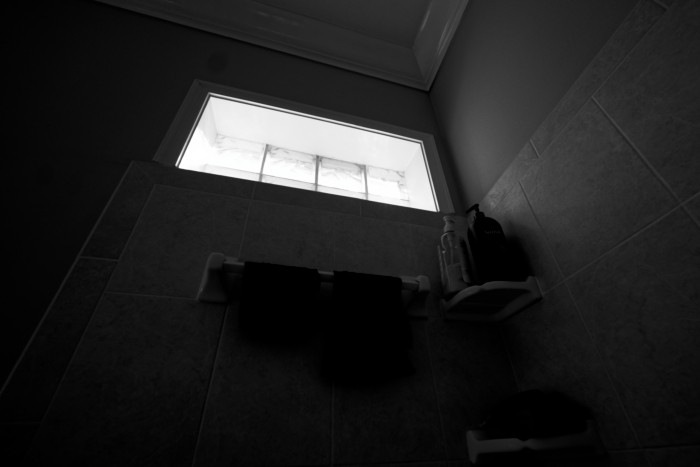
Today I was in the shower, and I saw the light coming in through a glass block window high on the wall. I wondered if there was a way to turn that into something.

I took a few shots with an 18-50 mm zoom, and it was no good. I couldn’t get far enough away to get much in the photo. I decided to try out a very odd lens: a Laowa 9mm zero-distortion lens. I got it for travel. I thought it would be good for shooting indoors. It goes down to f/2.8, which is better than the zoom, so I thought it might handle low light better and also fill an optical niche.

I got one or two shots I felt were worth editing. It would help me learn to edit, and for all I knew the photos might turn out to be better than I thought. I have learned that you don’t know what you have until you edit.

Well. Thats an exaggeration. Sometimes it’s clear you have garbage, but often shots that look like they could never be redeemed turn out to be acceptable. The right crop, the right color adjustments…you might save something you think was not worth shooting in the first place.

I picked the shot I thought was closest to good, and I turned it into this:

WordPress will not upload a file produced by Photolab, or at least it won’t for me, so I had to save this a second time using a website. I don’t know if all the quality will be there. This was already reduced to 700 pixels in width, which was bad enough. It will do for blogging.

It will not win any prizes, but it’s a lot better than what I started with. It doesn’t look like a soccer mom made it by dropping her camera in the bathroom. You can tell someone thought about it and tried to get the best composition possible with the raw material. There are several shapes that interact with each other to make a composition.

It’s not what I hoped for at all. I wanted to make something from the light coming in the window, but then I got all excited about the brooding black and white look. I can get some sunstars if I edit it differently, but I haven’t done that yet.

I might do it again from a different perspective.

I guess I could call it “New Year’s Hangover,” although I didn’t have a hangover when I shot it. Imagine some guy lying on the floor of his shower, unable to believe he has to stand up and function.

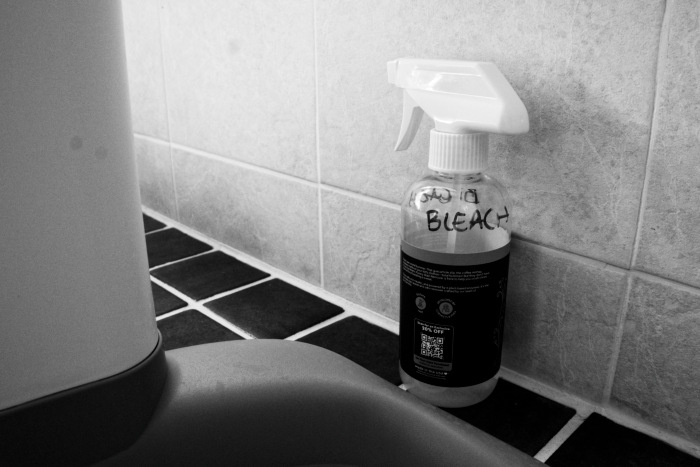
I also shot a bottle sitting on the edge of the bathtub. I had an idea. Shots of people walking away look good when they are next to things like walls that shrink in the distance. I thought maybe I could play around and get something similar from a bottle sitting next to a wall. I came up with the following photo.

It’s not what I wanted, but I enjoyed fooling with it. I think I need to shoot it over again from a slightly different angle. When the light is right. Not now. Then maybe one day I can find an extremely short person to take the bottle’s place. He will have to be about 9 inches tall.

I will continue shooting in the house, and I should be able to get some very nice pictures in the workshop, where there is so much interesting junk.

Maybe if I plan these things a little better, I can get some shots that are really good.

MORE

I wrote something incorrect earlier.

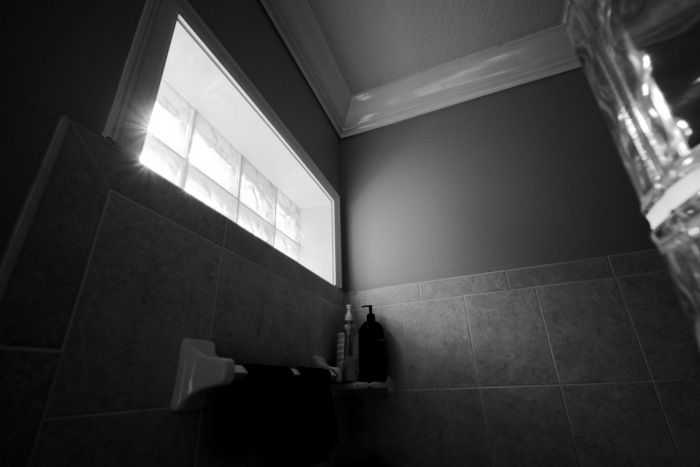
I posted a black and white photo of my shower, and I said I had managed to get sunstars out of it earlier. It turns out I was confusing it with another photo which I like better. The sunstars are still in the other photo, and I will post it below.

I think this is the image I wanted to publish in the first place. The angles are more dramatic, and that glass block wall on the right adds interest.

Trunk Show

Monday, January 5th, 2026

Keep Buying Lenses, and Eventually, You Will be Talented

I took the old (a week old) A6700 out in the yard again today, and I took some photos that I consider worth not deleting. I also got some wonderful shots of my son in the house, but I won’t be uploading them here. It seems like all my really good photos are of things I don’t share.

The other day, as I have written before, I took a shot staring up into a live oak, and all I expected to get out of it was some experience running the camera, but when I edited it, I liked it. Now that I have seen that the tree has potential, I am determined to try to get some quality shots out of it. I took a few snaps, and I created a better photo than the first one, although it is still not going to win prizes. Here it is:

A6700176_DxO_DxO recrop

While I was doing this, I saw that I was able to bring out colors on the shady side of the tree, and I found a nice area of the tree that would fill a frame and make for a better composition. I cropped that area and exported it as a JPG in order get an idea what the new shot would look like.

A6700176_DxO wide

Because the crop is pretty harsh, the photo is extremely fuzzy. I think I should take the A7IV out with a bigger lens and see how much detail I can get.

I have to do what I can before the red leaves fall off the other tree in the pictures, because those red leaves are important to the images.

I also took some more cow photos, and they were as bad as the old ones. I used the proper ISO and so on, but there is no way to get cow photos in the shade at full zoom without getting a ton of grain. At least I think there isn’t.

I made a valiant effort to find things out there to shoot. I keep telling myself a good photographer can find subjects anywhere, so I don’t want to give up. On the other hand, I am not a good photographer yet, so how much can I expect at this stage?

I found some colorful leaves to shoot, and from that, I learned that you never shoot a leaf with the light behind you. The glare on the leaf will kill the whole project.

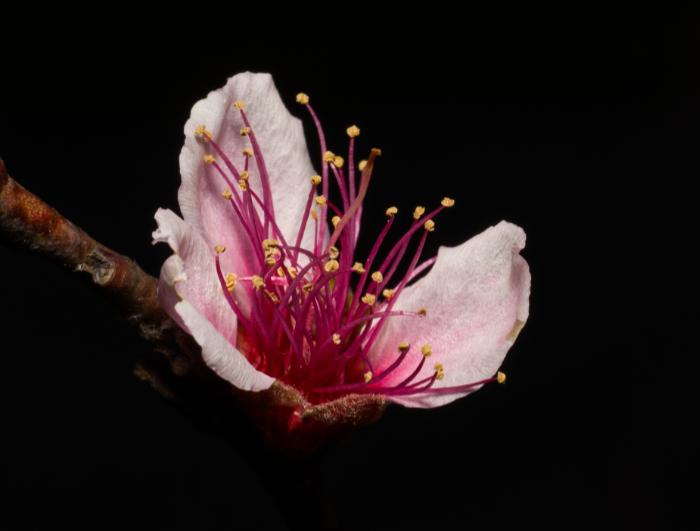
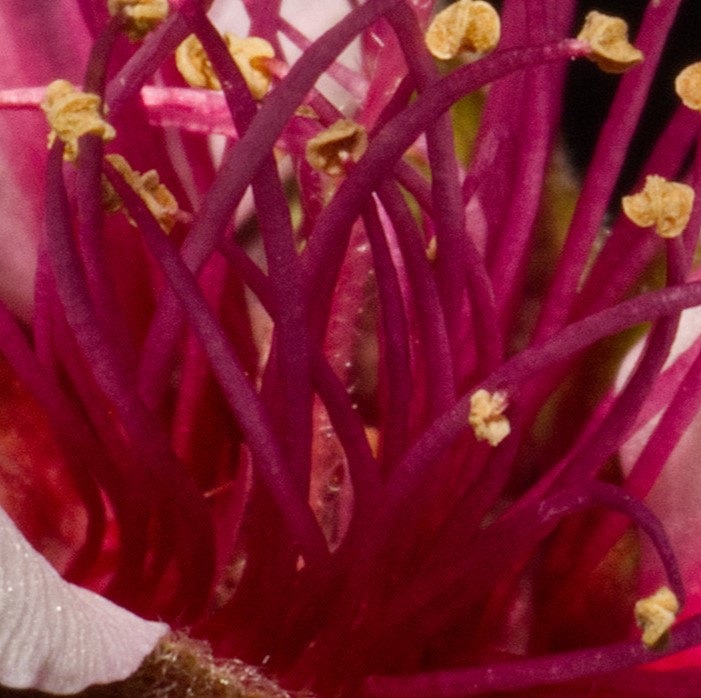
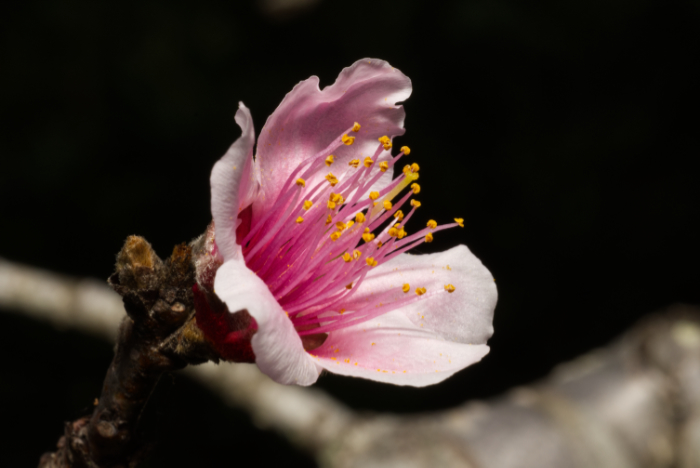
I took a shot of a peach blossom, just to see what would happen. The idea was to fake macro by zooming in. The photos are very pretty, but you wouldn’t want to blow them up. The grain is too much.

A6700182_DxO new

These are like shots from a low-budget version of James Cameron’s Pandora.

It’s a shame I can’t post shots of my son, because they are on another level. He makes it easy. He is as good a model as any professional in New York or Paris. His skin is perfect. He is relentlessly cute. He comes up with all sorts of poses. I don’t know what I’m going to do with all the top-notch photos I’m taking.

I got a Viltrox 27 mm f/1.2 lens for the A6700, and when people say it’s amazing, they are not lying. It seems like every image is beautiful. I shoot my son during breakfast every day, and the Viltrox is now my official breakfast lens.

Viltrox is Chinese, and it is shaming Sony and Canon and the rest by making exquisite lenses at Chinese prices. I figure I should snap some up before the inevitable price increase that will follow mass recognition.

I am sorely tempted to get a Viltrox 75 mm f/1.2 as well, for outdoor shots of my family.

I took a lot of atrocious photos today, but the ratio of atrocities to usable shots is shrinking, and I am fully able to work Photolab, so now I am finally able to edit with some degree of competence. I also got a new TV and calibrated it for editing, so if my photos look weird on your screen, it’s your fault, not mine.

I am considering driving downtown from time to time and doing some street photography. I can only take so many photos of bewildered cattle. When summer returns, which I dread, there will be more bugs and flowers and so on to shoot right here.

It would be wonderful to have a big zoom for birds and animals. The Sony 200-600 mm would be a joy to have. I don’t know how often I would use it, though.

Things are going well, and I see no reason why they shouldn’t continue to do so.

Photographs are neat because they don’t necessarily show what subjects look like, but they do show how you feel about them. If you love what you’re shooting, other people will see that you love it. Of course, if you feel hatred or contempt, they will also see that, but let’s dwell on the positive here.

I have a Flickr account now, so I’ll be using that to post big photos here. I don’t know if I’ll ever be able to overcome WordPress’s upload preferences well enough to post them to my own server. I’ll keep fiddling with it.

Light Entertainment

Friday, January 2nd, 2026

New Year’s Tree

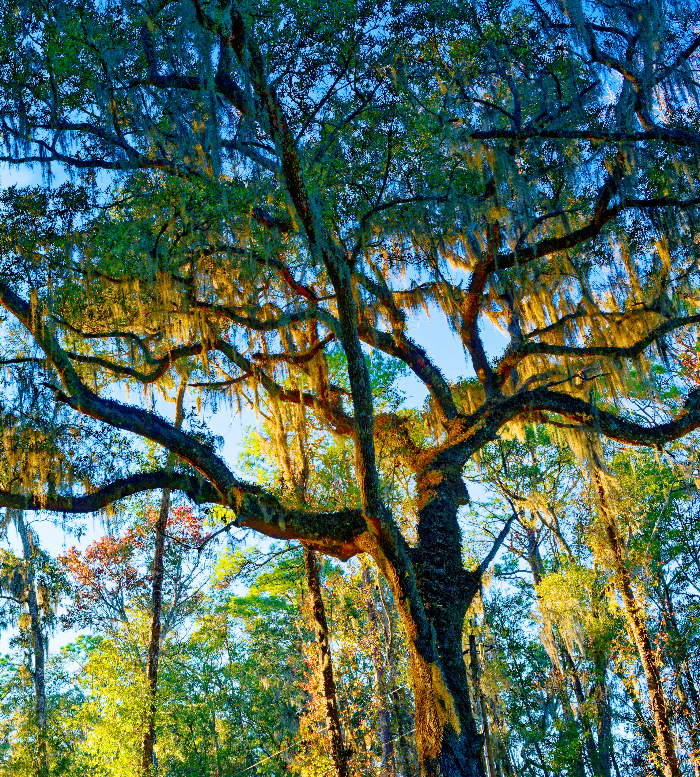
I am still fiddling with Photolab9, trying to improve a photo of a tree. I shot it yesterday, thinking the only purpose of shooting was to learn how to use the camera and lens, but later I saw that with editing, the photo was very nice. It lacks a compact subject that ties it together, but such subjects aren’t always necessary, and also, there is nothing wrong with a photo that serves as a non-distracting background.

Google AI told me to use Photolab’s AI masking tools. These are somewhat like the old magnetic lasso tool in Photoshop Elements, except they require less work and give you less control. The magnetic lasso would let you draw a border around an area and apply changes within it. It would automatically cling to the object to avoid selecting things outside of it. The AI mask simply guesses and grabs a large area it thinks you want to isolate, so it may include or exclude things against your will.

I have not been able to get the mask to work well enough. It grabs the entirety of the tree’s canopy, so if I try to brighten up the trunk and limbs, I will also ruin the color of the sky behind the canopy.

I decided to try Smart Lighting instead. It tries to compensate for things like inadequate flash.

The first version of the edited photo is in yesterday’s blog post. Here is the new one:

I think this is considerably better than the first version. I lose some of the encompassing feeling of the dark tree, but on the other hand, I get a lot of detail on the side facing me. Sadly, reducing this to blog size really makes it coarse.

I can’t upload a better version because WordPress rejects files over a certain size. Maybe it’s a webhosting issue. I will look into ways to put bigger shots on the web so I can link to them.

AI thinks there is a way to make the mask work. Maybe I’ll figure it out later.

Last night, I had an emotional experience. I had been editing photos for a long time, and I started thinking about the way photography had opened my eyes to how much beauty there was around me.

That sounds trite, but there is more to it than it seems.

I don’t like this world. The suffering here is beyond anything we can imagine. We are numb to it because we have to get used to it in order to survive without being miserable around the clock, but it is here. All around us, creatures are always suffering tremendously, and it would never have gotten this way had we let God rule us.

There are a lot of sickly people in this county, and then I’m out and about, I see them. When I spot somebody with enormous, swollen legs, a hunched back, morbid obesity, or some other serious problem, my heart sinks, and I think, “This place is horrible,” referring to the entire world. It reminds me how much pain there is and how unusual it is for us to be able to do anything about it.

Heaven isn’t like this. The Messianic Age will not be like this. We did this to ourselves.

I said photography shows us the beauty of the world, but that’s not really true. It makes the world look more beautiful than it is. We choose subjects we like, and we choose our variables and edit our shots to bring out beauty they don’t really have. We bring out a little bit of the much greater beauty God intended them to have.

It’s like there is a black sheet between us and God, with little holes in it, and what we see in beautiful photos is like looking through the holes briefly and seeing what the world is supposed to be like.

The tree I photographed doesn’t look as good as the photo. It’s my effort to show what an ideal version of the tree would look like. A version in a world that isn’t cursed.

When I edit photos, deep relaxation settles over me, and I believe it’s because I feel as though I am making things right. I am creating images that feel a little bit like they were shot in heaven.

Maybe God helped me get back to photography and start creating better pictures in order to provide a painkiller to reduce the pain of living in this world. My life is wonderful, but I still hate it here because of the suffering of the creatures around me who are not so blessed and who are so hard to help.

Maybe God is reminding my heart that something better is coming.

I don’t just see beauty in photos, of course. I see it in love; in the relationships I have with God and the people who know him.

In 2018, I was praying, and in my mind, I kept hearing, “Thank you for beauty.” I wonder if God was hinting at things to come.

When I went out to shoot yesterday, a group of sandhill cranes were eating in the pasture. These are 4-foot-tall birds just made for wildlife photos. Unfortunately, I could not get anywhere near them, and my 50mm zoom made them look like ants in photos. I wonder if I should consider getting a real telephoto lens. Is it worth it? This farm is loaded with birds and squirrels, and we occasionally see coyotes, foxes, possums, and coons.

I may try it. The more beauty I can grab while I live in this rotten world, the better I’ll feel.

New Year’s Day Pixel Party

Thursday, January 1st, 2026

Some Day I Will be the Richard Avedon of Beef Cattle

I have settled on the Sony A6700 as my main APS-C camera, and I am learning to use Photolab9 to edit photos.

I thought Photolab was a better choice than Lightroom and Photoshop, based on some confusing information I worked pretty hard to obtain. I thought I was being told Photoshop was not good for working with raw files, but in a comment, a reader said that was not correct, so I went back to my research and discovered that just about everyone agrees with him. Nonetheless, I have Photolab right now, and it’s a top-notch program, so I am learning to use it. Maybe I’ll eventually give up, join the Adobe subscription herd, own nothing, and be resentful.

Today, in order to learn, I decided to do a photo walk around the property. I can’t publish all the photos that came out reasonably well, because I want to keep some private, but I can show a few things that seem to have worked. The ones I won’t publish are considerably better, but even these mediocre-to-bad shots have some value. I had to shrink them quite a bit, so the original large files are a lot nicer.

It was a productive experience, and I really enjoyed the camera and lens. I found the A6700 much more pleasant to work with than the A6400 it is replacing.

I think I would have done a lot better had I gotten out earlier. I started after the light had started dying, so it was a short session, and that cost me opportunities.

My single biggest problem is inability to deal with lighting challenges, so I think shooting in bad light is good for me, but this lens may not be up to it without a tripod and low shutter speeds. I’m not sure yet. Maybe I should have risked lower speeds today to find out.

I bought a Sigma 18-50mm zoom to go with this camera, and that’s what I used today. I like fast primes, but I have to learn to use slower lenses and zooms.

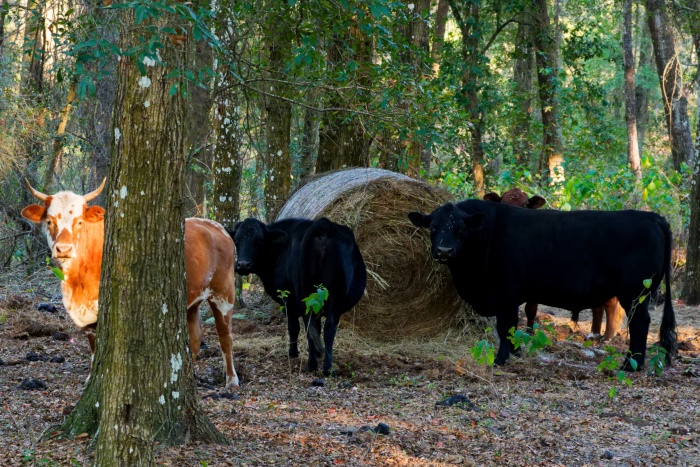
First off, the worst of the lot. I came across the cattle working on a round bale in the shade, so I thought I would see how well I could handle the poor light. The cow in the sun is the star of the picture, and unfortunately, her face is pretty grainy, but this would be just barely good enough for social media, if I had social media. I wonder if I had the camera focused in the wrong plane.

Hmm. Maybe it wouldn’t be good enough.

I figured this shot told a sort of story. The cows are all staring at me, and they have stopped eating, which makes it seem as though something that would be important to a cow has happened. The cow in the sun looks as though some higher being has selected her for some special purpose, which is not likely but gives the picture some appeal.

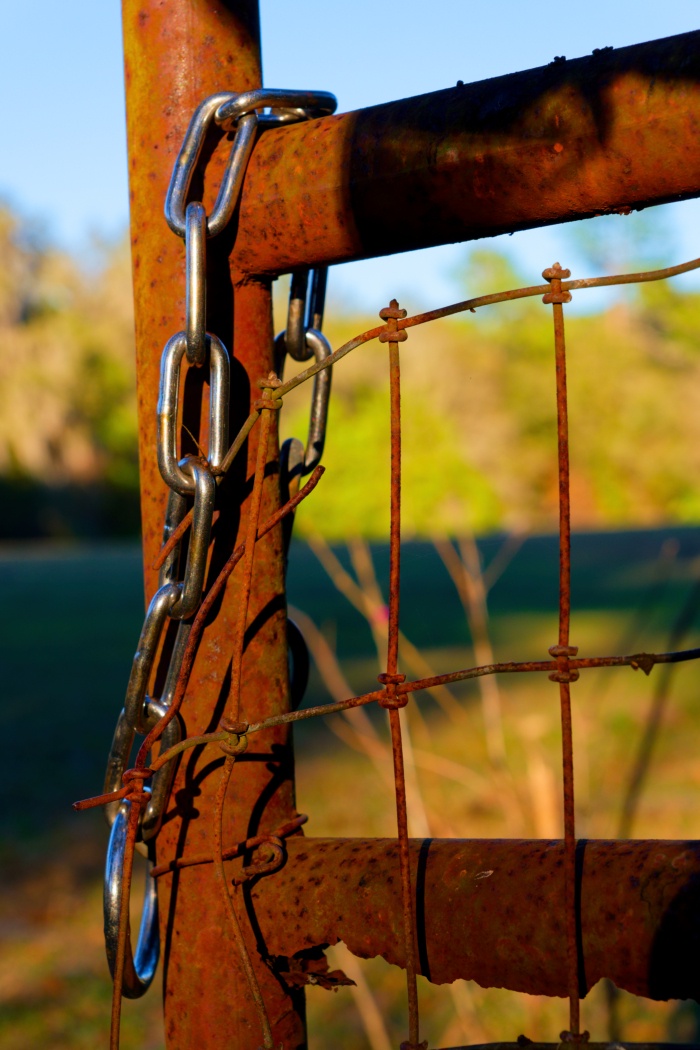
I also shot a photo of a chain hanging on a gate. Not the most exciting subject, but the light was excellent, the gate had interesting color and texture, and it was an opportunity to work on composition. I don’t know if it’s possible to do much more with this subject, but it helped me get used to running the camera.

The focus is not great. I may have alternate shots that will look better. The bokeh seems fine.

I just checked the original large JPG, and the focus is considerably better.

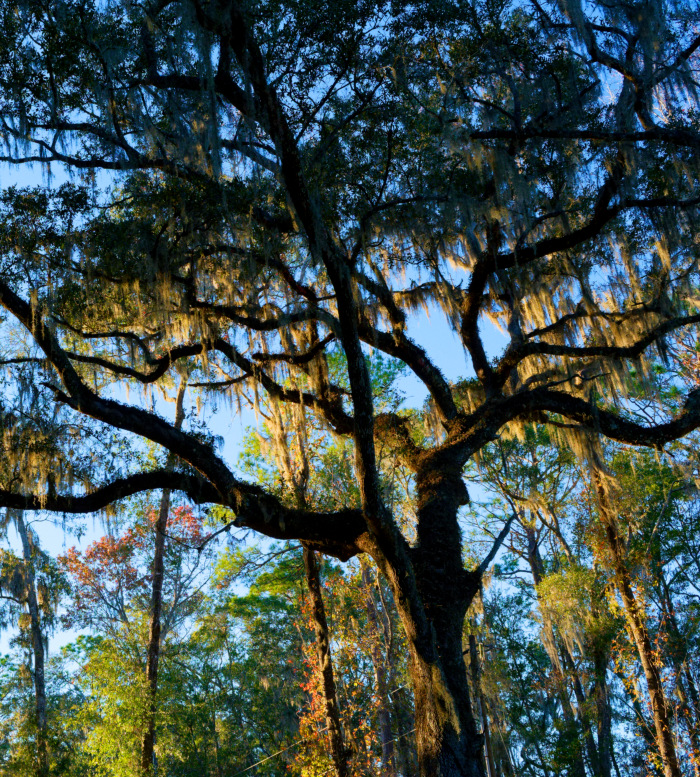
The weirdest shot is an upward look into the branches of a live oak. I was trying to find a composition in it. I did not expect much from it. In fact, I assumed it would be trash, but once I started playing with the raw photo, surprising colors came out. I really enjoy looking at this picture, so it must be okay.

I’m not sure how to crop it. Sometimes I like one version best, and sometimes I like another one.

It’s a shame I can’t post the full version, because people will probably look at this small, crude one and wonder why I didn’t delete this picture. There is a world of difference. I would never have expected this photo to be so pleasing to look at, but there it is.

I’ve learned that you can’t tell whether a photo is good until you edit it. They will really surprise you.

I got a very good shot of my wife with my son sleeping by her side, and I also got a nice shot of some mailboxes in good light as well as a surprisingly pleasing shot of the workshop with a sun star over it.

I have seen people claiming that high ISO numbers are no problem, but that doesn’t seem to be true. I use Photolab’s denoising, which is supposedly better than Adobe’s, but it looks like there is still no substitute for good light and a fast lens. Or a slow shutter.

I took a lot of useless pictures today, including shots I knew would be useless. I took shots I didn’t expect to work out, just so I could get used to running the camera and lens.

I hope to get out earlier tomorrow. If I get out earlier, I won’t have to struggle so hard to find things to take pictures of.

Doing Shots

Monday, December 29th, 2025

Life Never Gives me a Straight Answer

My photography journey gets weirder and weirder.

A couple of years back, I got better photo gear and bought Photoshop Elements 2024 for editing raw photos. I did quite a bit of research and still ended up making some bad decisions.

On the gear end, I failed to realize that I really needed wide-aperture lenses if I wanted indoor photos and other low-light shots that truly looked good. I think middle-of-the-road optical quality is less harmful than a small aperture. Nearly all lenses shoot photos that are sharper than most people can appreciate, so it’s not a big deal if your lens isn’t optically excellent, but if your lens is too slow, you have to use high ISO settings that create a lot of noise, and software that cleans up noise is not as good a solution as not having noise in the first place.

I think this is right today, but I could be wrong.

On the software end, I bought Elements, a program that is good for editing JPG images but unbearable for raw files. I didn’t know the difference. I thought that if I bought a photo editing program, it would naturally be good for everything from snap to print. It looks like that is not true. I have spent many hours trying to edit raw files in Elements, and often, I spent so much time trying to make the program work, I ended up editing nothing or nearly nothing.

When you edit raw in Elements, you can’t go straight to the bit where you get to create a finished photo. You go to an incredibly nonintuitive middleman program where you do certain things to the raw file and then export it as a JPG. Then you use what everyone thinks of as Photoshop to edit the JPG.

Unbelievably (to me, at least), every edit you do to a raw file in Elements is instantly saved, permanently, so you’re stuck with it forever unless you can figure out how to undo it, and there is no simple “undo” function as far as I know. Maybe there is, and I have forgotten it. To me, this seems like common sense: don’t save a file until you’re satisfied with it. Is that crazy? That’s how most programs work. If you have a Word file open, and someone sits on your keyboard and ruins it, it’s not instantly saved, overwriting the original.

I have seen all sorts of photographers praise Photoshop, and I haven’t been able to understand why they like it. Today I learned a few things. As is so often the case these days, a chat with AI answered questions multiple human beings failed to answer in the past. Ominous.

1. Editing raw is generally a completely separate process from editing JPG’s and other images. Raw edits are generally (not always) global, like changing brightness or reducing noise. JPG editing can do things like that, but you can’t make adjustments as large as the ones you can make in raw, and JPG editors are better at things like removing and inserting objects.

2. Most pros are not all that concerned about creating beautiful, detailed images. They are pumping out prom pictures and family photos in JPG form at low resolution. They are largely interested in erasing zits and removing boogers from noses.

3. A lot of pros use Adobe Lightroom to get their raw files in shape, and then they take them to Photoshop to cut out the warts and pimples. Supposedly, Photoshop does things like that very well, without a painful learning curve.

I wish I had known all this two years ago.

As far as I can tell at this stage, it looks like it works this way: subscribe to Lightroom and Photoshop. Use Photoshop on JPG’s. Maybe Elements can do the JPG work. I don’t know yet, because I NEVER GOT PAST THE HORRIBLE RAW INTERFACE.

When my son was born, a nice photographer who presumably had a contract with the hospital showed up in my wife’s room and offered to take photos, and we hired her. The photos are not good. They’re sort of okay, and they serve the purpose of documenting the existence of a new person. We were given JPG files she had already edited. We have never received raw files. She probably photographed 10 babies that day. She was not in the art business. She was in the documentation business. She was putting food on her table.

I think this is the sort of person you usually end up talking to on the web when you ask for help with photography. Lightroom is good at improving raw files, and it helps organize the thousands of mediocre photos a typical photographer will take in a year, so when someone wants reprints, they are easy to find. Photoshop makes people and things look a little better. The people you ask for advice will generally have these things in mind, and they won’t mind paying for expensive Adobe subscriptions because they get paid for their work, and Adobe makes for an efficient business.

I think that if I really wanted to make life simple, right now, I would get Lightroom and use it. Then I would try to edit everything in Elements 2024, which is a non-subscription product. Then if that didn’t work, I would subscribe to Photoshop and use it to finalize JPG’s. Then I would delete Elements, because it would serve no purpose.

Instead, I bought Photolab9, which is a competitor to Photoshop. It is not a wannabe clone, as far as I know. It is better than Adobe’s stuff for a lot of things. It has fantastic denoising. It keeps up with new lenses as they are released. It makes working with raw files easy. It produces glorious JPG’s.

Does it remove boogers well? I don’t know. I am not in the booger-free-portrait business. I haven’t tried it. I have Elements, though, and one would hope it would suffice for the retouching stuff.

Photolab lacks some important Photoshop features. It won’t put cat ears and noses on people, and it won’t surround you with stars and butterflies after you get dressed for the prom. I’m not sure Photoshop actually does those things, so perhaps I’m being unfair, but it has some icons that look like they are intended to create equally pleasing and classy effects. I think I can do without all that.

Ansel Adams managed.

Photolab has opened my eyes. I have used things like Befunky.com and free Canva Affinity to edit things. I generally made small changes. I changed exposures and cropped and so on. With Photolab, I have been able to do more. It has a ton of useful presets that will move my images into the general ballpark where they need to be before I work on them. It lets me change one part of a photo without changing the rest of it. It will bring out things that were barely visible before. I was actually able to change the composition of a photo by increasing the color saturation of the clouds and sky. It turned an acceptable photo into one I really love.

Now I’m looking more closely at raw files to see if I can turn dumpers into keepers.

I don’t like overworked pictures. They’re tasteless. A lot of people jack up colors and make other changes that make photos look the way you would expect them to look on picture placemats for tourists in Thailand or the Philippines. I’m not interested in that stuff. I believe Photoshop excels at it, partially explaining its popularity.

No one ever went broke investing in bad taste.

I have a feeling I will start seeing the above sentence on the web in people’s online profiles, not attributed to me. Story of my life.

I don’t like Adobe. I don’t like the forced-subscription model. I don’t like the way they turned “free” Acrobat into an annoying ad platform for things I don’t want. I am hoping Photolab will turn out to be a better choice. These days, Adobe is offering Lightroom plus real Photoshop for $10 per month, so if I change my mind, all is not lost.

Oops. I just found out Elements uses a very limited color palette for certain useful tools. Forget Elements, I guess. Funny how they didn’t mention that when they sold it to me. “Pay once and create inferior images for life.” I guess it’s just for people using Pinterest and Instagram.

I would post some shots to show people what I’m talking about, but my best pictures include the wife and son, and I am not going to make them Internet curiosities at this point.

Houston, the Toast is Burned

Thursday, December 18th, 2025

This Much Memory Should be Illegal

It’s an interesting day here at the Armed Northern Florida Compound.

I think I have solved my photo-editing problem. I bought Photoshop Elements 2024 because I got very bad advice. It turned out to be a horror for editing raw files. Useless. Then I tried Affinity, a free program which works very well. It turned out not to be the answer, because I bought a Canon Powershot V1 for shooting while out and about, and I learned that Affinity would never, ever be set up to take this camera’s raw files and produce photos without black (black) corners. I had to download Canon’s free program, and it works, but I don’t want it. I want to use one good program well, not 53 programs badly.

Adobe Lightroom appears to be a perfect solution, except that it costs a fortune. Adobe has adopted the lamprey business model. They went to subscription-only, so stupid people who can’t multiply by 12 will think it costs $20. Of course, it’s really $240 per year. Every year.

Enter DXO Photolab9. I’m not sure, but based on video reviews and tutorials, it looks like it will do everything Adobe does, considerably better, and while it is expensive, you don’t have to pay for it over and over and over. It is particularly good at fixing noisy photos, which is a huge plus for me. Low light is always an issue. It also updates lens profiles fast. Adobe can’t deal with my lens, but Photolab can.

I have a trial version, and I am going to go through tutorials before I make sure I should pay. It costs $240, just like Lightroom, but you only pay once. Until you upgrade, yes, but the upgrades are cheaper than a Lightroom subscription.

It looks great so far. Extremely intuitive by editing-software standards, which means not all that intuitive, but usable. And it has sorting features that should make dealing with thousands of old photos easier.

In addition to all that, I decided to mirror my phone photos and videos to Google’s cloud. I don’t like clouds or Google, but I don’t think this will allow Google to spy on me for the feds or basically turn me over to Big Bro. Not that there is any point in spying on me, because it would be unbelievably dull, but it’s the principle of the thing.

Finally, I received my new hard drives today. I have a new editing PC, and I’m going to keep all my media on backup drives, not C. It’s hard to find deals on hard drives now. Apparently the AI revolution is somehow drying up the supply. Inexplicably, however, I found two pro-grade 14TB drives on sale from the manufacturer, cheaper than their consumer drives. I saved a hundred bucks moving from consumer to pro, and I also got 14TB per drive instead of 10. I wasn’t looking for 14TB, but if it’s cheaper, why not?

I formatted one drive and installed it in my old PC so I can move all my media files to it, and I formatted the other and put it in my new PC. When the files are moved, I’ll install the second drive in my new PC, and then I’ll set them up so my stuff is synched. I’ll put stuff on the first drive, I’ll save edited files there, and I’ll have my PC set up to sync everything to the second drive.

What if my house burns down? Well, that would be bad. Maybe I should eventually find a big cloud I trust.

I got my first real PC in about 1993, and it had a 340 MB drive. I told somebody about it, and he rolled his eyes and said, “Oh, that MIGHT be enough.” It seemed outrageous. Huge. As of today, on one PC, not counting C, I have 41,000 times as much space.

That figure comes from AI, so feel free to double-check. “AI” often means “Artificial Idiot.”

AI claims the best Apollo spacecraft computer had about 72KB.

It says my toaster has more memory than that.

I think I should put a big external USB drive on my PC for additional peace of mind. I could put it in the workshop and bring it indoors for synching once a month. I can’t do much better than that without an annoying subscription that will go way up in price once I’m comfortable with it. You know it will.

I will now buckle down, clean my glasses, and watch the rest of a Photolab tutorial. I hope this program turns out to be what I need, because Adobe is just too annoying to live with.

Canon Bawls

Sunday, December 14th, 2025

Thank You, Oh Thank You, for Taking my Loathsome and Repulsive Money

Yesterday I wrote about the difficulties I had had with my new Canon Powershot V1 camera. The camera itself is nearly perfect for what I want it to do, and no one else makes anything comparable at any price, so I plan to keep it, but editing the photos is a real challenge, and it is impossible to connect the camera’s memory to a real grown-up PC.

I found that the camera produced black (not just dark) vignetting in raw files, and it was not possible to fix this with Affinity or Photoshop Elements. Why not? Because Canon will not provide support to Adobe or Canva, the parent of Affinity.

Canon has pulled this kind of thing before. They have been very hostile to companies that make lenses for their cameras, so Canon customers have had to buy expensive Canon lenses instead of enjoying the kind of incredible, affordable array of fair-to-outstanding lenses Sony customers are used to. It’s like what Apple did in the last century when it refused to license things and handed Microsoft the bulk of the computer market.

Canon pretty much forces people to use its proprietary Digital Photo Professional software to edit raw Canon Powershot V1 files. This is stupid and unreasonable. Canon makes no money from the software; it had to pay people to develop it. It’s not like Canon loses money when you use other programs.

Photographers like programs like Lightroom and Elements, which come from Adobe, and there are other companies that make good software. I had no idea DPP existed until I had my editing problem, because no one uses it. The majority of working photographers use Adobe. Because it’s better.

Canon is currently the most popular camera company on Earth, but that is changing. People used to love digital single-lens reflex cameras, but mirrorless has taken over, and Canon has failed to prosper in that area. Sony is the world leader, and it will continue to increase its dominance as Canon focuses on outdated technology.

Seems to be Canon ought to be doing everything possible to court customers. To the contrary, it seems to be trying to become the Blackberry of cameras. Instead of making sane efforts to maintain and increase its customer base, Canon seems determined to run off everyone but the mindless zealots.

I decided to try to get help from Canon, and like many inept companies, Canon provides a forum which is supposed to be useful to customers. I had to join if I wanted help. I joined and posted questions. I didn’t get any actual help, but I did get cranky, pointless, wrong responses from customers, and then I got an amazing lecture from a Canon employee. I’m going to paste it here.

We provide tools that enable users to work with our products. If users choose to use different tools, they are responsible for verifying compatibility. We cannot (and will not) troubleshoot or otherwise support any non-Canon or third-party software or tools unless they are specifically listed on the product’s support page.

If you need help using non-Canon software, you must contact the software developer – they are the experts on the software they created, not Canon. They may need to update their software to include the latest RAW codecs; this is their responsibility, not ours. We cannot force a third party to update its software.

This is incredible. This is from a guy who, one would think, is paid to improve customer relations and keep people coming back.

I didn’t ask this character to “support” Adobe or Affinity. I thought that Canon employees and other forum users might be aware of the problem I was having, and that they could conceivably have useful input. “We are sorry you are not able to remove vignetting in Elements. We will be working with Adobe to help customers edit Powershot V1 photos with its industry-standard software. Please be patient, as your camera is a new product.” Something like that. Or maybe, as a paid expert, an employee would have some tips on using the programs I was using.

No, I got a rude lecture. After I had moved on and come up with a jerry-rig solution on my own.

This is not how you compete for market share. It’s astonishingly inept. This guy seems to think I need Canon. It’s the other way around. He doesn’t understand how capitalism works. No consumer base has ever gone bankrupt, but companies do it all the time.

I’ve had 4 Canon cameras. I bought a Canon photo printer a long time ago. I’ve had to work in an office with a Canon laser that couldn’t feed typing paper correctly and had to be replaced by a Brother which worked perfectly. That about sums up my Canon experience. I will never buy another Canon product again if I can avoid it. If a more competent company releases a pocket camera that will do what the Powershot will do, I will buy it and quit using the Powershot.

The photo printer is pretty annoying. When I bought it, of course, Canon wanted everyone to use Canon ink, because that’s where the actual profit is. They installed some kind of ink-level monitoring technology in the printer, and if it decides the ink is running out, it will prevent the printer from running. If you don’t print photos for a while, the printer will decide it’s running low when it isn’t, and then you have to buy ink you don’t need.

Like other Canon customers, I had to learn how to fool the printer so it would run.

I think there is aftermarket ink now. I hope so.

I haven’t printed a photo in maybe 15 years. I would like to use the Canon again, in order to avoid spending more money, but if it gives me trouble, I’m going to look for something else. Supposedly, Epson makes printers that are just as good and cheaper to run. I hope so, because the Epson monochrome inkjet I bought in about 1994 used 40 cents’ worth of ink to print one page of text.

I don’t want to get any deeper into Canon than I already am.

Of course, Epson could be worse.

I hope this blog post is helpful to anyone considering buying a Powershot V1 or any other Canon product. You should do your research carefully before investing. I did, but I still got bitten in the rear end.

Loose Canon

Saturday, December 13th, 2025

This is How You Give Your Competition the Future

It has been but three days, and I have already discovered the annoying things about my new Canon Powershot V1 pocket camera.

I got it because my Sony ZV1M2 had a disgraceful problem: it was made for video, but when you actually shoot video, it overheats in a few minutes and shuts down without telling you. It fails, and miserably so, at the main task for which it was created. It’s like an air conditioner that only works on cold days, or an SUV you can only drive 50 miles at a time.

I can’t understand why Sony would do something this stupid. Are they unable to do better? They’ve made a lot of outstanding products. It’s hard to believe they let this one slip by.

It’s great if you like shooting three-minute videos, and you don’t shoot them less than 10 minutes apart.

Maybe I should have just bought a good selfie stick and external mikes.

The Canon is often described as a point-and-shoot camera, although that is not true. It has a pretty good optical zoom, and if you have to zoom, you’re doing more than pointing and shooting. It has a manual mode, so you can pick your shutter speed and ISO. It has all kinds of features. It has an APS-C sensor, which is pretty big for a compact camera. It’s not a 1970 Kodak Instamatic. Stay within its limitations, learn to edit, and you can produce very, very nice pictures with it.

It does not overheat. It has a fan. Video is not a problem.

I’ve already produced some photos so good, I am shocked. It’s not a pro-grade full-frame camera with a $15,000 lens, but what it can do, it can do very well.

So what’s my beef? I’ll tell you. Canon has rigged things up so it’s hard to edit raw photos that come from this camera.

Canon has a reputation for being a jerk. Sony will let just about anyone make a lens for its cameras, but Canon, perhaps hoping to equal Apple’s disastrous performance in the 1990’s, makes people use Canon lenses for its latest mount. That’s just idiotic. It also has a proprietary raw format. On top of that, it does not cooperate very well with outfits that make editing software.

Bottom line: I pretty much have to use Canon software to edit this camera’s raw CR3 files. I have Affinity. I have Elements. I have Topaz Photo AI. I had to download a fourth religion…I mean program…to fix this camera’s CR3’s without a ton of hassle.

I never saw this coming. I don’t know anything about photo software. I just figured any software would edit any photo. Not so.

Let’s talk Affinity. It’s a real program. It’s not a joke, even though it’s free. I can edit Sony raw photos all day with it. It’s nice. It’s intuitive. It is useless for my Canon’s files.

When CR3 and JPG files come out of this camera, they look just fine. When I try to edit a CR3 in Affinity or Elements, I get what is called “vignetting,” which really should be called “dark corners.” That way, no one would have to look up “vignetting.” The corners are black. Not dark. Black.

Everyone always says it’s easy to fix vignetting with software. Well…it’s not. The software has to like the format. If not, you can’t fix the corners.

Affinity relies on lens profiles to fix vignetting. Canon, being the unhelpful company it is, does not provide profiles. Helpful consumers create them, and they upload them to a site called Lensfun. That’s where Affinity gets its profiles. There is no profile for the V1. Maybe there will be some day; it’s a new model. If you look at the other Powershot profiles at Lensfun, what do you see? The site says they don’t fix vignetting. So even if someone creates a profile, you’re probably sunk.

Canon’s software is free, so why does Canon care if people use Affinity? It doesn’t cost Canon a dime in software profits, and it makes their products more pleasant to use.

Affinity has manual vignetting correction. It does not work. The V1’s vignetting is far too severe.

I worked on this for hours yesterday, and AI kept telling me I could correct the photos. It was wrong.

Elements would not even open the files. It kept telling me to download and install its Camera Raw plugin. When I did that, and I tried to open the files again, it told me to download and install its Camera Raw plugin.

I can convert the files to something called DGN, and then I can edit the DGN files. But they don’t contain all of the information in the CR3 files, so it’s a low-grade hack. And if you want to keep the information, you end up with a huge CR3, a huge DGN, and the huge JPG’s you create. Hard drives only go so big.

It’s a stupid approach.

I had to download Canon’s free program: Digital Photo Professional. It works, but I can’t get the exact results I got (apart from the black corners, which wouldn’t go away) with Affinity.

I wasn’t planning to buy any more Canon products after this one, and I would have chosen another Sony compact if I could have found one. Now I am determined never to buy another Canon product as long as I live. I don’t need to be treated this way.

Why not buy another camera? Because the Powershot has absolutely no rival in its niche. Even if you had a billion dollars to spend, you could not do better. It shoots good stills and saves them to raw and JPG. It has a good optical zoom which provides an excellent low end. It does better than the ZV in low light. It has a headphone jack for video monitoring. It won’t overheat. Nothing else comes close. I looked.

If I want a pocket camera that will do what I want, it’s this Canon or nothing. So I have to use Canon’s ridiculous program until a better camera comes out.

Of course, you can’t connect it to a PC. It’s aimed at the saggy-pants Free Palestine crowd. You can upload images to your phone, which is not useful if you’re trying to produce quality work. A grown-up uses a PC, not a phone. You can’t connect the Canon wirelessly or even with a cable. You have to pull the micro SD card out and put it back, over and over and over.

Someone tell me why you need a camera this good to take pictures of you and your saggy pants and exposed underwear for Instagram. It makes no sense.

I want to get rid of it, but since there is no escape route, I will stick with it until someone makes something better.

Photo Realism

Wednesday, December 10th, 2025

What I Think Works…as of This Evening

I keep working on my photo skills as well as my gear. I am strongly aware that my baby son’s first year will never happen again, so I am doing what I can to produce quality photos and edit them well.

I’ve learned a lot of things since 2023, when I finally bit the bullet and started buying new equipment and learning to use it.

When I found my wife in 2021, I had a 2006 Canon 350D, a Samsung Galaxy S8, a Yi action camera, and a Gopro Hero 8 Black. The 350D was a decent amateur DSLR for its day. It had an 8-megapixel APS-C sensor, meaning it was smaller than a full-frame sensor, which would be about the same size as a rectangle of 35 mm film. In 2006, putting 8 megapixels on an amateur-level camera was fairly impressive.

We started traveling in order to see each other in 2021. We made three overseas trips with phones and action cameras. The 350D stayed home, covered with the cockatoo dust it had accumulated after years of hanging near a bird cage. I don’t recall why I didn’t take it with me. Weight, maybe.

We got acceptable photos and a little video that year, although I screwed up more than once and ruined videos. I found the Yi to be difficult to work with. I have a video about 10 seconds long which I accidentally shot so it would be sped up upon viewing. I would guess it was supposed run more like 5 minutes. All that’s missing is the Benny Hill music.

In 2023, instead of taking the 350D on trips, I bought a used 200D. This is a more advanced camera from about 2017. I was under the delusion that my 2006 zoom lens needed to be saved, so I stuck with Canon. The lens fits the 200D. This was a bad idea, since I turned right around and bought a better zoom. I should have gone with Sony or maybe an Olympus.

I also bought a Sony A7IV and a Sony ZV1-M2. The A7IV was my no-holds-barred (few, anyway) quality-gear splurge. It’s a full-frame camera. I thought I should have the gear to do a truly top-notch job of capturing things. The ZV is a compact camera made to appeal to vloggers. It has a built-in zoom lens, and it’s very handy. Much better photos than a late model Samsung Galaxy, too.

I have never taken the A7IV anywhere. It’s heavy and expensive. I don’t want to carry it on trips, and I don’t want to have it stolen. It’s great when air travel is not in the plan, however.

When we went to the Far East for the second time, I took the ZV and the 200D. I was not ecstatic about the shots I got with the 200D. It was like I had forgotten everything I knew about composition, and I didn’t think they were sharp enough. The video was also extremely amateurish. I don’t know how I managed to perform so badly. The ZV gave me good video, but the stills were not always great. I relied mostly on my phone for stills.

I learned something interesting: the ZV1-M2 quits in hot weather. My wife and I were on a food tour in Singapore, and I noticed the camera’s monitor would go dark during video shooting. At first I thought it was saving energy, but in reality, it was turning itself off, without so much as a warning beep. It was overheating. Black camera that absorbed heat. Hot equatorial sun. I later learned that the ZV is just about useless for video in hot, sunny weather. Oddly, Sony does not trumpet this fact in ads. You find out after your videos of your priceless trip are ruined.

In retrospect, I find it amazing that anyone recommends this camera. It’s like buying a car you can only drive 10 miles at a time. Its primary purpose is video, and that is the only purpose at which it fails.

It is helpful if you remove the battery from your ZV and power it using a cable. The battery contributes a lot to the heat. But it’s still a very poor video camera for anyone who shoots videos in hot weather, unless they’re very short. If you have this camera, it’s fine for short indoor videos. Other than that, stay away. And it’s not cheap. I think they still cost about $900.

Since I began to buy better stuff, I have drawn a few conclusions, which may very well be wrong. And they overlap.

1. The most important thing is equipment that works, not equipment that works perfectly.
2. A handy camera you use is better than a heavy, complex camera you dread taking out of the bag.
3. Useful lenses are more important than buying the best camera.
4. Unless you want to spend a lot, don’t buy a few pricey lenses with top optical quality. Buy lenses that shoot well in low light.
5. For video, and maybe photos, you want some kind of stabilization.
6. A very good camera phone will do everything 95% of the population wants.
7. You absolutely must use wireless external mikes.
8. Good photography is almost completely about choices.

I guess I’ll start with 1.

Consider 2015. Ten years ago. They made pretty nice cameras. Twenty megapixels and more. Good connectivity. Good features. Excellent accessories. You can spend maybe $600 and get a very good, lightly-used camera from 2015, with a nice low-light prime lens that will be useful in lots of situations. On the other hand, if you buy a very, very good newer camera with a truly excellent low-light lens and a big sensor, think more like $4,000. Will the photos be 4,000/600 as good? No.

If you want to take photos that are optically very good, and you aren’t a perfectionist, buy a very good camera and lenses. If you want to take photos that are technically superior, spend 6 or 7 times as much for superior equipment. But consider the fact that many of the world’s great photographers used cameras and lenses that were, objectively, bad by today’s standards. Most of photography is about content and exposure, not corner-to-corner sharpness or minimal chromatic aberration.

2. I would guess my A7IV weighs over three pounds with the big zoom attached. There is no way to have a normal day with that hanging on you from breakfast to bedtime. You’re not going to drag it around with you unless you take pictures for a living. The a6400 weighs much less. It’s doable. The 200D also weighs less. All the other cameras weigh less. Then there is the phone, which is pretty good. Figure out what you are willing to lug around and use, and concentrate on whatever that is for day-to-day photography. If you insist on heavy cameras, you are going to end up using your phone nearly all the time.

3. Any 20-megapixel camera made can shoot excellent photos, but not without the right lenses. A $10,000 camera with one crummy zoom is less useful than a used $200 camera with several good lenses.

4. You can spend $15,000 on one amazing lens, but when people look at your photos, almost no one will be able to tell the difference between the photos it takes and the ones you can take with a $500 lens. You’re better off with several okay lenses than one lens that makes photo nerds cry when they see it on your camera. If you can afford it, get very good lenses, but if not, get lenses that will take okay photos with the exposures you want. It is EXTREMELY important to have lenses that shoot well in low light. You will find this out when you try to use your $1,500 f/3.5-5.6 lens to shoot a once-in-a-lifetime event in a dim restaurant. Go for 1.4 primes, at the highest.

5. Shaky video is annoying to watch. You can buy a thing called a gimbal, and it’s a big, cumbersome device that holds your camera and moves it up and down to cancel out your shaking, but it’s a royal pain to use. There are cameras that stabilize, and there are lenses that stabilize. Stabilized is better. My understanding is that a stabilized system will also let you shoot images in lower light (if it stabilizes images as well as video), because you will not move as much, and you can use a lower shutter speed without getting blurring.

6. If you don’t want the hassle and expense of getting camera gear, get a phone that does a very good job. Some phones are much better than others.

7. Buy external mikes, like Rode or DJI. My wife has the speech volume of a turbine-powered helicopter at home, but getting her to speak up on videos while traveling is nearly impossible. I have videos where you can see her lips move, but that’s about it. You, too, will find that ordinary situation noise kills speech, so buy external mikes. You can even use them with phones and selfie sticks. And use dead cats (wind noise suppressors) unless you like listening to wind instead of people.

8. Choice, not gear, is what makes photography an art.

I came up with my own system for categorizing photos. There are two kinds in the system: documentary, and artistic. A documentary photo’s main purpose it to show that something happened. “Wayne Newton kissed me at his show.” “This is really my driver’s license.” An artistic photo is, well, art. A documentary photo doesn’t have to have artistic merit, and it doesn’t have to be done well. An artistic photo has merit, and generally, although not always, it should be technically good.

A lot of people think photography is not an art, because you don’t have to draw or paint something in order to take a picture of it. They think it’s like having a sprained finger x-rayed or Xeroxing your behind at the office Christmas party. Of course, this is not true. An artistic photo evokes emotions. It usually seems to tell a story. It may tell a story that has nothing to do with what was actually happening in front of the camera. For example, a photo of two strangers at a bus stop, who don’t even know each other, may seem to be about dramatic events taking place between two people who have some kind of relationship. The mind and heart of the beholder fill out artistic photos with backstories that may be completely imaginary.

You choose your subject. You choose your camera. You choose a focal length, f-stop, ISO, and shutter speed. You choose the angle. You may be able to choose the lighting. You may shoot a number of shots and then choose the only one that says what want to say.

This is what makes photography a legitimate art.

If you want to take artistic photos, which is what I want to do (even when shooting my family), if you master the art of making choices, you will not be blocked by your equipment’s limits. You may not perform as well as you want to, but it’s better to have the right choices and the wrong equipment than the wrong choices and the right equipment. Bottom line: you should use whatever equipment you can get, today, instead of moaning about being unable to take pictures because you don’t have the gear you want.

I say all this stuff, but I keep buying gear. I got myself a couple of f/1.4 lenses for my a6400, and they have made a huge difference in my life. I can take shots now in light that used to produce noisy photos that looked awful. I also replaced the Sony ZV1M2 with a Canon Powershot V1. It’s bigger and heavier, but it will do everything the Sony will do and more, and it has a built-in fan.

I like the small size of the Sony, and it’s a little annoying to put the Canon in my pocket, AND I just wrote that handy is better than not-handy, but I’m willing to put up with a little more bulk in this case, given the enormous advantages the Canon offers. It shoots better in low light, it’s not going to overheat as fast, and it has image stabilization for still shots.

It’s too bad I don’t put photos of my son on the web, because he is extremely cute and possibly the most photogenic person in history. I’m not just saying that as his dad. He is really something. And I don’t consider “photogenic” to be a compliment anyway. Many ugly people are photogenic.

If I could post some of the shots I’ve taken lately, I think people would see how helpful the 1.4 lenses have been, not to mention how much better the ZV1M2 and the Powershot are than my phone.

I’m continuing to work on my editing. I just got a new PC. I bought a gaming computer because it happened to have a lot of parts that were excellent for editing photos and video. I am learning Affinity 2 and Topaz AI. I have Photoshop Elements, but I find it annoying and not noticeably better.

Editing photos is shockingly relaxing and satisfying. I don’t know why. I honestly think it’s one of those things that will improve your health if you do it regularly, like spending time outdoors.

I am going to put two very large hard drives in the new PC to store photos and video. One will back up the other, and my hope is that no catastrophe will wipe both out at once. I am hoping 10 TB will keep me going for a few years. It would be nice to have two huge, fast SDD’s, but that would run around $1600, and I don’t think I really need them.

I don’t like the idea of cloud storage. I don’t trust it, and I have an irrational (I hope) fear of having hostile people root through my files in order to harm me or my family. I also think it would take a decade to upload a single terabyte.

Now you know my current stance, valuable as it may or may not be, on the subject of photography.

The Hardest Thing About Learning is Weeding Out the Bad Teachers

Friday, November 28th, 2025

Let the Light In

I take a lot of photos of my son using my phone. I also shoot video. It’s very convenient. It’s quick. My phone is always in a handy pocket on the side of my leg. It’s not heavy. It’s not in the way. It takes around 4 seconds to get it out and get the camera function working.

The photo quality is amazing I don’t mean it’s good. I just mean it’s amazing. The phone is around 1/4″ thick, the lenses are smaller than Cheerios, optical zoom is a mechanical impossibility, and yet somehow, I get photos that are more than good enough to blow up to three feet wide and hang on my walls.

Does that mean they’re “good”? Well, no. Not if you judge them by camera standards.

The other day, I shot some photos of my son, using a Sony ZV1-M2. This is a camera that cost me around $900. If you’re not a photo buff, you may not know it, but $900 is not anything close to what new professional-grade cameras cost, so I’m saying it’s not the best camera there is.

It has a built-in mechanical zoom lens. It has an APS-C sensor, meaning it’s smaller than a full-frame sensor. It has an articulated touch screen on the back. It has two microphones. You can also plug external mikes into it. It has a hot shoe.

It’s aimed at the video-blog market. It will give you better videos than a phone. It’s not intended to be the world’s best still camera, but of course, you can use it for stills.

I bought it for travel. I found it to be good for video, albeit cumbersome with all the audio stuff and the mini-tripod or gimbal attached. It overheats quickly in the sun, however, and the Rube Goldberg nature of adding mikes led to me making a number of videos without sound. Unintentional silent movies. The stills were okay, but I also took a DSLR to see if I could do better.

When I put the shots of my son up on the 65″ TV I use as a monitor, I saw that I had been missing out. Even though I was using a compact vlogging camera with numerous limitations, the photos were clearly superior to anything my phone could produce. Better subject separation. Better sharpness. He just plain looked better.

Last night, I wanted shots of my son at Thanksgiving dinner. I grabbed a Sony a6400, figuring it would be better than the ZV1-M2. Problem: I didn’t have any lenses that combined a suitable focal length with acceptable light-gathering. In other words, I wanted a wide-angle lens that would give noise-free shots in my kitchen at night, and my only option was 9mm, which is over the top. I gave up and grabbed the ZV1-M2, which can shoot as wide as f1.8. The shots are probably pretty good. I have not seen them.

This experience made me realize, once again, that I had been looking for, and buying, the wrong lenses.

Photo gurus really push handy zoom lenses for travel, as well as sharp primes that don’t do well indoors. I listened to them, so now I can’t use my expensive cameras to shoot family photos without additional lighting.

Seriously, am I going to run and get a complicated lighting contraption and set it up every time I want to take a candid shot of my wife and son? Am I going to fiddle with my complex on-camera flash and hope I don’t end up with what looks like a bad amateur wedding reception photo? No. I’m going to grab the phone or the compact.

As fate would have it, things aren’t all that bad. Help was on the way before I realized I had the wrong lenses. Before Thanksgiving, I ordered a 23 mm Sigma f1.4 prime lens for the a6400. This would have been perfect for last night. It’s very sharp, it’s not terribly expensive, and the focal length is just right for most indoor people shots.

Before I bought it, I took my 18-135 mm zoom and took shots inside the house. I simulated 23 mm and 35 mm shots. The 35 mm shots were claustrophobic. They left things out. This is how I landed on 23 mm.

By the way, I put a space between numerals and “mm” for a reason. The convention of putting them next to each other is stupid and anomalous, and it causes all sorts of problems for search engines. It needs to stop.

Sigma makes a family of low-priced, good-quality f1.4 lenses, and that’s why I had to take the test shots. I could have gone wider or narrower.

The lens arrives today, and I expect it to revolutionize my a6400 game. I should be able to keep the camera sitting out where I can grab it, and I should be able to get a lot of very nice shots with it.

I also found a useful video about low-light shooting. Finally.

Why didn’t I know what I needed sooner? Well, I did study up. Quite a bit. But there is a lot of bad advice out there, from people who claim to know what they’re doing.

There are a bunch of camera courses on Youtube, and they must be pretty good, because people say nice things about them, and some of them used to cost a lot of money. I picked one, and I started watching it.

I have not seen the whole thing, so maybe the host will eventually get around to really useful information, but so far, he has not done all that well. He has spent considerable time talking about the Rule of Thirds, a maxim (not a hard rule) which seems useful when you first hear about it and then turns out to be disappointing.

It works like this. You divide your frame into 9 boxes. When you frame subjects, you try to arrange things so each third (bottom to top) contains something different. For example, ocean at the bottom, blue sky in the middle, clouds at the top. If you have an important object in the frame, put it near a corner of the middle box; the Paul Lynde box.

This is considered aesthetically pleasing, and it definitely works in many circumstances, or nobody would teach it. On the other hand, the vast majority of photos I enjoy violate it pretty vigorously.

I like watching Youtubes featuring the works of great photographers, and when I watched a few after learning about the Rule of Thirds, it seemed more like the artists were obeying the Rule of Avoiding Thirds. Makes you wonder if they ever heard of the rule. Go look at some great photos, and you will see I’m right.

I’ve watched other advice and instruction videos as well.

My impression is that most instruction videos are useful but not terribly so, and they can push you into formulaic approaches that obscure whatever talent you may possess. Photography is an art, so talent is the main thing.

I listened to Youtubers when I chose lenses, and they talked a great deal about things that aren’t nearly as important as getting the shot in the first place. Vignetting. Barrel distortion. Sharpness. Focus breathing, which, I believe, only applies to video.

The sharpness obsession got me excited, so I bought sharp lenses. I think they’re just swell, but I also realize I got too caught up in sharpness. Even as I was shopping, I thought I was probably focusing, if you will, too much on the wrong thing.

If you want to see how right I was about being wrong, go look at photos from Vivian Maier.

Maier was a nobody when she lived. She was a professional nanny. She owned an expensive Rolleiflex twin-lens camera that shot square photos. Guess how many photo lenses she had. “Two,” you’re thinking, because I just called it a twin-lens camera. Wrong. It had one. The other lens was just for feeding the viewfinder to set up pictures. The images it passed never touched film.

Guess how sharp the shooting lens was. I’ll tell you. Not very.

Maier had a one-lens, one-focal-length, unsharp camera that shot square photos, and her work was magnificent.

She used to shoot photos on her days off. The families that hired her traveled, so she shot in exotic locations as well as around New York and Chicago, where she lived. She left 150,000 negatives behind, that I know about. Maybe there are more. She was discovered posthumously in 2007, when a guy looking for useful old photos of Chicago bought a box of her negatives for $380. It had been left in an abandoned storage unit.

I will take the liberty of posting a photo or two. I don’t think I can be accused of infringement, since this is pretty clearly fair use, and it’s not like anyone can blow up a grainy resized photo from a blog and sell prints to the public or charge money to see them. There are a bunch of photos on the site named for her, and they advertise books you can buy on Amazon. My understanding is that the site is legitimate, and the profits go to people who are entitled to them.

It seems obvious that most photographers default to cameras that shoot 3:2 frames these days, and maybe Maier would have done so if she had had access to the variety of quality cameras we have today. In fact, she moved to 3:2 later in life. But she did just fine with square photos. It didn’t matter what shape the photos were as long as she was behind the camera.

Also, she didn’t seem to care about the Rule of Thirds. Maybe she didn’t know what it was.

The low-light video I found was made by a guy named Jason Vong, and he provided some simple rules I had never heard of before. He said there was one set of rules for handheld photos and another set for tripod use.

He says using the “auto” function on a camera will give you poor-quality low-light shots. You’ll preserve your precious memories, but they won’t look very good. I think it’s a waste of money and potential to use a good camera in “auto” when you don’t have to. It’s like driving a Ferrari with the valet key.

Handheld: set your aperture, your speed, and your ISO, in that order. “A-S-I.” Use the lowest f-stop you can. Use a shutter speed that matches your focal length for full-frame, and double the focal length for APS-C (example: 60 mm and 1/120 second). Use an ISO no higher than 3200 (APS-C) or 6400 (full-frame), and try to stay below 800 APS-C or 1600 full-frame. If you have to go higher than 800 or 1600, but you stay below the upper limits, software should give you an acceptably clean photo.

Tripod: S-I-A. You can set your shutter speed to be very low because the camera won’t shake.

Is Vong right? Probably. I haven’t tried his suggestions yet, but he is talking about basic theory, and he does photography for a living. I will find out.

Most instructors give vague advice. “This is what aperture does.” “This is what shutter speed does.” They don’t present information about exposure in a systematic way, as Vong has.

Maybe the longer video I haven’t finished watching will eventually cover the same points.

So what do I take away from all this?

Learn the Rule of Thirds, but remember that it’s just a suggestion. Learn what composition is, and get good at it. Then you can forget the Rule of Thirds. Don’t let a rule ruin your photos.

If you want to take candid photos instead of having people line up unnaturally and give creepy smiles in unison to produce bad flash photos where everyone has red pupils, you should get a couple of low-light lenses. I think this is probably a good conclusion.

I think you are better off with a bad camera and a good low-light lens than you are with a fantastic camera and a lens that quits at f3.5. When I started upgrading in 2023, I had a 2005 or 2006 Canon 350D with an 8-megapixel sensor. I thought moving to a 200D with way more resolution was the best move, and for $200 or so, it was a good buy, but now I believe faster lenses would have had more impact for indoor work.

I took some surprisingly excellent photos with the 350D back when it was young, and in the 80’s, I took some great shots with a Yashica FX-2 that only had one lens.

If you have to choose between optical perfection and low-light performance (or whatever other kind of performance you need), go with performance. People will care more about the quality of your photos than they will about “softness in the corners” or whatever other flaws they may have, and you will miss far fewer shots.

I think these are sound conclusions, but I am still fairly uninformed as photographers go, so anyone who knows more is welcome to chime in.

Here’s a great suggestion: don’t take advice from bad photographers unless you’re sure their badness is unrelated to the advice. I keep seeing videos and articles from successful photographers, accompanied by images I would delete instantly. It looks like there is, quite literally, no substitute for talent. No amount of experience, training, or equipment can help someone who is just not wired to take a good photo.

I am planning to work with the 23 mm lens to see what it can do, and after that, I will consider other low-light primes.

By the way, that little ZV1-M2 is not bad at all for travel stills. If you can’t stand the weight and size of a more serious camera, you can put it in your pocket or purse, and it will definitely outdo your phone.

Stacked Against Me

Tuesday, November 18th, 2025

Inching Upward Toward Mediocrity

Some new gadgetry arrived today, so I made some effort to shoot some more macro shots.

I was interested in focus stacking and focus bracketing. I should cover these things first.

Macro teachers on the web bamboozled me into thinking all I needed were a camera, a diffuser, and some patience. Not really true. You can get plenty of good pictures without a ton of equipment, but there are things you just will not be able to do, and the smaller you go, the more obvious this is.

With the lens I’m using on my APS-C Sony, the depth of field is something like 1 mm. That is small. It means that if I’m shooting a flower that measures an inch in my sagittal plane, I’m only getting about 1/25 of it, in terms of depth, in focus. That is no good.

A lot of people take shots that focus on one part of a small subject and give up on the rest, or they settle for low magnification. That’s okay, but sometimes you want to see more.

The way to get more depth of field, assuming you can’t back up enough to get it naturally, is to combine images using a computer. This is focus stacking. You take multiple images, changing the in-focus plane in steps. Then the computer discards the fuzzy stuff and puts the rest together in one sharp image.

How do you get all those images?

First of all, you have to use a tripod. Forget doing it the old-fashioned way. You will move around and get shots that are not the same.

Second, you can forget changing the focus between shots manually. It’s just too hard.

I thought in-camera focus bracketing might be the way to go. It looked that way when I read about it. It doesn’t work.

When you make your camera do focus bracketing, you push the button, and your camera shoots more than one shot, changing the focus between shots. The problem with this is that if you’re doing macro, not just “taking pictures of small things,” the camera will not change focus in small enough increments.

It turns out you need to move the camera, using a device that has a micrometer screw. That device is called a focusing rail. You mount it on your tripod, you line up your shot, and then you take numerous shots, leaving the focus alone. This moves the focused plane along your subject, giving you the desired material for focus stacking.

I got a pretty good tripod, and it arrived today. I got a geared head for it because geared heads hold stuff more reliably and allow for easy tilt adjustments around several axes. I found out how to make my A7IV do focus bracketing, and then I took pictures. I merged them in software, and the results are about what you would expect if I just held the camera and hoped for the best. Bad.

It isn’t going to work. I’m not going to fool with it. I’m getting a rail.

The tripod is excellent. I’m not saying it’s a great tripod, because it seems like any piece of equipment that qualifies to be called “great” by real photographers had to be made of spun platinum and cost over $50,000. I believe it’s excellent for my plans, given what I am willing to spend.

It’s a Vanguard Pro 2+, or something like that. Carbon fiber for weight reduction.

It holds a lot of weight, and you can move the legs and the central column in ways that will put your camera just about anywhere, solidly.

Using the tripod for the shot above was heaven on Earth. So much less aggravation than an Amazon Basics.

If you want to photograph a mushroom on the ground from 8 inches away, this tripod will hold your camera right where it needs to be. That’s pretty neat.

I got a geared head for it, and that’s also fun, but I think I could have lived with a regular ball head, which has a ball-and-socket joint you tighten with a screw.

I think I blew around $350. It’s not a childish splurge. It’s me, being a grown-up about photography. You can’t nickel-and-dime everything. You can’t buy a nice camera and nice lenses and then cheap out on everything else.

My $20-$25 tripods are amazing for what they cost, but you can’t put a real camera and a real lens on one and expect things to go smoothly. The weight is just too much. They’re wonderful for things like smartphones and Gopros.

I am getting a mid-range focusing rail, and with that done, I should be in good shape to do some photography. I am eager to see the results. The rail goes on top of the geared head, under the camera.

Pushing the button to take a shot is nerve-wracking, because it takes a lot of force and moves the camera. I’m going to be using remotes instead. I would stay away from Canon and Sony remotes. For one thing, they are back in the Stone Age when it comes to batteries. They use coin batteries that are a pain to replace, and my OEM Canon remote actually has a tiny Phillips screw you have to remove. Insane. I got rechargeable remotes from a company called Aodelan. I also have a tiny Smallrig tripod that has a rechargeable Sony-compatible remote in the handle.

I’m not using a phone app to pop the shutter because NOT EVERYTHING IN LIFE SHOULD BE DONE THROUGH A SMARTPHONE. Man, I wish millennials would understand this. I’ll bet I have over 100 apps, and in a sane world, maybe 35 of them would not exist. The 21st-century obsession with forcing people to do everything on phones is incredibly stupid. A 50-year-old who can use a desktop is almost godlike compared to a millennial who can’t.

I’ll bet there are kids out there writing term papers with their thumbs.

Well. That’s not true. They tell ChatGPT to do it, and they go on their illiterate, merry ways. Oh well; 6-7, right?

I guess I’ll want a real diffuser eventually. The fabric job I have is not very good. The diffusing part is white fabric, and the flash shines through it. This would be fine if there was any distance between the flash and the fabric, but it’s very close to it, so I think I’m probably getting a very localized light source. I think it’s a lot like wrapping your underwear around the flash. The light isn’t direct, but I don’t think it is spread out effectively. Could be wrong.

Diffusers are cheap, so no worries there.

Looking back, it’s a wonder I ever got any nice shots of small things.

My conclusions are always subject to change, because I am learning as I do, and I knew almost nothing to start with. I think I’m right about focus bracketing, but who knows what knowledge tomorrow may bring?

Small World

Friday, November 14th, 2025

Suddenly Semi-competent

I am getting better at macro photography.

I should say that I have learned that the term “macro” is used very loosely. In the most rigid sense, a macro photograph is one in which the subject’s projection on the sensor is at least actual size, but people use the word “macro” to describe photographing just about any small object up close, so I will use it that way, too.

I was not happy with my focus or depth of field with the new camera and lens. I have a real tripod on the way, and that will help. My TEMU-grade tripods are not up to the challenge.

Another thing that helps: backing up. The farther you get from your subject, the greater the depth of field is. Unfortunately, it’s an exponential change, so I don’t expect to be able to predict it while moving the camera. Today I tried to double my distance from the subjects, and I guessed at the distance by looking at the size of the subjects on the monitor.

I also changed the focus peaking settings. Focus peaking is the camera feature that makes things light up on a monitor screen when they are in focus. I have been using the high setting, because, hey, high has to be better than low. But it doesn’t. Google AI told me accuracy increases as you turn it down. I couldn’t really see the focus peaking on the low setting, so I tried the middle setting, and my focus improved.

A lot of people say not to use high f-stops because of diffraction, which will make things look fuzzy. On the other hand, it increases depth of field, or “DOF,” as we pro photogs call it. A French lady who teaches macro says to go high and not worry about it, so I did that today, shooting at f16. The results were not exactly crisp, but they were better than previous efforts. Maybe going down one or two stops is the answer.

Anyway, I’ll post a photo.

It is not going to win any sharpness contests, but on the other hand, photography isn’t all about sharpness. This isn’t science. I’m not a satellite shooting tiny features on the surface of Pluto so the human race can get the most information possible. It’s just supposed to be pleasant to look at.

To me, this is good enough to be considered a successful photo. The bigger version is sharper. I can’t post giant images here. I’ll post a piece of this photo for comparison.

That ought to be good enough for government work. I wouldn’t be embarrassed to have that hanging on my wall.

I have learned that some cameras do something called “focus bracketing.” You focus and shoot, and your camera takes several shots while changing the focus slightly. This is very useful for macro photography with a low depth of field. It gives you a number of images suitable for combining with software so more of the subject is in focus.

Guess which Sony camera doesn’t have this feature? The one I just bought. DOH!

My bigger Sony does have it, however.

I don’t think it’s that important. I’m using a manual-focus lens, so I couldn’t do it with this lens anyway. A lot of people get great results with this lens.

Things keep improving. I’m learning more about real photography where the dial is not set to “AUTO” all the time. I’m really enjoying the editing. I don’t know why it’s so relaxing.

I think I should be able to produce some pretty good stuff before the month is out.

Little Things Mean a Lot

Thursday, November 13th, 2025

A Lot of Money, That Is

The macro photography journey continues.

I got me a Laowa lens that was supposed to be fantastic for macro, and I also got real and bought a Sony a6400. I need to quit dividing my time between the Sonyverse and the Canonverse, and it seems pretty clear the Sonyverse is better. I don’t want to have to speak the languages of two manufacturers, because I don’t shoot often enough to keep my memory refreshed. I also got an a6400 because it was time to admit I needed a Sony APS-C camera for travel. I am probably never going to lug the A7IV around the world with its heavy lenses.

Yesterday, I tried shooting a tiny fly on a leaf, and it was frustrating. A Youtube guy said to use focus peaking, which is a weird feature through which cameras guess which parts of an image are in focus and paint them with bright colors in your display. The bug and the leaf lit up, and I thought everything was in focus, but in truth, very little was.

I have been told to use a tripod and try focus stacking. A tripod makes focusing easier. Focus stacking means taking several photos focused at different distances and using computer trickery to merge them into one image that has more stuff in focus than any single source image.

My best tripods cost about $20 and $25, and I got them in about 2004 and 2020
It is not ready for this kind of work. The camera, lens, and flash are light, but the tripod can’t handle the weight. It allows the camera to droop gradually toward the ground. I managed to get some shots, but this tripod has to go.

The tripod was inadequate, but it made focusing a lot easier. I got all sorts of color from the focus peaking. Then I looked at the images, and the depth of field was still no good. I got some gorgeous shots, but the focus was subpar.

I have to get a real tripod. K&F Concepts makes a cheap one that seems to work for some reviewers, and Vanguard makes a more expensive one that appears to be a more solid choice.

I have free Affinity editing software, and I checked to see if it does focus stacking. It does. So now I have to take some appropriate photos and try it out. It is conceivable I could do it with the $25 tripod, but I don’t know yet.

I don’t know if Affinity is good at focus stacking, but if it isn’t, finding something else won’t be hard.

The tripod I used today sometimes held steady long enough for me to fool with camera and flash settings, so I was able to get some okay exposures. That was a big step forward. I have watched tutorials about the flash, but I forget things, so I will have to watch again. It seems to have a mind of its own.

I am getting truly beautiful photos, even if they are seriously flawed, and I’m very gung-ho about macro. I think I’m less than a week away from a few photos that will make me very, very happy.

I’m also going to shoot other stuff. I am used to using a phone or shooting in aperture mode, so my understanding of what really works when I go manual is not what it should be. I have been trying to get good shots of my son before he is so old he gets mad at me and drives home.

Doing all this makes me appreciate phones more. I don’t know who designed my phone so it does such a good job making me look like a great photographer, but he must be a genius.