Warning: This Blog Does not Conform to the Fairness Doctrine
In the morning, I always look at Drudgebart.tv.com to see what’s happening in the world. Today a headline says one of the morning news shows is dedicating a whole day to the guy who landed the plane in the Hudson River. Let me get his name right. Okay, it’s Chesley Sullenberger.
Now, I don’t want to diminish this man’s achievement. He pulled off what is supposedly a very hard maneuver. He landed a big jet in water without breaking it up or harming the passengers. He kept a lot of people alive. That being said, can someone please tell me what all the fuss is about? Why are people calling him a hero?
Think about this. If he had crashed the plane, he would have been the first to die. The pilot sits right up front. If the plane had been totally empty but for the cockpit, he would still have worked very hard to land the plane safely, to save his own life.
Is every person who saves lives a hero? Shouldn’t the term be reserved for people who subject themselves to special risks, or who help others with no expectation of reward? I’ve seen film of the plane that went down in the Potomac a long time ago. It was winter. People driving by got out of their cars and walked into the freezing water to save crash survivors. Cold water can kill you in a very short time. Those people are heroes. They risked their own lives, saved other human beings, and got nothing in return.
What Chesley Sullenberger did was wonderful, and by all accounts, he demonstrated real courage and character as well as skill. But a purely selfish person in the same position would have been just as determined to land the plane safely.
For contrast, consider another man who lost a plane in the water. I refer to Bush I. He joined the Navy as a volunteer, fresh out of high school, instead of sitting around waiting to see if he would be drafted. He became a bomber pilot, which is a high-risk job. He was shot down while flying a mission for the benefit of his countrymen. He didn’t have to be there. He exposed himself to machine gun fire and flak and so on, when he could have been safe at home, minding his own business. By the time he was finished, he had served 58 missions.
That’s a hero. Maybe not the greatest hero in American history, but certainly, a hero. His actions beat anything I expect to do in this life.
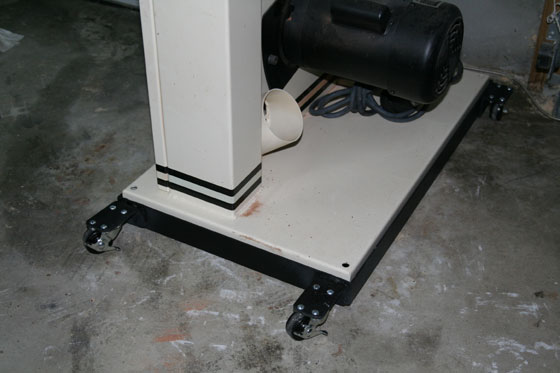
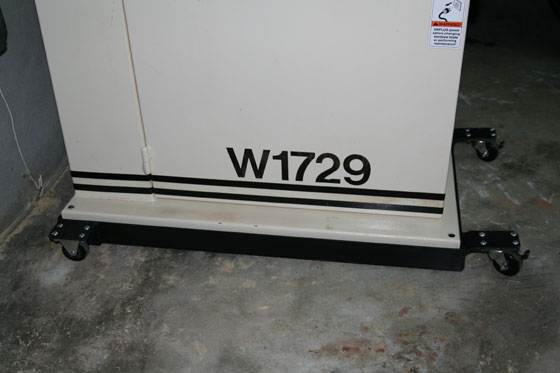
What else is going on? I’m still rethinking my tool strategy. I am convinced that my life will be complete if I have a milling machine and a belt grinder (and an acetylene rig and a Bobcat*), but it’s hard to decide which way to turn first. I would very much like to have a mobile base for the milling machine, and if I get a mill before I build a base, it will be mighty hard to get it onto a base later. A mill will weigh 1000 to 2000 pounds. I can’t hoist it. I’ll have to come up with another answer.
A belt grinder would be very helpful while I build the mobile base. I’ve built one base already, and I used a 6″ bench grinder to clean up the parts, and it was pretty slow, and it wasn’t always possible to get to the surfaces I wanted to fix.
The conclusion so far? Belt grinder first.
But wait. A belt grinder has a lot of holes in it. And I would have to make metal parts for the thing that tensions the belt and makes it track correctly. At the very least, a drill press is called for. A mill would be perfect.
On top of that, if I want real freedom in the design of the grinder, machine tools are a must. For example, I’d like to have 4″ or 6″ rollers, so I could use the machine for a wide variety of belts. For metalworking, I would only have enough juice to make use of a 2″ belt, but for woodworking, you can easily run a 6″ belt with 1 1/2 horsepower. I know of no reason why you couldn’t use the same machine. You’d have to have a couple of different tool arms, that’s all.
It’s my understanding–correct me if I’m wrong–that a milling machine can also be used as a lathe, provided you stay within certain limitations. It must be true; people use drill presses for turning small bits of wood. If I can turn small metal objects on a mill, I can make my own pulleys. Think how much easier that is than trying to make them with a welder and a plasma cutter. I can make pulleys by cutting pieces of 6″ tubing to length and welding hubs into them, but imagine how hard it would be to get them centered correctly. I can buy other people’s pulleys, but then I have to live with whatever hubs they have in them, and they may be a pain to match up to the other stuff.
I suppose, then, that a milling machine would be a good first step. Maybe I’d end up with a less-pretty mobile base, because I wouldn’t have a grinder to make it beautiful, but having an ugly mobile base is better than suffering for two weeks trying to make pulleys with, as Spock put it, stone knives and bearskins.
I was thinking about getting a Bridgeport, but I don’t know if I want to utterly destroy a whole corner of the garage, and I’m a little nervous about pushing a one-ton machine around on wheels. Supposedly they like to tip forward. I was considering a Bridgeport because it seems like all mills cost roughly the same amount of money, and you might as well go big. But now I’m thinking Millrite again. I can get one locally, and it’s considerably more compact than a Bridgeport, and–here’s the best thing–I should be able to sell it without losing much, if I get tired of it.
The fun thing about all this is that I am still not making anything not related to tools. I’m starting to wonder if anyone ever does. Has anyone ever really made a bookshelf or a dresser? Okay, I know they have. My great aunt did. So did my great-grandfather. But from reading my comments and checking out forums, you would think every job mechanically inclined people do is something intended to help them use tools.
By the way, I appreciate the suggestions that I try McMaster-Carr and Grainger and MSC for parts. But if you can think of a place I should try, don’t be surprised if I’ve already been there.
* And a hydraulic press.