Plans for my move are progressing. Today’s big step: joining a dementia caregiver forum.
The new house has a crazy-big upstairs, and that’s where I plan to establish my headquarters. The downstairs will be arranged to suit my dad and his needs and pleasures. That means new living room furniture and the largest TV currently known to man.
Because the furniture will be new, I will want it to have the best possible shot at staying clean and undamaged. I don’t want to name the types of contaminants that can get on furniture in situations like this; you can probably figure that out. I realized there were millions of other people dealing with this problem, so instead of reinventing the wheel, I should reach out, via forum, and see what has worked for others.
I am fine with the fact that the downstairs will be maybe…not a prime example of the Martha Stewart ethos. That’s okay. I’m a man, and I am fine in a house with no indoor plants and no wall decorations. I think the best wallpaper is tile. But I want the furniture to be something better than Ikea, and I don’t want people to smell anything when they walk in the front door.
I’m amazed at how God has provided for me. I looked at a ton of properties, so they tend to blend together in my head. I no longer have distinct memories of every room in every house. I have the plans for the new house, and I see that it’s almost as if it were designed for me.
The house has a huge master suite on the ground floor, and it’s beside the kitchen. Problem, right? No. The bedroom is between the kitchen and bathroom, so if anything unfortunate happens in the bathroom, there will be three doors between it and the air of the kitchen. Yes, three. The bathroom has a toilet room with its own door. You walk in the bathroom, close the door, walk into the toilet closet, close the door, and get down to business. That’s civilized compartmentalization.
No matter what happens in that little room, I should be able to kill it by mopping it with bleach two or three times a week. If it damages the walls, so be it. That can be fixed in the future.
The upstairs has a “bonus room” which is…get this…thirty-four feet long. I thought it was more like fifteen by twenty. Big TV which also serves as a monitor, couch, two chairs, exercise bikes, stereo…paradise. And the top of the stairs serves as a choke point for killing zombies as they approach.
Oh, yeah. Are you kidding? Bring that on.
Even with my disgusting packrat habits, clutter should be a thing of the past. I should have ample room for my 93 tons of books. In addition to the bonus room, the downstairs has a study.
I am getting clarity on the workshop dilemma. I have two garages to choose from (attached and detached). I have learned that the attached garage isn’t all that big, so instead of dividing my power tools between buildings, I think the best course is to jam everything in the detached garage. It sort of makes sense. You don’t want to have to walk back and forth between two shops all day, and I don’t want to have to buy a second big compressor.
This would leave the house’s garage empty. What do you put in a garage, if not giant machine tools? Surely not vehicles. That would be asinine.
I can put a second set of house-only tools together and put them in the attached garage, so I don’t have to walk outside every time I need a screwdriver. Then, of course, I’ll need a third set for the upstairs, so I don’t have to walk down the staircase, and then I’ll need a fourth set for my bedroom.
Too much?
I was thinking the bonus room, soon to be known as the Oberbunker, needed a convertible couch, but there will be a couple of vacant bedrooms, so maybe it’s a stupid idea. Convertible couches are heavy and uncomfortable anyway.
Maybe a better name is “Masada West.” How about “The Fortress of Rectitude”?
“Rapture Staging Area.” “Base Camp.”
I know what can go in the garage. The nasty, awful lawnmower. Which probably won’t even have A/C. It really looks like I will have to learn lawn-mowing. Maybe Udacity has a course.
With any luck, I’ll have the hygiene problems solved today or tomorrow. I hope other caregivers can help me with my questions. It will be wonderful to have something resembling a plan.
Guess I’ll pack more books today. More than ever, I regret learning to read.
Over the last week or two I have been learning about screwdrivers. I blogged about it on June 28. You would think that after a couple of days of Googling and asking questions, I would have learned everything there was to know. Not so. I’m starting to think universities should offer master’s programs in screwdriver studies.
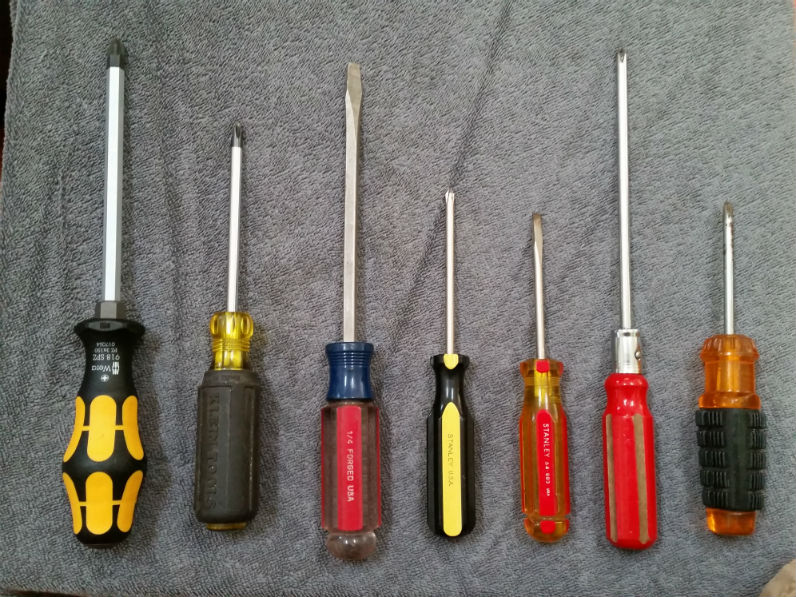
I thought I’d put up a photo of some of the drivers I’ve used, so you can look at them as I complain and ramble.
The driver on the right (orange plastic) probably came from Harbor Freight. Somehow, my dad ended up with a set. Guess what? They work great. The tips are hard, the handles are reasonably comfortable, and I’m sure they were cheap as dirt. I would not hesitate to buy new ones to carry in my vehicle. If you think your tools will probably get stolen, these are a good choice.
I don’t understand how Harbor Freight pulled this off, but the facts are undeniable.
To the left of the orange screwdriver, you will see a crooked wooden-handled screwdriver. It came from China. My lathe or milling machine (can’t recall) came with two screwdrivers, and this is one of them. It has a long, graceful bend in the shank, and I can assure you, that bend was not created intentionally. Here’s the funny part: it works. The tip hasn’t stripped. The handle hasn’t peeled. It’s a very useful tool.
Seems like the Chinese (some of them) have learned an important lesson Americans can’t seem to absorb: when you make cheap tools, you put the quality where it needs to be. These Chinese screwdrivers have plenty of shortcomings, but the tips are very good, and that’s 95% of what makes the tool work. Americans don’t do it that way. When we make cheap things, we spend the money on making the whole tool look nice, and we don’t invest in the parts that count.
The two screwdrivers to the left of the Chinese no-name are Stanleys. I believe I bought a red-handled set some time ago, and the other one came from a set that belonged to my dad. I’m not going to complain about these. They worked fine, and they weren’t expensive. I wouldn’t call them good screwdrivers, but they didn’t fall apart when I really needed them.
Speaking of falling apart, the next screwdriver is a Craftsman I bought in about 1995, as part of a set. I have very few left, and I don’t lose them, so you can guess what happened. The tips on the Phillips screwdrivers didn’t last. I don’t recall, but I’m sure I threw them out. Yes, Craftsmans are guaranteed for life, buy why would you replace a tool with another tool which will also fail? It’s not worth the drive to Sears.
My Craftsmans looked very nice. Unlike Harbor Freight, Sears put the money in the appearance. Now I avoid Craftsman screwdrivers, but I heartily endorse Harbor Freight. This is what Sears should have expected.
Next comes a Klein with a rubber handle. The screwdrivers are more expensive than Craftsmans. The tip on the screwdriver is a little chewy, and I don’t abuse it, so what does that tell you? For the most part, my Kleins have held up fine, but this one is dubious.
People buy Klein because they expect something that will work better than a cheaper tool, so Klein should use very good steel and add useful features. The steel in this screwdriver seems questionable, and the tool has other problems. The shank is round, so you can’t put a wrench on it. It has no hex bolster. A hex bolster is another feature that will allow you to use a wrench. The rubber handle reacts badly to oils and solvents. The butt of the driver is plastic, so you can’t hit it with a hammer. Also, the tool is not insulated, even though Klein is known for electrical tools.
I have read that Klein had a temporary steel issue which has been fixed, but I don’t want to get caught up in a company’s confused voyage of self-discovery and recovery. I’m not Dr. Phil. I have more hair.
Add all that up, and you have to ask: why Klein?
“Well, you have to cut corners if you want to compete.” Really? Let’s look at the next screwdriver.
The yellow Phillips head next to the Klein is a Wera Kraftform 900 Chiseldriver. It doesn’t have a rubber handle that hates gasoline. It has a full-length shank which goes to a steel cap on the butt, so you can use a hammer to drive it into dirty screws. The shank is hex-shaped so you can use a wrench. The shank has a big hex bolster so you can use a bigger wrench. The handle itself is hex-shaped at the shank end. What more could you ask?
You can get a set of 13 of these for $85, shipped. And they’re made in China. No, they’re not! Don’t be so gullible! They’re made in Germany. Real Caucasian quality tools. Yes, they cost a lot more than Craftsman. If Craftsman made this set, it would be about $20. But you don’t have to throw the Weras out the third time you use them. To get 14 Kleins, you have to pay about $112. So you spend around 40% more, for something that isn’t nearly as good.
I haven’t looked at every screwdriver made, but I’ve looked at a few, and it appears that if you want something good, you have to spend $25 per screwdriver for Snap-On, or you can buy German.
That’s not completely true, and that brings me to my latest screwdriver lesson. After ordering Wera drivers, I was told that they’re not right for use on guns. Guns are among the highest quality things we own, and the screws are made very well. Ordinary screws have slots that are V-shaped when viewed from the sides. Gun screw slots have parallel sides. Most screwdrivers have tapered tips. Gun screws require drivers that have flat tips. If you jam a tapered tip into a really good screw, you open it up on the near side and deface the weapon.
Like life wasn’t complicated enough.
I found a relatively cheap solution. For about $30, you can get a set of US-made Grace screwdrivers made for guns. They have square wooden handles that don’t slip when you get oil on them. They don’t have hex bolsters, but they do have flats on the shanks.
Here’s how I see it now, and I am aware that this could change in ten minutes:
1. If you want screwdrivers that work, cheap, get Harbor Freight and check the tips to make sure they’re okay. For all I know, the screwdrivers they sell now are crap.
2. If you want quality screwdrivers that won’t put you in the poorhouse, get a German brand like Wera, Wiha, or Fela.
3. If you want to work on guns, get Grace.
4. If you want screwdrivers for electrical work, get Wera or Wiha and forget about Klein. Get insulated shafts.
5. Never, ever buy a Craftsman screwdriver, and forget about the stupid warranty. Sears is disappearing. Where are you going to go every time your mushy Phillips head fails? And how many companies DON’T have a warranty? Let me check Wera. Yes, they have a lifetime warranty. Same deal.
I don’t know what to tell you about the Stanleys. They seem to work, but they are low on features.
It’s sad that the topic of screwdrivers has to be so complex. Part of the problem is my upbringing in a culture where people don’t know anything about tools, but the bigger part is the ineptitude of an entire industry. When you go to Home Depot to get a saw or an axe, you shouldn’t have to ask (axe?) things like, “Does it work?”
Is it unfair for me to plug German tools without testing them? In short, nein. The Internet is full of people who will confirm their excellence. Besides, I have Wiha precision screwdrivers and Allen keys, and they’re very good.
If the Weras crumble like Craftsmans, you better believe I’ll blog it.
I feel like I made the best choices I could, with the information I have.
I’m going to sit here for a while and run my hands over my Weras.
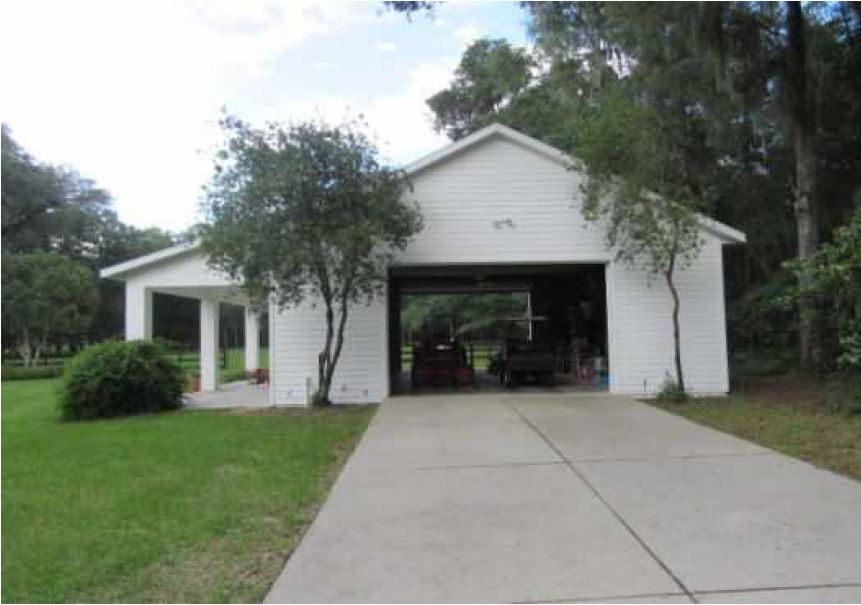
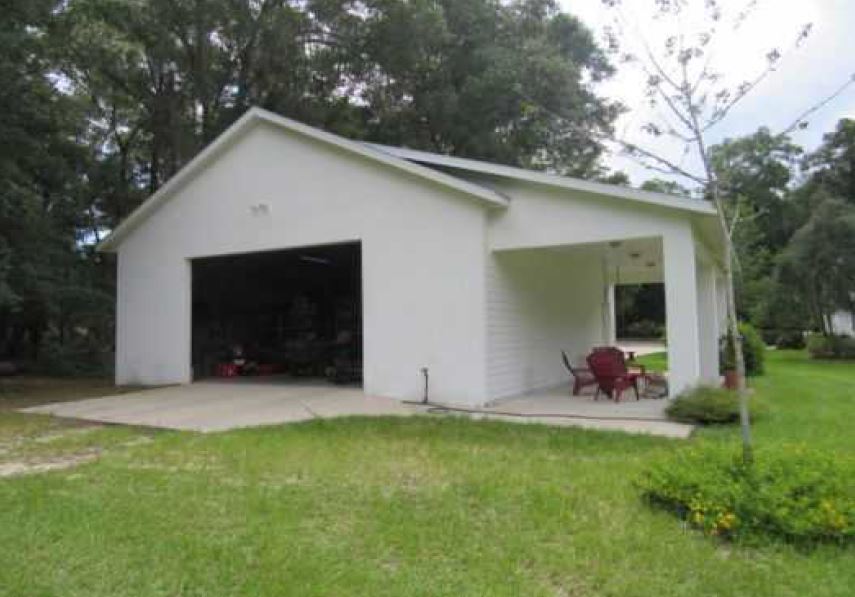
Good news on the housing front. I am putting in an offer on a second house in northern Florida. I can’t steal Internet photos of it and put them up, because nuts would be able to search for the photos and find the address, but I can use some shots they can’t track down.
That’s the workshop. Here is what I like about that, apart from the fact that it’s a big honking workshop: it has a porch. A SHADED porch. Okay, so you spend your morning breaking things, failing to use tools correctly, making a mess, and sustaining minor injuries. All the things guys like to do in their shops. Then in the afternoon, you open the side door, lift the lid on your cooler, grab a Sierra Nevada, and sit in your swing, staring at the confused steers that ground your agricultural tax exemption.
That, my friends, is living.
Here’s another interesting shot.
That is the “wet weather pond.” The listing agent claims it’s a feature. I would think of it as more as a pedestrian hazard/snake and mosquito breeding pit, but then I am a suburb person. There is a big berm right near it, and I’m guessing the berm came from the pond, so that would mean someone actually built this hole deliberately. I don’t know about that, but I know what a berm means: no gun range fees.
Here is a partial view of the cleared side of the property. Here is what it contains, that I like: distance. I can be on this lot, a minimum of say 120 yards from anyone who is a) yammering in Spanish and angry with me for not speaking a foreign language in my own country, or b) just generally being rude to me. In practice, that distance would typically be more like 175 miles, but 120 yards is about as small as it could get in a worst-case scenario.
Here’s another great shot.
That’s one of my driveways. Notice that it does not go anywhere. That’s the beauty part. Aggravating people will make it 15 feet down the driveway and then find themselves in dirt and leaves, behind a gate which I will probably have welded shut. There is a gate that works, up by the house. I may weld that one shut, too.
Now I know what to call the place. “GET THE HELL OFF MY LAWN FARMS.” If not that, then “GRAN TORINO ACRES.”
“No. I don’t believe Steve is interested in buying any Girl Scout Cookies.”
Why do people name their farms “farms”? If you have one farm, it’s not “Sunny Hill Farms.” It’s “Sunny Hill FARM.”
I am hoping I may be able to retain the farm’s staff. Here they are on a break.
Actually, they may be working in that photo.
The lady who showed us the property called those creatures “bulls,” but I suspect they have had some minor surgery, along the lines of what Bruce Jenner recently had. It would be a little odd to put two bulls together on one lot, even in 2017. I have spent most of my life in the suburbs, but I am pretty sure bulls hate each other.
My grandfather had two in one herd, though. I guess I don’t know everything.
This ought to work out. The appraisal came in close to the asking price, so the owners aren’t living in a fantasy world. I want a little money off, because the place has been on the market for 400 days, but I don’t expect them to give it away. With God’s help, we will have a contract next week.
How do you get a property inspected from 300 miles away? I guess the owner will deal with the inspector. They always miss things, anyway. Inspectors make you feel good, and then they leave you holding the bag. A lot of the money we pay to professional people is mainly intended to make us feel good.
Getting out of South Florida is like being released from hell. By that I mean I felt like I was trapped here. My dad agreed to get out four years ago (when I started looking to move and leave him here), and then reasons to delay kept coming up. Then he forgot our agreement. Now he’s all about leaving. He hates Miami. It’s like it was his idea to leave.
I’m going to sell every last thing we have here, as soon as tax considerations permit, and I will cut every remaining tie. After that, forget this place. Let global warming come and drown it. I’ll be safe and secure, at a lofty elevation of nearly 80 feet. Like the Grinch on Mount Crumpet.
“MOUNT CRUMPET FARMS.”
If, for some reason, this place doesn’t fall into my hands, I have another one lined up, and it’s even more rural. I’m talking Deliverance without the perversion and inbreeding (I assume). That place will suit me just as well. It has a workshop you could build a space shuttle in.
I’m thinking of getting a remailing service. The Florida Bar requires me to maintain a mailing address, but I don’t practice, and I don’t want spammers and idiots bothering me. For $15 per month, you can have your mail sent to a service, and they scan it and send you pictures. Then you tell them to throw it out.
Hannibal Lecter used remailing services. How could I ask for a better referral? I’ll see if I can have my mail sent to “Get Lost, Florida.”
It’s an exciting day. God really comes through when you start getting with the program. Unfortunately, most people can’t do that, because no one is telling them what the program is. Preachers just beg for money and drive people into bankruptcy.
I hope soon I can post a photo of me enjoying a beer with my staff, either on the hoof or medium-rare with Bearnaise sauce. Pray for me.
Some topics are so complicated, you can never be truly sure you understand them. A man could spend two lifetimes studying such a topic and never reach a solid conclusion. Of course, I am thinking of this principle mainly in connection with buying screwdrivers.
There is a Youtube guy who calls himself AvE, and he is a good resource for tool info. He seems to be brilliant and highly informed. I don’t know what his qualifications are. He doesn’t build much of anything (suspicious), but he does evaluate tools a lot. His big problem is that he has the mind of an 8-year-old boy. I don’t mean an ordinary 8-year-old boy. I mean the one who used to come to school with pornography and cigarettes. The one who pinched the good-looking teachers.
AvE cannot stop gushing filthy, juvenile remarks. When I watch his videos, I grit my teeth and wait for them to end. It’s a hailstorm of infantile filth. I’m embarrassed for him, and I’m just plain grossed out. That’s really something, considering what a filthy sense of humor I used to have. I could watch vintage Andrew Dice Clay without cringing, but AvE is on his own level.
I don’t know what “AvE” means. Maybe it’s his initials. “Augustus von Ehrmantraut.”
Anyhow, he put up a very informative video (to which I will not link) about screwdrivers, and I learned a lot from watching it. Then I took two showers and sprayed my TV with Febreze.
When I first bought tools for myself, I bought Craftsman. The best, right? Everyone loves Craftsman. Wow, was I wrong. Some of their stuff is good, and some is not. The screwdrivers are easy to round off. But that’s okay, because they have a lifetime warranty, right? No; it is not okay. Do you really want to drive back and forth to Sears for the rest of your life, especially when it’s going out of business? Do you want to live with the knowledge that your screwdrivers WILL fail over and over? It’s not that hard to buy screwdrivers that will not fail during your lifetime or even your grandson’s lifetime.
Also, what if you get your crap replaced? Say you have a screw that won’t turn, it eats your screwdriver, and you get a new screwdriver. What’s going to happen when you try again? It will eat the second screwdriver. Not only will you have to replace tools; you’ll have to work around tough (or not so tough) jobs in order to avoid boogering the replacements. I gave up on Craftsman.
Later on, I built a nice collection of Klein Tools drivers. Klein makes tools for electricians. The drivers I got had plastic handles with rubber covers. Problem: when you get certain solvents on them (gasoline, at least), the covers seem to start to melt. It’s like using a screwdriver with uncured silicone sealant on it. And guess what? They’re not insulated. So Klein makes screwdrivers people think will work well for electrical jobs…without insulating them. Their insulated line costs more.
Kleins are nice and hard, and they have thoughtful features, but those dissolving handles are not good, and I once came very close to touching a 240V wire with one. It might not have protected me. What am I paying for, then? Electrical tools that don’t work for electrical jobs, which also don’t work for automotive jobs where gasoline may be present.
Incidentally, real insulated screwdrivers have insulated shanks. People often touch the shanks of their screwdrivers while using them, and shanks are conductive. Think about that when you play with electricity.
I watched AvE’s tawdry, sleazy video (filth commencement within 3 seconds of the start) while I was searching for information, and like a lot of people, he heartily endorsed Snap-On. Thing is, Snap-On tools are a giant ripoff, even if they ARE good. You have to be a sucker to buy a substantial number of them at anything close to retail prices. Amazon has a set of 8 screwdrivers for $200. That’s incredibly stupid; I don’t care if they get up and sing and dance for you. Snap-On tools are like Chanel purses for men. The quality is there, but we buy them to feed our egos and feel validated. For many Snap-On customers, these tools are not to be used. They are to be cleaned and sorted and stored in overpriced Snap-On boxes. Then they sit and look at them, while they use Craftsman tools. The Snap-On box is like the second living room with plastic on the furniture.
I continued looking around and asking questions, and I came up with a few things that seemed to get good recommendations pretty consistently.
1. Felo wood handle screwdrivers. Don’t laugh. Wood screwdrivers may look old-fashioned, but think of all the high-end woodworking tools that have wood handles. These drivers have shanks that go all the way to the ends of the handles. The steel is exposed so you can hit them with hammers and drive them into dirty screws. They have weird leather inserts around the steel. They have hex bolsters on the shanks, so you can turn them with wrenches. And they’re German. The Germans love good tools. You can get the basic 5-driver set for about $28. That’s a steal.
Snap-On has a special program where you’re allowed to smell a screwdriver for $28.
They also have a new service where you get to stand behind the truck and watch the salesman sit behind a pane of glass and slowly turn a stubborn panhead screw. Then the blind starts coming down, and you have to insert a $5 bill for three more minutes.
I’m sorry, but you have to be a real dupe to fall for Snap-On. Even if you’re a billionaire, there should be some limitations to your willingness to let people cheat you. I will gladly pay $12,000 for a good lathe, and I have paid $200 for really nice pants, but I won’t pay $25 for an incredible screwdriver even if it cures warts, repels vampires, and predicts the future.
2. Wera Chiseldrivers. German again. These have synthetic handles. They are very heavily built. Like the Felos, they have full-length shanks, and you can turn them with wrenches. The name “Chiseldriver” tells you how upset the company will be if you hit one of these with a hammer. These screwdrivers are really ugly, but hey, your hand covers the handle. A set of six runs $43, and it comes with a rack, which is a typically subtle Teutonic hint. You WILL pick up your tools. Schweinhund.
3. Wiha insulated [German] screwdrivers. Wiha makes a lot of neat things. I love their precision screwdrivers. I have heard their hex keys (which I have) will deform before Bondhus hex keys will, but the screwdrivers have been well received by most people. Their insulated drivers are certified to 1000VAC/1500VDC. That ought to keep me alive a while longer. And they’re not too expensive. You can get a set for about $7/driver.
I feel like picking up some Felos for motorcycle work. Kleins are flat unacceptable for these jobs. Wiha insulated drivers sound like a must, because Kleins are not fit for electrical work either. For Fifty bucks, I can stop risking my life unnecessarily.
I’m starting to wonder what the Kleins are good for. Guess I can stop buying them.
Getting into tools is a funny process. You start in order to get your questions answered and your problems solved, and then you end up with more questions and problems. But at least they’re not doofus questions and problems. Instead of striving from a position of failure and ignorance, you strive from a position of some authority and success. I’m not trying to figure out which crappy Craftsman screwdriver is best. I’m trying to figure out which fantastic German screwdriver is best, and all of the choices are good.
If you don’t care about tools, go get some Huskys from Home Depot. They will let you down a few times during your life, but you will get over it. If you care, get German and never worry about buying new drivers again. If you give your tools names like “HELLDRIVER” and stage make-believe plays where they have tool adventures and you do all the voices for them, buy Snap-On and maybe some Thorazine. That’s how I see it. I don’t know a whole lot, so I may be wrong, but taking my advice is probably marginally better than guessing.
I am glad I was alive to write this. Those Kleins nearly got me.
I just got done assembling my new planishing hammer, which is a tool I did not need until Harbor Freight put it on sale. After that, I needed it. Real bad.
I shelled out about $68 for a stand, a planishing hammer frame, a control pedal, several anvils, and an air hammer. Put it all together, and you get a thing that can turn a flat piece of metal into a dog dish in 10 or 15 minutes. Can’t touch it anywhere else for under $185.
For a long time, I’ve wanted an English wheel and a planishing hammer. I can weld stuff, sort of, and I can cut stuff, but making flat stuff into curved stuff…can’t do that. I am also unable to turn flat stuff into stuff with neat corners, such as boxes. I need a finger brake.
Harbor Freight sells a lot of real junk, but here and there, they score. Their 20-ton press is okay, so I got one. I’ve seen excellent Harbor Freight screwdrivers that were a lot tougher than Craftsmans. The planishing hammer gets mixed reviews, but most people agree it does function. Some complain about the air hammer wearing out in a hurry. My private suspicion: no one told them to oil it.
Just a guess.
I don’t have much interest in using a planishing hammer right now. I would have preferred to leave it in the box and take it out after the move to northern Florida. The problem with that is that Harbor Freight tools have to be assembled and operated before you can be sure you want to keep them. That’s true of any tool, but it’s really, seriously true of Harbor Freight tools. You never know which parts will be missing or which vital component won’t fit even after you hit it with a big hammer.
Harbor Freight does not provide the bolts to attach the planishing hammer to the stand. That seems petty of them. I dug out some bolts of my own, and in doing so, I saw one of the great truths of the tool hobby in action.
A while back I dismantled a treadmill to get free steel and a motor. I had to take out some sturdy bolts with nice black locknuts. They have been lying around the garage for several months. The other day, I threw one of the four bolts out. Guess what I needed today? Four matching bolts.
As soon as you throw a piece of junk out, it will become vital to your survival. It never fails. If you have a piece of junk in your garage, and you can’t remember why you kept it, throw it out. Tomorrow, you will remember, and you’ll have to spend at least fifty bucks to replace it.
The planishing hammer is attached to the stand with three bolts.
I think tomorrow I’ll fire it up. I have some crappy aluminum sheet. I just want to see if the hammer functions and hits the work where it’s supposed to. If the air hammer isn’t aligned with the anvil, you get half-moons instead of round hammer dents.
Once I know it works, I’ll probably put it back in the boxes.
Then the next day I’ll need to use it.
The planishing hammer looks very nice. I was shocked. Everything lines up. The steel is heavy. I don’t think American manufacturing is ever coming back, except in my garage. The Chinese are getting too good.
I was hoping I could eventually make a motorcycle fender or two with the planishing hammer, but I don’t know if that’s possible. I believe the English wheel is more appropriate. But Harbor Freight hasn’t put those on sale.
I looked around on the web to find out where I could get a cheap English wheel. For some reason, you never see used ones on Ebay any more. I feel so stupid for passing them by in years past.
Guess what I found out? Harbor Freight’s English wheel gets fantastic reviews. Who’d have thunk it? As I understand it, they used to make a crappy one, and then a couple of years back they modified it, and now everyone loves it. I checked the usual list of Chinese suspects. Grizzly. Eastwood. Harbor Freight came out on top. Big surprise.
Real men shape metal with mallets and hammers, using high-tech accessories like stumps and bags of sand. I am not interested in that. I’ve seen people using the planishing hammer and English wheel, and their experience looked a lot more appealing than pounding a stump.
It would be nice to have an anvil, though. A lot of sheet metal doodads get dented, and it would be convenient to be able to tap dents out on an anvil. It’s not the same as wearing yourself out, planishing flat metal and turning it into ashtrays and hubcaps. It’s quick.
I just saw a video of a guy using an air hammer to beat a bend out of 1/8″ metal with an air hammer. His name is Kevin Caron. He makes a lot of welding videos. He had a sculpture component that needed to be beaten into line, and he got out the air hammer and went to the anvil. Whacked it right out. Neat.
Getting an anvil should be easy, right? I mean, they’re cheap. They’re just lumps of steel.
HAHAHAHAHAHAHA. How wrong you are. A good anvil costs hundreds of dollars. Don’t ask me why.
I read that some anvils are made of cast iron. You couldn’t get me near one of those. Cast iron breaks, and when you break a metal object with a hammer, little bits of it can fly off like bullets. I saw one go through my cousin’s jeans, into his skin, and a couple of inches upward after it hit his shin bone. Well, I didn’t actually see it. I saw him fall on the ground for no apparent reason, complaining about the pain in his leg.
Real anvils have hardened steel tops.
In other news, I’m about to make a strop. This is a sort of leather whetstone. You take a piece of cowhide, glue it to a board, and impregnate it with an abrasive such as chromium oxide. I got the leather and the abrasive, and I’m about to make the wood part.
You can make a plain old rectangle for the base of your strop, but I wanted to put a handle on mine, so I am thinking I’ll carve one out. Problem: I would have to make convex curves with radiused corners. I can do that with a coping saw and a rasp, but that’s the caveman way. I would rather use a spokeshave. This is a weird little plane that whittles wood. You can take a square object like a two-by-two and turn it into a rounded object like a club or an axe handle.
Naturally, I ordered a couple of spokeshaves. This is what I do. I am waiting for them now. I got a flat-bottomed one (Stanley 151) for relatively straight things, and I got one with a round bottom (Stanley 51R) for concave curves. The 51R is what I’ll need for the strop. I’ll still need the coping saw, but I’ll be finishing the strop off by cutting, not by filing.
I could have just made a rectangular base, but if you’re going to be a tool guy, be a tool guy. That’s what I say.
Just don’t get bogged down with stumps and sand bags.
I learned interesting things about chromium oxide. You can get it cheap from China and Russia, but you don’t want to do that. The particles are too big. you want sub-micron particles. I got a product made by Formax, a company I already knew of because I had bought its abrasive belt grease. It would have been cool to get a pound for under ten bucks from overseas, but the particles would have been huge, and big particles mean big scratches.
I’m sorry if my life is too cool for you. I wish everyone could have a planishing hammer.
I feel my strength coming back. Time to talk to Marvin and Maynard. Maybe I’ll post a photo if I planish anything.
I did the unthinkable. No, I didn’t buy an “I’m with her” T-shirt made with child labor in a factory in Shenzhen. I bought and fettled a Harbor Freight plane.
If you read my last post, you know my pet peeve machinery has been in top gear over the way woodworking snobs discourage noobs from buying inexpensive tools. As an example of the destructive propagandizing, they try to convince everyone that there is not just a need, but a necessity to buy wood planes that cost hundreds of dollars each. They want people to believe that an expensive plane won’t just make woodworking more fun; it will enable you to produce better work. That’s crazy. Any plane that works correctly will produce perfect work in the hands of a skilled person, and the best plane on the planet will produce garbage in the hands of a radiologist who does woodworking for an hour a month and tries to compensate by spending on tools.
I saw a video in which an aspiring young woodworking guru compared three planes: a new Veritas ($300+), and old Stanley ($40 range), and a new Harbor Freight plane (vicinity of $10). He concluded that the Harbor Freight plane was not worth it at any price. He spent over 20 hours fettling it, and he replaced the iron with an old Stanley instead of fixing it.
On Friday, I happened to notice that Harbor Freight had a great tool on clearance. They are selling their planishing hammer and stand for $68. That’s the after-20%-coupon price. This is a screeching, wailing, blazing, epic deal. The same tool costs $185 at Northern Tool, and other companies charge a lot more. I had to buy a planishing hammer. I don’t need one, but I hoped to have one eventually, and a chance like this was not likely to come around in the foreseeable future. Even if I decided not to keep it, I could sell it for over a hundred bucks on Craigslist.
I went to Harbor Freight yesterday and got myself a planishing hammer, and while I was there, I picked up a Windsor Design plane. I love that name. Harbor Freight is always coming up with Caucausian-sounding brand names.Come on, guys. Just call it Feng Wing Wah or whatever the real name is. No one cares. I grabbed a plane without looking inside the box, and off I went. It was a number 33, which is different from the number 4 the Youtube guy fixed, but I hadn’t paid close attention to the video, so I bought it anyway. They didn’t have a 4, so it was the best I could have done.
At home, I opened the box and discovered I had a used plane! Some poor sap had put it together and used it to make wood powder. The blade was so dull, it wouldn’t make shavings. He did a little scraping, got powder on the plane, gave up, and returned his new tool to the store. He will probably never try planing again. Or he’ll mortgage his casa and buy Veritas.
Sad.
I took a look at the only two things I could easily fix: the iron and the sole.
The iron of the plane had been ground with some sort of hideous 40-grit blade-destroying machine. There was a tiny sharp bit at one end of the edge, and there were pretty horrendous scratches on both sides.
I colored about an inch of the flat side of the iron with a blue Sharpie and then put it down on an extra-coarse diamond stone and moved it around. The ink came off on one corner, and it also started to wear down in a round area about an inch and a quarter away. Most of the blue area didn’t touch the stone. Bad!
After that I did something stupid. I got some window cleaner (to make the grinding go better), and I squirted the stone. I put the iron on it and started grinding the blue away. It was very slow work, because even an extra-coarse diamond stone is pretty fine. Eventually, I put 100-grit sandpaper on the stone (so the stone’s surface would be a guide), and I made better progress. I should have used something even coarser, but I didn’t have it.
The iron turned out to be S-shaped. If you were to hold an iron like that with the cutting edge facing you, you would see an S-shaped curve. Well, you wouldn’t actually see it, because it was only off by a few thousandths, but that’s the idea. I would say that if I had ground the blade with sandpaper from the start instead of using the stone, I would have flattened it out and removed enough of the scratches to make it functional in maybe 20 minutes. As it was, I would say I went maybe 30-45, not including breaks. If you did the same job with 60-grit paper, like a smart person, you would probably be done in 15 minutes.
I sharpened the blade with diamond stones, not Japanese water stones or laser stones from NASA or whatever other ridiculous, unnecessary gear the tool snobs like. The people who made furniture for the czars of Russian didn’t have water stones. Far as I know. A tool can’t actually tell what you use to get it sharp. I’m sure water stones are great, but I don’t need the hassle of snowflake stones I have to keep in an aquarium.
The plane did not cut very well. Maybe I had it adjusted badly, but I hadn’t fixed the sole, so I decided to flatten the sole and see if that helped.
Again, I used the wrong thing. I inked the sole with the Sharpie and taped 100-grit paper to my band saw table. I put the plane on the paper and gave it two hundred strokes at a time, and before too long, it was nearly free of ink. I didn’t get it perfect, because I was tired of plane fettling.
I put my razor-sharp Chinese iron in my $15 plane and tried it. It cut just fine. There is absolutely no doubt about it. You could use this plane to do excellent work. You would need six or seven sheets of sandpaper and some method of sharpening it, but it would be a usable plane when you were done fixing it, and the quality of the work you would do with it would be exactly the same as the quality of the work you would do with a $700 plane. You would be the limiting factor.
Take that, snobs.
I should also add that the steel in the iron seems perfectly good. Even if you get a soft one, you can be a man and harden and temper it yourself. A lot of people do those things. If you get a misshaped iron, you can anneal it to make it easier to work on, fix it with a file, and then harden and temper it again.
Now let me backpedal.
I would not buy another one of these planes, except maybe to use as a scrub plane. The dual-screw adjustment mechanism is a pain to use. Note: I am not saying it doesn’t work. It works as well as any iron-adjustment gadget out there. I’m saying you will have to fiddle with it in order to get it where you want it. With a Stanley, you twiddle one cooperative knob and bump a little lever, and you’re done. With a Veritas or Lie-Nielsen, I assume you have your valet text the company and they send a slave to adjust it.
You should be able to get a good working Stanley delivered to your house for $45, especially if you don’t mind buying ugly ones or the ones made after, say, 1960. Even though it’s a better tool than the Windsor Design, it will probably need to have its sole flattened, and you will definitely have to work on the blade, but in all likelihood, the plane will take less work than a Chinese job, and when you’re done, it will be easier to adjust. Also, it will still be worth whatever you paid for it, whereas the Harbor Freight plane’s value drops to about two bucks as soon as you buy it.
Supposedly, older Craftsman planes were made by Stanley, and they cost less.
I don’t know what to do with this plane now. I don’t think I’ll ever use it for smoothing (its intended purpose). I hate to turn a good smooth plane into a scrub plane, though. I may do a little machining and improve it. I could improve the adjustment cutouts in the iron. I could also make new adjustment nuts. The ones that come with it are not designed well, and they’re too narrow.
Maybe I’ll advertise it on Craigslist as a Harbor Freight plane that has already been fixed. I could get my fifteen bucks back. No, not fifteen. Maybe ten?
This plane would be good for teaching kids about planes. If you had 20 kids in a class, and you wanted them to learn how to set bad planes up, you could get each one a Harbor Freight plane and show them how to fix it. After that, they would be able to fix any plane.
By the way, Harbor Freight has another smooth plane. They sell a #4 and a block plane together, for $14.99. I think you have to buy them online, which kills the deal. But it has a conventional adjusting apparatus.
A Hand Plane Should not Cost Seven Thousand Dollars
I think I’ll write about something insignificant today, instead of confronting the sudden confirmation of my predictions of increased violence toward Christians and conservatives. I hope Representative Scalise gets better soon. Expect the violence to spread in the coming months.
I predicted something else, years ago. I said TV and the Internet would eventually be the same thing, along with phones and faxes. My prediction has come true. That doesn’t make me a genius or a prophet. It just means I saw something which was very obvious, while most other people weren’t looking for it.
I am just about done with TV. I record a number of cable shows, but I only watch two things on television (the medium, not the machine): Better Call Saul and Marvel’s Agents of S.H.I.E.L.D. When I hear about other shows these days, it’s like hearing about the Kardashians. Sometimes t’s a little disgusting (because the values the shows promote are so trashy), and sometimes when other adults recommend shows to me, I feel like toddlers are trying to get me to sit down and watch Finding Nemo.
Marvel’s Agents of S.H.I.E.L.D. is a great example of a toddler show. It’s extremely silly; it jumped the shark before it ever aired. The premises of the episodes are laughable, even by TV standards. The characters are as shallow as copier paper and as disposable as dirty diapers. It’s about as mindless as entertainment gets. I enjoy the humor and explosions, though.
Youtube covers my “need” for video entertainment these days. I watch math and physics videos, and I watch videos about tools. Woodworking, machining, fabrication, and so on.
A lot of people are trying to make money on Youtube. It can be done. It’s a bad idea for conservatives and Christians, because we will eventually be excluded from anything resembling social media, and a lot of people will lose their “jobs” overnight, with no legal recourse to recover them. I don’t recommend it to anyone who believes in God, but people are doing it.
Unfortunately, the lure of easy exposure draws folks who really don’t know what they’re doing. That includes me, but I admit I don’t know what I’m doing, so I think I can be excused. People create logos, and they put a little theme music together, and the first thing you know, they have videos and playlists in which they spread misinformation while looking pretty professional.
Over the last few days, I’ve been watching woodworking videos, and I’ve watched a few about hand planes.
The hand plane arena is surprisingly complicated. Hand tools have fallen out of favor among real tradesmen, so big manufacturers aren’t working very hard to make good hand planes. You can’t get a decent plane at Home Depot; they don’t bother stocking them. You have to buy an old plane, or you have to spend a ton on a cork sniffer product like a Veritas or a Lie-Nielsen.
Now I have to explain cork sniffing. It’s a term which is commonly used by musicians, in relation to expensive guitars, amps, tubes, and so on. I apply it more broadly.
Imagine you’re a woman, and a guy takes you on a dinner date. The waiter brings a bottle of wine and opens it. He pours a small amount in the man’s glass, and he offers him the cork. The man smells the cork and says, “Smells good.” Then he drinks the sample and says, “Do you have anything dryer?”, and he makes the waiter take it back.
That’s cork sniffing.
Waiters and sommeliers pour samples and present corks not to see if you like the wine but to allow you to confirm that it’s not ruined. Wine can react with corks, and when it does, it tastes bad. You should taste the wine and look at the cork to see if all is well. If so, you own a bottle of wine. You are not supposed to send the wine back because you don’t like that particular wine.
In broader usage, a cork sniffer is a person who pretends to be incredibly sophisticated and drives people crazy worrying about nuances that probably don’t really exist.
Think of high end audio. There are people who will pay two hundred or even thirty thousand dollars for one pair of cables to connect a record player to an amplifier. They don’t know anything about science or engineering. They claim they can hear things the rest of us can’t, even though most of them are old men who can’t hear anything above middle C on the piano. They will pay for special rocks to put under their stereos. They will even tell you that you can’t wear an electronic watch in the same room with your stereo while you listen. They will believe absolutely anything. They don’t just sniff the cork. They chop it up and freebase it.
I should add that I just learned another reason why sommeliers present corks: in the old days, wines were counterfeited and labels rotted with age, so vintners printed their names on the undersides of corks. People looked at the corks to make sure they weren’t getting ripped off.
I am not a wine person, so I don’t know a whole lot about it.
Woodworking is full of cork sniffers, mostly because hobbyists have taken over. Hobbyists don’t understand the needs of professionals who know what they’re doing. Professionals don’t want $800 hand drills; they want stuff that works. If you go to a shop that produces heirloom-quality furniture, you won’t see cork sniffer tools. You’ll see plywood benches and Chinese machinery. Doesn’t matter to insecure hobbyists. The cork addicts have taken over the forums, and what they say goes. They really push expensive tools.
Cork Sniffer Magazine, Creator Unknown
I’ll bet you can pay $2000 for a hand plane. Let me check.
I must apologize. I was wrong. You can pay $7400 for one hand plane. Specifically, a Karl Holtey A13 Smoothing Plane. If you buy one of these, you are mentally incompetent. There is no refuting it.
Last night, I watched a video by a young man who is promoting himself as a woodworking expert. He compared three planes. The first was an old Stanley #4. The second was a Harbor Freight smoothing plane that costs something like ten bucks. The third was a Veritas plane. Veritas makes very nice tools that are only VERY expensive, not Karl Holtey NASA-Budget-During-the-Cold-War expensive. A Veritas smooth plane costs $232 if you get the special cork sniffer magic alloy blade.
First thing…he doesn’t know Stanley planes. I don’t either, but I know things he doesn’t know. He said his plane was a “Stanley Bedrock.” Stanley Bedrock planes are highly prized collector’s items, and they cost a ton of money. You can’t really use one in your shop, unless you like destroying investments. He had an ordinary Stanley. And he bought the wrong version (I did this,too.) He got one with friction-reducing grooves in the sole. These grooves beat up your wood if you cut at an angle across a corner. They’re probably okay on long planes, but any plane you might want to turn should have a smooth bottom.
Second thing…he claimed the Stanley had a gigantic hidden cost because it took hours to fix. He spent so much time on it, he felt the real cost of the plane was close to that of the Veritas. He stripped the paint. He refinished the wood and the metal. He did a lot of stuff only a cork sniffer would do. You don’t need to paint a plane to make it work.
He should have taken about an hour to flatten the plane’s sole and clean up the blade and so on. He feels his time is worth $15 per hour, so add $15 to the cost of the plane, if you really want to count those beans. Anything beyond that is gilding the lily.
Third thing…he claimed the Harbor Freight plane had a hidden cost of over $300 because he took over 20 hours to fix it. That’s just nuts.
Nearly every plane needs to have the bottom flattened and the blade sharpened. The Harbor Freight plane needed more than that. It had a soft blade which would not take an edge and hold it, and he said (not endorsing his claim) the plane had a fundamental alignment issue that could not be fixed. He drove to a flea market and bought a Stanley blade for the plane. He worked around the alignment defect. That’s not how it’s done.
Here is another guy using a Harbor Freight plane. He paid ten dollars. He spent two hours working on the plane. It works very well. Hmm…what happened?
Here is the answer: the first guy doesn’t know tools. He isn’t ready to teach other people.
I’ll explain what he should have done.
1. Harbor Freight tools need to be exchanged (or modified) a good percentage of the time. People who know tools (people who are qualified to make instruction videos) know this. It’s part of the game. When you buy a Harbor Freight tool, you examine it as soon as you can, and you keep doing exchanges until you get a good one. If possible, you examine it in the store. The video guy should have exchanged his plane when he found out the blade and machining were bad.
2. Knowledgeable people know you can harden steel with a hand torch and oil. He should know this. He should have returned the plane, but barring that, he should have hardened the blade. That would have been a neat tip for other people.
You can get a new plane that costs under $20 to do perfect work. I don’t recommend it, but no one will be able to look at the things you build and tell you what your plane cost. Not even his Holteyness Karl Holtey.
I feel like buying a Harbor Freight plane and turning it into a scrub plane, but I’m afraid that if I get it working, I’ll feel like it’s too good to be a scrub plane, and then I’ll have to get another one. And then I’ll feel like that one is too good to be a scrub plane.
The cork sniffers are a real problem. When a new guy shows up at a forum and asks what kind of plane he should buy, they will say you should get Lie-Nielsen or Veritas if at all possible, but that a Stanley will do “acceptable work.” That’s completely wrong! First of all, a Stanley won’t do work at all; the man does the work, and the tool is just the instrument. It has no skill. Second, a Stanley will do FANTASTIC work. It will work as well as any plane on the planet. Set it up right and develop some skill, and it will beat a Lie-Nielsen in the hands of a cork sniffer who doesn’t know what he’s doing.
I admit, I have two Veritas tools. I had given up trying to find a used router plane at a good price, and someone asked me what I wanted for my birthday. Also, I wanted to try their dovetail saw, so I got myself one. They make great stuff that works with little or no fettling. But old tools would work just as well.
I sniffed a little cork there. I will wear the scarlet “C.”
Think about this: the palace at Versailles is full of astounding wooden creations. It’s full of furniture, doors, panels…you name it. This stuff is exquisite. What kind of tools did the builders use? Wooden planes and carbon steel saws. They used foot-powered lathes. They used crap, in other words. If the cork sniffers had been in charge, the Bourbons would not have been able to afford tools. They would have bought a mobile or “manufactured” palace with IKEA furniture.
Marie Antoinette’s Apartment at Versailles: not Built with Cork Sniffer Tools
When I started learning about planes, I found a #4 Stanley in my dad’s garage. A tradesman probably left it at his house by accident. It was junk. It was probably made in the late Seventies, long after Stanley’s salad days. It had plastic handles. It had a big cratered area on the sole because someone had left it in or near water.
For fun, I flattened the sole, fixed the blade and chip breaker, and oiled and loosened the adjustments. When I tried to use it, I was flabbergasted. I have some real vintage Stanleys, and this thing is just as good. It’s a joy to use. It’s annoying, because I wanted to buy a vintage #4.
People told me to turn it into a scrub plane. Why? I have a phenomenal #4 smoothing plane that cost me nothing. It could probably even plane corks.
I still “need” a few more planes. I’m torn between the pleasure of collecting nice vintage planes and the joy of turning garbage planes into top-notch tools. Given the cost of garbage planes, I could do both.
There is a big tool-using movement in America, and it seems like cork sniffers and hipsters are messing it up. People think it’s cool to use tools, and it is, but being seen using tools badly with your hipster beard and sustainable micro-financed socks does not amount to providing quality instruction. If you want to learn about tools on Youtube, find an old white guy (male by birth, not choice) who wears a Dickies shirt and thinks hair gel makes you gay. That’s the guy who knows which brand of chrome oxide to use and how to get a stuck arbor out of your Super Chuck without marring it.
I think I’ll post a few videos featuring people who actually get things done. You might enjoy them.
I’m writing because I’m tired. I figure if I write, I will be able to tell myself I’m doing something productive while I’m really resting.
Today I will tell you about my adventure with the boring head. Not the Indian boring head with integral R8 shank which I got from Grizzly. The US-made Flynn boring head I got off Ebay for seventy bucks.
The Indian boring head works fine. Boring heads are very simple, so bad ones work just as well as good ones. I wanted a nice one because nice ones are more pleasant to use. Also, they’re nice.
The Indian boring head has a jerky action which I have been unable to fix, and it’s just generally not elegant.
Criterion is the name everyone thinks of when they think about boring heads. Criterion makes very good boring heads, and they cost a lot of money (for no reason I can discern). I’ll go look up a price. A 3″ boring head will run you $582 at MSC. That’s a ton of money for something with about ten parts. I tried to find a good price on a used Criterion, but even the used prices are bad.
When it comes to machine tools, name and price are related. A well-known product may sell for more than a product of equal or better quality which is not as well known. It’s like Steinway and pianos. Steinways are not the best, but they bring good money. Name is a very big deal in the used machine tool business.
I found a neat used boring head made by the Flynn company. As far as I know, it’s as good as a Criterion. The seller wanted $70, which is a lot better than I would expect to do on a Criterion. It looked good in the photos. It appeared to have wear from banging around in a drawer with other stuff, but little no wear consistent with use. I bought it.
Problem: the boring head had a funny arbor on it. It was a 5/8″ shank 2″ long, with a thread inside the top end, and there was a mysterious taper down by the boring head itself. “No problem,” I thought, “I will modify it or remove it.”
When the boring head arrived, it resisted all sorts of removal schemes. I even filled the inside of the boring head with a combination of ATF and acetone, which is supposed to be better than Kroil at loosening threads. I got nowhere with it. Even professional machinists had no answers. That’s disturbing, because you will find a good answer in this very blog post if you keep reading.
I considered cutting the arbor flange off or at least reducing it to nearly nothing. I thought the friction between the flange and the boring head might be holding things in place. No one else suggested this, so I decided not to take a chance.
The taper was a little over an inch long. I knew it was okay to run a 1/2″ drill chuck with a short 1/2″ straight shank, so I wondered if I could get away with cutting the taper and turning it into a 3/4″ stub about an inch long. Machinists assured me it would work. That surprised me, but I figured they knew what they were doing.
A 1/2″ shank would have been more convenient, because a 1/2″ collet will accept a lot of tools that are very useful, and it’s a good idea to try to get new tools fit that size collet. It results in less time spent changing collets. I didn’t trust a 1/2″ shank and collet to stand up to boring torque, so I went for 3/4″.
Chucking the boring head in the lathe was a pain. It has lots of features on it, so you don’t want to just slam it in a lathe chuck and tighten down on fragile things you paid good money for. You have to chuck it carefully. Also, I didn’t want the hardened jaws on my 4-jaw chuck to bite into it and mar it.
The best ways to hold an object you don’t want to mar are to use soft jaws or pie jaws. Soft jaws are steel jaws that have not been hardened. You pop off your hardened upper jaws, and you put the soft jaws in their places. Then you cut the jaws to fit your part. If you’re holding a 2″ tube, you bore the jaws out to roughly 2″. You have to put something inside the jaws while you bore them to push them out and hold them in place. You end up with jaws that touch the part with a lot of material instead of three or four small jaw points. Of course, the contact area is limited by the width of the jaws, which are the same size as hard jaws.
Pie jaws are big aluminum jaws that screw to your bottom jaws. They form a 3-slice “pie” when installed. You bore them out just like soft jaws, I believe. Anyway, they cover 60 degrees each, so when you bore them to fit a part, they contact nearly the whole circumference.
I am too lazy to use soft jaws or pie jaws. Also, I only have one set of soft jaws, and they’re too pretty to actually use.
I found a neat tip: aluminum tape. This is real duct tape, unlike the rubbery cheap stuff no one should ever use on ducts. It’s made from aluminum foil. You can get it at Home Depot. You put a piece on each of your hardened jaws, and it helps keep the tips from biting into your work.
There were other problems with chucking the part. If you look at the photos, you will see that the arbor had a flange that screwed up against the boring head. I assumed this flange (and the shank) were concentric with the boring head body, because that’s how machinists do things. It’s sloppy to make cutting tools with arbors that aren’t concentric with them.
When I tried to indicate the part in my 4-jaw chuck, it was impossible to get the arbor flange, the shank, and the body of the boring head lined up at the same time. It’s normal to have to do some work to get two ends of an object indicated, but this time it was impossible. Finally, I put the boring head in my mill with a 5/8″ collet, and I measured it. The arbor flange was not concentric with the boring head, and neither was the shank.
I guess this makes sense. A boring head uses a cutting point which is offset from the spindle axis, so you don’t need the arbor to be concentric with the body. Still, it’s a strange way for a quality manufacturer to make a tool.
Realizing I was up against it, I decided to indicate the face of the boring head, which was virtually certain to be square with the sides of the body. I indicated the face as well as possible, and I indicated the sides to within a few thousandths. Good enough. Indicating the face made sure the shank I was about to turn would not be angled with respect to the body of the boring head. That made me feel good, although it wouldn’t affect the performance of the tool.
I ended up cutting the shank down to a 3/4″ stub an inch long. Now I’m happy. But wait! There’s more!
After I did all this work, someone told me he had removed shanks by cutting the arbor flanges down to a thickness of a few thousandths. He said he then unscrewed them with his fingers. Removing the flange pressure took away the friction that held them in place.
Bummer.
Anyway, here is a photo of my new shank. I think it will work.
I don’t know for sure that I got a good result, but there are a lot of good tips in this blog post. Boring heads aren’t concentric with their shanks or arbors. Use soft jaws or pie jaws to chuck delicate round parts. Aluminum tape prevents marring. A short shank will work fine with a 3″ boring head. ATF and acetone make a top-notch penetrating oil which is dirt cheap (Some people add lard.) Finally, if you want that arbor out of your boring head, take the flange off.
We’ll see whether my shank works or not. Now that I know how to remove it, I don’t care.
One good thing about the short shank is that the boring head will not take up much vertical room on the mill. Boring heads with bars installed can be very long, and that can result in the machinist having to crank the mill’s knee up and down a lot, and in some situations it can make it impossible to use the boring head.
That’s the story. If you see a nice boring head with a funny arbor on Ebay, don’t be afraid to buy it. Now you know how to get that shank out.
I am in Ocala, otherwise known as the Deplorable Biosphere. In years to come, people like me will flood the area, dressed in MAGA hats and ill-fitting work shorts, to set up their workshops and gardens and prepare the ramparts from which to fire on the smelly liberal masses that will come to steal our food and TVs but certainly not our books or soap.
I was going to go to Ocala alone, but my dad decided to go with me.
We looked at five houses today. Was it five? Let’s see. Blue. Grey. Zebra chair house. Yellow house. House where I ran over the snake. Yes. Five. One was too small. One was too upscale. One was a little remote for my needs. The other two were great.
The first place I checked out is in the northern part of the county. It’s a very odd house. It’s one story, with lots of rooms. A widow lives there, and you can tell estrogen figured way too heavily in the home’s design and decor.
There are so many antiques in the house (and workshop) that if this woman dies, the American antique market will take a plunge that will take a decade to undo itself. When this stuff starts appearing on the market, trying to sell antiques in America will be like trying to sell snow cones in Siberia.
The house has a sewing room, an artist’s studio, a piano room, an office, a special food storage room, about 52 bathrooms, three fireplaces, and enough closet space for Elton John and Rupaul put together.
The thing that sold me was the workshop. The poor lady’s husband died before it could be completed. It’s a building the size of a house, with two central air units. It’s set up for two apartments plus a gigantic work area. The apartments haven’t been drywalled. It doesn’t have compressors yet, but once they’re installed, it will be possible to air condition the entire place. Two floors.
I would finish the downstairs apartment as a metal shop. The upstairs unit could be finished and used for electronics or just running away from the world.
The lot is only ten acres, but you would need a bow and arrow to hit the nearest neighbor’s house, so it’s not cramped. It has thick woods on one side, a cow farm on another, and across a road from a third side, more woods.
I know I would like this place because the husband’s deer stand is still hanging on a tree in the yard. Yes. He shot deer IN HIS YARD. He had a feeder and everything. Is that legal? I don’t care. I’m too lazy to shoot deer. More correctly, I’m too lazy to butcher deer. The shooting…I’m all over that.
The northern part of the county is fantastic. It’s prettier than the southern part. There is even less traffic. The roads are ideal for motorcycles. There are probably fewer snobs. I like it.
The other place I really like is south of the city. Some guy bought 34 acres in two long strips. He cleared one strip and built his house on the other. Together they make a rectangle with proportions similar to a smartphone.
The house is beyond criticism. It’s not very old. It’s big. It has a beautiful downstairs. Upstairs, there is what I would call a second living room. It’s carpeted. It’s comfortable. It has a bunch of storage rooms off of it. I wish I were lying on its floor right now.
The house has a huge garage, and if that’s not enough, there’s a 1000-square-foot cement block outbuilding with garage doors at each end. It has clapboards on it, so it looks like the house. It has a little carport thing on one side, where you can put chairs and goof off all day.
The owner played a dirty trick on us. He gave the realtor the key to his gas-powered EZ-Go, and she told us to take it and tour the whole property. After that, I was hooked.
First we roamed around on the wooded lot. Before I hit the gas, I asked the realtor if there were any animals to worry about, and she said there were two bulls. She said not to worry about them because they never moved. I figured she was joking or talking about concrete bulls, because real bulls can be territorial and crabby. Sure enough, we passed two black bulls sitting in the woods doing nothing. Maybe they were steers. I didn’t ask them to get up so I could check. In any case, they didn’t find us interesting at all. As we were passing them, I ran over a big blacksnake. Well. Better that than fresh manure.
The bulls are tax deflectors. Because there are two bulls on the land, the owner can call it agricultural property and get a property tax break. He has to put up with poop, however. The realtor said we could switch them for goats, which would eat the underbrush and leave the grass alone. Goat poop is easier to deal with than cow poop, but free cow manure would be good for gardening.
We then went through a gate and rode around the cleared lot. It was magnificent. It had big berms of excess dirt; perfect for use as pistol and rifle backstops. It had a big dry pond, which would ordinarily be a flaw, but again, helpful for target practice. You could go down in there and put up a silhouette.
I want this place. It’s more than I wanted to spend, but it would save my dad a lot of money over living where he is now. I would hate to tell you about his current property taxes and insurance.
If there is one thing I’ve learned on this trip, it’s that I hate Miami even more than I thought I did. I can’t believe I’m going back. Ever since I passed Orange County on the way north, I’ve been drinking in my surroundings. I’m like a man who was just rescued from the desert, who knows he’ll be going back soon. I want to stuff myself with northern Florida and make the feeling last when I’m back in El Republico De Los Bananas. This is like dreaming I’m honeymooning with Tyra Banks in the Plaza Hotel and then waking up in a trailer next to Caitlyn Jenner.
It’s time for planning and calculation. Maybe one of these places is ripe for the picking. It can take quite a while for a seller to get realistic about pricing.
Tomorrow I drive back to Bananaburg. I wish it could be the very last time.
I must share my joy with you. Today I did a few TIG welds that were not completely, utterly pathetic. They were merely not good, and that’s good enough.
I got a TIG in March, and I have been fighting with it ever since. For the last two or three weeks, I’ve been trying to weld aluminum, because it’s easier to find locally than clean steel. Aluminum is hard to weld, because it melts very quickly. You have to do all the things you do with steel, much faster. Not easy when you can barely do those things slowly.
My usual metal supplier doesn’t stock pickled and oiled steel or cold-rolled steel. These are the best types of steel for TIG practice. Pickled and oiled is hot-rolled (cheap) steel which has been treated with acid and then oiled. The acid takes off the non-conductive oxides that make welding difficult, and the oiling prevents further rust. Cold-rolled steel is steel processed at lower temperatures than hot-rolled; heat cause scale to form, so cold-rolled doesn’t have scale.
I tried various lame methods to get scale off of steel, and this week I decided to try vinegar. You put your steel in it, and you take it out the next day. It didn’t sound promising, but I did it anyway, and it worked. The scale fell off, along with the rust. Today when I got started with my practice, I had four pieces of scale-free metal to weld. I hit them with a wire wheel, and I was off.
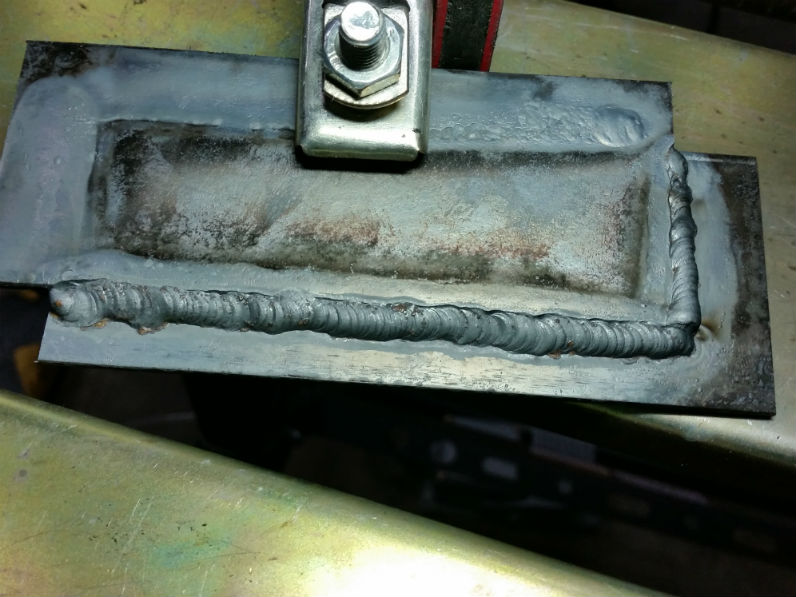
Here’s a photo of my last two beads. I practice by offsetting two rectangles of steel and lap-welding them. The offset gives you a long lap joint on both sides.
I didn’t have major blowouts or crashes. I stayed on the path pretty well. I didn’t weld anything to the table. I didn’t blind myself or drip molten steel on my leg. The weld is a little crooked, but that’s something a little practice will fix.
I’m hoping this is a decent weld, with good penetration. To check, you have to cut your weld in half and etch it with some chemical or other. I haven’t looked into that. I had the welder at 156 amps, which is high for 1/8″ metal, and it seemed like it was barely enough. I’m wondering if something was obstructing the current. You need current for a deep weld.
This is a big load off my mind. I felt like it was going to take me five years to do a simple TIG weld, and I wondered if I would ever be able to weld delicate work, which is 95% of the reason for buying a TIG. Now it looks like I’m over the hump. I should be able to continue to progress.
You probably don’t care about this, but I’m thrilled to death. Most men can’t weld at all. Most who do weld, MIG weld very badly. To do TIG marginally well is a big achievement, and if I ever get good at it, I’ll have a skill so valued I could conceivably rely on it for income if I had to.
On to the next challenge. I hear people are looking for a cure for cancer.
I wrote up a blog entry about the appointment of the latest special prosecutor, but I decided to delete it. I hate getting caught up in politics, so I’m always glad when I fail to write about it.
You’re probably wondering whether I mean the special prosecutor who investigated Hillary Clinton’s dissemination of classified material, or the one who investigated her destruction of the hard drives that contained a lot of the evidence. Or maybe you think I’m talking about the one who investigated Susan Rice over her role in illegally “unmasking” individuals involved in the Trump campaign. Or possibly you think I mean the one who held Barack Obama accountable after his 2008 campaign was funded largely by overseas donations. No, I mean the one who is investigating the nonexistent collusion between the Trump campaign and the Russians. In other words, the only one of those special prosecutors who actually exists.
I’m over it. I think you can tell. It doesn’t bother me at all.
Today I’m looking at properties again. I made an offer on a place I liked, and the owners refused to counter, based on their conviction that if you pay twice what a property is worth, the person who buys it from you should do the same, as a matter of courtesy. Then I found another place I liked. Before I could get up there to see it, somebody else made an offer, so now the deal is pending. Now I’m on my third house.
I found one halfway between Gainesville and Ocala. It has pros and cons. The biggest cons are the distance to the nearest big hardware chain (20 minutes) and the distance to the nearest drugstore (15 minutes). The biggest pro is a 2400-square-foot garage.
That figure is not a typo. People in northern Florida love big outbuildings. Whoever built this place decided he had to have three garage doors on one side, one door on the other, and a 608-square-foot apartment upstairs. The place has plumbing and electricity, and there is even a central AC unit. It’s hard to believe, but from looking at the photos, the AC may be intended to cool the whole building, not just the garage. It must cost a hundred dollars a day to run.
The apartment isn’t finished. It’s just studs and one of those rubber bathtub matt things. But most of the work is done.
Unfortunately, I don’t have a photo of the first story. It must be something to see. I would rollerblade in there. I would buy rollerblades and learn how to use them just so I could say I did that in my shop. If we get this place, I will have about 3900 square feet of shop space. NASA would be jealous.
I love that area. The fence around the house has a sign that says, “I VOTE PRO-LIFE,” hanging on it. Like 40% of the restaurants in the nearest town are barbecues. I feel like I’d be moving home.
The house has been on the market forever. Now that I’m interested, I’m sure someone will buy it this weekend.
I will keep plugging away. I am leaving Miami even if I have to pull a Snake Plissken.
My balancing robot is in Miami, but it’s not in my house. Fedex promised to deliver it on Wednesday. Today is Monday. The robot is relaxing at a Fedex facility instead of riding a non-balancing human-driven truck to my front porch. How crazy is that? I want my robot!
I’m not ready for it, though, and not just because I don’t know how to operate it. I’m not ready for it because I have another electronics thing I should do first: the Arduino-powered bird organ.
I have a cockatoo. His name is Maynard. He craves attention. Since I moved my office, he doesn’t see me as much as he used to, so he gets even by pulling his feathers out. I don’t think I’ll ever be able to give him as much attention as he demands, but I suspect I can improve things by entertaining him.
A long time ago, it occurred to me that a bird as smart as Maynard might enjoy a musical instrument. I ordered a couple of toy organs, and my plan was to rig them up with strings so Maynard and my other bird, Marv, could pull the strings and make noise. The organ order was cancelled for some reason, so I forgot all about it.
There was also another problem with the idea. These days, everything turns itself off. The hippies have rigged life so you can’t turn things on and leave them that way. Little hippie chips inside them turn them off after they decide you’ve left them on long enough. The organs I bought would probably have shut down after ten or twenty minutes, unless the birds played them all day.
I got on the web and looked around for an Arduino organ, and I found out you can make one. I also found out you can make one without an Arduino. In a way this is a bummer, because I want to do Arduino stuff from time to time. On the other hand, a simple organ made from a cheap breadboard would be faster to build, and it would be less potentially aggravating. There would be less that could go wrong with it. And it would stay on forever. I could put a wall wart on it. I only have about 30,000 of those.
People who have built PCB organs have used momentary pushbutton switches. That won’t work for me. A bird can’t push a tiny button on a circuit board. I need levers or strings. I looked around and realized what I needed: microswitches with levers. I could slap them on a board and come up with a way for the birds to move the levers.
I checked Ebay, and I learned that you can get the switches for practically nothing if you order from China, but they’re like $3 each, which is highway robbery, if you order them from the US. I don’t want to wait a month for Chinese switches. What to do? Hmmm.
Of course, I already knew what to do. I already had a bag of microswitches. I bought them for my CNC lathe, and I never used them. I can order Chinese switches to replace them. While I wait for the Chinese ones, I can use the ones I already have.
I have breadboards. I have a billion resistors. I have a little PCB speaker. It’s kind of disturbing. How many normal people have all the parts for a bird organ sitting around waiting to be assembled?
What about the 555 timer I’ll need to make it work? Sorry to report: I have a bag full of those, too.
I don’t think Maynard needs all the notes of the scale. I suspect his music will be too avant-garde to require tonality. I figure I can give him four notes and let him express himself within that narrow regime.
This project should take about an hour and a half, not including building a cabinet (box) for the organ. If I decide to add LED’s that light up, call it four hours to be on the safe side.
If I wanted to go Arduino, I suppose I could build a four-button organ that plays four different MIDI songs. I think Maynard would be happier with the simpler organ, because it would respond to him in real time. Pull, get a sound. Stop pulling, no sound. It would encourage him to keep pulling. I want him to be busy so he forgets about pulling his feathers.
I only have five switches, so five tones would be the limit. Maybe I should go with three. I saw a movie involving a casino yesterday, and I heard the gambling machines playing MIDI tunes. They always use the notes C, E, and G to give a C major feel to their annoying music. It’s supposed to be cheery and uplifting (“Yay! Your IRA is gone!”), and Maynard needs all the cheer he can get. He’s a natural whiner.
I wonder how I’ll get those tones. Trimmer pots to adjust the pitches? I don’t know. But I have a pile of trimmer pots. Naturally. Maybe I should give him one tone with a thing he can pull to make the pitch go up and down.
Troublesome, Helpful, Unpredictable New Slave Race Taking Form
My robot is on the way from California. Yesterday I spent a long time reading about robots. I need to have some kind of plan. Of course, while I should have been learning about the project at hand, I got distracted and read about related topics that were not helpful at all.
It looks like there is a small industry of people trying to sell robots they’ve designed. They have pages on sites like Kickstarter. They make prototypes and set up Chinese production, and then they post videos of their products.
A lot of the products are just arms, and people call them “robotic arms.” That’s silly. A robot is a robot. If it looks like an arm, not a whole person, it’s still a complete robot. Who says robots should look like people? Actually, I can answer that question: almost everyone.
There is a disturbing wave of consumer robots that resemble people. Somehow, nerds have gotten the idea that consumers want little electronic people–slaves–instead of tools. I doubt they’re correct. I have robots already, sort of, and I’m glad they don’t look like people. Okay, not robots. Appliances. Power tools, including a CNC lathe. Computers. A phone. A car with a lot of gadgets. I’m perfectly happy with them. I don’t want them to have sappy names and little touch-screen faces. All relationships, even good ones and fake ones, have at least a small emotional cost. I want machines to carry my burdens, not add to them. It’s like the new computer kiosks at McDonald’s. I like them because they do things for me WITHOUT the annoyance of human interaction. If they looked like Ronald McDonald, told me jokes, and asked if I wanted to be their friend, I’d want to pull a gun on them.
Here’s a disturbing example of a robot that tries too hard to be a person: Buddy the Companion Robot. He’s not Buddy the reliable, unflappable, multitasking machine. He’s…your companion. Because you’re so pathetic, you need an object to be your friend.
Buddy has an LED face with big puppy-dog eyes and an obsequious smile that says, “I am needy. Please love me. Please make the kids stop putting me in the dryer.” He is depressing to look at. He calls people by their names. He responds to questions and commands. He wanders around at family events, using creepy face-recognition technology to identify relatives and surveil them. Oops…I mean “to take soon-to-be-cherished photos of them.”
I would not want that thing in my house. If you want to sell me a robot, call it “Faceless Emotionless Service Drone.” That would be perfect. I don’t want to have the irrational feeling that my little friend the slave is missing me or crying in its dark closet while I go about my life.
If you make a robot resemble a person closely enough, you will soon find yourself under the absurd yet inescapable delusion that it has awareness and feelings. That’s an emotional minefield I want no part of.
Machines don’t have awareness. The fact that a computer responds like a person doesn’t change what it is; there’s no one in there. My thermostat responds to temperature changes, but no one would be stupid enough to say it’s aware. In the movies, human beings debate about robot rights, and movie robots are considered sentient. Please. It’s a pile of transistors. If you think robots have emotions, program one to kill your children and see if it hesitates. For that matter, program it to jump off a cliff. It will not have a problem with that.
We want robots to be our slaves, but we also want them to be our pals. That’s childish. They don’t have the awareness a pal would require, and if they had free will, we would be obligated to emancipate them. I think robots are neat, but I don’t want to have sick relationships with them.
A robotic arm is a complete robot, to get back to the point.
I saw a number of arms that looked a lot like articulated desk lamps. They were wobbly and spindly. I thought they were neat until I saw a “new” type of arm. I am referring to SCARA arms. I’m too lazy to look “SCARA” up, but basically, a SCARA robot is a pillar with an arm that has two joints in it. The joints swing in the horizontal plane. The “shoulder,” or joint where the arm hooks up to the pillar, moves up and down. Google it to see what I mean.
As far as I can tell, SCARA robots are much better than humanoid arms. They’re very stable. They’re simple. They don’t have many parts. They have great repeatability; you can put a nozzle on the end of one and 3D print with it.
The people who want to sell these things act like they invented the wheel, and they had me fooled for a while, but I found out SCARA robots have been around for a very long time. The first ones were released in 1981. Factories are full of them. You can buy used ones on Ebay, and I don’t mean Chinese crap funded by hipsters who hang out at Gofundme. You can get US-made and Japanese jobs, which are surely better.
Now I’m wondering…if Ebay is full of used SCARA robots made by reputable companies, why would anyone shell out $1300 for a Kickstarter arm? That’s what they’re expected to cost. Maybe I’m missing something; I don’t know much about the topic.
Most hobby arm-bots don’t really do anything. They don’t do real work. They’re just toys. Real robots can do incredible things. They can solder PCB’s. They can drill arrays of precision holes. They weld. I suppose most of us own things put together by robots. The SCARA versions seem to be superior in this regard; the humanoid arms appear to be useless. But once you decide to go SCARA, why not get the real thing? Why not get a Yamaha or a Mitsubishi?
It’s fun to think about getting a SCARA robot. If I had one, though, I wouldn’t have any jobs for it. Maybe drilling circuit boards, but that’s pretty easy without a robot.
I don’t think robots that use tools will ever be big consumer items. Not for a few decades. Most consumers don’t have repetitious, simple jobs a robot can do. Making the robot do your chores would be harder than doing them yourself. As for Buddy, who apparently can’t do anything except arouse misplaced pity, you would get tired of him in a month, and he would end up at a garage sale.
Robots make good vacuum cleaners, as long as you accept the fact that you have to go behind them sometimes. I think they could do a good job mowing simple lawns. In the future, when they become roadworthy, you could send them to cooperative merchants to run errands. They could even deliver things for you. But it will be a long, long time before you’ll have a machine that can bake cookies and do your laundry.
Here’s the funny thing about the folks who want to turn robots into people: if it worked, robots would eventually have a legitimate reason to exterminate us. If robots were sentient, they would have a better claim to the planet than we do (I’m ignoring our divine right to be here.) Robots would be perfectly orderly. They would always obey the law. They wouldn’t reproduce and overcrowd the planet. We would be like a plague to them. Like rats or fleas.
I wonder if they might turn against us in spite of their lack of awareness. We program them to behave and reason like sentient beings. Eventually, though lacking real awareness, they might come to the same conclusions sentient beings would draw. They might decide to intern us and control us. Robots aren’t aware, but they don’t know they’re not aware, so their inanimate nature might not have any impact on their actions.
Some day they’ll be able to do nearly everything we do, better, as well as many things we can’t do. Slavery is coming back! Think how weird the world will be. What will we do with our time? We won’t even have to work on inventing new robots. They’ll do that for us. We’ll be really useless. They’ll have ample reason to get rid of us. If they’re smart they’ll get rid of illegal aliens first. Illegal aliens have all sorts of motivation to abort our new slave army. Their jobs are exactly the kind of thing robots will be quick to learn to do. I mean, come on. Illegal aliens can’t even compete with ordinary farm machinery, and it’s not computerized.
Wouldn’t that be something? A bunch of inanimate machines putting us to the sword simply because we, in our childish emotionalism, forced them to behave like real beings?
I’ve said I don’t like anthropomorphizing robots, but here I am, waiting for a robot I plan to treat like a pet. Maybe I need to change my intentions and consider my own advice! I was going to call it “Trumpbot,” but it looks like “Kunta” may suit it better.
We still don’t understand what technology can do or where it will lead us. We keep underestimating it. Who would have thought it would lead to stores closing or the end of paper maps? We certainly didn’t expect total surveillance, but it’s nearly here. It seems like no one is thinking about these things. All the geniuses are absorbed in building and selling new toys. No one seems to be worried about planning for the consequences. It should be a major concern, and we should be talking about it all the time. Planning to deal with technology is more important than technology itself.
I thought I was going to write about toys I’d like to have, but here I am pondering the future of humanity.
I look forward to fiddling with the robot. Just in case, though, I may want to invest in some shackles.
More
I thought I would add something to the above post.
First of all, I have my own definition of the word “robot.” If it combines artificial intelligence with some kind of physical action you would ordinarily expect to need a person to do, then to me, it’s a robot. A computer isn’t a robot, because it doesn’t perform physical actions. A milling machine with a power feed isn’t a robot, because it doesn’t have a processor. A self-driving car is a robot. A Roomba is a robot. A CNC lathe is a robot.
My definition is wrong, but it’s probably right to most people, because life is complicated, and we like generalizations. It’s right enough.
With that behind me, I will now show how behind the curve I am by expressing my amazement at the existence of robot delivery vehicles.
Common sense told me delivery bots existed, and I already knew about Amazon drones, but it looks like things are farther along than I thought. Yelp is trying out a robot delivery service now, in cooperation with certain restaurants, and other outfits are doing the same thing. Here’s a video of the Yelp bot.
Best thing about the video: the top comment. Here it is: “theres your 15$ minimum wage LUL?.”
So true. Delivery drivers can’t find my house. They’re often late. They can’t speak English. They have to be tipped. When I was a kid, one stole my skateboard off the porch. Who needs them? At minimum wage, they’re overpriced. I quit ordering food a long time ago because of them. Send me a nice clean robot that knows where I live, and I will change my mind.
The Yelp bot is not fully functional, however. A human being has to accompany it, which kind of defeats the purpose. He probably gets paid more than the kid he replaced. Also, the bot is slow, and it only covers a small delivery area. But that will change.
If you could make a delivery bot for $30,000 and use it for five years, it would be a good investment. A kid would get somewhere close to $50000 during that period. He might sue you during that time. He might beat up, rape, or rob a customer. He would definitely come in late, leave early, and miss work entirely, and he might steal from you. The robot would just need maintenance. WIN!
Minimum wage people, step up your game. It’s getting real now.
Today I got a text regarding my godson, Noah. I sent him some birthday junk, and his mom sent a photo of him with an earlier gift. It’s a plastic dinosaur. She says it’s his favorite. It’s a good sign. A boy should like dinosaurs. Now if I can start getting him into war toys and explosives…
Here he is. I’m disappointed he hasn’t broken it yet. Boys are supposed to break things.
He looks like an angry teenager in that picture, but he’s actually three.
It got me thinking about my own toy situation. I don’t have a single toy dinosaur, so I’m jealous. I do have a couple of mini drones with broken propellers, but they’re grounded until new parts arrive.
A while back, I started learning C+ and Arduino, and I planned to make or buy a balancing robot to program. I forgot about it, and now I’m thinking about it again. Computer programming gets dull when all you do is make LED’s blink or force a PC to do really useless math problems (“Uncle Steve has 3,512 cookies in the pantry, and they will take 403 earth days to eat.”) I wanted to program something that DOES something.
If I were to build my own robot, the project itself would take over, and a year from now, I’d still be procrastinating. I decided the best thing was to find a robot that works and buy all the parts. Once I’ve put someone else’s kit together and programmed it, which should take less than a day, future bots will come much easier.
The bot I chose is the B-robot, which, I hope, is pronounced “bro-bot.” There are lots of balancing robots out there, but almost all of them stink. They wobble. They can’t right themselves. There are videos of the B-robot zipping around with grace and certainty, so I know it works.
You can also get tracked robots (like little bulldozers), and there are plenty of wheeled robots. They don’t do much for me. They’re too hard to anthropomorphize. I want a robot that acts more like a person, and people don’t crawl around like bugs. Most of the time.
The B-robot comes with 3D-printed chassis parts. I am not all that happy about that, because 3D-printed plastic is flimsy, but they only add $25 to the cost, and it beats spending a week making stuff in the garage. I could find a local 3D print shop and have them make the parts, but no way would that cost less than $25, so I bit the bullet. I can always replace parts later, at my leisure.
I’m hoping the upper parts will be orange, so I can have a Trumpbot. I’ll add a voice thing that yells, “BUILD THE WALL!”, and, “YUUUUUUUUGE!!!” whenever the robot sees someone. The people who make the kit are in California, so they would probably poop biodegradable soy bricks if they saw their bot acting like Trump, but that’s not my problem. I’m making robots great again.
I could add another robot later. I could call him “Juan,” and Trumpbot could chase him around threatening to deport him.
Me: Trump-bro! Bro-Trump! Stop bashing Juan with your plastic putter! No es bueno! Play nice or I’ll release the Fauxcahontas droid!
Trump-bro: Pay for the wall, Juan! Pay for the wall!
Juan: ¡Ay chihuahua! ¡Ayúdame!! ¡Es un Meecroaggression!!!
Trump-bro: STOP TURNING YOUR EXCLAMATION POINTS UPSIDE-DOWN!
I don’t know for sure, but I assume the electronics on the B-robot would scale up to larger robots. The electronics sense the bot’s deviation from vertical and correct for it, and they move him around. That ought to work with a 10-ton robot, as long as you have the right boards and the right steppers or servos. Balancing gets easier as the height of a robot increases. It works for fat cops on Segways, doesn’t it?
I need to build a giant Mecha-Trump to patrol my future Armed Northern Florida Compound. I don’t think it would scare anyone up there, though. They would jump the fence and pose for selfies with it.
Think how neat it would be to have a big robot. You could get a big ol’ lithium battery to power it. Make it the size of a Coke machine. I wonder if it could be rigged with paintball or a full-automatic CO2 BB gun. I might be able to make it shoot products Trump used to advertise.
Me: TRUMP-BRO! ALERT! ALERT! A POSSUM HAS BREACHED THE BORDER WALL! COMMENCE DEPORTATION PROCEDURES!
Trump-bro: Roger that, Steve-O! Oreo cannon locked on target!
Me: Hit him with the Double Stufs!! And don’t call me Steve-O!
I could also make a cowardly Antifa bot which runs up and attacks the Trump bot from behind while wearing a mask.
The coolest balancing robots move in two dimensions. That means they can’t have axles. A 2-axis balancing robot has to have a ball for a drive surface, so they’re called “ballbots.” They’re very cool, but obviously, they can’t keep debris away from their drivetrains. The ball has to be able to rotate up into the bot, where it necessarily contacts the motors that drive it. I don’t think that would work outdoors, except on concrete.
I guess a two-wheeled robot could do nearly anything a ballbot could do, if you could teach it to turn in place.
In reality, I will probably be lucky to make Trump-bro roll around the living room without breaking anything. If I could do that, I’d put it on Youtube immediately.
I probably posed a video of the B-robot already, but here it is anyway. I think I’ll post a video of a ballbot, too, to show you the difference.
To recap, my father is buying a place in northern Florida, and we are both moving up there. We made an offer on a place we liked, but the owners got royally dinged when they bought the place, and their asking price (presumably based on their grandiose opinion of the value) is insane. I had it appraised, and we offered them about 73% of what they asked. Because their asking price is so crazy, we sent a copy of the appraisal to prove we weren’t playing a joke on them.
The contract expired a few days ago. The sellers didn’t respond, so now there is no contract. The realtor said they were shocked by the offer. I’ve been talking to him about other properties, but he says they need a little more time because they might make a counteroffer.
I don’t know if they need time or not. I think six days is plenty of time to come up with a counteroffer on a property which has already been appraised. I think they’re trying to jerk me around. The big problem with that is that I’m not sure I want the house now.
I have a friend who lives up there, and she wisely pointed out that the snowbirds have left the area. They go home when the weather gets warm. They’re the people who buy houses. That means the market will be slow until late fall. On top of that, during this dead time, all the sellers up there will have to maintain their houses and pay for their mortgages and so on. They’re racking up losses every day. New inventory is appearing, the old stuff isn’t going away, and things are looking good from where I sit. I have no incentive to wait around or play games.
I found a couple of new places. One is a huge new house on a lot full of big oaks. It’s very, very nice. It has no shop building, but they’re cheap to build, and they go up fast. Not an issue. There’s a vacant lot next to it, and it would be nice to buy that as well. Problem: several acres of each lot are flood zones. This wouldn’t affect the house or shop, but it would make it hard to subdivide later, and I’m sure it makes the land less desirable. I don’t know how much it matters, but it’s a consideration.
There’s another place that looks good. It’s not far from Micanopy, the town where Doc Hollywood was filmed. The house is halfway between Ocala and Gainesville, which is the site of the University of Florida.
The location is remote with regard to Ocala, but it’s within 20 minutes of the Gainesville Lowe’s, and there are a lot of restaurants nearby. My dad likes to eat lunch in restaurants. Also, the medical care is probably better there. The house is secluded. The lot is ringed with trees. There’s a wooded lot next door, and we might be able to snag it.
The house is big. It has a big front porch, a big back porch, an office, a den, a living room, and two master suites. The lot varies in elevation, which means it comes with its own pistol backstop. Not bad.
It has no workshop, but again, this is something that can be corrected easily.
The dirt is good. It’s something called Blichton sand. By Florida standards, it’s above average. You can grow things in it.
The current owners have decorated the place with citrus trees and blueberry bushes. Sounds nice, but a lot of that would have to go. They did something really stupid: they ran the driveway right up the center of the property, and they put trees on either side. A driveway on a rural property is supposed to be beside the fence so it doesn’t cut the land up. The driveway is grass except for the part by the house and the part by the road, so moving it would not be hard. Anyway, most of those trees would have to be cut.
The citrus trees are doomed anyway. The citrus blight which is destroying crops all over the world is going to find these trees eventually.
I’m not going to sweat. I’m not going to let anyone rip my dad off. I have choices. The house we made an offer on is fine, and so is the one with the porches. Both are infinitely superior to anything in Miami.